
Asking for feedback can feel uncomfortable. What if you hear something you don’t agree with? What if it confirms your worst fears? And how do you ask without it feeling formal or awkward? In this Squiggly Shortcut, Sarah shares 3 simple ways to ask for feedback that actually helps you learn and grow.
📚 Resources Mentioned
3 Ways To Give And Get Constructive Feedback – episode #457.
Need some more squiggly career support?
1. Download our free careers tools
2. Sign up for our Squiggly Careers Skills Sprint
3. Sign up for Squiggly Careers in Action, a weekly summary of the latest squiggly career tools
4. Pre-order our new book, Learn Like a Lobster.
Sarah Ellis: Hi, my name's Sarah and in this squiggly career shortcut, I'm going to talk to you about how to ask for feedback in a way that puts learning first.
There are loads of fears that get in the way of us asking for feedback. What if I hear something that I don't agree with? What if someone confirms the worst things I already think about myself? And just practically, how do I ask in a way that doesn't feel forced and formal? That kind of feels like part of your everyday. But we know asking for feedback is really important. Self-awareness comes from understanding yourself and understanding how other people see you too. So it is a critical part of learning, growing and developing in your squiggly career.
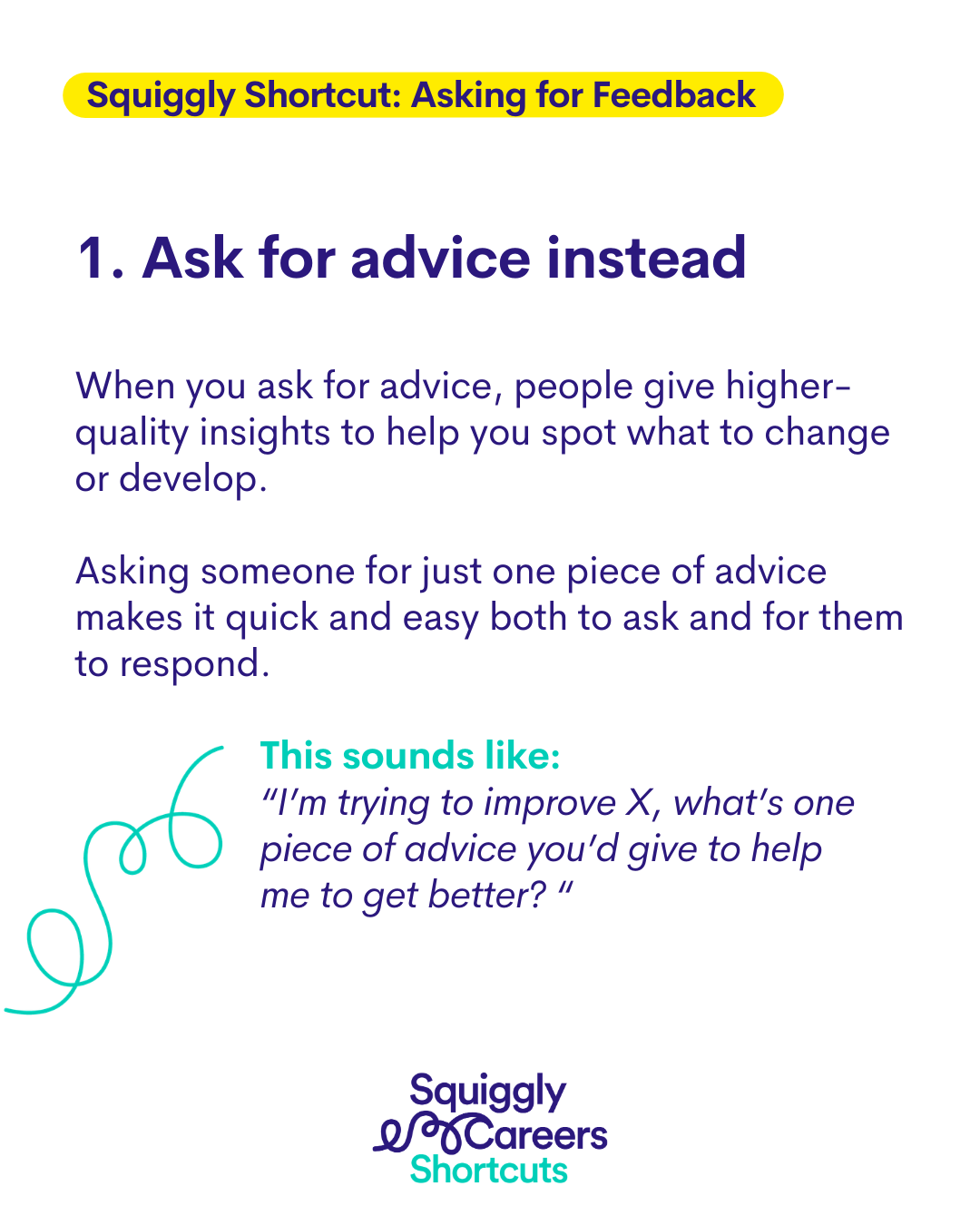
So let's talk about some ways to hopefully make it that little bit easier. Firstly, try swapping out the word feedback with advice. So rather than saying to someone, please could I have some feedback on that presentation I've just done, what about instead saying, I'm trying to improve my presentations, what's one piece of advice you would give me to help me to get better? What research has shown is that by asking for advice, people actually tend to give you better quality insight, so you actually get better feedback. But it also tends to be more about the future, so things that you could change and develop for next time versus things that have happened in the past that you can't control anymore. And the advantage of advice is you can ask lots of different people. You can ask quite quickly and as I did there with that question, you can ask for one piece of advice so it feels quick to ask and quick to answer, which is always a good thing. So it's not a chore at the end of your day.
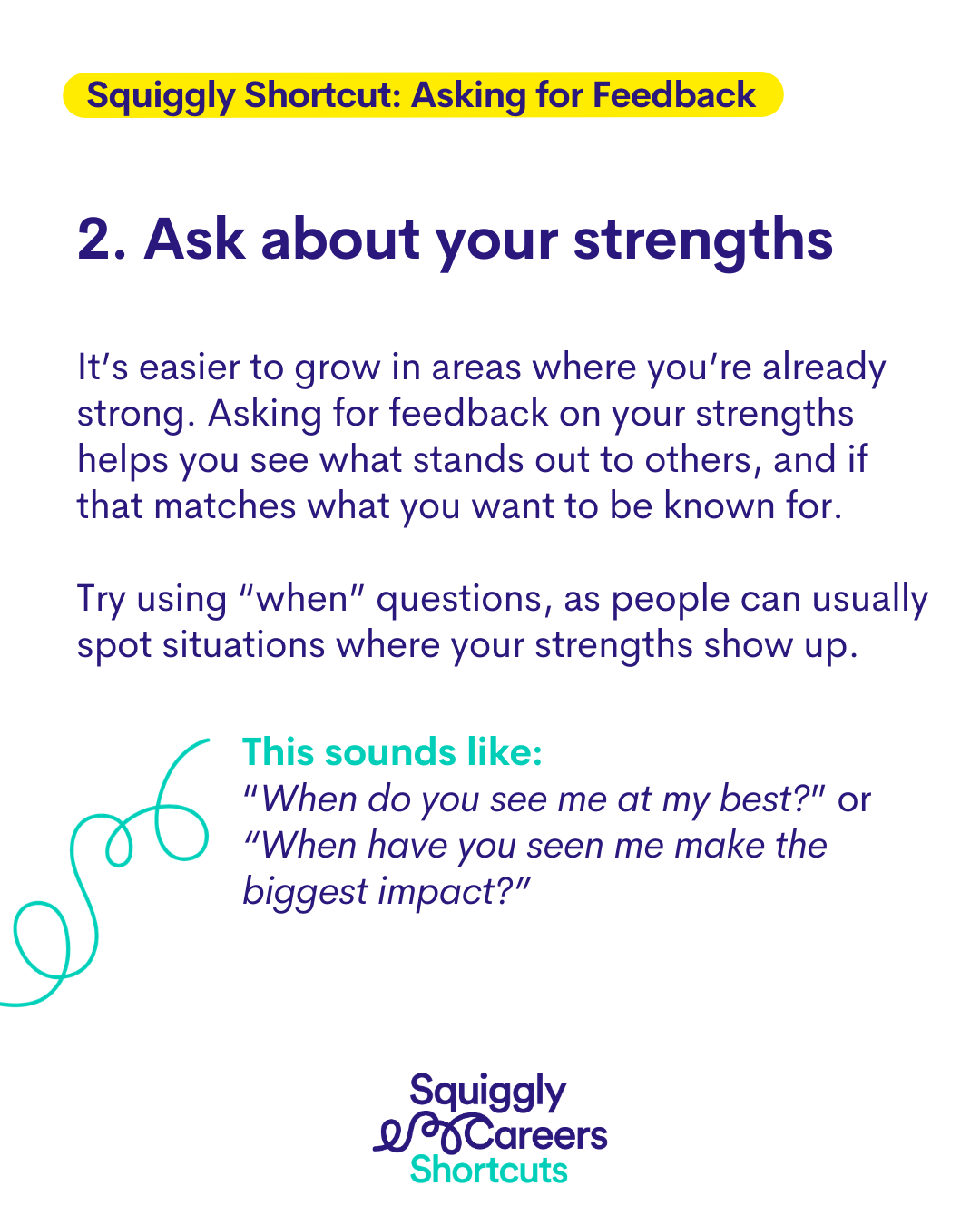
Second idea for you - don't avoid asking about your strengths. So we of course all have a tendency to be our own worst critic, to focus on what we've not got rather than what we have got, and that negativity bias kicks in. But our strengths are really important because it's easier to grow in the areas that we are already good at. But also our strengths are where we have the most impact in the jobs that we do. So start asking people when questions. When do you see me at my best? I love a when question because people will spot situations for you and you're just asking maybe for one example, one example of when you've seen me at my best in the last week or in the last month. And then it just helps you to figure out the strengths that are standing out and showing up to other people. And then you can start to ask yourself questions like, is that what I want to be known for? Am I using my strengths in all the different ways that I possibly can? So again, hopefully lots of different people that you can ask a when question to.
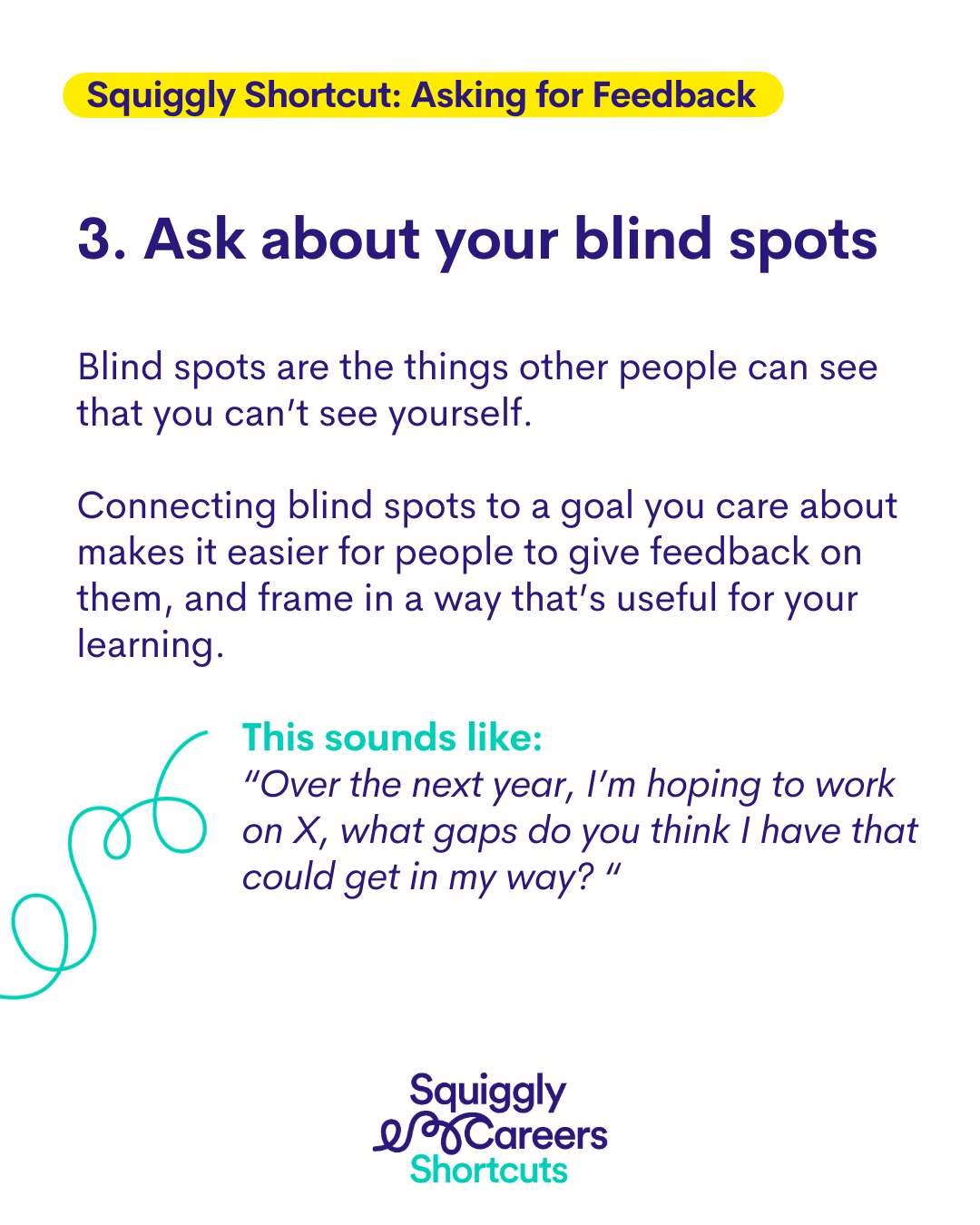
Finally and probably the hardest, but then also arguably maybe the most useful is thinking about your blind spots. How do you ask about your blind spots where you just don't know what you don't know? Now, if you tried asking somebody, please can I have some feedback on my blind spots? That's a really hard question to answer. Instead, if you connect your blind spots to a goal you've got, it makes it much easier. So let's imagine my goal was to work on bigger projects with bigger budgets and more cross functional projects. I could say to somebody over the next year, I'm hoping to work on projects that are bigger scale and involve more people from across the company. What gaps do you think I've got that could get in my way? Or what might I be missing that would be useful for me to focus on? You're making it much easier for people who to point out your blind spots to you, but by connecting it to a goal that you care about. So again, you're also not getting random feedback that you're not really sure what to do with. You're framing that feedback in a way that hopefully will be useful for your learning. So I hope those three things help and just make it a bit easier and more useful. If you want to dive into another podcast, episode 457 of the Squiggly Careers Podcast is, is all about asking, giving, receiving, constructive feedback so you can really get into it if that would be useful for you. But thank you for listening or watching and I hope you're finding these shortcuts useful.
Sign up to our Squiggly Careers in Action newsletter and get our latest ideas, tools and inspiration every week - all in one place, straight to your inbox


