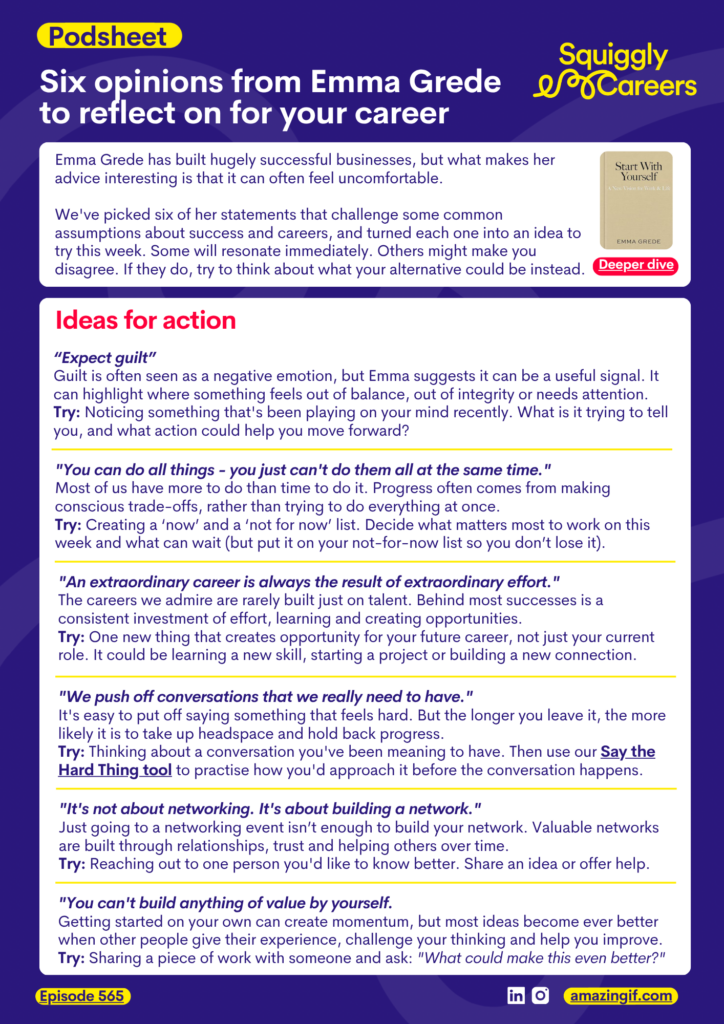
Emma Grede has some strong opinions about careers, and not everyone will agree with all of them. In this episode, Helen and Sarah borrow brilliance from Start With Yourself, Emma’s new book, picking out six of her most provocative statements and asking the question: do we agree?
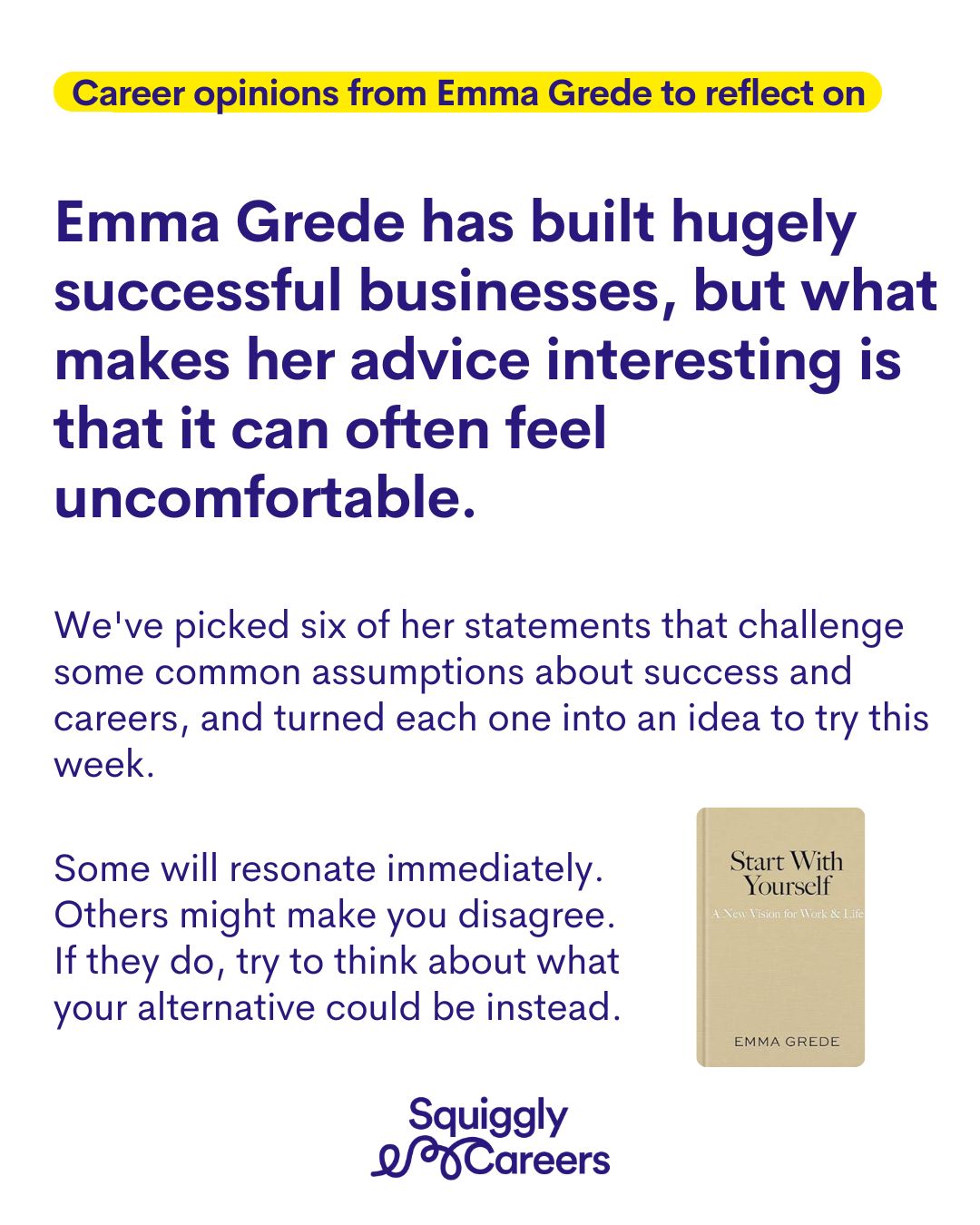
Emma Grede, co-founder of Skims and Good American, is refreshingly unfiltered about what it takes to build a career on your own terms. Helen has curated the statements most relevant to squiggly careers, and Sarah hasn’t seen them in advance. What follows is honest, at times uncomfortable, and occasionally results in a rewrite.
This episode is brought to you in partnership with the Post-it® Brand. If today’s episode sparked an idea, stick it down, find out where to buy Post-it® products at go.3M.com/squiggly
🎯 What You’ll Learn
– Why guilt might actually be a useful signal (and when it isn’t)
– What “you can do all things, just not all at the same time” really means for how you prioritise at work
– Whether an extraordinary career always requires extraordinary effort, and why the word “extraordinary” is more personal than you think
– Why pushing off difficult conversations is costing you more than you realise
– The difference between networking and actually building a network
– Why you can’t build anything of value by yourself (and where Helen respectfully disagrees)
📚 Resources Mentioned
Start With Yourself: Emma Grede
For questions about Squiggly Careers or to share feedback, please email: helenandsarah@squigglycareers.com
Need some more squiggly career support?
1. Download our free careers tools
2. Sign up for our Squiggly Careers Learn Like a Lobster Skills Sprint
3. Sign up to the for Squiggly Careers Newsletter, a weekly summary of the latest squiggly career tools
4. Order our new book Learn Like a Lobster
00:00: Introduction on borrowing brilliance from Emma Grede
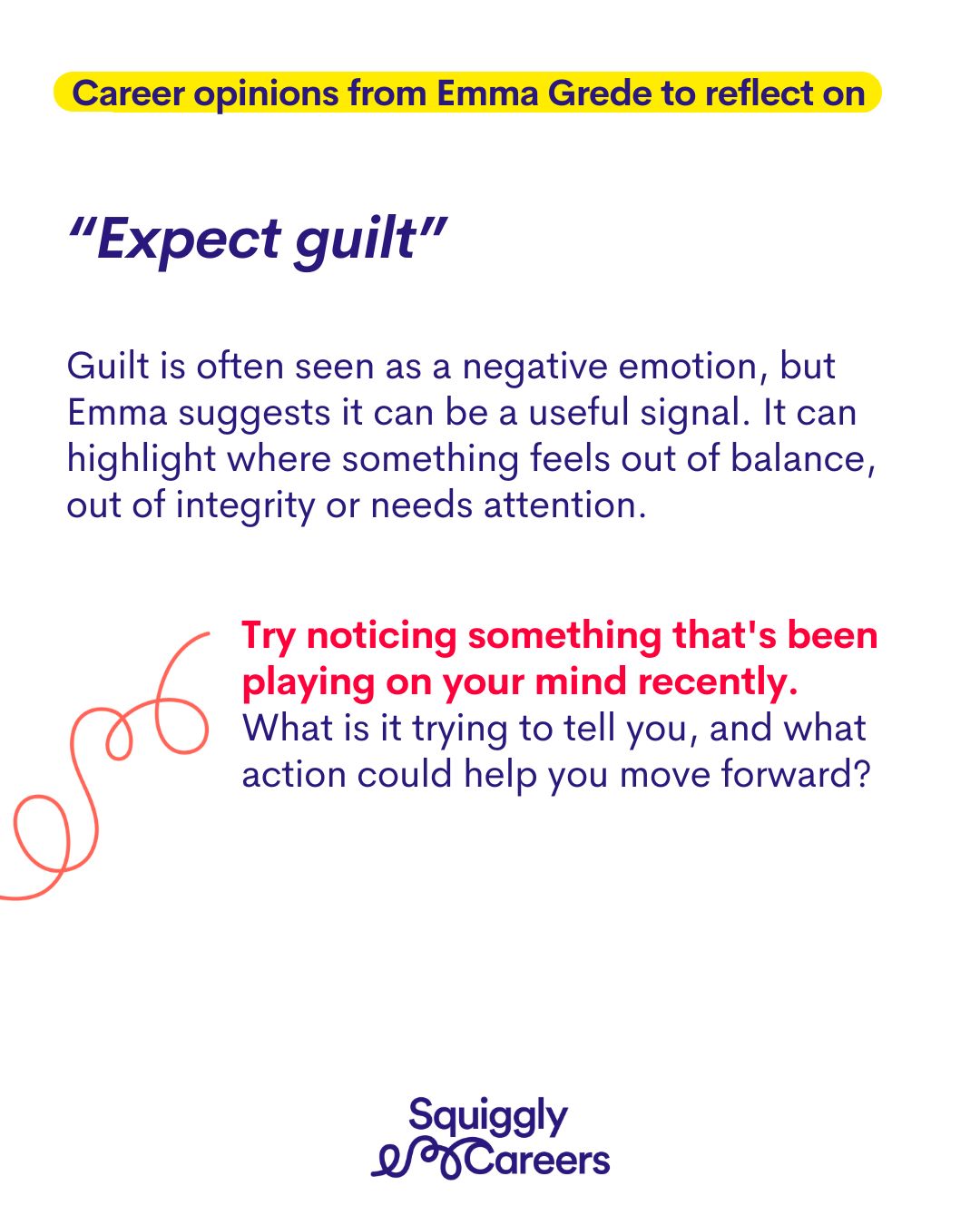
04:34: Statement one: “expect guilt”
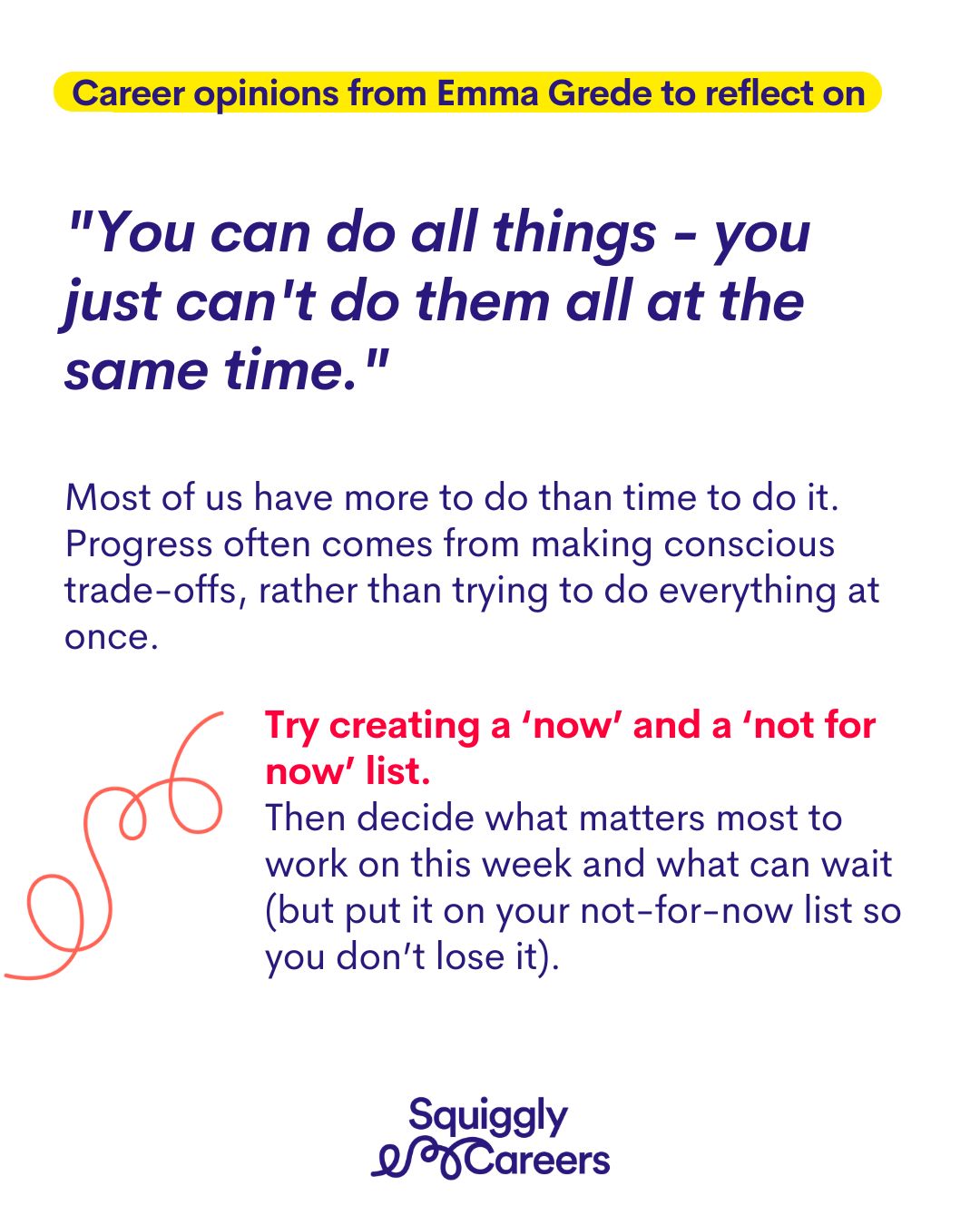
12:55: Statement two: "You can do all things - you just can't do them all at the same time."
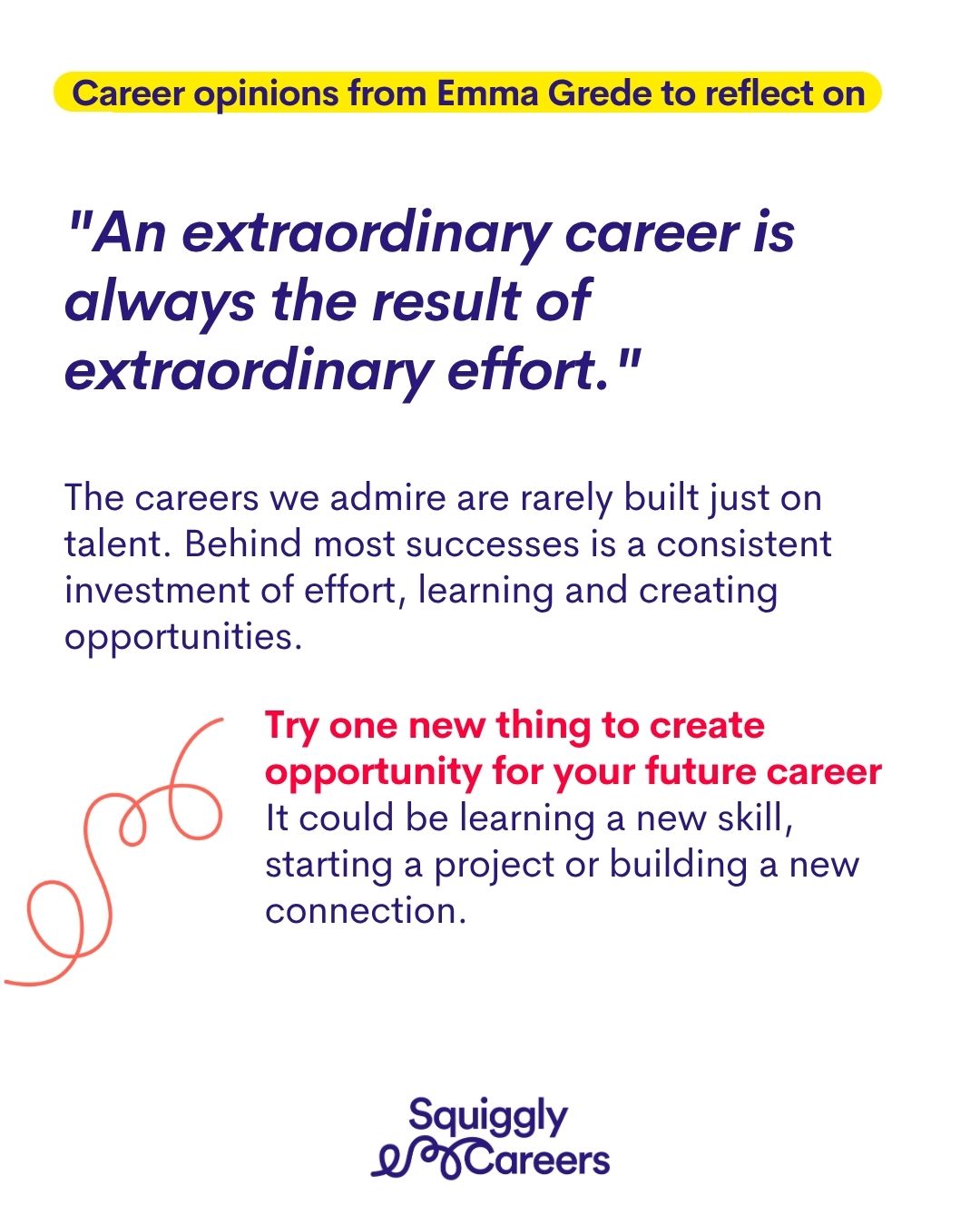
19:40: Statement three: “An extraordinary career is always the result of an extraordinary effort”
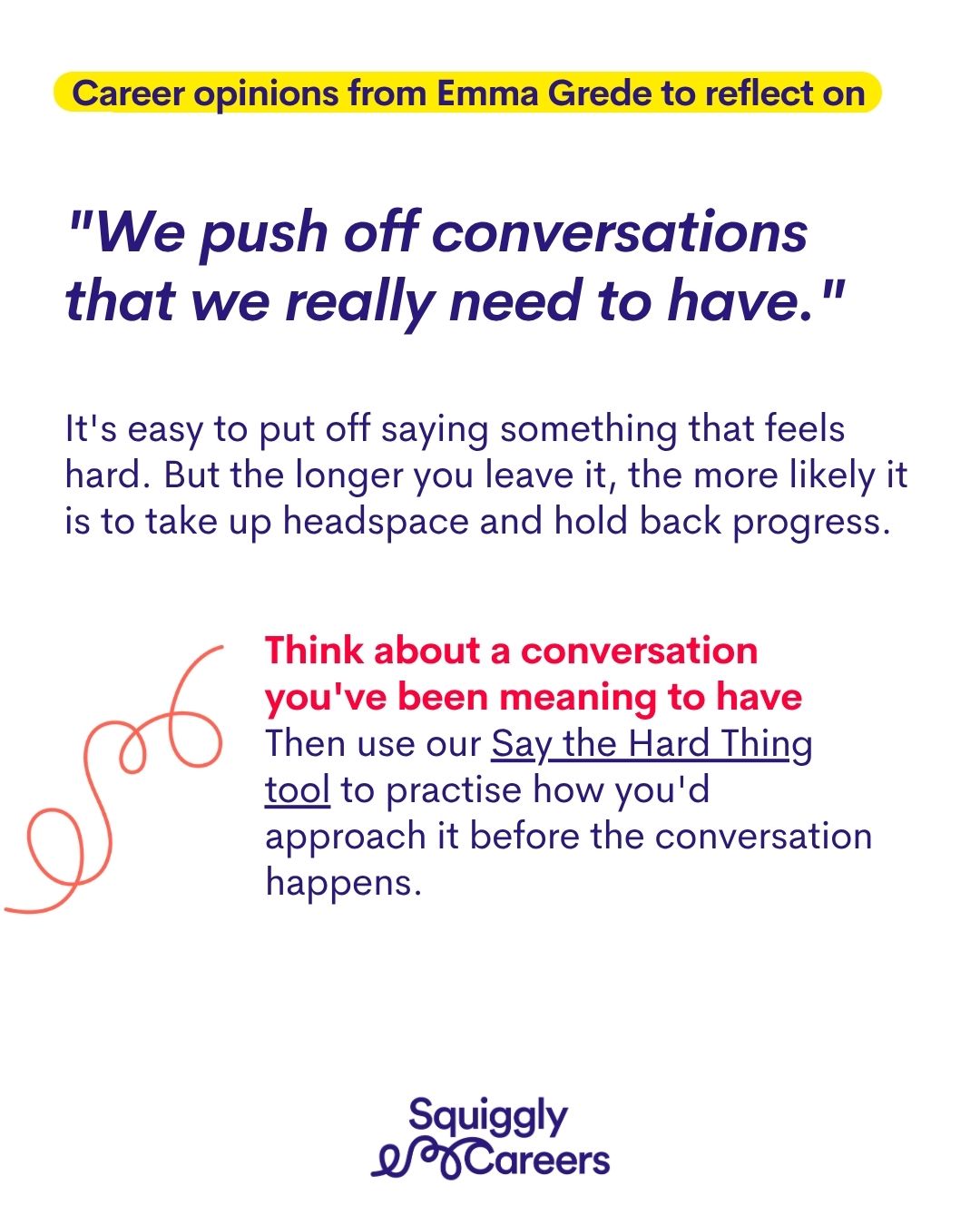
26:48: Statement four: "We push off conversations that we really need to have."
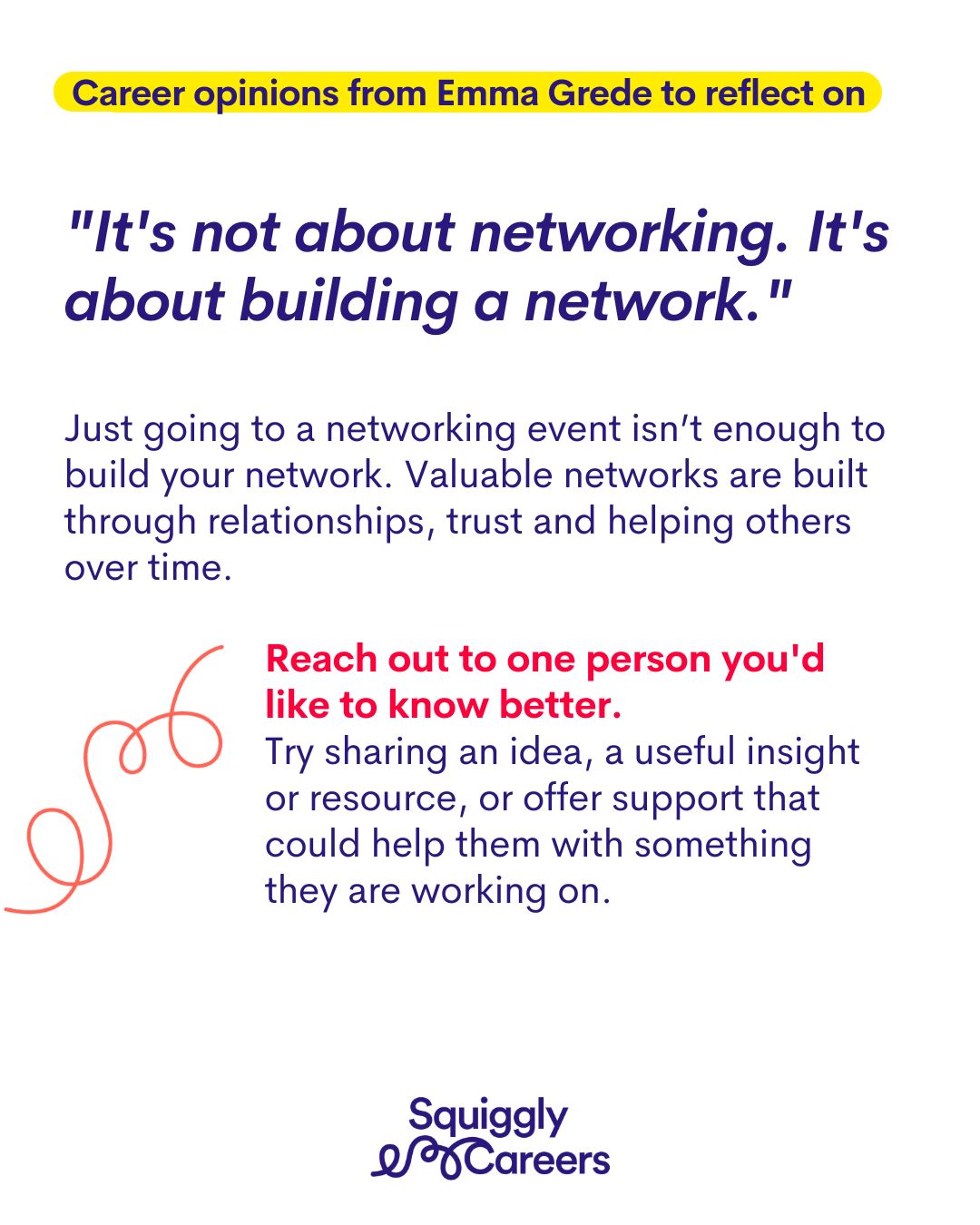
33:04: Statement five: “Networking is not about networking, it's about building a network”
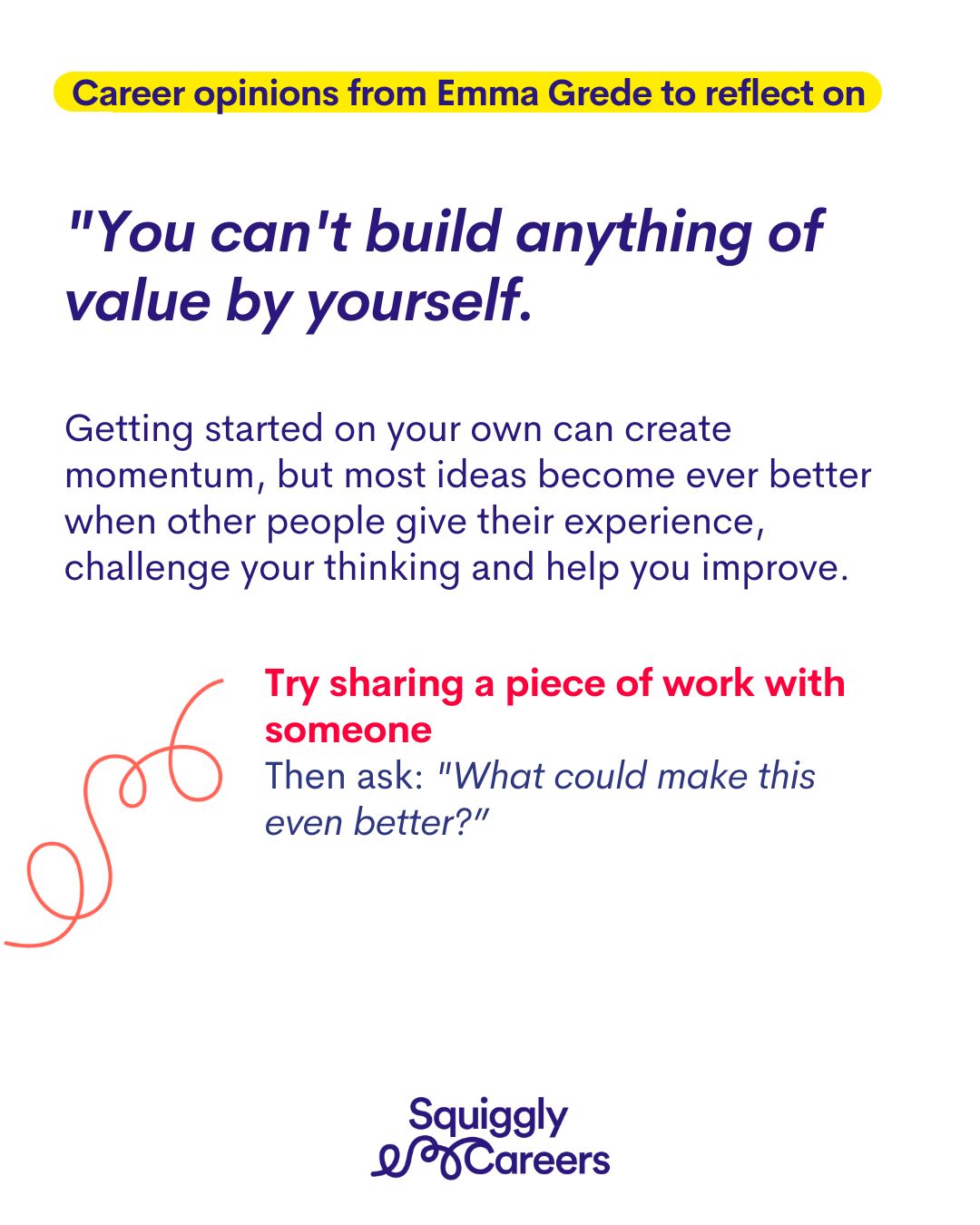
38:31: Statement six: "You can't build anything of value by yourself.” “
44:24: Closing remarks
Sarah Ellis: Hi, I'm Sarah.
Helen Tupper: And I'm Helen.
Sarah Ellis: And this is the Squiggly Careers podcast. Every week we borrow some brilliance from a person, a place, a feeling, an object.
Helen Tupper: The list is getting longer of things
Sarah Ellis: we're borrowing brilliance from, but it's endless. It's endless. So that means the podcast will never end.
Helen Tupper: It's just curiosity.
Sarah Ellis: And we do try to turn that borrowed brilliance and that curiosity into useful actions for you and your squiggly career.
Helen Tupper: And this episode is another one of our episodes in partnership with a brilliant Post-it and we are going to be talking about a someone. We're borrowing brilliance from a someone and we're going to combine it and think why? Why have they got this here? This is because this is a post-it's tabletop meeting chart and we are going to be using it in the episode to talk about the person we are borrowing brilliance from. And I'm very excited because I love this person and I've loved this person for ages. The person is Emma Grede, who has recently come out with this book, Start With Yourself, which has been all over social media. I think she's been very smart with pr, I would say.
Sarah Ellis: And I didn't even know who she was
Helen Tupper: I was gonna say, because I'd followed her for ages.And how did you find out about her?
Sarah Ellis: Because of all the controversial things that were happening. And I think people that I. We must follow on amazing if or like people I'm aware of. That's how it kind of came into my consciousness.
Helen Tupper: Okay.
Sarah Ellis: You know, people reacting and I was like, oh, like who is this? And you were like, well, well, let
Helen Tupper: me tell you about my love of Emma Grede. So if you don't know who Emma Grede is, she is the founder of St Skims, which is a shapewear business that's gone into all kinds of. I saw them advertise this morning. They've done some collaboration with Nike. Probably known most for the. I don't actually know exactly what Kim Kardashian's involvement is. It. I don't whether she's co founded or whether she's like got a brand. I don't know what the equity arrangement
Sarah Ellis: is there something Kardashian based.
Helen Tupper: But Emma Green is the founder of it. Like she. She is a super smart businesswoman. She has like number of different businesses that she runs. She's also part the founder of Good American, which is the business that I guess is visibly fronted by Khloe Kardashian. So she's built quite a lot of brands with the Kardashians but then though, she's got other brands as well. And as well as being a brilliant businesswoman, she also is a mum of four children. She talks very openly about, like, parenting and how she manages that alongside her job. And she also. This is probably, this, probably it might have been my way into Emma Grede. Her fashion is amazing.
Sarah Ellis: Oh, that makes more sense now because I was thinking, I don't know who this is.
Helen Tupper: I don't want to undermine her business brilliance.
Sarah Ellis: That's okay to be into fashion and you love fashion.
Helen Tupper: So, like, her handbag collection is my dream.
Sarah Ellis: Okay.
Helen Tupper: I literally screenshot every handbag that she has. Yeah. Honestly, my phone is full of screenshots.
Sarah Ellis: A little AI agent.
Helen Tupper: I absolutely love her fashion. There's feathers and there's leather and there's sequins and there's silk and it all happens at once. And yeah, cool. It is my dream. But we are not talking about fashion today. And actually I should say there's two other things that I've intentionally not planned to talk about because I'm not sure how helpful it is for the podcast, so. As well as fashion, which we're ruling out in the book, which is going to be kind of, I guess, the spark for our conversation today. The book Start With Yourself has a lot in there about parenting and it also has a lot in about entrepreneurship, which I think is really interesting. But I'm conscious that the majority of our listeners are managing careers in companies. We do definitely have lots of people that manage their own company, but majority of listeners are in companies. So I wanted to pick out some statements that Emma Grede has sort of said and written about that I think have the broadest relevance for everybody.
Sarah Ellis: More about careers than some of the kind of wider things that she might discuss.
Helen Tupper: I just didn't want to talk to one population in the Squiggly Careers community. I wanted to talk to as many people as possible. So here's the plan. I have picked out six sort of statements that she has written about in this book. And I am. Sarah doesn't know what these statements are and so I'm going to. They're on here, they're pre written on here. So we're going to like get each one up at a time. I'm going to read a little bit. So I've kind of put the key statement on here and then I'm going to share a bit more context from the book and I want to get Sarah's perspective on. Do you agree with this?
Sarah Ellis: Yeah.
Helen Tupper: Do you think it's true. And also if you do think it is true, what do you currently do that kind of supports this statement? And we'll just have a little bit of chat about it. Are we ready for statement number one?
Sarah Ellis: Yeah. Let's get our massive flip challenge.
Helen Tupper: They're getting bigger. Everyone is very excited. Oh, my God.
Sarah Ellis: That's actually true. We've gone from the big yellow ones. They get bigger to the big tabletop ones. Okay.
Helen Tupper: Okay. So in your squiggly career, Emma Grede would say you should expect guilt.
Sarah Ellis: Right.
Helen Tupper: Let me expand on that for you.
Sarah Ellis: Okay.
Helen Tupper: Okay. Expect guilt. It can be a helpful and healthy check when you're out of balance in your life, have fallen out of integrity, or need to put something wrong.
Sarah Ellis: Right. Okay.
Helen Tupper: So what do you, what do you think?
Sarah Ellis: Guilt?
Helen Tupper: Because I think we did guilt. She's. I think when we think about guilt, it feels like it's quite a negative emotion. I don't, I don't hear conversations at work where people are going, when was the last time you felt guilty? Or I don't, I don't ever hear like that kind of a conversation around guilt. And I think what she is saying is like, actually guilt can be a good thing for your self-awareness. And actually tuning into what's making me feel guilty can then help you take action.
Sarah Ellis: I think people talk about guilt a lot more to do with parenting. Like you do hear that.
Helen Tupper: Yeah.
Sarah Ellis: And that's like, I feel guilty that I'm spreading myself too thinly or I'm not here or I'm not there, which I also don't feel. I don't. I would say controversial statements. Yeah, I would say guilt is top of my mind generally for anything like. So what's your first question? Do I, do I, do I expect guilt? No.
Helen Tupper: Do you think that, does that resonate with you as a statement? Because I read it. I mean, it's a big book, but I picked out things that I thought, oh, that's, that's an interesting point. And actually I think we could. I think I could have conversations with people that I don't have about what's making you feel guilty right now? What does that tell you about how you're working? What could you do differently? So actually the first real question that I have in my mind for you is, what, if anything, do you feel guilty about right now?
Sarah Ellis: Very little. And I don't even know if this is guilt, but I was really trying to think about this. Then when you sort of shared that statement. I sometimes feel guilty that I've not spent more time on certain pieces of work. Does that count?
Helen Tupper: Yes.
Sarah Ellis: So sometimes I'll think, oh, I would have liked to have done more on that, researched more, worked harder on it, and I haven't been able to for whatever reason. And I feel guilty because I'm like, oh, I think that could have. I could have tried harder or that could have been better if I had not, I don't know, just relaxed at home and spent an extra hour prepping for the podcast. You know, like the choices that you make. And sometimes I see, like, I'll see something that maybe we've done in our company and I'll be like, oh, like, yeah, I chose not to do that. Or I made a different choice. And I do feel a bit guilty because I can see it's not as good as I would like it to be. So I think my guilt is all to do with things not being as good as I want them to be.
Helen Tupper: So, like a quality trigger.
Sarah Ellis: Yes.
Helen Tupper: Because, well, so what are you worried? So you feel guilty that the quality of something isn't good enough.
Sarah Ellis: Yeah.
Helen Tupper: And so what? So people are spending time with something that isn't worthy of their time.
Sarah Ellis: Well, that's something that could have been better if I'd have spent more time on it.
Helen Tupper: So let's think about it. It can be a healthy and helpful check when you're out of balance or falling out of integrity or you need to put something wrong. Right. So if that is your signal, like, equality, guilt is a signal. How could you put that wrong? Right. What would you do differently if you became more aware of guilt?
Sarah Ellis: Well, I mean, some of this, like, nobody wants the answer to. So some of this equals micromanagement, essentially. So especially if you've listened to our episode on, like, Good enough is great. I think some of it. Some of it, I think I choose to not get involved and I might then still feel guilty because I'm like, well, I wish I could. And it's. Yeah, it's a funny one, the guilt thing for me, because I think it could be dangerous because it could go. It could force me in a unhelpful direction.
Helen Tupper: It is not helpful in excess. She does. She does say that at the end, but I was thinking I was in a different place. I was thinking. So you said, like a quality guilt. And because you. The worry is that people are spending time on something that isn't to the quality that you think it should be at, but that's your perception and it's their time.
Sarah Ellis: Yeah.
Helen Tupper: So surely you should ask them, like, On a scale of 1 to 10, if you were to evaluate the quality of this, I don't know, whatever the thing is you're worried about project content, podcast, whatever, it would be. On a scale of 1 to 10, like, how useful did you find that if people are going, oh, I don't know, 7 out of 10, it would be even better if you might actually get some. Or maybe they're going 10 out of 10, I don't know. But the point is, you don't know. So you could have this perception of quality and guilt about other people's reality that is not their reality.
Sarah Ellis: Yeah. I think I'm very much using my own. My own judgement and my own view without. Without seeking, like, other people's.
Helen Tupper: I think in mine, what do I feel guilty about at the moment? I would probably say not getting back to people.
Sarah Ellis: Yeah.
Helen Tupper: I feel like, you know, I'm like, oh, someone has taken the time to get in touch with me and I've not taken the time to get back to them. And I was thinking, is it a helpful and healthy check? I don't know, it just makes me feel more guilty. I'm like, now I've brought it up, now I feel even more guilty because I'm like, all those people sat in my inbox that I've not gone back to yet. Have I fallen out of integrity? As I've not gone back to.
Sarah Ellis: I had that this morning. So I had that exact example where someone had emailed us partly to say thank you for something I'd done, like a zoom session I'd done, but was also sharing some things that were quite hard. And it had taken me a little while to go back. I was never going to not go back, but it had taken me a while and I was feeling guilty about that, actually, so. And it. And I'd never. It was on my mind. It played on my mind the whole time. And I responded this morning and I was thinking, that didn't take very long and what stopped me from doing that sooner? And I think it was because in my mind it was going to take me longer than it did. Actually. What it took me was a focused five minutes, you know, to then be like, to do that quickly. And I was also including, like, a link to something that I thought would be helpful. And I was thinking if I had just done that in the moment and. Or probably someone in our team could have been just as helpful as me and say, you know, back to, like, the. Cause I'm the same. I always feel guilty if I've taken ages and someone has. Because they've put effort in. Right. And then like that took me, let's say two weeks to respond to. I think it was about two weeks.
Helen Tupper: I could so imagine that. I could already feel that.
Sarah Ellis: Yeah. And I was like, oh, okay, that's that. And also that's not what I. Cause what if that might mean a lot to that person and to then feel like they're. Are they ghosting? Are they like, why are they not replying? And so that did. To your point on like, can guilt be a useful prompt, a bit of like a bit of data for your development? I think it made me think actually that didn't need to take two weeks either. I need to put some time in my diary where I have like focused five minutes and I literally go, this is a focused five. This is a focus five. And I am going to work my way through them. And I think probably like Sarah, who helps us in our team could almost help me by going, here are the ones you need to do, you know,
Helen Tupper: like, get it all ready to go into an action. So based on this, like expecting guilt, do you think you would benefit from if you reflected at the end of a week or at the end of fortnight, what have I felt guilty about over the last five days? For example, do you think that would be a useful reflection for you or do you think it would put you in a negative headspace?
Sarah Ellis: Well, and our whole point of doing this is to like, is to just respond, right?
Helen Tupper: Yes, respond, reflect.
Sarah Ellis: I don't like the word and I think the word can be quite unhelpful. So I don't think I want to ask myself questions about guilt because I think it might get me into. I already feel bad. I think it might make me feel worse versus even doing what would be my biggest, even better if for this week it would be to have got back to that person sooner. How am I going to do that?
Helen Tupper: That feels like a more positive way for you to respond to the same situation. Yeah.
Sarah Ellis: So I don't think it's a word that I want to kind of bring into my week more.
Helen Tupper: Okay. Okay. We will not accept guilt as a way in. Okay, our next one, let's turn it over. Next one, I'm moving on. In the book, you can do all things, you just can't do them all at the same time. And this is a part of the book where she talks a lot about trade offs and she's really, really honest in the book about. In order for her to be successful with all these different things that she's doing. She makes a lot of trade offs like, and the kid thinks she'll be like, I don't go to that meeting, I don't do that thing. And she says basically she doesn't feel guilty. Back to this kind of guilt point, it does come up as a thing. She's like, she's not guilty about a lot. She's unashamedly herself, I would say. And she's like, you just have to know that you just can't do all the things and that's okay. You don't need to feel guilty about it. Whereas some people, they think doing everything is success and then they are more likely to burn out or they want to project perfection rather than admit that they can't do everything and kind of own and own that trade off. Where are you at with that statement? Think that's helpful? What's your thoughts on it?
Sarah Ellis: I think it's actually really helpful for people in their jobs to prioritise. So that's probably not what people. When people first read that kind of statement and you know, you've seen versions of that statement around, people will be like, oh, you can't be all things to all people and work, life, balance, etc. I'm like, actually maybe what's more helpful thinking about this like in a different way or in a new way is, you know, everybody's to do list is longer than the time that they have. Yeah, like everybody. Whenever I do that in a workshop, I'm like, who has more to do than time? Everyone's like me and you kind of can't do everything on your to do list and you probably can't do everything you want to do at work. You know, like that sort of a, you're setting yourself an impossible task. And I was thinking back to kind of a time in a job where I think I was very focused on what I could do and really trying to put a lot of energy and effort into like my strengths and doing things, doing a few things really, really well. And that really paid off for me in my career, in my progression. And I think it still like pays off for me. And I notice actually when I do try to do all things at work, you know, like if I start to get involved in more things, you can see this and you're always like, can you not? Basically. But when I do do that, actually it means I get a bit antsy and a bit frustrated and I'm like, oh, that's not right and this is not right. Or Whatever it might be. And that, I think is me trying to do all things, whereas I think when I go, okay, here are the two things where I'm gonna really try and be brilliant. Like, I put a lot of effort into preparing for a couple of the podcasts that we've recorded today and I feel like that was useful. Yeah, you turned up this morning. I'd done some good work and then that meant that we could have a more helpful conversation, I hope, for our listeners. And that was me making some trade offs around how I spent my time over the last few weeks. I listened to the same podcast twice. You could be like, well, that's not doing all things right, that's doing the same thing twice, all in pursuit of like one or two things. So prioritising is hard and I don't think people necessarily connect that with prioritising. But I wonder if it's quite a helpful frame.
Helen Tupper: I was, I was just thinking in a team context as well, what questions if you held this to be true for a team.
Sarah Ellis: Yeah.
Helen Tupper: Nice questions would you ask of each other? And I think I might say like, what do you need to trade off this week so that you can get that thing done?
Sarah Ellis: Nice.
Helen Tupper: That could be a nice question. What needs to be on your not for now list so that you can move that thing forward? I actually really like the not for now list because my worry with this sort of statement sometimes is that you go, you can do all the things, you just can't do them all at the same time. So people just like go, I'm not going to do that. I'm not going to do that. Yeah, I think it probably has some importance, like it was on the list because it is important. So you don't just want to lose it. I almost want a kind of now, this kind of now and not for now and just having this. Well, we're going to, you know, this is what we're focusing on. That's just not for now. But I don't want to lose it and dismiss it because I think sometimes you can be like, well, you just can't do it all. And you just have that kind of slightly flippant aptitude about things.
Sarah Ellis: Yeah, I like that. I think I've interpreted it at an individual level. How can I prioritise? And then you've done. How can we prioritise some good questions there to ask in a one to one, I would say with a manager. So if you're a manager, you could do what you've just done and ask about like what are you not going to do this week? So that you can really do a good job of this? But also you could ask that question of your manager.
Helen Tupper: Right.
Sarah Ellis: You know, like, yeah, that's a fair. Here are the five things that feel important for this week. I was planning to prioritise one and two, and then if I get to three, four, five. Great.
Helen Tupper: Yeah.
Sarah Ellis: But like, is that what you would do?
Helen Tupper: Yeah.
Sarah Ellis: Does that feel like the right. Does that feel like the right choices and trade offs? I always think if you're making trade offs together with other people, it's easier than making them in isolation. And also it's very rare that your trade offs don't impact other people. So if I. Let's say I had traded off podcast preparation and I hadn't told you this week, and I had turned up this morning with, you know, a bit. But not. But not load then, and you hadn't known that you might have been like, oh, wow, crikey, we're starting from scratch a bit here. Like, we're. That's. That's quite unsettling for you. And also probably quite annoying and quite, quite frustrating. And then you might even be like, well, look, if I had known, I could have done some of this. Yeah, yeah. Or we could have got some help.
Helen Tupper: Telling people your trade offs is probably an important insight here.
Sarah Ellis: Yeah.
Helen Tupper: If you just make the trade off in isolation, it has an impact you probably don't appreciate. So that's probably.
Sarah Ellis: And you and I also do this to go slightly into life, which I never like to do too much because I prefer talking about work stuff on career stuff. But when you and I are trading off work to other things, we will often tell each other, like, you, what was that? Me one day this week and you went, basically, I'm done. I think you said it, you said it slightly nicer than that. But I think you were actually, not even gently, you were saying to me, we've had some very long days this week. And you were like, I'm out. And I was like, I'm gonna stop. I won't want to happen now. Because you were like, I now need to just trade off a bit of work time for just a bit of. I mean, I assume you're just going to sleep
Helen Tupper: I think I was watching something on Netflix. I think it was like 9 o'. clock. Because the context of Sarah and me is we're not together in the day. We're often with companies and with learners. And so when we are kind of connecting, catching up, it's often in the evening when we're back. And I think I was just like, I just need to not talk about work for the next, like hour. At least, at least an hour. Just an hour. Just an hour to sit here and just watch something like, not particularly cognitively challenging, you know, like talk about your trade offs.
Sarah Ellis: Yeah, that's a good outcome for that one.
Helen Tupper: Good. All right, more on board with that one, number three. We've got six, so. Okay, one, number three. Oh, I like this one. I've got loads. Also, I've got loads of underlines in the book on this one. You can tell I like this one. Okay. An extraordinary career is always the result of an extraordinary effort. Let me give you some context here. So what she says in the book is you basically have. You have to put more in. You have to put more in. Which I think some people find controversial because they say, well, I'm not being paid to put more in. I'm being paid to do a certain set of hours. And she, she basically calls that and says, well, it fine, but if you want to be successful, you're gonna have to do more. So she says, I refuse to tell people that they can be really successful without giving 150%, without waking up most days and doing some type of work or at least thinking about work. It has not been my experience that people achieve great things by doing less. And I mean, there's more, there's just more. Everyone I know who's extremely successful is a little bit of a workaholic. I mean, there's just, there's just more and more on that theme. So as somebody who runs her own business and has had some big jobs in big companies, what's your take on this?
Sarah Ellis: So I can see why it's controversial. So there are some things that are really tricky. Right. So there is a point, and I have heard this from, from lots of people and I think probably you and I both have been in this situation before, you know, where you are not being paid for the job that you do and do. I think that does happen. And sometimes you have to accept that for a period of time in pursuit of something that you want to do. Yes. Not forever. You know, that thing of like you're basically, I don't know, you're doing two people's jobs or you're doing loads, loads more, and that's not being reflected or rewarded or recognised does not feel good. Right. I think if you are doing that for a bit to show, well, I've got the capability here, I can, I can lead this team or I can run this scale of projects. And you have made that choice. You're like, I think that's the difference. I know why I'm doing this versus this is happening to me. And no one asked me if I wanted to do this. And then I'm not being paid for all the extra time or whatever it might be. I think you have a very different relationship with it. I suppose everybody I know who I admire, who I think who I would describe as extraordinary, and that's not really about their job title, it's more just about I admire them or they inspire me or whatever it might be. I always feel like they've put in a lot of effort. There are people who are incredibly talented, you know, just like naturally incredibly talented. But then I just think, then they add on loads and loads of effort. And so no wonder they're brilliant to work for, or no wonder they're in influential jobs or writing books I love to read or whatever it might be. Because the effort is like, you're trying really, really hard. And I suppose because I think, well, I try really hard. And I see. And I do see other people try really hard. And I think sometimes from a distance, you can look at those very quote unquote successful people and you can be like, oh, you know, are they working?
Helen Tupper: That's a fair point.
Sarah Ellis: Are they working that hard? And they always are.
Helen Tupper: Yeah, that's a fair point. So. So there's a few points that she makes in here. One is a perception point of when you see, you know, the whole overnight success thing.
Sarah Ellis: Yeah. I mean, never true.
Helen Tupper: Yeah. And she's like, it's not true. Like. And so she makes this point, like, now she is sort of building a brand because she wants to share what she's learned to help other people. But she says, you probably didn't know about me before because I was building a business. I was spending my time building lots of businesses, and it was hard and it took a lot of effort. And now I'm choosing to build myself as a brand and help other people with it. So don't assume that because you might have only just seen someone's success. They've only just started working on that.
Sarah Ellis: If I look at Emma Grede, Right. Who. I don't know. I haven't followed her. I could just be like, wow, look at that. She's. She's massive. Because I don't know any of, like, the backstory to where she's got to. Yeah. And I think that kind of my own. My own experiences you know, you can look at a CEO, right, that you're working with for the first time and you can be like, oh, they're, you know, swanning in and out of meetings, they've got so much support. And then I worked with a few quite closely and they work really, really hard. I've still never worked with people who are in those big kind of senior, like, full on roles. And maybe it's not true everywhere, but certainly the ones that I've worked for, we're all putting in a lot of effort, not just hours, but they cared and they were, they were trying hard.
Helen Tupper: Yeah.
Sarah Ellis: And yes, they had got a lot of support around them and all those kinds of things, but they were still, they were still working really hard.
Helen Tupper: Yeah, I think that I was just, I was. I've got to. So I think this is, I mean, the strong words on the extraordinary careers.
Sarah Ellis: Extraordinary.
Helen Tupper: They're strong words. I do, I do think that you have to create if you want to have a great career. I think you have to create opportunity. And I think that that has to come from you.
Sarah Ellis: You doing stuff. Yeah.
Helen Tupper: I think otherwise you kind of have the career that everyone else has. And so I, you know, we did a side project. So the reason we run this business now is because we did a side project on top of a full time job for about five years.
Sarah Ellis: Yeah. It sounds hard, doesn't it, when you describe it like that?
Helen Tupper: I know. I don't think we realise we're building business.
Sarah Ellis: No, that's true, actually, to be fair.
Helen Tupper: But it was extraordinary effort. We were doing really big things in the day jobs and then children came along and we still did all of this. So I do think, I do think that took extraordinary effort to do some of what we were doing then. And I think it has led to what I think is an extraordinary career. But I was remembering.
Sarah Ellis: It's an important point though, right. It's like, I think what makes this more appealing is an extraordinary career is extraordinary as long as you're. As long as you think it's extraordinary.
Helen Tupper: Yes.
Sarah Ellis: It doesn't have to be by anyone else's definition because I think sometimes you might look at this and be like, it is, well, have I made it to be a CEO or not? But when I think about people who've had extraordinary careers, I'm thinking like Margaret Heffernan, who we talked about recently in Uncertainty podcast. I'm like, that's an extraordinary career.
Helen Tupper: Pip Jameson. Yeah, Pip's got an extraordinary career, brilliant business, doing loads of great stuff
Sarah Ellis: And I don't know whether those people would like self identify in that way. But you know, people listening to this might be like, oh, I'm not extraordinary. And I'm like, well, you are. I think if you are working hard, having an impact, like making a difference, that's. That's extraordinary. Like that's something more than just I go to work every day. And you don't have to do that either. That's a choice, isn't it? You're like, well, do I. How much? Because the word effort is interesting. How much effort do I want to put in to my work? How much effort do I want to put into my career? And that also might change at different points in your squiggly career.
Helen Tupper: Yeah, I do like that the word extraordinary is subjective and individual and that this is more like. If you want to have your version of that.
Sarah Ellis: Yeah, your version. Nice.
Helen Tupper: Put some effort into it.
Sarah Ellis: Which I think is always true.
Helen Tupper: Yeah. Otherwise you're gonna get someone else's version of it.
Sarah Ellis: I feel like we're now writing our version off her book.
Helen Tupper: We know we've already got enough books of our own. We're not gonna do that. Okay, so let's move on to number four. I'll explain this one. Cause it might not make sense straight away. We push off conversations that we really need to have. Okay, so this is in the section which talks about building a brand and a business. And it's all around difficult conversations. So I'll just read the little paragraph and then I'll come to your reflections. Because so many of us feel afraid of conflict, the truth, and making other people uncomfortable. We push off conversations that we really need to have. And we hold onto relationships that no longer serve for fear of having the hard conversation and moving forward. What do you think? Do you identify with it in your own career?
Sarah Ellis: Well, yeah, because I hate conflict, so
Helen Tupper: I may pick this one out for you.
Sarah Ellis: And because I definitely have a confidence scrambling around conflict, which I have worked very hard to cage. I think it is true and it's the reason that say the hard thing is in learn like a lobster. Because we know hard conversations, difficult conversations are shell-shedding moments. They are hard to say, hard to hear, hard to hold. And I think I'm getting better at doing them because you just see how important they are for you to get better, for other people to get better. And I was reading an interesting. There's a good HBR article out at the moment. Maybe a future podcast, who knows? But one of the things that it talks about under feedback and it's all about like super teams, high performing teams. Is that in a high performing team, they're good at feedback, but particularly they do give, they sort of give criticism, but in a way that is always received. That feels like continual growth. Like you feel like you're on someone's side. So you do say the hard thing, but it's always delivered in a way where someone's like, okay, well that might be hard to hear, but it's going to help me to get better. But I think doing that well takes loads of practise and is really hard. So I think even knowing, like, we spent quite a lot of time thinking about this and talking about this, and I still do sometimes, actually, I would say I still, let's say at least every month will push off a conversation that I really do need to have. Because I use this sometimes when I talk to groups about this one. You know, the. For me, it doesn't pass the is it worth it? Filter. So I think in my head, oh,
Helen Tupper: is it worth the conversation?
Sarah Ellis: Is it? Yeah, I have this like, is it worth the conversation?
Helen Tupper: How do you even. What's your criteria for is it worth it?
Sarah Ellis: I'll just think it'll be like, have I got the time to do it? Well, yeah, it's like, people, you're making excuses, right? But like, is it like, have I got the time to do it? Well, does it really matter? Do I believe this person's actually gonna do anything with this? There's like, there's things that go through my mind and I think. And the point is it doesn't make it past the like, is it worth it? You go, no. So what do you do? You push off the conversations. So I would say of everything actually we've talked about so far, this is the one where I'm like, I still need to get better at this. I think I hold myself and other people back because I'm still not as good at this as I would like.
Helen Tupper: I, I think I'm better at this than you. And I was trying to think, like, why I think I still put off conversations, but I was thinking, I think I practised this more. So I text you this morning. I mean, I had a bit of a grumpy start to the day, to be honest, but I was on a train, I was on a train this morning and I thought there's absolutely no way that Sarah would do what I
Sarah Ellis: did this morning in a million years.
Helen Tupper: So my, the reason I'm saying this example, because I think I. Low pressure Practise this. You know, like, so many feel afraid of conflict, the truth, or making other people feel uncomfortable. I think I low pressure practise this so that if I do have to do it in work, it's not the first time I've done it for a while.
Sarah Ellis: Yeah.
Helen Tupper: So I was on the train this morning in the quiet coach, obviously.
Sarah Ellis: Who doesn't love the quiet coach?
Helen Tupper: In the quiet coach. It was quite early, I was a little bit tired. I was trying to get ready for the podcast, et cetera, et cetera, and there was a lady on the seat in front of me who was on the phone talking very loudly. Now, for the first five minutes, I
Sarah Ellis: was like, give her a bit of a pass or whatever.
Helen Tupper: Like, who might have something going on at home, who knows what. Like, off you go. Then a lady next to me. It was so loud that the lady kind of. I could see her. She left and went to a different carriage. And I was like, okay. And I was like, I'll just leave it. I'll just leave it. I'll put my headphones in. Unfortunately for her, my AirPods were flat.
Sarah Ellis: Oh, no.
Helen Tupper: So then I was listening a bit longer and then somebody else moved and
Sarah Ellis: I was like, no, that'd be me. I'd move.
Helen Tupper: Yeah. No, I was like, nope, this has had enough. Now I actually really want to do some work.
Sarah Ellis: Oh, it's making me tense. Just think about it. What did you say?
Helen Tupper: I stood up, I waved at the woman who didn't see me. She think she was so engrossed in her conversation. And I waved and I point up. It was awful.
Sarah Ellis: Oh, my God, Helen, this is making me so tense.
Helen Tupper: But I pointed at the quiet coach thing and I just sort of shrugged and was like. Because I think she couldn't.
Sarah Ellis: So you mimed it. You didn't even say anything. You mimed your aggression. I'm like, oh, my God, how passive is it? So there was no actual words because
Helen Tupper: she had headphones in so she couldn't hear me anyway.
Sarah Ellis: So what happened?
Helen Tupper: She stopped talking and she apologised. No, but interesting. And then she. She got off her stop before me. But my point is that, I mean, I don't know how. I mean, I probably made her feel a bit awkward, to be fair, but she was in the carriage and I did let her talk for 15 minutes really loudly before I intervened and two people left the carriage. I felt like, there's enough. There's enough in here. I'm going to say what other people are saying.
Sarah Ellis: Anyone say thank you to you, a
Helen Tupper: man smiled at me who was opposite me. Nice.
Sarah Ellis: A little knowing. A little knowing.
Helen Tupper: Sm. Um, so. But I think I'm not afraid to do that. I. I'm. And that probably did make that lady feel a bit uncomfortable. But I did feel like I'd given it the chance and I think so that makes me a little bit more confident at doing it in other. In other situations. And I think I'm also doing this. I didn't used to be very good at this. You know, they are holding on to relationships that no longer serve. I think I'm getting a little bit better.
Sarah Ellis: Yeah, you are getting better at that.
Helen Tupper: Kind of really thinking about what. What relationships serve me best now. And you really have to get over, oh, I'm a bad person because you
Sarah Ellis: feel like I should spend time with everybody. I don't have that one.
Helen Tupper: That's interesting because you never spent time with them in the first place. Or. I'm having to stop spending time with some people. So I'm having to stop rather than.
Sarah Ellis: Well, I only spend time with people I really, really like anyway. And that's about five people.
Helen Tupper: So you're fine on that Frontier filter.
Sarah Ellis: Yeah.
Helen Tupper: Yeah.
Sarah Ellis: Okay.
Helen Tupper: So this point, this one, you relate to this 100%. Okay. And is there anything that you think you could do differently?
Sarah Ellis: I think sometimes I think I've got to make a choice to, like, you know, like I said, the kind of. The what the is it worth it Thing.
Helen Tupper: Yeah.
Sarah Ellis: I think all of my things that. Around that are just excuses.
Helen Tupper: Okay.
Sarah Ellis: And I don't think they're, like, valid. And so I'm just. I think I need to ask myself, like, I mean, you're just giving yourself an excuse. Probably what I need to get better at is I do just need to practise and accept that sometimes I might not do it really well, or sometimes it. I don't know. Or that it's probably gonna feel uncomfortable, but I maybe have a bit of an accountability partner in you. Like sometimes you will maybe say to me, oh, you know, you need to say that or you need to do that, but then you'll never ask me if I've actually done it. Okay.
Helen Tupper: Ooh, I like that challenge.
Sarah Ellis: So, again, that is probably the thing that would make the difference for me is you saying to me, oh, you're gonna have that chat? Yeah, like, oh, like when. You know the when.
Helen Tupper: Like, when are you gonna do like a when? All right, I'll be your when.
Sarah Ellis: Do you like a when.
Helen Tupper: I'll be your when to help you with that one. Right. Two more.
Sarah Ellis: Okay.
Helen Tupper: Oh, I loved this one. I love this one.
Sarah Ellis: Okay.
Helen Tupper: It's not about networking, it's about building a network.
Sarah Ellis: 50%.
Helen Tupper: No, no. Okay. So the point she's making here. I might not read this one because I can just explain it. The point that she's making here is that lots of people go to networking events and think that they are building a king. Yeah. They're like. So you go to. Whereas Sheen's saying, actually what you need to do is you need to build a network. And that is different from just rocking up at a networking event. That is much more intentional. If you're going to build a network, you've got to know what you need. You've got to be confident enough to make the ask. You've got to maintain the relationships in it. Like, that is harder but much more important for your career. That is a bit of a cop out. That doesn't actually convert into value. Like, you might have a nice night, but you're probably not going to build a good network.
Sarah Ellis: Yeah.
Helen Tupper: What do you think?
Sarah Ellis: I think I realised quite a long time ago that this was true. So when I first started networking, I was like, right, okay, I'll go to an event, I'll force myself to do it. I don't want to, but I will. I'd go, obviously not really talk to anyone if I could avoid it, maybe have a little chat with somebody, but then I just leave. And I think I very quickly learned the difference between, like, it is okay to go to an event and just listen.
Helen Tupper: Yeah.
Sarah Ellis: I went to one this week with a friend called five by 15, which are always really good. And it was about the art. Five people talking about the art that changed them. And I went with one person who I was going with and talked to that one person. And that's not networking. I think honestly previously I would have said to myself, oh, that's me trying to go to something. I mean, probably not in art, but, you know, like in those areas. Because I realised that was what was happening. And also I'm safer and feel more comfortable just like listening and learning. And then I think I flipped my approach to also think about what does building a network mean for me and using our definition of networking, people helping people. I then went, oh, I'm going to build a network by helping people. Which is how, like lots of the career development stuff I started to do in the days before we were a team, unbelievably. And when I used to do some, like, leadership learning and some volunteering Outside of work. And that was all about building my network in my own way. So I think it's really true. Very valuable. But I think there are lots of different ways to build a network.
Helen Tupper: Yeah, she does make, I mean, in the book, there are quite a few points around gender differences in the book from her perspective, and she does make a point here that she sees that women tend to do networking and men tend to build better networks, as in they make the asks, they know what they need, they're bolder and more confident in making the asks and, and kind of, you know, really managing those relationships tightly. So I, you know, I'm not going to necessarily ask you for your perception on that, but I think it's an interesting point. When I, when I read this, I'd actually just been to an event and it just made me reflect on, at that event, was I networking or building a network? And I thought, I think I was just networking and it was nice. But actually, if the network is what makes the biggest difference to your development, then am I spending enough time doing that or am I just going to nice events where I'm networking? You know, it made me think about
Sarah Ellis: that and I'm not sure on the gender thing. So do you think it can depend on, obviously, like the industry, But I would say obviously we go to quite a lot of events where we're speaking, we're like doing keynotes or workshops, whatever it might be. And I was at one the other week where there's no reason why that gender, why there would be a gender imbalance. But their room was 70% female to reflect kind of what Emma's saying there. But the two people who came up to me at the end to ask for help or connections were both men. And so, I mean, sample size of one event, and that's not kind of always true, but maybe it's just a watch out or like, just something to think about, like less about gender, but just more like how you show up at those events.
Helen Tupper: My counter one would be that I was at a LinkedIn event recently where I was also speaking, and it was, it was with influencers. And I mean, almost everyone came to me afterwards. They were like, oh, can we do this? Can we do that? Because I think it was more of it used to.
Sarah Ellis: It.
Helen Tupper: Yeah, it wasn't nothing to do with gender. It was more about their. Their role. I think their role is to create. So they're very good at, like, just creating and asking. So, yeah, I kind of didn't see it play out there. All right, last but not least, we are going to. I quite like this one's around team stuff. The last one. You can't build anything of value by yourself. So quite a bold statement, but let me contextualise it a little bit. So you can't build anything of value by yourself. Everything you do will be better by bringing other people into it to teach you what you don't know, to add strength where you might be weak, to give you leverage on your time and energy, and to give you an honest reflection of how you're showing up in the world. So it's a bold statement, but it's in the context of you are better with other people.
Sarah Ellis: I do think you can build things of value by yourself, but do I think that you can build things with more value with other people? Yes.
Helen Tupper: Okay. You can't build. So you disagree with that statement, that
Sarah Ellis: in isolation, without your context.
Helen Tupper: Yeah.
Sarah Ellis: You can't build anything of value by yourself. I do disagree with. I think you can.
Helen Tupper: What is something you've built of value by yourself.
Sarah Ellis: I created a leadership programme that was called the Magpie Leadership Programme. What a name. Because it was all about being curious, though, actually. I discovered later magpies are actually a bit aggressive. But, well, they actually are.
Helen Tupper: You might go into, like, other.
Sarah Ellis: Yeah, it's actually not great. Lobsters are way better than magpies, it turns out. I needed you to help me with the lobster idea. There you go. Better value. But I created that.
Helen Tupper: You did.
Sarah Ellis: By myself.
Helen Tupper: You did.
Sarah Ellis: And raised money for charity through that and helped loads of people learn and got speakers in the room that they could learn from. And I did that by myself for quite a few years. And I know that that was valuable. Feels a bit ego y to say these things you're allowed to say, but I know that helped people because I still know some people who did that programme and will message me and be like, you might not remember me, but I did the Magpie Leadership programme. I'm like, oh, God, it wasn't even, like. It wasn't a thing. I just gave it a name. That's what happens when you're in marketing. You give everything a name. But I. I did. I took the initiative and I created that. Do I think it's anywhere near as good as it would have been if, like, we had done that together? No. And that then led to actually me doing some volunteering with a group where we then put on much bigger leadership programmes. Those people actually who I volunteered with had all been on Magpie, so they came on Magpie, got to know me. We then became a group and then we put on these massive leadership events at Google where they used to, like, give us the venue and stuff. And all the tickets, all the money that we raised all went to charity. And so the impact of the thing that I had started got way bigger and better because there were other people, but I still felt like I created something of value by myself.
Helen Tupper: Yeah, I kind of. I look at that statement. I do really believe everything that is in there about the bring other people leverage time. But I sometimes think you create stuff
Sarah Ellis: of value by yourself. Well, I. I can name them. I'm like, she's built another prototype. Christ, can't keep up.
Helen Tupper: She's got a grace.
Sarah Ellis: She's done this. And she's.
Helen Tupper: Well, I think I. I think starting something of value by yourself is useful. I don't want to sometimes if you don't wait to end. But, yeah, I actually find that if you've got an idea, I think you can prototype and create momentum and get some fast feedback, like just doing it on your own. And it also doesn't matter if it doesn't work. I think the thing, as soon as you get other people in. Involved in stuff, like, it can slow it down a bit.
Sarah Ellis: It makes you, you know, some, like the weird and wonderful stuff you put on LinkedIn. And I'm like, well, you're not running any of that past me, like, because it was.
Helen Tupper: Did I tell you about that event that I was at where people roasted posts and mine was there? Did I tell you about it? Oh, my gosh.
Sarah Ellis: Oh, my God. You roasted your post.
Helen Tupper: Okay, so some of the people that
Sarah Ellis: were at that moment. Oh, my God, it's been making me really tense again.
Helen Tupper: So someone that, you know, who I won't name, but I like an awful lot, was doing a bit of a comedy sketch. Okay. We both know this person, and they chose LinkedIn posts as the content for the. I mean, you would have liked it. LinkedIn post as the content for the comedy.
Sarah Ellis: I'm sure they had lots to choose from.
Helen Tupper: Exactly. So everybody in this room is then sitting there going, is this person gonna pick on me? Is this. I mean, I'm an obvious person to pick on, aren't I? For LinkedIn, I'm an obvious person to pick.
Sarah Ellis: Oh, no.
Helen Tupper: So they're getting up your last post, right. Literally critiquing. You know, like, I'm delighted. You know, you start, like, any post just sat there. I was just. I was squirming so much in my. In my.
Sarah Ellis: Were you really embarrassed of Course I
Helen Tupper: was embarrassed, but I was like.
Sarah Ellis: But I was everyone laughing.
Helen Tupper: Yeah. And I was like, but I really.
Sarah Ellis: That's, like, laughing at you, not with you.
Helen Tupper: I was really delighted and I did really mean it. I thought it was so funny. But, yeah, the weird and wonderful things that Apple on LinkedIn, Helen Tupper on LinkedIn, everybody, if you want to come and roast my post.
Sarah Ellis: But I was like, you do think build things of value, not just on LinkedIn, but I was just like, you will definitely, like, sometimes have an idea. You, like, started an idea, or you've built something and you will share on LinkedIn.
Helen Tupper: Yeah.
Sarah Ellis: And I'm like, well, I've had nothing to do with that. No one else has either. And sometimes some of those things might be more popular than others, but there'll be some where you're like, that's clearly been really valuable to somebody. Like, that post has been really valuable. Somebody feels heard or. That's felt really kind of useful.
Helen Tupper: I would like to rewrite this, which Emma Grede might not like, that you can start something of value by yourself, but you can always build it better with other people. I might. I might. I'll just write that in the book.
Sarah Ellis: I'm not sure she asked us to go through and, like, critique her book. Basically, I'm just gonna put it over
Helen Tupper: there and I'm gonna rewrite my new. My new statement. But. But that has been a lovely. There is Emma. There is Emma.
Sarah Ellis: Lovely.
Helen Tupper: What are your overall reflections on some of the things that we have said and talked about from Emma Grede?
Sarah Ellis: Well, I think it's an alternative take to perhaps what I have seen everywhere else about her and her book.
Helen Tupper: Yes, yeah, yeah. The things that other people have picked out on.
Sarah Ellis: Yeah. And I hope that feels useful for people. And I think the things that you have picked out feel relevant for everybody's squiggly career, like whatever stage you're at, whatever age you might be. And also it's a good reminder, like when I first suggested to you doing this podcast, because I was like, well, oh, I don't know who she is, but you obviously do. And you were sharing that you kind of really related to some things. You were like, oh, I'm not sure because, like, some of it's a bit controversial, but, you know, like, it's okay, right. For people to have different opinions about things, to pick out different points of view. And I think what people talk about a lot at the moment, which I really want all of our listeners and people watching to get really good at, is, you know, Creative thinking and critical thinking, like, you can have your own point of view. I think that's what we. That's why I was like, this is why we should definitely do it, because people are interested. So let's have our own point of view, let's think about it creatively, write our own versions and let's think about it critically. Like, well, what do we think? Because I do think it's so easy, right, to just point the finger and to criticise, to just be like, well, that's not right, that's ridiculous. But it's much harder to actually then go, well, what would an alternative be? Or like, what do you think? And I feel like hopefully we've had a go at doing that. But if people take anything, I'm like, well, you don't always have to agree with everything you read. But if you're gonna think critically, then go, well, what, what would an alternative be? What could this look like? What would feel more useful? I think those are really helpful skills for us all.
Helen Tupper: Well. And for any fellow fans of Emma. Agreed. I would say I listen to this on the audiobook and I have the book and it's a lovely. Yeah, and I really enjoyed the audiobook because she's got. She's just a.
Sarah Ellis: She read it.
Helen Tupper: Yeah, she reads it and she's a great communicator and she's from East London, so it's just. It's really nice to hear her voice and her energy when she's talking about it. I think she. I feel like she reads it like she believes it and it is also a lovely book. So I would recommend it and I'm glad we spent some time with her work and her words.
Sarah Ellis: I've still never listened to an audiobook.
Helen Tupper: Oh, okay. We'll add that to the list of learning things for the year. Oh, you should pick someone that you love. Someone's like Roman Krznaric and just listen to his lovely voice while he's talking about things.
Sarah Ellis: Yeah, I think because I just read. I just read, I suppose, you know, like.
Helen Tupper: Or Alan Jefferson. I love just like listening to his voice. He could just.
Sarah Ellis: Very meditative.
Helen Tupper: Yeah, yeah. Okay. Add to this. But everybody, thank you so much. If you have read the book, let us know what has resonated with you and if you. I don't know if you disagree or you agree with any of the things. Always up for hearing your perspective.
Sarah Ellis: Helenandsarah@squigglycareers.com that's everything for this week. Thank you so much for either listening or watching. I'm back with you again soon. Bye for now.
Sign up to the Squiggly Careers Newsletter and get our latest ideas, tools and inspiration every week - all in one place, straight to your inbox