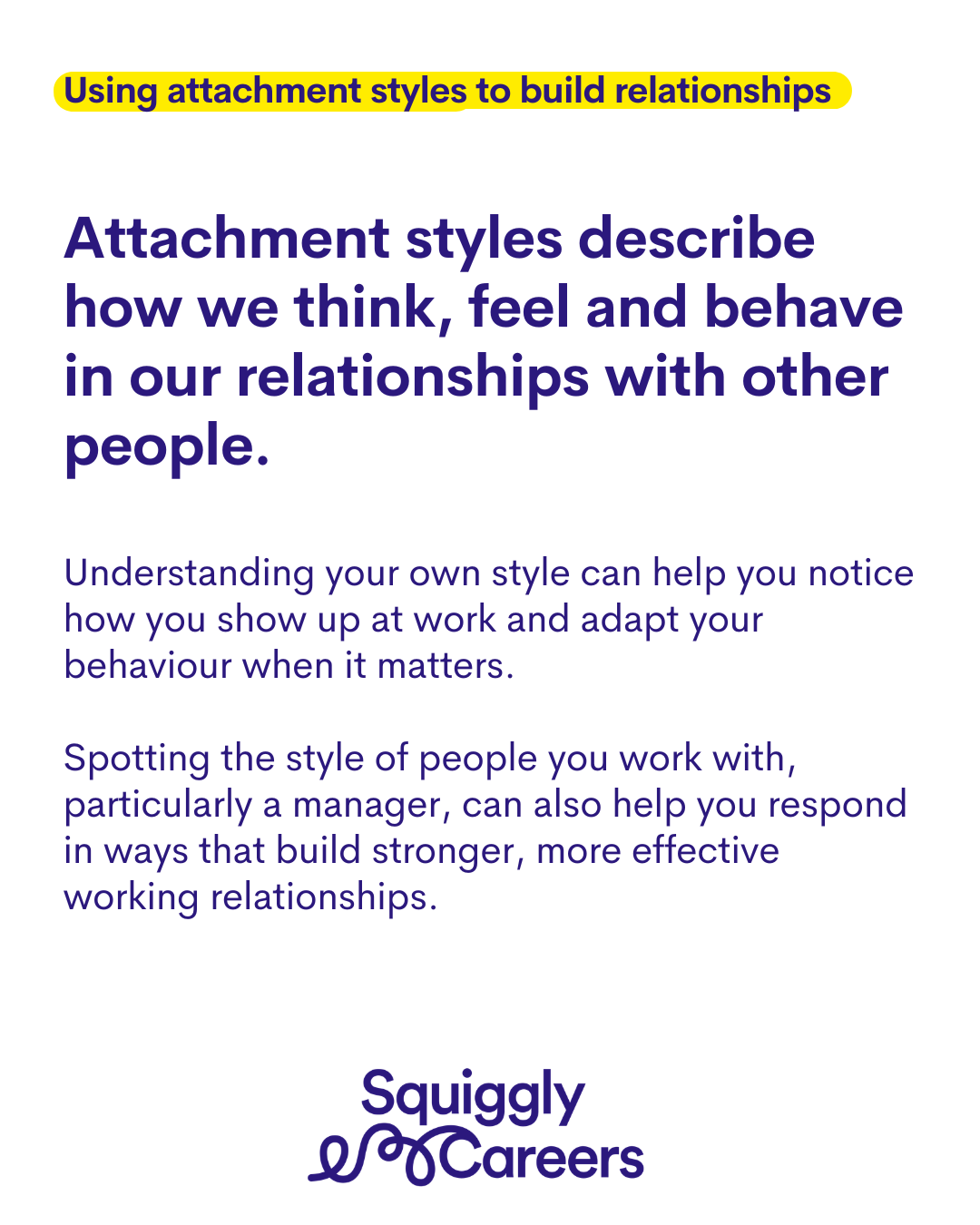
In this episode, Helen and Sarah borrow brilliance from the psychology of attachment styles and explore what this concept can teach us about working relationships. Sparked by a Harvard Business Review article on managing insecure leaders, they unpack the four main attachment styles and what they might look like in the workplace: secure, anxious, avoidant-dismissive, and fearful-avoidant.
If you’ve ever wondered why certain working relationships feel easy while others feel surprisingly tricky, this episode will give you a useful lens for understanding behaviour and adapting in ways that help you work better together.
📚 Resources Mentioned
How to Manage an Insecure Leader (Harvard Business Review)
For questions about Squiggly Careers or to share feedback, please email: helenandsarah@squigglycareers.com
Need some more squiggly career support?
1. Download our free careers tools
2. Sign up for our Squiggly Careers Learn Like a Lobster Skills Sprint
3. Sign up to the for Squiggly Careers Newsletter, a weekly summary of the latest squiggly career tools
4. Pre-order our new book Learn Like a Lobster

(00:00) Attachment styles at work
(01:14) The four attachment styles explained
(09:13) Helen and Sarah reflect on their own styles
(22:20) How secure styles show up at work
(25:06) Managing anxious behaviours
(29:01) Avoidant-dismissive patterns and how to adapt
(34:18) Avoidant-fearful behaviours and building trust
Sarah Ellis: Hi, I'm Sarah.
Helen Tupper: And I'm Helen.
Sarah Ellis: And this is the Squiggly Careers podcast where every week we borrow some brilliance and try to turn those ideas and that curiosity into useful action for you and your squiggly career.
Helen Tupper: And so today we are going to borrow brilliance from the concept of attachment styles, which I have known about for a while, probably in a very much like an out of work concept, because it's the sort of thing that I'm quite interested in and curious about. And often when I'm talking to friends about their relationships, it will often come back to what's your attachment style? What's their attachment style? And I knew that Sarah would never give this the thumbs up to talk about on the podcast until it was featured in Harvard Business Review. And I was on an aeroplane last night to come to Toronto, which is where I now am, because we are doing some Learn Like a Lobster work here as part of our book launch. And I was reading Harvard Business Review and there was an article in it - How to manage an Insecure Three Steps for Dealing with Anxious or Avoidant Executives. And anyone who is familiar with the concept of attachment styles will know that a lot of it is about whether you’ve got a secure attachment or an anxious attachment or an avoidant attachment. And this whole article is about when you spot those styles in the people that you work with, particularly your leader, what should you do about it? And so I've managed to get attachment styles on the podcast.Well, I guess you need to adapt dependent on someone's attachment style if you care about working with them.
Sarah Ellis: Right.
Helen Tupper: I mean, it's a choice. You could just be like, oh, that's how they are. This is who I am. And, I'm not going to do anything different. But in reality, particularly if this is your manager, I think having an awareness of their style and being able to spot that and then being able to do something different as a result of it is useful. But we did also want to get, I guess you to reflect a little bit on what your style might be. So it isn't just about, oh, they're so avoidant, they're so anxious. Yeah, I think it's very easy, isn't it, to point the finger at this stuff. I think it is quite useful to reflect on, well, what might my style be for the majority of my time? Not all of your time. The majority of your time. And then what. How could that affect the people that you work with too?
Sarah Ellis: Looking at both sides of it and when you dive into this, I think this is probably not one that I can imagine teams talking about together because it feels quite personal. So, like having spent some time doing it and like, you're trying to work out what your attachment style might be, you know, when you take these ideas and you figure out, like, when do we think you're most likely to use this? When will we apply this? And in lots of the work that we do, we'll often talk about, oh, this is even more useful if you talk about it together as a team. But I actually just couldn't imagine that. So as I was going through, I was like, I can't imagine even a very psychologically safe team probably having this conversation. It's also probably not the first thing that I would suggest that teams should do. I think this is helpful for you, for like your own self-awareness, as Helen said, and probably particularly useful if something isn't clicking or you'll find something really hard with someone else who's in a position of power. I think this might just help you understand and adapt enough. To Helen's point, you don't have to like, change who you are. It's often about adapting enough. So, Helen, are you going to tell me what style you are?
Helen Tupper: Yeah. I do feel like if there are any actual psychologists listening to this, I'm apologise.
We're just trying to kind of do it at a high level so that people can build better relationships. And I don't think there's anything wrong with that.
Sarah Ellis: They'll be like listening to you going, defensive, she's defensive. So, like, if a psychologist is listening now, they'll be like, what can we infer from that?
Helen Tupper: Sorry. So at a high level, I will just talk through the four attachment styles. And by the way, the research on this shows that your attachment style is largely formed through your early life experiences. Quite interesting. But I'll go through them at a high level. When they can work for you, when they work against you. Some things that you might, you might spot. And then Sarah and I are going to have a bit of a chat because I wanted to know intuitively which one did you think you might be. And then we have used an AI prompt to get some, I guess more specific insight into based on a couple of questions. Which ones do we, are we most likely to identify us? So the four styles then.
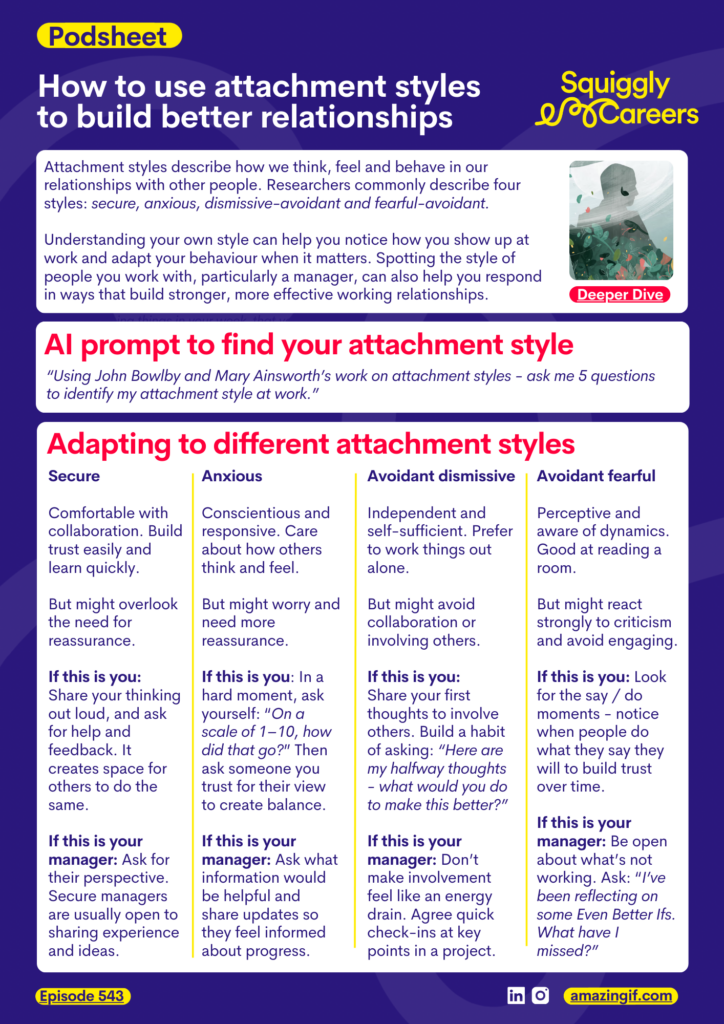
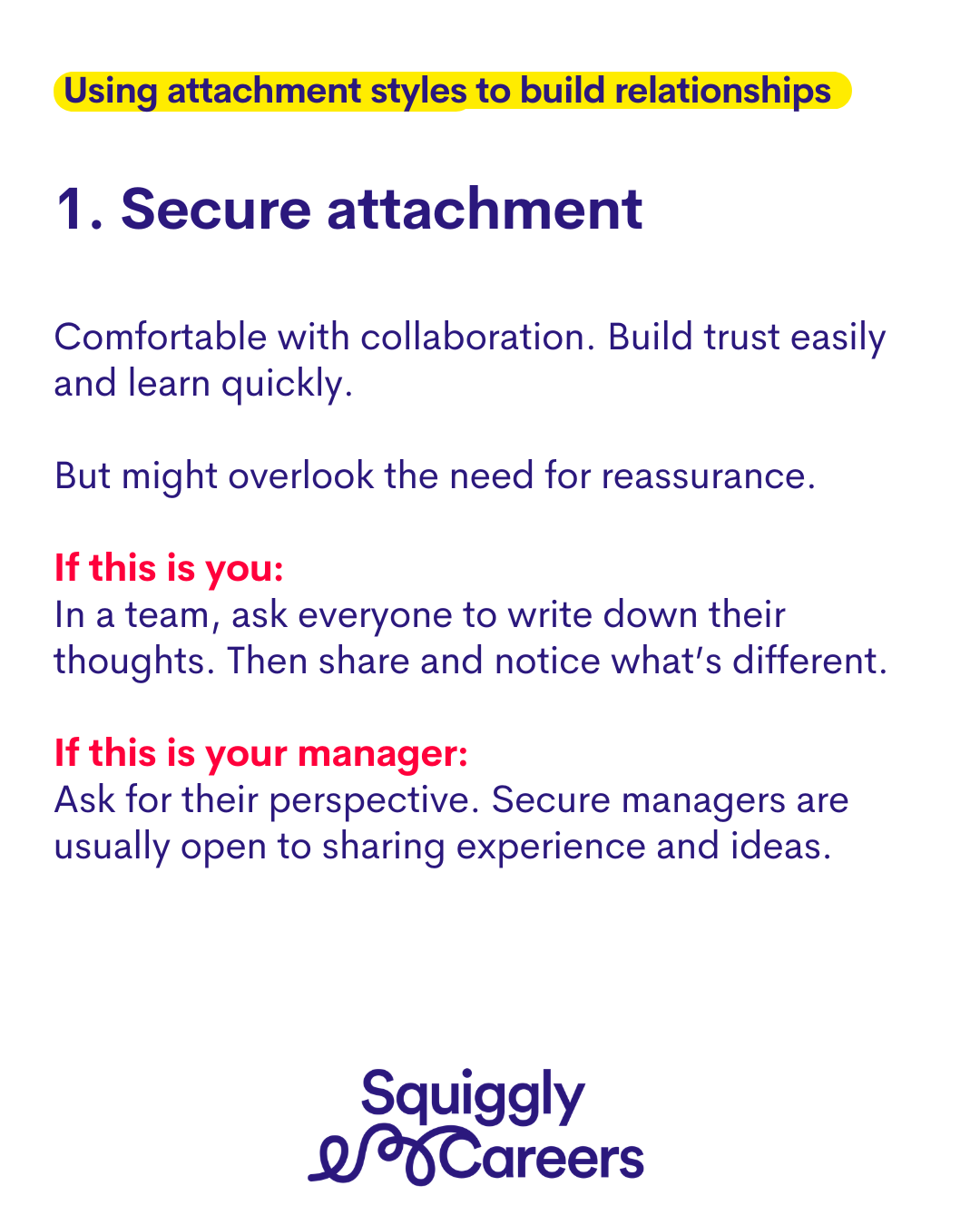
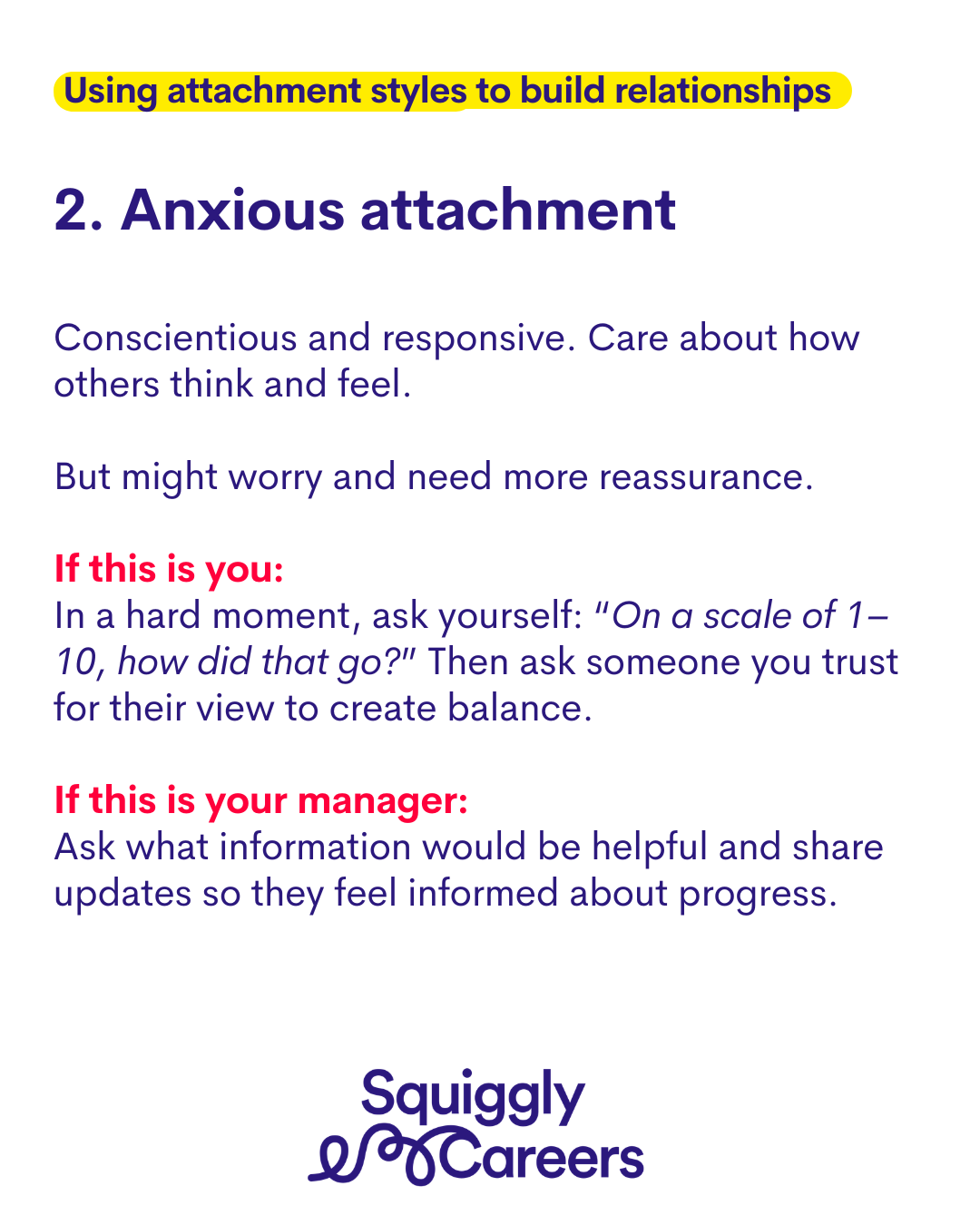
The first one is secure. So the good thing about this style is that these are people that are very comfortable collaborating. They are very open, they, they build trust easily, they learn quickly and then this is the one that we all want to be okay. This is like, this is the one that works well with everyone. However, there are some, I guess, challenges. If someone is secure predominantly they may assume that other people are too. Like, we're all just fine with this. We're all fine learning and getting feedback and collaborating. Everyone's comfortable with that and they can underestimate that. Other people might see, seek more reassurance or you know, might need that because it's not in their head to think like that. So they, they don't necessarily think other people need that either. So that's secure. Anxious is someone who, the advantage of this one is they're very conscientious, they're very responsive. You know, these, these people care about how other people think and feel and react to situations. So there's a lot, you know, loads of high care in these people. However, the flip side of someone who's got quite an anxious style is they might need a lot of reassurance or approval. They bring quite a lot of worry into their work and you know, that kind of anxiety can actually become a source of stress for somebody with that style. The next two get, I think a little bit more, a little bit more nuanced. I feel like it's quite easy to get your head around secure and anxious.
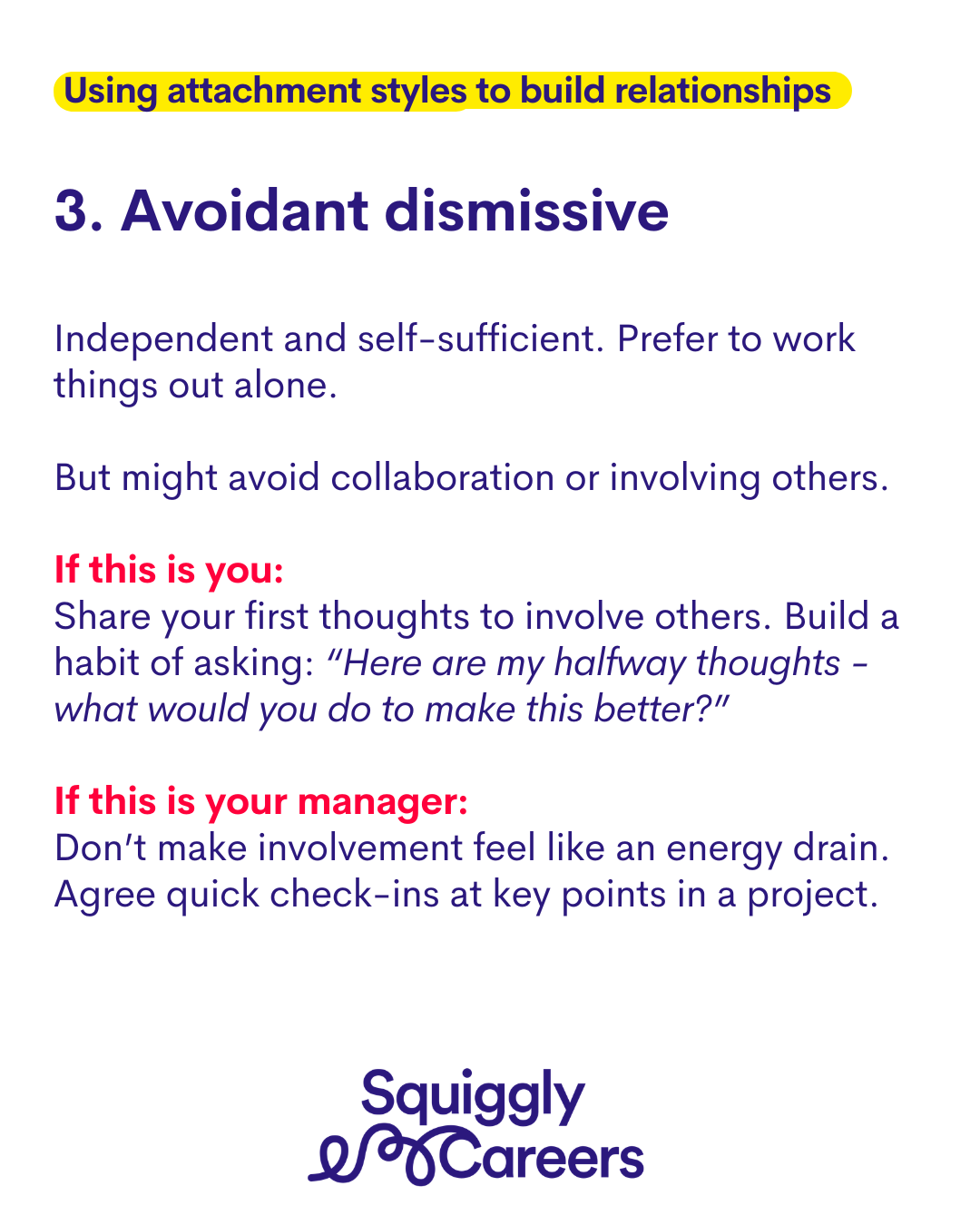
The next two are around avoidant. So you can be avoidant-dismissive, which is somebody who's super independent and self-sufficient but bit different to the secure person who is comfortable with collaboration. These people kind of dismiss or avoid the collaboration. They're like, I know what I'm doing, I don't need to involve other people. I just get on with it and make the decision and that's fine. So very independent. Sarah's laughing. Why are you laughing, Sarah?
Sarah Ellis: I'll wait, I'll wait till you tell me which one you were.
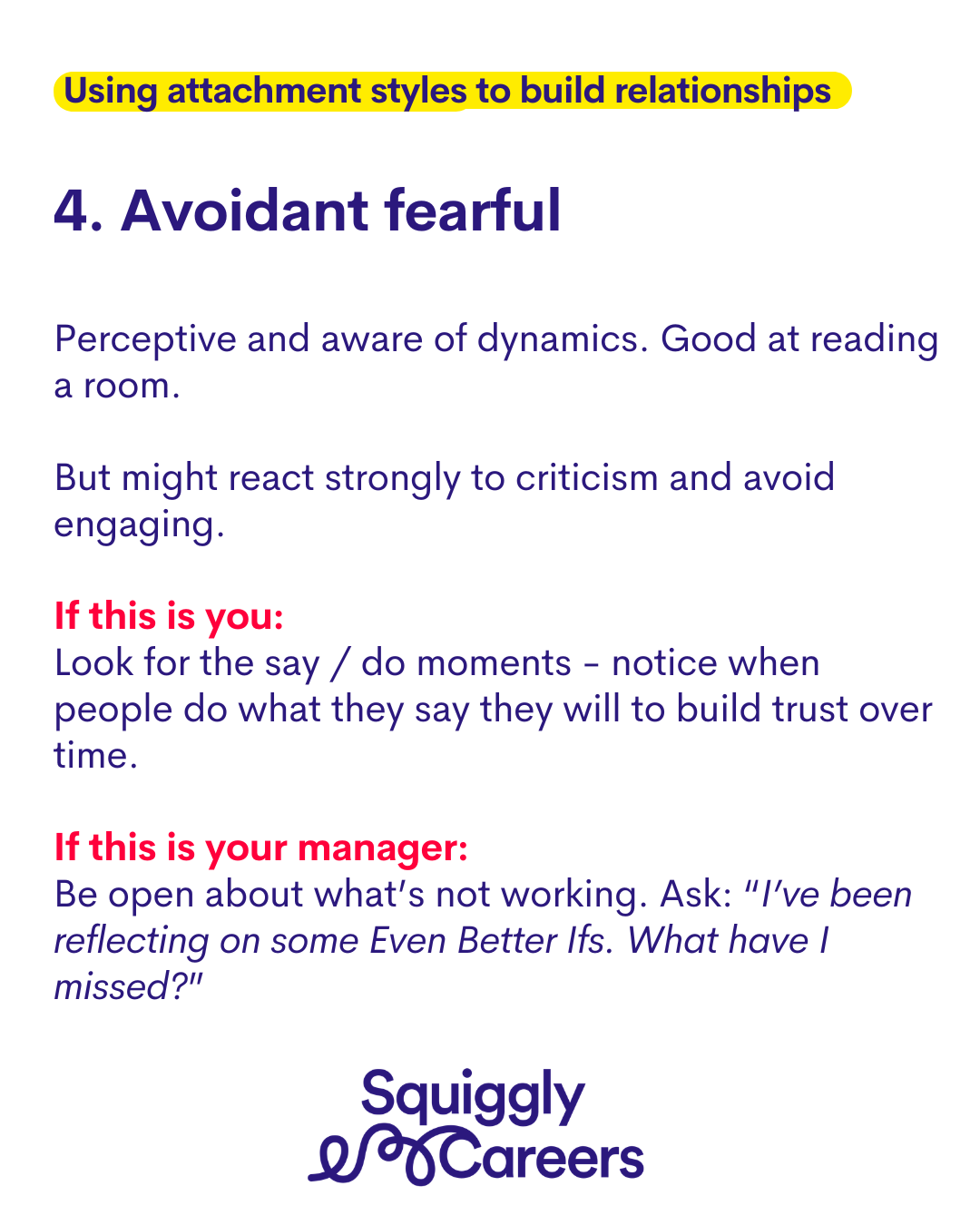
Helen Tupper: Sarah's waiting. So yeah, super, super independent. The challenges we'll just hold, we'll hold these challenges for now. So they may avoid collaboration can appear a bit distant or disengaged. Because of that independence. And they may not proactively learn from other people because they kind of don't see the need to. I just want to get on with it and get stuff done. We'll come back to it. And then the last one is avoidant but fearful avoidant. So just like the anxious ones, these people are perceptive so about other people and they are aware of, like, power dynamics, for example, in situations they are very good at reading a room, but sometimes that means that they are sort of too sensitive, so they don't engage. They talk themselves out of it. This avoidant fearful. They're so scared of a situation or worried about what will happen that they don't even put themselves in a position. So someone who's anxious probably still get involved, but the avoidant fearful just talks themselves out of being involved in it at any point. And they have very strong reactions to criticism. They can be quite inconsistent. So it's quite hard to read. If you've got one of these people, for example, that you work with, avoidant fearful, it's quite hard to read them. And they just seem to kind of worry and get worked up and never actually commit to doing anything. So these are our four styles. So Sarah and I were going to have a chat. What do we see in each other? What do we see in ourselves? And then what did AI say?
Sarah Ellis: Does AI know us better than we know ourselves?
Helen Tupper: What do you see in yourself? What do you see in me?
Sarah Ellis: In myself? I thought I would be mainly secure and that was true when I answered the questions. And you can describe the prompt that we both used, and we both used that. I actually used it twice on two different platforms, partly because one of the times I was out and about and I was like, oh, I've got a different one on my phone. I'll just try it, see if I learn something new. So mainly secure. But I recognise the avoidant fearful one specifically when you then start diving into some of the questions that it asks you around conflict. So obviously I don't. I don't like conflict and so I would sort of fear that and kind of avoid that. And I don't think I'm always really proactive about feedback. And that's one of the other areas that it would ask you about other things, like open collaboration, asking for help. It's like, are you prepared to ask for help? I'm like, sure, great. I love asking for help. You know, I. And I don't mind evolving other people. I don't have that kind of sense of I'll always have the best idea. I think I, you know, I love having ideas, but I do want to involve people along the way. So definitely the kind of secure. But then the last one as well. And then with you, the avoidant-dismissive one, I think can sometimes happen. I don't recognise all of your description, though, I would say, which, like, most things were hardly ever 100% one thing. Right? So if you said to me, “does Helen like learning with other people?” I'd be like, yeah, of course, of course, of course she does. And actually, really, you're really curious and you love learning with other people, but there is a phrase in, like, the research that you'd done, that you'd sent to me where the phrase was, let's just move it forward. And I was like, well, has Helen written that phrase or has that just come from the thing? Because it just sounds like Helen. And, you know, obviously I can see sometimes in you the. I don't know, it's because you want to be pacey. You wouldn't always want to involve people because you just thought, well, that's going to slow us down or slow me down. And so, yeah, probably some of the phrases, I mean, even that last one, it says, I'll take this. And like, I've never known anyone sort as much stuff out as you do. All of the time. You're like, I'll sort that. Well, I'll just do that now. I mean, you literally did it right before this call where we were talking about something that I offered to do and then you still did it and I was like, I mean, I love it. Obviously you, like, you take. I can't even remember what that was.
Helen Tupper: That's the thing, you can't. I can't even remember what we were only talking about.
Sarah Ellis: It's interesting, isn't it? And I think I literally said the word I will do that because it, like, made sense for, like, me to. To lead on that thing. By that point, you clearly weren't listening because you were like on your phone, like, trying to solve the problem. I was like, oh, it's all good content. It's all good content. I mean, and then even, even then, like, I've looked at it and I was like, oh, actually, it doesn't. Doesn't quite work, so I do actually need to do it. But yeah, it did. It did make me laugh. What about you, when you did it?
Helen Tupper: Well, I thought, I can. What did I think with you? I see you as secure generally. Like when I kind of think you're very open, probably more than me, you know, you're very, very open to feedback, you're very willing to collaborate. Maybe sometimes the bit of the anxious one like you, I think you'll flip to that more than me. I think I rarely get into that world of worry. It just doesn't, it doesn't because I just go, well, I'll just do it like. So I rarely flip into the world of worry and I don't have thoughts that go, you know, I would never really have that spiral situation. So I would say like for you, probably 90% secure, 10% some kind of anxious. I never feel like you're avoidant, like you always, like you never do it
Sarah Ellis: in my own head.
Helen Tupper: Welcome to my brain.
Sarah Ellis: Yeah, the other thing you described something which, when you said it, I can't which one it was in now see if you can remember. And I was like, oh, I wonder if that's me sometimes. You know, when you were like you, you didn't quite use the word scattergun, but you said like, someone can be a bit, you know, almost like your worry could show up in lots, in lots of different ways. And because I have, I do have quite a lot of agility in like my, my thinking. But then sometimes I think my anxiousness, which I, I don't. I. It's funny, isn't it?
Helen Tupper: Like the word.
Sarah Ellis: I think I get a bit worried about using it because I do feel like other people are more anxious. And also it can be very stressful to be like that and I wouldn't want to take that away. And like, I'm generally not an anxious person, I'm a pragmatic person. But I think sometimes I wonder if I can be quite hard to read. Someone in our team even said something to me. They were like, oh, yeah, I'm going to try and stop second guessing what messages mean. And I was thinking, is she actually trying to say to me, I'm going to try and stop second guessing what your messages mean. You know, when someone's like, they're not quite sure. And because sometimes I think my tone, I was thinking about this, that my tone can vary really wildly. So if I looked at my team's messages to the same person, I think they can be everything from very thoughtful, ask, like a really insightful question and like connect to what people are doing outside of work to something really quite direct. And so you're like, oh, is that a Bit, you know, like the kind of. Sometimes that is.
Helen Tupper: That's the avoidant fearful one then.
Sarah Ellis: Is that what avoidant fearful is?
Helen Tupper: Okay, well, does your collaboration feel inconsistent.
Sarah Ellis: Yeah. Kind of hard to read. Yes. I wonder if my collaboration feels inconsistent. And I wouldn't. I know I'm hard to read because every time I do those, any kind of profiling things, I'm always the weird one. There's always like, no one really has this profile, so it will ignore it. And then they're like, oh, no, but you do. And so that must make me hard to read though, right? Because you're like, well, I'm never quite sure unless you know me really well. You can get a really wide mix of things from me. You could get one minute that font is wrong in a presentation and then the next minute a really strategic question. And that is definitely true. So you're like, oh, it's interesting when you think about your impact. Right. The more you understand for yourself. It's not like I'm. It's almost what has made me reflect on is less how I hold myself back, more how it's holding other people back. So if you think about those descriptions there that you just talked to me about, well, I can communicate and collaborate inconsistently almost. It's not impacting me, but maybe people are sort of sometimes second guessing, like, oh, she's been quite direct. Does that mean she's mad at me? Is she angry?
Helen Tupper: I don't want, I don't want people to feel disconnected.
Sarah Ellis: No, I don't.
Helen Tupper: Just because my desire to move things forward. It's quite interesting because I do, you know, it's a bit like the radical candour stuff when they talk about manipulative insincerity and obnoxious aggression. I feel like the term. Well, yes, but actually it is almost quite useful to think about it at its worst. Yeah. So the fact that my avoidant dismissive style could make somebody feel like I'm not open, I don't care and I'm dismissing someone. It's quite emotive language. But maybe that's sometimes when you need to kind of hear that you at your worst can feel quite dismissive to the people that you're working with. Or you at your worst could feel like you're very inconsistent for your colleagues. Like, it's quite useful to like think about that..
Sarah Ellis: I think it is actually really useful because it would make me. It would make me think about my actions. So, you know, back to like, there's no point in having awareness without thinking about, well, what are the actions that then I might take? Or like, what might I do differently? And some of it could maybe be, you know, we talked about how do you turn this into, like more of a tool for teams. I can imagine this kind of conversation in a team. You're probably still going to be a psychologically safe team. But, you know, if you'd used it yourself to then say, I've realised that my worst, that perhaps I could be hard to read, I could be inconsistent, my collaboration, those kind of things. And, you know, you'll probably get some – “I might see that from you some of the time”. But then you could also talk to people about going, well, what I might experiment with or what would be useful because, you know, sometimes you also can't solve your own problems. Like, I think so, you know, actually someone may be saying, oh, well, like, for example, in our team, I think if people were ever thinking, oh, is Sarah, like mad at me? Or does she think I've done something wrong or does she blame me? You know, almost giving people permission to just be like, ask or call me or, you know, is something wrong. Is it worth having us having a quick chat? And probably I'd be like 90% of the time like, oh, no, it's fine, I'm just in a rush, you know, like that how easy it is to like, misinterpret things. I wonder if there are some things that you could do as a team. Particularly if this is not a massive issue, like, we're going to talk a little bit about, you know, if you've got a manager that's, let's face it, a bit of a nightmare, you're probably in a slightly different scenario if you're in a team that's working relatively well. These kind of chats are probably like, probably useful starters.
Helen Tupper: Like the even better if riffing it, isn't it? But you're right, it does depend on the team. So we'll just briefly talk through what AI told us and the prompt that we're putting.
Sarah Ellis: The prompt. Yeah, I think that was that. I found that really helpful. I copied yours.
Helen Tupper: So there's an interesting data point in the article which we'll put in the PodSheet, which says recent research suggests that about 36% of adults have an insecure attachment style. So that is the anxious one or the avoidant, whether that's dismissive avoidant or fearful avoidant. So it's just useful to know that like one in three people kind of come out like that. But if you do want to get maybe a bit closer to what your style might be, the prompt that we use and again, I'll put this in the PodSheet which you can download in the show notes or from amazingif.com on the podcast page is: “Using John Bowlby and Mary Ainsworth’s work on attachment styles - ask me 5 questions to identify my attachment style at work.” I think we both did this in chat GPT and Claude were the platforms we used. So what did, what did it tell you, Sarah? Was it a surprise or was it similar to what you thought you might be?
Sarah Ellis: So actually no, it wasn't. It wasn't a surprise. So it said I've got a mostly secure attachment style at work because it did do it in a work context. I actually think I might sometimes be different for this outside of work with a slight independent avoidant tendency.
Helen Tupper: Ooh, interesting. Which is more the dismissive one, right, Than the, than the fearful one if you're independently avoiding?
Sarah Ellis: Well, the avoidant bit is the fearful one and then the avoidant dismissive is the other. So I think it was actually saying a little bit of both because apparently, I've got one deviation. I use that word and actually it gives two examples. So it was like basically you don't like conflict, which is more the kind of fearful one. And then it's if some, you know, they ask you a bit about like distance. So if someone feels like distant, I tend to withdraw and rely on myself rather than investigate a relationship. So that's where you also end up in avoidant dismissive as well. So like, yeah, so what's helpful, and I know this is because this is obviously how that prompts work is. I did actually found I sort of spent longer than I imagined because it kept saying would you, would you be interested in this? And I was like, well, yes, I would be. You know, like it caught, it caught my imagination and it started to like give me examples and it kind of made suggestions. It did a deep. I did a deeper dive assessment.
Sarah Ellis: It was telling me like the five signals that you could look out for which helps you to understand different styles. So yeah, I did actually get. I ended up diving quite a lot deeper really, just from start, you know, like you can start with one prompt and then actually the AI helps you with the other prompts.
Helen Tupper: Yeah, I mean, because I think you can tie yourself up in knots a little bit with like, oh, is it avoidant dismissive? It's avoidant fearful. So I do think actually the AI stuff helps you create a bit of clarity. And I came out as mainly secure. But when when there's a bit of uncertainty, that's when I can deviate into different ones. Say, for example, because uncertainty, my avoidant, dismissive, like in uncertainty, I'm like, well, I'll just do it. I'll just work away. You don't need to worry about it. I'll just get it done. So that's when I can probably dismiss someone else's worries. But largely secure, which is interesting. So what we thought we would do now is we spend the rest of the podcast just quickly going through each of the styles and just talk about some sort of adaptive behaviours. So whether if it's you or if it's someone that you work with that you see this style in, what could you do differently so that you can, you know, be it either be at your best or build a better relationship with them. Shall we start with secure, Sarah?
Sarah Ellis: Yes, I do. Like, I assume some people are listening and chuckling, being like, oh, claimed behaviour.
Helen Tupper: Sure.
Sarah Ellis: They've both said that they're secure. Which I think if that is you listening now, I think that's very valid because obviously this is us just deciding, like, of course, of course we're collaborative and all this good stuff and can ask for help. So I think if you're secure, if this is you, I think it's important that you don't underestimate almost like the value of some of the behaviours that you have because you are secure. And so things like sharing your thinking out loud so people can understand the processes. I actually was thinking about our team and sometimes Helen and I do hear this feedback where people say, oh, it was so helpful just to hear you talk about that. And I'll think, oh, really? Like, you know, like, I'm like, oh, I thought everyone's sort of new. Or like, okay, fair enough, or it perhaps won't have been the thing that I had imagined would be most useful. And so I think sometimes when you're secure, which is a brilliant place to be, you can then underestimate that, actually the kind of value and how valuable it is to kind of do some of those things, like people seeing you ask for help would be another really good one. So when you're secure, you don't mind asking for help because you're secure enough to ask for help. And again, just thinking about, like, if you're listening to this as a manager or as a leader, like the ripple effect of your team, knowing that you do that, asking them for help, seeing you ask for help from other people, hearing you say phrases like “I don't know” or “I'm actually not sure how we're going to approach that. What do you think?” And I think both Helen and I are very kind of confident doing that. I also think it is easier now doing what we both do and running the company that we run than it has ever been in my squiggly career. So if I think if I was doing this back in the kind of Sainsbury's days, working a big retailer, some of these things I think kind of would have, would feel harder. So I do think your context makes a big difference.
Helen Tupper: Yeah. I think if you are genuinely a secure leader, I think what you role model for your team can be transformative because you're basically creating safety for everyone for sharing mistakes, for asking for help, for collaborating, for, you know, not having to hoard. Yeah, all of that. So you are genuinely this, like the, you, the impact that you can have on the people in your team is, is amazing. If you are working with somebody, you know, your manager, and you think, oh, how can I build an even better relationship with them? Secure people quite like ownership, they're very confident with ownership and so, you know, asking them for their views and their thoughts, they're very, they're very willing to share, you know, they're not going to hold on to their knowledge in a way to make them feel bigger and better. They're very comfortable sharing, so just proactively going to that person. I'd really like to get your input. I know you've been in this situation before. Can you share your thoughts with me and sort of treat them as that peer? Because that's sort of how they're approaching, they're approaching their work generally. So let's move on to anxious for the next one. So if this is you, so this is kind of, you know, you're worrying, you're second guessing, you maybe start to spiral, that kind of thing. One thing that can be useful here
Sarah Ellis: is to use scales.
Helen Tupper: So let's say you're in a situation, I don't know, a meeting that didn't go very well and you're thinking, ah, it was awful. What's it going to mean? Are they going to ask me to do it again? All that kind of stuff. It can be very, very helpful to use a scale to stop a spiral. So I might think, on a scale of 1 to 10, how did that meeting go? And I would be like, absolute two, disaster meeting. They're never going to want me in that situation again. If you can go and ask someone that you trust, what was your view of that meeting? Give me a score of 1, of 1 to 10. And they're more like, well, 6. I noticed that you kind of were a bit nervous at that point. But, yeah, main messages came through, then suddenly you're starting to get a bit more perspective that can help you stop the spiral. And I think an even better if with this one is because if you're anxious, you can overlook for validation and approval from other people. I would say get that data point for more than one person, because if I'm anxious and I just seek Sarah's approval, then I might. I'm not necessarily getting the full perspective that I could. Whereas I asked for a couple of people, I become less dependent on Sarah's need for approval to make me feel safe, I suppose.
Sarah Ellis: Yeah. And actually, I was thinking about this one for then, if your manager is anxious. Now, I don't think I am universally anxious. I think most of the time I'm relatively secure. But I do think I have anxious moments and I think. So I was thinking, okay, what have I seen our team do well, when I'm like that? Or what would help me to maybe chill out a bit, basically, because I think when I get a bit anxious, I think I probably go into the detail more. I'm like, asking lots of questions. I think I could be quite relentless. And so I think if you notice that your manager is quite anxious, actually saying to them, what do you need from me? Or what can I do for you that would be really useful? Or what questions have you got that I can help you find the answers to? And so actually I can think of one or two things that I'm anxious about at the moment at work. And actually what I want to feel less anxious is data. I want to know where we are, like data and status. And I think actually that would, you know, sort of what would lessen your anxiety. Those two things wouldn't actually make the problems go away that I'm thinking about, or it wouldn't. The challenges would still exist. But I think I would have. I think I'd feel like I had more of a hold on them. You know, sometimes you're anxious because you're a bit out of control or you don't know what you don't know. And then obviously you can get into, like, micromanagement behaviour and all sorts of things that are kind of not very. Not very helpful. So I actually think being really explicit about this is really helpful. I once worked for someone where initially I was not sure if I'm going to enjoy working for this person. She was really anxious the whole time. You know, I was like, oh, just leave me alone, you know, I'm fine, let me get on with stuff. And then funnily enough, once I. I started to share a lot more with her, I'm like, I wonder if sharing is quite a useful word here. So I started sharing a lot more and then I would really proactively ask her, like, what else? Like, what else do you need from me? What else would be useful? And just really did that really consistently for her. And then it sort of changed our dynamic and also we became friends and, like, we got on really well. But I think probably she was initially a bit anxious because I was doing a new job, so no one really knew what I was meant to be doing. She probably hadn't been doing that job for that long. She was probably under loads of pressure and maybe naturally a tad more anxious. You know, you talked about behaviours and distress. Maybe that was like a high moment of stress for her. And so that, I think, made our relationship there. Me just sort of. Just slightly trying to figure out, you know, like we talked about adapt. I think I adapted enough to kind of just lower the anxiety.
Helen Tupper: I think there's quite a sort of tricky combo with the next one here, which is the avoidant dismissive. So if you take - Sarah has moments of anxiety. And I know some of the things that Sarah's worried about, so I know exactly what she's talking about. And I have moments of avoidant dismissive. There's a bit of a tricky combo here, which is basically, Sarah wants to feel more comfortable by diving into the data and the detail. And my dismissive nature kind of goes either, well, it's not important what you worried about, or, well, I'll just do it, don't worry about it..
Sarah Ellis: Or just get on with it.
Helen Tupper: I'll just. Just get on with it. It's not that big a deal. And it's interesting. It's not that Sarah is always anxious, but on those topics, that behaviour for me would be the worst thing for Sarah because that's not, that's not helping her. If I'll say, well, I'll do it or don't worry about it or dismiss it as being not important. None of those things in any way help, you know, if Sarah was my manager in any way, Sarah in that situation. So I think it's interesting how these, you know, your behaviour, their behaviour can interact and so if you are leaning towards the avoidant dismissive. So I'm talking about myself definitely here a little bit. I think what can be really useful here is to get used to doing two things. One - sharing your first thoughts earlier to sort of practise engaging people. So if you're dismissive, what I can sometimes do at worst is I'll just think, well, I know what I'm doing. I don't need to involve anybody. But actually involving people sooner. So getting used to kind of sharing where are you at halfway with something with, you know, a podcast script or a project or something, but use it as a forcing function to involve people earlier rather than dismiss doing it with somebody else. And then I think having a question almost as a bit of a habit, like a question you ask. So “what are your questions about this or what your builds to make it better?” And I think the trick here is to know your question so you've got it in your head, so it becomes a habit. But then to actually genuinely make time to listen to people's responses. Because if you just put a message on teams, I'll give you an example. Put a message on teams – “here's my halfway thoughts on the project. Really appreciate any questions or builds you've got”. And asking for that isn't the same, I think, as actually like reading, listening and responding to it just slightly. You know, you can ask and still be dismissive. Like I'll be like, oh, yeah. I think you actually do have to then acknowledge and you know, even if you use it or don't use it, I think you have to kind of sort of close the loop on it a little bit. So if you are working with somebody who potentially shows behaviours like me. Not all the time, but can be avoidant, dismissive or guarded or closed. And you want them to be involved. You don't want them to just dismiss you or the project or what you're working on and don't make their engagement feel like a real time or energy drain. They're just going to dismiss it if you do that. So you want to get their involvement in quick, specific times. So you might say to them, “I'd really like to get you involved at critical points on the project. I want to do that in a way that is as efficient as possible. So what would that work look like for you?” I think if you are using like critical points, efficient engagement, that appeals to someone like me. So, and then hopefully then they're also, they're also determining what that involvement like look like rather than resisting what you might want it to look like. You might think, oh, I need two one hour meetings a week and they're thinking absolutely not, just email me. Whereas if you say, you know, I need, you know, two 10 minute check ins or something like that, I think make it higher energy, ease of engagement, quick and efficient for them. You're more likely to get that person.
Sarah Ellis: I also think if I was working for you and was sort of struggling to keep up like that could, you could definitely feel like that sometimes, you know, because someone's quite fast and they're a bit dismissive of needing to involve everyone. You're like, we know what we're doing. I've got the clarity. You have a lot of clarity. But then I could feel left out. And so I also think I would probably be actually saying to my manager, like I'd be really explicit about wanting to be involved because I sometimes think those behaviours aren't people intentionally leaving you out, it's just that they are naturally moving fast. And so I could obviously think about this for you. If I could see that you were sort of running quite fast with something and I was thinking, oh I've got an opinion or I want to get involved. I know that I would have to explicitly say that to you. I would say, “on that project, can I be involved in those conversations?” Or “I'd like to add some ideas in as part of that, is that okay?”
Sarah Ellis: Last one. Avoidant fearful. So fear of rejection. Maybe you've got issues with trust. Maybe you can feel more pessimistic. And obviously sometimes these things come from you've had really bad experiences. So this is not the case with me, albeit I have had it a couple times in my overall squiggly career. But if you've worked in a really toxic environment and then you've got trust issues at work, you're like, well, okay, that's really understandable. Or if you have had lots of rejection, fearing rejection is a very normal, natural response to that. So I think what you then need to do, if this is you, is notice when people do what they say they are going to do. So you're aiming here for sort of fair over fear. So this is what you're trying to do here, I think, is build up a picture of what is actually happening. So sometimes I think if you can get a bit negative, you might be like, “oh, they've not done that again”. Instead think, “okay, is that the last 10 times they were doing that action? Have they not done it? Or is that nine times out of 10 they have done the action and this is the one time?” And so you're really just trying to notice things that build trust. And I think that people who do what they say they're going to do, who show up, who turn up and take the action and do the action and that, to me, sometimes it's easy to skip past that and you just don't notice it. But I think if you start to notice it, you go, “When Helen says to me she's going to send me that podcast script for the podcast, like, I believe her. And I also believe that if she can't do it, she’ll tell me.” But I don't then feel the need to be like, “I'm just checking in. Are you doing it?”. Imagine.
Helen Tupper: Imagine.
Sarah Ellis: My God, imagine if we started checking in with each other. It'd be a nightmare. So I think, like, we have a very high trust relationship because of that. Say/do it doesn't mean we always do everything. We absolutely don't but we sort of tell each other when we're not going to. So I think notice that. And then I think if you're working with somebody who is like this, who you're like, okay. They don't seem to trust me. They seem to be worried about rejection. I think people are often looking for reassurance, those people, and usually they're not very well practised in saying the hard thing, because their experience of saying the hard thing might have been horrendous, you know, like really badly delivered feedback or, you know, like that much more fear over feedback. And that's where we did this actually, with our team last week and it worked really well. Helen and I said the hard thing about, like, a project that we were all working on and we'd got some examples that we'd worked together on first and then we asked the team to do it in a - so now if you were all going to say the hard thing, like, what have we missed? What do we need to add to this list? And people did it in groups. And so I think that just made it really safe. No one worried about being rejected for, like, saying the, like, wrong thing. And so if I got a manager who I thought was like this, I think I would be saying the hard thing to them. I'd be saying, oh, I've been reflecting on, you know, the even better ifs or maybe what's not working. And I think it might be these two or three things. And I think it's really important that we're open about those. Like, what would you add? What do you think I've missed? And so you're trying to build that trust by saying, I'm not trying to hide the hard stuff from you. Because in some cultures that happens, right? The hard stuff gets hidden. I'm not trying to hide it. I'm being really open. I'm being transparent and I want to involve you. And maybe it's. You start easier. Even better if is easier than, say, the hard thing. So, yeah, perhaps you start with even better ifs and perhaps you try and progress to say the hard thing.
Helen Tupper: So I think this conversation today is one that really benefits from the PodSheet, because I think you might be listening to it and thinking, oh, it's quite interesting, but you could potentially get lost in like, oh, which one am I again? So my recommendation, if you want to put today's conversation into action for your squiggly career, is go to the pod sheet, because we'll put a table there of the styles and how it shows up and what to do if it's you, what to do if it's them, we'll put that in the PodSheet, and I think also for your own self-awareness, I would use that prompt because you will get some much more personalised insight into what yourself, what your style might be if you use that prompt. So it's a particularly useful one for the PodSheet. As I said at the start, I'll put this in the show notes, we'll put it on our website amazingif.com we will also put this PodSheet on social so if you go, if you follow us either on Instagram, or on LinkedIn, we will post about it there. So it's really easy for you to find.
Sarah Ellis: So have fun, you know, reflecting on your attachment style. Avoid analysing, analysing everyone you work with and being like, what do I think their attachment style are? But we hope you are finding them useful and that it always feels like you listen and there's some action that you can take just to feel that bit more confident and control in your squiggly career. If you ever have any even better ifs or ideas for us to borrow brilliance from, you can email us. We're helenandsarah@squigglycareers.com but that's everything for this week. Thank you so much for listening. I'll be back with you again soon. Bye for now.
Helen Tupper: Bye, everyone.
Sign up to the Squiggly Careers Newsletter and get our latest ideas, tools and inspiration every week - all in one place, straight to your inbox