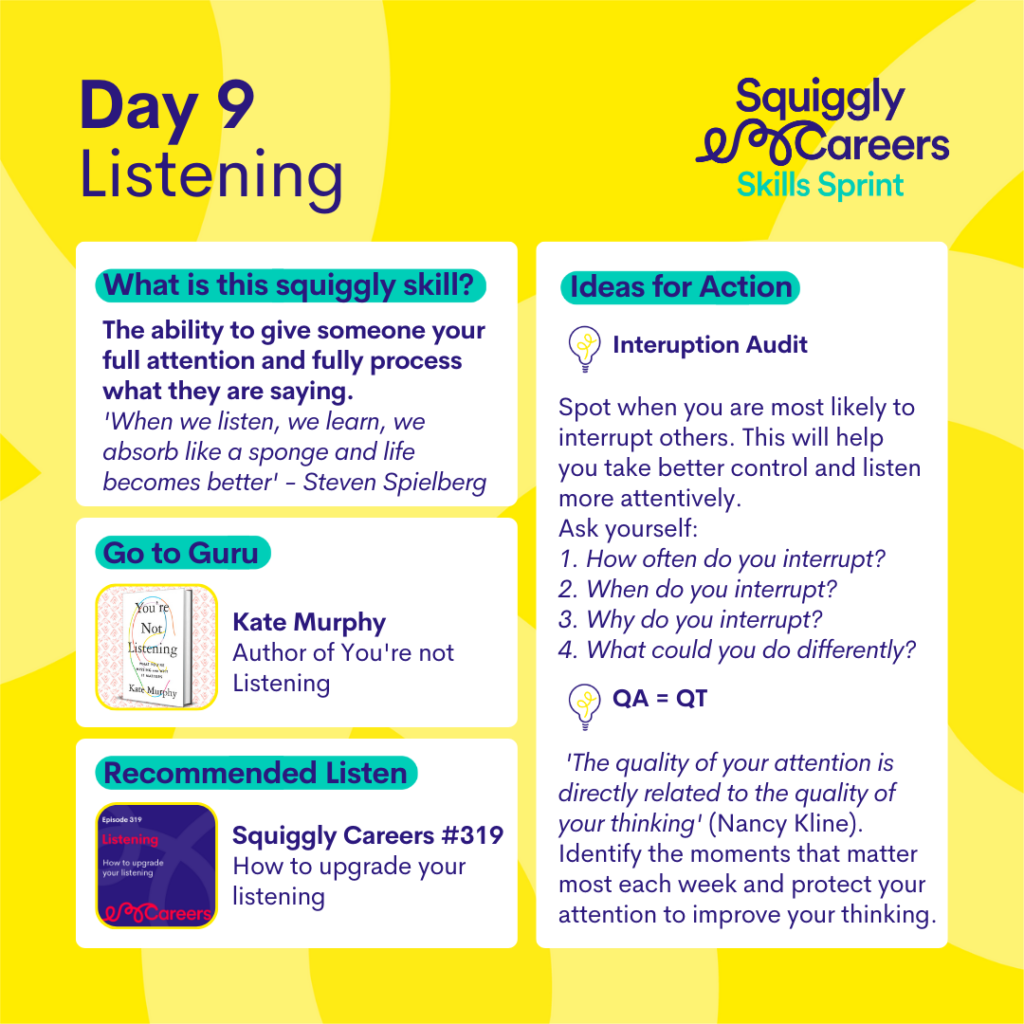
In this episode of the Squiggly Careers Skills Sprint series, Helen and Sarah talk about listening and share their ideas on how to do an interruption audit.
There are 20 episodes in the Skills Sprint and each is designed to help you create a regular learning habit to support your squiggly career development. Each episode in the series is less than 7 minutes long and has ideas for action and go-to-gurus on a specific topic.
Sign-up for the sprint and receive our Ready, Steady, Sprint guide here.
If you have any questions or feedback (which we love!) you can email us at helenandsarah@squigglycareers.com
Download the episode summary below
00:00:00: Introduction
00:02:18: When your listening is at its best
00:03:44: Idea for action 1: be intentional about your attention
00:04:52: Idea for action 2: do an interruption audit
00:06:34: Go-to guru
00:06:40: Relevant podcast episode
00:06:44: Final thoughts
Helen Tupper: Hi, I'm Helen.
Sarah Ellis: And I'm Sarah.
Helen Tupper: And you're listening to the Squiggly Careers podcast. And this episode is part of our Squiggly Skills Sprint series, where we've recorded 20 episodes, each of them are less than seven minutes long, to help you build some career development momentum. In each episode, Sarah and I are going to talk about a Squiggly Skill, what it is and why it matters, we're going to share an idea for action from each of us, give you a go-to guru and a podcast episode so that you can listen and learn a bit more.
And we really, really want you to turn this Squiggly Skills Sprint into your own learning streak. And for anyone who lets us know how they're getting on and who completes the 20-day streak, we can't prove that, so we trust you, but if you tag us that you've done the sprint, you've completed the streak, then what we will do is we'll get in touch with you and we will invite you to a free Five Skills to Succeed virtual workshop that Sarah and I are going to be running in September, so we can help you dive even deeper into the world of Squiggly Careers. All you've got to do is tag @amazingif in any of your social posts, and then we'll be in touch.
Sarah Ellis: In this Skills Sprint, we're talking about listening. And I always find listening is an interesting skill, because I think we feel like we are listening all the time as part of our working week, but it's one of the few skills where we overestimate our capability. So, I think I'm an 8-out-of-10 listener, a fly on the wall observes me for the week, and in reality I'm maybe more like a 5 or a 6. And that's because I think active listening is really hard to do, because it means listening with your full attention, being 100% present, you're not thinking about what are you going to respond with, the question you're going to ask, how do you make sure your voice is heard; and I think often it's a learnt behaviour in lots of organisations, where we feel like our value is based on how much we say, not how much we listen.
When I say that in organisations, you always get loads of people kind of nodding along. So, you feel like that's how you have to contribute, is by talking rather than listening. But there's a brilliant phrase I read where somebody said, "But when you talk, you don't learn anything new, because you're just saying what you know, whereas when you listen, that's how you learn, that's how you learn new information". And it's a really interesting insight. So if we want to optimise how much we learn in a week, we need to listen more. So, Helen, having just said that, how good are you at listening, do you think?
Helen Tupper: Well, I mean obviously I was listening! How good am I? I was trying to think. I think there are situations where I'm good at listening. So, when we're doing a podcast together, for example, I'm listening because I want to think, I want to think about what you're saying and I want to use your words to sort of inform mine.
So, when Sarah and I are doing a podcast, we'll often come up with ideas whilst we're talking to each other as a result of listening. So, I feel like in those situations, I'm really good. But in meetings where I'm bored, well, I'm a bit bored, I'm just like, it's not the distraction, it's the fact that I'm not that interested in what's happening in the conversation, and so I stop listening, honestly!
Sarah Ellis: I was like, "What meetings?" "No offense, Sarah, but I'm really quite bored here"! Sometimes I think I see you're a very good listener, and I see all the time with our team, you're really good at giving people space to speak, and I think you are very good at listening. I just see it when things are not going fast enough for you. I just see this sense of like, I mean, we could be going twice as fast as this, either because your brain has already gone there, or to your point, I think speed and pace is what keeps you interested.
So, it's just often good to observe, when is your listening at its best? I can actually think of loads of examples of Helen, I see her very actively listening a lot, particularly with our team, I think she does that brilliantly, better than I do. And then you start to notice maybe what gets in the way of listening for you. So what's your idea for action here, Helen?
Helen Tupper: It comes from Nancy Kline, who is kind of big in the coaching world, everybody; worth a look if you're interested in coaching. But she has a point that underpins her work, is that the quality of your attention is directly related to the quality of your thinking. So, I guess the point is, if I want to do a good podcast for Sarah, I need to make sure that I have a high quality of attention, because then my thinking is going to be better; we're going to come up with ideas of career development that no one else has come up with. So the thing that I really need to protect is my attention.
And I think I am intentional about my attention in the moments that really matter for my listening. And because that takes quite a lot of energy, I think you have to almost look across your day and go, "What's the moment that matters in terms of the quality of my thinking today?" because you'll be in loads of meetings and some of them matter more than others. And so for me, the podcast is a real moment that matters for the quality of my thinking, so that is when I have to be very intentional about my attention.
And so things like my phone or whatever, I've got to put that away because otherwise, I'm basically not going to produce such a good podcast. So I think scan through your day, what are the moments that matter in terms of the quality of your thinking, and then be intentional about your attention in those moments, and it will increase the quality of your thinking.
Sarah Ellis: My idea for action is, have a go at an interruption audit. Our brains cannot multitask but they can switch quite quickly, and we can also sort of split our attention. So, to Helen's point, we're never going to do great-quality thinking if we're splitting our attention across three things at once. And often I'll ask this question like, "How many times do you think you get interrupted in a day, including tech?" and people have a lot of fun with that question.
They're like, "A billion, or way too many zeros for me to even know what number it is". But I think the point of an interruption, sometimes just asking yourself that question can feel quite confronting, because maybe you do realise, "Oh, I don't have an hour in the day where I don't get interrupted". And I'm like, "Okay, well that's just quite revealing in itself". The thing that I have found most useful is spotting when am I most likely to interrupt, because I can control that and I can do something about it. And I think, if you do an interruption audit, you start to realise, "Oh, I interrupt because…". So, "I interrupt because I've had an idea", that's my main problem in life and my brain naturally has ideas and kind of creates new things. And so, what I have to tell myself is, "Not now".
So, it's okay to have an idea, that can be a useful thing, but someone doesn't need me to interrupt to tell them that idea. I can jot it down, I can come back to it, if it's that good an idea I'll remember it. I often think we're listening, it's letting go of your ego, which can be quite a hard thing to do because you think, "Well, this is a brilliant idea", well that might be what I'm thinking. But I think sometimes other people interrupt because they think they know the answer, because they're trying to be supportive, because they've got a different point of view they want to share, maybe because they feel like, "If I don't interrupt, I'm never going to get heard". So, just think about doing an interruption audit for yourself, when are you most likely to interrupt; and, what could you do differently.
Helen Tupper: And if you want to learn a bit more on this topic, our go-to-guru is Kate Murphy, someone that I interviewed on the podcast, and you can listen to that episode 319, it's all on How to Upgrade Your Listening.
Sarah Ellis: Thank you for listening to this Skills Sprint, we hope you found it useful. We'd love you to share and subscribe so you don't miss a sprint. And that's everything for this episode, so bye for now.
Helen Tupper: Bye everyone!
Sign up to the Squiggly Careers Newsletter and get our latest ideas, tools and inspiration every week - all in one place, straight to your inbox