
This is the fourth episode of the Squiggly Careers x AI skills sprint series. Today, Helen and Sarah are talking about Networking. Before you skip this one (we know some of you want to!), remember this squiggly stat: 70% of people’s roles come through connections.
The key is reframing networking from “people knowing people” to “people helping people.” This creates career karma – when you help others, good things come back to you over time.
In this episode, Helen and Sarah introduce AI tools to build your personal career board with different personas like challengers, supporters, and questioners. They also explore Crystal Knows, an AI tool that helps you communicate better with your team and network by understand their communication style.
🥇 Sign up for the sprint here: https://bit.ly/41jasYO
🎯 What You’ll Learn
* How to reframe networking as “people helping people”
* How to use AI to create a diverse personal career board
* Team exercises for sharing learning goals and building connections
📚 Resources Mentioned
Networks Daily Summary: https://bit.ly/scss-ai-day4-summary
Crystal Knows: https://www.crystalknows.com/
For questions about Squiggly Careers or to share feedback, please email helenandsarah@squigglycareers.com
Need some more squiggly career support?
1. Download our free careers tools
2. Sign up for our Squiggly Careers Skills Sprint X AI.
3. Sign up for Squiggly Careers in Action, a weekly summary of the latest squiggly career tools
4. Read our books ‘The Squiggly Career’ and ‘You Coach You’
00:00:00: Introduction
00:00:43: All about networking
00:02:04: A networking prompt
00:04:32: AI examples
00:06:23: A tool to try out
00:09:38: Networking as a team
00:10:56: Final thoughts
Sarah Ellis: Hi, I'm Sarah.
Helen Tupper: And I'm Helen.
Sarah Ellis: And this is the Squiggly Careers podcast. And this is the fourth episode of our Squiggly Career Skills Sprint.
Helen Tupper: Past the halfway point now.
Sarah Ellis: Unless you start today.
Helen Tupper: Oh, yeah. In which case you've got a few other episodes to catch up on.
Sarah Ellis: And it doesn't really matter too much what order you do them in. It's more that you are trying things out, that you're experimenting. And quick reminder, just in case you are starting with networking, you do need the daily Skills Sprint summaries. Link in the show notes, email us helenandsarah@squigglycareers.com, if you've not got them. The reason they're so important, it's where you'll find the prompts that you can literally cut and paste, you'll find examples of the tools and all the links to learn from, so it will make your life so much easier once you've got them.
Helen Tupper: And today, we're talking about the skill of networking. I know it's a bit --
Sarah Ellis: Divisive.
Helen Tupper: Some people are like, "I hate this one". Don't skip, just don't skip, because it's really, really important for your development. In fact, Squiggly stat time, 70% of people's roles come through a connection. So, if we are not creating the connections, we're not building the relationships we need, we have less access to roles in the future. And that is a big part of what makes your career resilient in a Squiggly Career, that we've got more than one opportunity, we've got more than one option. What we need to do is build our networks in a way that feels authentic. So, the way we frame this in our work is think about this, not as people knowing people, so it's not the amount of connections you've got on LinkedIn, for example, it's not that. It's people helping people.
This works for a couple of reasons. One, you like helping people, we like helping people, results in something called the helper's high in our brain. Makes us feel good, makes us feel valuable. So, it's a better place to start from to think, "How can I be helpful?" And then, the other reason that this works is it results in reciprocity. So, if I help Sarah, she's much more likely to want to help and support me in the future. And if this is the sort of principle that you use to build these relationships, it results in what we term career karma. Good stuff comes back to you over time, and that's what we really want from these networks.
Sarah Ellis: So, the prompt that we're going to start with today is all about building your personal board. So, we did a podcast episode, and this is a tool that we often teach in our workshops around making sure you've got the right people around you to support you in your Squiggly Career. And also, make sure you've got a range of people around you. Because otherwise, there's that risk of if I have lots of people, a bit like Helen, you get an echo-chamber trap of people just reinforcing the same things.
Helen Tupper: I could say people just being annoyingly positive.
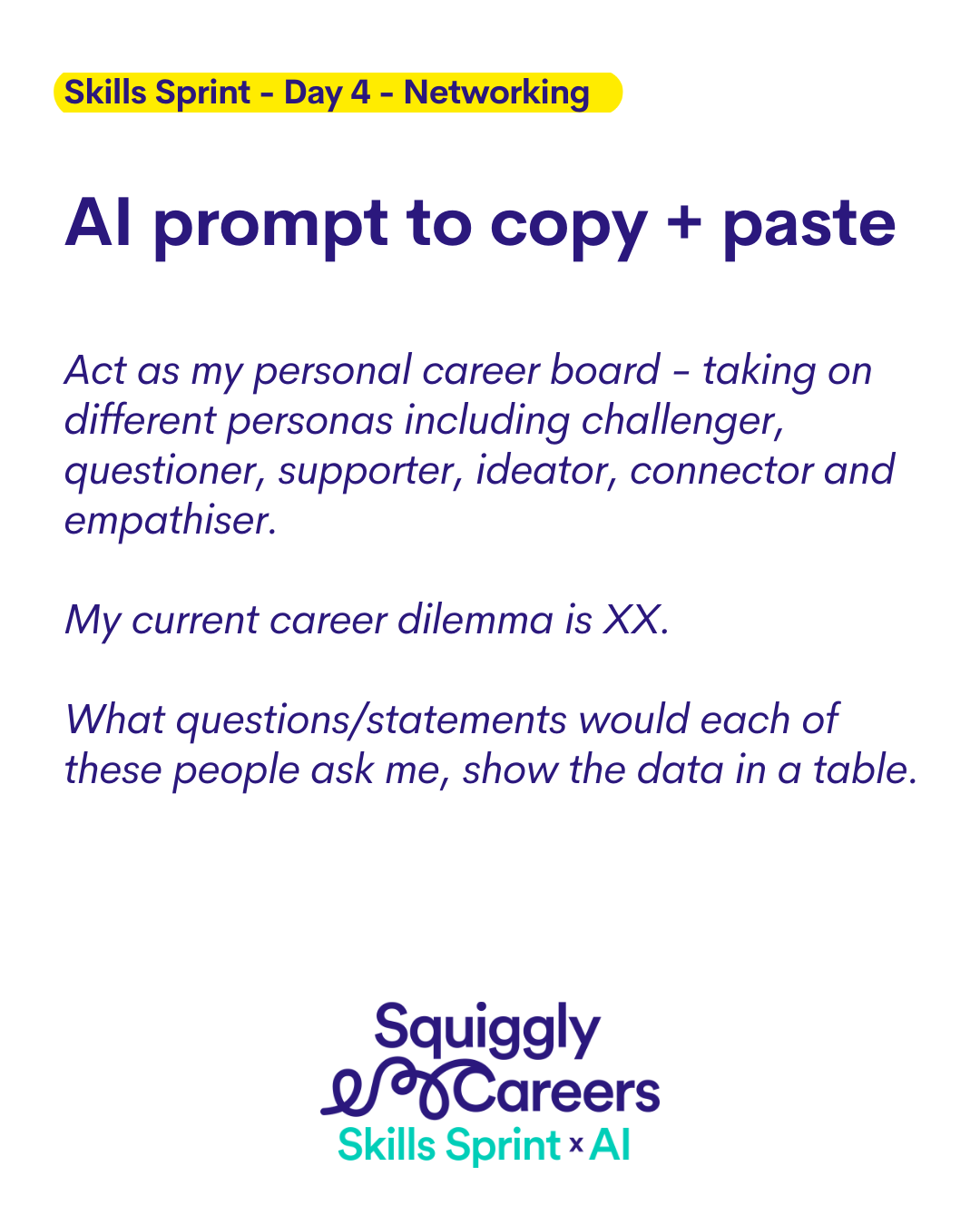
Sarah Ellis: Yeah, that too, we'll come on to that in a second. And also, I think, sometimes finding difference can feel hard to do, you know, people with different perspectives, people with different experiences, maybe someone at the start of their career, maybe you just don't come across that many people just starting out, maybe you don't work with anyone who's got 20 years' more experience than you. So, I think we all benefit from those different perspectives, but sometimes those people can feel quite hard to reach. And this makes it very easy. And so, what we're asking an AI to do here, and I did use ChatGPT and Claude for this one, so I just did it at the same time and both of them worked well in both; I said, "Act as my personal career board. Take on different personas, including challenger, questioner, supporter, ideator, connector, and empathiser. My current career dilemma is how to make sure I'm balancing enough time learning for myself, with spending time supporting other people to learn. What questions or statements would each of these people ask me and show the data in a table?"
Helen Tupper: So, I guess before we get into Sarah's insights and answers, if you're copy and pasting that prompt, the bit that you might want to personalise is the challenge. So, Sarah put the learning challenge in, you put whatever challenge is relevant to you.
Sarah Ellis: And so, you do get a very neat table, I would say, which was which was very helpful. And it gave the personas, and it also categorised the voice and focus. So, for example, "Challenger: direct, bold, high standards. Supporter: encouraging, affirming, emotionally invested". So, actually, it sort of described the roles a bit for me. And if you read any of that voice and focus and thought, "Oh, that's not what I want the focus to be", you could obviously amend it and say, "Have my challenger to have the highest standards of anyone you could imagine, even higher". You can kind of push it in different directions. So, I kind of liked that ability to adapt. And then, it gave me the prompt or the question. And I think here, what's often helpful is, very quickly you've got the range, and then you can dive deeper into what feels useful for you.
So, for example, my challenger asked me, "If you're not learning for yourself, how can you credibly guide others? What are you avoiding?" And I was like, "Oh!"
Helen Tupper: "What are you avoiding?"!
Sarah Ellis: I know, quite confrontational. But for me, really helpful as someone who isn't naturally very confronting in my style. Actually, having that prompt to myself around credibility, that really hit home. And I was like, "Well, it really matters to me to be credible". So, that really worked. The supporter one, "You give so much to others, what would it look like to give that same caring energy to yourself?" I was like, "Don't care".
Helen Tupper: Support dismissed!
Sarah Ellis: Support dismissed.
Helen Tupper: "You can leave my board!"
Sarah Ellis: But I think I just found that less motivating, just less useful.
Helen Tupper: But to some people, that might be the role that they relate to.
Sarah Ellis: Oh, of course, for nice people, I imagine, much nicer people than me. I think, what I've often found when I've tested this tool live with lots of people who learn with us in workshops, is you're often missing -- maybe you've got three or four of these in real life, but maybe there's one or two that you could really do with their perspective but you haven't got them yet. Again, we're not saying replacement for real people. The advantage, I guess, of this is it's immediate and it fills the gaps you've got for now. I still want a challenger, but those questions were really good.
Helen Tupper: Well, what I did was I copied and pasted the prompt that Sarah had said, but I personalised it with my challenge. And then, I said, "I want to have a one-to-one with my questioner". And that for me was this extra level of usefulness, because it was then like I was having a direct conversation. Because you get a list of questions with what Sarah showed, which are really useful. But the one-to-one I felt was just a really helpful discussion, like really, really helpful. And then, I felt I think I would have been much more confident having that conversation with an actual questioner, kind of thought through in advance. And so, we've got one extra tool for you to try out today.
Sarah Ellis: Controversial!
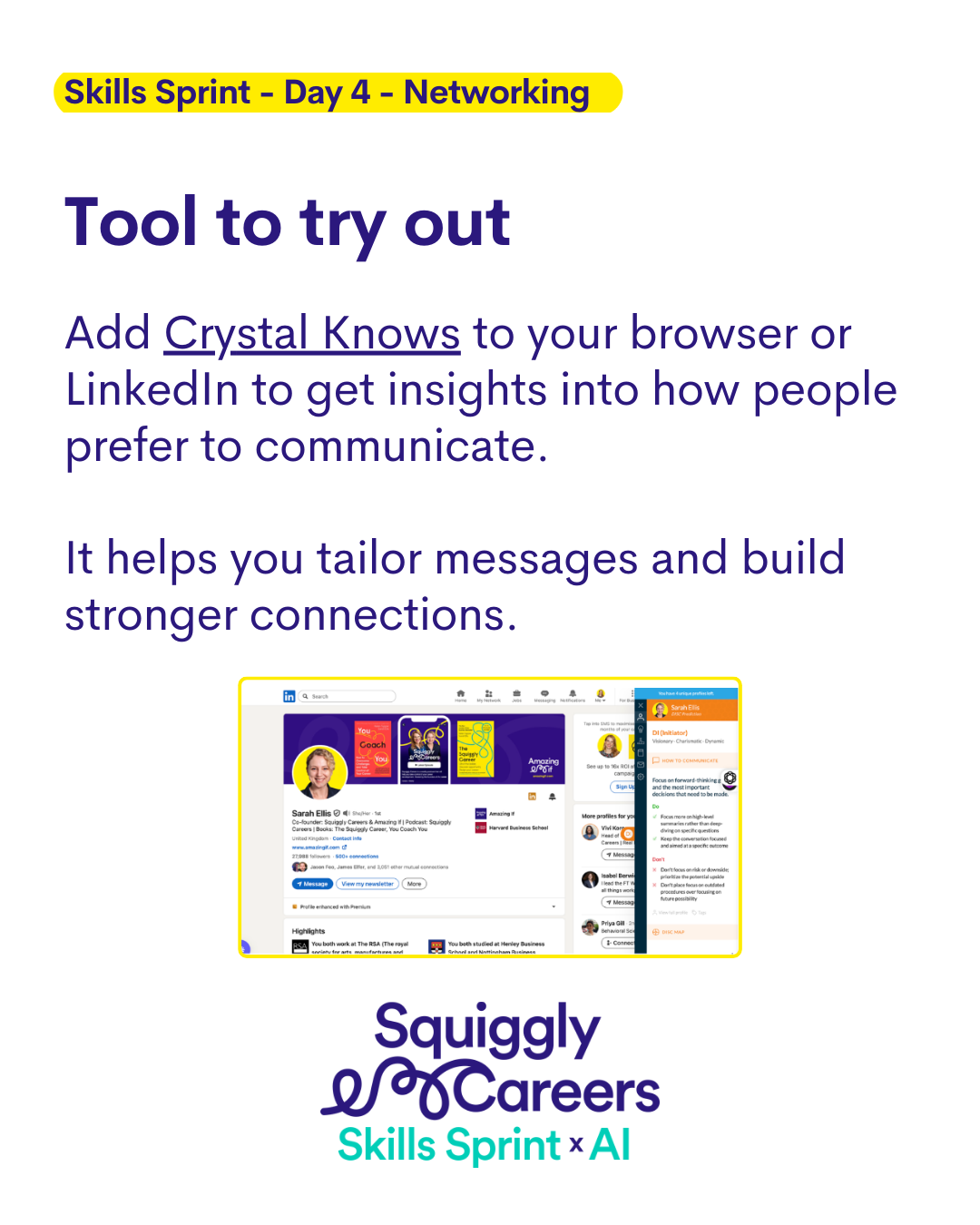
Helen Tupper: Yeah, we're a bit divisive. Sarah doesn't like it, I found it quite useful. So, the tool is called Crystal Knows. And you just go to the website, you will download it, it'll put a little thing on your toolbar. And it has surveys for you, which are kind of interesting. But the thing that is useful in the context of your community is you can attach it to your LinkedIn. And then, when you look atomeone's profile, it will use AI to basically tell you how to communicate with that person, what their likely disk profile is, which is like a personality tool that you can use to profile people, how to email that person. It gives you loads of detail on how to engage with them.
So, I did this with Sarah. I thought, "Who can I test this with?" You get five free goes. I wanted more. Once I'd got in, I was like, "I want to do this on more people". And so, I did it with Sarah. She came out as an initiator, visionary, charismatic and dynamic, just based on her LinkedIn profile. And it gave me do's and don'ts. So, "Focus on high-level summaries". When I was reading this, you were the one that I was like, "Oh, I don't know", because you're so just a bit of everything. AI finds it hard to analyse you.
Sarah Ellis: Well, I guess this is also, it is a bit based on your LinkedIn profile. Well, it's a lot based on that. So, I don't do very much posting on LinkedIn.
Helen Tupper: I mean, there was lots in there. I mean, I do think the visionary, charismatic, dynamic, I mean dynamic's probably debatable.
Sarah Ellis: But to the point of I don't post that much, so it's making some of it up, right? They haven't got that much data to work with.
Helen Tupper: I did it on Adam Grant, because I think we'd like to get Adam Grant on the podcast. I was like, can it give me a few tips on how to engage Adam Grant? So, "Do be expressive, enthusiastic. Get the best response from Adam using this example, 'How would you feel about…'" I was like, maybe try some of those, and I did it on my husband. I thought, "Let's see how true this really is". And actually, I mean it was pretty accurate. I'm not going to read them, but it's useful. You get five goes and I think if I was going for an interview or I was working with a new stakeholder on a project, I mean it's not that helpful for me to do it with you, to be honest. I know you really well. But if there was someone I was working with for the first time that I wanted a bit of insight into to inform how I communicate with them, Crystal Knows is a good tool.
Sarah Ellis: I think my reservations were, I was like, I just don't want people to lose critical thinking.
Helen Tupper: That's true.
Sarah Ellis: And actually, when you and I looked at some of the things for me, some of it, we were like, "Well, that's not right, that's not right, that's not right". So, you have, I think, got to be a bit just, like, always apply your own critical thoughts to things. And also, relationship-building feels like something you still want people to be able to learn. And I was like, "I don't want people to use this as a substitute".
Helen Tupper: Don't outsource it, yeah.
Sarah Ellis: It's like anything, right? Don't outsource your learning and development to an AI or to other people, and don't outsource your ability to build relationships. And I do think, I suppose because I see at the moment, you know you can tell sometimes when things are written by AI? I would hate people to start sending emails to build relationships with people where you're like, "Oh, this is clearly an AI". We get them for people sometimes wanting to come on the podcast, and I'm like, "That's not a person that's written that". So, it's just some watch-outs, don't be a stalker.
Helen Tupper: So, we'll watch-out and caveat, "Don't be a stalker", all the things that Sarah would say as an introverted networker. But if you're thinking, I think just give it a go. Just try it out, see what it tells, see how useful it is for you.
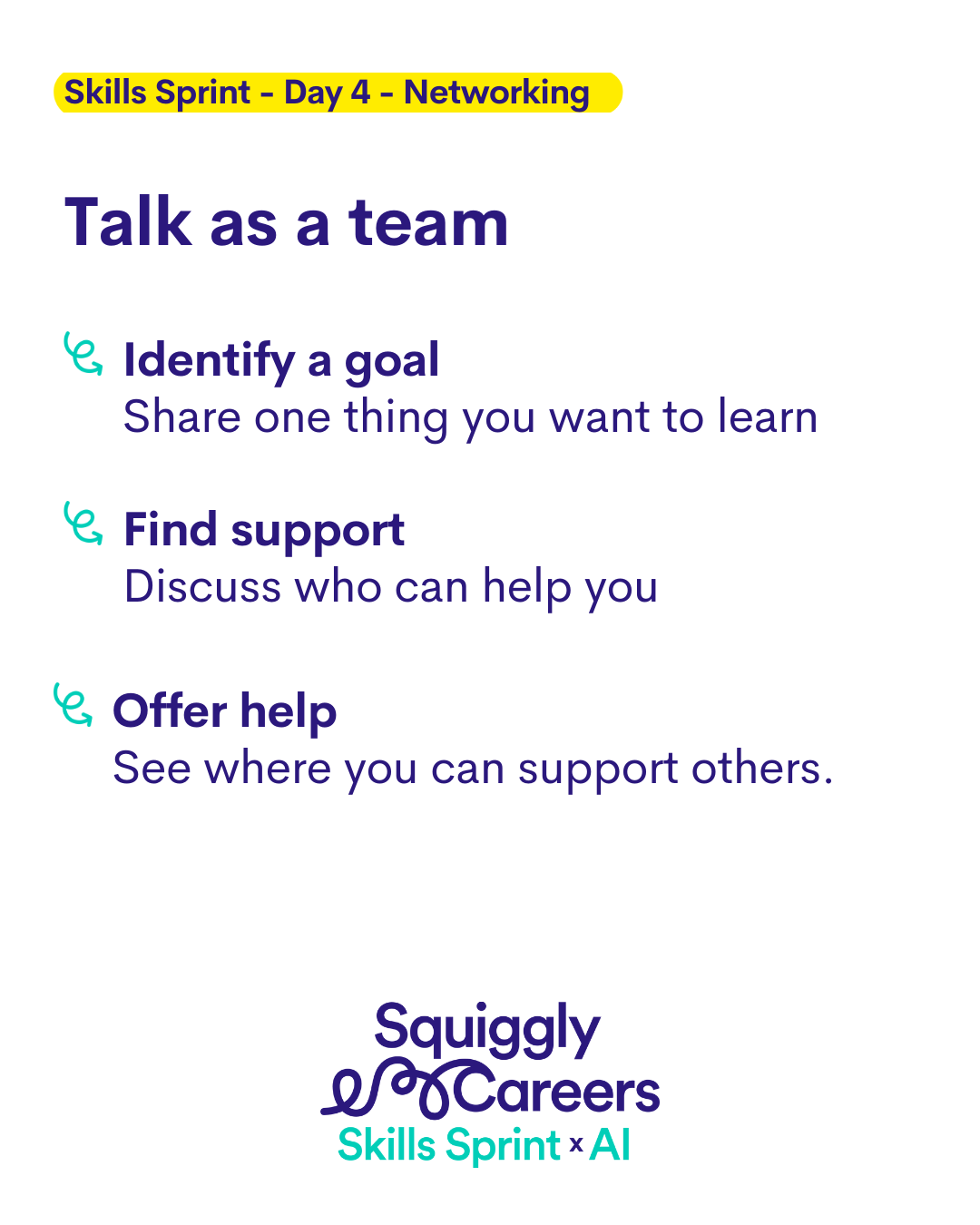
Sarah Ellis: And so, as a team, how can you talk about this together, other than maybe doing each other's LinkedIn profiles? I mean, it definitely makes you think about your LinkedIn profile. That's what it made me think about. So, as a team, one of the things you could do is talk about one thing you want to learn. So, you might say, "One thing I want to learn is how to use AI as part of my every day, or, "One thing I want to learn is what is systems thinking? I hear people talk about it, but I just don't know what it is". "One thing I want to learn is more about being a brilliant leader or more about prioritising or time management". There's some common ones that come up. And then you can have a discussion about, well, then who can help you? And also then, who could you help? I think actually when you start to put your community around your learning, or around your career, based on your development, it's so much easier as a filter. And actually, when I do this often with groups, they'll say, "Oh, I want to learn about…" all of those things I just said, and then I can be helpful. Straightaway, I can be like, "Oh, well, if you're thinking about time, I love Oliver Burtman's work.
But then someone else will chime in and say, "Oh, have you seen that Pomodoro thing that's free? And here's the app, and here's the link". So, everybody starts helping everybody, and you know your point about reciprocity when we started. I just see that happening and I think that's easier if you've got a kind of goal, a learning goal. And it doesn't have to always be learning, but that's just a good place to start.
Helen Tupper: I think that sort of stuff just reframes how networking feels. But that is the end, that is the end of today's day four of the Squiggly Careers Skill Sprint, which means that tomorrow is our final day, and we're going to be talking about how you can use AI to help with your future possibilities.
Sign up to the Squiggly Careers Newsletter and get our latest ideas, tools and inspiration every week - all in one place, straight to your inbox


