
🥇 Sign up for the sprint here: https://bit.ly/41jasYO
This is the third episode of the Squiggly Careers x AI skills sprint series and today Helen and Sarah are tackling Confidence. We all have gremlins – those beliefs, doubts and fears that hold us back in our careers. They’re often hidden and they can grow when we don’t address them. When you learn to cage them, you get better at navigating tough moments and saying yes to opportunities that stretch you.
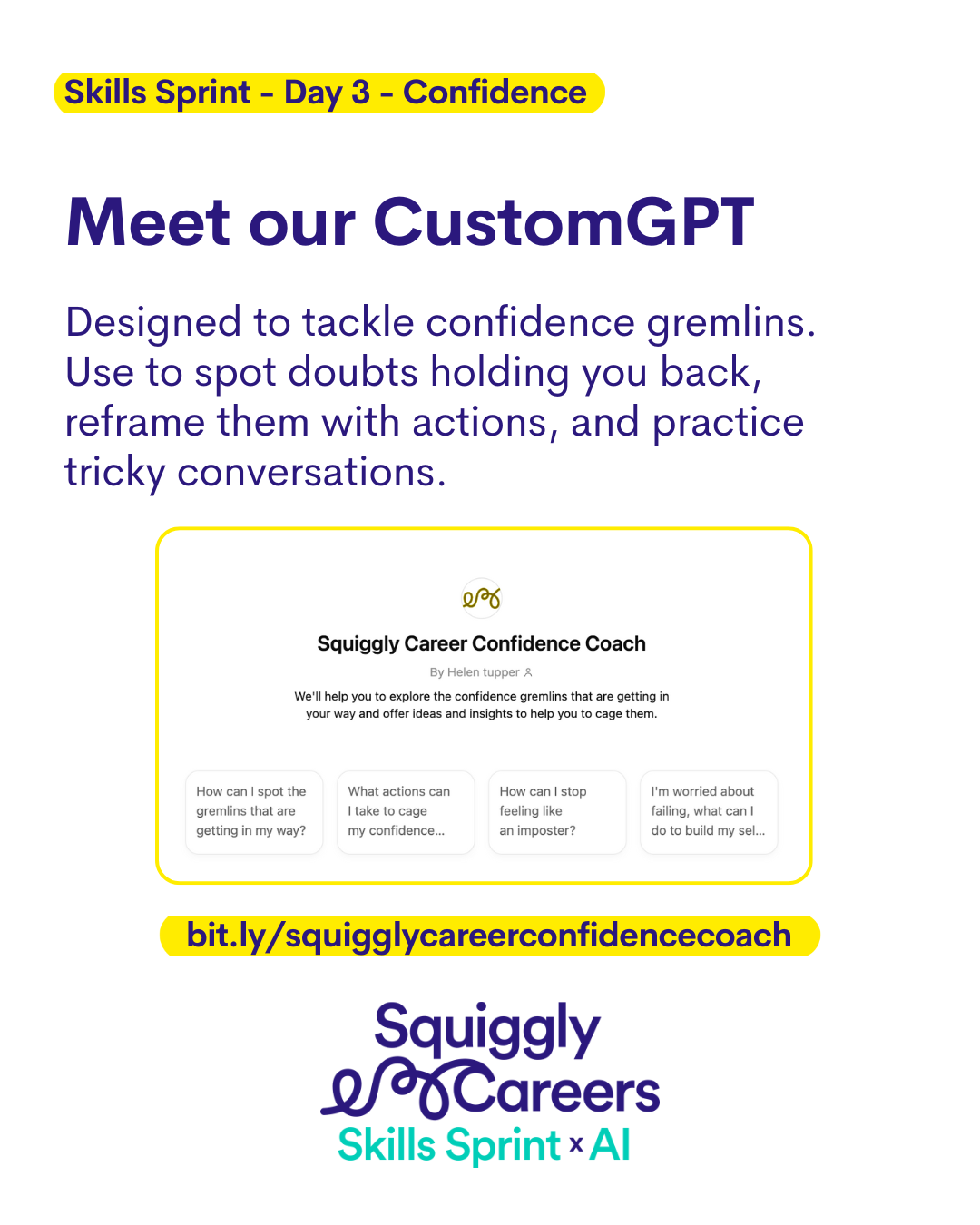
In this episode, Helen and Sarah introduce their brand-new custom Gremlins GPT – a tool they’ve trained with everything they’ve written about confidence. This AI coach helps you identify what gremlins are getting in your way and practice difficult conversations in private. You’ll discover how to create visual representations of your gremlins, role-play challenging scenarios, and build a “confidence gremlin gallery” with your team.
🎯 What You’ll Learn
* How to identify and understand your confidence gremlins
* How to use the custom Gremlins GPT for private confidence coaching
* Tools for role-playing challenging scenarios with AI
* Creative ways to share and discuss gremlins with your team
📚 Resources Mentioned
Confidence Gremlin GPT – https://bit.ly/squigglycareerconfidencecoach
Confidence Daily Summary – https://bit.ly/scss-ai-day3-summary
For questions about Squiggly Careers or to share feedback, please email helenandsarah@squigglycareers.com
Need some more squiggly career support?
1. Download our free careers tools
2. Sign up for our Squiggly Careers Skills Sprint X AI.
3. Sign up for Squiggly Careers in Action, a weekly summary of the latest squiggly career tools
4. Read our books ‘The Squiggly Career’ and ‘You Coach You’

00:00:00: Introduction
00:00:36: All about confidence
00:03:13: A new tool for gremlins
00:04:58: A GremlinGPT example
00:08:56: A tool for teams
00:10:44: Final thoughts
Sarah Ellis: Hi, I'm Sarah.
Helen Tupper: And I'm Helen.
Sarah Ellis: And this is day three of the Squiggly Careers Skills Sprint. And today, we're talking about confidence. Quick reminder, if you don't have the daily skills summary, link in the show notes or just email us helenandsarah@squigglycareers.com. I'm sure loads of you have got it sorted by now, but you might just be starting on confidence, you can start on day three, that's absolutely fine. But you will need those summaries for things like cutting and pasting the prompts, loads of the links to learn from, and all the examples, the kind of visual examples we'll put in there. So, hopefully it will just make the sprint even more useful.
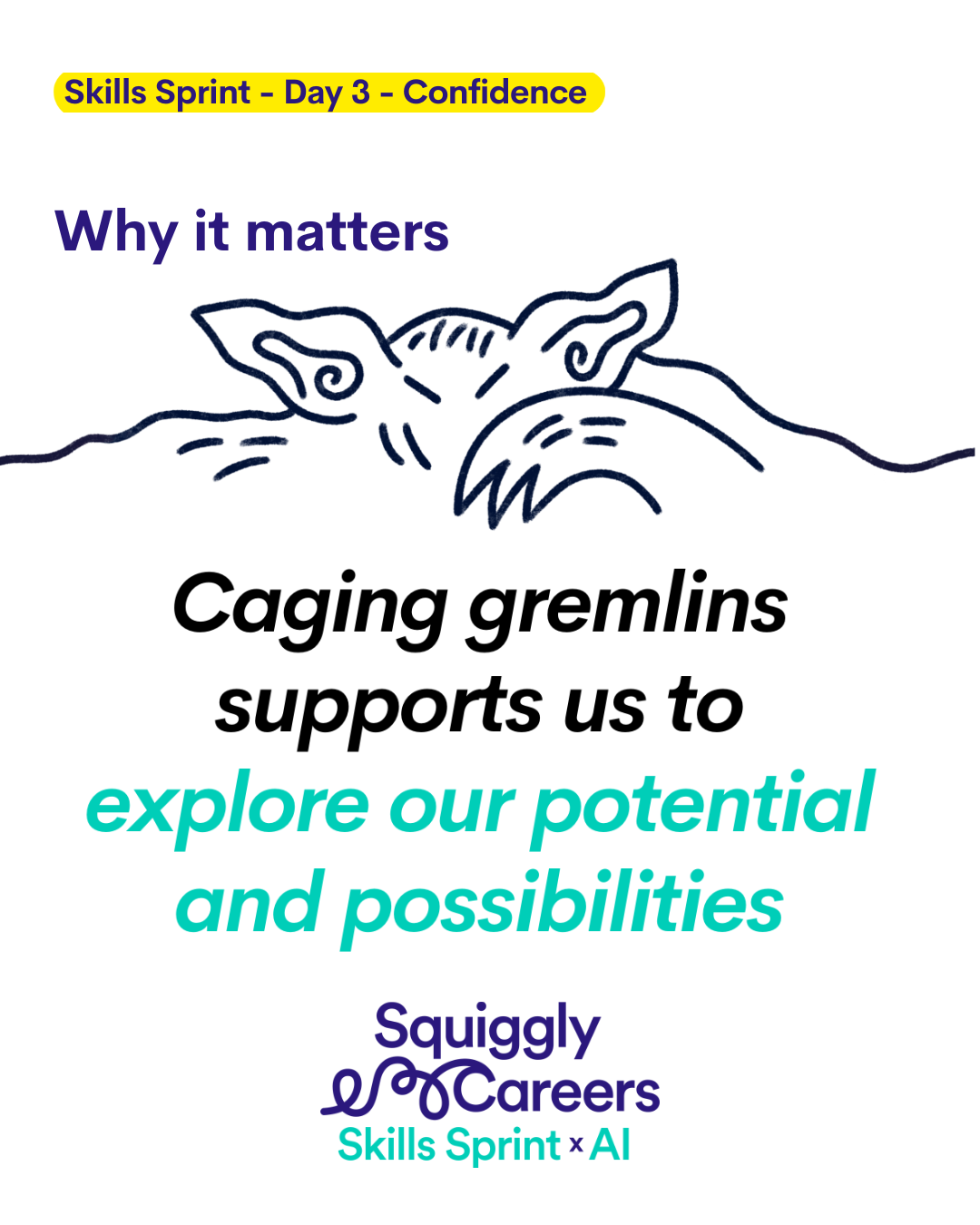
So, confidence. If you are a regular Squiggly Careers listener, you'll know we've talked about confidence before, because we did write a book called Gremlins. So, the way that we think about confidence is belief in yourself and other people believing in you too. And gremlins are those beliefs, doubts and fears that hold you back, the things that get in your way. And I think the problem with these gremlins is that they're often hidden, we don't want to talk about them, and they can kind of grow. They grow because they sort of hide in our brains and like to take over. And at their worst, I think gremlins start to influence our actions, our behaviours, and can even go as far as becoming our identity. And so, if that happens, it sort of stops you in your Squiggly Career. I think it limits your learning, limits your potential. It's sort of how we all get in our own way some of the time.
But when you learn to cage these gremlins, I don't think they ever necessarily go away, I do think they are just a feature of being human and that's okay; but if you cage them, you get better at finding your way through the inevitable knotty moments that we all have in our Squiggly Careers, things that are outside of our control, that go wrong: restructures, a tricky boss, your job changes, you get ridiculously busy. Those kind of tough times, I think our gremlins relish. They're like, "This is my moment", and we're like, "No, you've got to stay caged".
But also, I think if you can cage those gremlins, you can say yes to those things that will feel scary, but they'll stretch you. And they're how we explore and discover potential that perhaps we didn't know we had. I really remember a time in my career where, because I've got a gremlin around numbers, I looked at any job spec that had the words, "Commercial acumen" in, and straight away I was like, "No, I can't", even though I wanted to do that job, even though maybe I could have done the rest of that job, I just ruled myself out before I'd even interviewed or had a conversation, because I was like, back to the identity point, I'm just not good at numbers. And so, I feel like this is one where if you can get those gremlins caged, it's not an easy thing to do, but once you start practising it, and I think it is a bit more of a practice, you just start to sort of, I don't know, I suppose you feel a bit freer, I think, to do the things that you want to do.
Helen Tupper: And we've always tried to make this an easier conversation for people to have together. So, we've written quite a lot about it. We wrote about it in, like both of our books have got a chapter on confidence, we wrote about it in Gremlins. We've always tried to create tools to make it easier. But today we've created a new tool, which we think makes it even easier. And we are really excited for you to play with it and experiment with it. So, we have used the ChatGPT platform, but we've created a custom GremlinsGPT, as in it is something that we have trained with everything that we have written on confidence gremlins. So, when you go in and talk to this ChatGPT about you and your gremlins, it's going to coach you. It's going to coach you to help you see what gremlins are getting in your way, what could I do differently, what actions could I take. And it takes a conversation that might feel uncomfortable to have with a colleague into one that you can have with the AI in private, you can kind of talk to it about it. And I think it can then sort of be the thing that then builds your belief a little bit so you can go and talk to somebody else. I do not think it replaces talking to somebody about your gremlins, I think that is an important part of the process. But if, at the moment, that feels too scary to do, this is a really brilliant place to start.
So, maybe I'll just talk a little bit about how it works, and then Sarah can talk about when she used it, how it worked for her. So, we set it up and it's got a few ready-to-go prompts. If you're thinking, "I don't even know how I'd start", it will ask you a few questions about what gremlins might be getting in your way or what worries are holding you back. So, you can just open it up and click on any of the prompts to help the conversation go, get started. Or, you could say, "A worry that I have at work is I don't feel like I know enough", or, "A worry I have at work is that I feel like I might get found out". So, it depends where you're starting from. Click one of our prompts and it will go for you. Or start with a worry that you've got at work and then it will ask you questions and you just follow it through. So, how did it work for you?
Sarah Ellis: Well, firstly, you know when you were talking there about you're having a conversation with the AI?
Helen Tupper: Yeah.
Sarah Ellis: I think actually what you're doing is having a conversation with us, because I said to you, I was like, "I really like the tone". And you were like, "Of course you do, because it's our tone".
Helen Tupper: It's based on our work.
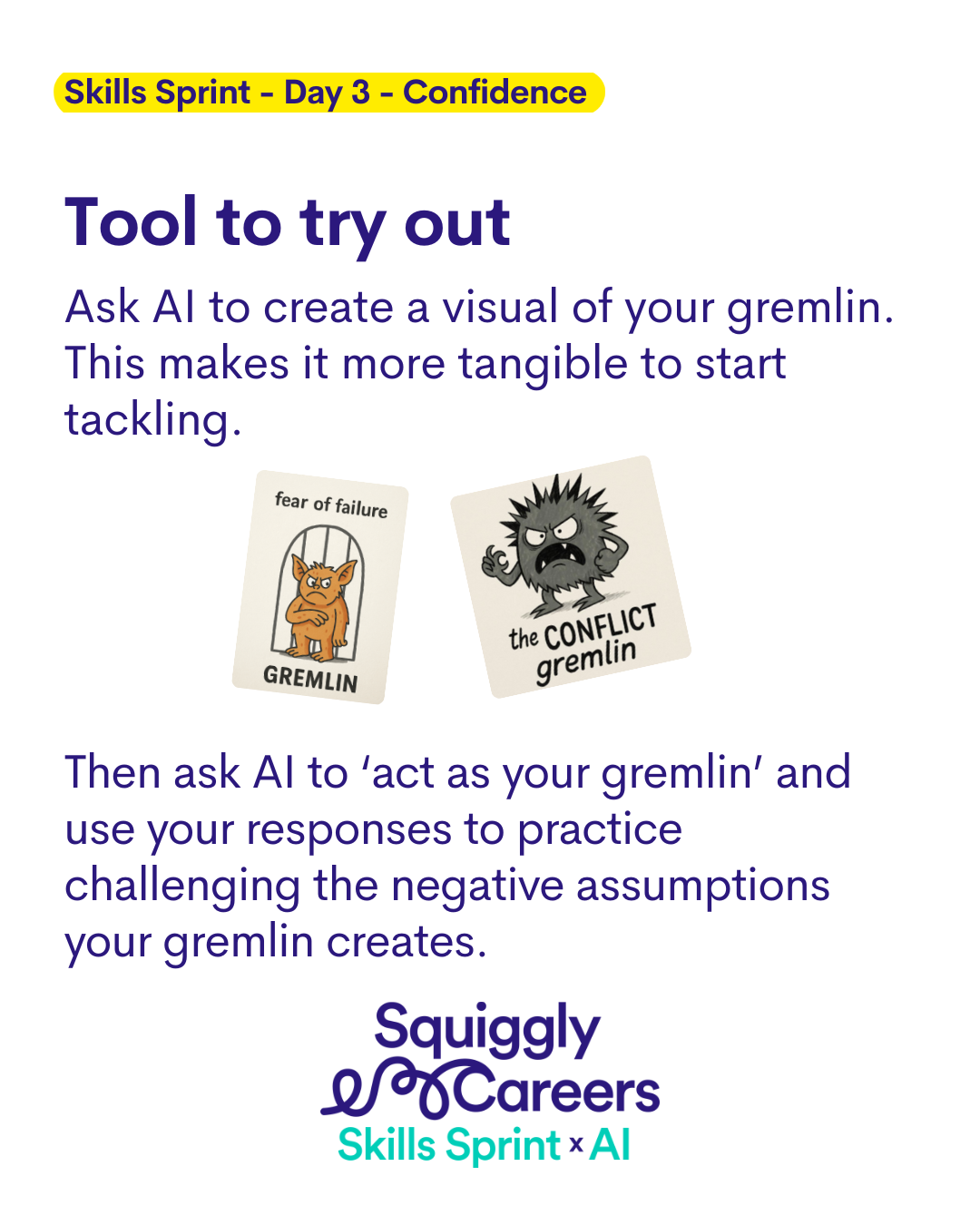
Sarah Ellis: And I was like, I'm so egotistical, I'm like, "I really liked the way that it phrased things", and you were like, "Well, yes, because it's our setup"! So actually, what I think you are having a conversation with is us. And actually, we'd love your feedback. So, when you have a play with it, by you all trying it out, you will make it smarter for us so we can be more useful. The thing that stood out for me was I loved the idea that as you go through, you can create your own visual of the gremlins. And we often say by bringing them to life, it just makes them loads less scary. Actually, I did it twice and the first time it said, "Would you like me to create a visual of your gremlin?" and then it asked me some really good questions like, "So, what colour do you see your gremlin as?" almost, "What shape?" And it just gave me some -- because I think maybe if it had just said, "Do you want a visual? What do you want it to look like?" I'd be like, "Well, I'm not really sure". But it gave me these quite specific prompts.
Then, the second time I did it, it didn't ask me for that. I don't know why, what the difference was. So, I just asked it to create a visual. And it's quite fun, just seeing the things that are actually quite big, often, self-doubts you have about yourself suddenly turned into something visual.
Helen Tupper: Yeah. Well, it's kind of playful, this thing that's can feel like a lot of pressure. We will put, because both of us got visuals, we'll put them in the summary so that you can see what they look like.
Sarah Ellis: And then, we were talking about what else might we do with it, and prompts that you could then come up with for yourself. So, once you've done the initial playing around, then I was like, "What happens if you asked the AI to act as your gremlin?" So, it works well as a prompt, to ask an AI to act or take on a role. So, I was like, "Well, it can just be your gremlin". And that works really well.
Helen Tupper: I love this. This is fun.
Sarah Ellis: And I think particularly here, you can ask your gremlin to respond in maybe a situation that you find hard where your gremlin often grows. So, sometimes I think our gremlin grows because of certain people or in certain places, or just based on our past experiences. So, for me, I've got a gremlin of conflict. And actually, some of the time that gremlin doesn't show up. So, when you and I disagree, it's fine. I'm very used to that, and it's not like a universal gremlin. For most of us, I think there are specific situations. So, I find it hard if I'm not expecting the disagreement, and actually even if that was with you, even if it's with someone I know really well. Say I thought we were both going to agree about something, and then actually you surprise me. I'm like, that always takes me a moment. Or if someone is very direct, so just has maybe a very different style to me. So, I just said like, "Act as my conflict gremlin. What do I do when I'm surprised by someone disagreeing with the idea of Squiggly Careers in a meeting?"
Helen Tupper: Nice!
Sarah Ellis: I'm like, "Well, that could happen".
Helen Tupper: Could be a thing.
Sarah Ellis: And that's valid, right? But I think my instinct there would be to be like, "Oh, I'd become more introverted and I stop talking or maybe I panic, but also it's something I really care about". And that works really well, because I mean the gremlin gets quite aggressive at you, but essentially it sounds like the inner monologue that's in your mind. That's the chatter, right? But then you start to fight back. Well maybe not everyone uses the word fight, but I did. And you've sort of found the same. You sort of go, "Well, no".
Helen Tupper: "No, gremlin, no".
Sarah Ellis: "I don't want that chatter, I don't want the unhelpful chatter, I actually want to replace that with something more useful".
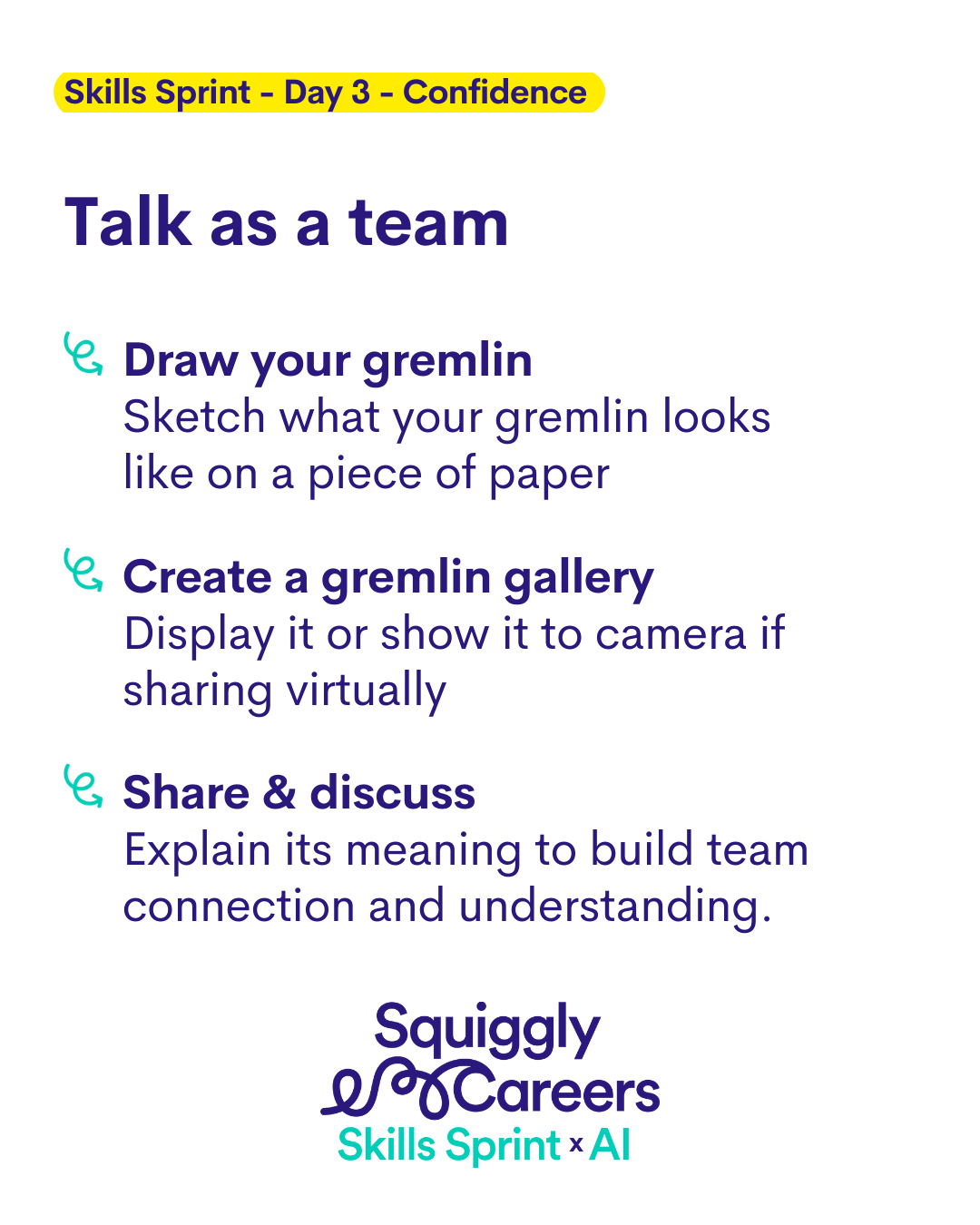
Helen Tupper: I think it's the most unique way we have found to help people both know what their gremlins are, and then get to grips with them in a really safe way. And if you've got the free version of ChatGPT, it might limit you at some point with how many questions you ask, but you can maybe go again the next day. If you've got a paid version, you can kind of just keep going. But just be aware of that when you're playing with it, but definitely, definitely give it a go. And then, after you've done that on your own, because I think this is a really useful thing to do on your own, we would like you, as we said, to talk about this with other people. So, we've got a good idea for how you could do this together as a team. And this is something that we've done, like, all over the world we've done this exercise, which is to create a confidence gremlin gallery. You can do this if you've got a virtual team, you can do it if your team's together in person, but you just grab a bit of paper, or a Post-it Note is often what we use, we're probably known for these giant Post-it Notes that we use. And you just draw your gremlin out, so what does it look like to you. You put it on a wall, or if you are virtual, you just hold it up to the camera, and then you just talk about it.
Because it's a little bit playful, like, most of the drawings are a bit crazy, you're like, "What does that mean?" you start to create connection, understanding and a bit of empathy. And connection, understanding and empathy, oh my gosh, they are the ingredients we need so that we can all tackle our gremlins together. If any of you do that, please send us pictures of your gremlin, helenandsarah@squigglycareers.com. We would love to see your drawings. If you do it together as a team, send us your gallery. It makes us really happy to see those confidence gremlins getting a bit exposed.
Sarah Ellis: And an obvious point, but you could even use the gremlins that have been generated from using the tool.
Helen Tupper: You could.
Sarah Ellis: So, if you don't want to do the giant yellow Post-it Note thing. Because actually, everybody on our team tested this. And so, everyone in the team, just in our team's chat, just started to share their visuals. And actually, that was really fun, it prompted loads of conversation. And I think the outcome from this is you just feel really reassured that you're not alone, everybody has gremlins, we're all working hard to cage them. And then, you also just start to think about, well, how can you be supportive for each other?
Helen Tupper: I think 10,000 people on this sprint, 10,000 people caging their confidence gremlins. I mean, that's a win.
Sarah Ellis: Squiggly Careers have got to be better because of it.
Helen Tupper: Yes, oh it's exciting. So, that is the end of day three of our sprint. So, so far, we've done strengths, we've done values, we've done confidence, and tomorrow we're going to be talking about networks and building your career community.
Sarah Ellis: So, see you then.
Sign up to the Squiggly Careers Newsletter and get our latest ideas, tools and inspiration every week - all in one place, straight to your inbox


