This week on the Squiggly Careers podcast, Sarah and Helen borrow brilliance from Vanessa Urch Druskat’s research on team emotional intelligence, first featured in Harvard Business Review.
While emotional intelligence is often talked about at an individual level, this episode explores what happens when you apply it to teams — and how emotional awareness can build motivation, trust, and high performance together.
Sarah shares how she used AI (Claude) to turn Druskat’s research into a practical team emotional intelligence quiz, helping teams assess their habits and find simple ways to improve.
🎯 What You’ll Learn
📚 Resources Mentioned
For questions about Squiggly Careers or to share feedback, please email: helenandsarah@squigglycareers.com
Need some more squiggly career support?
1. Download our free careers tools
2. Sign up for our Squiggly Careers Skills Sprint X AI.
3. Sign up for Squiggly Careers in Action, a weekly summary of the latest squiggly career tools
4. Pre-order our new book Learn Like a Lobster
00:00:00: Introduction
00:00:56: Vanessa Urch Druskat
00:01:34: AI explains team emotional intelligence
00:03:35: A team quiz and score comparison
00:07:45: The three categories…
00:08:46: ... 1: understanding each other better
00:10:49: Challenge and build
00:15:37: ... 2: assessing strengths and opportunities
00:20:28: Scenario planning
00:25:09: ... 3: build relationships with stakeholders
00:27:49: The flywheel concept
00:33:33: Mapping and mattering
00:35:07: Frequency of team reassessment
00:37:36: Final thoughts
Helen Tupper: Hi, I'm Helen.
Sarah Ellis: And I'm Sarah.
Helen Tupper: And this is the Squiggly Careers podcast, where each week, we take something that sparked our curiosity and turn it into some ideas for action for your Squiggly Career. So far, we've talked about how maps can be useful for your career.
Sarah Ellis: We did. That was one of our weirder weeks.
Helen Tupper: We've talked about a Nobel Peace-winning scientist, we've talked about Richard Feynman, we've done various different topics and we are trying to make those as useful as possible for you. And it is Sarah's turn today to spark our curiosity for our Squiggly Careers. What are we going to be talking about?
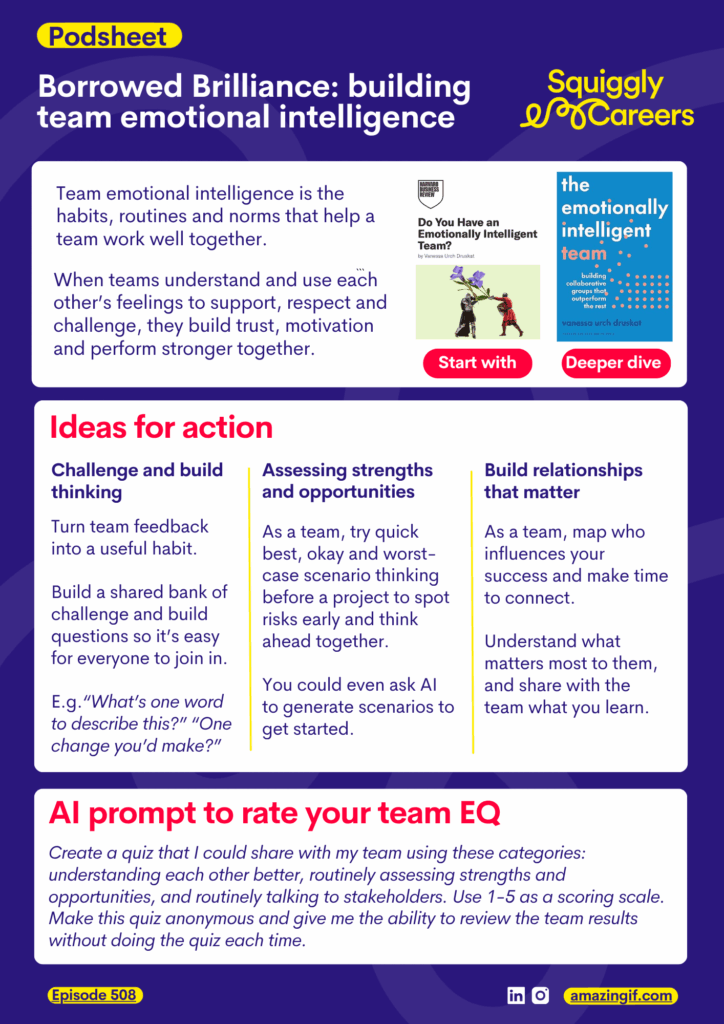
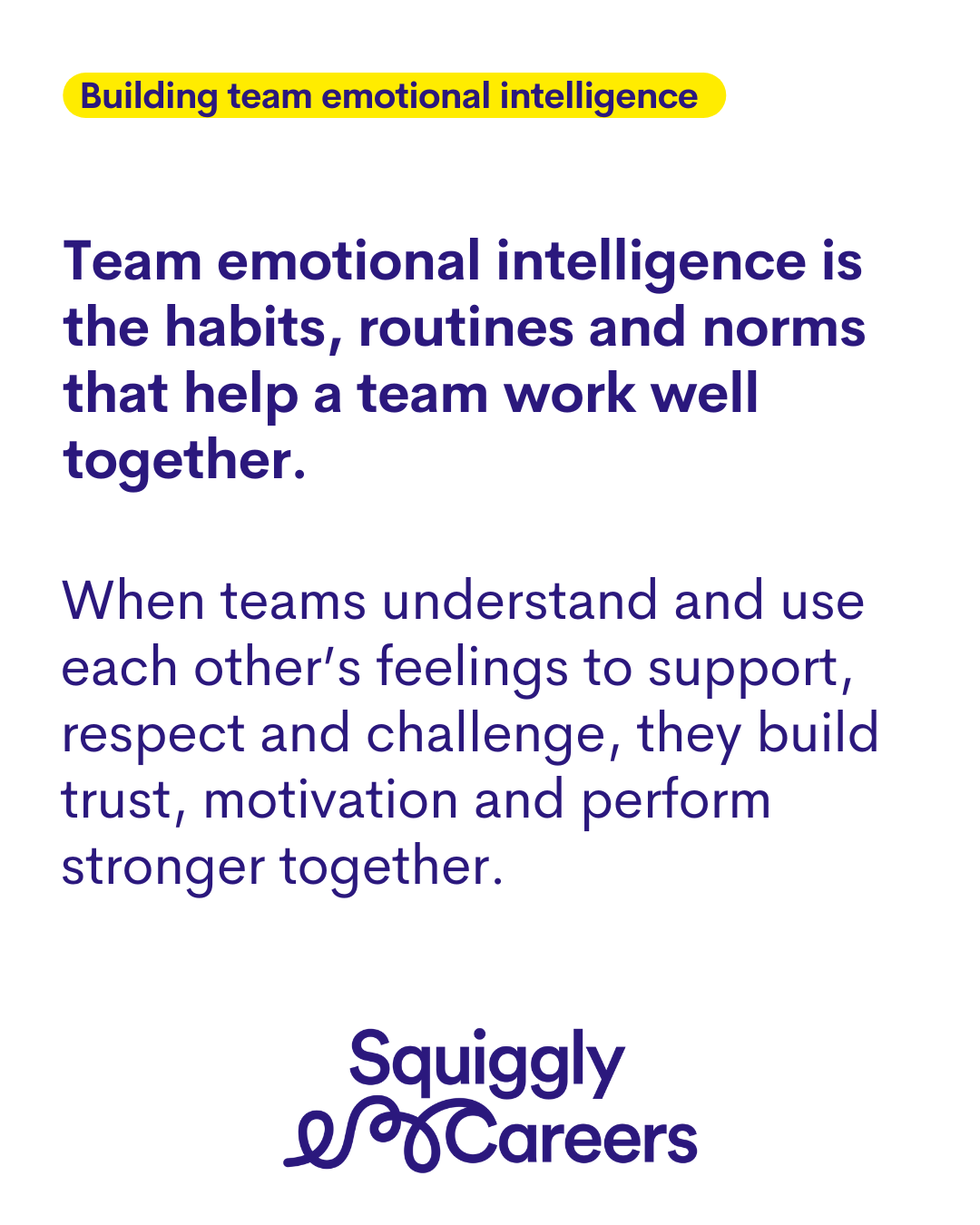
Sarah Ellis: So, today we're going to be talking about team emotional intelligence. So, lots of you might have come across emotional intelligence before, and I had, I'd read Daniel Goleman's work. And I think often, it's something that is talked about in organisations, but I'd not seen the concept applied to teams before. So, that sparked my interest. And there's a lady called Vanessa Urch Druskat, I hope I'm pronouncing that broadly right, who's written an article on Harvard Business Review, which obviously we'll link to for everybody in the show notes. So, that was my starting point for borrowing some brilliance, but I did go quite ambitious this week and I have used a lot of AI to help us, and I've created a quiz, which got very exciting. So, what is team emotional intelligence? So, it's about the habits, routines and norms that you have as a team, and whether those habits are helping you to be a high performing team. And so, I started off by asking Claude to explain team emotional intelligence to me in a way an 8-year-old would understand, and in a single sentence. I'd really recommend that as a prompt. It's a really useful prompt. I actually used it in a workshop the other day, but rather than asking AI, I asked my group, and they all actually did a really good job.
So, Claude said, "Team emotional intelligence is when a group of people working together are good at understanding everyone's feelings, and using that understanding to help each other and work better as a team".
Helen Tupper: It's sort of, you know we talk about often with our work, this combination of awareness and action. And so, it's awareness of the people in the team, how they're feeling, what they're bringing, and then doing something with that awareness. I think sometimes, you get some people that are good at one or the other. For example, you're like super-high awareness, I feel like you're always quite tuned into individuals. And you'll often call me on that and be like, "Oh, Helen, that happened in that meeting and I think you might have missed it". Whereas I'm very just naturally action-oriented. But I guess what we're looking for is this, with emotional intelligence, maybe it's creating more of the awareness and the action across the team.
Sarah Ellis: Yeah, I think that's spot on. And I suppose the payoff or the reason to care is sort of an individual reason to care and then a collective reason. So, from certainly her research, it finds that when you've got emotionally intelligent teams, everyone's just more motivated, because that makes sense, right, because you're all understanding each other and you're also performing better together. So, the kind of simple 'why' I think here is the whole being bigger than the sum of the parts. And her point is that the emphasis shifts from individual performers, like individually are we all performing really well, to actually collectively are we performing really well. So, that's kind of like all of us is bigger than any one of us. That's the sentiment. There is definitely crossover. When I've been reading the work and diving in, definitely crossover psychological safety.
Helen Tupper: It's so funny, your brain is exactly where -- I've gone, "Oh, hang on a minute, because don't we talk about high-trust teams equals high-performing teams?" So, how does it work with that one?
Sarah Ellis: Yeah, and so, there was quite a lot of similarities. What I particularly liked about this though is, so I read the HBR article and I thought, "Right, what could I do with this? How could I start to make this useful for me if I'm going to borrow some brilliance?" And I've challenged myself to then use Claude, my current favourite GPT, which people will know if they've done the Skills Sprint, that that's my current favourite, to try and create some sort of analysis for our team. And actually, the article really helps you to do that. So, the prompts that I used were, "Create a quiz that I could share with my team using these categories", I'll talk about the categories in a moment. "Use this for a scoring scale", and actually, there's one suggested in the article, so I just used that. I was like, "Let's be consistent with that", so it's just like a one-to-five scale. "Make the quiz anonymous", because I thought some of the questions, people might just feel more comfortable if it's anonymous. And then, "Give me the ability to view the team results without redoing the quiz each time".
Now, I will say I had mixed success. So, firstly, I was like, "I've done it, it worked". I didn't do all of these prompts at once, which would have been better. So, I think I iterated as I went, like I built it and then I was like, "Oh, no, I've forgotten this part". So, then I was like, "Can you now redo the quiz with this added in? Can you now redo the quiz again with this added in?" And so, I think I've got about 75% of the way there with this. It definitely works individually. I've been able to do it, you've been able to do it. I haven't quite got the aggregate view working in the way that I would like it to, but I think I'm really close. And actually, it was a really good experiment.
Helen Tupper: I was very impressed.
Sarah Ellis: Thank you.
Helen Tupper: Sarah sent me the link, she's like, "Can you fill this in so we've got some insight for the podcast?" and I went on and I was like, "Have you created this?"
Sarah Ellis: "Yes, I have"!
Helen Tupper: We would normally use Typeform for, I think, anonymous surveys, and it's a great platform, but it does take a little bit of knowing it and building it; whereas actually, I thought yours looked really good and it worked really well, so definitely one to give a go.
Sarah Ellis: But it's quite a good way of borrowing brilliance, right? You know when you're taking something and then you're trying to make it your own. You know the, "What does it mean for me?" question?
Helen Tupper: Yeah.
Sarah Ellis: It helped me quite quickly to go, "What does this mean for me?" And because it's team emotional intelligence, "What does this mean for us in terms of our team emotional intelligence?" So, we both did it independently. And the three categories are understanding each other better, routinely assessing strengths and opportunities, and routinely talking to stakeholders. And then, as we go into some ideas later, we'll go into the descriptions of each of those a bit more, because they are really important, those descriptions. And then there are questions under each of those. But I thought we'd start with comparing our scores. So, you get an overall score out of 5. Mine was 3.19 out of 5. And actually, the scores went down for each of them. So, I was just over 4 for understanding each other better, 3.3 for the strengths and opportunities, and 2 for routinely talking to stakeholders.
Helen Tupper: I mean I have questions on the three areas and how they create emotionally intelligent teams. But I'm going to hold it until we go through each one. But I'm just going to put out there that routinely talking to stakeholders would not be one of the things that I would think made you an emotionally intelligent team, but I'm curious to learn a little bit more about why that's in the mix. But our scores on Sarah's survey, that she created from reading the article, are actually pretty similar. Mine's slightly more positive, which we decided was quite standard. But it's basically the same. So, I think Sarah got 3.19 out of 5 for how emotionally intelligent she thought our team was, and I got 3.39. And actually, for each category, they were in the same order in terms of how we rated them. So, yeah, we're not too far away.
Sarah Ellis: So, now I think what you can do is go from the 'what', so, "What is team emotional intelligence?" to the 'so what', so we're like, "So, what does that mean for us as a team?" That's kind of what we've done with that quick analysis to get us started. Then you're into the 'now what', "Now, what do we do with that data?" Because you've got the current state, but then you've got to think about, "Well, what do we do with that data? How do we make that data useful? How do we turn those insights into action?" So, we're going to go through each of those three areas. I'm going to describe it in a bit more detail, so you will get a feel for what's under that category, because I do think some of it is surprising. And I'd made some assumptions about what would be in some categories that actually wasn't right, so it's worth understanding those. And then, the way that I've turned this into action is I've just used 'what worked well' and 'even better if'. So, I've kind of gone, "Well, what's working well in our team at the moment that's helping us to be an emotionally intelligent team?" And, "If I was coming up with one 'even better if', what could we try?" So, that's the structure.
So, understanding each other better, the one we both gave the highest score to. So, this is all about understanding each other's needs. You know the talents and skills of people in the team. Again, link to psychological safety where you know about people's strengths, there's definitely that sense. People feel like they're treated with respect, you give each other feedback that helps members learn and grow. So, feedback is in there, which I think for some teams would put the scores down. You know, there'll be a specific question around feedback; hard to get feedback flowing in teams. And so, my reflection on this one was, "What's working well for us at the moment?" I think we're particularly good at strength-spotting. We even did a 'brilliant because' exercise at our recent Squiggly Staycation. We're doing work on things like job-crafting at the moment, so that's about working with people's talents and skills to make sure we're using those. And generally, I think people are very connected in our team. When we talk to people in our team about what matters most to them about work, they use that word 'connection' a lot. I think we might have shared that before. I didn't use that word, but everybody else does. So, everyone else is very kind of connected, very collaborative. Would you have any other observations, Helen, on what's working well?
Helen Tupper: I think people individually support each other as well. I think I see that in our team a lot. So, we have this kind of a collective, we come together as a team and it all feels very connected. But actually, I'm really proud when I hear about, "Oh, I went round to somebody's house and we worked on this together", or, "We met in a coffee shop halfway and we did this", because we have a remote team. I think that's a particularly nice way that people are understanding each other and demonstrating it in a remote environment, where they're not just sitting next to each other in an office all day.
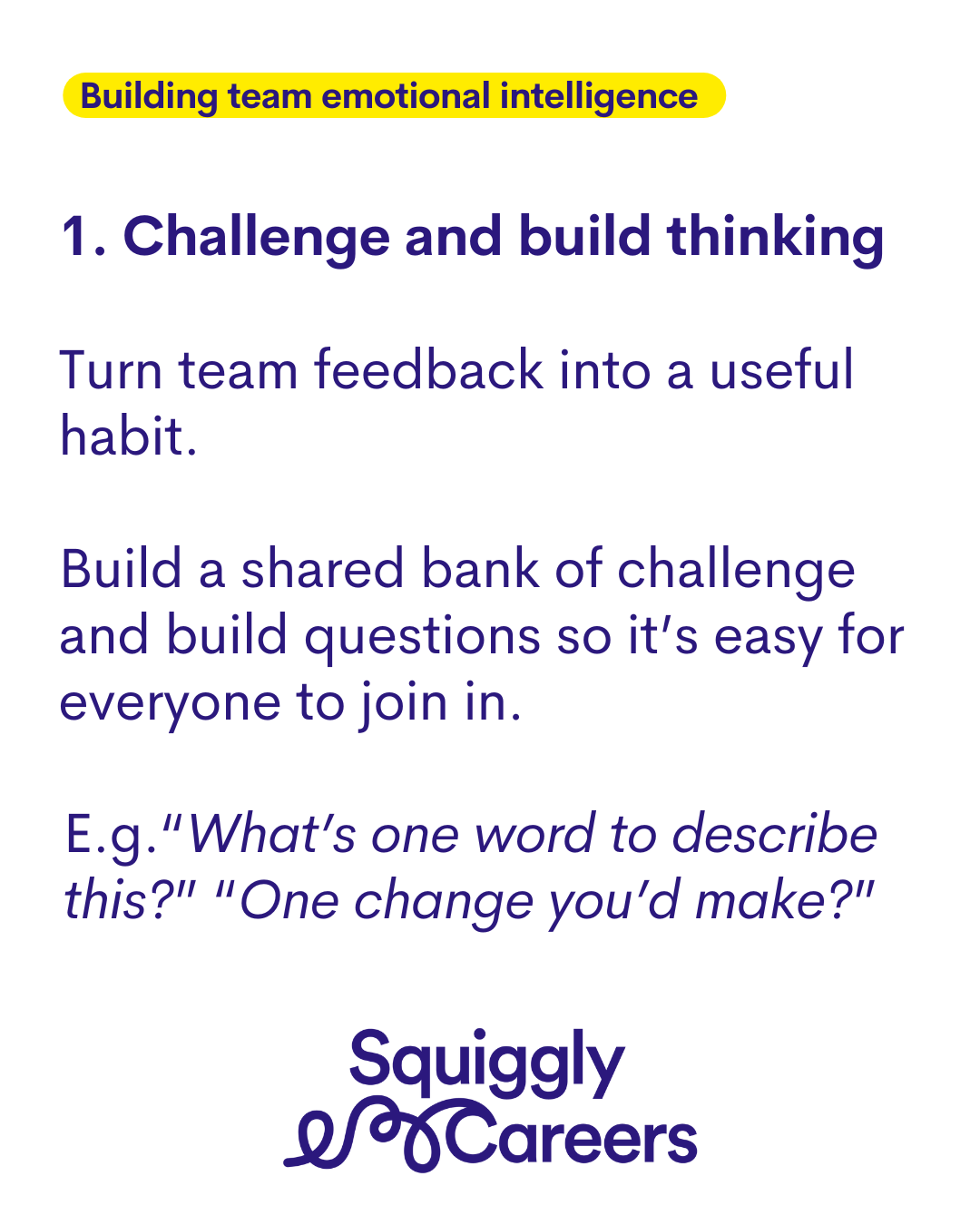
Sarah Ellis: And I think part of the respect, I was also thinking, people do their best to support and respect everybody's priorities, and people are not very judgmental and everyone's got different things they care about or different ways of working. Because everyone on our team works so differently, I think we do generally have that sense of, well, how one person works is going to be different to somebody else. So, I think that means there's just naturally a lot of respect. So, the 'even better if' suggestion that I came up with was challenge and build. So, challenge and build is a way of giving feedback maybe on some of the things that might be harder to hear, or where you want to give feedback to really improve something. And the reason that I chose this is we don't use this idea very often in Amazing If, but I have used it lots recently in a workshop.
So, we shared our PodSheets in a workshop with one of our big learning partners, and I just asked everybody in those workshops, and we've done lots of them with thousands and thousands of people, so it's quite a brave thing to do, but actually it ended up being very fun. So, I showed a PodSheet and I said, Right, we're going to do a challenge and build. What's one word you would use to describe that PodSheet? And what's one change you would make to the PodSheet?" and asked those two things. So, really simple questions to do a challenge and build. And if I hadn't done that, I think the PodSheet would be exactly the same today as it was two months ago. But by doing that, I really quickly got from those groups, okay, the PodSheet actually does feel overwhelming. There are too many words on there. We're trying to be useful, but actually in our attempts to be useful, we've probably just got a bit overwhelming for people.
Then, people were suggesting really useful changes, just like a few more headers, a bit more white space, can you make it more visual? And some people then started from scratch and came up with completely different ideas. But it was just such a quick way of getting feedback on something that is really easy, we could have just kept doing in the same way. So, I think I've already seen that work really well. Funnily enough, it's one of our ideas that then has worked better elsewhere than it has internally for us. And I think sometimes, that's because we rely on, like a meeting, "Oh, we must do a challenge-and-build meeting", whereas I was starting to think about the whole point of team emotional intelligence is it has to feel like a routine or a ritual. So, it can't be something you've got to remember.
Helen Tupper: So, I guess it's when things become language.
Sarah Ellis: Yes.
Helen Tupper: You know, If I'm in a meeting that was already in the diary and I said, "Actually, if you've got five minutes, can we just do a quick challenge and build on this?" And so, when it becomes less of a task, you have to remember to do a more just language that -- so, we talk about, I don't know, like borrowed brilliance, for example, has become part of our language; 'what worked well', 'even better if' has become part of our language; mistake moments has become part of our language. And I think I think when some of these activities, the team identifies with them, I guess that's when it becomes part of what makes the team emotionally intelligent. Yeah, and I think maybe what would make this easier, so my observation from doing a lot of challenge and build with these groups who don't know us that well, is having a few questions as a frame was a really helpful starting point.
So, if you just said, "Let's just challenge and build on this proposal", everyone goes in different directions. Whereas actually, if you are the person instigating the challenge and build, if you do what I did, which is kind of going, "Right, well, what's one word that would sum it up? What's one change that you would make? What's one thing you would do differently?" if you come up with those questions, or even if you had a set of questions as a team, like challenge-and-build questions to choose from, it could be a longer list and just choose some, you could ask AI to come up with some challenge-and-build questions, I wonder if that helps everyone to get started. Because maybe otherwise, it just feels, I don't know, a bit too vague or it could be a bit unwieldy.
Helen Tupper: So, can I just recap for a moment, because I just want to make sure I'm following it and everyone's like, "Oh, how could I do what Sarah has done for my team?" So, the first thing is that you can read the article, you don't need to, but there is a broader thing about taking articles and turning it into something that you can relate to by creating a survey, like you've done. So, people could create the survey. But essentially, the survey is a way for you to rate your team's emotional intelligence across three areas. And one of the ones is the one that we just talked about, so understanding each other better. And so, you get a starter score. And ideally, that should be a team's view. So, it's not just my view of how the team's performing, it's the team's view. And then, as a team, because again, I'm conscious this is just you and me talking about 'what worked well', 'even better if'; ideally it's a team conversation, "What do we think we do well?" If that's the definition of understanding each other better, what do we do well, which is your point about strengths, for example, and what's at least one thing that we think we could do even better.
So, your framing there was challenge and build, but adding that into things that are already happening, rather than it being another meeting.
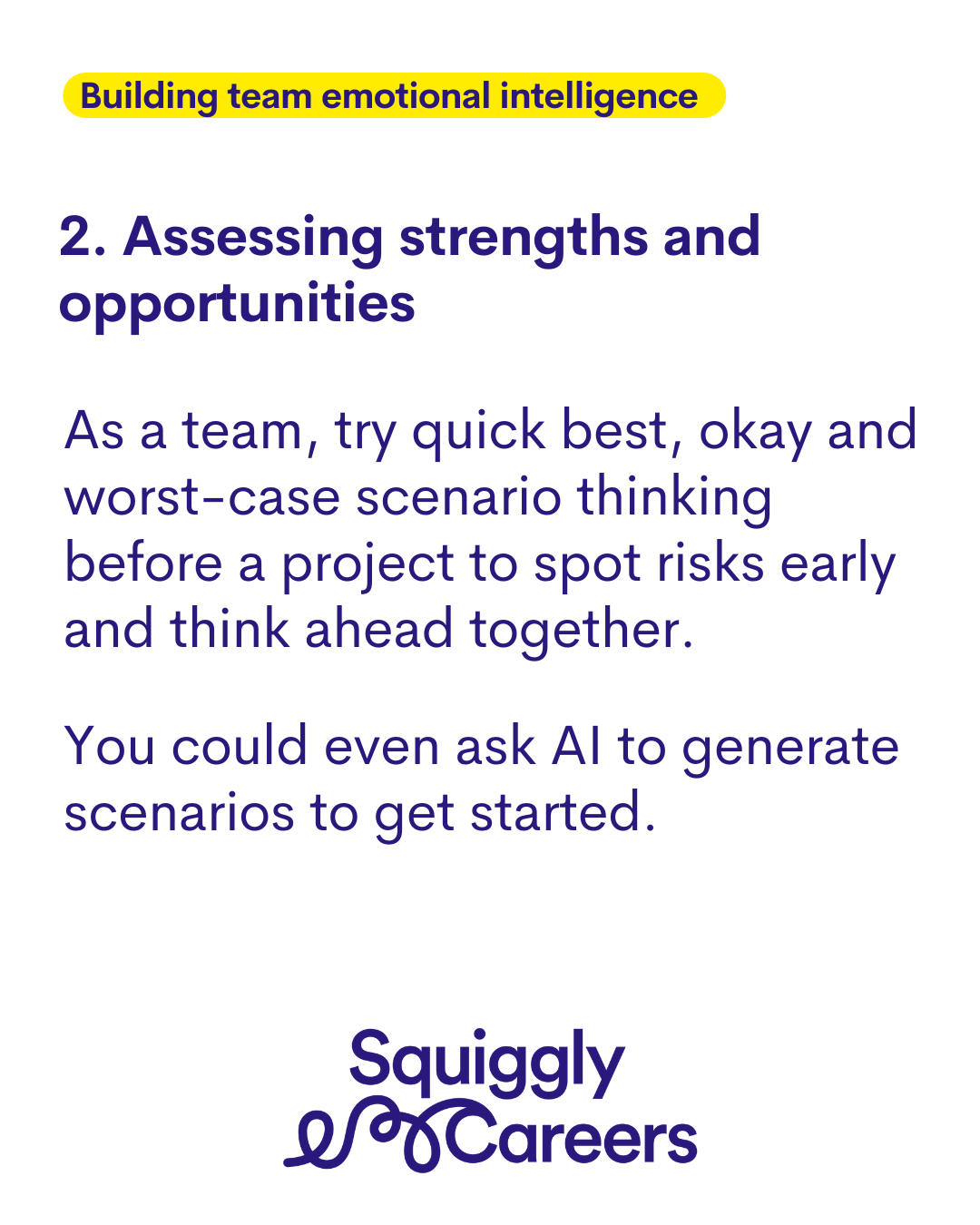
Sarah Ellis: Yeah, because it has to end up as a ritual or a norm for it to contribute, I think, to team emotional intelligence, is the way that I've understood it. And if it's not, it probably won't do that. So, the next one is assessing strengths and opportunities, which is not quite what you might imagine. It wasn't quite what I thought it was going to be. So, I was like, "Is that about strengths of individuals in the team?" That's not what it's about. It's more about your strengths as in your ways of working. So, how effective are you? How efficient are you? Are you always reviewing processes and performance, like always getting better? Actually, when you read that description, it's about always building better, is probably the words that we would use. And it's a mixture of anticipating problems and challenges, so kind of looking ahead. I think quite a lot of critical thinking when you really look at this one. So, that's the anticipating, the being critical, the striving to be better. Risks, like thinking about the risks that might happen. And then there's, when problems do happen, which they will, do you take quick actions to solve it? So, it's more about strengths and opportunities spotting as a group around the work that you do and how you work, rather than at an individual level.
Helen Tupper: Your definition makes sense, yeah, but I get why that title can take you to the wrong place.
Sarah Ellis: Yeah, sometimes it is where you do actually need the detail or you could go a bit wrong.
Helen Tupper: Okay, so what did you think we did well?
Sarah Ellis: So, I put here, I think we're really good fast fixers. So, as a team, when things do go wrong, everybody is pretty responsive, people want to help, probably because everyone's very supportive, and we do fix fast. In the main, I think we resolve things and get under the skin of why it's wrong and what's wrong and what we need to do. And it probably does help us that we have a value as a company of being work in progress. So, because you're work in progress, you go, "Well, we don't want to stay in a steady state". We experiment. We're much better now than we used to be at experimenting. And a lot of those experiments are around the effectiveness of what we do.
So, I thought the podcast, actually, we've really looked a lot more, at the last year, of the effectiveness of the podcast. Effectiveness for us would be usefulness. And then, we are going, "Right, how do we make it more efficient? How do we make it more effective for us, but also for our listeners?" Here, I think the EBI, the 'even better if', is we have a very optimistic team. So, when we've done things like profiling and things in the past, you've got lots of people who, you know, glass is always half full and it's all going to be fine and you're very enthusiastic and you're very like this as well. So, we don't have a team where people are naturally about spotting problems. I don't think it's a natural skillset that we've got, or natural critical thinkers. So, for people who've done things like the colour profiles before, that's sometimes described as the blueness. Critical thinkers, you spot problems before they even arise. I think I'm the most blue person in our team. It's not even my first one in terms of my profile.
Helen Tupper: I have to tell you about this. I was at a museum. I mean, museum is a very grand word for what I went to. I went to the Paradox Museum at the weekend with the kids.
Sarah Ellis: Oh, yeah, you said about that.
Helen Tupper: Yeah, and it was really funny. I mean, I'll leave my views of the whole experience for another day. But as I was going around, there was a lady who was in front of me, who was what I would describe as a very blue person. So, there was a lot of, like, yellow people who were just excited about playing with all the random things that were in there. And then, there was this one lady who kept going around, and she obviously had some kind of science background, and she just kept going, so I was sort of following her around, and she's like, "Well, that's not a paradox". And then, she proceeded to explain in a very critical way why that wasn't. And she wasn't being particularly negative, because I actually was quite intrigued by it. I was like, "Well, I'm here to learn and I'd quite like to work out why that isn't a paradox".
Sarah Ellis: "Why is it not a paradox?" yeah.
Helen Tupper: But that would have been a bit weird if I was just following her around, listening and learning. But it was that she was a blue person, because she was critically evaluating the experience and just identifying where it could have been better and what wasn't quite working. But she wasn't being negative.
Sarah Ellis: Yeah, so I don't think that's what our team would do. I think they would just go around and really enjoy it.
Helen Tupper: Yeah, I think you're right.
Sarah Ellis: They would just be like, "I'm just here for the experience and this is great".
Helen Tupper: Yeah, they'd do that.
Sarah Ellis: I'm probably not smart enough to know about all the different paradoxes, but I would definitely struggle to not think, "How would this be better?" Like, I think I do think in that way. And so, Helen and I were chatting about this. So, we were like, "Oh, so what would we then do as a team? Practically, what could become a routine or a ritual?" And we were like, actually, we are quite good at taking a current state and iterating. So, like what we've done before, how do we make it a bit better? So, that bit we're okay at. What we probably don't really do is any scenarios. And I think if you do scenario-planning or scenario-imagining, you think really differently, but you also get to some very different kind of answers. And so, then you get into more improving rather than just iterating.
So, we were thinking about, for example, let's say when we do our next Skills Sprint, which we will, coming soon everybody, not that soon, soonish, so when we do our next sprint, probably our natural inclination as a team is just to go, "How do we make that sprint that bit better next time? We've done a few now, we'll just keep iterating". And we do, we do make things that bit better next time. But probably what we don't do is just pause and imagine all of the different scenarios around that sprint and then say, "Well, what would we do if…? Or, how about this happened? What would our response to that be?" We probably don't very often talk about worst-case scenarios, what if no one signs up to the next sprint, because actually, something in the world happens that week that means that no one can do it? I mean, that's not that unrealistic based on the last five years. You know, based on some of the things, you're like, "That could happen". And then, we might have designed something that then no one can use.
Helen Tupper: Or what if someone really famous says, "I'm going to sprint", and suddenly you get double the amount of people?
Sarah Ellis: Like, we break our own website or something.
Helen Tupper: Yeah, who knows?
Sarah Ellis: But I think it's probably not something that we've really experimented with as a team. And again, I just wonder whether, as part of when you're already planning something, whether you could -- I think AI can help you with scenarios. So, if you're struggling to come up with them, I think you could describe what you're going to do and you could say to a GPT, "Okay, come up with a best, an okay, and a worst-case scenario based on this", and I think it would give you something as a springboard to start with. So, it might even be about adding it into agendas, like, "Let's have a discussion around a best, okay, and worst-case scenario when we're planning something big". It might also be about, I think, I wonder for our team, if I was being really realistic, I wonder if it's, how do you help people who want to be positive to be able to talk about these things in a way where they don't feel bad? Because it doesn't make me feel bad, but I think if you're naturally very enthusiastic, people don't want to talk about worst-case scenarios, because everything's going to be fine, right? And so, the thing I would have to think about a bit more I think for our team is how do you make this fun, because it still needs to be optimistic in a sort of scenario way, otherwise I think people won't enjoy it and it won't ever become a ritual or a routine.
Helen Tupper: Yeah, I don't know if I've cracked that either, but you know statements like, "What could break the business?"
Sarah Ellis: Yeah, I don't think people in our team would like that.
Helen Tupper: I think it's a bit too disaster.
Sarah Ellis: Yeah, you and I could probably do that, because I think we probably have done some of those things before. But I think -- maybe people could. You've got to test it, right? Maybe this is a good example of like, sometimes you just got to test some of these questions and see.
Helen Tupper: "What could sink the sprint?" or something like that, "Just to get playful for the next ten minutes, let's write down all the things". But I guess the bigger point, and I hadn't thought about this, which is the emotionally intelligent teams are the ones that can both proactively spot problems and they can respond to them promptly. Because your point is, we're really good at responding to problems promptly because we're quite a highly reactive, supportive team; but the really emotionally intelligent ones spot the problems before they need sorting.
Sarah Ellis: It's because you're good at sensing, right? It's because, I think if you are emotionally intelligent, you sense and you look ahead and you're probably quite good at imagining, and because you have a feel for what might go wrong. Some of it's judgment, I think, as well, like sensing and judgment. So, yeah, I think that'll be a fun one for us to have a play with, because also, I feel this is my own point of view, I haven't read this around team emotional intelligence, is you've also got to work with the DNA of the sort of team that you have. And so, that was kind of my point around if we were going to do like, "What could break our business?" I think we would have to do that in a really fun way, otherwise I think our team either would just find it hard to contribute or would feel awful.
Helen Tupper: Just panic, "But what if it does happen? What if Helen and Sarah do fall out? What then?"
Sarah Ellis: Or they just won't contribute, or they'd be just like, "But that's not going to happen". But then you're like, "Oh, but we're not going to learn if we can't have a play with it". So, the last one that we scored ourselves badly on, or what should we say? Not as good. An area for improvement. So, like you said, this one surprised me a bit. But then actually, when you start to get into it, I'm like, "Okay, this makes sense". So, this is about building relationships with stakeholders. And as a team, do you speak to and build relationships with other groups or departments that are going to then affect your performance. And I think probably you need to think about this both inside and outside of your business, depending on what kind of business you are.
So, actually, when I took myself back to big-company world, I was like, "Oh, of course", because emotionally intelligent teams don't act as a silo. And in most big companies, you get loads of silos, and then you don't understand all the into relationships, the cross-functional nature of what you do, how if this team aren't doing the thing that they need to do, that you can't do what you need to do, and no team is an island. You know, every team has those interdependencies. So, I think what they are describing here is kind of going beyond your team and thinking about, "Well, who else? Who else impacts our performance? And are we actively building those relationships? Are we really thinking about partnering with those people, understanding what's going on in their world?" Because part of being emotionally intelligent is being empathetic. And you can only be empathetic if you understand what's happening for other people.
So, I think this is about escaping silos, being empathetic, being quite meerkat-like. You know we talk about having meerkat moments, like popping your head up and seeing what's going on in the world? And I think in a big company, actually probably easier to understand, because I think a lot of people would recognise siloed working. I think in a smaller company like ours, when I was answering these questions, I was actually thinking, "Do you know what, we still have examples where parts of our team don't talk to each other". So, I was like, "That has definitely happened in the last year". So, even in a small company, that's happened. So, there's a bit about like, are we working together as one overall team or lots of mini teams? And then for us, we've also got all of the learning partners that we work with, and we work with about 100 companies all across the world; and actually going, "Are we proactively building relationships with those people that we work with?" Because if you go back to that bit of 'affect our performance', those learning partners, our ability to build those relationships with those people really affects our ability to do our job, to design and deliver really good learning experiences, to keep doing that, to keep building our business.
Helen Tupper: I have some thoughts on our 'what worked well', 'even better ifs' on this one.
Sarah Ellis: Okay, you go for it.
Helen Tupper: Well, I think on our 'what worked well', you know you talked about even in our team, sometimes we're not connected?
Sarah Ellis: Yeah.
Helen Tupper: I think one of the things that we have done that I think other companies could copy, or other teams could copy, is we sort of borrowed that flywheel concept. So, the flywheel concept comes from Jim Collins and we can maybe link to that on the PodSheet if you want, if you're listening or watching.
Sarah Ellis: He's been on the podcast in an episode that I absolutely loved.
Helen Tupper: I mean, there are some funny stories about that. That was a good episode, it was an intense episode for Sarah. But the flywheel concept that I think helps us to connect as a company and see things from each other's perspectives is, it's how our business grows and it is how everybody's roles connect to each other. And we have tied metrics to that, we talk about it every month. So, there is a lot of clarity and transparency in our company about how roles are connected and how everyone's roles is, as helping Squiggly to grow bigger and better. So, I think that's a good thing that we should say we work well there. What did you add as well for what worked well on this one?
Sarah Ellis: I think we get good feedback from the partners that we work with, that they really trust us, that we are kind of on their side and they sort of believe that we're like an extension of their team. I mean, I would say generally that's not feedback about us, that's feedback about everybody else.
Helen Tupper: Our team.
Sarah Ellis: In Amazing If, yeah, in our team. We sort of turn up and do the learning. But we do get that feedback, so I was like, that's a good data point in terms of talking to our stakeholders, understanding what they need. I think we do that well. I actually saw this in action as an 'even better if' even yesterday, obviously it was on my mind. And then, something happened yesterday where I was like, "Oh, that's because we don't do this". So, for our new book, Learn Like a Lobster, we've got this virtual lobster library where there's accelerators, like workshop accelerators that we're doing. And we did the first one yesterday and we forgot to include our own team.
So, we had invited hundreds of people to come to this accelerator to do the first one, and it suddenly occurred to me, that is one of our biggest priorities. This idea of learning like a lobster is one of the biggest priorities for our company, it goes way beyond a book, it's really important that everybody understands the key concepts, not everyone will have read that book yet, cover to cover, in our team. The single best way to upskill everybody on that is for everybody to come to those half-hour accelerators. And we didn't do it. And yeah, it's a good 'even better if', it's a good mistake moment, but it is an example of how we're not thinking across the company. What we really focused on was, we had an accelerator we needed to run for some external people, so had we set the tech up right; what were we going to deliver? And I think I asked the question, I think I thought of it 24 hours before. And obviously by then, a couple of our team had proactively sorted themselves out. Great. But obviously, if you've not put in your diary by then, you probably can't come. So, it did mean that 50% of our team missed out on a moment where actually, we would have been connecting all together.
Helen Tupper: So, I'm trying to think about what is the question that people could take there to apply to their team? What are the moments that matter this month that we want everyone to be involved in? Is it that kind of a prompt?
Sarah Ellis: I think there are two things. I think to make this practical, you've got to think internal and external. So, that's an internal prompt. What are the moments that matter most for our team that we all want to be involved in? Great. And we would have said that. If we had asked that question at the start of a month, we would have spotted that and we would have been, "That's good". I do think there's an external, or certainly for us as a company, there's an external thing about who are you proactively building relationships with that are not just the meetings that pop up in your week. So, I think people are very good at building relationships that are just there as part of their day job. They almost couldn't get their job done without those conversations.
But then there's the relationship building, where you're more asking questions about what's going on in someone's world, you're working out what's important to people. They might still have an agenda, but they're more curious and they're more about being intrigued. And again, as a team, I don't think we're that good at doing those. And this was actually an example that I did read from the article, where one team set a target where they said, "Every single person in the team every month is going to meet one new person from outside of the company". And then, they'd done like a Teams channel, and it was like, "Who we're learning from". I don't think they'd quite called it that, that's probably me using an Amazing If phrase, but it was that kind of sentiment. And you had to share who you had met and what you had learnt.
Helen Tupper: That's really nice.
Sarah Ellis: So, that's a good example of going, it's kind of curious conversations. It's not necessarily curious career conversations, because I think team emotion intelligence is about team performance. So, this wouldn't be about going to have a chat about your career. It would be me saying, "Oh, well I've gone to have a conversation with an HR director that I've not met before. This is who I met, this is what we talked about, this is just what I noticed or what I observed". And I was thinking we could all probably do that in our team. That'll probably be a good thing for our team as well, because everyone does work remotely, to keep the connections going, but a different kind of connection. And also, I'd be really interested to read those. You did a version with your CEO thing, I was thinking.
Helen Tupper: Yeah, a while ago.
Sarah Ellis: That's our prototype.
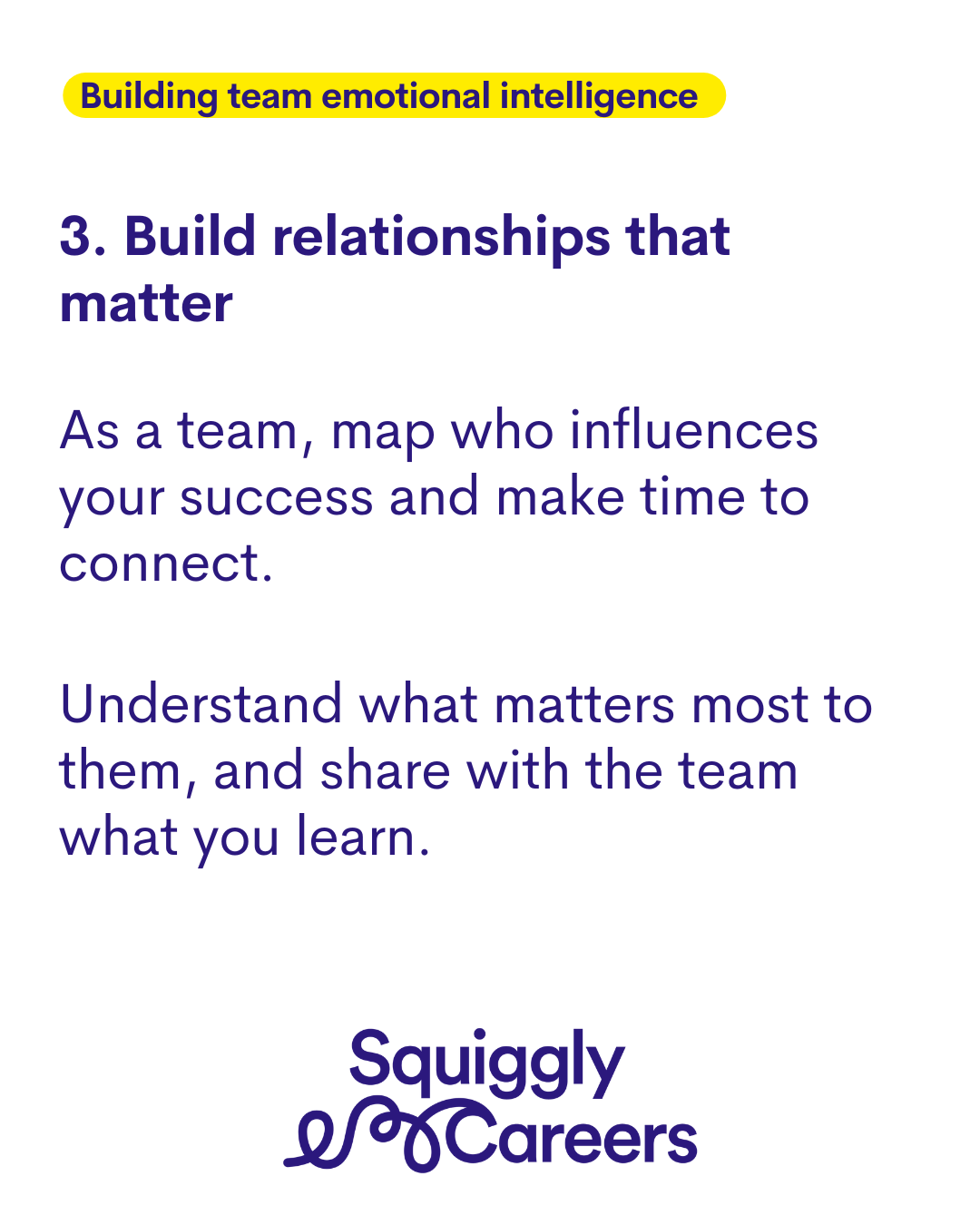
Helen Tupper: The idea that I had there, so the routinely talking to stakeholders, what you could do to make that even better as a team, I think you can have a really useful team conversation, which I'm just going to call mapping and mattering for now, where you could map your stakeholders that could affect the performance of the team, inside and outside of the business, and then I think against each person, I think you need to know and write down at least, "Well, what do we know that matters to that person?" And I think if they're on your map, but you don't know what matters to them, I think that's a bit of a red flag. And you can go then and meet with them, like map, matter, meet, there's probably something in there. But I think you should, if we haven't got that clarity, then you can't really serve and support the stakeholders. So, it's probably quite a useful exercise for teams to do.
Sarah Ellis: Bit like influence impact mapping, which again, if you google that, it's a really easy way to think about your stakeholders. And it sort of prompts you just to go beyond the sort of waiting to see what happens to you in terms of the stakeholders that you meet versus creating the conversations that matter. I think there's a waiting versus creating thing here. And I think probably the reason we both scored ourselves and as a team lower on this one, is we're probably more, we respond but we're probably a bit more passive versus creating the conversations that you think, "Well, we've got gaps here", or, "These are the people that we want to talk to find out more".
So, overall, I've loved it this week. I got very into team emotional intelligence.
Helen Tupper: May I ask you a final question?
Sarah Ellis: You may.
Helen Tupper: Because Sarah has really dived into it and I've just been learning through the conversation, really. And the last question that I have is, how regularly do you think, having gone into this, that teams should reassess themselves?
Sarah Ellis: I actually think not too often, because the risk would be, and you say this to me sometimes, because I think because I'm ideas-y, that the potential risk is initiative overload. You can't have loads and loads of rituals and routines because people can't keep up and it's overwhelming. And I think there's a balance to get right here. And as you described, we already have quite a lot. We have mistake moments, what worked well, even better if. There's quite a few that we can name. We talk about borrowed brilliance, links to learn from, lots of ways that are definitely our team norms. So, I think you've got to be really mindful of not having too many, is the first thing, so the volume of them. I also think it's okay to experiment and see what sticks. So, it doesn't really talk about that in anything I've read, but personally, from what we have seen, better to just experiment and try stuff out. And the stuff that sticks is the stuff that becomes your norm. Rather than over-designing a norm now, I'd almost rather just try something and be like, "Oh, that stuck, that didn't, that's probably a norm, that probably is not".
I would say probably every six months. I think every six months to go, you could redo the questionnaire, but I would probably just use the 'what worked well', 'even better if'. And you could just have a team conversation where you keep coming back to this, because like any of this sort of work, I think it's never about going, "We're aiming for the perfect 15, 15 out of 15". No team is that good. I think the teams that are really good are the ones that just continually improve and continually keep learning. It's not like they reach this heightened state of perfection and excellence, but they keep coming back and they're like, "Oh, we tried that and that didn't work. Oh, this half worked. Or, half of the team have done this, but actually the other half of the team have not. Why not? What's got in the way?" So, I think it's the conversation, it's the actions, it's the reflection that then probably feels really useful. I really like it as a concept.
Helen Tupper: The research does, yeah, it provides a structure for the reflection and a structure for the conversation. I think what you've done is added a bit of a 'what worked well', 'even better if', 'Amazing If-ness' to make it easy then to apply.
Sarah Ellis: And so, I haven't read her book. So, I'm very mindful with borrowed brilliance that we don't want them all to be books. I have got into this enough that I have bought the book. And also, I wanted to be supportive of her work because I feel like I've borrowed a lot of brilliance from Vanessa, who I've not met. So, this is what her book looks like. Very nice cover. And it's called The Emotionally Intelligent Team. I have started it and there's a really good forward, actually. I don't usually read forwards, but there's a forward by Daniel Goleman. So, they have made the explicit link between individual and team, which I think is interesting to read the difference. So, I think with some borrowed brilliance, you know you kind of go, "I've got enough now", whereas other times, you do think, "I do want to dive a bit deeper". So, it has made me think, "Actually, I am going to read the book, I'm interested enough".
But the other thing that this week just really showed me was like, actually, probably the thing that I loved the most was taking one thing, an article, and turning it into something different. It was using Claude to then make this useful for our team; it's the 'what worked wells', 'even better ifs', that's where all the value has come from. So, I actually don't think you necessarily need to read the book, I think you can just read the article. You can come up with your own quiz, you can use what we've talked about today.
Helen Tupper: And what we'll do is I'll put in the Squiggly Creators in Action, which is our weekly newsletter, I'll put some screenshots of the survey that Sarah created, so that if you want to create your own --
Sarah Ellis: Which nearly works.
Helen Tupper: It nearly works, it's fine. Good enough for now. But just so that you can see if you want to create your own team survey in Claude or you can use Typeform, or whatever you want, but you can just see what that looks like. So, we'll put that in Squiggly Careers in Action. And if you are not signed up for Squiggly Careers in Action, that's our weekly newsletter. The link for that will be in the show notes. If you can't find that, just email us, helenandsarah@squigglycareers.com, and we will send you the link for Squiggly Careers in Action.
Sarah Ellis: But that's everything for this week. Thank you so much for listening. We hope you're finding them useful, and we're back with you again next week. Bye for now.
Helen Tupper: Bye everyone.
Sign up to the Squiggly Careers Newsletter and get our latest ideas, tools and inspiration every week - all in one place, straight to your inbox