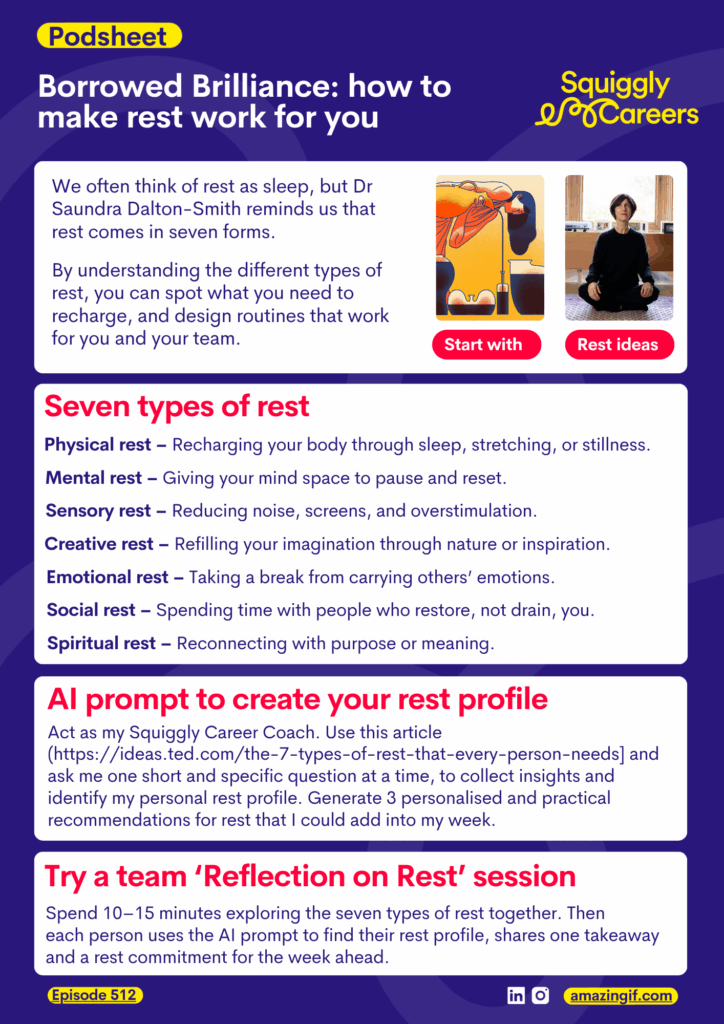
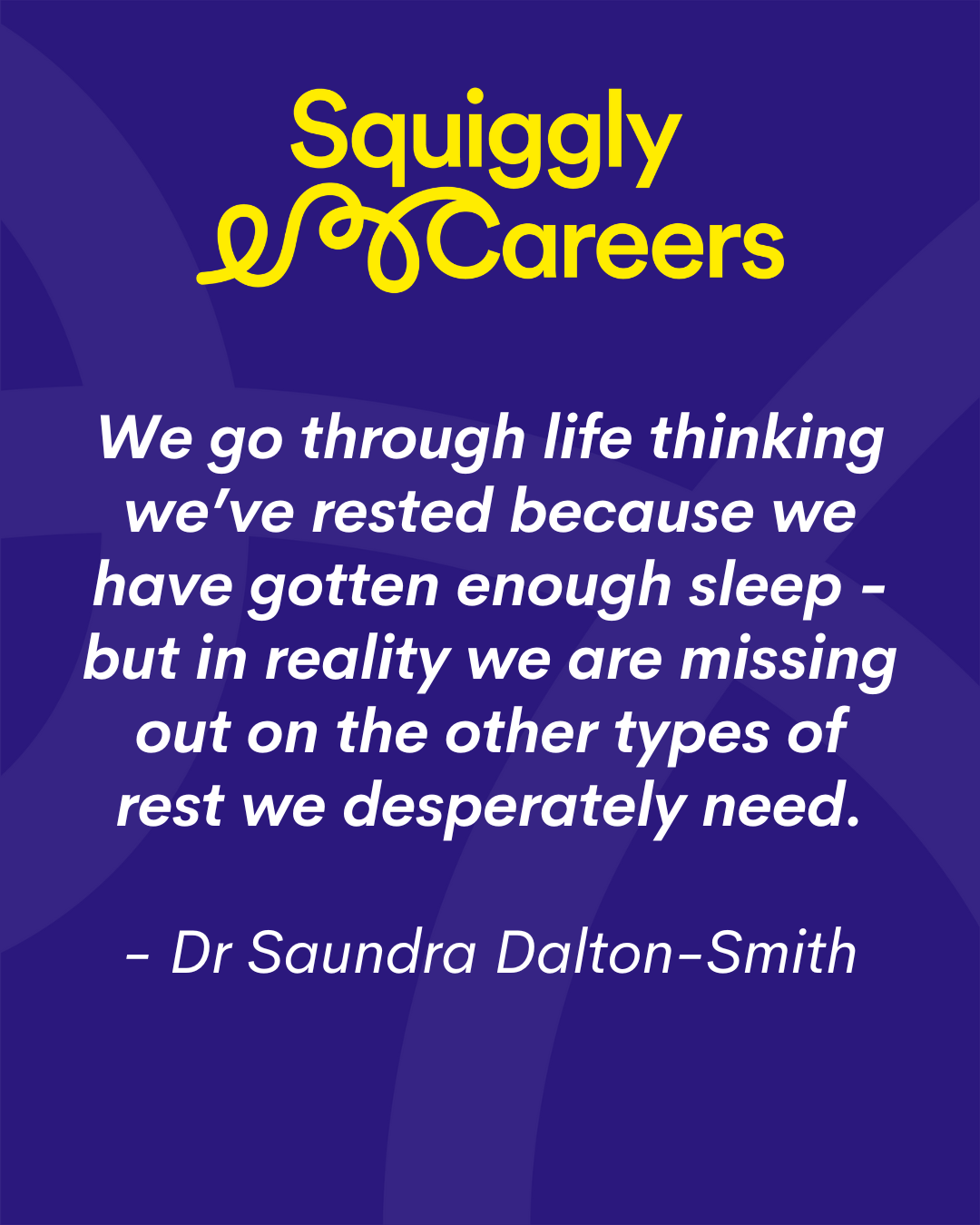
This week, Helen and Sarah borrow brilliance from Dr. Saundra Dalton-Smith, who writes about the seven types of rest that everyone needs.
Rest is far more than sleep – it’s a set of rituals that help you restore energy, creativity, and motivation in your squiggly career. From physical and mental rest to creative, emotional, and social rest, Helen and Sarah share how to identify your biggest “rest gaps” and design routines that actually work for you.
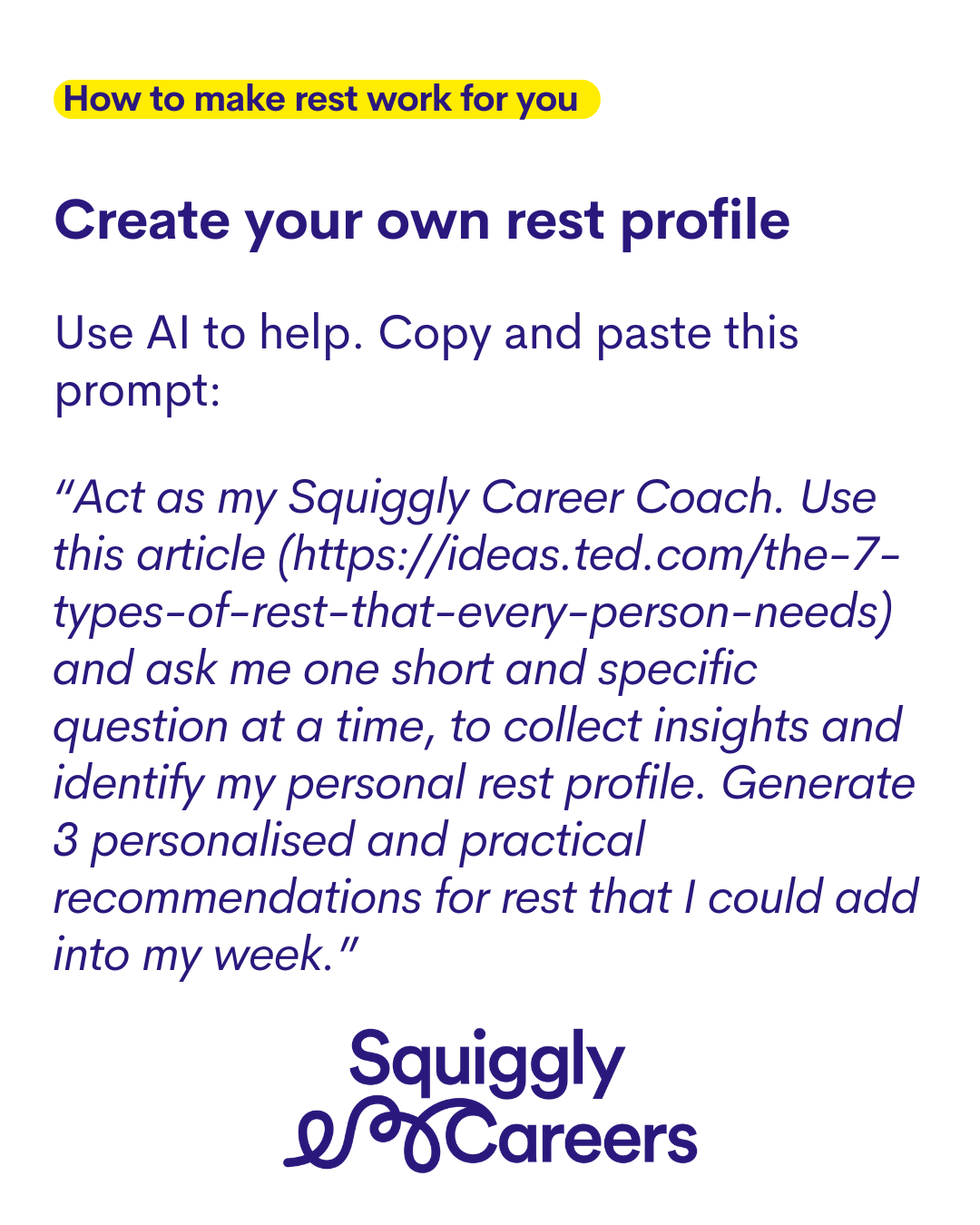
You’ll also hear how Helen used AI to create a personalised rest profile (with some surprising insights) and how you can try the same coaching prompt to find your own rest reset.
🎯 What You’ll Learn
📚 Resources Mentioned
For questions about Squiggly Careers or to share feedback, please email: helenandsarah@squigglycareers.com
Need some more squiggly career support?
1. Download our free careers tools
2. Sign up for our Squiggly Careers Learn Like a Lobster Skills Sprint
3. Sign up for Squiggly Careers in Action, a weekly summary of the latest squiggly career tools
4. Pre-order our new book Learn Like a Lobster
00:00:00: Introduction
00:00:29: Saundra Dalton-Smith
00:01:12: Seven types of rest...
00:01:49: ... 1: physical rest
00:02:30: ... 2: mental rest
00:03:28: ... 3: sensory rest
00:03:56: ... 4: creative rest
00:04:22: ... 5: emotional rest
00:04:45: ... 6: social rest
00:04:54: ... 7: spiritual rest
00:06:54: Coach-yourself questions
00:22:19: Personalising your rest with AI
00:29:08: Final thoughts
Helen Tupper: Hi, I'm Helen.
Sarah Ellis: And I'm Sarah.
Helen Tupper: And this week, we are together in person. It doesn't happen! So, it's a Squiggly Careers episode that might sound a little bit different, because we always, I think, get extra excited when we're talking about things together.
Sarah Ellis: Yeah.
Helen Tupper: But what will be the same is we're going to be borrowing a bit of brilliance from an idea that we think is very interesting and important for your Squiggly Career, and making it really practical so that you can apply it to what you are doing. So, Sarah, what are we going to be talking about today?
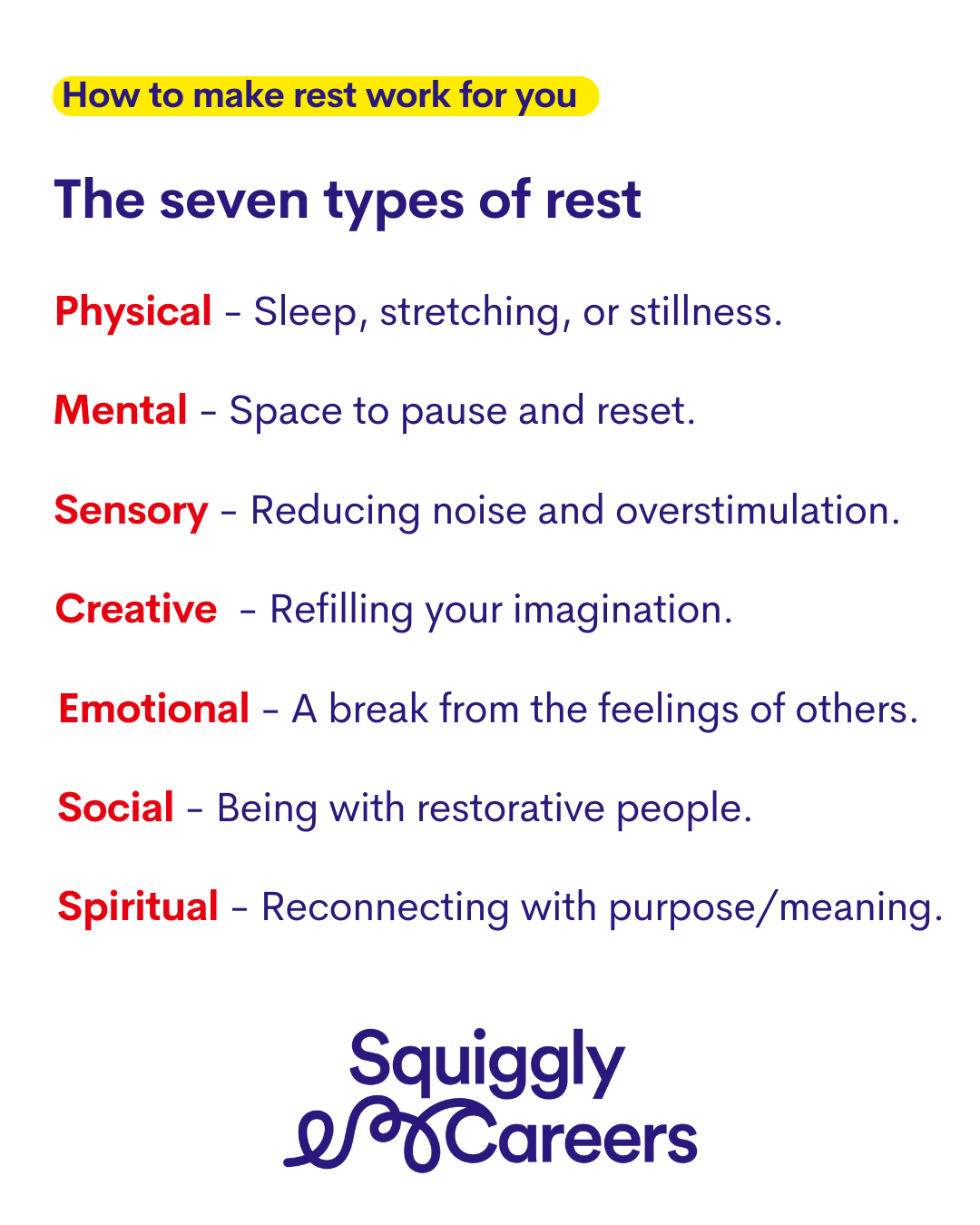
Sarah Ellis: So, we're going to be borrowing brilliance from Dr Saundra Dalton-Smith, who writes about the seven types of rest that every person needs. And so, I read an article that actually I think was published on Ted.com a little while ago, so I've always known about these seven different types of rest and found it really useful. I think it's a much more nuanced approach to resting and more relevant, because I think you can make it much more personal to you. So, I think it's really helpful. And then, someone in our team actually said to me, "Have you read this article where someone took the seven types of rest and tried them all out and shared what she found?", a journalist at The Guardian. So, I read that as well and I was like, do you know what, we can all take a bit of inspiration from this. That's what we're going to do today.
Helen Tupper: So, Sarah will go through the seven different types of rest, we're going to talk a little bit about it, and then we've got a really useful AI prompt so that you can personalise it. And we will summarise all the ideas that we're talking about today in the PodSheet. So, you can get that from either amazingif.com, or it will also be in the show notes.
Sarah Ellis: So, we're going to go through the seven quite quickly. You can always read the article if you want to dive in a bit deeper. And then, move on to me asking Helen some coaching questions to see where she is with her rest, and then how we make it sort of hyper-personalized for Helen and for me at the same time. As ever, we're using the podcast to help ourselves, but hopefully it's useful for you too. So, first type of rest is physical rest. Probably the one that you go to fastest. And that can be more passive, like sleep or just sort of napping. I like the fact I said 'napping'. I was like, I never take naps.
Helen Tupper: I was going to say, do you nap?
Sarah Ellis: No, because they make me feel worse.
Helen Tupper: I think it's quite cool when people say they nap. I'm not a napper.
Sarah Ellis: No, I'm not a napper.
Helen Tupper: I do admire a napper.
Sarah Ellis: But it can also be active rest, things like yoga, stretching, apparently massages count. I was like, "Oh, that's quite appealing". But as in, if it's permission to book myself in for a massage, that feels more appealing. Right, so that's first kind of rest. We're already on number one. Second kind of rest, mental rest. So, this I guess kind of gives your brain a break. If you don't have mental rest, I guess this is where you're feeling always on. You get described here as like, you can't switch off. I think that's probably, I reckon, quite relatable. That idea of going to bed and is your mind still racing? I had that one night this week where I knew I was tired. I'd had two really bad nights' sleep, I was still really tired, and I could not go to sleep. And I was physically tired, but the brain is still going and it's still going and it's still going.
Helen Tupper: I don't have that because, you know, we talk about this sometimes, because I think as soon as I'm in bed, I literally go to sleep straight away. But it's more, I'm like, "All right, I'll stop now", to watch some TV or even to read stories of my children. And only half of me is there because the other half of my brain is still --
Sarah Ellis: So, basically you have to go to sleep to stop?
Helen Tupper: Yes.
Sarah Ellis: Okay, we'll come back to that. The next one is sensory rest. So, this is rest where you've perhaps been overstimulated by lights, screens, which I suspect is the most popular one, scrolling, noise, conversations. I was actually in an event earlier this week with 600 people in one room and it was just so noisy, and I definitely needed some sensory rest after that. I always find that kind of auditory rest is quite important for me. Next one is creative rest. So, this can be actually if you've almost been working on lots of hard problems, almost like you've been doing lots of creative work, but then you can get a bit almost kind of creative-out, like it's almost too much, and it talks here about reawakening that creativity, but probably by doing something else, like nature or art is talked about quite a lot here.
Emotional rest. Emotional rest is particularly important, I think, for people who, you know some people really feel other people's emotions, like that transference thing? And if you are naturally a people-pleaser, then I think often those people need emotional rest, because you're thinking about other people a lot more than you are yourself.
Helen Tupper: A sort of weight of empathy.
Sarah Ellis: Yes. Social rest, and this is about surrounding yourself with relationships that kind of revive you rather than exhaust you. That's quite interesting. And then spiritual rest, which I think it doesn't have to be about religion, this one, or about kind of a higher sense of spirituality. But it's really about purpose and belonging and meaning, kind of connecting to something that is beyond yourself. Like, I think this can be true for all of us, you know, when you've had a really, really busy week, and you've done lots of doing, lots of tasks, but perhaps not zoomed out at all.
Helen Tupper: It's actually quite a nice link to our next podcast, which is on mattering, because I think that is very kind of connected to that idea of spiritual rest, feeling that you matter.
Sarah Ellis: So, what I really like here is that it's describing rest as like a dynamic process. So, we all need different kinds of rest at different moments, it doesn't stay the same, but also you can design it in a way that works for you. So, for example, if you're someone who's thinking, "I am definitely a people-pleaser", you probably need to take emotional rest really seriously. That's not the case for me. So, I sort of go, "Well, for me, that one feels less useful". Whereas there might be some of the other ones, like the sensory rest, where you go, "I'm self-aware enough to know that I would find that hard". So, then you can think about how you can design rest in.
Helen Tupper: But we always talk about, with our podcast, we always want what we share to be useful for individuals, but also to be talked about together in teams, because we know that that's often where you're going to help each other the most, and so where this stuff is really going to stick. And I think if you had this conversation, like, "These are the seven different types of rest, which ones do you recognise are important to you? Where might you have some gaps in the questions Sarah and I are going to talk about in a moment?" I think not only do you learn more about each other, I think it gets rid of the judgment. Because if you said, "Oh, I need physical rest, I need to go for a walk, it's really important to me", then I would just say, "Oh, that's because that type of rest is what Sarah needs right now", whereas maybe my rest is creative rest. And you're just sort of recognizing that different people rest in different ways, and it's not better or worse, it's just what's right for you. And you can have a really interesting team conversation about it.
Sarah Ellis: So, a few coach-yourself questions to sort of get you started thinking about like, "What does this mean for me?" If the seven different types of rest are the 'what', this bit is kind of the 'so what'. And then, Helen's personalisation that we'll do at the end is the kind of 'now what'. So, we're kind of in 'so what', and then we'll move into 'now what'. So, I thought the first question, helpful for maybe Helen to reflect on first, and I'll do it too, is, "Where am I at my rest best?" So, where do you rest really well at the moment? And where's your current biggest rest gap?" It's sort of the, 'what's working well' and the 'even better if' for rest for you right now.
Helen Tupper: I think what's working well for me is probably either -- I can have two, I'm allowed two.
Sarah Ellis: You can never pick one thing, ever. Yes, you can have two. Also, I'm like, "It's a Friday afternoon. I can't argue with you at this point of a week. Great, I'm going to ask all the difficult things now".
Helen Tupper: So, physical rest, because of my sort of regular peloton-ing, I feel like that really, really helps me and I invest in it and I've got a good routine with it. And then, I think social rest as well. I know what energies recharge me, I really prioritise those, so I feel better because of that. Like, I feel well rested having spent time with certain people and I make sure that that time is quite protected. So, those things I do think I do well. What about you?
Sarah Ellis: What's your gap?
Helen Tupper: What's my gap? I actually think sometimes creative rest, which I think is an important point, because sometimes people might think that creativity is just artsy stuff. But I think in our job, we are constantly creating, because we have a new book out so we are creating new workshops that we run for companies; we record a podcast, two podcasts every week; we write on LinkedIn. We are constantly creating new sources of career support for people. And I think sometimes, I've just come back from holiday, and that was a lovely period of rest for me and I've got more creative energy coming back, like I've got more ideas for posts that I want to share and things I want to do. And sometimes, I just need that time away from creating, writing, recording to reconnect with my ideas.
Sarah Ellis: Also sounds a little bit like the spiritual one as well, maybe.
Helen Tupper: I did meditate quite a lot whilst I was away.
Sarah Ellis: Did you? We must have recorded an episode at some point about when we tried that meditation that you made me do. What was it called?
Helen Tupper: It's called Vedic meditation. I'm a fan, Sarah less so.
Sarah Ellis: I didn't even make it through the programme, did I, which probably tells you everything you need to know. My rest best, I've made a really conscious effort over the past three months to do more physical rest. And that has looked like making some different decisions, stopping work at certain times to go to a class. And I also really try to set myself up for success based on how our work works. So, I think sometimes I would almost complain that I wasn't getting to do physical rest and almost blame work. Whereas I was like, actually, if I accept that work works as it does, and actually I really like how our work works, but what it does mean is that I need physical rest that is really flexible. And also, to stop giving myself excuses, like, "I can do this, I just need to be flexible about it". And so, I now have four or five different apps on my phone, all in a little folder that I think it just says like, "Physical", or something, something like that.
Helen Tupper: This is new to me.
Sarah Ellis: Yeah, I think I actually have used the word 'physical', or maybe 'fitness', 'fitness' actually. But each of them is a different place that I go to do exercise. So, one of them is the Reformer Studio I go to, another one is a HIIT class, another one is Pineapple Studios where I sometimes go dancing, another one is a place where I've now joined like a cheap, quite a basic gym. So, actually the reason I've done that is that if I can't get to any class, which is always my preference, I haven't got any excuse because there is somewhere that I could go that's got a treadmill. And so, I've sort of done that and I've set myself up so that actually in every week, it doesn't matter what was happening at work, at least once or twice a week, there's always a way to rest. And even last week, I even just left my front door and went for a run, which never happens. It was awful the next day. I felt awful. I needed some other rest afterwards. So, actually, I've worked really hard on that one, and I have felt better. And I know it's such a cliché, isn't it, the whole, "If you exercise, you feel better". But it is also so annoying, it's true.
There's some exercise I really enjoy, but less so when it's just exercise for exercise sake, and sometimes I do have to do that. If it's sport, that's fine.
Helen Tupper: Did I tell you about my weighted vest?
Sarah Ellis: No. Is this just another trend that you're just like, "Oh, I'm going to jump on board?"
Helen Tupper: Yeah, but I love it. So, I'm now hiking on my treadmill with a weighted vest --
Sarah Ellis: Really glad I don't have to see that.
Helen Tupper: -- whilst I watch various podcasts.
Sarah Ellis: When you say, "Various podcasts", tell everybody what you watch every time.
Helen Tupper: I'm really into --
Sarah Ellis: Because you message me about it every time.
Helen Tupper: I love it. I literally message Sarah whilst I'm watching it. The Diary of a CEO. But the behind-the-scenes bit, I really like, because you watch somebody building their business real time. So, this is a complete tangent, everyone. But Stephen Bartlett talks about, "Wouldn't it have been amazing to have been behind the scenes watching Apple being built?" And I think that's his aspiration as an organisation. So, he's kind of showing you.
Sarah Ellis: Going to show you how.
Helen Tupper: Yeah. But you look at how he is hiring, how he recruits, I mean he gets thousands of applications for roles, how he has built things that help him test company fit. And he's really open with it all. I would honestly say if anyone's interested in entrepreneurship, running their own business, they already run their own business and they're trying to scale it, he's very open about what he does.
Sarah Ellis: Which is amazing, right, to be that transparent.
Helen Tupper: So, I do that while I'm hiking with my weighted vest. I'm loving life.
Sarah Ellis: I listen to a lot of Dua Lipa because it's about the right -- I put into an AI what the beats per minute needs to be when you run, like what songs match the beats per minute, and loads of Dua Lipa songs fit obviously how fast I can run, which is not super-fast, but she does help me go a bit faster, so I'm very grateful for her. And I think my biggest rest gaps, that's why it's good to keep coming back to this, like I know this quite well, is probably social rest, so my friends, and my friends who are not to do with work. So, they're probably people I've met through work, but they are just my friends. I don't get to see my friends very often. I think with the mixture of work, trying to do physical rest, my family, after that, your friends end up coming quite low down. And also, it often takes quite a lot of effort, because everybody's got lots going on in their lives. But every time I see my friends who are friends first, I think I always just feel like, "Oh, yeah", it reminds me there's life outside Amazing If and a life outside my family, because it's just for you.
So, coming up to Christmas though, I have got -- sometimes I can't make things, so I always feel quite like, "Oh, I'm often not able to do those". But I have got one of those I'm really trying to protect. And I do find the mental rest one. I don't think I have any coping tactics. I think when I'm fine, I'm fine. But when my brain is really busy, I need to do something differently. I sort of rely on just how my week is going. And I really noticed it actually this week where I had a couple of nights where I was just like, I need to go to sleep. And all I was doing was thinking about just work stuff. It was like, you know the worry list, and I feel like I probably wasn't working on those worries. I was literally just worrying.
Helen Tupper: I can always tell when you're in that mode. Well, actually, I probably don't know how bad it is, because a lot of it you're keeping to yourself. It's kind of the messages that I get from you. It's a lot of messages, but they're all about lots of different things. And so, every five to ten minutes, there'll be another one, but it's on a different topic. And I know that's just because your brain is like --
Sarah Ellis: Like you said earlier, it's the too many tabs open thing, probably. And it's also probably a little bit caused by, we were saying, we've both been on holiday back to back. So, I mean we can't feel too sorry for ourselves, right? We've literally been on holiday, but then we haven't spent very much time together. And then, sometimes I think that opens a lot more tabs, because we're always quite mindful of there's only so much you can do. You can't close a tab until we've had a conversation. It's always an interesting insight.
Helen Tupper: So, next question, "What's the smallest action that you think you could take to start closing that rest gap that you've got?" So, if you took creative rest, if you were going really small, because we're not really talking here about significant changes, what are some things you think you could perhaps experiment with or try out?
Helen Tupper: Well, I think I know what it is and I've talked about it before, and it just rarely gets prioritised and protected in my diary, I think. Because I think our creativity is a lot of 'out'. It's write, record, deliver. There's a lot of out of Helen's brain into the world, and I think a creative rest is just 'take it in'.
Sarah Ellis: Take it in from the world to you.
Helen Tupper: Yeah, which for me, one of the best ways of me doing that is reading. And that's not just swiping through a couple of quick articles on my phone. I was actually reading a book on the train this morning. They must have thought I was mad because I got my highlighters out. And it was a really packed train. It was one of those where you sit in six people.
Sarah Ellis: Do you know, that's one of my dreams, is to see someone reading our book with a highlighter.
Helen Tupper: That would be amazing.
Sarah Ellis: Which I've never seen. But I would really be so happy. I think that would make my life.
Helen Tupper: I feel like I might need to set it up. But yeah, so I was like knee-to-knee with someone highlighting a book, and there were so many good quotes, like I felt really inspired by what I was reading, it was really making me think. And that, for me, is creative rest, because I'm focusing much more on what's going in my brain than what goes out of it.
Sarah Ellis: Yeah, interesting. And I thought about this as well, particularly for my social rest. I think I sometimes rely on big moments where friends get together. So, some of my friendship groups, every four or five months, we're like, "Oh, we'll get together". And then, if you can't make it, you've missed the moment. And because it's quite a few people together, obviously, then it's just like, there's quite a lot to organise. And I actually don't see many of those friends just for coffee. Or actually, I was like, "Oh, I could see some of those friends just by myself to just get dinner, and stuff. And often, that's so much easier to organise. And I did have it once with one of the friends recently who actually lives quite close to me. And we were like, "Oh, on a Friday, should we meet up halfway?" And we just got a coffee and did a quick walk. And I was like, "Oh, that was so lovely", and it felt really rare. And so, I think for me, it's sort of letting go of waiting for these friendship moments and just being like, "Oh, well, most of my friends are around London. I'm in London on, let's say, Tuesday and Thursday next week. I wonder if my friends are around to get a coffee on either of those days". I could usually do that, but you know it's that intention and then doing it.
Helen Tupper: It's a nice insight though, that you kind of wait for the bigger moments and you could create some smaller ones. Yeah, and I'm actually quite good at creating some of the bigger moments. So, two of my friends, we always have a Christmas meal and I sort the date and I sort the venue. But again, I'm like if that goes wrong, I wouldn't see those two people. So, just sometimes having those in-between moments. And then, last one, before we move on to the really personalised rest, is a 'who' question, because I do think, and you already slightly linked to it with what you were saying before, "Who can support me to protect my rest at the moment?" so that you're not just sort of flying solo. You are thinking, I suppose, and spotting, is there an interdependency here with making this rest happen? Do I need someone else to do something for this to be okay? What would help me?
Helen Tupper: I'd probably say the two Sarahs in my life. I actually have more than two Sarahs in my life. I think I have about five Sarahs. But the two for this will probably be you, because I know that you know it's important to me, you'd probably hold me to account and be like, "Come on", and I think you'd keep me to it. And then there is another Sarah in the world of Amazing If who helps manage all the things that are happening in a week, and I think she could probably help me to protect the time. So, I think you could probably help me to protect my commitment and accountability, she could help me protect the time. You'd be like a pincer movement between the two of you, and I feel like it has to happen.
Sarah Ellis: I also think the reason selfishly, I would care about you doing that, is I see how important that reading time is for you, for then what you bring back. Because I suppose I see the outcomes and the output of that, because actually you read in a really different way to me. I think I'm more of an always on, whereas you sort of go deep, go quiet, and you could read two books in a day, which actually I would really rarely do. And so, I think I sort of go, "Oh, so what books are you going to read? And what did you learn?" And then, you will often leave me a voice note with like, "Oh, I really liked this book for these reasons, and this is what I've learned". A bit like when you've done your walks with the old Diary of the CEO, weighted-vest thing, I usually get a voice note. But I'm always quite interested in those. I feel like I'm learning by osmosis from you. And I think when you do the reading, I learn. But then also, I think the team learns and we all learn. So, that's kind of a good incentive. I guess also, I can ask you probably questions other people can't, like, "Well, when are you next doing that?" And if you said to me, "I can't, I'm too busy", I could probably be like --
Helen Tupper: You would, yeah.
Sarah Ellis: -- like, "Okay, well what are you busy doing? Like, I can ask you harder questions than the other Sarah, who's much nicer than me, would ever ask. And I think, who could support me? I think I could actually think a little bit about my time, because when I'm in London, you know sometimes you pack your time in too tightly. And then you're like, "Well, I can't have a coffee with anyone, because every single moment I'm in London, I'm either in a meeting or delivering a workshop". And I think I could just keep space -- and again, Sarah can help us with that -- keep space where I'm like, "I'm going to have a coffee with a friend at this point". And it doesn't matter who it is. I'll find a friend to have a coffee with at that moment, but then just see that as being as important as whatever else I'm doing that day.
Helen Tupper: I wonder whether it's the equivalent of, remember when you, in your previous role before this one --
Sarah Ellis: What? Life before Amazing If?
Helen Tupper: I know, there was! But you used to have a coffee-with-Sarah thing at this time. But you could have, let's say, once a month, you have a Friday where you're working in London, and you always keep the Friday morning. And you say, "Oh, if you're free for coffee on a Friday I'm going to keep this free". And if someone takes the time, great; and if they don't, you've probably got 101 other things to get done in that time.
Sarah Ellis: Yeah, this is a long time ago actually, I did used to have a boss who we'd always meet in the same coffee shop on a Tuesday morning. And it was called Sacred. Is Sacred still there?
Helen Tupper: I don't know.
Sarah Ellis: It was good coffee. And I think those coffee moments were really important to me, partly also just the ritual and the rhythm of it, and I think that's probably what I'm missing a bit. Though I probably wouldn't choose a Friday, because I think if this is a Friday and we are in London, having got on the train this morning, clearly it's the day that everybody works from home. So, I think if I said, "Oh, I'm going to meet my friends on a Friday", everyone would be like, "Well, we're not, because none of us are actually in London". But small things like that, you could think, "Well, Friday is probably the day that I'm freest, so I'll do it then". You're like, "But not if no one else is around".
So, you then took the work that I did on these seven types of rest and then you went, "Right, I want to make it even more personal to me. What prompts did you use? Do you want to have a read?
Helen Tupper: Yeah, so I actually played with a few different prompts. I was putting it into ChatGPT, but this would work in whatever tool you want to use. And my aim was, "How can I get this prompt to understand me so that it can make me some rest recommendations that feel really unique and relevant and doable?" not like the, "Get up at 5.00am and do something creative". Like, no.
Sarah Ellis: It did say one of them was, genuinely, in one of the recommendations, it does say, "Book yourself into a massage", and I did think, "Sure, maybe once a year?" That's not going to solve things, is it?
Helen Tupper: So, this is the prompt, and we'll put this in the PodSheet so you can literally just copy and paste this and try it out for yourself, "Act as my Squiggly Career coach and use this article", and you insert the link to the article that Sarah found for this episode today, "use this article and ask me one short and specific question at a time to collect insights and identify my personal rest profile. Generate three personalised and practical recommendations for rest that I could add into to my week". And so, what that will do is it will just ask you a series of questions, you type out your response to each one. So, one of the ones was, "Do you find it difficult to sleep at night because you've got a lot on your mind?"
Sarah Ellis: Yes!
Helen Tupper: And you can do it. I always try to give it a little bit more. Like I'd be like, "Oh, no, I can go to sleep well, but sometimes I get distracted when…". So, I tried to give it, because the more you give it, the more it's going to get to know you. And then, you'll go through your series of questions, and then it will come up with your rest profile and your rest recommendations. So, for example, my rest profile, it said that my strengths, weirdly, it said my strengths were creative rest, social and spiritual rest. That's because of all the friendships and the meditating; and that my gaps, which probably are true, it said my gaps are mental and sensory, like I'm thinking about all of our stuff and I'm constantly on a device, that's where it got those from, and physical.
Sarah Ellis: What is interesting is it is the opposite to what you said for yourself, which doesn't make you wrong. It's just interesting that by answering those questions you get to a different perspective. Or I guess you could challenge your GPT and say, "Well, I actually think I'm --" because you could argue, you could say, "Well, I'm good at physical rest". But maybe the way that you answered the questions, it interprets it as, "Oh, you're not as good as you want to be", for example.
Helen Tupper: Yeah. I think it probably stress tests your self-awareness because it's really asking you questions that are specific. So, then it identifies you some rest recommendations that are specific to your profile. So, mine, for example, I got three. "Do a mind reset between meetings, so that you've not got that mental overload". Quite like that, and it told you how to do it. "Be phone-free for the first 30 minutes of the day". Sarah doubted that that was doable for me.
Sarah Ellis: But then you reminded me what time you got up, and then I said maybe it was more doable.
Helen Tupper: I get up at 5.30 and I have been meditating in the morning. So, I'm not that far away from that. I meditate for 20 minutes without a phone.
Sarah Ellis: Oh, you've only got to add ten minutes on that.
Helen Tupper: Yeah, I have a shower and I'm done.
Sarah Ellis: You have a shower!
Helen Tupper: Shower, meditate, done. 30 minutes phone-free. And then, "Movement moments". I quite like this one. It says, "Book some body breaks into your diary", which could just be, if I'm at home, I could just kind of go for a bit of a walk down the road around my garden. I live in a forest, so I could just a little stroll in the forest for ten minutes or so. Or if I'm in London, Sarah knows this, because we've literally sat in the same space for like the whole day, but I struggle to leave a room or a location because I just want to get more and more done.
Sarah Ellis: She hasn't let me leave this room or this location today.
Helen Tupper: Bad friend and business partner. But if I was scheduling in some movement moments --
Sarah Ellis: If we were doing this, I would get to leave!
Helen Tupper: -- on another day perhaps, I might go for a coffee a bit further away than the room next door.
Sarah Ellis: What an aspiration that would be, to leave a building!
Helen Tupper: "We will not leave, we will get more done!" But I think it's quite useful. The other thing, like Sarah and I were looking at what it had recommended and saying, "Actually, should we challenge some of that?" So, I think the good thing about this is not only do you get some, maybe it's a bit more self-awareness, you get some personalised recommendations if you're feeling a little bit stuck on what you can do with rest; you can also challenge it and say, "Well, 30 minutes phone-free in the morning doesn't work for me. What else could you suggest instead?" until you get to some ideas that do feel useful for you.
Sarah Ellis: I think I would also then build on ideas that you feel are right for you with a 'when' question. I always love 'when' questions, because it helps you to spot specific situations. I think it holds you to account. So, if Helen is going to do these body breaks, these movement moments during her day, my next question would always be like, "When are you realistically most likely to do that?" So, are you thinking in the middle of the day? Is it going to change every day? How long is it going to be for? Are you going to put those in your diary at the start of every week? Because otherwise, it just probably won't happen. And so, I think asking yourself, "When?" around rest really makes a difference. And it can just be, like I do go for a lot of walks, and this morning I had a really short window of time to go for a walk before starting my day. But I still went and I did a really short walk, I had to be back really fast. And I mean, it was barely worth it, but I still felt better because I'd got outside, just moved a bit, and then I think I was in much better spirits for then being in the same room all day.
Helen Tupper: You still left me a few voice notes as well during your walk.
Sarah Ellis: Yeah, I did leave you two voice notes, but that's an insight into a different rest issue that we both have! But I do also really like your suggestion of every so often, asking a team where people are, because the thing I like the most about this, is I honestly think during a year, this changes for everybody all of the time. If you'd asked me about physical rest six months ago, I wasn't in such good shape; just actually physically, wasn't in such good shape. But I just wasn't doing as much exercise as I am now. And so, now I feel quite proud. I do feel I try quite hard to do more exercise. So, it can also be a bit of a point of pride for people. So, we're recording this in November. If you're thinking about team things to do towards the end of the year, we often talk about pride postcards or like, what do you feel proud of? I think asking everybody like, "What do you feel proud of around how you've rested this year?" is a really good question, and maybe one that will prompt people to think, "Actually, do you know what, I do need to do a bit more of this as I go into next year as well".
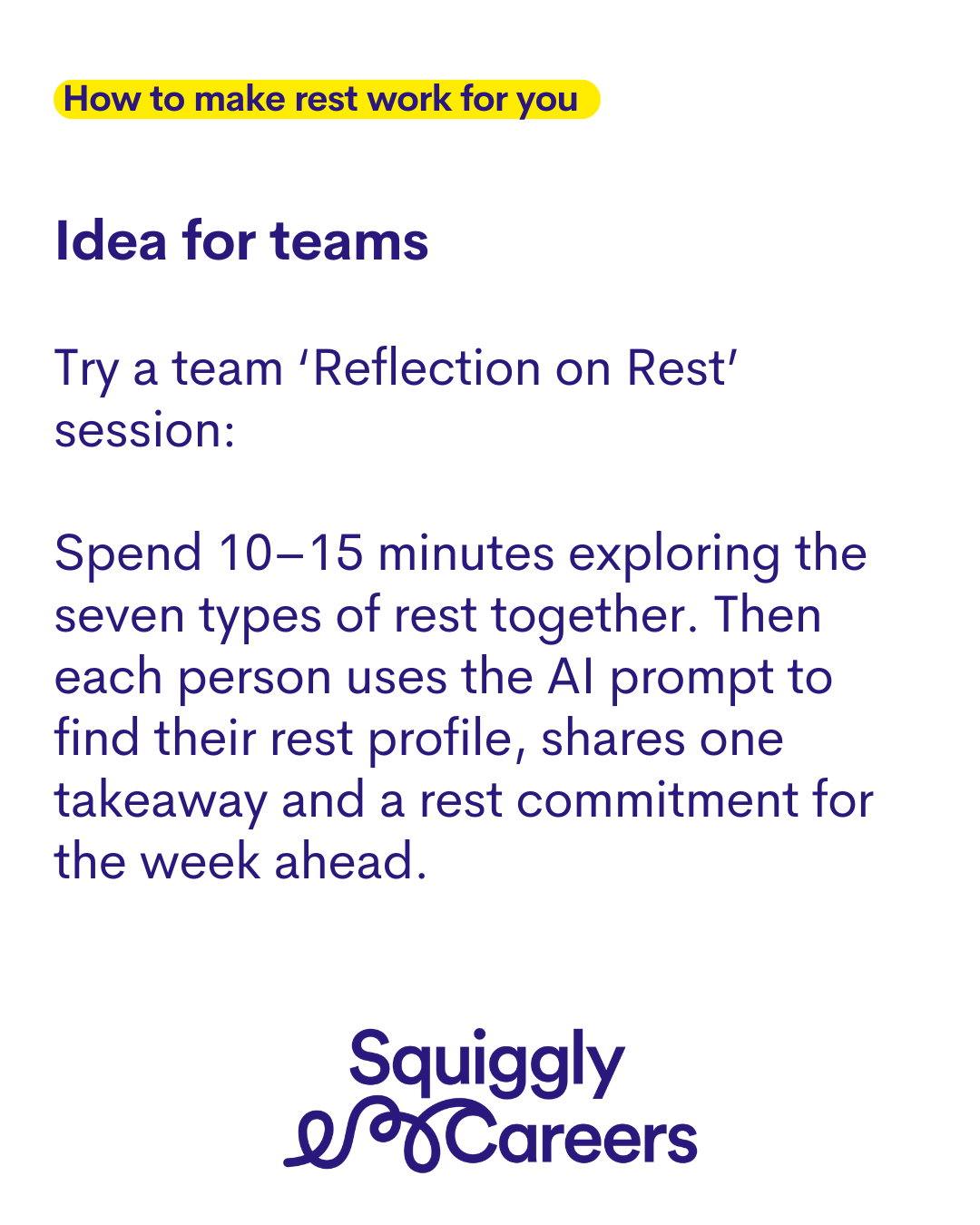
Helen Tupper: Like a 'reflections on rest' session, where maybe you spend 10 to 15 minutes talking about the seven areas and use the questions that we did with each other, and then you use five minutes with the prompt and see what it generated, and then you share back those insights together with a team and maybe make a bit of a rest commitment.
Sarah Ellis: Yeah, really nice.
Helen Tupper: Quite a nice half an hour to spend as a team together.
Sarah Ellis: So, that's everything for this week. As Helen mentioned earlier, our next episode is going to be on mattering, quite an interesting topic, one that we might not know loads about, but we will know more by the end of the next episode. If there are topics you'd like us to cover, things that you would like us to borrow brilliance from, if you've got ideas, you can always email us. We're helenandsarah@squigglycareers.com. And please do share the podcast, subscribe, give us some feedback. We read every one and it makes a really big difference to us and our work. So, thank you to everyone who's already done that because we know lots of you do. And for those people who come back every week, we really do appreciate it.
Helen Tupper: That's everything for now everyone. See you next week. Bye for now.
Sarah Ellis: Bye everyone.
Sign up to the Squiggly Careers Newsletter and get our latest ideas, tools and inspiration every week - all in one place, straight to your inbox