This week on the Squiggly Careers podcast, Helen and Sarah borrow brilliance from Dr. Zach Mercurio’s book The Power of Mattering.
They talk about how mattering goes beyond belonging, why it boosts motivation and wellbeing, and what happens when we feel invisible or replaceable at work. From personal reflections on high and low mattering moments to practical ways to help others feel noticed, affirmed, and needed, Helen and Sarah bring this idea to life with real-world examples.
You’ll learn how small actions — from giving meaningful feedback to showing appreciation — can make a big difference to how people feel, perform, and connect at work.
🎯 What You’ll Learn
– How to understand the psychology of mattering at work
– The difference between belonging and mattering
– Three simple ways to help others feel valued and valuable
– How to create a stronger sense of purpose and performance in your team
📚 Resources Mentioned
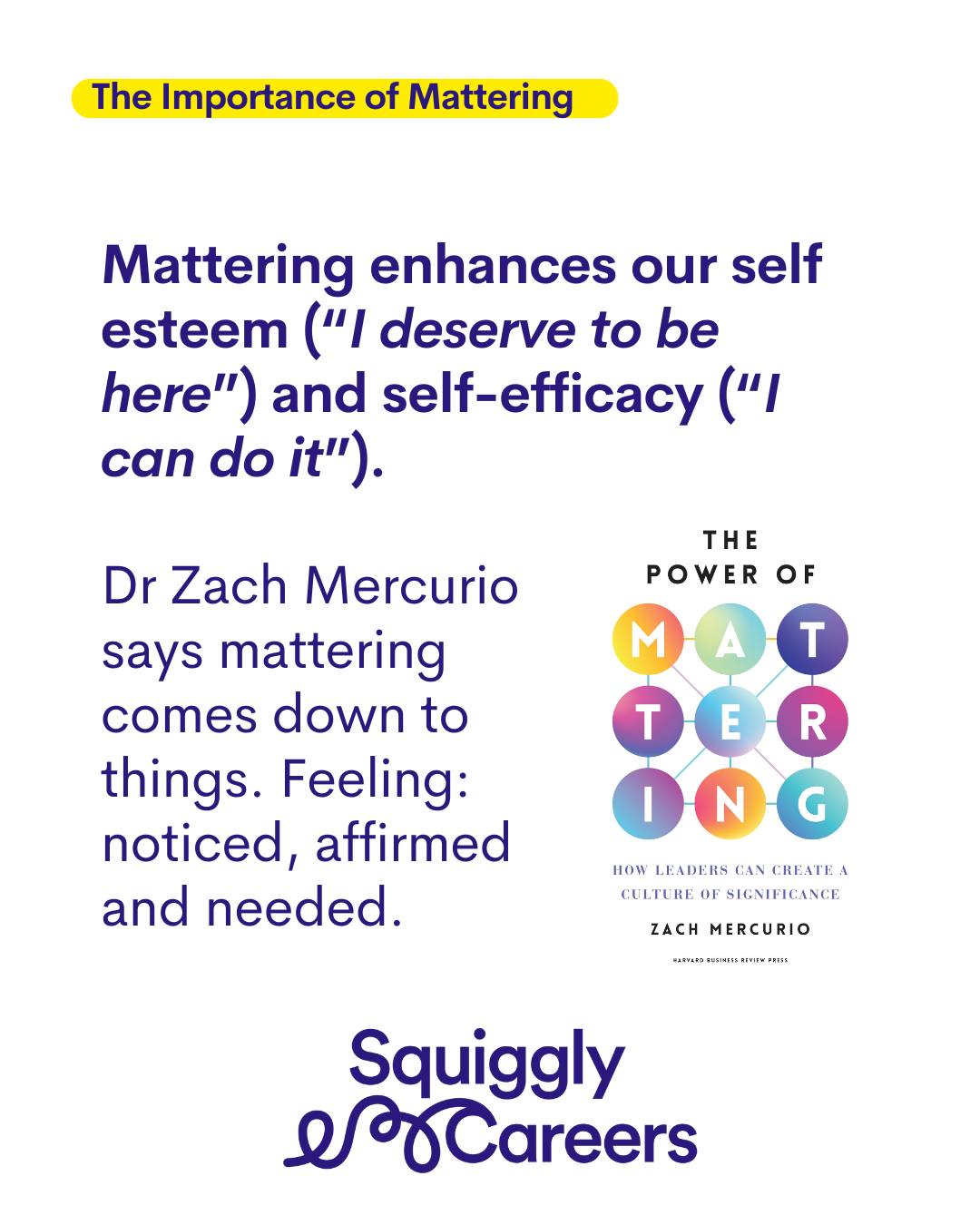
The Power of Mattering by Dr. Zach Mercurio
For questions about Squiggly Careers or to share feedback, please email: helenandsarah@squigglycareers.com
Need some more squiggly career support?
1. Download our free careers tools
2. Sign up for our Squiggly Careers Learn Like a Lobster Skills Sprint
3. Sign up for Squiggly Careers in Action, a weekly summary of the latest squiggly career tools
4. Pre-order our new book Learn Like a Lobster
00:00:00: Introduction
00:01:06: Defining mattering
00:02:31: Mattering vs belonging
00:05:39: Some valuable research
00:07:37: Questions for reflection
00:15:00: The ingredients of mattering
00:16:09: Ideas for action...
00:16:39: ... 1: noticing
00:20:41: ... 2: affirmation
00:25:25: ... 3: needing
00:32:32: Meaningless, mattering, enmeshment
00:33:13: Final thoughts
Sarah Ellis: Hi, I'm Sarah.
Helen Tupper: And I'm Helen.
Sarah Ellis: And this is the Squiggly Careers podcast. Every week we borrow some brilliance from a person, a concept, a place, an object, even notoriously one week with marshmallows.
Helen Tupper: And another week we did a chair.
Sarah Ellis: We did do a chair. And what we try to do, as abstract as that might sound, is turn that curiosity into really useful actions for you and your Squiggly Career.
Helen Tupper: And so, today, we're going to talk about the concept of mattering, and we're going to lean on a book that's come out quite recently by Zach Mercurio, a book I actually really enjoyed. But there has been another book on the same topic out recently. So, clearly, mattering is becoming, I don't know, hopefully a slightly more common conversation. And we wanted to bring some of the insights to you in today's episode and help you think about what mattering might mean for you and your team. If you are a leader or a manager, I think this is particularly important, some of the ideas we're going to talk about. And then, we're going to give you some specific actions for how you can increase mattering.
Sarah Ellis: Excellent, good to go?
Helen Tupper: Let's do it. Shall we define mattering first of all?
Sarah Ellis: Yes.
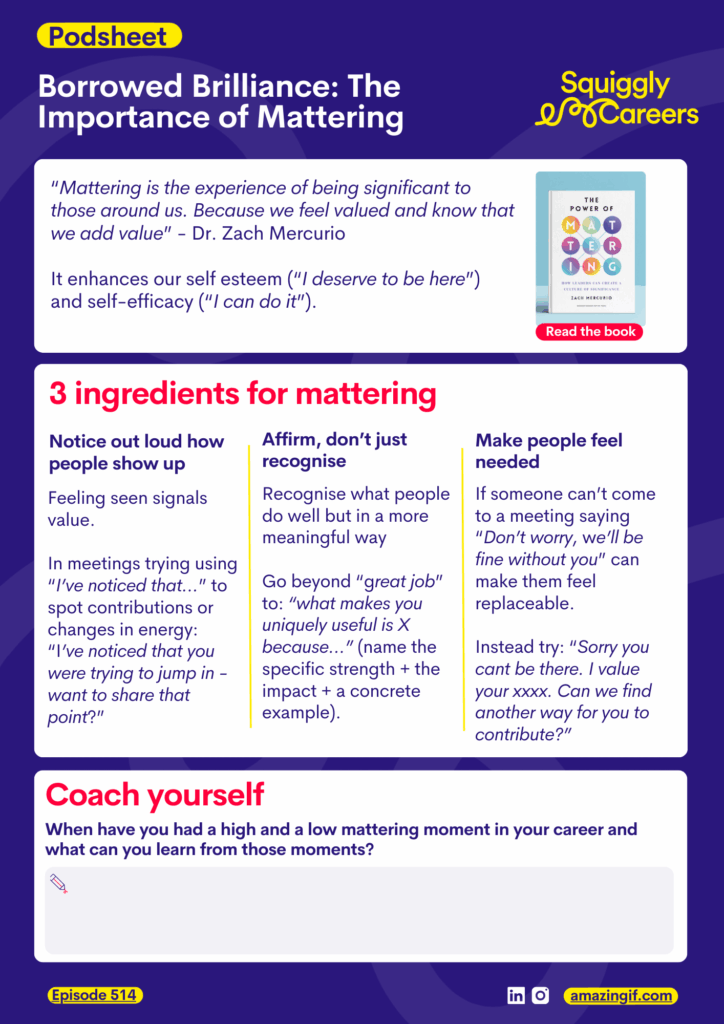
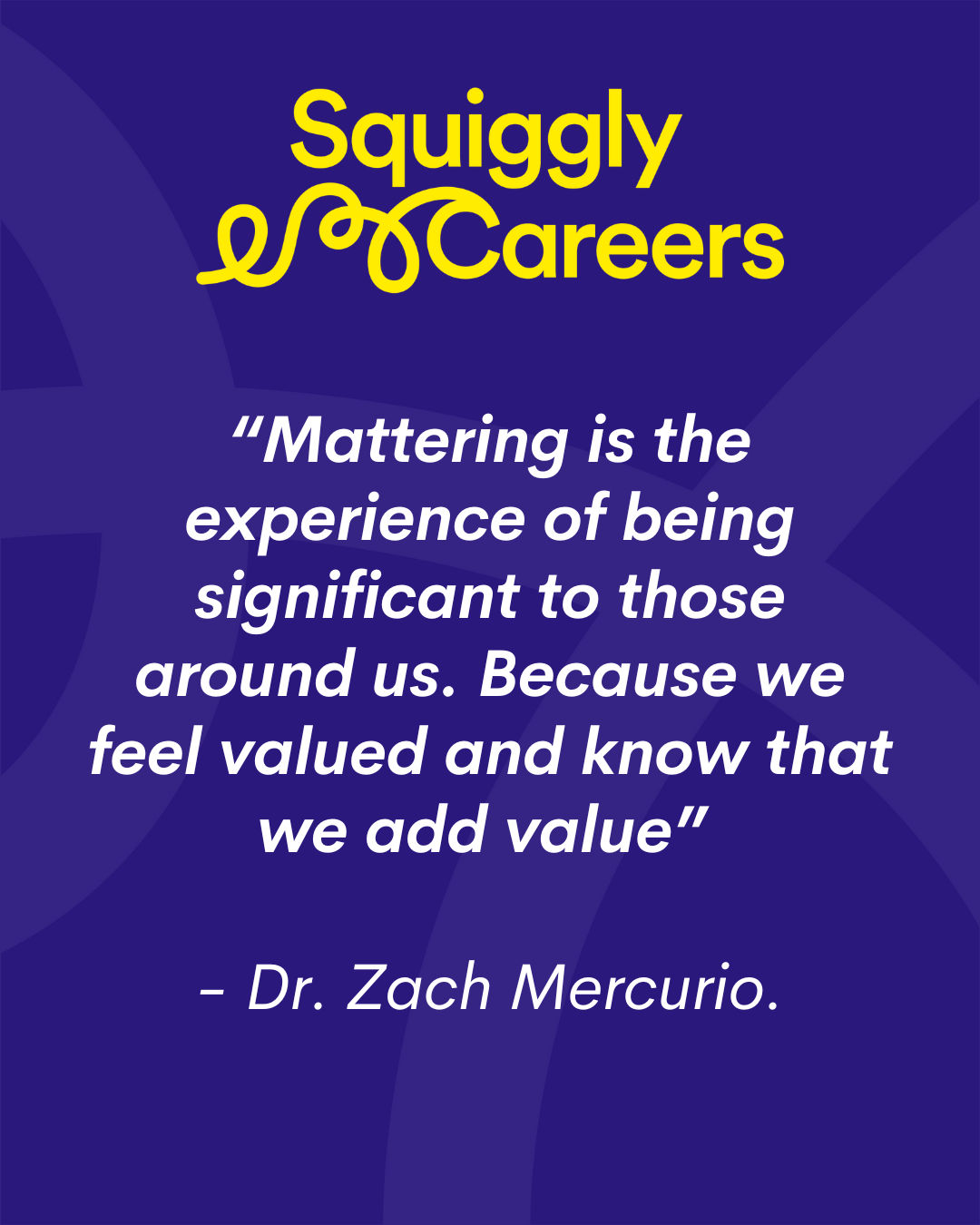
Helen Tupper: So, again, I borrowed this from the book, and it says that, "Mattering is the experience of feeling significant to those around us", Sarah, for example, "because we feel valued and know that we add value". And as I've gone through this and Sarah and I have talked, I just keep coming back to that. Like, "Do I feel valued and am I valuable?"
Sarah Ellis: Yeah, valued and valuable.
Helen Tupper: Yeah, if you want a shortcut to what mattering means, valued and valuable is probably the thing to keep in your mind. And the reason it matters is because it enhances our self-esteem. So, when you feel like you matter, you believe you deserve to be there, to be in the team, to be on the project, to have the job.
Sarah Ellis: Kind of the opposite of imposter syndrome?
Helen Tupper: Yeah, if imposter syndrome is, "I feel like I'm going to get found out", then self-esteem is, "I feel like I have a right to be here". And so, when you get a sense of mattering, you feel that right. The other thing is it enhances self-efficacy, which is a belief that you can do it, not just that you have the right to be here, but a belief that you're going to do a good job, you've got the skills, you've got the knowledge, you are able to do a good job. It's those two things, self-esteem and then self-efficacy that you get when it feels like you matter.
Sarah Ellis: And I asked you this question and you had already pre-empted it, how is it different to belonging? Because I think it would be easy to mix those two up. But I think they are quite different when you start to get into it in a bit more detail.
Helen Tupper: So, they are different. So, belonging is where you feel like you're accepted in a group.
Sarah Ellis: Do you accept me?
Helen Tupper: I do accept you, I feel like you belong, you belong to me. But you feel like you're welcome.
Sarah Ellis: I don't want to belong to you. That sounds like ownership!
Helen Tupper: I own you!
Sarah Ellis: You can try.
Helen Tupper: So, if we take this idea of ownership out of it, it feels like you're in a group situation, let's say in a team, and you feel like you're in the right place, you're with the right people. That's belonging and it's definitely a nice thing to have. But mattering goes further, because mattering is where you feel significant. So, it's not just, "I feel like this is a good group for me to be in. I feel like I fit in this group". It goes beyond that, "And I make a difference, I make a difference to this group. I feel like by being here, I add value", which goes back to the mattering point there.
Sarah Ellis: I'm trying to work out how interdependent the two things are. Can you belong without mattering? Can you matter without belonging? And I suspect those things can be true.
Helen Tupper: Well, so if you think about mattering --
Sarah Ellis: Obviously, in the best-case scenario, you have both of them.
Helen Tupper: Yeah, ideally. So, I guess the question would be, "Have you in your career had a moment where you felt significant to a team or a company, but you didn't feel like you belonged in it?"
Sarah Ellis: Yeah.
Helen Tupper: I think I have.
Sarah Ellis: Yeah. So, I think those things, I suppose your ideal is that you have both of those things. That's probably how you have the most enjoyable week at work and have the most impact in your week at work. But I suppose one of those can be true when the other one is not true, I think.
Helen Tupper: I was actually thinking, just to give a specific example, I think when I worked for BP, I felt like I was doing a significant job, I was making a difference and I was contributing value. But I didn't always feel like I fit in.
Sarah Ellis: Yeah, okay.
Helen Tupper: I think the profile of the people there was a little bit different. Maybe even at Capital One a little bit as well, because they valued a particular intellect that wasn't mine. I never felt like I quite belonged because I didn't have that intellect, but I still felt like I was adding value. So, yeah, I think you're right, you can do it, but the ideal, I guess, is you want both. I think the dream jobs are where you feel like you belong, so you feel like you fit in and you're accepted, and you also feel valued and valuable. That's our 'mattering' sweet spot. And the payoff when you get to that sweet spot is the research shows that you get higher performance, you get higher wellbeing at work, people are happier in their job. So, we all feel better when it feels like we matter at work. And there is some research around this that highlights why this should be a priority conversation. Would you like to talk about the research?
Sarah Ellis: Well, I suppose some of it is what happens when you don't have this, which I found interesting when Helen shared this with me. So, in the UK, 42% of employees say they feel undervalued at work. And that's this idea of, "I don't feel valuable". So, I often think, what's the opposite of that? And that's probably feeling invisible. It's not, "It doesn't make that much difference that I'm here", like almost, "No one would miss me if I wasn't here" and you feeling that way like, "I don't make that much difference". I think that's just not a very nice feeling to go to work with every day, but then also very hard to stay motivated. If you have that sense of, "Oh, I'm invisible, it's a bit irrelevant whether I'm here or not here, and no one's going to notice if I'm not around", then you sort of go, well, it's very hard then to be really committed to what you're trying to do. And that 42% I think feels like a really high number. I think that is a number from 2025, so it's quite a recent number. So, I think that's quite a worrying stat, four in ten people.
Helen Tupper: Yeah, to make it really real, that means that four in ten people listening to this podcast episode right now feel invisible at work, which means they feel like they don't matter.
Sarah Ellis: Let's hope that's not true.
Helen Tupper: Well, I mean, based on the research...
Sarah Ellis: No, but maybe because they listen to the Squiggly Careers podcast, they've really thought about their career and they're in amazing roles with lots of relevant impact.
Helen Tupper: I hope that is true as well. But I think if you are one of those people --
Sarah Ellis: You're not alone.
Helen Tupper: Yeah, I think that's really important. If you are one of the people, one of the four in ten people that feels invisible at work right now, know you're not alone. Know that other people are feeling like this too and know that hopefully by listening to this episode, you'll be able to identify some different things you can do, and also different things that you can support other people with as well so that you create more connection. So, we are going to just share a few reflections ourselves on some coaching questions to start with as you're thinking about reflections on mattering in your career so far. And then, we're going to go through three areas that contribute towards mattering. And that's where the ideas for action for you or for people that you work with will be.
So, the questions we thought are useful to reflect on are, when have you had a high mattering moment in your career? And when have you had a low mattering moment in your career? And what can you learn from the two? So, can I ask you?
Sarah Ellis: Of course, of course. So, I have thought about this before, before anyone thinks, "Wow, they can just think of these examples on the spot". And actually, I think what's interesting about my example, it was in the same company. I went from a low-mattering moment to a high-mattering moment when I did a squiggle-and-stay move, when I changed teams. And back to our reflection on the connection with belonging, I felt like I belonged in both teams. So, I enjoyed being in both teams and I felt I could be myself and I really enjoyed the people that I was working with, but I felt like I mattered a lot more in one role than in the other. And I think it goes back to that valued and valuable. I think in that first role, this is when I was working for Barclays, so for a big bank, very easy I think in a big company to feel like you don't matter. But actually, that hasn't been my experience. I've had both experiences in big companies. But I think in that first role where I didn't feel like I mattered as much, I think it was a job that was maybe a bit of a nice-to-have job, if I'm honest; it was very hard for me, I wasn't very senior, and it was quite hierarchical for me to really feel like anything that I did ever made a really big difference.
I was also working on innovation that took a long time, I couldn't see a lot of fruits of my labour. I could work hard and then, you know like you're working hard to do a PowerPoint, I do think I had a job that was like, "I'm working hard on PowerPoint slides", and that is a bit demoralising after a while. And so, I probably felt a bit valued. I worked for a great leader who I loved, so I felt a bit valued. I didn't feel very valuable, and that's probably why I wanted to squiggle and stay. I then moved into a job where it was a brand-new job, brand-new team. And suddenly, I was using all my skills, all my strengths, I was making stuff happen, a very different style of role. I really found my flow in that job, and I felt both valued and valuable. I knew the work that I did made a difference, I could see it. It was almost like, well, if I didn't do it, no one else was going to do it. It wasn't like anyone could do that job. And I was probably a very good fit for what that job needed. So, it was a really contrasting experience.
I do think it's always so interesting, isn't it, in a big company? I could have easily left Barclays being like, "Oh, I'm not enjoying my role". But actually, I'm really glad that I stayed, because I moved to a job that then I both belonged in and had that mattering. I think that I've had a few of those experiences in big companies.
Helen Tupper: And you know the mattering payoff is this motivation, wellbeing at work and performance. In that second one, where you felt a greater sense of mattering, would you say that you had higher levels of those three?
Sarah Ellis: Yeah, across all of those. I worked so hard because I loved it. I was really driven. I worked harder. You know discretionary effort?
Helen Tupper: Yeah.
Sarah Ellis: My discretionary effort in that second job was massive compared to that first job. And also, it felt worth it, the discretionary effort felt worth it. And I was definitely performing better, because I know that from the feedback that I was getting. I think I moved into a more senior role, so there was lots of recognition of the impact that I was having. I was a way better employee in that second job than I was in that first job.
Helen Tupper: It's interesting. My insights are slightly different. So, my highest-mattering moment, or a very high one.
Sarah Ellis: Now?
Helen Tupper: I say, "No!" No, it's very high mattering.
Sarah Ellis: Neither of us have actually chosen what we're doing today.
Helen Tupper: That's true, but that's not because it doesn't. But a previous high-mattering moment, I would say, was when I was at Virgin and I was launching Virgin Red. And it was a high-mattering moment for me, I definitely felt valuable. I mean, I felt valued because there weren't a lot of us starting that business. There was no one other than me, so I felt like, "We need Helen".
Sarah Ellis: "If not me, then who?"
Helen Tupper: Exactly that. But I also felt valuable because I was bringing lots of energy and ideas to it. So, that was definitely a high-mattering moment for me. I don't think that business would have made as much momentum as it had or actually have looked like it did without me. And then my low-mattering moment, I reflected and I was quite surprised by it, was actually when I was at Microsoft. And I really loved Microsoft, so I feel like I have to caveat this moment. And I was thinking, "Why did it feel like a low mattering moment?" So, why didn't I feel valued and/or valuable? And I think it was partly because of the team that I was in. So, there was quite a lot of politics around what teams held the most power in the business, and I'm not sure mine did. And so, I felt like I was in a team --
Sarah Ellis: Hard to matter.
Helen Tupper: Yeah, I felt like as hard as I wanted to work and --
Sarah Ellis: Yeah, you wanted to matter.
Helen Tupper: I wanted to matter and I wanted to do a good job. But I think the reality was, at that time, the organisational dynamic was that, the team and the area that I was working in, people were quite, I don't know, quite critical of, and it was very hard to matter in a team that didn't feel like it was valued or valuable to the organisation. That was hard, and I got to that reflection from these questions. I hadn't really thought about it before.
Sarah Ellis: I've done a few of those jobs though, where in some companies, there are those nice-to-have jobs. Maybe less so now that companies have to work really hard to be efficient and effective. But particularly I think in big companies, there are the teams where that team really matters. So, we're talking about this at an individual level, right? But if you go, "Oh, what teams matter most in that organisation?" You know organisations have like a slant or like a DNA, and you're like, "Well, if it's a really operational company, the operational teams matter most". So, naturally, if you're in those kinds of roles, it's probably easier. Whereas I sometimes have done jobs that are new or a bit peripheral or a bit left field that I really wanted to do. But like you said, it's almost like it doesn't matter how hard you work or how good you are, they're never going to be quite as important as some of the other things. And that's probably okay. It's just I actually do remember feeling that in a few roles, and almost spotting it and thinking, "Okay, how can I take what I really enjoy about doing this, but is there an area where I could have more of an impact in terms of mattering?"
Also, knowing that your role is probably slightly more at risk, because that has also definitely happened to me. But I think I always knew that and made that choice being like, this is a riskier role because it clearly doesn't matter as much as some of those other ones. Even if I thought it should, I just know that it doesn't.
Helen Tupper: I think it's just quite a useful reflection to think about mattering, and maybe use your past experience, think about what you're doing right now. So, ask yourself those questions. I think it's good for your own insight. But what we wanted to get into is sort of the ingredients of mattering.
Sarah Ellis: It's really interesting.
Helen Tupper: It is really interesting. And based on Zach Mercurio's work in his book, he talks about three things that add up to how much people feel like they matter. So, the first one is 'noticing'. So, people feel like they matter to a team and an organisation when they feel noticed. And so, that is not just someone who's ticking off tasks, but they feel like they are noticed as a human being. Like, you know who I am, not just what I do. So, that's the first thing, people feel like their values are known and they're recognised as an individual at work. So, that's the first thing, "Do people feel noticed at an individual level?"
The second thing is 'affirmed'. So, this is about, "Do people feel like they're adding value? Do they feel like they are recognised and affirmed by other people as adding, as in value?" And then, the third one is, "Do people feel needed?" So, do they feel like they're, "If not me, then who?" It's that sense. So, what we wanted to talk about was these three areas of being noticed and being affirmed and being needed, and to share some practical ideas for what this might look like at work. And these ideas, they're not actually from the book, they're me and Sarah thinking about --
Sarah Ellis: Out of our head.
Helen Tupper: Yeah, out of our head. Based on I think the company that we run now, Amazing If, and the work that we've done, "What do we think works for noticing, being affirmed, and making people feel needed?" Should we start with noticing?
Sarah Ellis: Yeah.
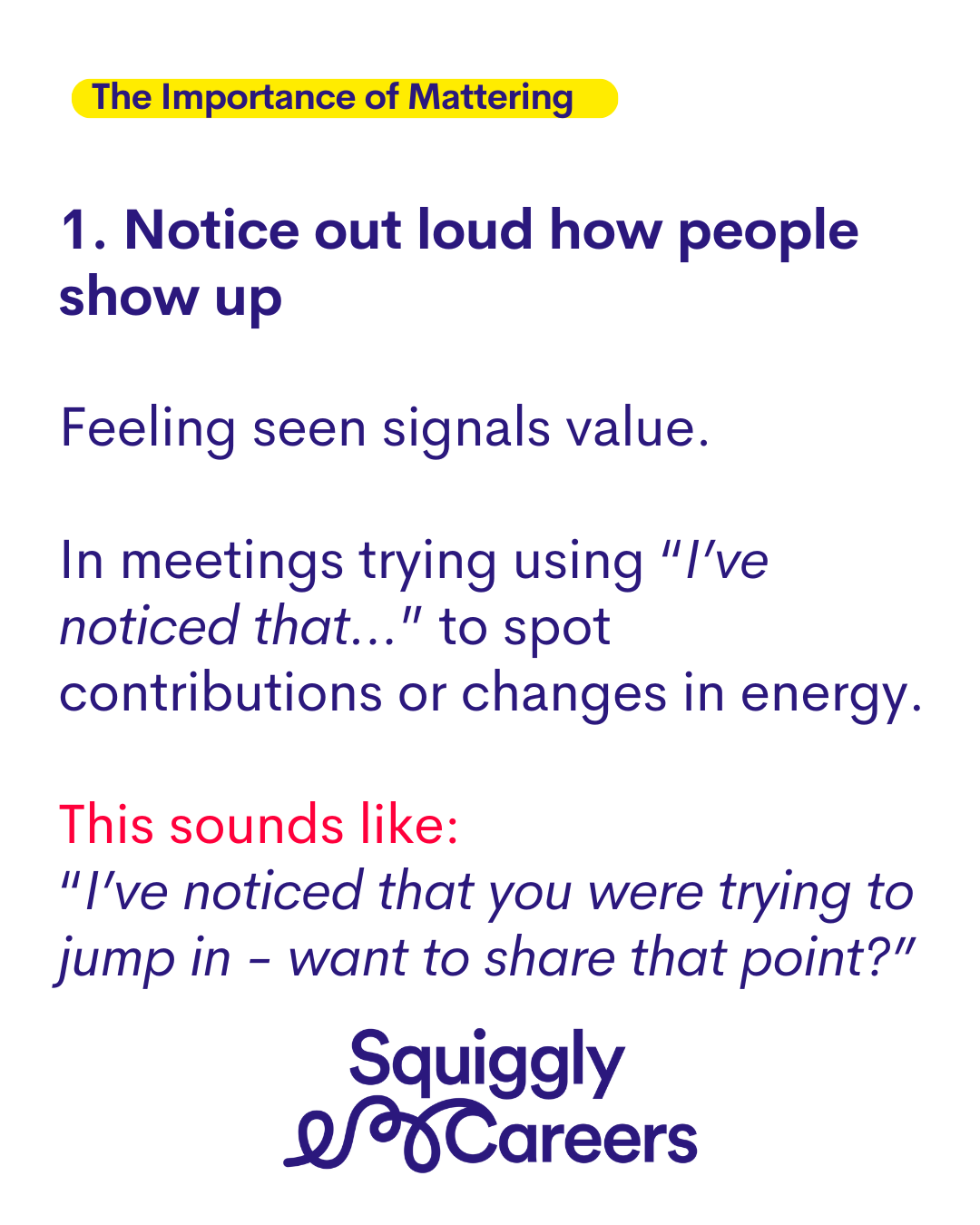
Helen Tupper: And so, the ideas here, we've actually done an episode on noticing, where we talked about why we think this is a bit of a secret career skill that no one talks about. But if you want people to feel like they matter, average day or average week at work, we would say start to notice how people are showing up in meetings. It's a really simple way to make people feel seen and heard. And there are loads of things that you can look out for. If you've really got like a noticing filter on in a meeting, you might notice that someone's engagement in that meeting is slightly different to normal, and you might ask them a question.
Sarah Ellis: So, I had this happen to me.
Helen Tupper: Did you?
Sarah Ellis: I did. So, someone on our team who did a good job of noticing, so we had spent some time in meetings together in a week and that's not unusual, we would normally spend time together. And she said to me, "Oh, I've noticed that meetings with you have felt a bit different this week". Now, I was in a different place and in quite a different headspace to a normal week, and so I was sort of half on holiday. My partner and my son were on holiday, but I was sort of working where we were. And I think basically, I had probably shown up and she was like, "Oh, you've been very sort of, you've taken more of a coaching approach this week to our conversations than probably normally", whereas normally I'm probably a bit more like, "We've got to get this action done. I think it's what we need to do", probably more directive. So, more directive versus coaching. And I was like, she'd noticed that, and then also taken the time to tell me. So, I felt very noticed. And I think some of that had been effort, that I think if she hadn't told me that, that she'd noticed that, I probably wouldn't have had it as enough of a reflection to do anything differently, because it did make me think.
It's not like I think being directive is always wrong, but I thought, "Well, I don't only want to take a coaching approach when I happen to half be on holiday", because I'm probably more relaxed, very calm, I hadn't got as much going on that week. And so, it did make me then think, "Oh, that is a way that I can be valuable". Back to, "Am I valued and valuable?" She really valued that coaching approach from me that week. She was essentially saying, in a much nicer way, "I found that really useful, and perhaps sometimes more useful than you just being really directive", as in she felt like she'd learned more from me, she'd felt very supported, she was very positive about the impact it had had on her. And so, it did make me think, "Okay, I don't want to rely on that only happening very infrequently. How can I take more of a coaching approach? If that is valuable and also something I enjoy doing, what would that look like more frequently?" So, I thought it was good noticing.
Helen Tupper: It's very good noticing. Also, quite a nice link, I think, to last week's episode on resting, which is maybe the better that you rest, the more in that mode you can be.
Sarah Ellis: Yeah, versus, "We need to get these things done, now!"
Helen Tupper: "It needs to get done". Also, I think that when you shared that example, the fact that someone said, "I've noticed that", I think that is the easiest way to take this action. If I just say, "I've noticed that you were trying to say something in the meeting and you didn't quite get your initial thought. Would you like to share it?" Or, "I've noticed that you're really emotive about that point". I'm always listening when people say, "I absolutely love that", or particularly, I listen for the hate. Sometimes, when I'm having career conversations with people, and I'm just listening and listening, and they'll say, "I really hated that job", I'm like, "That's an unusual level of emotion". It's a strong statement, people saying, "Hate that work". So, I would be like, "Oh, I noticed that you used the word 'hate' when you talked about … I'd love to hear a little bit more about that". But literally, just use the statement, "I've noticed that", and people feel seen and heard more than if you're not saying that, and that's what this point is really all about; people feel seen and heard at work.
Sarah Ellis: Tell me we're not going to have to do some positive affirmations now.
Helen Tupper: So, the affirmation is about mantras at work. No, no, it's not!
Sarah Ellis: Okay, good.
Helen Tupper: So, the affirmation really is about recognising what people do well, but in a meaningful way. And there's a really interesting point in the book about this difference between recognition and affirmation. Like, there are different things. We do something in Amazing If which we call Squiggly Shoutouts. We might do this in a meeting or we might do it on Microsoft Teams, and we just call it a Squiggly Shoutout. And it is where we are intentionally calling out what someone has done well. But we thought we would talk about Squiggly Shoutouts and how they might differ from just recognition to affirmation. And we're trying to get to this level of affirmation in order for it to feel like someone matters.
So, level one Squiggly Shoutout is just recognition, which might sound like…
Sarah Ellis: "Helen, great job this week. I know you've worked really hard".
Helen Tupper: Great, I might feel praised by that, but it's not enough to make someone feel like they matter. So, let's go to a like a level two Squiggly Shoutout, what would that sound like?
Sarah Ellis: "Helen, Thanks for all your hard work on presentations for our partners this week. I thought you showed great initiative on putting together all the data and the information we needed. Thanks for that".
Helen Tupper: Okay. So, that feels better to me. I listened to that, I think it feels a bit more personal, it feels a bit more detailed, so I definitely feel better. So, that's a level two Squiggly Shoutout. And level three is the level of affirmation, which is what matters most to people when they feel like they matter. So, if you were doing a level three Squiggly Shoutout, what would that sound like?
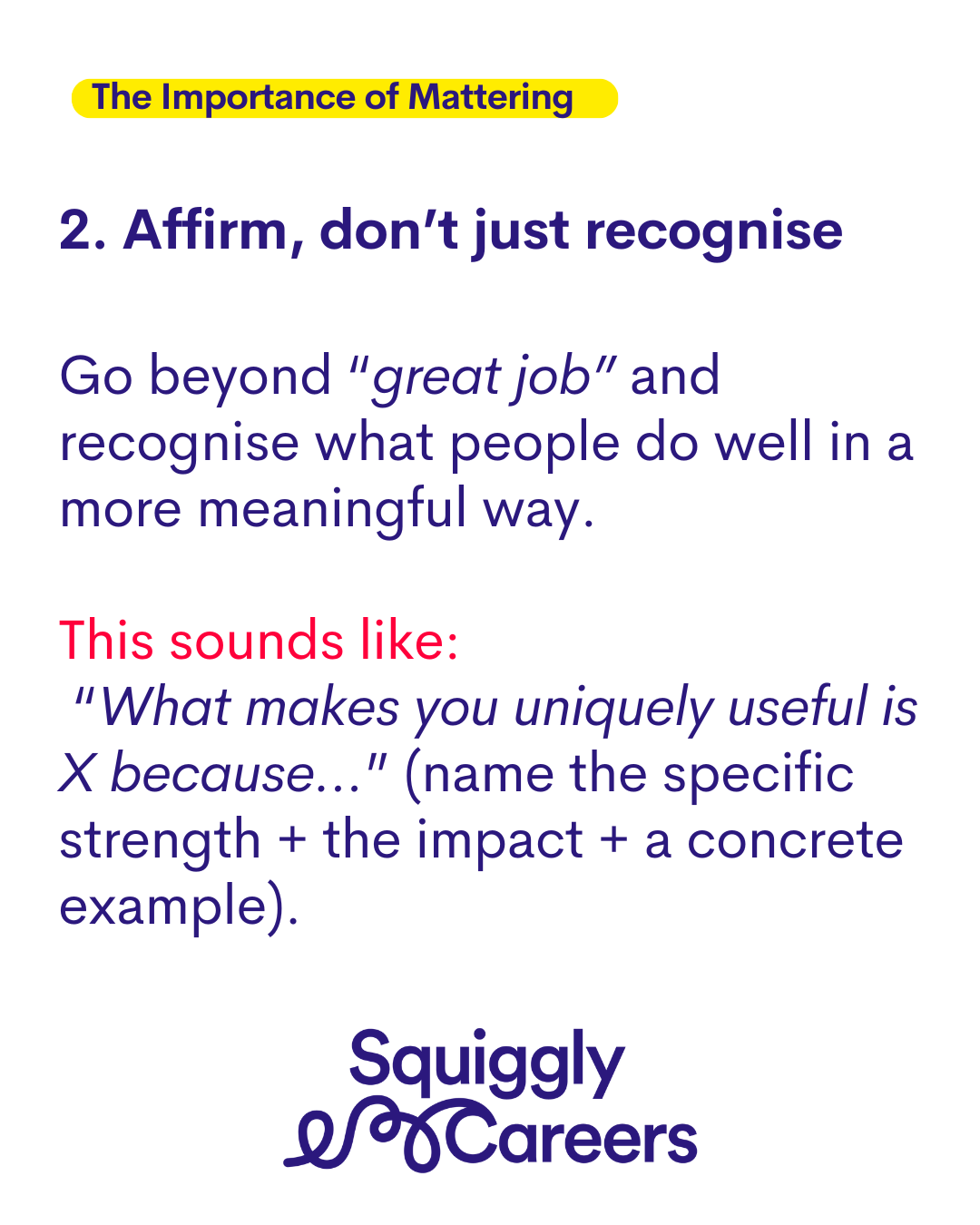
Sarah Ellis: So, that would be, "Helen, thanks for all your hard work this week. One of the things that makes you uniquely useful at Amazing If is your ability to anticipate what our learning partners need before they even know it for themselves. And that is such a brilliant skill. And I really see that show up across everything that you do. And particularly this week, in that presentation you sent to our partner, you sent them some things they hadn't asked for, but I know they're going to find really helpful".
Helen Tupper: Now I feel amazing! I'm like, "I did a really good job, I'm really useful, I'm really valuable". And I think the statement that I would copy, from what Sarah said there, is 'uniquely useful', because this idea of someone feeling affirmed is where they feel like they have made a unique and valuable contribution. We talked before about the 'brilliant because', "I thought what you did was really brilliant because…" could be another way that you could get into that. Or sometimes, I talk about, I might say to our team, "Oh, it's a real Sarah super-strength when you…". The point of affirmation is, it's something that that individual has done that other people hadn't done or couldn't do that is a unique contribution from them. That's the level you're trying to get at. So, it's not just, "Well done, good job". We've got to go a little bit further if we want people to feel really affirmed, appreciated and feel like their contribution matters.
Sarah Ellis: And I don't think you have to go overboard, right? It would be a bit overkill if you were all the time trying to get into this deep level of affirmation. But I think it is just spotting opportunities for when that is relevant. Sometimes I think a Squiggly Shoutout that is just like, "That was brilliant because…" is fine. But I do think there are moments where people do work where you think, "Oh, it's because of who you are and what makes you valuable, that's why that has been so good". And you don't want to miss those moments to tell people that, because I think remembering most people are their own worst critics. When I ask people that in workshops, they're always like, "Yeah". I think so many people give themselves a hard time and it's really easy to assume that people know that they matter. Because you're like, "Well, obviously, because they're amazing at data analysis, and look at the good impact that had". You might just be thinking that, but I think just don't underestimate the importance of saying it as well.
Helen Tupper: I think, again, if you want to make this really easy, on the point I'm noticing, I think it's, "I've noticed that…". On this point with affirmation, I'd either go with, "It's uniquely useful…" as a way into it, or I'd use someone's strengths, because that feels like a very normal conversation, "You've got a real super-strength", or, "I really see this … strength when you…" because I think strengths feel personal, they feel really ownable for somebody. So, just an easy way into, if you've never thought about these conversations before, that might be a quick way to remember it.
Sarah Ellis: So, needed, are you going to tell me why you need me?
Helen Tupper: Would you like to? You are a bit needy sometimes!
Sarah Ellis: I know I am!
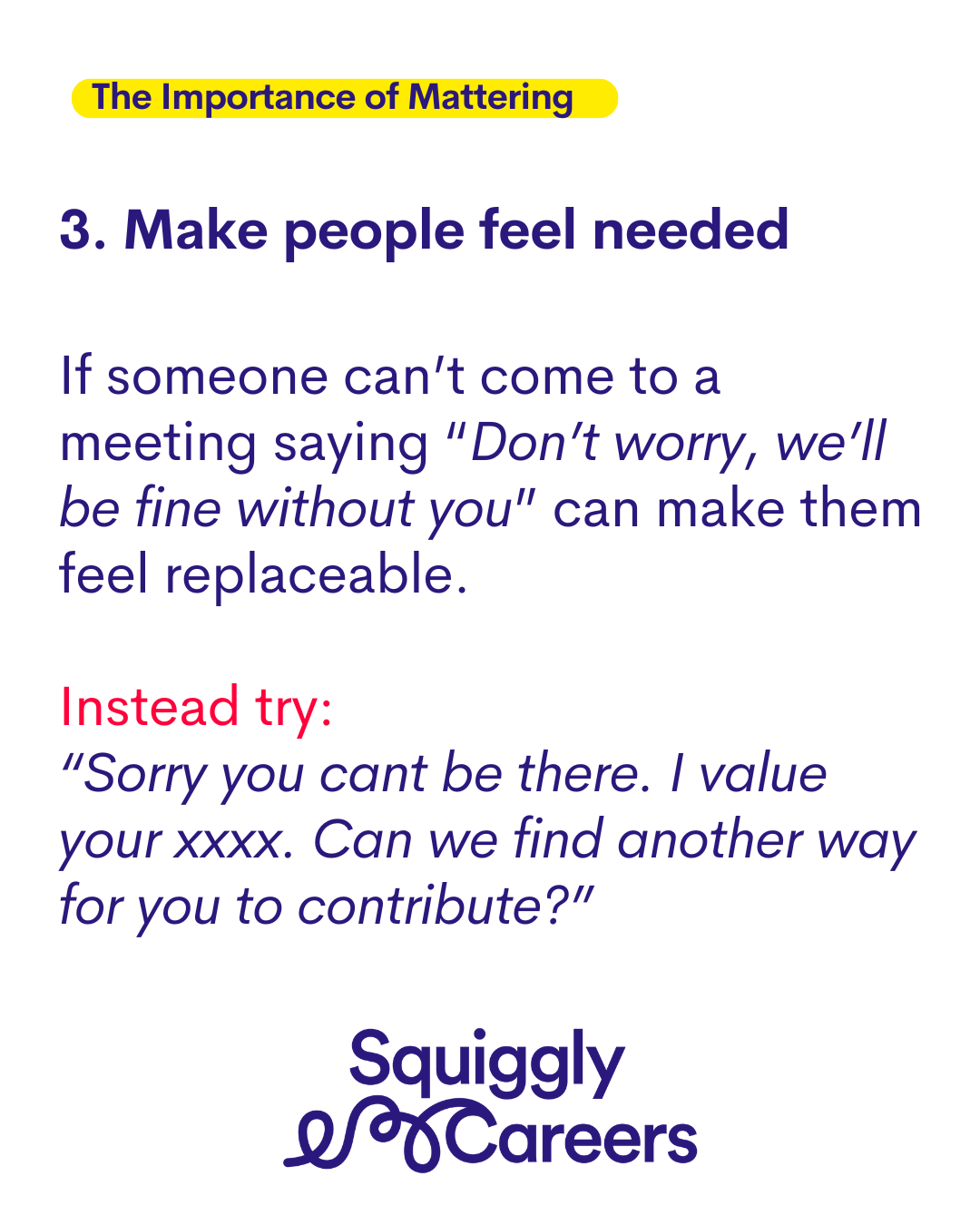
Helen Tupper: But that's not the point. The point around needing is people want to feel like they are needed. And it was interesting, when we were reflecting on, "Well, how do you say that someone's needed at work?" The opposite to this is a bit of a watch-out, because I think we might say this without meaning to make someone feel not needed. But you know when people go on holiday, or they're, I don't know, they can't make a meeting. Let's say they can't make a meeting because they're in another meeting, or they're on holiday, or they've got a maternity leave, and you want to take the pressure off them, that's the intent, so you say to them, "Oh don't worry, don't worry, Sarah. You go away, have a break, we'll be absolutely fine without you, you don't need to worry about anything". That is like a red flag to someone feeling like they are replaceable. And there's quite a nice quote in the book actually which says like, "If people feel like they are replaceable, they will act like they are replaceable".
Sarah Ellis: So interesting
Helen Tupper: "Well, I don't matter, what's the point anyway?"
Sarah Ellis: I definitely say that to people, from a really positive place of trying to get people to take a break. I think I'm doing it to try and reassure someone like, "Of course it's going to be okay that you're on holiday, because we will do the things that need to make happen and that's okay". Or, especially if someone is in that more vulnerable moment of you going on maternity or paternity leave, being like, "Oh, but don't worry, we were okay before and we'll just be brilliant when you get back". I have definitely said those things.
Helen Tupper: But you know when you put this filter on it, you're like, "Oh, gosh, that probably doesn't feel very nice". That probably feels like, "Oh, I'm not that significant. They don't really need me after all, they're just going to go back to the way it was before me". It's quite hard, isn't it?
Sarah Ellis: What do you say instead? Because if you do still want people to -- because I do think the intent is genuinely positive, like I do want people to take a break. So, is it more about saying, "Well, obviously, we're really going to miss you. It makes a difference that you're not here".
Helen Tupper: Yes. So, I think what you might do, I think there's a before and an after the moment that that person isn't in that you can still make them feel needed. So, I think you can say, "Oh, Sarah, I really want you to have a good break. The thing that is really useful is the questions that you ask in a meeting, or the way you keep us focused. Could you maybe have a look over this before you go so I make sure your input is in the meeting?"
Sarah Ellis: Okay, yeah.
Helen Tupper: I was actually in a board meeting this week where the chair of the meeting -- someone couldn't come, and on multiple times the chair said, "I just want to add in this perspective from the person that couldn't come", and they would have known that they were still valuable in that meeting even when they couldn't have been in. So, I think you can do that beforehand, like, "Don't worry, go have your break, enjoy yourself. I would still really like your contribution. Is there any chance you could give me some questions so I can bring that in?" Or after the meeting, I think you could say to somebody, "I hope you had a great holiday. I really want to run by a couple of things that happened when you were off, because I really need your input on this. I think it would be a real miss if we didn't bring you into it". So, I think you can cover the moment that someone might be missing and still make them feel like they are needed and valuable to it.
Sarah Ellis: I was just thinking, there's also probably a point, if I was being critical of myself, is if you are a bit needy, also you have to sometimes let things go a bit. Like, the other side of this is I'm just imagining, I'm like, "Oh, God, it sounds like quite hard work for you to have to tell me before I go for a break". And then, when I come back, like, "Oh, Sarah, you do matter". There's also a bit of like, "Oh, Sarah, get over yourself. Obviously you make a difference!" Because I was saying to you beforehand, the reason I say this is I said, "Oh, sometimes I haven't always felt that needed in Amazing If", and you were shocked. You were like, "What do you mean?" And I was saying, "Well, sometimes I definitely have had a holiday or perhaps been away ill or not been around". And you probably do say to me like, "Don't worry, I've got it". And then, I probably do come back and be like, "Well, she has sort of got it, so..." you know, you don't feel as needed. But I am somebody who does probably quite like to feel needed. So, that's probably harder for me. But I'm like, do I really need you to then start telling me, "You matter"? I'm like, probably not.
It's probably a bit of just recognition though, like based on your own -- I think I got used to, over lots of years, you know when you work in bigger companies and there's more recognition. It's quite ladderlike thinking, some of those sorts of things. And I think I've had to just get used to my own self-worth a bit and not needing other people to tell me that I am valuable.
Helen Tupper: Yeah, I mean I don't want to get into a meta-conversation about need, but I do wonder whether saying like, "What I need and value from you…" because you might think, "Oh, I'm not valuable because Helen's, I don't know, put something on LinkedIn without approving it with me", or whatever. And I'd be like, "Well, yeah, but that's not what I need from you. What I really need and value from you is our connections and our conversations and our ideas and our debate". And if you had that conversation with people in your team about, "What I really need and value from you is…" I wonder how often those conversations happen, like, "What I need from you and what I value from you is…". I think maybe you'd get to a deeper level of understanding from people. We don't use that word very often.
Sarah Ellis: You know if you were saying, "The hard thing about…" which is a phrase that we sometimes use, which is quite good just to stress-test ideas I think, and I think we should all be open to saying the hard thing; you know you said about jobs, "If jobs feel replaceable, you feel like you can just be replaced". But I guess there is also a bit of a reality check of like, most people and jobs are replaceable. I remember having that advice from people like, "Remember, no one person runs a company". Everyone is replaceable to an extent. So, I do think there's perhaps also a bit of a point of like, you do matter. I was thinking about, what's that phrase? 'Enmeshment'. So, I'm like, "Oh, there's an interesting grey line here I think between going, you definitely want to feel like you matter, valued and valuable, but what you don't want it to turn into is enmeshment, which is when all of your self-worth and your self-efficacy is all tied up, in that you matter so much in the job that you do that then, if something changes that is outside of your control, it's a real shock to you. And I think I have seen that happen.
Helen Tupper: Where it goes too far?
Sarah Ellis: Yeah, where I think people would say, the mattering was so high, they felt valued and valuable. But then they forgot that sense of perspective and it did, it merged into enmeshment. And then actually, things change. Even though their jobs might have felt irreplaceable, then they turned out, "Actually, we don't need that team anymore".
Helen Tupper: I mean, maybe this is a new thing, but I'm seeing a spectrum.
Sarah Ellis: Of course you are.
Helen Tupper: I'm seeing a spectrum.
Sarah Ellis: It's either a spectrum or a matrix.
Helen Tupper: A spectrum or a matrix, this is the way our brain works. But you've got 'meaningless', 'mattering' and 'enmeshment'. And 'meaningless' is not good, because people will feel completely replaceable and they will act that way; 'mattering' is the aim, because that's where we get motivation and wellbeing and performance; but if it goes too far, you get 'enmeshment', which is where people are basically not very resilient to change, because they feel like a change to the company is a change to them, and the highs and lows of work affect them. So, it's interesting. I mean, the work hasn't gone that far, but you could.
Sarah Ellis: That's just my brain.
Helen Tupper: It's just Sarah's brain taking it to the next level of thought. But if we bring it back to the middle ground of mattering, and maybe we just summarise what we've talked about on the podcast. So, mattering is where you feel valued and valuable. And the benefits when we get this right, at an individual level, are I am more motivated, my wellbeing is likely to be in a better place, and I'm likely to perform at a higher level. It is perhaps more important now than it has ever been because of that stat that we shared about four in ten people feeling visible at work. So, this does feel like an important thing to reflect on and support people with. And if you want to make people matter more, there are three things that we want to focus on. So, the first is, Do people feel like they are being noticed? Do they feel like they're seen and heard? The second is, do people feel like they're being affirmed, so they know that they are uniquely useful? And then, a third area that contributes to mattering is, do people feel needed, which is I think just having that conversation about, "What I value and need from you is…"? And then, maybe the more that we do that, the more that people know what that need looks like rather than assuming that they are or aren't needed at work.
Sarah Ellis: Quite a deep reflection?
Helen Tupper: Yes, I feel like it went quite deep, but I mean it's quite a deep and important topic. But I think if you can have this conversation as a team, maybe it's not so much a team conversation, I feel like maybe this one's maybe more a peer-to-peer, like, "Do you feel like you're mattering at work on these three areas? What's working well?"
Sarah Ellis: I think if you've got a good relationship with your manager, I can imagine it in like a career conversation. It feels like it could stray into that sort of territory, could be quite good with a mentor, like if you feel like you don't matter. Because that stat is high, right? So, the opposite to what I just said is like, well, if you're one of the four in ten, that's not very sustaining, you don't want to stay in that position for too long. And maybe your manager or your team might be part of that, so they might not be the right people to have a conversation with. So then, I think I would be thinking about who else, given I don't feel valued or valuable, or one of those isn't in the right place. I think I'd be looking for some mentoring, some career conversations with people, either in other parts of my organisation, if that's big enough to do that, or outside of my organisation. Because sometimes, I think, when I have been in those positions, talking to some other people does remind you that where I am now is not where I have to be forever. And it can give you those glimmers of, okay, this is not great at the moment, but it is possible to be in a role where I will matter more.
Helen Tupper: I think you could also ask for some strengths-based feedback. So, "When do you see me at my best?" because maybe you're not proactively getting some of that affirmation. And so, what you might need to do is just ask for some of it.
Sarah Ellis: "What skills are most valuable? What skills do you see that are most valuable in our team or in our organisation?" Because that's also quite interesting, because I might say, "Well, these are the strengths that I want to stand out. These are the strengths that I want to be known for". And that's fine, that's up to you to make those choices and to make those strengths stronger. But you might then also say to me, "And some of the strengths I see in you or the skills that you've got that are particularly valuable are XYZ". Some of those might be the same, but some of them might be different. And that's quite useful, just data for my development, I think. I think some of the things that you would say to me are useful about me are not the things that I want to be known for. But that's also okay. because it would help me to know, "Oh, but I'm needed".
Helen Tupper: Yeah, "I am having a positive impact". So, yeah, if you're one of the four in ten, maybe just, "What makes me uniquely useful to the team? When do you see me at my best? What's the value that I bring?" Go and get some of that if it's not naturally coming to you, so that you can get some of the insight that can help you feel like you matter if you're not getting that data at the moment.
Sarah Ellis: But that's everything for this week. We hope you found the episode useful. Any feedback, we'd love you to email us. We're helenandsarah@squigglycareers.com. Or you can find on amazingif.com, which is our website, all of our previous Skills Sprints, loads of free tools and actions, and all the old podcast episodes, about 500 or so, that you can catch up on if you're looking for some extra career inspiration.
Helen Tupper: And don't forget that we now do two episodes every week. So, we have our longer borrowed brilliance episodes on a Tuesday, which is an episode like this one; and then, on a Thursday, we have Squiggly Shortcuts. They're just five minutes long, they focus on a very specific topic, we cram in lots of ideas for action. So, if you subscribe to Squiggly Careers, wherever you listen, it will make sure that you don't miss out on those episodes.
Sarah Ellis: That's everything for this week. We'll see you again soon. Bye for now.
Helen Tupper: Bye, everyone.
Sign up to the Squiggly Careers Newsletter and get our latest ideas, tools and inspiration every week - all in one place, straight to your inbox