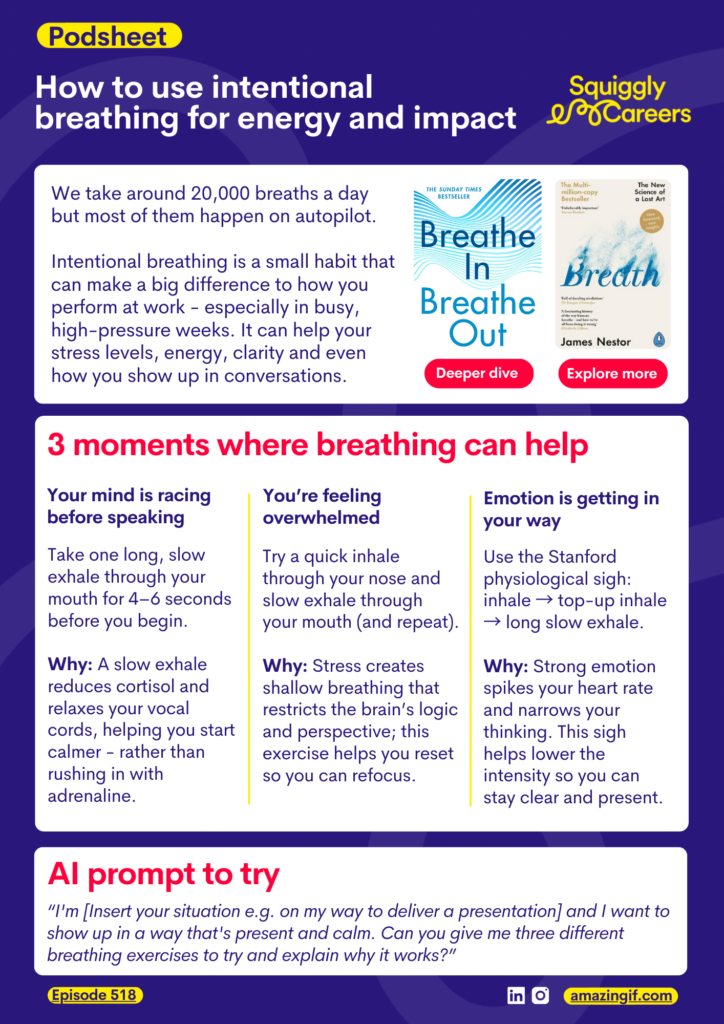
Sometimes work (and life) can feel full-on — especially at this time of year when deadlines, expectations and emotions all seem to intensify. Whether your mind is racing before a meeting, you’re feeling overwhelmed by everything on your plate, or emotions are getting in the way of what you want to say, these simple and science-backed breathing practices can help you reset, refocus and respond with more calm and clarity.
For questions about Squiggly Careers or to share feedback, please email: helenandsarah@squigglycareers.com
Need some more squiggly career support?
1. Download our free careers tools
2. Sign up for our Squiggly Careers Learn Like a Lobster Skills Sprint
3. Sign up for Squiggly Careers in Action, a weekly summary of the latest squiggly career tools
4. Pre-order our new book Learn Like a Lobster
00:00: Introduction
02:52: Facts about breathwork
04:45: Breathwork examples
08:17: Ideas for action...
11:44: ... action 1: when your mind is racing
15:46: ... action 2: overwhelm
18:03: ... action 3: when emotion gets in the way
23:03: AI prompt to try
26:10: Final thoughts
Sarah Ellis: Hi, I'm Sarah.
Helen Tupper: And I'm Helen.
Sarah Ellis: And this is the Squiggly Careers podcast where every week we borrow some brilliance from a person, a place, an object, a thing of some description, and we try to turn that curiosity into useful action for your career.
Helen Tupper: And today our thing is breathing.
Sarah Ellis: I'm sorry, we've gone back to basics.
Helen Tupper: Quite amazing. I'm so happy I've convinced you to do this episode. I think you must have been sceptical
about us doing an episode on breathing.
Sarah Ellis: Yes. Though I have read, I know we're going to talk about four box breathing, that particular kind of technique. I have read a lot of evidence around, you know, that works for kind of high performing athletes, that it is actually really kind of good for you. So actually, I think less scepticism than the chairs episode.
Helen Tupper: I got some fun messages, emails from people about the chairs episode.
Sarah Ellis: Yeah, that wasn't my favourite episode. So actually I think I was a bit more on board with this. I believed that breathing could be useful. Especially maybe this time of year.
Helen Tupper: Okay. Yeah, we did say, in fact, if you are watching on YouTube, you will note that we are dressed festive. because we are doing a team Christmas Day after today, which we will write about in Squiggly Careers in Action. So if you are not subscribed to our newsletter, subscribe to the newsletter because we'll tell you about some of the fun things we're doing in case it's useful for your team to copy. But yes. Dressed in our Christmas best for the episode today. And it does feel like a good time of year to talk about breathing.
Because we were, we were laughing about the last couple of weeks of the year where people are like, oh, can.
You just squeeze in, just squeeze this meeting in or just, get this done before the end of the year and you're just like, absolutely not.I have no more capacity.
Sarah Ellis: But I think it’s a tricky one, isn't it, for people? Because I think everyone recognizes there's quite a lot of fun stuff. So there's like fun I want to get together with friends and family. Maybe there are extra commitments that come your way. If I don't know, you've got kids, you've got the nativity play. Sometimes you don't get loads of notice.
For some of those things. I think lots of parents would kind of go, you have that in common. Oh, actually there's a carol service that everyone needs to go to next Thursday. And you think, yes, well, next Thursday I'm delivering a session or feedback or whatever it might be.
And so I think I also find there's a lot of like last, there's more last minute rearranging in December than there is at any other point in the year, you know, where just like new things come your way. Whether that's demands from other people, people you work with, wanting to catch up, wanting to see people. And I suppose you also have a bit of like an end of year mindset of like what needs to get done so that I can enjoy Christmas.
I think I have that in mind as well. Like, well, as long as all these pieces of the puzzle all fit together. Then at Christmas I can just stop .It's a bit like the pre holiday thing.
Helen Tupper: And so our premise really is that breathing is useful at any time of the year, but it might be a particularly relevant skill to reflect and invest in right now. And the reason this all got started and I was like, I think we should talk about breathing on the podcast is I randomly went to an event by this guy, I've got his book here, Stuart Sandman. I was at this place and he was doing a talk and I thought, you know what, I'm going to go down. I've never really been to anything on breathing before. I'm going to go down.
Sarah Ellis: Breathe in, breathe out.
Helen Tupper: Breathe in, breathe out.
Sarah Ellis: Useful reminder.
Helen Tupper: That's what it says.
Sarah Ellis: Just do one of those.
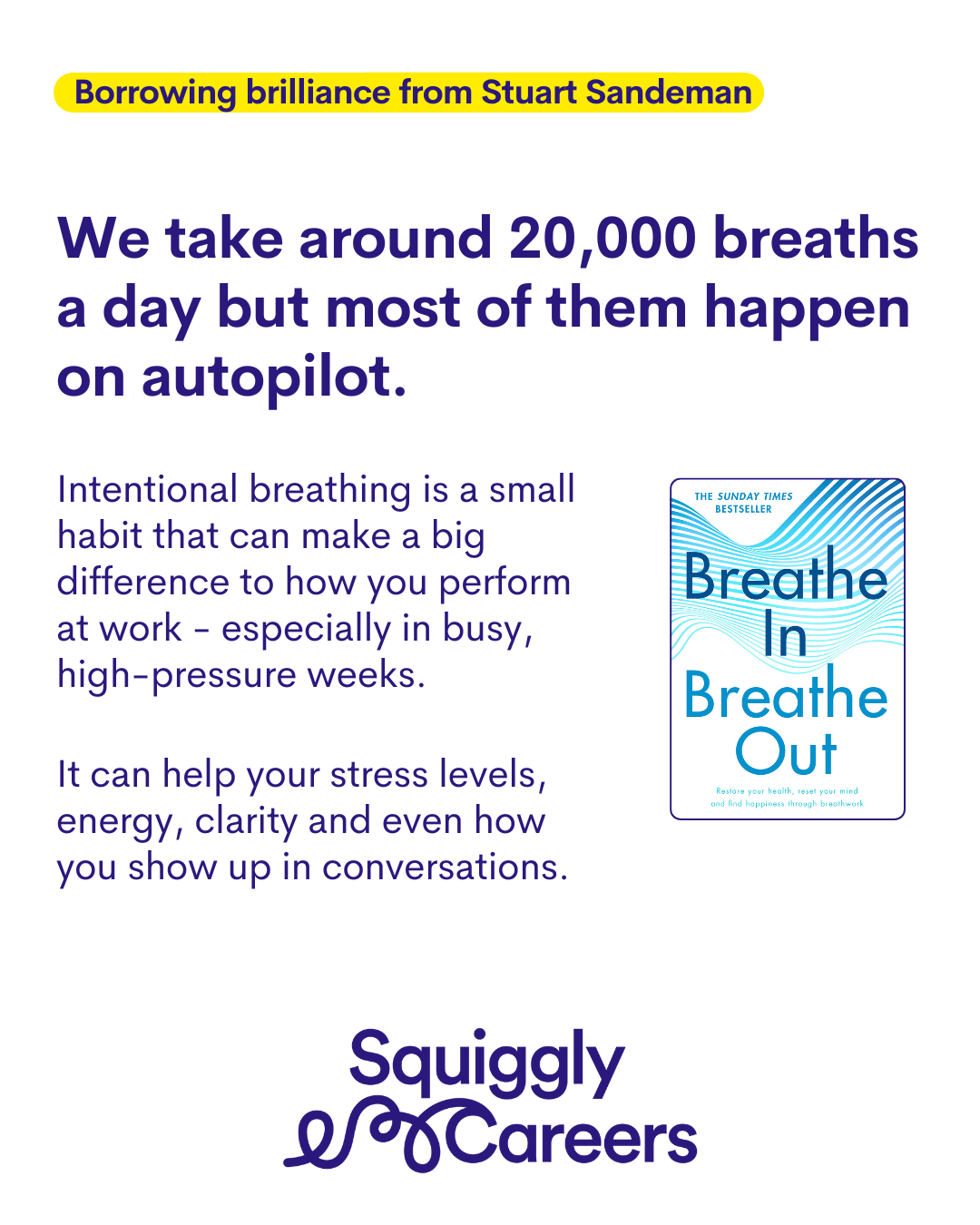
Helen Tupper: But he has a fascinating squiggly career story. Like he was a DJ and now he's like this breathing expert and had some like, personal stuff. Very, very interesting. And yeah, now he has a Radio 1 show, I think, but he shared in the presentation some facts about breathing because they'd done a big experiment with, they have a, a business called Breath Pod and they did a big experiment about the impact of intentional breathing exercises on, on people's performance. And there's some really interesting stats that you shared. So when people did a conscious breathing practice, of course we're all breathing, but there are some breathing practices that are more beneficial. And when people did that every day, except for seven days, stress and anxiety went down by 48%, brain fog went down by 56%, ability to switch off and relax increased by 54% and energy levels increased by 49%. I think you'd be getting those kind of benefits.
I know I can see a little bit of skepticism, a little bit skepticism.
Sarah Ellis: Those kind of numbers feel too big.
Helen Tupper: My energy has gone up by 50%.
Sarah Ellis: I was like, I, well, 49% increase in energy.
Sarah Ellis: I'm sort of like, how is that even possible? Wow. Like already bring quite a lot of energy to the work that I do. Imagine your energy increasing by 49%.
That would be something to behold. I actually don't, I actually don't want to imagine that.
Helen Tupper: A good dangerous level of energy. Well, if people do want to test. Then Breath Pod has like a free seven day experiment basically you can do for yourself.
So if you want to kind of see what your energy and levels and brain fog reduction could be in reality, you could do it. And we'll put the link in the show notes if you want to try it out. But in this episode we wanted to talk about some sort of practical ways that you can bring better breathing into your work. So as I have gone deeper into the world of breathing, I also read another book as well. If I'm halfway through this and I'm really enjoying it. This book is Breathing the New Science of a Lost Art by James Nestor. Just lots of things I just didn't know about breathing. For example, breathing through your nose is much more beneficial than breathing through your mouth.
Sarah Ellis: Oh, that's interesting. I feel like I have been taught through, mainly through exercise to breathe in through your nose, out through your mouth.
Helen Tupper: Yeah, I think it's the breathing in through your nose.
Sarah Ellis: Oh, I think, yes.
Sarah Ellis: That I have been told, yeah.
Helen Tupper: There's loads of science about why, but. But one of the things that stuck with me about why. Well, the first was if you breathe with your mouth open at night, this is nothing really connected to. With work I thought was interesting. You lose 40% more water. So you're far less hydrated if you breathe.
Sarah Ellis: That's why there's all those things, you know, where you can like stick your mouth together. And my partner does sometimes snore quite loudly. So he's tried some of these like things but for that reason. And some of them are really freaky. I'm like, as long as you don't look across, that's absolutely fine.
Helen Tupper: They've got these like eye masks on. But you know, anything to help medicine can help better performance. And. But the other thing was about this nose breathing was the difference in breathing through your left and right nostril, which was an exercise that Stuart did when I was in that session. He did this. But I think you know the science behind it and so if you are breathing in through your left nostril. I mean, this is really embarrassing if you're watching on YouTube, because I'm. I'm now holding my nostril. If you breathe into your less nostrils, that is designed to kind of calm your system.
So if you're stressed or something, like holding your right nostril, breathing in through your left one is more likely to calm. It's somehow connected to, like, the parasite, your brain or parasympathetic nervous system, which is a whole territory that I don't really understand, but that's one thing. Whereas the right is more likely to energize you. So, you know, if you're feeling like a bit like, before a presentation, like, upbeat. Yeah, you need to. Upbeat, like. And we'll talk about specifically the breathing exercises.
But the science of it is that that whether you're breathing through the left or right nostril has an impact on how your body responds.
Sarah Ellis: That is interesting. I did do something the other week where I was having a massage, and. I just thought it was going to be a normal massage, but then the lady made me do some breathing first. Before I was allowed to have the massage. And I was like, I don't want to do the breathing.
I jus want the massage. Because I knew we were doing this podcast at that point, I was like, oh, well, it's just more content. When I first start doing any of these exercises we're going to talk about, and I've tried a few of them and got some other ones as well, I get more stressed initially. I definitely get more stress.
So note my breathing. It gets, like, really shallow. I get a fit, like, oh, my God, I can't breathe. And so it just takes me a moment to be like, actually breathe in a way that this is. I sort of have to get past that first point. I think partly because she was watching me breathe and I was like, this feels weird. I mean, that is weird to watch them. I mean, she was sort of doing it with. But I think at one point, I clearly wasn't doing it right because then she sort of started, like, demoing it quite loudly. I think she didn't believe. She was like. Because she couldn't perhaps see me, like breathing out in quite the way that she wanted me to.
She was like, let it go, Sarah Ellis. Like, breathe out. I was like, I am breathing out. I was like, is this having the exact opposite impact of what she's intending? I did try to go with it for the purposes of the part, of course.
Helen Tupper: Am I allowed to share the sound Barb story?
Sarah Ellis: Yeah.
Helen Tupper: So every year Sarah Ellis and I meet in January, which is partly because it's Sarah Ellis's birthday, but also because it just gives us, like a moment to think.
Sarah Ellis: It's called, the year ahead.
Helen Tupper: It's a spa and strategy day, which iprobably annoying for everybody around us.
Sarah Ellis: As long as no one else is on the spa day, it's fine.
Helen Tupper: We basically go to a spa that we've probably not been to before, and in the morning we exchange some presents.
Christmas and Sarah Ellis's birthday, and then the rest of the day we just do spa, but at the same time is talking about strategy, which we learn books.
Sarah Ellis: We take notebooks around.
Helen Tupper: It's so funny. One year we did it and I always had my phone because I'm always making notes and I accidentally left my phone in a robe. And then we had to, like, chase the robe around the spot.
Sarah Ellis: You chased the robe once, but I said, just leave it and, like, it'll turn up. You were like, absolutely not.
You got your tracking out and you tracked it to the men's changing room.
Helen Tupper: Very relaxing experience. Spa shatter day.
Sarah Ellis: But we did both.
Helen Tupper: Did a sound bath and I went in and it was the breathing. For anyone that's done it, it was, you know, was the sounds and the breathing and the massage.
And I came out after three hours. I think, like, this is a revelation.
Sarah Ellis: I've never felt like this before. You came out very emotional.
Helen Tupper: I cried in the massage and I gave the person a hug.
Sarah Ellis: Oh, my God.
Helen Tupper: And then when I saw Sarah Ellis, she was about to go in, I said, oh, that was amazing. It's like a transformational experience. So Sarah Ellis's like, I just want a massage.
Helen Tupper: And I think you briefed the person. It's like, whatever Helen Tupper has had.
Sarah Ellis: No, I don't want that. I was like, I just want a massage. You can hit some of the gongs if you want. Like, if. If you want to do that, that's fine.
Helen Tupper: So when he said to them, you can hit a gong
Sarah Ellis: Well, yeah, they've got the things, haven't they?
Helen Tupper: Yeah, yeah, yeah. I mean, I think it's quite professional.
Sarah Ellis: Yeah. How is it? Well, you know. But I was also like, I suffer with migraines and so you do actually have to be a bit. So there was actually a bit of a serious point of like, please don't give me a migraine.
Which actually they took, to be fair. To them, they took very seriously. I think I just saw you come.
Out and what was the funniest thing was you panicked about clearly what was going to happen to me and refused to leave.
Sarah Ellis: So I was like, you go home, it's fine. And I was much nearer where we were. And then you were just sitting there.
Sarah Ellis: Looking really nervous when I came out and I was like, absolutely fine
Helen Tupper: Yeah, I think you framed the experience.
Sarah Ellis: Yeah.
Helen Tupper: Okay.
Sarah Ellis: I didn't have to breathe, basically.
Helen Tupper: So funny. That's going down memory spa.
Helen Tupper: Also we have a spa and Saturday soon, so we can, we do look forward to more fun
Sarah Ellis: but I'm in charge of this one, so I've not booked a sound bath.
Helen Tupper: Oh, okay. So we're going to frame the breathing. So what we've done is we've taken three whens at work that we think breathing might be able to help you. So like situations where perhaps you might be feeling a sense of stress or uncertainty.
And based on the research, this could be a moment where thinking intentionally about breathing could help you in that situation. So we've got a when we've got a then for which is that breathing exercise.
And then we also got a bit of a why, like what's the science behind it? I mean, like, obviously we're not experts in this area, so it's kind of high, high level science. And then what Sarah Ellis has done that we'll share at the end is use AI to create a slightly more personalised when then, which I have found very helpful.
Sarah Ellis: Like, did that today. So as much as we can joke about these things, I was like oh something very practical, very quick, very short and easy to do. I sort of used your kind of when then why as a starting point, personalized it. And I was like, oh yeah, this is great. I can imagine using this all the time.
Helen Tupper: So three practices and then one prompt for personalization. That's the plan. So the first one is when you're about to speak, but your mind is racing and your brain is really busy.
So I have this quite a lot because part of Sarah Ellis and I's job is to deliver workshops and presentations to companies. And we're often like, this morning, for example, my train was late. I know you said. I was really, really like, ah.
And I got here five minutes before I needed to be on. So everything was racing. I was annoyed at myself that I couldn't get here earlier. I was sort of worried about, like, look, my brain was racing.
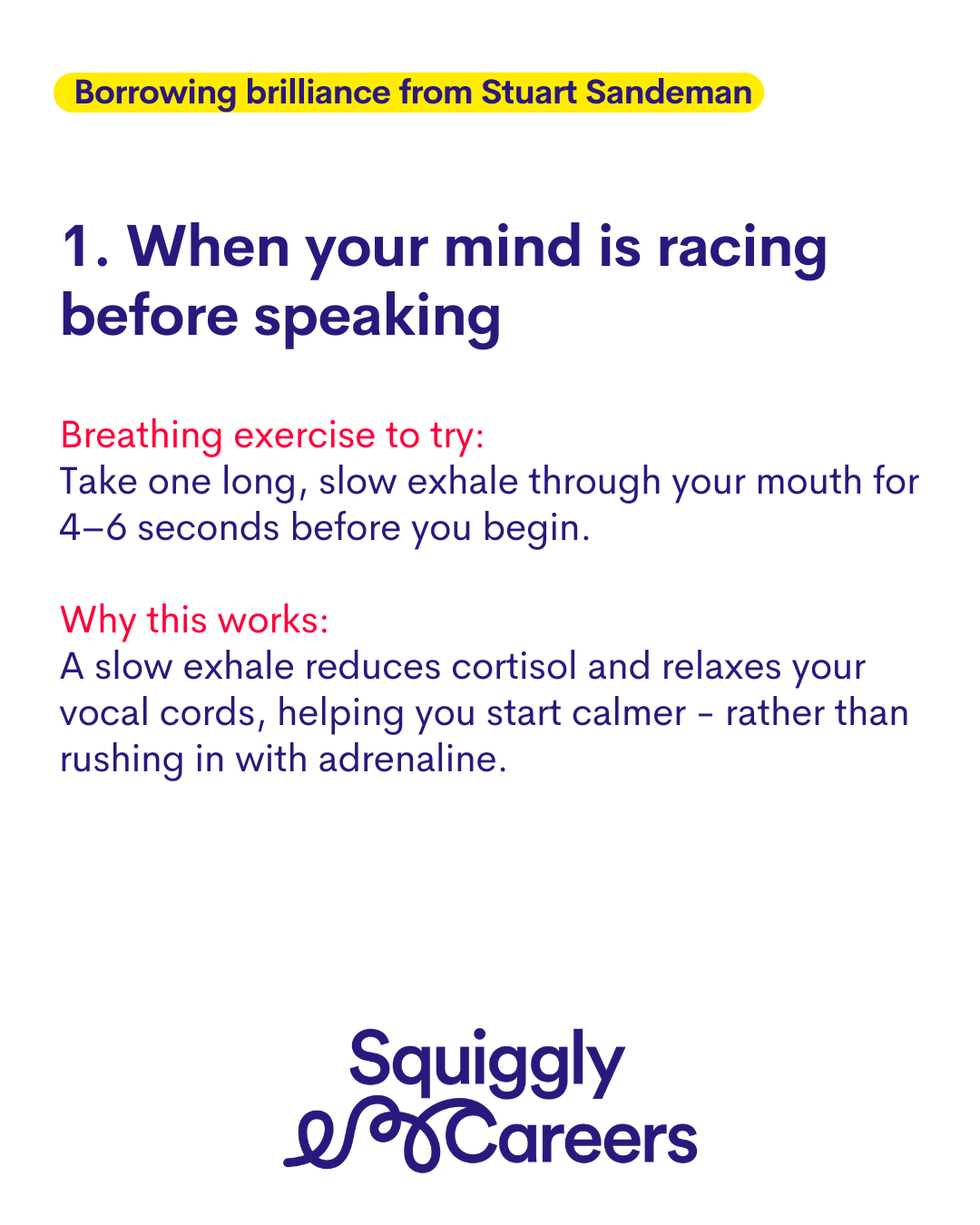
And so that is a moment where that mindset and also your physical body could affect your performance. Because I might start presenting and I might be talking too fast or it comes out in a bit of a rush. So this is a moment when breathing can help you to respond better to that situation.
So what we want to do here is when you are. You've got that kind of like panic, busy brain. You're not how you want to show up. The breathing exercise is to take a slow exhale through your mouth for four to six seconds. So really long, like, like really long. And you do that before you speak. And the reason that you want to do that is that long, slow release reduces cortisol. So cortisol is a stress hormone that gets kicked up and it means that we get all kinds of tense and we bring all of that into our conversations. The big long breath gets rid of the cortisol and it also steadies your voice so it will lower.
Remember when I did some voice training about, you know, making sure that you kind of want to have that lower voice that gives you a bit more gravitas, whereas when we are really tense, our vocal cords tense up and it makes us go naturally higher. And so if you, if you're kind of releasing all of that, then your voice is lower, you are slower, and that is what you bring to that moment versus the slightly stressed, sped up version of you.
Sarah Ellis: I actually had it this week. I was doing a presentation in the Shard, which was very fancy, as you'd imagine. And I'd read, I'd read this, you know, your notes beforehand on breathing. And I often find the moment I get most nervous is when someone is introducing me.
We present all the time. And I really enjoy presenting. I'm a. I'm a sort of comfortable presenter. I like doing that. But it's when it's that exact moment when someone's talking about you. And I think it's because it feels a bit awkward. You're like standing right there and I'm like someone's. I suppose selling you, obviously to that audience, like, Sarah Ellis's the best thing ever and you're just like, I don't think I know.
Sarah Ellis: What facial expression to adopt. Do I try and look like serious and credible, or do I smile?
Helen Tupper: Or like, what would that look like?
Sarah Ellis: I don't think I have a serious, incredible face. I don't look at myself doing that. But, yeah.
So actually, in that moment, I think I wouldn't want to see. I don't want other people to see me go. But I think actually you can. You can sort of do a subtle. Like, just like a little bit of a breath.
And I think that helps me as I'm then, because I was then walking onto a stage so, you know, in just that. That kind of millisecond before you're starting. And I actually also had the same. Earlier in the week, I was presenting to two very senior people in a company that I'd not met before. And, you know, there was just quite a lot of expectation on that meeting and somebody had kind of made that happen and they were there. So I also wanted to do a really good job for them because they really believe in our work.
So then I was like, my job.Is to be as good as she's clearly told them that we are. I hope I represent squiggly careers and amazing if. Well. And again, I. And I could feel my heart, you know, when, you know, we've said before.
About, you know, when you can. You suddenly feel your heart different way. And I think I was just a little bit nervous. And I did just breathe out just for a bit longer.
And somebody also said to me about, like, your jaw can get quite tense and sort of sometimes, especially like beforehand, people can't see you, like, almost like opening your jaw a little bit. And then I did feel quite. I got really good feedback after that meeting as well. So I was like, maybe the breathing works.
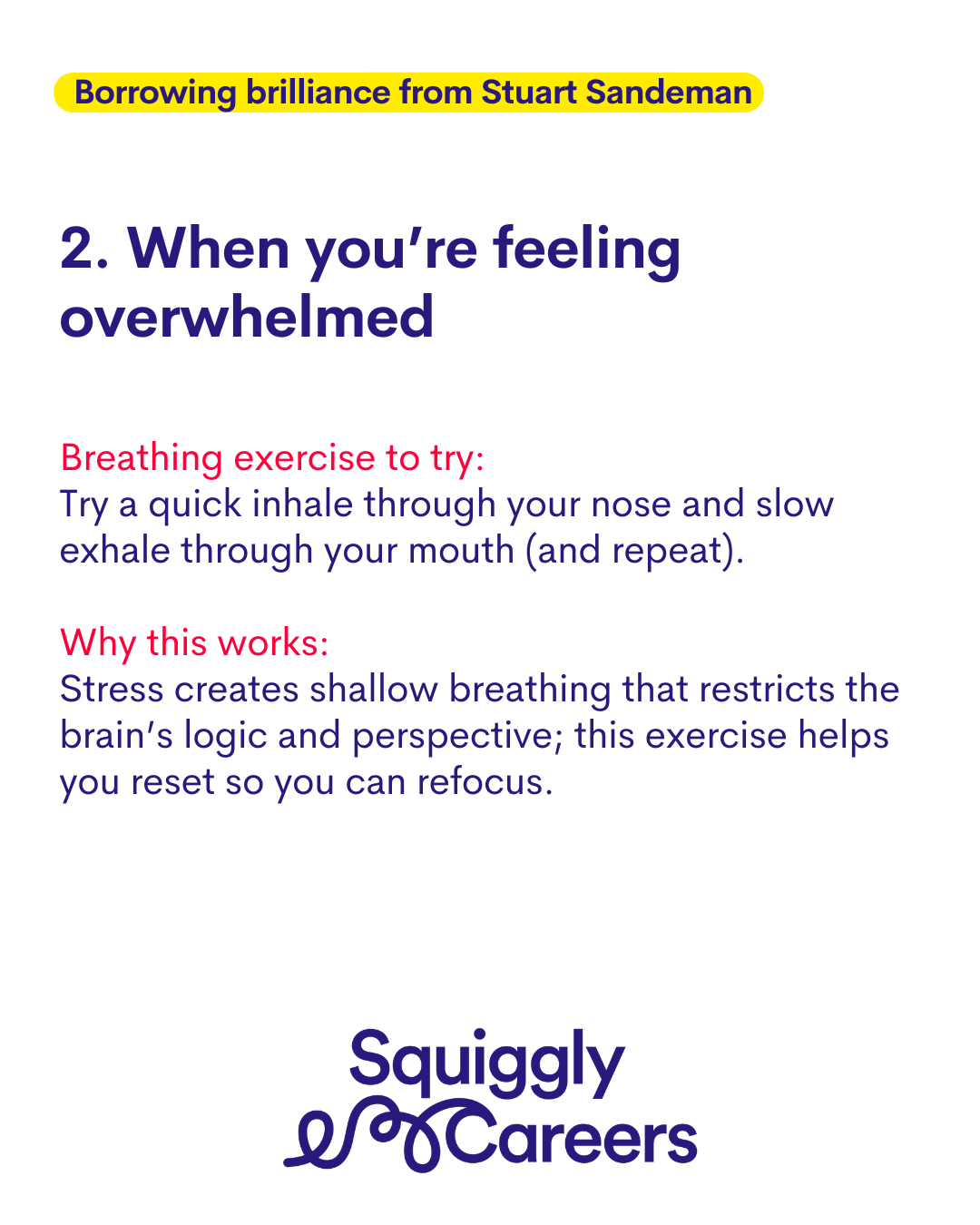
Helen Tupper: So the next one is when you're feeling overwhelmed, like out of control of your work, which I do think this time of year, you know, I was thinking, like, crunchy Christmas, you know. Yeah. Yeah.
Sarah Ellis: There's just so much to do and.
Helen Tupper: Just everything keeps piling on, or maybe like before a holiday, or there's just certain times where it just feels unmanageable.
And the breathing trick here that can help you regain a bit of a control is you want to take a breath for energy.
So in this situation, again, we might be feeling a little bit stressed. We might be feeling maybe just be tired by it all a bit.
Sarah Ellis: Yeah.
Helen Tupper: Oh. So a breath for energy is something that can help you kind of keep going because you probably can't stop everything. You know, it's like you probably do have to do all that stuff.
So anything to kind of help you through it is what we need here. So this is where you do a quick inhale through your nose and then A slow exhale through the mouth. And you want to repeat this a couple of. A couple of cycles. And what this does is a bit of a sort of an energizing reset for you. So, of course, this is not going to solve the fact that you've got loads of stuff to do, but if in that moment you're feeling so overwhelmed that you can't do it, an energizing reset is helpful and the science behind it.
Sarah Ellis: This is interesting, I thought.
Helen Tupper: Yeah, I thought it was quite interesting. So back to the stress thing again. So stress can make you breathe kind of shallow, and so you're kind of doing lots of kind of short, short breaths, really. And that affects our prefrontal cortex. So this is the. In your brain that you get clarity, logic, and perspective from. So the way that you're breathing is having an impact on how your brain is processing what you're trying to deal with. So stressed, short, shallow breaths, meaning that your brain is not able to process with logic and perspective. So it makes the hard thing harder if that is how you are breathing in that moment. Whereas when we take the breath in through our nose and the slow one out through our mouth, it sort of resets everything so you're easier to respond to the situation.
Sarah Ellis: So if the first one is more about calming down, the second one is more about, like, giving you energy.
Yeah, an energy boost.
Helen Tupper: Yeah, I would say the first one is about calm. The second one's also about clarity.
The energizing is a way of creating mental clarity, like helping your brain do what you need it to do in that moment, which is clarity, perspective, logic, so that you can respond to the many things that you're trying to deal with.
Sarah Ellis: So I thought the next one was interesting because this is about when emotion gets in the way. And I was thinking about, you know, if somebody's having a conversation with you and you're getting emotional, and there's nothing wrong with that, but most people would say they don't want to get emotional in that moment. Perhaps somebody's having a hard conversation with you or something's just feeling really difficult. And I've seen people get. It's almost funny, isn't it? You get, like, double emotions. I've then seen people get emotional and then get really upset about the fact they then got emotional. So you're like. It's like emotion on emotion.
Sarah Ellis: And so I think, I like the idea here that this could help you to choose, like, almost like your emotions. A bit more in a moment where perhaps something like hard is happening and you can feel yourself getting upset or you could, it could be the opposite, you could feel yourself getting angry. So what could we do in that moment?
Helen Tupper: Well, I have actually been in this situation this week.
Sarah Ellis: I know you have for everyone but the upset one.
Helen Tupper: And I had exactly what you were saying, which is it's like I don't need to be upset by this. And now I'm actually getting more upset by the fact that I'm feeling like.
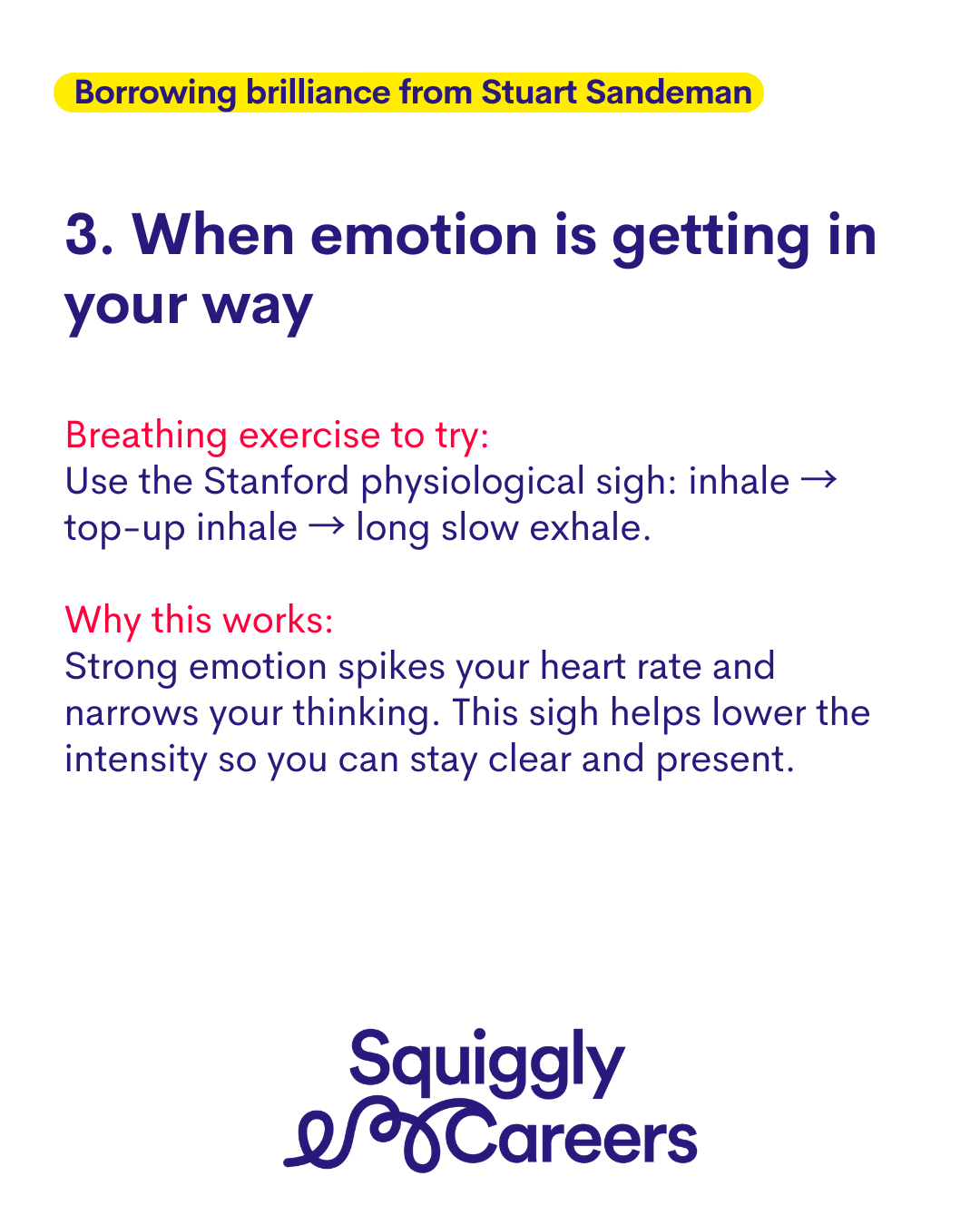
I might be getting upset and then this is just distracting me from the conversation I need. It's distracting and it's frustrating and none of that is actually useful for the conversation that you're trying to have. So I tried this one out this week because I'd done a bit of research before I was in that moment. And so the, the, the then if you are in this situation, my emotions are kind of getting in the way of how you want to respond. The then is the Stanford physiological sigh, which is quite hard to say but it is quite easy to do. So this is where you, you're in that situation. And again like I was on camera so I could still do this without feeling like they were seeing me doing something massive.
Sarah Ellis: Just need to breathe everybody. You want to breathe.
Helen Tupper: This is so hard. I did it like they didn't see my mouth or anything different than it would normally do. But you, you inhale and I did this through my mouth.
So you inhale and then you then do like another, like a top up inhale and then you do a long slow exhale. So I did this all through my mouth which actually I don't know whether it's supposed to be mouth or nose, but I did it through a mouth because it just felt easier and I, I think the thing that helped me was actually more just move it.
I'm sure the breathing did something better for my body and we'll talk about the science in a moment. But the thing really that helped me is my mind shifted from - I'm really annoyed about this emotion to the breathing. So it gave it redirect your attention.
That's exactly what it did and does do other things to your body as well like in a way of like controlling the emotions but just mentally focusing on this breathing exercise. I did it about three times and while I was listening, I wasn't speaking at that moment. It was just while I was listening and I was much more.
I just felt much more in control both of my emotions and of what I was going to say. So it kind of helped me. It helped me in two ways. So the science behind this as well as kind of my direct experience of it this week is that when you, when you've got strong emotions, it makes you breathe a bit faster, a bit more panicky about it and that spikes your heart rate and it can create quite tunnel visions because it's kind of how we, I guess, survive in those moments. Like survive, survive, survive. But that, that kind of survival costs is not very helpful if you want to remain curious in a conversation.
And sort of stay in it and keep doing it. Your that kind of heart racing fast is escape. Like it's that kind of fight, fight response. Whereas actually what we want you to do is to potentially be curious about the conversation.
And so the sigh just helps slow things down, it helps you calm down and it helps you to stay in a conversation rather than respond in a way that might mean you're kind of almost like mentally exiting it.
Sarah Ellis: Yeah, I do think there is a difference. I've tried out some of these. I think the breath that you do when no one's watching is different to the breath you can do in a moment. So I've done some where often it is quite useful to like really sigh out. But you're never going to do that mid meeting.
Helen Tupper: Yeah.
Sarah Ellis: Also that's like feedback for someone if you are, you know, they'll be like, oh God, is it that boring?
Helen Tupper: You do that before.
Sarah Ellis: I have seen you do do that. I've told you. I think you're not.
It's really interesting you say you have this breath that you do where it sounds like you're like, I'm so, so over this. And sometimes I don't think it's that you are. I think it's just that you're processing, processing and thinking. But it's almost like, you know, those unintended consequence things that we all have.
It's like the fact that I frown when I'm thinking. You have this particular breath that you do because sometimes it's not like you do it like. Maybe in like a workshop. And I'll say, well, I hope people don’t think she's like bored of doing it or whatever. And it's never that.
It's actually often that you're like processing maybe what someone said or like making a link or a connection. And obviously I know that really well. But you definitely have this like breath that comes to you like it's very particular moment.
Helen Tupper: I do think it's like a I just need a moment breath.
Sarah Ellis: Yeah.
Helen Tupper: And like. And then because I need to catch up and think about what I want to do next.
But yeah, I should probably do it less visibly and audibly.
Sarah Ellis: Do you want to hear about my AI prompting?
Helen Tupper: Yes, I would love to hear about your AI prompting.
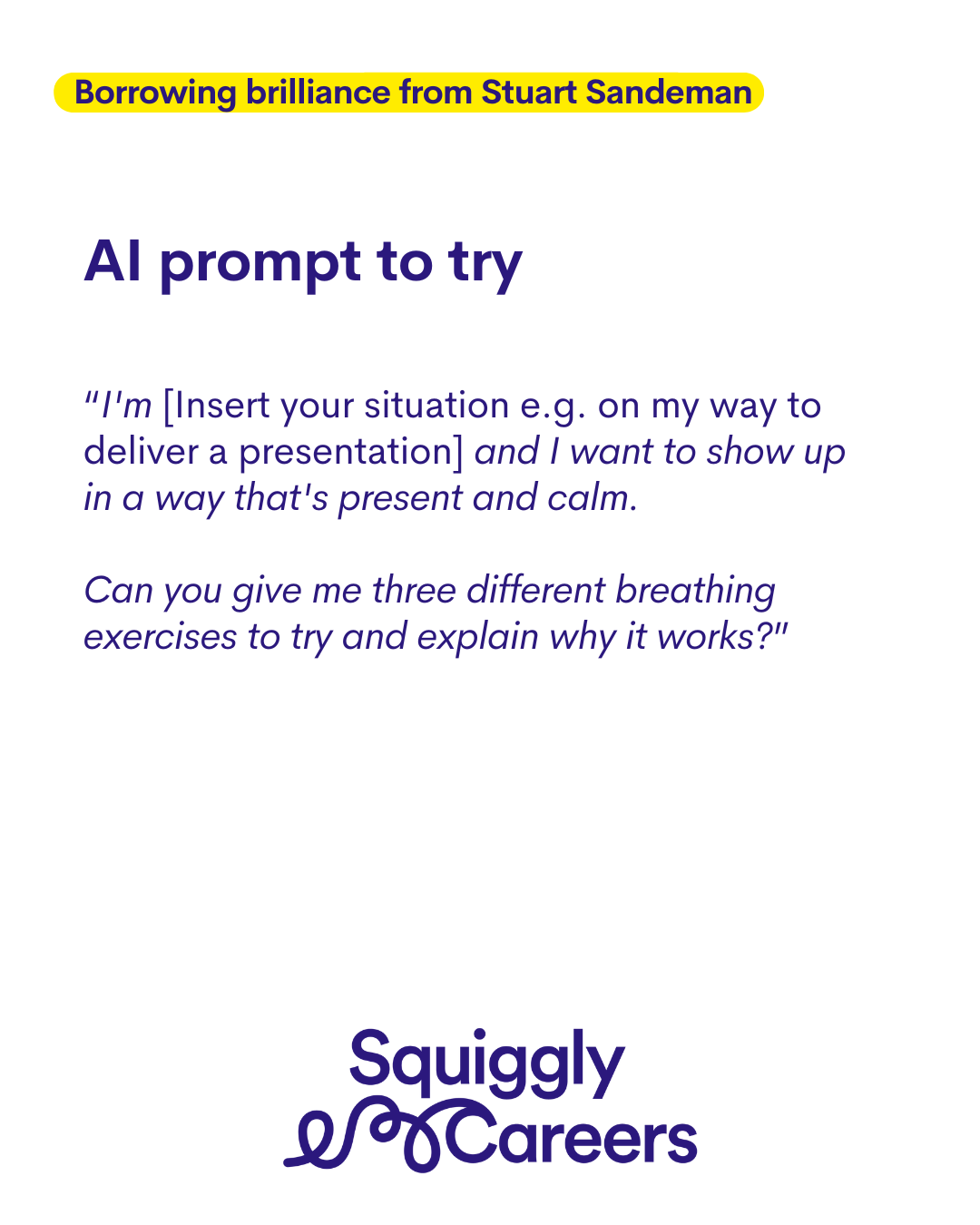
Sarah Ellis: So I was on the train this morning, so commuting on quite a busy train and I thought, oh, I wonder if you can personalize breathing based on, you know, sort of what's happening to you today. So I said, I've had a full on week with work and home life. I'm on my way to our end of year team day and I want to show up in a way that's present and calm. Can you give me three different breathing exercises to try on the train and explain why it works?
I was trying to do quite a specific product because I was, I don't. Want to look ridiculous on the train.
And also I was, I want to, I want to understand kind of why it works. And so it did and it actually gave me some different ones and it told me how long to repeat them for.
So it talked about the extended exhale. So we've talked about it like breathing. Basically breathe in for less than you breathe out. If I was doing the simple Squiggly Careers version box breathing, which I knew and that's kind of quite easy to do.
So that's you breathe in for four, hold four, out for four, stay still for four. That's kind of quite easy. I liked this one noting breaths. You know, we talked about noticing earlier this year, that episode always really stuck with me. This idea here is that just breathe normally, but all you do is say to yourself in your head, like in and out.
You know, basically you're just noticing your breath and what it's saying is that it's essentially, I suppose a bit like a kind of meditation. Meditation. It's like a mini meditation because it's say if you're, if your mind wanders, just think, oh, I've sort of stopped noticing my breath. Literally just notice your breath. And I was like, oh, that feels like quite a useful thing to do.
And then I liked this three minute arrive calm routine. And I was like, okay, you know, because we are all. I was thinking about how many back to back meetings people have. The amount of switching people have in their days, like into work and out of work. Most of us will have moments where we're like, we want to arrive calm.
You don't want to be that person. I'm always really mindful of this because I've worked with people like this, you know, people who turn up to everything frantic. Everything's frantic, everything's stressy, everything's full on. And those people are not, they're not nice people to be around. But that's definitely all of us, you know like some of the time.
But I'm always like, that's not, that's not how I want to show up. And so it kind of talks about almost like as you arrive, you kind of do that, like, notice your breath, almost like ground your feet on the floor.
So like, you know, like the whole like notice your feet, like flat on the floor, like, stand up straight, you know that open your diaphragm. So like kind of shoulders back, open your diaphragm. There's something about posture apparently that kind of helps you to, you know, like, enter a room with confidence and calmness. And then, yeah, it gave me this 30 second arrive study. And you do one deep breath, one four box breathing cycle, the grounding scan. That's the like, feet kind of shoulders back, one, like intentional breath where you go, I'm arriving here. And that point here is almost like your transition. Like, almost like saying to yourself, I'm here now. And I was. I mean, I've added the I'm here now in like a. I think it's quite nice to own that statement.
Helen Tupper: Did you do it?
Sarah Ellis: Yeah, well, I was. Well, actually. So let's talk about the actual reality of what happened. So I got to this room where. We're recording now, and I could, I could obviously hear you.
Sarah Ellis: So I'd got to come like, okay. I'm ready to do the podcast because like we're doing this and we're doing. We've got a bit of switching going on. It did make me think about, you know, like, my posture, how I was standing, and also just, you know, how you do want to show up. I was like, it helped me a bit to let go of other things because I have got in my mind emails in my inbox that I need to send and reply to and things that i've not done.
Sarah Ellis: So, like, that is definitely in the back of my mind and it helped me just with that tiny bit of perspective of like, what matters most right now is being here with our team.
Helen Tupper: So we hope that has given you a bit of a perspective on how breathing can help you to support your performance at work. We would love to know any breathing bits that we've missed. So anything you already do that's helpful. Also your reflections on the episodes, just email us. We're Helen TupperandSarah Ellis@squigglycareers.com.
Sarah Ellis: But if you are hoing through a busy time at the moment pre Christmas, we hope you're doing okay. We hope this felt useful and back with you again soon. Bye for now.
Helen Tupper: Bye everyone.
Sign up to the Squiggly Careers Newsletter and get our latest ideas, tools and inspiration every week - all in one place, straight to your inbox