In this episode, Helen and Sarah explore the idea of spaciousness at work — a powerful alternative to constant busyness that’s less about managing time and more about managing attention. Borrowing brilliance from Megan Reitz and her research on spaciousness, they unpack why doing more isn’t always the answer, and how creating space can help you think better, feel calmer, and work more meaningfully.
🎯 What You’ll Learn
– What spaciousness really means at work
– Why being busy can block curiosity and insight
– The four dimensions of spaciousness and how they show up
– Practical experiments to create more focus and clarity
📚 Resources Mentioned
Megan Reitz’s research on Spaciousness: https://www.meganreitz.com/spaciousness
#165 Setting Yourself Up For Success – How to speak up at work with Megan Reitz: https://www.youtube.com/watch?v=ozgO1R1IL3w
Episode on noticing: https://youtu.be/rid3L_XdePQ
For questions about Squiggly Careers or to share feedback, please email: helenandsarah@squigglycareers.com
Need some more squiggly career support?
1. Download our free careers tools
2. Sign up for our Squiggly Careers Learn Like a Lobster Skills Sprint
3. Sign up for Squiggly Careers in Action, a weekly summary of the latest squiggly career tools
4. Pre-order our new book Learn Like a Lobster

00:00: Introduction
02:36: What is spaciousness?
04:56: The four dimensions of spaciousness
14:07: Idea for action 1 - build unhurried attention
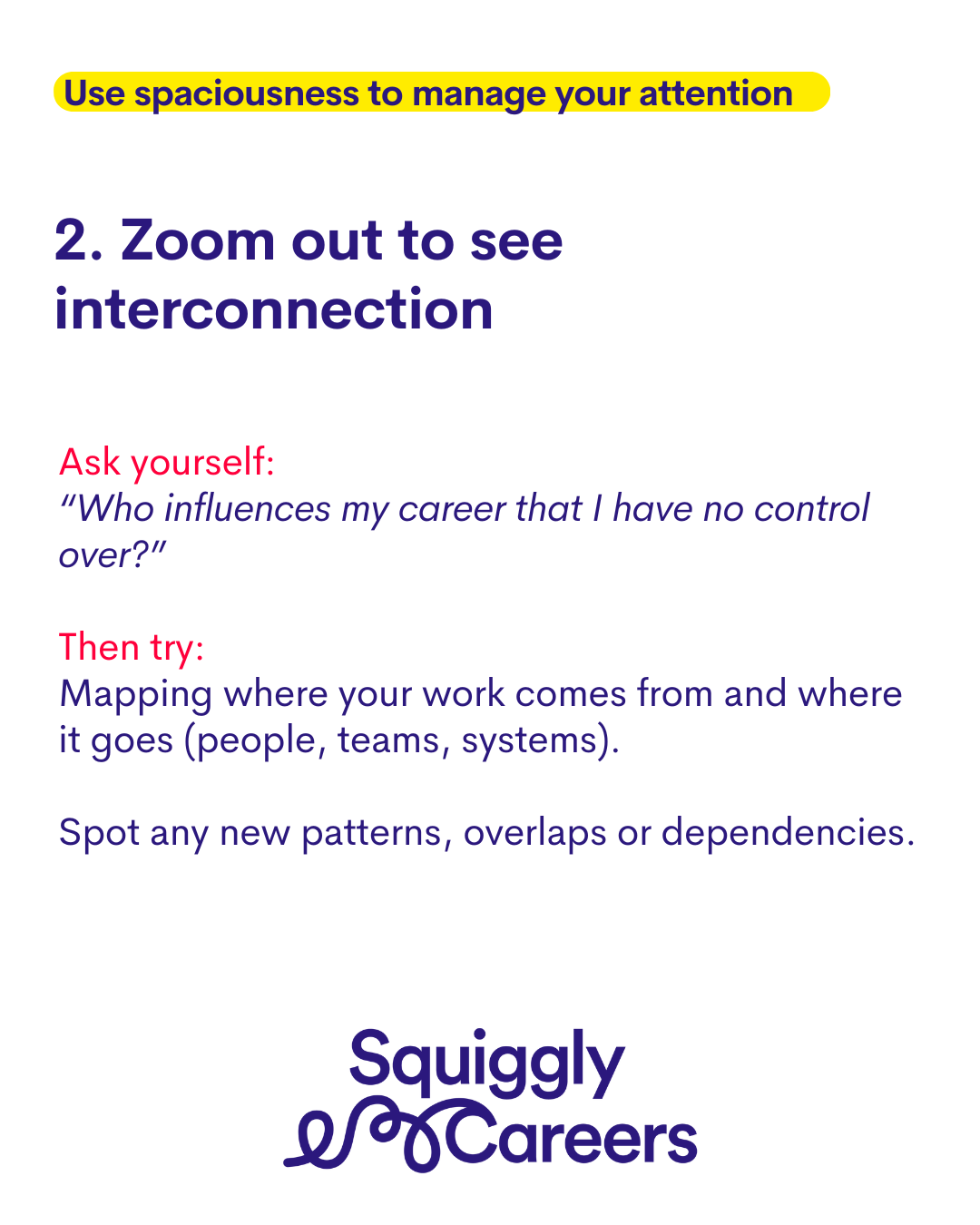
18:51: Idea for action 2 - zoom out to see interconnection
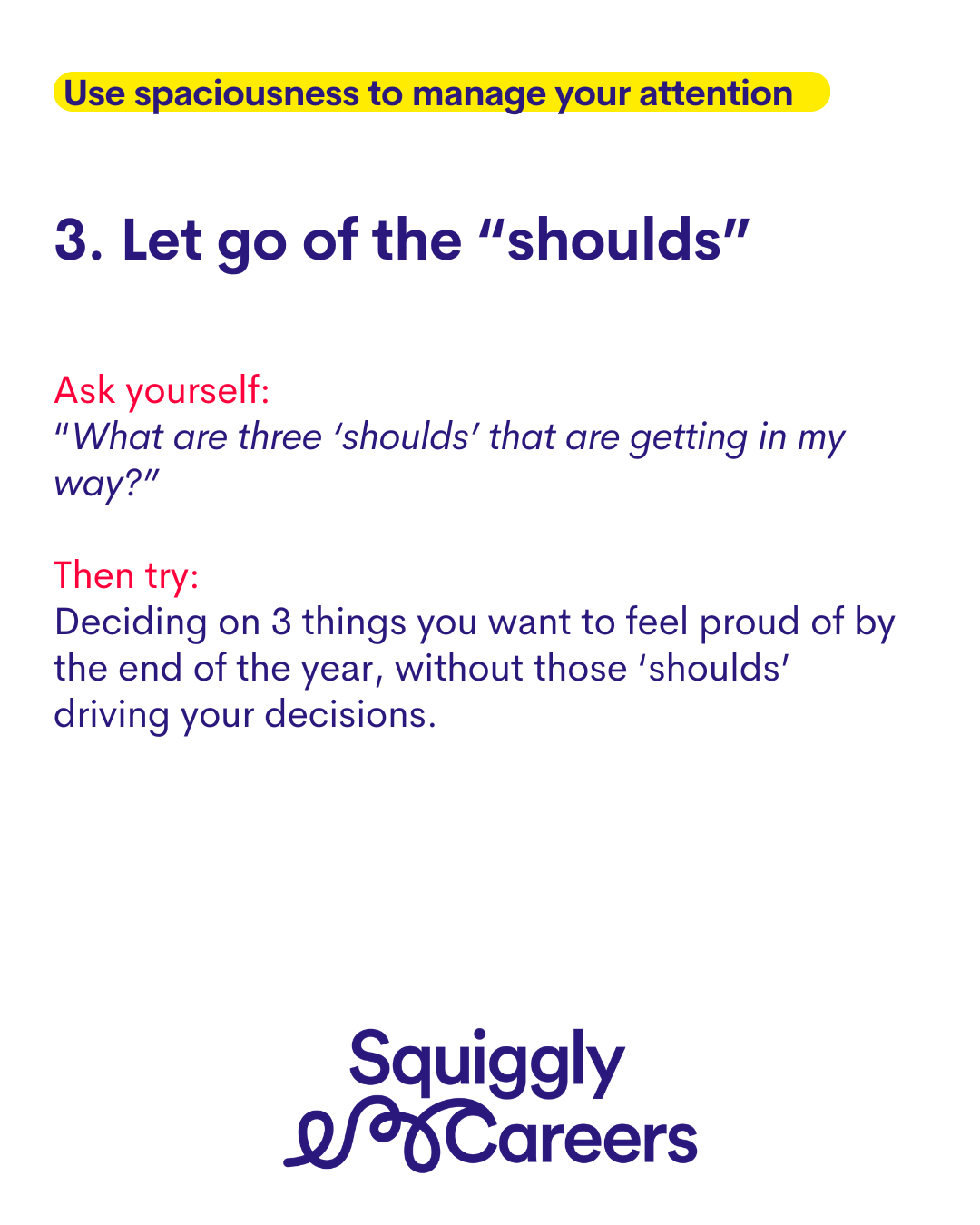
22:06: Idea for action 3 - Let go of the “shoulds”
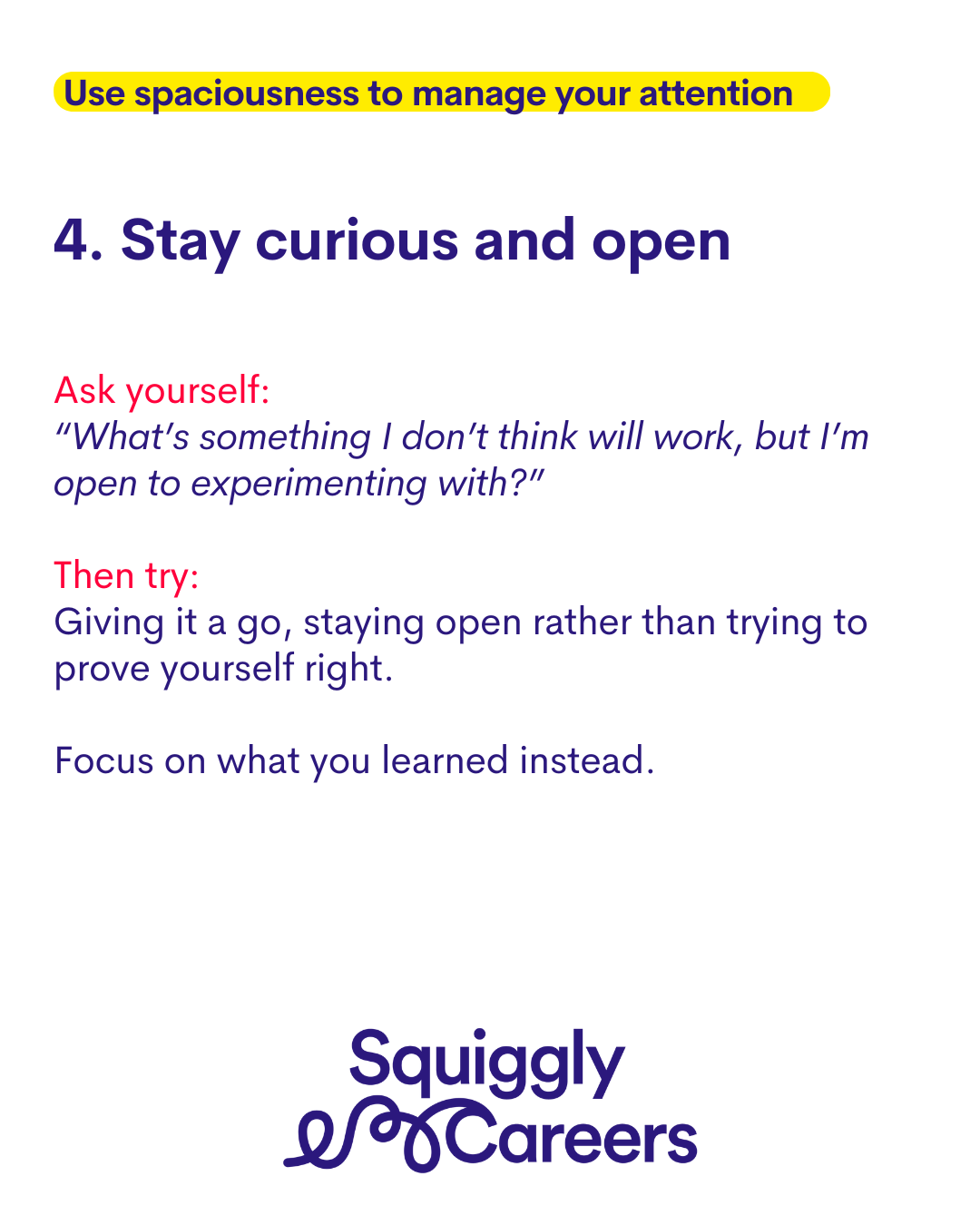
27:30: Idea for action 4 - Stay curious and open
Sarah Ellis: Hi, I'm Sarah.
Helen Tupper: And I'm Helen.
Sarah Ellis: And this is the Squiggly Careers podcast where every week we borrow some brilliance from a person, a place, sometimes even an object. And we try to turn that curiosity into useful action for you and your career.
Helen Tupper: And today we are going to be talking are we sort of borrowing brilliance from a person? And I guess a topic is a bit of, a. Bit of a report. Report a report.
Sarah Ellis: Sounds very grown up, doesn't it?
Helen Tupper: It's a big build up. We're talking about spaciousness everybo, uh, which might be a new term. It was to me when I heard about it, I was actually at an event where somebody, a previous podcast guest that I'm a big fan of called Megan Wright, who has written a book called Speak Truth to Power. And she was talking about a new report that had been released called Spaciousness. And I thought, how have I not read this? Like, I follow your work. I'm a big, like, I'm a fan of what Megan does. Have I not read this report? And I like, you know, I just kind of like, like the word. And I've talked to a few people about it and it's a word that seems to connect with people conceptually. And so Sarah and I wanted to take the research that Megan has done around spaciousness and what it means to people and how we can develop it and turn it into something that's really useful for the Squiggly careers community. And I guess as a bit of a heads up as well, Megan is turning the report into a book. So there is more work for Megan coming on this topic. So I think if you, if what we're talking about resonates with you today and feels like it's useful, I would definitely recommend following Megan so that you are first in line for when that book comes out.
Sarah Ellis: One of the things that's interesting actually is when she talks about the research that she's done so far is that she says when you talk to people about spaciousness, what everybody automatically does is, starts with doing. So they use being in doing mode as the default to then say, well, I, I know it's not this because this is what feels more familiar. You know, we're all, you know, we're all busy, people get distracted, people feel like they're in too many meetings and the meetings they're in are too rushed. And so her observation is we find it quite easy to describe doing mode and kind of what our reality feels like, but actually much harder, probably partly because of the word and it's not a word that's used in work very often to imagine what spaciousness is. And I think a really important distinction up front is that it's not about time management, it's about attention management. And I think that's. That is a. An important frame for everything we're going to. We're going to talk about today.
Helen Tupper: So should we do a little bit of a definition based on Megan's work of what spaciousness is? And then we thought we'd kind of just talk about different types of spaciousness, set a bit of context before we go into, well, how. How do we create more spaciousness in our work?
Sarah Ellis: I am actually going to read out her kind of full definition and then tell you what I did with that, which I can't work out if sometimes when I was preparing for this podcast, I was like, is this the oppos of spacious?
Helen Tupper: Anti spaciousness?
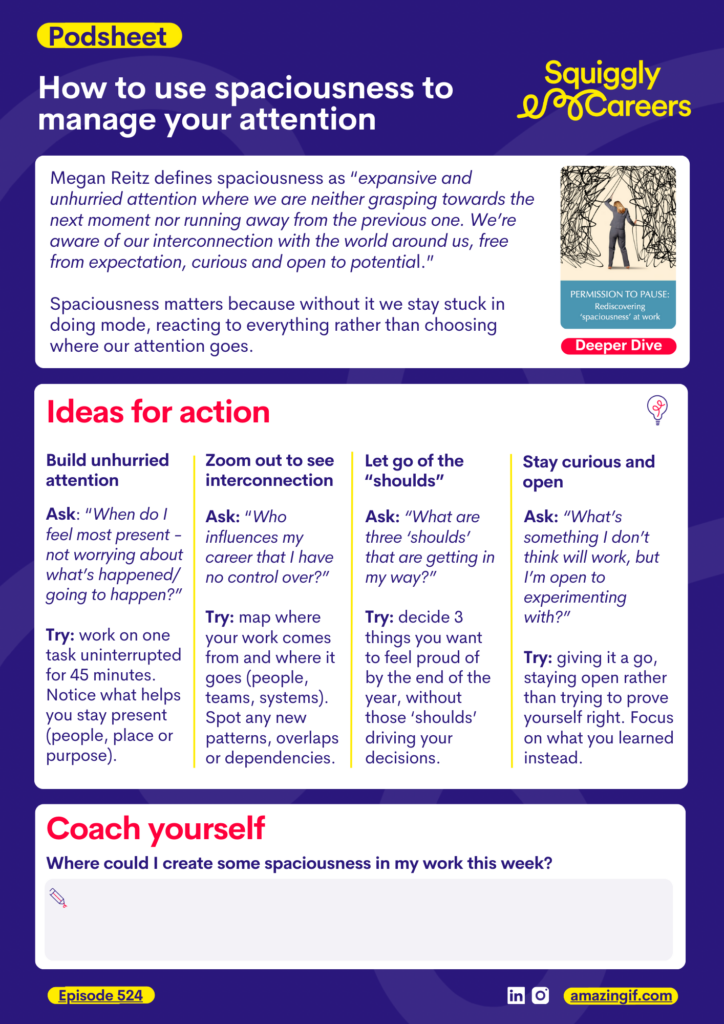
Sarah Ellis: Am I. Yes. Am I in anti spacious mode? So she describes it as expansive and unhurried attention where we are neither grasping towards the next moment nor running away from the previous one. We aware of our interconnection with the world around us, free from the expectation of how we need to be and what happens next, curious and open to potential. And I remember reading that and being like, oh, wow, that's not super easy to make sense of. So then I put it into Claude and I said, oh, can you describe spaciousness in one sentence? And I then did have a like, is this really ironic? Is this the opposite of what I'm meant to be doing? But I did like the short definition. So spaciousness is being present and relaxed, connected to the moment without worrying about what comes next or what just happened. But I think the argument against that, because I have read this report and actually I've read it again because it's. I think Megan's done a really good job here of, like, priming me to really understand this. Is that short definition does miss some of the nuances of things that are important. You know, the word curious and open is. Neither of those words are in that definition. And as we keep going through today's podcast, you'll see both those things are actually really important. And so I suppose sometimes our drive for speed, simplicity, and doing, which we're all very used to, can mean that you miss quality and critical insights. So it's just interesting. Like, I would encourage you to do the activity that both Helen and I have done, which is almost like, read the report in a new way and just see what you discover. I think that in Itself is a really good action.
Helen Tupper: One of the other things that I found useful, as well as the definition, and I agree with you that the longer definition does have some bits that are really important to be aware of. The other thing that I found useful was the dimensions of spaciousness, because I think another trap that you could potentially fall into is just thinking, oh, spaciousness is just having a clear head. You know, it's just having time to think.
Sarah Ellis: Time to think, yeah, that kind of vibe.
Helen Tupper: But actually what she says is there are four different dimensions of spaciousness and you're. You. You kind of want to think quite holistically about them. If you're trying to bring more of this into the way that you work and. And, you know, might even go beyond work, might be the way that you kind of live. So the four that she talks about are physical. So this is kind of your home, your work, your. Your kind of the air, you know, are you getting outside? Is your desk a mess? Have you got, like, space, like your actual. Do you feel, like, the spaciousness in the physical environment that you are in? And the second is cognitive, which I think is probably the one that people go to as a sort of default when we're thinking about this. But it's this one she talks about, you know, what do I notice about what I'm thinking? What do I notice in the world around. Not just the doing, but that noticing. We've actually done a podcast on noticing before, if people haven't listened to that one. The third is emotional sort of spaciousness with sitting with your feelings. Like, if you're not doing that, you're probably rushing on to the next thing because the thing that you're doing or thinking about or feeling feels a bit uncomfortable. But spaciousness is the ability to process what you're feeling, sit with those feelings for a bit longer and maybe be curious about, why am I feeling that way? Why did that feedback make me feel so frustrated? And the fourth one is spiritual. Was conscious of using the word spiritual because means different things to different people, but she frames that as the spaces and rituals that you consider have meaning. So I think that does allow you to personalise that. That, you know, for me, like being outdoors in the forest, that's quite, you know, that is quite spiritual. Those places have meaning for me. They feel, they feel like places that I get quite grounded in myself in. So spiritual can mean lots of different things. But I thought it was interesting. Physical, cognitive, emotional and spiritual. These are the different dimensions of spaciousness.
Sarah Ellis: And so then we've turned this into some from and to's to just try and bring this to life even more. So these, the froms are what this would look like, what an activity or a task or a process might look like in doing mode. And the two is what spaciousness might look and feel like. And this is some of our interpretations now, I think it's worth saying. So we might be getting these right, wrong, or somewhere in between. So let's talk about meetings. In doing mode, you go to every meeting you're invited to and you also probably complete every task you get asked to do, you know, without challenging or questioning. When you're being more spacious, you probably question whether you actually need to go to the meeting in the first place. So you bring that kind of sense of inquiry to meetings and you would be asking yourself whether the tasks that you're doing are the right ones. And actually Helen and I even had this conversation last week when we were together. So we were reflecting on November and December and we were talking about the work that we were doing and how that felt for the team. So back to emotional kind of curiosity and people saying, you know, people feeling like quite overwhelmed. And there was, there was lots on. But then there were some data points that we were kind of challenging ourselves on to say, well, actually, potentially that should have. There should have been more space in those months. But it obviously didn't feel that way for people. So that's. It's not about necessarily always having exact answers, but it's exploring those kind of questions, you know, rather than just. I think often we. You get busy or things feel hard for a bit and we just accept it and move on. You're just like, okay, yeah, that was, that was a difficult time, or that was just a busy month.
Helen Tupper: Right.
Sarah Ellis: On to the next thing.
Helen Tupper: Um, I need to tell you, it's a minor segue. I'm saying minor because it is related to this point about kind of should I be in that meeting or not. I got an email from Microsoft this morning. I'm. I mean, I wasn't the only person, I would imagine many millions of people.
Sarah Ellis: The Satya Nadella one. Yes.
Helen Tupper: Did you? I got it too.
Sarah Ellis: Okay, okay, okay.
Helen Tupper: So in this email, it talks about like three prompts that Satya Nadella thinks we should all be using. Copilot.
Sarah Ellis: Yeah, I read it.
Helen Tupper: I don't know whether it's his or not, but the third one is a really good cut and paste prompt. As long as you use Microsoft Teams. It basically says something along the lines of look at my emails and Meetings and I added teams communications to my prompt and tell me what percentage of time I've spent on different projects over the last month. And so you know like your time attention, communications and it then puts it into. You can see. So something like 35% of my time was on Learn Like a Lobster, which is our book that's coming out next month. Get involved everybody with the Sprint if you are listening before the 19th of January squiggly sprint.com and the next lot was something like 20ish percent of my time was on podcast content and strategy. But it's quite interesting, you know, if you kind of. Because you might be like, oh, I'm always in meetings or just go to meetings on autopilot. But then actually having a little bit of data I think allows you to like reflect on, well, am I in the right places? Does that reflect how I want to spend my time? All those sorts of questions. I thought it was good, good prompt.
Sarah Ellis: I've not tried that. I did read the email though because I thought, well, this is useful. Satya probably knows. Yeah, the next from is around emails. So back to attention management. Emails get most of my attention. So you know, when you're thinking about like where you're putting your focus versus if you're being more spacious, you would ask yourself like where do I want to give my attention or what do I want to give my attention to? And you'd be asking yourself like what matters most? So you don't give yourself that default of like, well, I'll do emails because I get the dopamine hit of like doing something conversations. If you're in doing mode, conversations would always relate to tasks to do's, you know, super efficient. You get through a checklist if you're in spacious mode. It doesn't mean that those things don't have to happen. It just means that you also have like exploratory conversations, curious conversations. You have space in maybe quite a busy conversation with lots of tasks, but to still ask questions, you know, it's still okay to ask a question. You would, you can say the hard thing. It doesn't feel like there's no time to say the hard thing. Like you put attention, you know, you pay attention to what might be missing or what's not being said. So I think sometimes when I was reading this, there's a temptation to divide this and go, oh, either you're in doing mode or you're in spaciousness mode. But the more I was thinking about this, the more I was like, oh, I'm not sure that's always the reality. You know, there are some moments where you're like much more spacious and much more doing. But I think probably the real value here is to go, how can you introduce spaciousness into things? Like a meeting, like, what would that look like? How do you introduce spaciousness into your team's ways of working, like things you already do? That's my own personal hypothesis. A few of the ones. If you're in doing mode, you do things based on what tech tells you to do. So tech triggered responsiveness, respond, you've not responded to this email or you need to do this thing and that's what you just do. Versus I decide how to use tech, like to help me. So you're making some conscious decisions and then maybe thinking about, from, if you're in that kind of more doing mode, it's often more about like shoulds and other people's expectations, other people's priorities, and maybe having a more narrow view of success versus something that's much more individual, personal to you. And you've probably consciously let go of shoulds, like almost you know what they are, and you've, you've decided whether that actually works for you, whether it works for you or not.
Helen Tupper: Another minor segue on that point. This is where I think, and I feel like I've got to mention that I've got to, I've got to say the word vision board. I would, I didn't feel like it wouldn't be me if I didn't say the word vision board. But I think if you are, it's.
Sarah Ellis: January, so I'll let you off.
Helen Tupper: It's January. It's vision board. She'll let me, she'll let me talk about in January. But if you're trying to get to a more individual view of success, like what is meaningful, motivating, you know, what does success mean to me effectively? I do think vision boards are very helpful for that because I sat down with a friend yesterday and like, we talked through our vision boards and it, it, they're so different, you know, they're so different. And I think it's a really helpful way of getting to that because I don't start with how can I get promoted and find a picture. I, I start with, oh, what does, what's, what's it going to feel like? What's it going to look like? What, what are the words that represent it? So, yeah, vision boards are useful for that one.
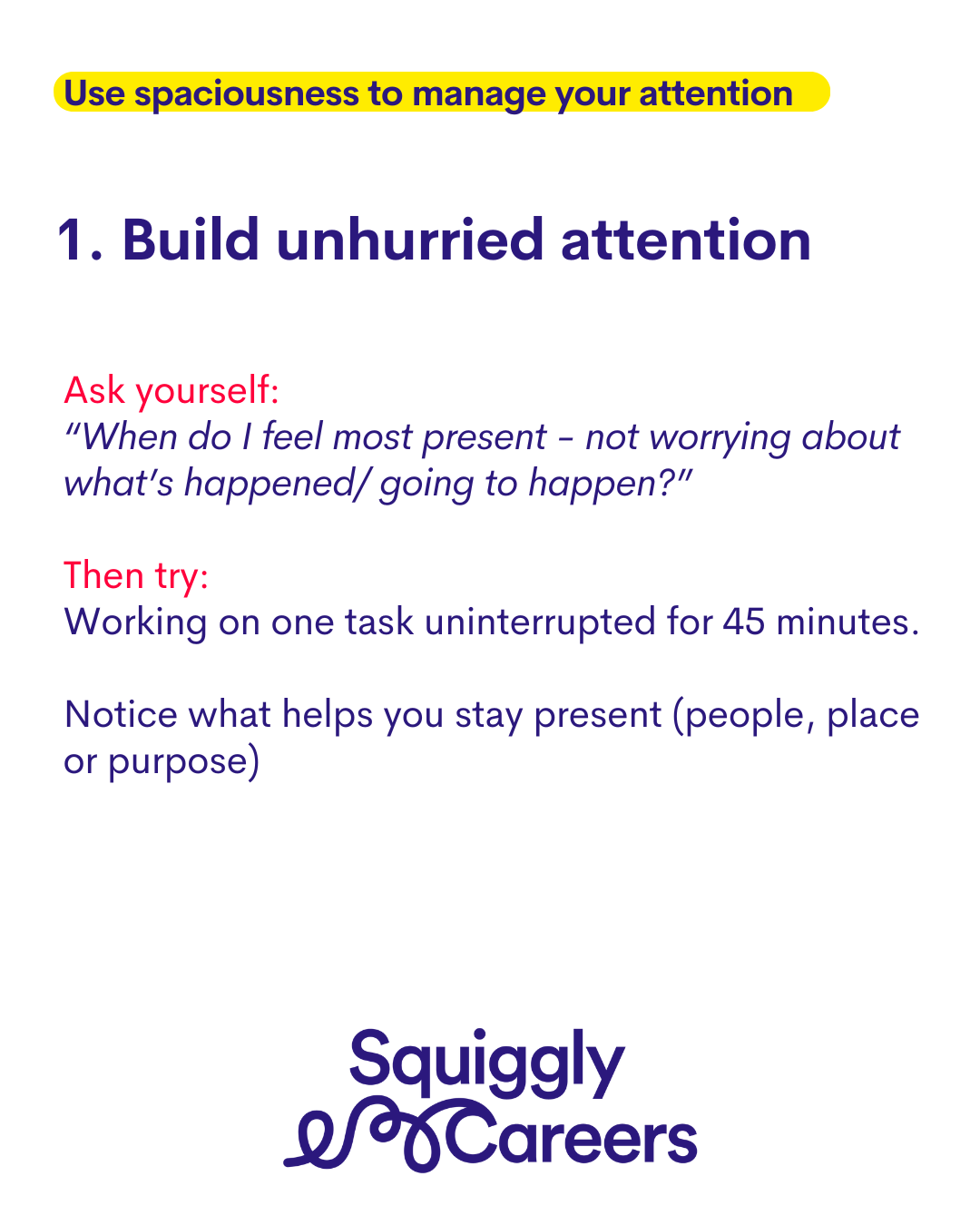
Sarah Ellis: What we've now done, we were like, we can't resist trying to make spaciousness practical. And we did have a debate like, should we even do this? Is this the right thing to do? So what we have tried to do is take the different aspects of the definition, come up with a question and a spaciousness action. And, you know, Megan's work is still very work in progress here. So this again is very much our interpretation. But, you know, see what you all think. So the first area is about expansive and unhurried attention, so essentially about being present. So a question to ask yourself is, when do I feel most present? Not worrying about things that have happened or things that are going to happen. And I think we can probably all think of moments in our day, you know, where you're not really in it with that person or even in it in terms of the work you're doing, because, I don't know, you've got something coming up you're a bit nervous about or something happened earlier in the day, and it's hard to let go of those things. So my thought here was try and think about, like, when you do this well at the moment and like, what. What helps you. What would be that? What would that look like for you? Helen?
Helen Tupper: Yeah, well, I was actually thinking about. Sarah and I were together a few days ago and it was very much like that for me. Like, it was very. We were in.
Sarah Ellis: We shut out the outside world.
Helen Tupper: And I was thinking what helped us to do that? A. A being together.
Sarah Ellis: So, and.
Helen Tupper: And there are certain people that. That probably wouldn't work as well for. So I think there's something about your brain is particularly like that. So me spending time with you and your brain helps me to do that. So think about who you're spending time with. The second was we did it in a different place. So I do think, you know, back to the. Your physical environment. I do think that can affect this a little bit. So, you know, maybe you might have a meeting in a coffee shop rather than an office, for example. Maybe that might help you to be a bit more present in the moment, not distracted by the doing that's around around you in your sort of default place.
Sarah Ellis: I think for me, it's also sometimes about if I'm really motivated by doing something well. So when we were preparing for today, for example, there are lots of things that you and I could talk about, and it's not that we don't, but I really want to do a good job of this today. And I think, because this topic was thoughtful and like, we were trying to put some structure around it so it would make sense. I felt very present because, you know, like the content, you know, the content of the conversation or the content of the work. I think when I'm very motivated by that or I think it's going to be useful, I have a good impact. It helps me, I think if I, if I'm being honest, if I'm like, I don't really want to do this work or, or like that's a bit annoying, it's not my favourite thing to do, then I'm a lot less present. So I think sometimes I probably need to. When the work feels more like that, I need to attach myself to a. Why, like why is this important? Like yesterday for example, I was recording some videos which funnily enough, I just don't like doing. Like, I love talking funny enough. It's not funny at all.
Helen Tupper: It's obvious that you wouldn't like it.
Sarah Ellis: All right, okay. Well, I don't know. I like, I love talking on stages and I love delivering workshops, but I don't like recording a video just sitting at my desk. I find it very annoying. I, and I don't want to do it basically. And in those moments I'm really not present. I'm thinking about all the things I'd rather be doing, what I want to be doing instead. Other things that have happened in the day and I sort of get in my own way. And that's one of actually Megan's observations is that often spaciousness is something that we self sabotage. So yes, there's lots of other reasons why we don't have spaciousness that some of which are outside of our control. But there are definitely quite a long list of reasons where you're like, that's kind of up to you. And I found that quite motivating because I'm like, well I could probably. It is up to me when I do those videos, I've got to do them. I could either do them with attention and being present and it'd probably be a more enjoyable experience or I could do it, you know, complaining, being distracted, putting my attention elsewhere, etc. Not very helpful. And so the action here is to work on one action or task or process uninterrupted for a minimum of 45 minutes. Now for some of you, you might be listening and be like, no sweat, like I do this all the time. But her research showed that 60% of people can't remember the last time they spent 30 minutes or more on anything. You know, because people are kind of switching so much. And I tested myself on this yesterday And I did work on one thing for 30 minutes, but nothing for longer than 30 minutes. So actually I think 45 minutes is that sort of stretching tipping point. And by uninterrupted it means like you can't cheque your messages, you can't cheque your email. You've got to stick with that task. I think it's a good thing for everyone to try out.
Helen Tupper: Yeah, I do too. And then go kind of into the feelings part of it. Like why does it feel uncomfortable? Is that sort of second thought process. So the second area that we are focusing on, it goes back to the definition that Sarah shared at the start is this idea of kind of interconnection. So when we are operating with kind of a spacious mindset, we are aware of how our work might connect to other people, what's happening around us that could affect our work. It sort of gets into the territory really of like systems thinking. But if you've not done anything on that, don't worry too much. Just think about it as incorporate interconnection. What, what affects me and my work beyond the immediate and the obvious perhaps. And so a question that we think is useful here in the context of your career, not just kind of the work that you do on a day to day basis is who influences my career that I have no control over? Because there are potent, there are some obvious answers. You might. Who influences my career? My manager, my manager's manager, the company policy, something like that. There's some obvious answers. But when you get into the, that that have I have no control over you start I think to think a bit bigger and broader. So Sarah and I were asking ourselves that, that question and we got to like oh well it's, it's. I went to government, I went to UK government, Sarah went to US economy. We were like all these, all these like things that are happening in the wider world that are way bigger than us that actually still could affect our career in running amazing if and in trying to make squiggly careers better for everybody. These are kind of less obvious but no less significant, perhaps even more significant influences that we don't have direct control over. And I think it just helps you to zoom out a little bit when you're thinking about you and your work and what impacts it. And the action that we have got here is to do a bit of mapping. I've done this, I've done this before, but I haven't really done it with a spaciousness like lens on, on doing it. So it could be an interesting thing to do it again. And it's something you could do individually or as a team. So this is literally you put yourself in the middle or you could put your team in the middle and you're thinking, who does my work go to? And it could be a person, it could be a team. And also I would do the arrows back, like, who comes to me for work, for insight, for decisions. And you really start to see the flows of work that go around you and the sort of system that you are operating in. And I think it does get even more useful, I think when you do this as a. Because you can start to see, like, oh, actually there's 10 people in my team and lots of us are going to the same person or lots of us are dependent on the same thing. And it just gives you a view of the interconnected nature of your work that I don't think you can do without creating that map to do it.
Sarah Ellis: One of the things that we often hear from the organisations we work with is, you know, a tendency to get stuck in silos and everyone. It's. It happens in small companies, it happens in our company. And so I think this helps you with that. It also helps you with that skill, which I think can feel a bit elusive when people say, oh, you know, we need to get better at connecting the dots, you know, we need to go beyond just our team. And that can feel quite hard to do or make happen. I think if you do that exercise that Helen just described about, like, where does my work go to? Where does my work come from? It just, it does, it just helps you that. It's like, it's big picture, it's zoom out, it's the kind of bird's eye view. So it's quite a useful career skill generally, I think, to kind of have a. Have a go at that. So the next one is free. I'm like, oh, free freedom, which actually is one of Helen's values. So I was like, oh, this one should feel very motivating to Helen. And the question here is around those shoulds again. So what are three shoulds or like I shoulds that are getting in my way? And just. I suppose it's sort of holding a mirror up to yourself to be like, kind of, what am I still holding on to? That perhaps isn't actually that motivating for me, it comes from someone else. It comes from expectations of what good looks like for a job or a career or society. Maybe it's still what your parents think you should do. You know, all those kind of things. Are there any shoulds, Helen, that you can think of that you think, oh, I still sometimes fall into that trap. Should trap.
Helen Tupper: I probably more about like, I should always be driving the business. You know, like we, we run our business. I, It's a growing business. I want to keep growing. And so I think I've got. I should always be working in order for the business to always be growing. And I actually think that's not very helpful. It's really not very helpful because I actually think, well, you kind of, you kind of really want it to grow without it always needing you to drive it. But I, I feel that should. I feel that should. I feel that should when I could do something else. And I think, well, I know I shouldn't do that because I should. I should do this. And so I talk myself out. I talk, you know, that back to the sabotage thing that you said earlier. I think I sabotage my space justness. That's quite hard to say because of the shoulds, like, particularly that one. Well, I could do the interconnected map and I could ask myself some of these questions, but I should be getting that thing done. I, you know, that's like constantly. And I, and it, it's like a magnet for my mind that I would have to, I would have to try and, you know, take some of the magnetic power away so that I could be more attracted to the spaciousness.
Sarah Ellis: Yeah, I think some of my shirt, my shirts are always very different to yours, but my shoulds are sometimes quite comparison led. I should be more like that person because I always find comparison quite hard to let go of. And you know, you know, objectively it's not, it's not useful. But yeah, I will just see other people or other companies. I'll be like, oh, we should be more like that. I should be more like that. And then I think we are getting better together. Your, your. What's useful is because I should are different. We help each other. So if I ever would say, oh, maybe we should be more like this, then I think you'll be like, oh, well, why would we. Or like, what would be in it for us? You would ask those kind of challenging questions. And then it makes it, it's. It helps me to figure out whether there's actually some like, decent reasoning there or actually is it really ego, shiny object stuff. And I think the same with yours where you're like, well, I, I should have. And I'm like, well, no, like why, why should it? I think my question too often you is like, why should it be you.
Helen Tupper: I've got a walk in my diary today. I'm gonna model it because you model it. And so I'm like, but Sarah does the same job as me, and this helps her to be better. Therefore, my. The way that I'm thinking may not be the way that I have to work.
Sarah Ellis: So, yeah, it's really helpful, maybe. And this is not in the report, but part of spaciousness is also thinking about, you know, the. How we can help each other being to be spacious, because I suspect we all do parts of this well already. But then just listening to this one in particular around, like, free, free, you and I probably help each other to be free of the shoulds and the expectations and the action here, which is a reflective action, really is. I think now is a good moment to consider what do you want to feel proud of by the end of the year? And actually, Helen even messaged me yesterday, and I was like, oh, I'll store that ready for the podcast. She messaged me she was working somewhere different that she has worked before, but not more recently. And she'd obviously just had a really good day. She sounded so upbeat and energetic, but also calm, because you don't always sound calm. You sounded calm and energetic at the same time. And you were like, oh, I've just, like, loved, Like, I loved, loved my day. And so one of the things I said back to you is I was like, oh, well, maybe you could aim to have. Maybe you could feel proud of having six days like you've had today by the end of the year, because it's not something you can do all the time. And obviously you want to try and be realistic. But I was like, oh, I wonder, like, would you. Is that something that you think you could feel proud of doing?
Helen Tupper: Oh, my God. I would say, okay, I feel like I've had an amazing start to the year. I just feel like I've, like, I don't know. I've done.
Sarah Ellis: Is it all those vitamin drinks you're drinking.
Helen Tupper: Got my balance right. And honestly, I'm like, I keep. Yeah, but it's gonna go wrong any minute now. I'm like, get. I want that voice to go away because the, like, the happy voice, like, I feel like, oh, I've got my balance right. Like, I feel like I've done some good stuff and had some new ideas. I've listened to podcasts and I've been hopefully, like, positive in meetings with people and all that kind of stuff. I'm like, please keep this going.
Sarah Ellis: Please keep going.
Helen Tupper: Yes, I Would be very proud if I got my, my day.
Sarah Ellis: There you go. There's a good example. Should we do the last one?
Helen Tupper: Yeah, our last one. It's interesting, you know, we're just saying about the power that people can help you. I was thinking this last one's about being curious and, and open and how that can help us to stay in spaciousness mode. And I was thinking about, oh, who do I spend time with that helps me stay curious and open? And obviously, I mean, you, you are the obvious answer to lots of these things, but other than you, Ian Sanders. Ian Sanders, who actually wrote a book on curiosity.
Sarah Ellis: Mr. Curious.
Helen Tupper: Mr. Curious. And is a journalist by background. But I spend time with Ian and both his brain and where we spend time back to environment. We will often meet. We'll just walk around a gallery. We're like, we won't even meet beforehand. We'll meet in the gallery and we'll catch up whilst looking at things and our conversations meander and then come back to whatever the priority is. But it's very like that. And so the question, if you're trying to bring a bit more curiosity and openness into your, into your thinking is what's something that I don't think will work? But I'm going to be open to experimenting with. And Sarah and I's thinking here was, well, if you're not being curious and open, you're probably being critical and closed. Like that's, that's the, the other side of that coin. And so if you are thinking, well, that's not going to work, you're probably being quite critical and closed. But we want to flip you into, you're allowed to think it's not going to work. Hey, you're allowed to be cynical or whatever, or you might have some actually, you know, very evidential data that is leading to you that thought, to that thought. But it's that willingness to stay open. It's the willingness to say, well, okay, based on my past experience, I'm not that confident this is going to work. However, I am genuinely happy to give it a go and I put the genuine thing in there because it's not like, well, give it a go and I'll watch you fail and we'll see who's right. It's not that it's genuinely going, okay, well, I can see that there could be some opportunity in this and it might not have worked before, but maybe it might work now. Maybe this is a different situation and different times and I'm open to giving that a go. I'M open to experimenting and exploring and seeing what might happen, I think. And we've all got things that we're critical and cynical and a bit closed about at work because kind of human nature. So I think finding that thing and then saying, like, how can I stay open to experimenting and doing something different with it? That's the question we want you to consider.
Sarah Ellis: And the action here is thinking about measurement. So one of the things that Megan talks about in the report quite a lot is one of the things that keeps us in doing mode is, you know, you measure what matters or what you measure gets done, all those kind of things. And it's not that those outcomes are not important, but sometimes those metrics I think can perhaps get in the way, particularly around when you are trying to be curious and open because the point of experimenting is you don't know the answer, you're exploring unknowns. So we were thinking actually a new kind of metric or question here could be really helpful. So it also gets you out of like know it all, well, I'm just going to prove that I'm right by letting you get it wrong mindset, which I think we probably all have. Maybe some of the time I maybe I maybe recognise that. And if you, if you change your metric from, well, kind of did it work or not in a sort of more I suppose like cold hard data way to actually a question which is, well, what will we learn from doing this or what have we learned from doing this? Then I suppose you get back to the only experiment that fails is the one where you failed to learn. And it's a very different way of approaching experiments. And we've been doing lots more experimenting at amazing if. And I see that it is useful, I think motivating for everybody. And actually I think we have moved to this kind of learning mindset with our experiments so we're less attached to, well, do a thousand new people now read our newsletter because of an experiment as an example. And we are much more attached to, okay, we did the experiment, so what did we learn? We definitely want to know the learning and it just really helps me, I think, to. I'm naturally curious, but I don't think I'm always naturally as open because I'm quite decisive and I make decisions and I've got that kind of, I suppose, energy that I would bring to things and you would be the same, you'd be like, well, we know this works, so let's just do more of that. And so I think actually between us sometimes we might both be A bit more closed because we feel like we know what's best. You know, maybe we do actually. Yeah. I mean join amazing. If we know what's best awful.
Helen Tupper: It's what we want you to do.
Sarah Ellis: But which I, but I think, you know, if our team was saying the hard thing, which I'm not, they're all very supportive. So I can't imagine them saying the things that we say to each other. But I think that is probably sometimes true. But actually doing it this way, it just primes everybody to behave in a way that's much more encouraging and much more curious and open. So I think especially, you know, if you're listening to this as a manager, as a leader, it's something that you can do, especially on those things where it's like obviously if it's really high risk, it's slightly different but most of the time things have low risk and we probably can just try and see what we learn.
Helen Tupper: I think if you are a manager you could ask these questions. Your team don't even need to know that you're on sort of like a spaciousness drive. You could ask your team some of these questions like add them into your. Add them into your one to ones and then I think just create then the space for them to reply. So I think if you're asking the question, you then being a brilliant listener and creating that environment where they can share without judgement from you, you know, and you're not immediately going, well, let's put that meeting in. Like it's not about that. But I think adding some of these questions into one to ones could be really useful to make this easier for you to ask yourself these questions, to add them into one to ones. We'll put them on the pod sheet. So the pod sheet is a one page summary of the episode conscious. There may be some people listening that have never been on part of the podcast before. So we create these one page summaries called pod sheets. You can get them. The link in will be in the show notes. It's also on our website, which is amazing. If.com go to the podcast page, find the podcast that you're interested in and the pod sheet will always be there for you. And if you ever can't find anything, you can email us helenand sarahquigglyclears.com and we will send you the link that you need.
Sarah Ellis: But that's everything for this week. Thank you so much for listening. I'm back with you again soon. Bye for now. Bye everybody.
Helen Tupper: Bye
Sign up to the Squiggly Careers Newsletter and get our latest ideas, tools and inspiration every week - all in one place, straight to your inbox