
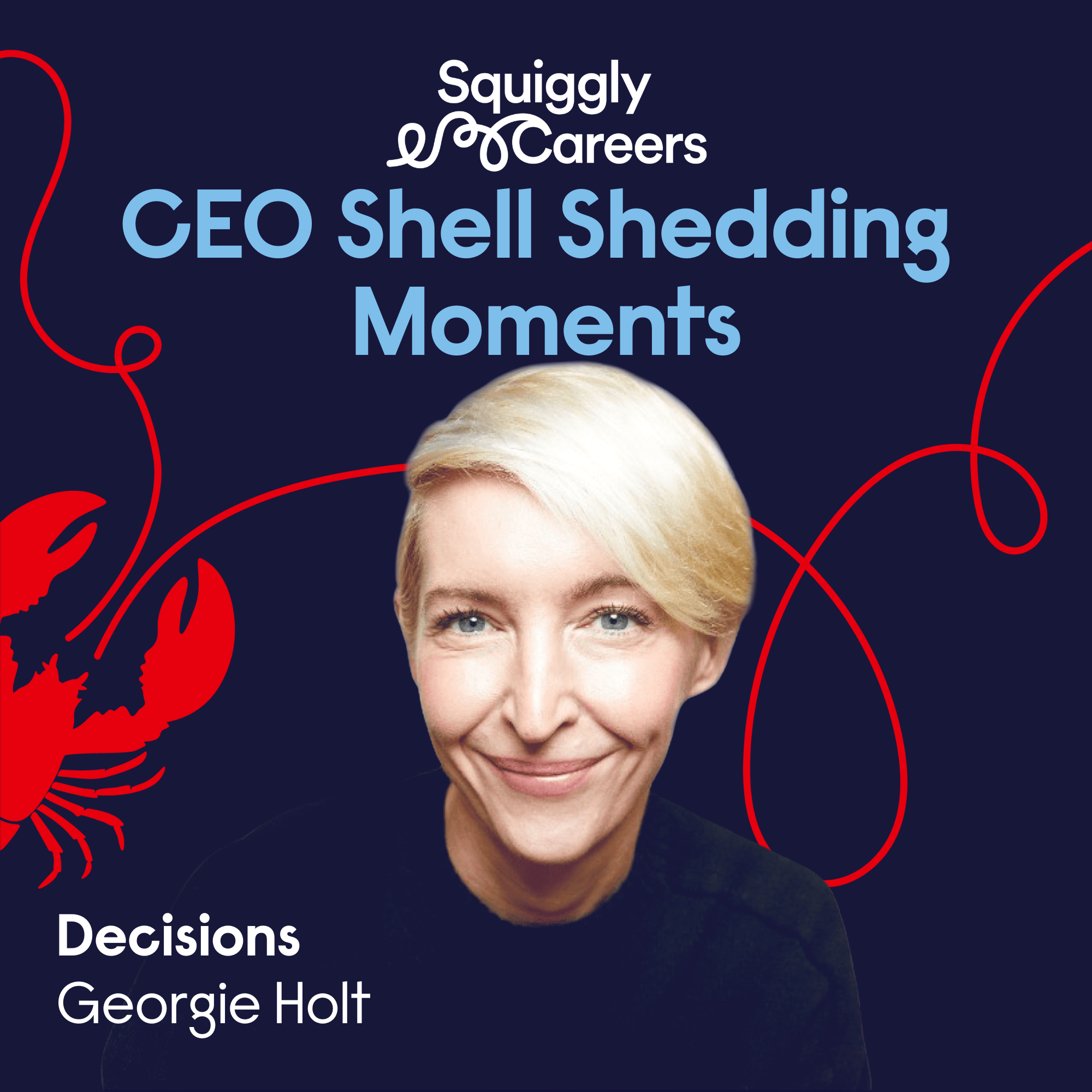
This is the third episode in our Shell-Shedding Moments series, a series where CEOs and leaders share the vulnerable moments, the challenges, mistakes, and personal revelations that most people never see.
Today’s episode is with FlightStory CEO Georgie Holt, who shares why great ideas are rarely obvious or easy, why comfort is the enemy of growth, and the necessity of experimentation to drive real progress.
For questions about Squiggly Careers or to share feedback, please email: helenandsarah@squigglycareers.com
Need some more squiggly career support?
1. Download our free careers tools
2. Sign up for our Squiggly Careers Learn Like a Lobster Skills Sprint
3. Sign up for Squiggly Careers in Action, a weekly summary of the latest squiggly career tools
4. Pre-order our new book Learn Like a Lobster
00:00: Introduction with Georgie Holt, CEO at FlightStory
00:17: Georgie’s shell shedding moment as a CEO - decisions
07:21: What is kill or continue? And why is it so difficult.
18:41: One piece of learning advice
Sarah Ellis: Georgie, thank you so much for joining us today on the Squiggly Careers podcast. I'm really looking forward to our conversation together.
Georgie Holt: Thank you so much for having me. I'm delighted to be here.
Sarah Ellis: So we are going to dive straight in and we try to use all the sea lobster like puns that we can come up with. So get ready for some of those today. We'd love to know a bit about a shell shedding moment that you have had as a CEO and perhaps as part of sharing that, you could also, just for our listeners who perhaps don't know, just describe the company that you're the CEO of. And give us an example of a moment that's felt hard, you felt vulnerable, maybe even a bit jelly, like, like our friend the lobster gets when it sheds its shell. But that you do reflect on and feel it was worth it. I grew back bigger, better. I learned more as a result of that shell shedding moment.
Georgie Holt: Absolutely. I think this is a great concept and I love a pun. So you're speaking my love language with puns. So I'm Georgie Holt, I'm the CEO of FlightStory. We are a media and investment company founded by Stephen Bartlett. Our mission and vision in the world is to scale creator led brands, what we call human IP. We really believe that the future of media is creator led. So when we look at our business, we think about building the future of media for the creator age. And what we mean by that is we're in a huge transition now in media that we're moving away from legacy institutions and moving towards creators as the major IP in the industry. And that individual human beings now have the opportunity to build major media companies and turn the content they make into companies. And we have the probably one of the highest profile blueprints in the world, which is Stephen Bartlett and the Diary of the CEO. Again, an amazing creator. He's built an incredible creator led brand, media brand, flagship ip and we want to do that for other creators because we believe that the human stories that they bring to media and that the way that there is a huge sort of human lens to the work that they do actually inspires a lot of progress in individual people and actually it's so interesting.
Sarah Ellis: So we interviewed Stephen when we started our podcast, which is quite a long time ago now because we're sort of over 500 episodes in every week and he talked about adaptability. So at that time we got kind of people who we thought were doing interesting work and this is before he was kind of quite the superstar that he is today, but not that different, you know.
Georgie Holt: Right.
Sarah Ellis: In terms of like just talking a bit about wanting to be really open and really flexible. And I think to your point, what individuals do that is always hard for companies to do is you connect at a kind of a one to one in a one to one way. And we, like Helen and I, always continue to be surprised when we listen to our podcasts that are the most listened to. They're often where Helen and I have had a hard time or something's gone wrong. And that's because people are like, oh, it's the, it's the human stories. Right. So I can see why, why you kind of, you do what you do. It must be. It's an amazing, amazing to see both his progression, but also what you're doing with other brands. So for you in your role as a CEO and you're in a company that is growing quickly, that you do need to be really adaptable. And it's almost as you described, you are setting the blueprint versus like following a blueprint from your own perspective. Like what feels hard, what feels like those shell shedding moments where you do think, oh, like deep breath, you're feeling quite vulnerable. You're probably thinking, I've just not done this before, or I don't know the answer because I always think it's reassuring to know that everybody has those moments.
Georgie Holt: It's so interesting that you're asking me this question now, because it's actually something I've been thinking really deeply about for the last few weeks and I actually came to a personal realisation on it, which has been enormously helpful to me and I wonder if it might be helpful to others, is there's a big difference between a good idea and an easy idea. And what I realised and what I've deeply come to know over the last two years, particularly working in this environment again, building a blueprint, trying to be a pioneer, breaking new ground, is that I think we've got to a place where perhaps we think the easy ideas are good, that something should be a good idea is something that's straightforward and you're in a flow state and everything is moving in the direction that you thought it was going to and you're meeting very few obstacles in your path and you're moving quickly towards that goal or that idea coming to life. And I actually think that's an indication of an easy idea. And what I've come to Realise and what I talk to my team about a lot is that a good idea is really hard because there aren't that many. And we say, you know, there aren't that many good ideas anymore, or actually, how do you find a good idea? And when we get a signal that something is hard, that we've hit an obstacle, a blocker, a paper wall, as we call them in our business, that most walls are made of paper. If you ask the right questions, you work with them. Enough urgency and a huge bias for action that they are made of paper. There are very, very few no's in the world or very, very few sort of concrete walls. Is that a good idea is really, really hard? And we're trying to coach ourselves. I've certainly coached myself over time. And trying to coach my team is when it gets hard, it means it's good. It does not mean it's bad. And when we hit those hard roadblocks and we push against those difficult moments, the idea is infinitely better on the other side, it's even better than we imagined because it was hard. So I think when I think about shell shedding, that has been a huge, pivotal realisation for me, and I've called it many different things. People call it failure. We talk about failure a lot in our business. They talk about experimentation, we talk about experimentation a lot in our business. But I've actually really come to understand that the good things are very hard and it is what makes them good and what makes them infinitely better is the hard things that you hit on the way there. So easy ideas aren't good ideas. In my, actually my shell shedding, I think I've got very comfortable with holding tensions and truths that can be completely opposite at the same time. And getting to understand that good equals hard, which is attention, that two truths are evident at the same time.
Sarah Ellis: That's really interesting. How do you know? So if you're kind of working on that hypothesis that good ideas actually, you expect them, you expect them to feel uncomfortable, you expect them to feel hard. And I suspect another tension that you must have to grapple with is when do you keep going and when do you let it go? Because there are also moments where as a CEO, you're making calls to stop something or to, you know, and that giving up isn't a bad thing. Sometimes you think like, we did think this was a good idea. You probably invested some time, some energy, maybe some money into something. But a big part of a CEO is prioritising and kind of making those calls. And if you're if you're kind of moving to this sense of, like, I think previously you might have been like, oh, it feels too hard. Well, that's the signal to give up and to kind of let it go. But what we're saying is, well, no, actually, that might mean. Actually, it's going to be something brilliant. We kind of need to persevere. What helps you. What helps you to kind of figure that out?
Georgie Holt: Gosh, that's a great question. We call it the killer.
Sarah Ellis: It's quite a hard question.
Georgie Holt: It's a great question. And I'm going to try and really think. Be thoughtful about how I answer it. We call it the kill or continue. And one of the great opportunities and the great challenges in our company is getting to kill or continue faster than ever before. So good equals hard is important. Good equals too hard. And too hard in the wrong direction is not a good use of time. And what we have gotten to in terms of how we determine this is getting extremely focused on our sense of direction. Where are we going? What is our vision? What is our mission? What are our goals? And is this idea, through all the evidence, data, and research, we have an idea that we believe is going to get us to one of these goals. And if the answer is yes and continues to be yes, we continue with this idea. If the answer through data. Because we experiment a lot. And the early data signals that we are getting from this idea that perhaps it is not going to get us to one of our primary goals and achieve that vision and mission that we have, it should be stopped and we should kill. And what we want to do in the company is that the kills or the losses feel like wins. Because the faster you kill something, the more that you can focus on your primary goals and drivers or other ideas that might accelerate that. And it is so important, and it's something that is a religion in our company, that failure is intrinsic to our results and our ability to succeed. So we're very comfortable with failure in our company. We encourage people to fail a lot. We encourage people to experiment a lot. But if we keep on failing on an idea that is good and hard, but the evidence is starting to show it's not going to achieve the primary goal that we have. And we have eight major goals that we want to achieve in the company in the next five years. And we spent six months on that piece of work. It was 130. Slide deck. Believe it or not, if it's starting to give us signals that it's not going to deliver one of those goals, even if we believed it would. We kill, and the faster we kill, the better. And giving those frameworks to kill and continue is critical in your business, but also the only reason you do that is to having very clear goals about where you want to get to. So it is one of the greatest strategic challenges, and I think one of the most exciting journeys that I go on in this leadership journey is how do you know when to say stop?
Sarah Ellis: Yeah.
Georgie Holt: It is a constant, iterative learning process of putting in frameworks, thinking from first principles. As a leader and as a CEO or anyone who wants to go on that journey, getting your first principles in place and rationalising and arguing and debating from those first principles is such an important piece of work, which is, who am I when no one is looking? Who am I in extremely difficult moments where critical decisions need to be made very quickly, when we don't have all of the information? And I'm only 50% sure on one way or another, going back to your set of first principles of who would I be if no one was looking? Who would I be if I had time? Who would I be if I was the very best version and most courageous version of myself in this moment in time? Even though all of my instincts, I'm scared, I don't know what the right answer is, but what would the most courageous version of me do? That is a question and a signal of, like, what are my first principles and how do I operate in a moment? Will enable you to make faster, better decisions in the moment. Kill the continued decisions. What's good, what's hard versus what actually is taking us in the wrong direction. And that, honestly, is a lot of the evidence that most leaders need to work on is, what are my first principles and am I very clear with others about what they are?
Sarah Ellis: Yeah. Listening to you, what really strikes me is I think you have created a sort of a structure, a set of systems and a structure that helps you and the company with shell shedding moments. So rather than the shell shedding decisions, or should we do more of this or less of this, feeling subjective or judgmental in a way that can feel confusing. And people are kind of not sure what's right or what's wrong or it just feels like it depends on how the CEO is feeling that day. You know, we've probably all been there where, you know, it's like you're never quite sure what your manager is going to say. My sort of sense of what you're describing is you've worked really hard to create a lot of clarity both for yourself but and for other people through asking those tough questions, writing things down like, what do we use as a filter for our decision making that isn't just like how I happen to feel about something and I'm interested in who helps you. Georgie. So when it feels really hard and being a CEO can feel quite lonely, I think from talking to a few of the CEOs and you can't always necessarily have every conversation kind of inside a company, you often do need support elsewhere. What does that look like for you? So you're in the middle of a shell shedding moment and you're like, this is feeling tough and uncomfortable. Where do you go? What helps you? Who helps you?
Georgie Holt: Can I be really honest?
Sarah Ellis: Of course.
Georgie Holt: I go to myself.
Sarah Ellis: Interesting.
Georgie Holt: And it's, it's not the right answer. Sometimes it's, you know, I, there are, there are people in my cell phone that I call and there's people that have been enormously and constructively helpful to me in difficult moments. What I like to do, because I like to think of operating from a set of first principles that, you know, I've been working for 25 years of a life, for 46 years that I have worked really hard on trying to understand who I am in difficult moments and in the dark and when things are extraordinarily tough, which they do tend to get sometimes, who am I? And therefore I quite often draw on myself in those moments. And I don't hear many women say this, and I don't know whether it, it's have having a strong sense of self worth or some way having what people might, I don't know, sort of start to say that, you know, might be more egotistical, I don't know. But it feels like an unusual thing for a woman to say. And it's because I like to understand how I think about something before I would even go and ask a question of somebody else and say I have got to this decision or I think this is where I am with this moment of the shell shedding. And does that sound like a decision I would make or does it sound like something that this is the right as you know, me and who I am as a human being, am I in the right direction? Am I doing something that feels extraordinarily different to the person that you know, I am, or does this feel like something I would do and therefore challenge me that if this is a good thing to do, even though it's something I deeply believe is aligned to what I believe in, but I've definitely also learned over time is actually opening your mind to information coming in when you need it most and almost asking for it internally, externally, it will arrive. And in fact, something, someone shared a quote with me yesterday and it was so relevant to what we were talking about today and it really helped me meant what we were saying in this meeting. I'm like, so again, it's another signal, like if I just open my mind and I'm conscious that I'm looking for an answer, but it's not necessarily something that I can get to extremely quickly or it's taking me a little bit longer than I thought previously. It does arrive. And the quote was, "it's on you to get you to where you want to be". And I was thinking about my shell shedding moments and I thought, gosh, that really does solidify how I think about it. It's on you to get you to where you want to be. And I think if there was a way that I thought about shell shedding, it would be, I'm shedding the shell because it's. Because it's where I need to go next. And it's on me to understand what the shell shedding moment is creating in terms of my frameworks, my first principles. What have I learned through this change or this transition? Because I'm getting to where I need to be and therefore it is uncomfortable and I am going to feel exposed, but it is on me and I should celebrate that feeling and get really excited and energised by the uncomfortable signals. And I think that we, over time, through habituation, through culture, through the way that we are currently living our lives, that we seek comfort. And comfort is so easy. It's so easy going back to like, is this a good idea or an easy idea? It's so easy to be comfortable actually.
Sarah Ellis: Just just listening to you and kind of the way that you approach things around being uncomfortable. We were talking before, there's some really interesting research that, as you said, we associate being uncomfortable with, I am getting this wrong or I should try and get back to comfort, so I'm uncomfortable. So that's the wrong state. And the right state is. And the reassuring state is being comfortable. What if we rewired our thinking to, oh, I'm uncomfortable, I'm in a shell shedding moment. Oh, and that's, that's great because actually I'm being a beginner, I'm doing things I've not done before, I am going to be better because of this. And I Just think it's a very different starting point and actually something I wish I'd known a bit earlier, probably in my career, because I remember having some of those moments, you know, where your. Your learning curve is so steep and almost. I had one particular job where my learning curve was really steep and I wanted to give up. I remember talking to my director and saying, because I'd moved internally at Sainsbury's, and I was like, this is a bad idea. I thought I would be able to transfer my talents into this team. I don't feel like I'm doing a very good job. You know, that learning curve was really steep. I can see all the things I'm getting wrong. And thank goodness for brilliant bosses along the way. She said to me, no, you're not. You're doing a great job. And of course the learning curve's steep because you've not done it before. The fact that I was feeling so uncomfortable was definitely a. Well, that's inevitable because there's just so much to learn. And actually, don't give up now because then you're not going to get the rewards of all that learning that you've done. So we're coming to the end, Georgie, and we always finish with the same question. What's one piece of advice that you would like to leave our listeners with? If they want to learn more at work, they want to explore more opportunities. It might be something you've said today that already that you just want to reinforce. You're like, this is the one thing I want people to remember. Or it equally could be just something that you live by that you find really helpful.
Georgie Holt: There's two things, and one is going back to that idea of really understanding the difference between an easy idea and a good idea. And good ideas are hard. That's why there aren't that many of them. And getting comfortable. If you're getting signals that this is difficult, but it is definitely going in the direction we want to take this company, this mission, this vision, this strategy, is that get very good at the difference between good ideas and easy ideas. And the other thing that I have got very invested into because of the work that we've been doing with one of our creators, Maggie Sellers, Ream on Hot Smart Rich, is that she has this sort of idea that you write yourself love notes, which is an interesting experience, actually, is that you. It can be positive affirmations. It can be words and phrases that maybe have resonated with you today. And particularly you've got a signal that that was an important thing for you to hear, and for whatever reason that has, like, gone into a layer of your subconscious that I needed to hear that today is to start to write those things down. And she calls them love notes, which I just adore so much because it feels that it's. It's a love letter to yourself, that you're writing this extended love letter through the rest of your professional and personal life, that all of these notes and ideas are going to start to be constructed into a sort of a sense of appreciation and gratitude of how far you are progressing and how much work you are doing to become the best leader you can become, the most courageous version of yourself.
Sarah Ellis: Georgie, thank you so much. I know our listeners and I certainly really appreciated your examples, your stories, but also just being really honest about what's working for you, you being a work in progress and I just loved hearing how you bring that to life kind of day to day. It's been really inspiring. Thank you so much.
Georgie Holt: Thank you, Sarah. And again, I said this before we started, but thank you for creating a space like this. It's extremely important that we are able to hear these stories, these stories of human progress that hopefully, in a very small way, maybe go and help someone progress through something that they are finding difficult.
Sign up to the Squiggly Careers Newsletter and get our latest ideas, tools and inspiration every week - all in one place, straight to your inbox


