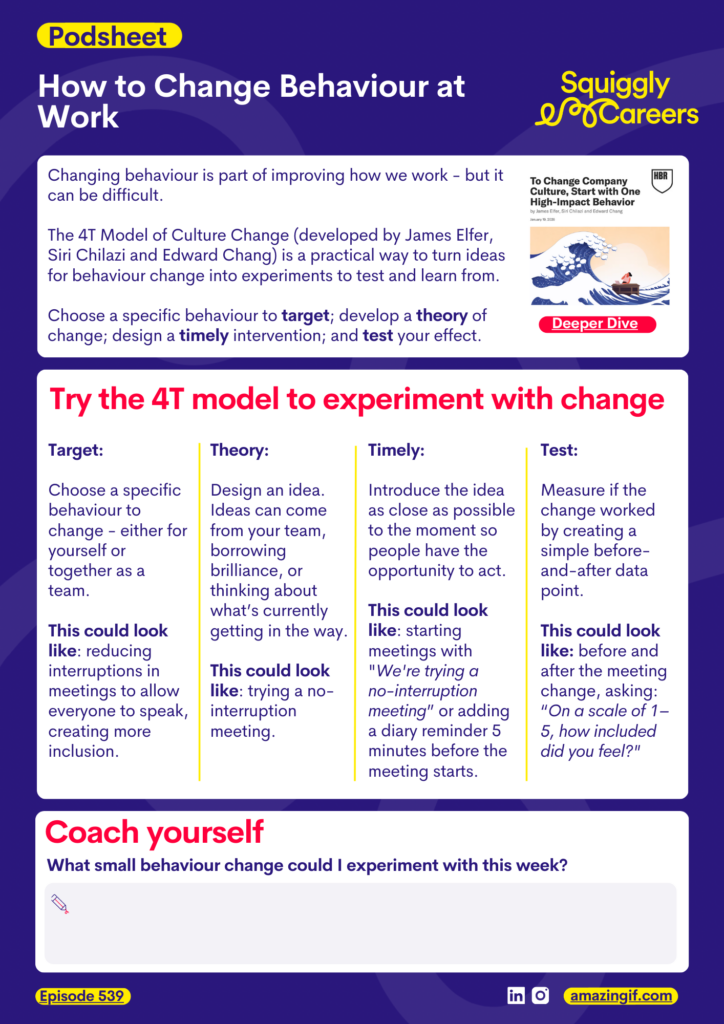
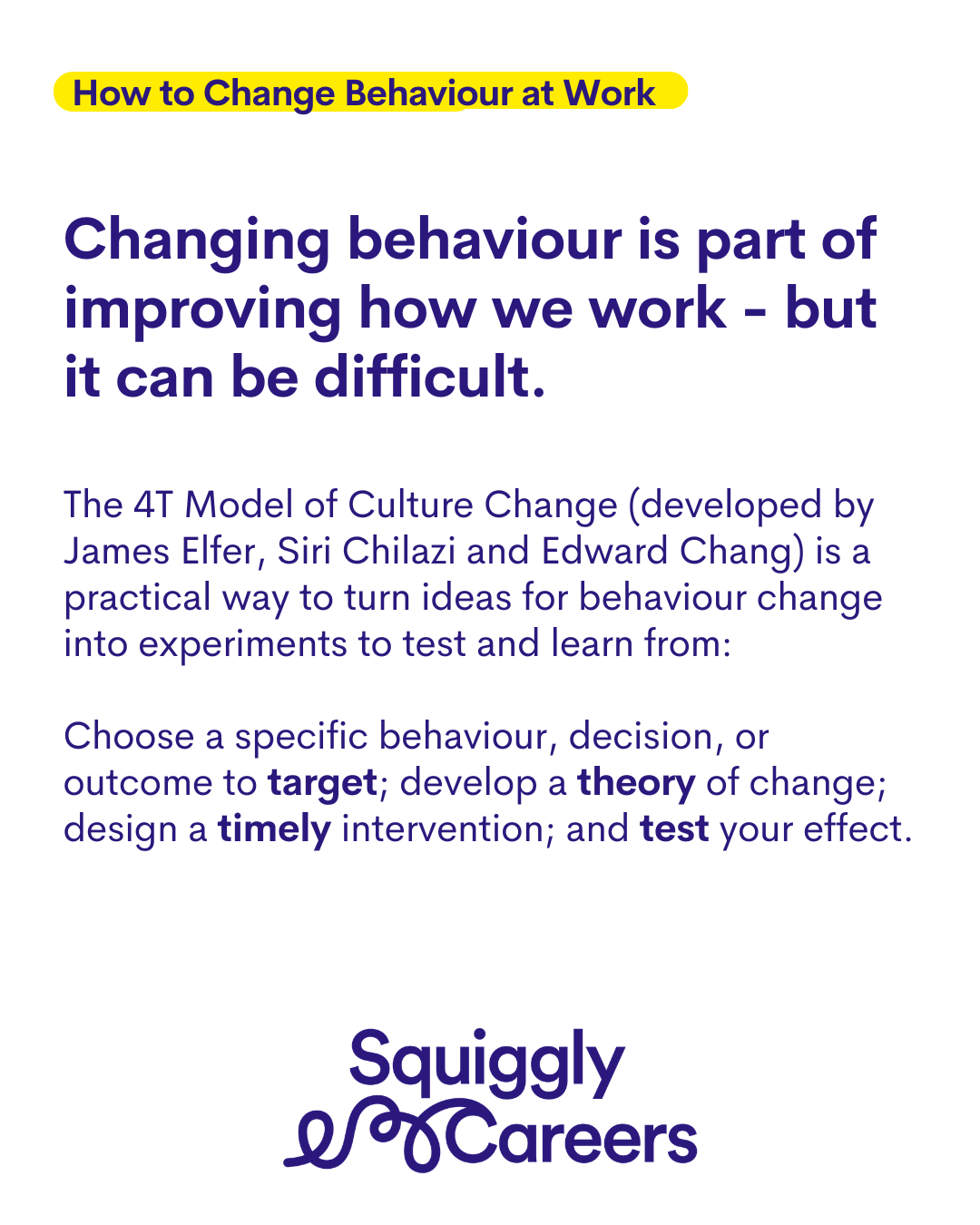
In this episode, Helen and Sarah borrow brilliance from a powerful Harvard Business Review article by James Elfer, Siri Chilazi, and Edward Chang on the science of behaviour change at work.They unpack the “Four T’s” model, a practical framework used in big organisations to drive measurable behaviour change. But instead of keeping it theoretical, they apply it to real team challenges like:
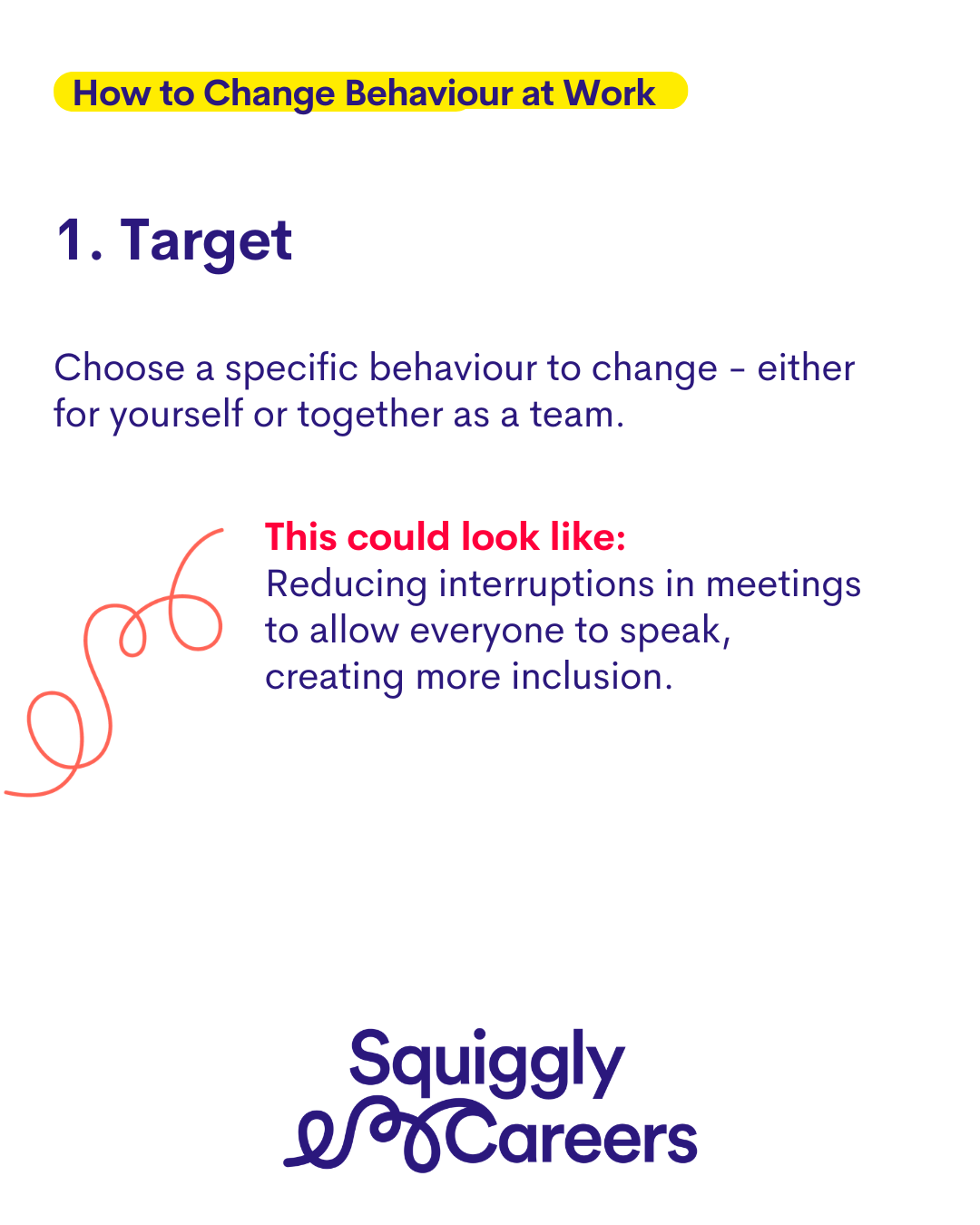
– Reducing interruptions in meetings
– Prioritising important work over easy tasks
– Keeping objectives alive (not just setting them)
– Moving from “busy” to genuinely impactful
You’ll hear how to get specific about the behaviour you want to change, design simple interventions that fit your culture, introduce them at the right moment, and measure whether they’re actually working. If you’ve ever said, “We know what to do… we’re just not doing it,” this episode will give you a structured, science-backed way to close that say-do gap, without adding more noise to your workload.
📚 Resources Mentioned
To Change Company Culture, Start with One High-Impact Behavior.
For questions about Squiggly Careers or to share feedback, please email: helenandsarah@squigglycareers.com
Need some more squiggly career support?
1. Download our free careers tools
2. Sign up for our Squiggly Careers Learn Like a Lobster Skills Sprint
3. Sign up for Squiggly Careers in Action, a weekly summary of the latest squiggly career tools
4. Pre-order our new book Learn Like a Lobster
00:00 How to Change Behaviour at Work
01:00 The Four T’s explained
05:49 Step 1: Target the right behaviour
07:02 Step 2: Build your theory of change
08:28 Step 3: Make it timely
09:27 Step 4: Test the effect
10:48 Real examples to try
Helen Tupper: Hi, I'm Helen.
Sarah Ellis: And I'm Sarah.
Helen Tupper: And you're listening to the Squiggly Careers Podcast, a weekly show where we borrow some brilliance from things we've been reading, watching, listening to, or conversations that we've had which we think are relevant for you in your Squiggly Career. And we take those topics and turn them into ideas for action. And Sarah has picked today's Borrowed Brilliance topic, so I'll hand over to her to let us know what we're going to be talking about.
Sarah Ellis: So we're going to be exploring how to change behaviour at work.
Helen Tupper: Trying to give me feedback. Is that why?
Sarah Ellis: Yeah, and we're going to be doing this live. This is based on a brilliant HBR article that was written recently by one of our friends, James Elfer. And James is the founder of a behavioural science kind of consultancy or practise. Practise is probably a better word called More Than Now. Definitely worth a follow on LinkedIn. You know when you follow some companies and people and you just think, every time I read something I'm that bit smarter than I was five minutes ago. That's what I want LinkedIn for. And he had two co publishers Siri Chilazi and Edward Chang. So the article is the three of them together and what they talk through is this scientific model of behaviour change. So what they have done is some very large scale behaviour change work in really big organisations, so often with more than 5,000 people at once. So they're trying to figure out, I don't know, let's say we need everybody to write objectives and they don't write objectives today or have better quality career conversations. And they test all these usually relatively small interventions, but then they really rigorously figure out what works and what doesn't. So they've kind of got this four step model which I'm going to talk you through. So we're kind of all up to speed. And then what we've done with James permission and a few emails back and forth to him saying, “am I doing this right, James?” Because I wanted to make sure I had my scientist hat on. We're going to apply it at a smaller scale, as in what could you do within the team that you're in, or even perhaps just thinking about it for yourself. So perhaps before I dive into the four steps, I think it is perhaps useful just to reflect for yourself what behaviours you actually want to change, because you need to know that before you get into applying this. And that's a really good conversation to maybe have as a team. Know what behaviours would we want to change as a team? But you can also just do it, do it for yourself. Helen, any behaviours you want to change that you might want to tell us about?
Helen Tupper: It is an episode of live feedback. Well, I guess two ways I'm thinking about this. So what behaviours in our team but also just generally, if you were looking at this as a team together, what behaviours might you want to do? I wonder whether. You can tell me because you've spoken to James whether these would be right. But I'm just trying to think about some behaviours of like simplicity as a behaviour. You know, if a team is becoming too complex like you know, like, I don't know, defaulting to meetings, long emails, too many messages. Could you, could you use this, do you think on like how could we behave more simply at work? Would that work?
Sarah Ellis: No.
Helen Tupper: Okay, tell me.
Sarah Ellis: I don't think so. Having gone back and forth with James quite a lot because. I think maybe the bit after what you said would work. So what you couldn't do is say the behaviour I want to change is we want to be more simple. I think that would be too almost big picture. That's probably, I guess the outcome that you're looking for. What you could do is there. You said too many messages. You could say what we want to do is like reduce the amount of messages that everybody sends. We're a message overload land in our team. So we want to reduce the amount of messages because we've kind of got a hypothesis - that it frees up headspace and quality work. So I think you almost have to be more targeted in the behaviour which will obviously hopefully lead on to kind of bigger things. But often the examples, if you kind of read the examples, they talk about it often quite small things. It could be fewer meetings. I guess that one would be quite appealing. There's like a behaviour change.
Helen Tupper: Can I give you another one?
Sarah Ellis: Yeah, go on to stress test it.
Helen Tupper: So what if the outcome I wanted was inclusion? Again that's too big. But the thing that we were going to use the model with was interrupting.
Sarah Ellis: Yeah.
Helen Tupper: Okay.
Sarah Ellis: I think that's a really interesting one. Let's take interruption and inclusion and go through the four steps. So. And they're all there. It's four T's so it's helpful to remember. So the first one is outcome to target. So this is like, well, what is your target? So what we might say here is our target is, I don't know, zero interruptions. Maybe no one ever gets interrupted. That might be unrealistic. Maybe our target is to half the amount of interruptions that there currently are in meetings. And here they do point out there is usually a long list of changes that you want to make. You know, if we were talking about all the changes we thought we could make that would improve inclusion, it's not just going to be interruption. Then what you are trying to consider is, which one do you think will have the most impact? So here we might say, well, we feel like interruption is going to have the most impact because we want to give everyone space to speak and we feel like that is more important than, I don't know, watching some videos about inclusion.
Helen Tupper: That's a useful conversation in itself. I really like this as a team thing, you know, like, because you'd start with, what's a problem? Or what's getting in our way, or what's something I want to improve? And that's like your outcome. And then to your point, what are all the things that we could change to make that happen? Which one do we think is the biggest impact? And then that's the thing that we target.
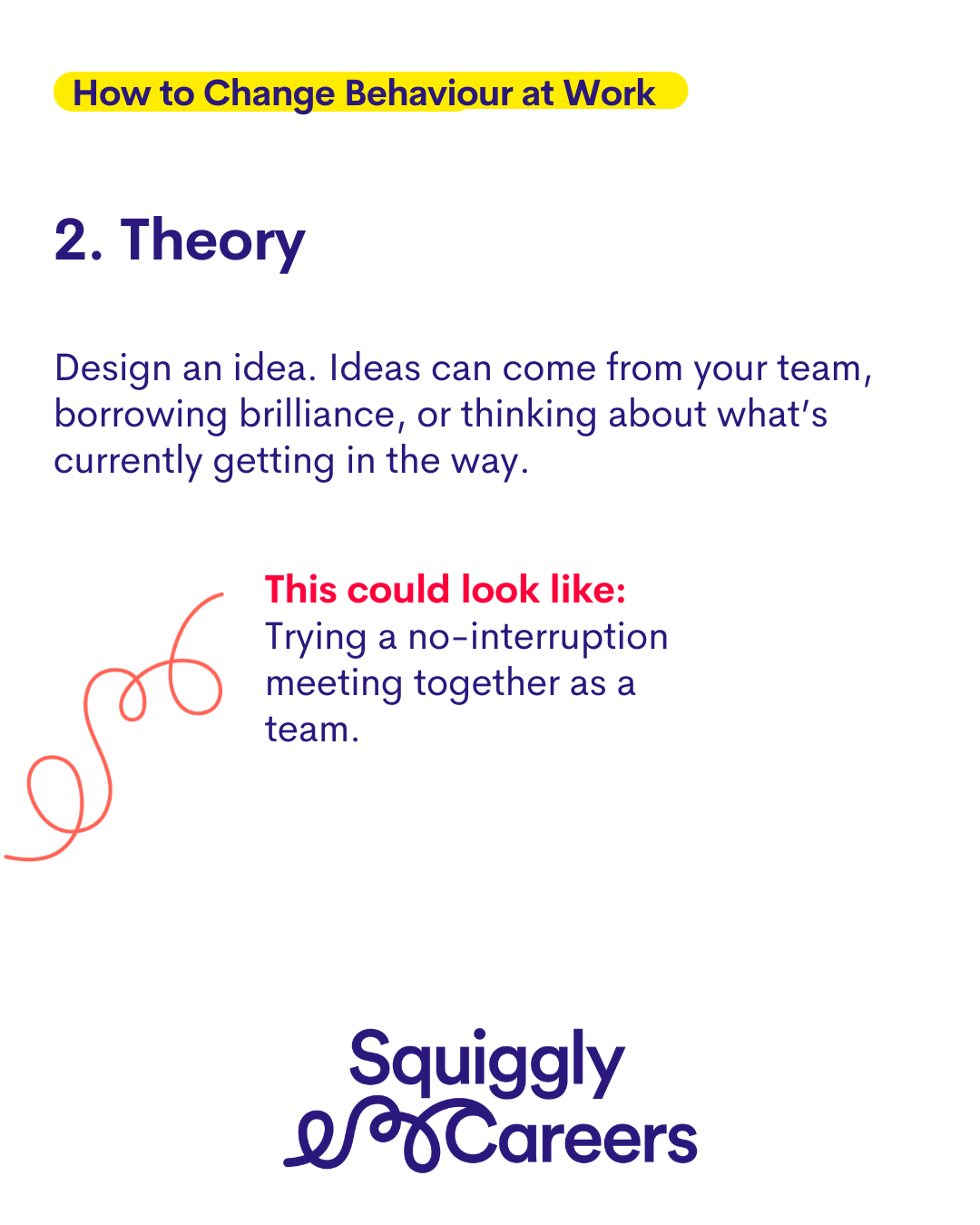
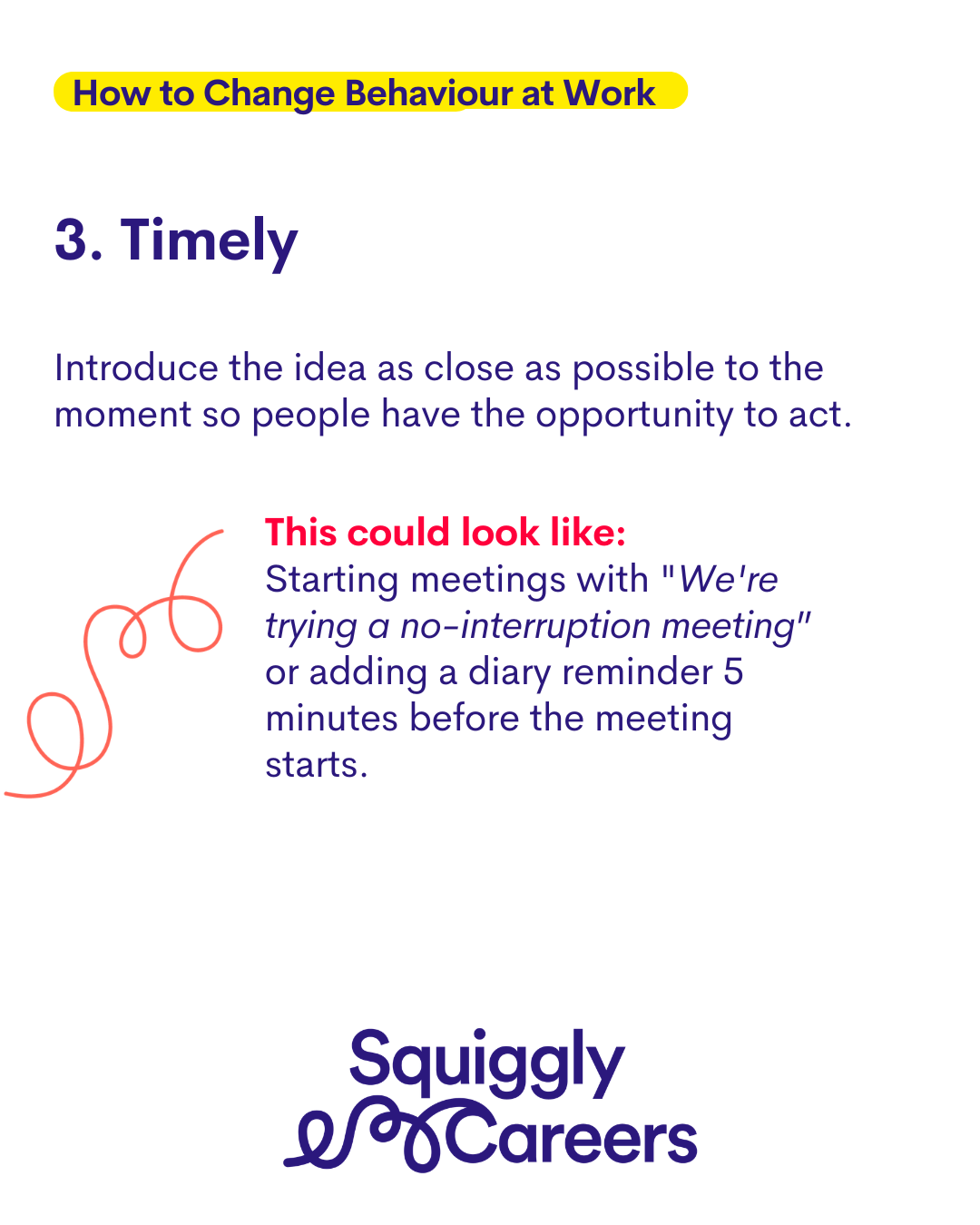
Sarah Ellis: Yeah, that's the thing. So then that really, I think that's how you get to the outcome to target. Yeah. You then need to have a theory of change, which sounds quite grand. Does sound grand, I'm sure. Well, I hope James does listen to this. I'm sure he will actually. He will be like, oh, yeah, I knew they'd say that. But this is the. I think this is your hypothesis, like, how do you think you're going to change that behaviour? So, for example, if we're doing the interruptions, one, it might be every time you go to interrupt, you write it down instead. Is that how you're going to change the behaviour? You could say I we're going to change the behaviour by putting a reminder in people's diaries just before the team meeting to say, this is a no interruption meeting. So we're going to do that. That's a Nancy Klein idea I've stolen there.
Helen Tupper: Well, that's a good point, because I did. I'm joking. I did read all the work that James had put out and when I was looking at that theory of change piece, it said part of to come up with it, it said, look for ideas for how you could do it. And they can obviously come from the team could generate them or, or you could look at what other people do. So you might be like, well, Nancy Klein says this, or person X says this and then it said also think about the barriers, like what might get in the way. And so I don't know, maybe senior people interrupt. The direction of the interruptions might be problematic, who knows? But actually talking ideas and barriers can inform a better theory of change.
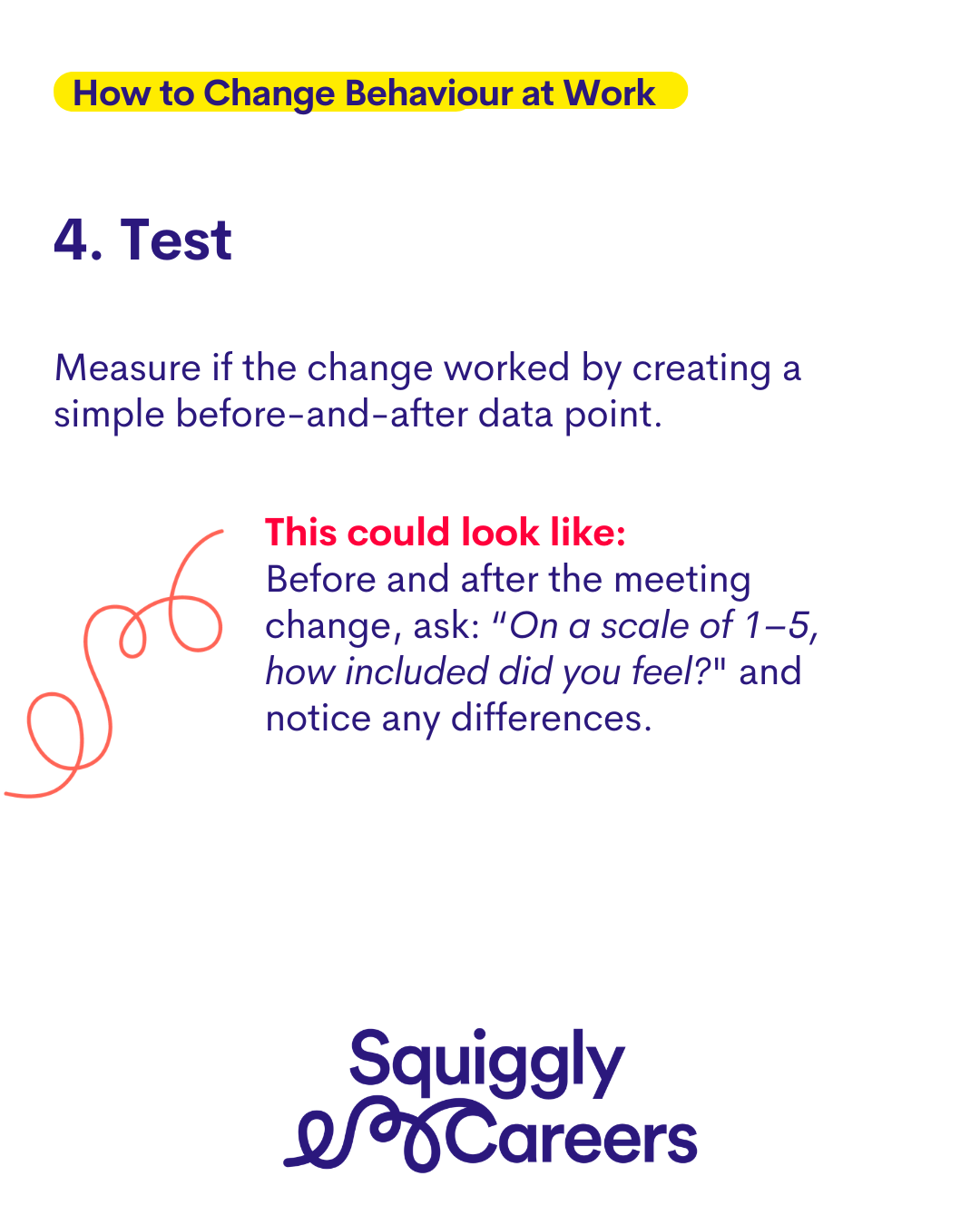
Sarah Ellis: So you've got your theory of change then. Then you need to figure out a timely intervention. So I really like this. This is my favourite out of the four because this talks about the when. And I think until this point you can almost talk a good game and then nothing changes because you don't actually do the thing because you forget everyone's busy doing loads of other things. And so here a timely intervention. Actually a good example would be right before a meeting, it has the no interruption meeting reminder. Or an even more timely intervention would be you start a meeting with as a reminder. This is a no interruption meeting. Or we're experimenting with no interruption meetings and this is one of them. Yeah. So you could even. No more timely than doing it in real time. So this is kind of getting as you're trying to remind people of the behaviour as close to the moment as when the behaviour will happen. Which I think makes sense. It's almost like the kind of habit stacking thing. Right. So that's being timely. And then for as with any good experiment and any good scientist, test your effect. I actually think this one can be quite hard. Like when I was trying to think about this at like a smaller scale, if you've not got behavioural scientists like doing this for you, you know how, like, how will you know? So if you did the interruption one as an example, you both want to, I suppose, test whether people are interrupting less, which you could do. You could get somebody neutral. Like I've actually had this done to me where they literally mark down are you interrupting or not? So you could do like an interruption audit as we would sometimes describe it. But I suppose here ultimately you're testing the effect on inclusion, so you're not just going, we might have interrupted less, but people might not feel any more included. So what you'd have to figure out there, I think is, well, what is our starting data point in terms of how included people feel? Like, where's that come from? Is that from an engagement survey? Or are we just going to ask people beforehand? Are we going to come up with our own metric. And then you're going to have to ask people again after a period of time to see whether the behaviour that you've changed has actually then affected that kind of ultimate outcome that you're, that you're aiming for.
Helen Tupper: Mm. It's making me think about our sprints.
Sarah Ellis: Okay. Because.
Helen Tupper: And I don't. We did not approach the sprints with the four T's in mind.
Sarah Ellis: No.
Helen Tupper: You could, you could, I think, almost critique them retrospectively. Because what I was thinking was when we do the sprints in our email. So for anyone that doesn't know and you're not a regular listener, twice a year we do five day sprints which are designed to accelerate people's development. We recently did one link to our new book, Learning Like a Lobster.
Sarah Ellis: And at the start of the sprint
Helen Tupper: we asked people for. I can't remember the exact question, but it was sort of like how confident and in control do they feel of their learning? Something like that. And we asked them. And then at the end. So we create our own data point from the group of people. I mean it's like thousands and thousands, quite a big group of people that do the sprint. And then we ask again at the end of the sprint so that we can see the impact of the learning. But you could, it's quite. I think we could take the four T's and kind of go what, you know, what are we targeting? I think what we're targeting is basically kind of making learning easier to do every day. And then you go to theory of change and what have we learned and how are we going to test it and then the moments. But I think actually there's quite a lot that we could apply. But I, I guess as a team, to your point, if you're going to do this together, you might just want to create a data point at the start which could either be qualitative or quantitative. But I, I always think scales are quite simple. On a scale of 1 to 5, how included or whatever the thing is you're trying to measure as a start point could be a simple way to see the impact of the test.
Sarah Ellis: And actually I always get a bit worried about claimed behaviour from jobs I've done in the past where people say how they are going to behave versus how they're actually behaving. But actually reading some of the work and reading the report, often people, it is just what people say. That is how you figure out like where people are. So it will be self-reporting. Sometimes it is more kind of scientific than that, more kind of factual. But I suppose, and we've said this before, feelings are also data. So, you know, if people are feeling more included, that's got to be a good thing than when people were feeling less included. That is a feeling and that's fine too. So occasionally you can read some of these examples, I think, and because some of them are at such big scale and are really significant, it can feel hard to take, you know, your experience, relate your experience to that. So hopefully we tried a bit with the interruption example, but we're going to do another one because we thought, let's pick another example to bring it to life. And I've tried to pick one, it's actually a real one from our team, but I also tried to pick one that I feel everybody will nod their heads at, hopefully when they're hearing it. So the context is everybody sort of says they're busy most of the time. If I say one word to describe your week at work, everybody always says busy. But our challenge to that is, in reality, it's quite rare that people are the same amount of busy all of the time. And so initially, actually, so I'll tell you my workings here because I got this wrong the first time I tried to design this too, because I have run this past James. The advantage of knowing the person who's written the article is I said, oh, I think our team would like to get better at prioritising. And he was like, oh, I'd like to just sort of probe the problem a little bit more, be more specific about the problem. And so rather than just saying prioritising, which almost kind of feels too big, it's quite then hard to design the experiment and what you're going to do. I then took a specific example that someone in our team shared with me where they said, I feel like actually probably what happens is I sometimes prioritise easy work over important or impactful work. So it's that like, trade off that I think we all have every single day at work. You think, hmm, the easy email or the hard one pager? I've had that today twice. And I'm like, easy one out. Yeah. And also I then did try to do the hard one pager and I was like, oh, this is actually really hard. Go back to the easy email. So the target is how to prioritise important over easy work. Got it. So you make it more specific so
Helen Tupper: you can almost, you can keep that first bit, the how to prioritise, but you add on that more specific element to it. That's nice.
Sarah Ellis: Yeah. I think you've just got to, like, drill down probably a little bit more than you might imagine, unless your brain naturally goes up. I think both you and I actually often go a bit bigger. So actually we have to zoom in a little bit more. We need that prompting. The other idea I had, by the way, on this is you could put the article into Claude, then you could put what you're going to do and ask it to critique it. So we're doing it for each other. But I reckon Claude act like James
Helen Tupper: and critique my design.
Sarah Ellis: He would be. He's like high challenge and high care, but sort of quite critical. Friend vibes, you know, like, he will always try to kind of make you better.
Helen Tupper: Yeah.
Sarah Ellis: Perhaps that's what we need to design like a James AI, a James bot. So you've got your target, then, your theory of change. So this is - how do we think we can solve this? This is my favourite bit because you just. You're allowed to come up with ideas. So some ideas that I came up with, I was like, well, you could try. I thought you could try an objectives reminder in your inbox. So I suppose that's me connecting the dots with the work. The most important, impactful work you do will be linked to you making progress on your objectives. So what if either in your diary or in your inbox every day, you got a reminder of your objectives this quarter are. That's. It just tells you. Tells you your objectives. Second idea was a sticking power coach. So this was the idea that, you know, often with important work, a bit like I did today, you end up switching too soon. You don't stick at it for long enough. And because we're all very good at getting distracted and things are used to stealing our attention, we're often not that good at sticking with the hard stuff. And so maybe. And I think you could do this using, like, Pomodoro technique, or you could use this using an AI, but you actually get something to hold you to account in that moment to be like, in the next 30 minutes. I'm going to work on that one pager. I want you to, like, ask me some questions that are going to hold me to account. I'm going to set a timer. Maybe I was. I was trying to work out if you could even create, like a blocker, you know, if you tried to, like, move tabs and it wouldn't let you imagine that, like, if you took. Because that's what happens. I do all my stuff on tabs, so Imagine if it, like stopped you using tabs. That was another idea I'd got. And then the third one was three coach yourself questions. So you just have three coach yourself questions that you keep coming back to. Like, what matters most to me this week? What are my objectives for this quarter? What's on my win watch? Like we have. We have a win watch. And actually sometimes from like, from knowing James and talking to him about his work, he will often really encourage you to be very simple here about the interventions. Keep them really simple, really straightforward. So I can imagine if, like his voice in my head at the moment is going, like, he wouldn't. I don't think he'd like the sticking power one. I really like that idea.
Helen Tupper: I thought of two more when we were talking. I was thinking you could do. So you do like. Well, you could do this a few ways. Maybe it's three ideas. So the first was you could have like. The first meeting of every day is sort of blocked out in people's diary for them. So everyone has a carved out time for half an hour, say, for example, every day. And that is. No meetings can go in that. That's sort of like a meeting for you to work on what matters most.
Sarah Ellis: So that goes.
Helen Tupper: That goes in there. The second idea I had was about doing that together. So, you know, there's. I see back and about borrowing ideas from elsewhere for the stereo change bit where people. I forgot it's called like studymate or something. Workmate, I think, where you. You just work. Sarah and I have a meeting at the same time, which we're both in, but we are not working. It's the sort of like an accountability thing. I'm sure it's like workmates. Then. The third idea I had, which I think was quite small, I think it was a play to James's. Like that specific is every day you just have to go on a team's channel and type - my most important thing today is. And it's just whether that articulating and sharing creates greater clarity and commitment, I guess is the thing. But I love the theory of change bit and coming up with lots of ideas and then deciding which one. That's definitely a fun bit. That's the good bit. Let's just do that all day.
Sarah Ellis: Yeah, we don't actually do this. Never change the behaviour. Just ideas for how you could change behaviour if you actually tried the other thing that you could do. And Helen. Helen did this for me today as she was kind of reading what I'd shared with her. You can Then borrow brilliance on, well, what do other people do? So I'm sure lots of you come across urgent versus important matrix. So you could be like, I'm going to try using that model. Stephen Covey talks about putting first things first. I always think that phrase is like a really memorable one. And so again, you could be like, you could literally just have that quote pop up every day. It could be like as simple as that. It's like a reminder to sort of behave in that way. We could do things like the. Which is what Helen was talking about with like time blocking the first half an hour, hour of a day. Like Cal Newport is always a really big fan of that. Like sort of deep work, monk mode, monk mode time. And so I think there's loads of different ways that you could kind of try this. And I think it is often quite good to also think about the barriers because if the barriers are too big, it makes the interventions really hard. So if, for example, the first hour idea, like we're all going to block out the first hour or half an hour for kind of this deep work on what matters most in our company. If a partner that we worked with then needed to talk to us, then I know for a fact both Helen and I would say yes. So that would go, you know, like the, the ability to then deprioritize, that would disappear really, really quickly. So I sort of think, okay, well we are a company that works with lots of companies and we sometimes need to react and respond quite quickly. So, okay, well maybe that's not the best, that's not the best intervention for us. Perhaps let's try a different one. Let's try the accountability partner, one that feels a bit more flexible. So, you know, I think you also want to design ideas in the theory of change that reflect your context and your culture because then they stand. You obviously want these to work. You want them to stand a good chance of success. I always think you want every idea to be like, oh yeah, great, I think that's going to work. That's going to be the one that's going to change my behaviour. So you've got all your ideas. That's the fun bit. Then you need to think about the timeliness. So like, when are you going to use the idea? So this is put the idea either in or as close to the moment as possible. This is kind of the adding in idea versus adding on that we sometimes talk about kind of with learning, which I think makes a lot of sense, then you have to track them. So one of the things that you will read about experiments is sometimes it's useful to have what's called a randomised control test, which is essentially, let's imagine there's 10 people in a team, half of you do nothing, five of you try one of these ideas. But I double checked for James, you don't have to have a randomised control test. So if as a team you wanted to try this out together, half of you could do one idea and the other half could do the other idea. So half the team could do the first half an hour of every day. The other half of the team could do the kind of live co working idea. The important thing is though, for both of them, you have to then know how you're going to track it. You know, to that last point, you have to know less necessarily how did that hour feel? But how are you going to figure out whether behaviour change is happening? So I was trying to think about it. I think this then gets quite tricky sometimes to figure out. And the best thing I could come up with for our team and see if you've got any other challenges or builds, Helen, was we have a win watch. So every quarter we all know what's on all of our win watches and we red, amber, green them. So you never get all greens. There's always a mixture of red, amber, green. Could you look back at your red amber, green percentage for the last six months and be like, that's my starting point. Then you try this intervention and then you see whether it impacts your red amber, green percentage succession. You obviously want your greens and your ambers to increase and you want your red to go down. Because the point is, if I am doing more important, impactful work that the kind of consequence of that or I should, I should see that show up in more wins happening in my win watch that. That was my best attempt.
Helen Tupper: Yes, yes, I would. I was very specific to our company. I think what's going through my mind is obviously it was an idea sort of based on our company, wasn't it? To make it really relevant. I was thinking, because your point is it's not just tracking the experiment, it's tracking the. In sort of tracking the impact, the change, the. Yeah. Has. Has it led to change. So I think, yeah, for our, for our example, it probably is that. Because there's sort of in the moment measurement and metrics aren't there, like. So for example, you could give people that for that, you could say like in the week or the fortnight that you were doing the change, you could get people to say, here are five words to describe your day. At the end of every day, they just could like pick a word and so you could like how many times they pick the word busy versus energised, efficient or whatever other words you put in front of them. But that, to your point, that would just be a feeling in the moment, not necessarily the behaviour change that we are looking for. I do, I would quite like both though. So I guess for other people it'd be objectives or impact, effectiveness of meetings. Whatever thing you're looking at.. I would quite like that. Both data points though. I know the first one isn't meaningful behaviour change, but I would quite like to see like it. How you've described it, I would almost like a - in that short period of time, does it look like it's made a difference? Because it could. Otherwise it's quite a gap between the intervention and the impact.
Sarah Ellis: I suppose you're talking about a how's it going and a how's it gone? You know, like, it's like both. It's like both framing both of those things. And I guess sometimes in some of the work they're doing at like big companies, big scale, they perhaps don't need it. They sort of let it play out and then be like, did it actually do anything? Has anyone actually changed their behaviour? One that I'm working on at the moment with a really big company, which I think is probably quite a typical one, is about performance objectives. So both setting performance objectives, which actually this company has quite a high like rate off, you know, like the percentage is quite high. And sticking to performance objectives, i.e. Do you keep them alive? Do you kind of go back to them? And that's often a much bigger challenge because you tick the box of like, we've all set our objectives, but then they sort of don't stay alive. You know, they're not then used. So one of the things that you could do is think about that is like, well, what are the. You know, the theory of change would be the interventions, the ideas. What are the ideas that we could try out that would keep performance objectives alive? Which is essentially actually the work that we've done for this company. I've kind of gone, you could try this, you could try this. And we've talked about like, when, like, when would they do that? And then actually they will have a very clear data point. Like, do people go back in and re-look at their objectives, do they remind themselves? Are they updating them as they go? Because some of the objectives, no doubt they'll, you know, you achieve it a bit earlier or something changes so you need to update it. Or do they sort of sit like they used to sit in a filing cabinet? I remember the days of officers were filing cabinets and they now sit in a system. And so they will literally have a percentage number of knowing, like, because it's, because it is on a system, it's actually very easy to see. And so often ones like that, I think are helpful for people because you've got a very clear outcome, but they will have to wait six months, I guess, at least three months before they can even get a sense of that. So to your point, that might feel a bit like if you were doing this together as a team, you kind of want something in the meantime because otherwise maybe you lose a bit of momentum.
Helen Tupper: Insights and then impact. I think it depends the level that you are using this at. I think in a team you might just want some more immediate things. If this is a cross company strategic initiative, you've probably given the scale of the people that you're. You might be talking about, you can probably sit and wait because the impact is, is bigger. But if it's about our team using the word busy less because they feel more in control of their time and impact, I probably want some more, some sooner insights whether this was working.
Sarah Ellis: And so I think the reason we wanted to do an episode on this today is as well as it being a brilliant article, I think it is a really simple structure to follow. I think everybody can have a go at this. Like, we are clearly no experts, but you can read it and follow it and then hopefully this will have helped as well. And universally, I think what team doesn't have a behaviour that they would like to change because we are all work in progress. No team is perfect at everything. And I like that this encourages you to be really specific. So it almost doesn't work. If you go too big, which both Helen and I have done initially, it's then quite hard to follow the four T's. Whereas actually, if you're like, right, the thing we want to change is loads of the people, teams and companies we're working with at the moment want to get better at saying the hard thing. So that's actually the other one that I've been applying this to. I've been like, right, you want to get better at saying the hard thing, right? All the ideas on how we might do that, when, when are we going to do that, how are we going to test it? Anything like that, where you just think, oh, you know, we've got a bit of a no do gap, or a bit of a say do gap. Like, we know this is important, but for whatever reason, we're not doing it. Usually because it's hard, because behaviour change is hard. And I think what James and More Than Now are always really trying to encourage us all to think about is going to. Yes, behaviour change is hard. And that's why you've got to be specific. It's why you've got to keep it really simple and you've got to kind of measure it so that then almost you don't waste your time in the wrong places. That's one of the things that actually James talks about a lot on LinkedIn, is often we or companies will invest in things because you think it's the answer to these problems. But a lot of that is without any of, you know, you don't know necessarily whether it works. So his point is massively overinvested. The things that work, like, figure out what works, if doing, sticking, power works, and suddenly everyone's spending more time on most important work, right? That's it. Go for it. Get everybody doing it. Really kind of create a lot of momentum around that. But don't waste your time on loads of stuff that isn't actually having the. You like to tell ourselves it might be having the impact, we think, but it isn't actually. So it's good. It's a good, rigorous test for your brain. It is.
Helen Tupper: And it takes, I think, some of the emotion out of it a little bit, you know, because, you know, behaviour change can feel like. Let's take the interrupting thing, like you saying to me, “I think we should. I think you should stop interrupting Helen” would be a bit harsh. And, you know, it's a bit of an emotive thing for you to say, it's hard for me to hear and
Sarah Ellis: all that sort of stuff.
Helen Tupper: But if we said, okay, this is. Behaviour is important to us and this is how we're going to do it, and we've got this rigorous process. So suddenly I think the process takes away some of the emotion from the problem. I find, anyway, I'm like, okay, well, I can focus, I can focus on this, on this process, I can work this through. It becomes a lot more objective, which I think is easier for teams when things need to be changed.
Sarah Ellis: Yeah. That's definitely true because I even found that today because I definitely had a moment today where I chose easy over important. And I was thinking, oh, if I. In that moment, if I had just had a nudge, a reminder, like a. Something that could have been like, no, Sarah, like this is. This matters most, whether that is a reminder of my objectives or someone online didn't let me, or some. I'm watching. I'm watching you, Sarah. You've just clicked off the one page that you're meant to be finishing or. I honestly think the old tablocker thing is genius. I just need to work out how you make that happen. Do you remember, like, oh, my gosh, I'm going to make myself really old now, really old. But do you remember, like, early days of Microsoft, the little, little paper clip that popped up, the little animated paper clip, obviously, and that came back. It's just like. It's your conscience. Yeah, yeah, yeah. I'm your conscious paperclip. Those emails can wait, but the one pager can't. I think it would actually be. I don't think to your point. It makes. Also involves you, you know, like, no one likes behaviour change that you've been told to do.
Helen Tupper: Yeah.
Sarah Ellis: Whereas here I think you are, you're creating. The idea is you're creating that theory of change and then you're sort of holding yourself to account to kind of have a go at it and then you're figuring out what works and what doesn't and that feels quite objective. It's not that you, like, I could try one thing, you could try another and one of them might work loads better. And that's not because of me or because of you, it's just because actually that intervention, that idea is what's had the most impact and then you all get better. So it has a nice mix of. It feels actually quite fun and quite playful to create. Like, I've quite enjoyed almost. I keep applying it to loads of different things. You know, you're like, oh, the sprint or say the hard thing. So I think you can see loads of examples of where it's useful and it's not that hard to get started. I feel here, like, the barriers to having a go, sometimes it takes a bit of thought. Like I said before this, I did write up a few and sent them an email to James and he came back and asked a few questions. So I think some bits of it are easier than others, but I think for most behaviours you'll be able to at least have a go, even if you're like, ah, my testing isn't perfect or it's not foolproof, it might not pass some sort of rigorous test. I'm like, probably still better to do it than to not do it.
Helen Tupper: And like we said, you could always run it by AI and say, you know, take what's in this article as a structure and tell me how to kind of build it better. Like, that's definitely going to help a bit.
Sarah Ellis: So that's everything for this week. Let us know if you do have a go at changing behaviour at work using the four T's. We always love to hear from you. And also if there's something you want us to borrow brilliance from a person, a place. We've done objects, we've done events.
Helen Tupper: Abook, a company that you're like, wow,
Sarah Ellis: They do this brilliantly, all this stuff. Very open to different ideas. But we're really enjoying exploring this format and we hope it's working really well for you and still feeling useful. You can always email us. We're helenandsarah@squigglycareers.com but that's everything for this week. Thank you so much for listening. I'm back with you again soon. Bye for now.
Helen Tupper: Thanks, everyone. Bye for now
Sign up to the Squiggly Careers Newsletter and get our latest ideas, tools and inspiration every week - all in one place, straight to your inbox