Are you a “track everything” person or a “just do the thing” person? In this episode, Helen and Sarah borrow brilliance from the world of gamification — and have a genuinely fun debate about whether it actually works for your career.
Helen comes in as a convert (she gamifies her sleep, her deep sleep, her exercise, her steps, and possibly her vegetables). Sarah comes in as a sceptic. What unfolds is an honest, practical exploration of when gamification helps, when it doesn’t, and how to design a game that works for you — not one that makes you feel judged by an app.
🎯 What You’ll Learn
– What gamification actually is and why it taps into some very human motivations
– Four games you could play at work right now — from your to-do list to your energy, relationships and learning
– Why the question to ask of any game is: does this make me feel more capable, or just more compliant?
– How teams can play together without it turning into an uncomfortable competition
– The rules of the game: how to design your own two-week experiment
📚 Resources Mentioned
Squiggly Careers Skills Sprints
For questions about Squiggly Careers or to share feedback, please email: helenandsarah@squigglycareers.com
Need some more squiggly career support?
1. Download our free careers tools
2. Sign up for our Squiggly Careers Learn Like a Lobster Skills Sprint
3. Sign up to the for Squiggly Careers Newsletter, a weekly summary of the latest squiggly career tools
4. Order our new book Learn Like a Lobster
00:00: Introduction
01:17: What is gamification?
02:57: How gamified are Helen and Sarah’s lives?
10:37: Can gamification go too far?
15:06: Idea 1 … gamify your to-do list
19:24: Idea 2 … gamify your energy
24:59: Idea 3 … gamify your relationships to motivate you to do something different
26:00: Idea 4… gamify your learning
27:42: How to play games together as a team
30:33: Closing remarks
Sarah Ellis: Hi, I'm Sarah.
Helen Tupper: And I'm Helen.
Sarah Ellis: And this is the Squiggly Careers podcast where every week we borrow some brilliance and turn that curiosity into useful action for you and your Squiggly career.
Helen Tupper: I'm excited about this topic because we're borrowing brilliance from the world of gamification. And I think when you, when Sarah and I basically like sort of bounce ideas off each other for borrowing brilliance and sometimes we'll bounce them and build and sometimes we just. I'm like, we're just doing it. We're just doing it. And I could imagine when Sarah was reading this gamification one thinking, oh, I don't know, Helen, I don't wanna do this, but I feel like the more we've talked about this, the more bought in you have become to the value of gamification in our careers.
Sarah Ellis: I don't know whether, I mean, I got halfway through some of the notes that you sent me and just thought, no, which we'll talk about when we get to it. And in lots of ways I think actually the reason I think I'm bought into the episode.
Helen Tupper: Okay.
Sarah Ellis: Because I think it's helpful for us to have different points of view sometimes.
Helen Tupper: Okay.
Sarah Ellis: And I think this is one where you and I, you and I are. We have very different starting points. And so I think I've become more interested in our differing perspectives versus being convinced by gamification.
Helen Tupper: All right.
Sarah Ellis: That's my starting point.
Helen Tupper: We'll see where we get to at the end of the episode. So as a starting point, maybe, maybe I'll present the what gamification is and why. I think it is a useful thing to us to apply to our careers and then you can debate me along the way.
Sarah Ellis: Tell you why you're wrong.
Helen Tupper: Yeah, all that sounds like a day in our lives generally. Okay, so what is gamification? This is a. This is not my language. But to be accurate, it is the use of game-like elements such as points, levels, challenges and rewards in a non-game context to motivate behaviour and increase engagement. What are we thinking? Yeah. You fine with that definition?
Sarah Ellis: Well, I mean, it's not definitions ever used because.
Helen Tupper: No, but you want to motivate behaviour and increase engagement, right?
Sarah Ellis: Motivate behaviour. I understand. When we say increase engagement. Engagement in what?
Helen Tupper: Well, I guess in the context of our career, it could be learning. So if you want people to, let's
say sort of interest, like the engagement could be like sort of interest in it.
And I think the. Maybe the motivation to start something and then the, like the engagement to continue. So let's say you were gonna. Sprints are probably a good example because a lot of our audience might have done them. Gamification could be used as a way to get people to sign up to a sprint because maybe they get something at the start. Lobster badges.
Sarah Ellis: Yeah.
Helen Tupper: In our recent learn like lobster skill sprint. And then it could also be used for maybe they get like a little lobster token each day or something that then they're trying to collect so they can complete like the, like the stickers along the way. So I think the motivation is get started engagement is kind of keep people going with it.
Sarah Ellis: Yeah. And I think it's interesting if you're listening to reflect on almost how gamified is your life today.
Helen Tupper: That's a good, that's a good thought
Sarah Ellis: Because I think about. I was thinking about this in my work, but also just in the rest of my life. And I don't think I gamify anything, so I couldn't come up with a single example. So I do play some games. So I really like wordle, for example, but I don't track it. I don't do any streaks. I don't do all of the gamification that goes around Wordle. I just do Wordle because I like Wordle. So I was thinking about lots of different aspects. I do exercise. But I don't gamify any of my exercise or collect any of that data. Because there's some overlap here, I think, as well with like data field development. And at work I don't have any trackers. Like, I know people who, you know, will track habits or sort of try to gamify themselves because they are trying to like do something different. So maybe at work you'd be thinking I'm going to try and do. Try and take a lunch break every day, for example, and people might naturally like gamify that. And I, I don't do any of it today. So I think I am starting from zero. What about you?
Helen Tupper: I think my life is very gamified and I haven't really thought about it until you just like, like pose that question. Because if I think about the amount of gamification in my life. So I'll start with my ring. So I like gamify my sleep, but I find it so helpful. I have like a sleep score and I'm trying to get my sleep better. I get. I don't even just gamify my sleep. I gamify my deep sleep. The percentage.
Sarah Ellis: No, you do you keep telling me about it.
Helen Tupper: So happy about my deep sleep. I'm trying to get it even better. So I gamify that. I gamify exercise because I try to get like a streak. This week's been awful. Really annoyed about it. Really annoyed. My streak's been dreadful this week, but I really. And I find that really helpful for my health to do that because it really, to the point around it motivates me to do it and it keeps me engaged. Definitely though, those things like that, that streak. And then I was thinking it's like, oh, there's also other things that I gamify. I. I gamify my diet. Like, you know, the vegetable thing. Like my, like 10 veg fruit vegetables a day.
Sarah Ellis: Yeah, I definitely.
Helen Tupper: Now I don't actually track that, but in my mind I will think because, I mean, how many are you supposed to have? Is it like five a day?
Sarah Ellis: I don't know. I don't gave up on my life. I just eat what I want when I want.
Helen Tupper: Oh my gosh. Oh my. There's more steps. I even gamified steps. Yeah, my life is quite gamified, but. But in a way I quite enjoy.
Sarah Ellis: As long as you're happy, you're happy,
Helen Tupper: I'm happy, you're happy. Yeah. So I think probably I can see why this would naturally, for me to take this concept from my personal life into my professional life, it feels like quite a natural and enjoyable thing for me to do. But if you're starting places, I haven't gamified my life, therefore why would I want to gamify my work? If that's a starting voice, then I can see why, you know, might need some convincing. Can I give you some research to convince you?
Sarah Ellis: Yes. And then I've got some research for you as well.
Helen Tupper: Oh, is it counter. Counter research?
Sarah Ellis: You give me your research and I'll give you mine. Okay. Okay.
Helen Tupper: All right. So my research is about the self-determination theory, which I think we covered on our. I think we might have done this back in the day.
Sarah Ellis: Well, do you know who talks about this? I think we did. And then I think Bruce talks about it in Fortitude.
Helen Tupper: Oh, maybe that's. Maybe that's.
Sarah Ellis: We've done that thing. I think we did do it originally at university because it's quite a recent research. Right? Yeah, but he does he. I think he talks about it in that book as well.
Helen Tupper: So this is a very light summary of self-determination theory, but it basically says that gamification taps into the drivers of self-determination theory. So you know, people's desire to personally commit to something and that is because it taps into progress. So people are motivated when they can see that they're improving. My sleep's getting better autonomy. So I feel like this is something that I have control over. Don't have to wait for someone to do this for me. I can take control of it. And connection, which I thought was quite interesting because I, I'm probably not doing this with some of my things at the moment, but motivating by sharing goals. So if you are, if you are gamifying in a, in a group of people, I, that's actually less me because I don't need to compete or compare in that way. That doesn't really do it for me. But I thought that was quite interesting about the self-determination theory, that there's an element of connecting with other people who are maybe also gamifying things.
Sarah Ellis: So have you made the link that gamification links to self-determination theory? So have you connected those two dots?
Helen Tupper: No, it came up in some research that I was doing on this.
Sarah Ellis: Interesting.
Helen Tupper: Why?
Sarah Ellis: Well, well, no, I believe, I believe in self determination like those, those three things, but I just don't think you need gamification to achieve them.
Helen Tupper: Oh no, I don't either. Yeah, I think, I think it's an and like. And gamification is one way in. I think you can do that stuff without gamification. I think the self-determination theory is a theory. I just think of gamification in some of those things.
Sarah Ellis: Yeah. And I guess it does help you with. One of the things about that theory is usually as humans, I think most of us are hardwired to want at least some level of control. And I think one of the things around gamification, like when I listen to you being obviously very open-minded about what you're saying, I see that it sort of gives you a sense of control in a week where every week, like for you would be full on lots happening, pulled in lots of different directions.
Helen Tupper: Yeah.
Sarah Ellis: Something that you can control potentially is your sleep. Yeah, it is, you know, like you can decide when you go to bed.
Helen Tupper: Right.
Sarah Ellis: You can create an environment where you're going to sleep. Well, yeah, you can control to some extent like the exercise you do, how you exercise, when you exercise, what you eat. So it's like, it's an interesting way of kind of thinking. Everybody likes to have control. Gamification is kind of one way to do that. I read a couple of interesting articles and actually we both read these. So Tim Harford, who writes for the ft. Yeah. But you can also subscribe to his newsletter and often. And he'll summarise what he's written. The ft.
Helen Tupper: He's writing that.
Sarah Ellis: Oh, is it free? Yeah.
Helen Tupper: Ooh, great.
Sarah Ellis: And it's funny because, actually I end up reading them twice sometimes, which I don't mind because my partner has the ft. So I don't mind sometimes a magazine, you know, with a coffee, and I'll be like, I sort of read his. And then there's not loads of the FT I read, but that bit I do read. And then I quite like coming back to the ideas in his newsletter. So everybody be able to read these. And he has reflected over the last year on. He started running and he talks about, like, gamification and he said, like, running and using, like, fitness trackers and things, how it has sort of helped him in one sense in that he talks about. He's like, never run so far. But he's also like, I have never behaved so weirdly. And his sort of conclusion is like, sometimes I'm doing things for the wrong reasons. It's all. You almost get so into the game. And he describes it as like, gamification. It's sort of like foot. And then he says, but it's more hellish.
Helen Tupper: I have to tell you, like a funny. This is not going to make me look good at all in anyone's eyes.
Sarah Ellis: Gamification gone too far. Yeah.
Helen Tupper: There was a moment on a New Year's Eve, a few, I don't know, three or four years ago. So they have this annual challenge on Peloton where you have to, like, get a certain amount of minutes on the bike or something like that. And I was really close to getting, like, the gold badge or something for like 10,000 minutes or whatever. Was measuring. I don't even know what I was measuring. It was just a badge, obviously. Quite drunk on New Year's Eve and I. And we also had friends over, right. So I got on that bike drunk, even though there were people there in order to get my badge.
Sarah Ellis: What did the badge give you? Nothing.
Helen Tupper: I don't know.
Sarah Ellis: Just a badge.
Helen Tupper: Joy. Short term Joy.
Sarah Ellis: Okay. You don't get, like, free.
Helen Tupper: No. There was absolutely no other reward other than personal pride and, you know, embarrassment. Many years on that I actually did that. But to your point, does it always. Was that the right thing to do? Right then? Probably not. But to the Tim Harford point, sometimes it probably gamification could go too far. That would be my personal indication.
Sarah Ellis: So I was trying to think how gamification can be useful, like what would motivate me to start to gamify anything that I do at all, given my starting point is zero. And I was sort of playing around with some AI prompts, kind of using Claude and he, he, oh look, he's become a, he's become a hero's best friend. I don't know, I don't know what they should be. They said to me the question to ask of every mechanic is does this make people feel more capable or just more compliant?
Helen Tupper: Okay.
Sarah Ellis: And so I actually did find that distinction quite useful because I don't think I like the compliant thing. I was like, I don't want anyone else to tell me what exercise to do or how to work because I think I really value like freedom and variety. It like to be in control. I think I feel like gamification takes my control away rather than gives me control. But I do like the idea of being more capable because being more capable is basically continual improvement, is, is getting better, is even better ifs. And so I was thinking, right, can I then design a game that is much more about me being even better at work? Because that I find motivating. And so you may or may not need that depending on where you're starting from, if you're listening. But I just found that distinction useful I think, because I don't like, I don't like the idea, for example, of a game like telling me off for not doing something that I've not done. I'm like, how dare you? How dare you tell me off for not getting a star or not doing something as quickly. And I think my worry with it is always like, say for wordle, I really enjoy it and it takes like three minutes and I'm like, don't suck the joy from it. Don't take away something I really like that I just have zero need to gamify. But if an outcome is going to be at work, a kind of game could help me perform better, learn more, build better relationships. Then maybe there's something interesting. So we're going to have a go together, aren't we? Playing and designing a game? Yeah.
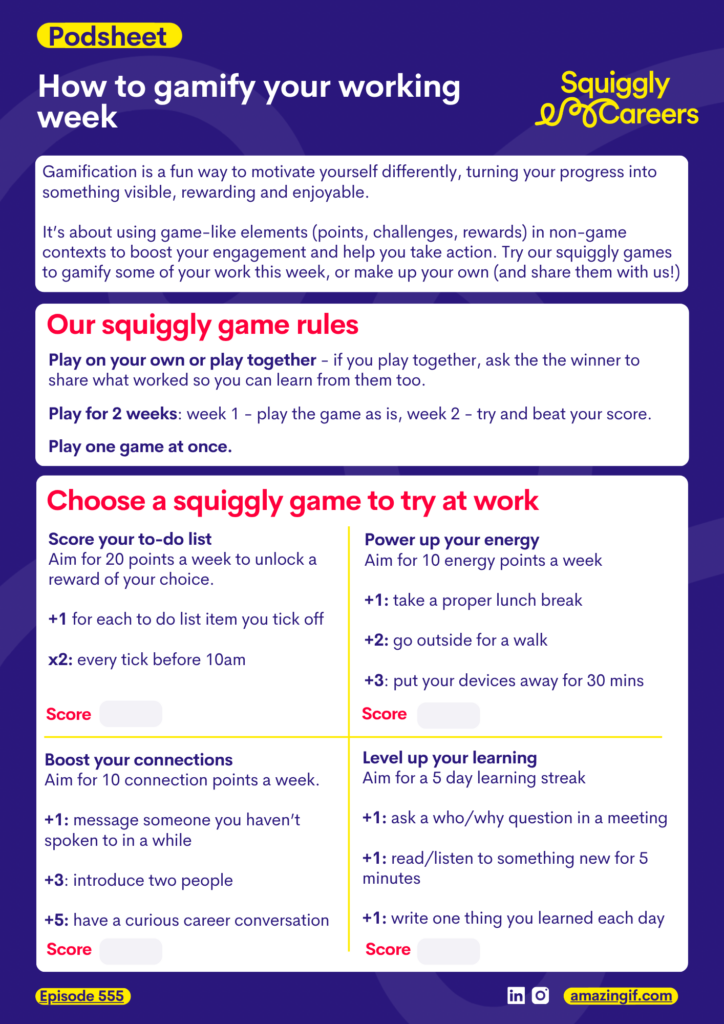
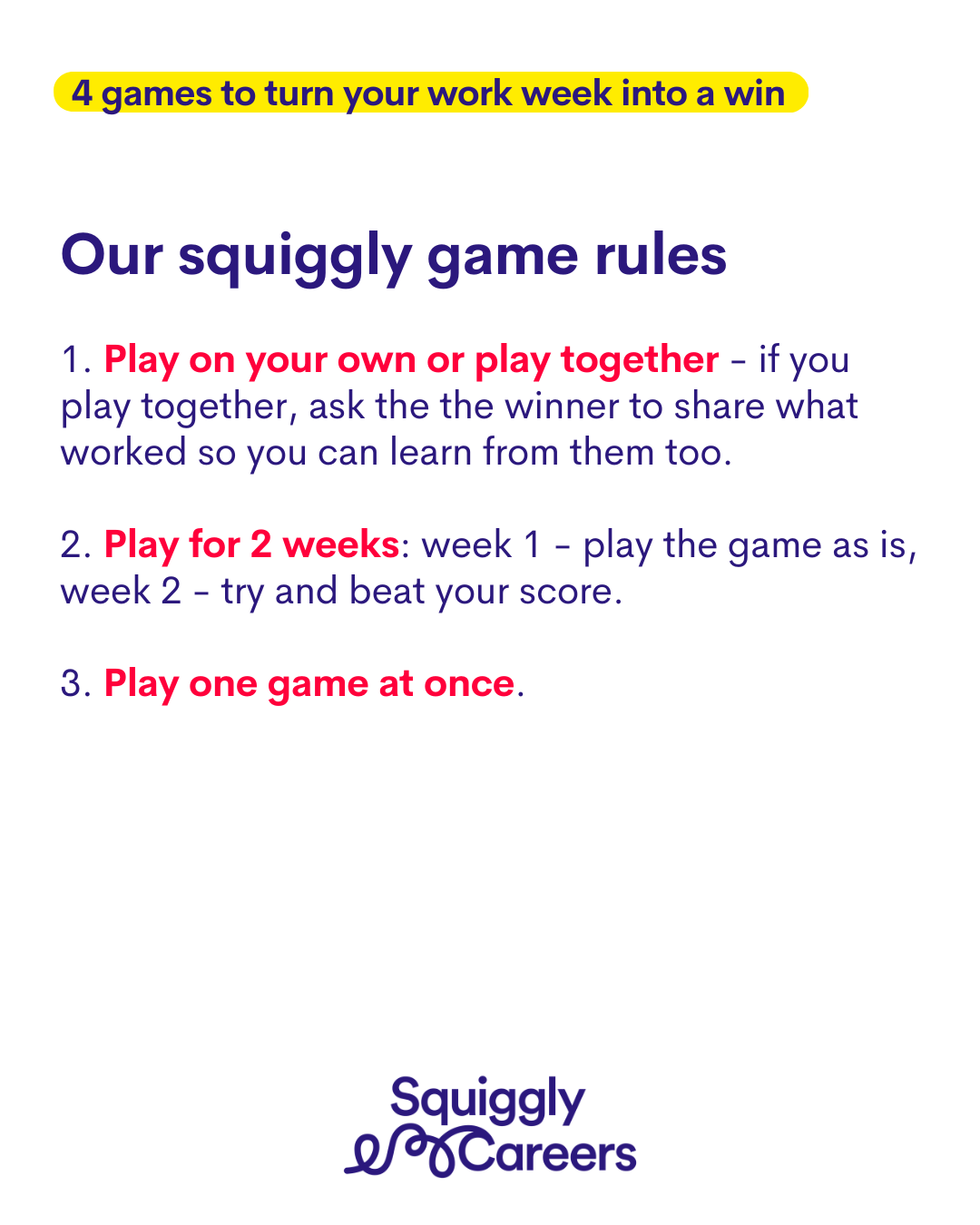
Helen Tupper: So we've got some rules of the game and we've got some ideas that you can include in your game. And I think what's important is that you, you play your own game. So the things that would appeal to me in my game are probably very different to the things that would appeal to Sarah in her game. So we're going to go through the rules of the game, we're going to go through the elements of the game and our, I guess our guidance is to play, play your game. We will summarise this, everybody in the pod sheet as well. So you should be able to get that. If you go to the Show Notes, you'll be able to get it there or just go to our website, amazingif.com so that you can kind of use what we've got here and design your own game. So rules of the game, choice, play on your own or play together with somebody else. So we're not going to kind of mandate that if you do play together and you're playing a game, then there's probably you're introducing an element of winner of the game. I think, you know, if you're doing it with someone else, that's kind of the outcome right of a game. There is, there is a winner. And I don't think you want kind of this idea of winner, loser. I don't think that's helpful in what we're talking about. I think you kind of want winner, learner. So the person that wins the game and they get the most points for the elements we talk about what their requirement is is to share kind of well, how, how do they win, what do they do, what do they do well, so that everyone can learn from it. So it's not win or loser, it's kind of winner, winner, learner. But you can play on your own or play together. We would say play for two weeks. So we're going to go through all the elements. We would say pick one game at once. So just going to pick one element at a time and play for two weeks and for the first week you're just gonna do your normal thing and collect some points, which is what we'll talk about. And then you are going to reflect on your score and how you can improve. And then week two, you're going to play it with some improvement, try and, try and beat your score basically. And you can use our games as a starter or you can make up your own. That's, that's the rules. That's the rules. So quite a lot of flexibility in there. So we're going to go through some potential games that you could play and we'll talk about the ones that are more, more appealing to us. Shall I go first?
Sarah Ellis: Go for it.
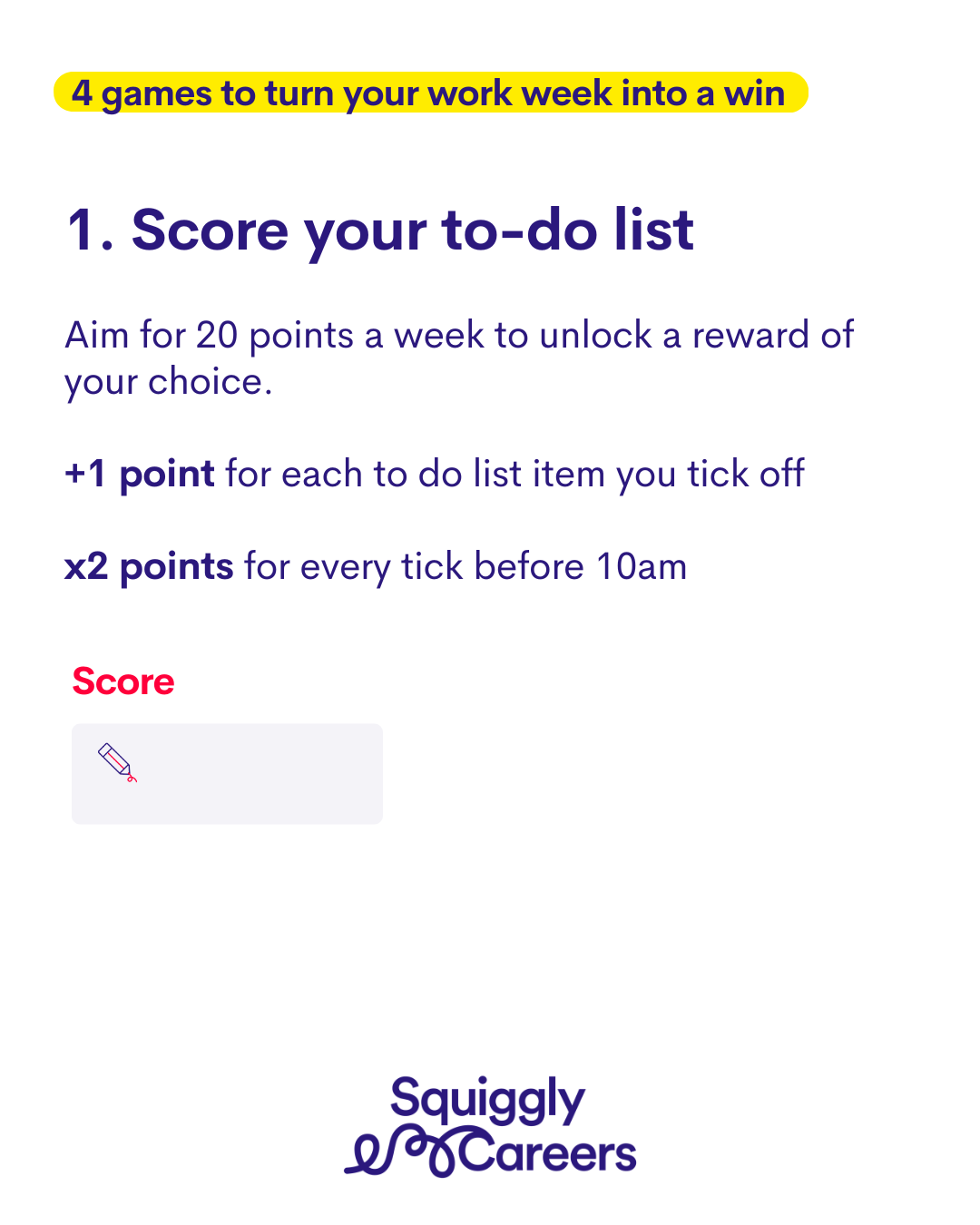
Helen Tupper: Okay, so I think the first game that you could play your two week game with yourself or oh, as a Team is to gamify your to do list. I like this one. So I think you can set your own target here. But I started with aim for 20 points a week to unlock a reward.
Sarah Ellis: What's the reward gonna be?
Helen Tupper: You choose.
Sarah Ellis: You choose your own reward.
Helen Tupper: You choose your own reward. Or I guess if you're doing this as a team, you could, you could have a team award, like, I don't know, a Deliveroo voucher for 10 pounds or something. You can pick what you want, but pick a reward. So here's how you can get points in my game of gamifying your to do list. So every to do list item that you tick off equals a point. So you kind of, I'll be motivated, but I've got to get my 20 points. Got to keep ticking those off. Thinking about my list now and how many points I might have earned this week. And then a special one that gives you double points is you get double points for every tick you do before 10am and so this is to start your day. I think if I think about my week, I don't always start my, my days with what is on my to do list. I often start with what is on
Sarah Ellis: somebody else's because I'll probably look at
Helen Tupper: a message from you and you'll be like, can you do this? But yeah, sure. Or I'll sort, I'll look at my emails and I think, oh, I need to reply to that person. And actually the first thing I do is not start my day with what I want to do. And so I think if I knew I was going to get double points for anything that I did off my list before 10am that would motivate me to put my list first. Well, what are you laughing at?
Sarah Ellis: No, this was a point where I nearly stopped reading. When I read this one, I was like, I don't know if I even want to do this episode, to be honest.
Helen Tupper: I've got a to do list.
Sarah Ellis: Not really.
Helen Tupper: What do you do?
Sarah Ellis: Not in the way that I think you have a to do list.
Helen Tupper: I mean, I have a Filofax.
Sarah Ellis: I know you have Filofax because we spend enough time together that I know. I suppose I have a system in my inbox. So as in like I flag things. So I know that everything that's flagged, I need to. There's an action. So sometimes I will obviously sometimes I'll just work, work my way through those.
Helen Tupper: Yeah.
Sarah Ellis: And then. Yeah, I do. I sort of. But not in a really systematic way. Yeah, I also block I time Block in my calendar. So to do is become actions in my calendar. So for example, if I need to write a proposal.
Helen Tupper: Yeah.
Sarah Ellis: I'm not going to remember to do that because I will have put on a list.
Helen Tupper: It goes on your diary.
Sarah Ellis: Yeah, my diary sort of is my to do list. Yeah.
Helen Tupper: And it's.
Sarah Ellis: Yeah, we diary. Yeah. We often have like a phrase, don't we? If it doesn't go in the diary, it doesn't get done. Yeah. And I think for me that's really true. Yeah. So even for. When was it Last Friday, I was in Denmark and I'd got a couple of hours before I was flying home and I'd blocked out time for actions. And if you went into that, there was a list of things that needed to do with like the links or like.
Helen Tupper: Yeah.
Sarah Ellis: With that kind of extra nights. And so I'm not, I'm not sort of referring back to something else. I'm like, in that time, this is the thing that kind of needs to get done. That's the way that I work. And also I, I think it was this idea of, oh, you need to get. Every tick before 10am is double points. And I was like, well, if something is really important to me, doing it before 10am is not a good idea because my brain is not at its best pre. Pre 10:00am yeah. Your argument back to me when we were arguing about this beforehand was discussing. Discussing it's okay. What's okay to argue? You were like, oh, but it' good to. It's good to start with a win. Right. And I was like, oh, actually that, you know, is a good point.
Helen Tupper: Right.
Sarah Ellis: Creating kind of some momentum. But I wonder whether, you know, when you're choosing like what to gamify, whether you choose something that you want to get better at. Whereas I, I go, oh, I don't, I don't want to get better at my to do list or I don't need to get better at my to do list. I think I've got a system that in the main works for you. Works for me. So there's sort of no point of, point of gamifying it. Whereas I think if you pick something that that's not working well for you and it might be your to do list. Yeah. Then actually there's, you know, like the motivation to gamify it is. Go back to your point about it will drive behaviour, it'll drive interest and engagement. I think starting almost like with a frustration or a problem or something naughty. Yeah. Gives you more of an incentive to gamify if it's not your natural, you might be like, well, I could do it on anything because I just enjoy.
Helen Tupper: I like gamification.
Sarah Ellis: You like gamification.
Helen Tupper: Okay, so if it's not your to do list, then.
Sarah Ellis: Yeah.
Helen Tupper: What. What would your game look like?
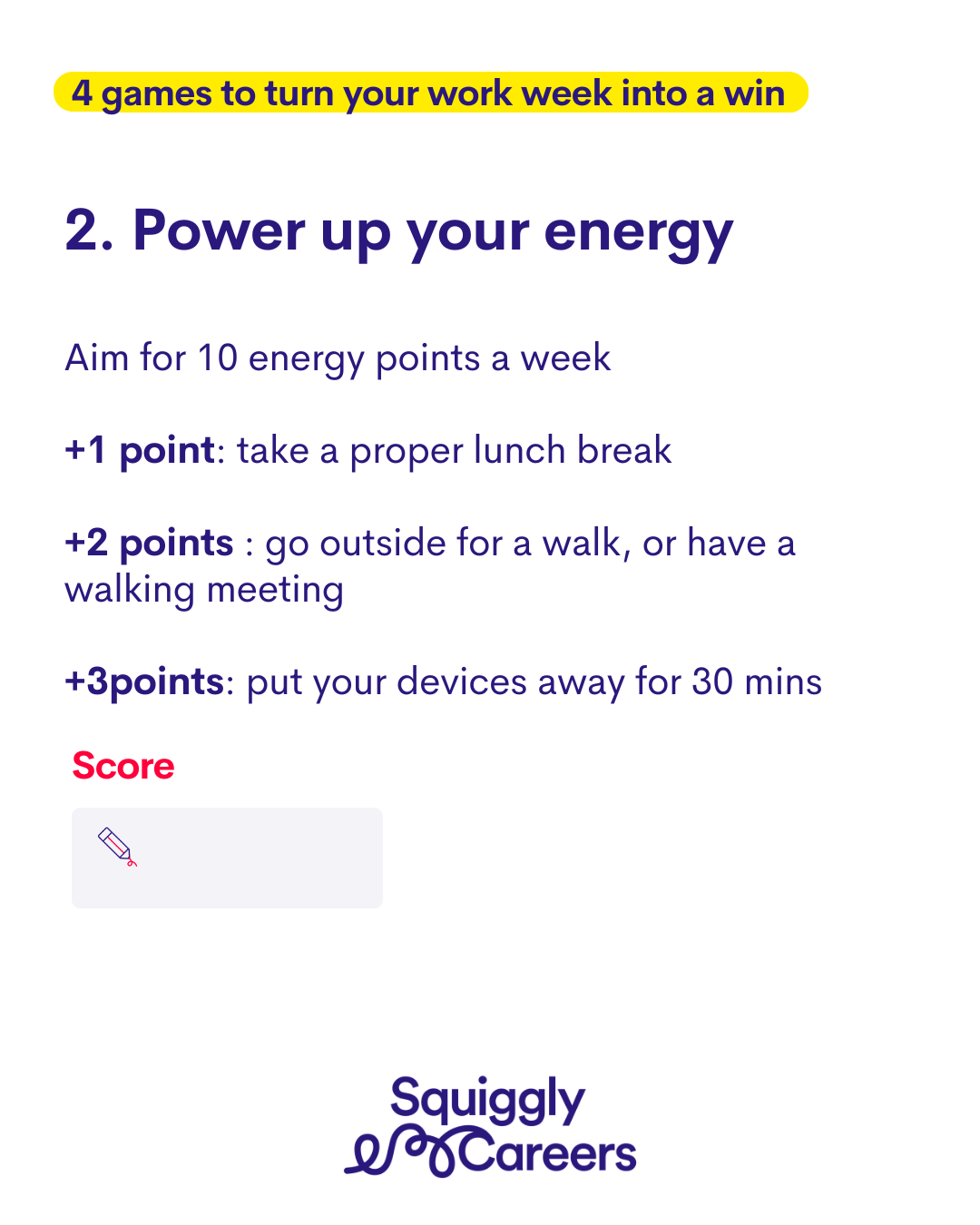
Sarah Ellis: So you were giving me some suggestions, I think, to try and find. To try and find one. What game would you play? And you know, the irony is in. In sort of real games. Like, I love a real game. I didn't love sports. Yeah. I don't want to play an actual game with you. Yeah. Whereas you like. What's really interesting is like, I like to win a sports game. I like to win a game of netball or play tennis or wheelchair basketball. Or wheelchair basketball, which, to be fair, you were actually very good at. But I just. Yeah, it's interesting. Like that kind of games I really enjoy. It just doesn't translate to this. But the one that did appeal to me was gamifying my energy. So we sometimes talk about prioritise your energy, sort of, rather than worrying about time management, which I do find useful. And it's not. My starting point for this is not that it's a disaster, but that I'm inconsistent. And I know that when I get this right, I am definitely better because of it. Like, my brain is better, I come up with better ideas and I'm happier and I'm sparkier. But at the moment that varies quite a lot, like kind of day to day. And so here I thought, okay, maybe you could have one point for a half an hour lunch break every day. So if you, like, stop for half an hour and have a lunch break. I also spoke to somebody who told me they hadn't had a lunch break in five years. It made me really sad. And she was talking about culture and where she might want and just there was just. She was.
Helen Tupper: So she's eating, but she's eating in?
Sarah Ellis: Yeah, just sort of. And I, I do remember that I definitely had that before.
Helen Tupper: But to never have a break where
Sarah Ellis: you're feeling like you're basically kind of always like eating on the go or whatever. And it's like you probably don't even need to be having. I think for me it's less about having the lunch, it's more about having a break.
Helen Tupper: Yeah.
Sarah Ellis: So I was. But you could do. You could say like a half an hour lunch break where I step away from my tech and, you know, people talk about, like, mindful eating. Yeah. You actually, you are focusing on, like the food you're eating and you're enjoying it.
Helen Tupper: How many chews? Yeah, don't do that. No, no.
Sarah Ellis: So we'll do that. Then I thought, like, going for a walk and maybe even things like walking meetings. Walking, walking and talking could be like two points. Yeah. So one point for a lunch break, two points for a walk. If I was doing this for myself, mine would always be two points for starting my day with a walk. Okay. My day is always better if I've been for a walk first thing. And that hasn't happened to me once this week. Haven't been for a single walk. Haven't actually been for a single walk. And I haven't been for a walk first thing in the day. And so I go, oh, okay. So I'll be on zero point. So it helps you to be like, okay, well, that's interesting. And then maybe there is something about gamifying your energy without putting your devices down. So stepping away from tech.
Helen Tupper: Yeah.
Sarah Ellis: And again, that might just be. That could be to read a book or that could.
Helen Tupper: You said previously about not messaging in the evening or not going on your phone in the evening, you could give
Sarah Ellis: like the six, which I actually would find really hard.
Helen Tupper: Yeah.
Sarah Ellis: So maybe that's like five points. Yeah. Or triple bonus points. I don't know. Something I was reading yesterday, somebody talked about, ah, it was James, I Think, from Tempest 2. He's been on the podcast before. I think it was James. He said he couldn't remember the last time he'd had 24 hours or even like a day. I think he said, like, without devices. Yeah. So like no phone, no screen and stuff. So he was like, I think it's been more than 10 years since I didn't have a day with devices, so I'm just gonna do it for one day. And I was like, oh, that's. And I'm someone who thinks I'm quite good at, you know, getting rid of distractions, not having notifications and that kind of stuff. But I was like, I can't remember the last time.
Helen Tupper: That sounds like a fun challenge.
Sarah Ellis: And I was like, maybe that would be like 50 points. I don't know. But then I get a bit like, I'm like, oh, I sort of don't need a game to do these things. I'm just like, I'm just.
Helen Tupper: Don't talk yourself out of it.
Sarah Ellis: But I do. I can't get myself back out of it. I like the ideas. I just don't need a game to help me to do the ideas.
Helen Tupper: What's going to be your reward? At the end of the week when you hit your. Your points.
Sarah Ellis: Yeah. Maybe this is part of my problem because I think the reward is the thing is that doing the thing is the reward for me.
Helen Tupper: Yeah.
Sarah Ellis: So actually if you said to me every day next week you will go for a walk before you start work, that that's enough.
Helen Tupper: Yeah.
Sarah Ellis: I'm like, brilliant. That's. That's what I want in my life
Helen Tupper: is some things that are important to me.
Sarah Ellis: Yeah.
Helen Tupper: Maybe gamifications help me, but I don't need extra.
Sarah Ellis: No need. I think I need rewards. Rewards work for me when things feel hard or I've got to do some tough things. And then I think, oh, but then after that I'll get a treat.
Helen Tupper: Be a nice win of the week to share like that you'd stuck with that. You'd start that game on Monday and you'd kind of share. I can imagine sharing that with a team and that would feel like it's a positive thing to share with people.
Sarah Ellis: So I think this is like, okay to say. I'm still not convinced that I would gamify. Gamify it. It's made me think more about. Oh, but those things are important to me, like, and I believe in those things. And it's really easy to let those things go, you know, to like, forget about them. So it helps you to sort of re. Like remind yourself and kind of refocus. But it didn't make. It still didn't make me think. No.
Helen Tupper: Let me share a couple of other ideas to see if any of these other ones might resonate with you and the people that are maybe more, I don't want to say open to game occasions because it's not that you're not open to it, it's just that it might not be.
Sarah Ellis: Well, not everything that works for everyone is it. And that's. I think that's okay.
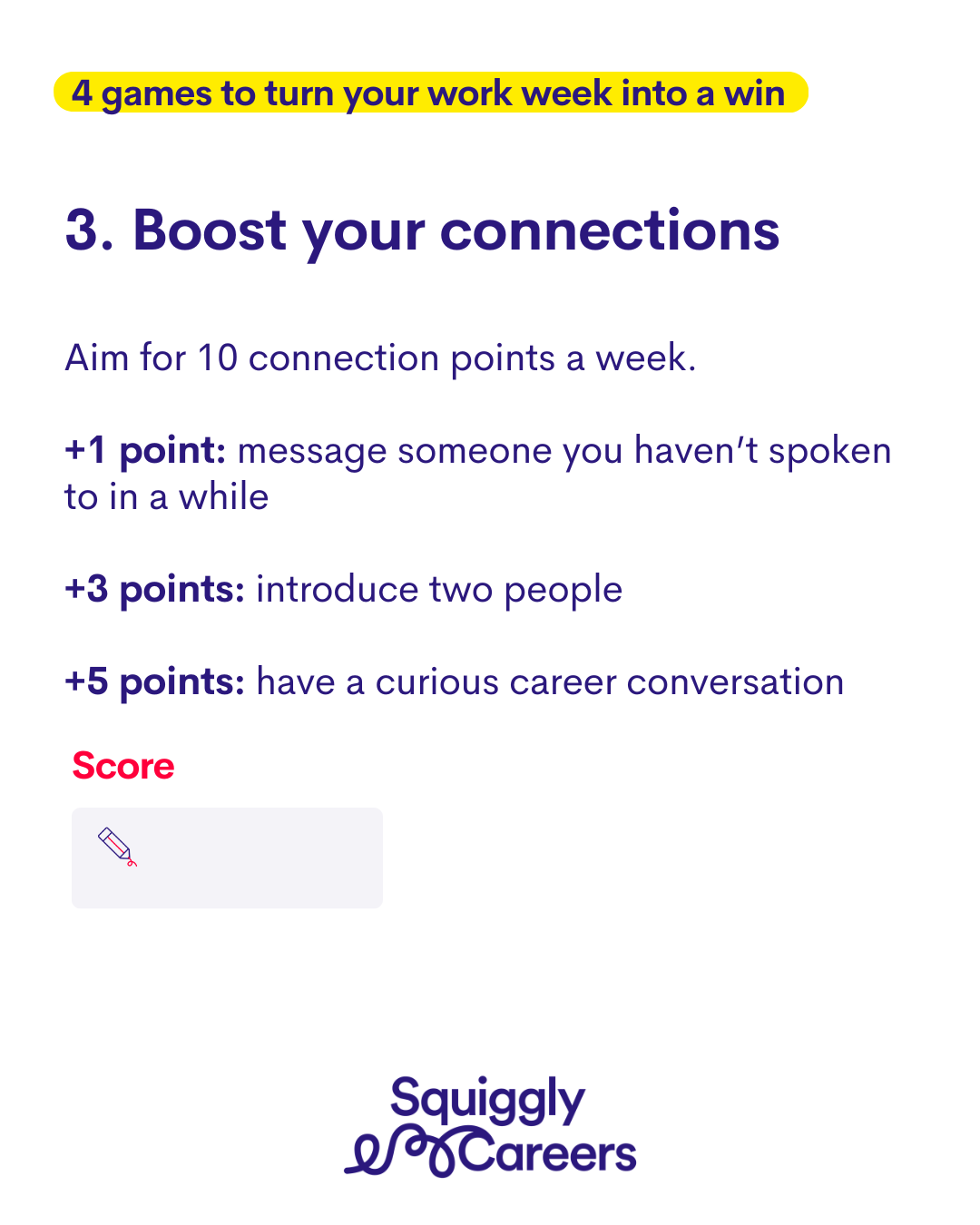
Helen Tupper: So I guess for people that think it could be useful, I suppose that's a better thing. Some other ideas, you could gamify your relationships. So to Sarah's point, I think if you're feeling like you're maybe a bit isolated in your career or, you know, you're just talking to the same kind of people and you need something to motivate you to do something different, gamifying your relationships could work. So these would be connection points, and that could be two points for messaging someone you've not spoken to in a while, 3 points for making introductions between people, and 5 points for having a curious conversation. So the only agenda is to learn.
Sarah Ellis: Oh, I've done that this week. So I get five points. You get five.
Helen Tupper: I mean, you're just ad hoc playing
Sarah Ellis: the game now, just collecting random points in your week. Oh, my God. Which ones do I do?
Helen Tupper: You're allowed.
Sarah Ellis: Who is your curious conversation with someone in one of the partners that we work with who has been in her job for 80 months, not worked in public sector before. It wasn't a chat about a programme or something we were delivering. It was more just what she'd noticed, what we were working on. It just felt really curious and exploratory.
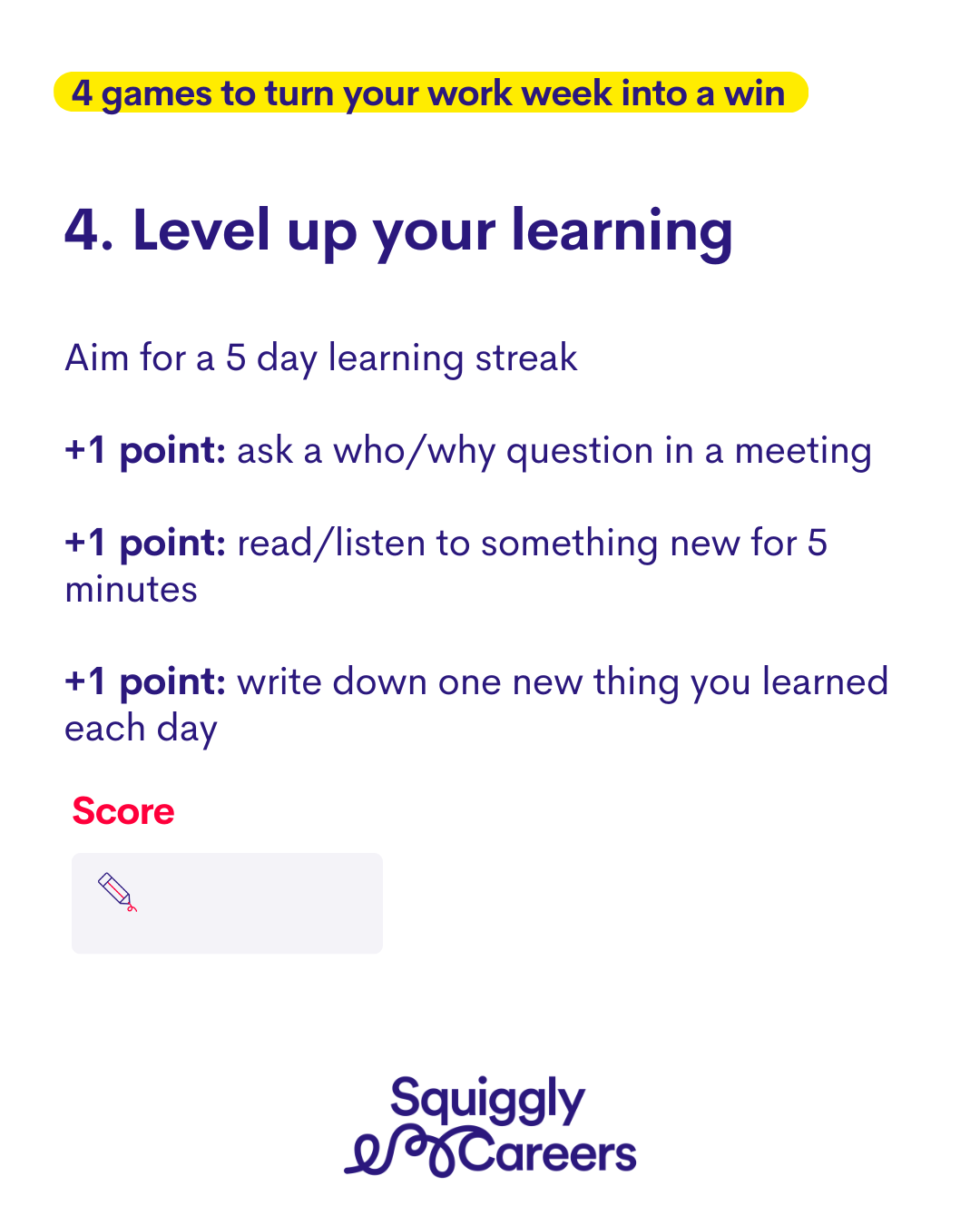
Helen Tupper: Nice. Okay, so maybe there's something there and also gamifying your learning. So that feels kind of very, I guess, on brand for us and squiggly careers. So this here would be like, you know, you're aiming for a streak, a learning streak, so you could ask a particular question in a meeting. So if in every meeting or every day you ask a maybe a who, who else could we learn from? It'd be a who question or a why question. They can feel quite hard to ask. But I think you can learn, Learn a lot from. You get a point for those questions. You could read, listen, or watch something new every day.
Sarah Ellis: Nice.
Helen Tupper: I think you get quite a lot of points for doing that. You know, every morning I read a chapter of a book this morning.
Sarah Ellis: Did you?
Helen Tupper: Instead of scrolling on my phone, I was like, right, I'm gonna read a chapter. Yeah, I'm reading a book called how not to Die.
Sarah Ellis: Oh, I've seen that.
Helen Tupper: It's actually really good. It's actually quite positive.
Sarah Ellis: Why have I seen that? Oh, I think I saw that in the bookshop that we were in together.
Helen Tupper: It's a very chunky book. There's a reason I need to do a chapter a day. It's really, really chunky.
Sarah Ellis: But so afterwards you'll be able to tell us all how to die.
Helen Tupper: It's quite a negative title, maybe. I don't know, but it's actually quite positive about nutrition. You could write down one thing you'd learned today. So you're sort of learning by reflecting that gets some points. And then when you get your streak, you can get a reward or perhaps your time. That could be another thing you could gamify. So I was thinking, here you're trying to get some friction fixes. That was how, if I was gamifying my time, I'd be like, how much friction am I fixing? So you could get some points for cancelling or shortening a meeting to get a bit of time back with two points of that. Delegate something that doesn't need. You get a point for delegation, saying no to something that is a good priority. I think that might be a five pointer. You know, like saying, actually, that's on my. The. No. Actually we've done a whole podcast on saying no. So if that feels like hard to do, because it could be. Not now, not yet, not me. All different ways that you could say no. But that could be some extra, extra points for that.
Sarah Ellis: I wonder if you could do it as a team where. Because I think competing as a team is not great. I can't imagine that ever working. Yeah.
Helen Tupper: Competing doesn't feel like the wrong. The right term, I think.
Sarah Ellis: But what you could do is you could all say your own games, right? And you could be like, I'm going to give myself. Maybe there's like one point for this, three points for this, five points for this. Everyone has a one, three and a five. Yeah. And then actually you just play your own. Everyone just plays their own game. So I pick energy, someone else picks learning, you pick relationships or time. So everyone sort of plays their own game. But then what you could do is come back, you know, you could be like, right, and in a month's time, we've got a team meeting. And in that team meeting, you're all going to share, like, your experience of playing the game, how many points you got. And then it is quite interesting to then hear from people what helped them to collect those points. So, you know, you might find that people were slow to start, but then they kind of got momentum or they started to remove friction. You know, just like some observations and some learning. Yeah, I can. I think that could be. That's quite a good team reflection. The other one I was thinking about when I was trying to think, how might I ever do this? Is when we look at our sprints that we do, lots of teams join those sprints together and you get a badge at the end, which I think people like getting, but you're never doing it just for the badge. I think that is sort of team gaming and I think I've been most motivated by that because that's not, oh, I'm sprinting better than you. It's, we are sprinting together. And I think I would be motivated. It wouldn't work in our company because we're not big enough. But if we're in a big company, you know, if, like our team was sprinting and then other teams were sprinting and it was like, how many learning minutes have you Collected across a week as a team.
Helen Tupper: Yeah.
Sarah Ellis: I would want my team to win.
Helen Tupper: Yeah.
Sarah Ellis: And I would be like, oh, let's all do that together. And you know, it's sort of like a learning leaderboard. And then you could be like, back to your point. Well, this team has done a particularly good job of learning, but what are they doing well, that's helping them to do that. How have they sprinted so well? And we already do that. Right. When we do these sprints, we will often say to teams that have done it before, what has worked well in your company? Yeah. What got in the way? Have you set up a teams chat and those kind of things so you could gamify learning together also as a way of keeping up momentum, like sharing as you go. I think I can imagine I would be more up for joining a game as a team actually than I would be doing it as an individual.
Helen Tupper: Also, just shout out to the sprint because they are ready made and ready to go. And they are free. And they are free. And they're all. On amazingif.com, there's a whole page now with all the sprints that we have done so far.
Sarah Ellis: What's our Most popular?
Helen Tupper: The AI one squiggly skills times AI. That is our most. We've had over 10,000 people do that
Sarah Ellis: sprint and then we've got one on Learn like a lobster. And then we've got a couple where we just. These were the first ones that we did where we just chose 20 day sprints. We were like, oh, critical thinking. Oh, curiosity questioning. So again, you can pick those, but you can download everything. And actually quite a lot of people have told me that they've done those in small groups, not even as a team, where just three or four of them from different teams have just said, oh, should we all do this together? And then that's really nice. And I think that's like gamifying your learning a bit, isn't it?
Helen Tupper: So, final review on the idea of gamification and its relevance to your work and career.
Sarah Ellis: So I don't think it's for me.
Helen Tupper: That's the end of the podcast.
Sarah Ellis: I don't think it's for me. But then I don't think I am reflective necessarily of everyone, clearly, because you and I are starting from such different places. And also, you know, all those things that you've described are really, really popular. You know, like streaks and measuring things and they're popular for a reason. So I don't feel the need to gamify things in my work. But I do want to get better. And so probably what it's made me think of more is just the being intentional about the things that matter or where things are inconsistent. I just think I probably don't need the points thing.
Helen Tupper: Yeah.
Sarah Ellis: What I like is the. Actually I should try and go for a walk every morning because I know that really helps me or take a look, like those sorts of things I found useful. I just don't need the game. I don't think the game. Yeah.
Helen Tupper: So we would love to know what you think about this. Are you pro?
Sarah Ellis: This is where everyone goes. 99% of people are pro gaming.
Helen Tupper: Maybe we should put it in our newsletter.
Sarah Ellis: We should definitely get everyone to do a vote.
Helen Tupper: Yeah.
Sarah Ellis: Like how? Maybe like, would you gamify your work or. I sort of want. I actually want quite a binary vote. Like, are you more Helen or are you more Sarah?
Helen Tupper: No, not that. Because that's a bit like. Not that.
Sarah Ellis: No, but like as in like the. Can you imagine doing this?
Helen Tupper: Can you imagine gay.
Sarah Ellis: If you've listened.
Helen Tupper: Yeah, maybe we'll put it. Maybe we'll put some kind of thing in the newsletter for people or if you don't see it, that's because we've not worked out how to do it.
Sarah Ellis: We can't work out how to ask the question.
Helen Tupper: And you can just email us your thoughts at helenandsarah@squigglycareers.com but thank you so much for listening. I've had lots of fun talking to you.
Sarah Ellis: I've had lots of fun.
Helen Tupper: So if nothing else, it's been fun, but we hope that it's been useful for you too.
Sarah Ellis: Thank you, everybody. I'm back with you again soon.
Sign up to the Squiggly Careers Newsletter and get our latest ideas, tools and inspiration every week - all in one place, straight to your inbox