Have you ever noticed how much more you get done in the week before a holiday?
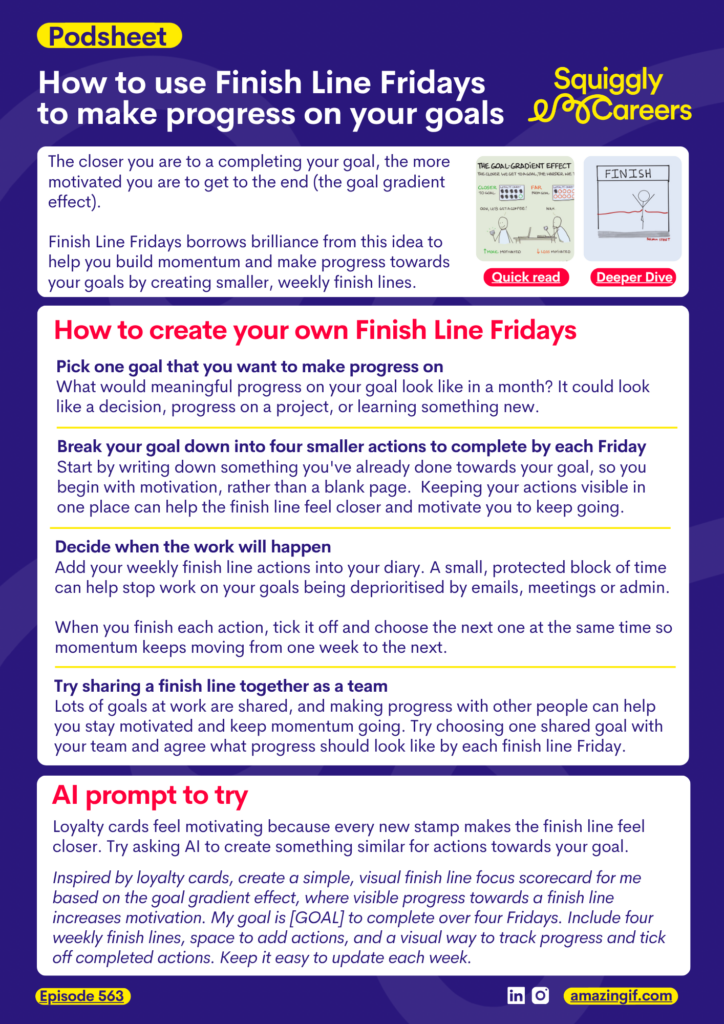
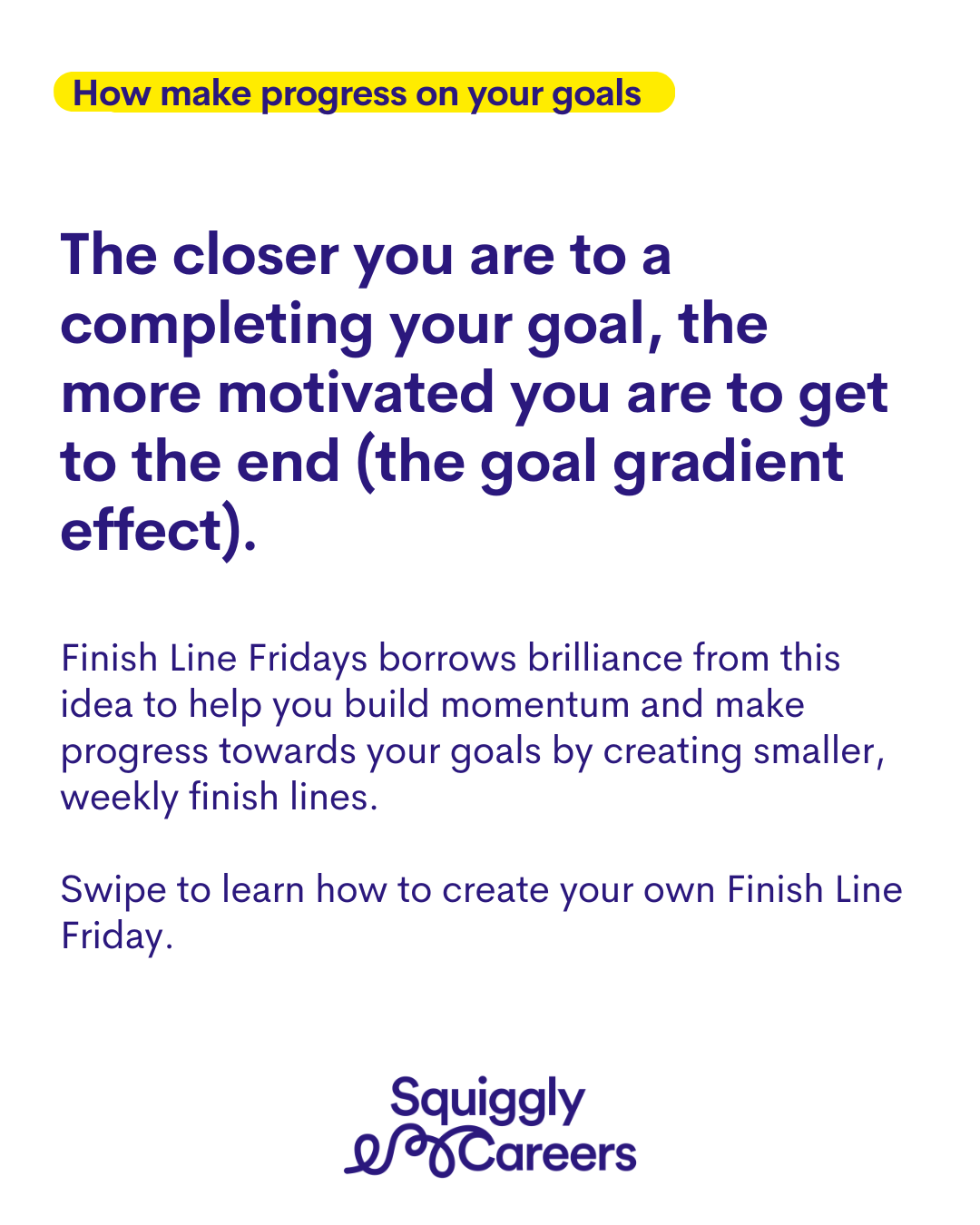
In this episode, Helen and Sarah borrow brilliance from the goal gradient effect; the research-backed finding that the closer we are to a finish line, the harder and faster we push, and turn it into something genuinely practical for your career.
Sarah introduces Finish Line Fridays: a simple way to use the psychology of progress to build momentum towards goals that matter, one week at a time. Helen tests it live with her PhD as the goal, and together they explore whether you’re more of a fresh start effect person or a finish line focus person, and why pairing the two might be useful.
🎯 What You’ll Learn
– What the goal gradient effect is and why it explains so much about how we work (and why rats are involved)
– The difference between the fresh start effect and finish line focus (and which one you’re more naturally wired for)
– How to run your own Finish Line Fridays: from picking your goal to setting your first action before you’ve even finished the current week
– Why knowing the “when” matters as much as the “what”, and how to actually protect time in your diary
– How shared finish lines might be even more motivating than solo ones
📚 Resources Mentioned
Farnam Street, Goal Gradient Effect
For questions about Squiggly Careers or to share feedback, please email: helenandsarah@squigglycareers.com
Need some more squiggly career support?
1. Download our free careers tools
2. Sign up for our Squiggly Careers Learn Like a Lobster Skills Sprint
3. Sign up to the for Squiggly Careers Newsletter, a weekly summary of the latest squiggly career tools
4. Order our new book Learn Like a Lobster
00:00: Introduction
02:25: What is the goal gradient effect?
07:54: Fresh start effect versus finish line focus
10:05: How to create Finish Line Fridays
26:37: Could AI help create you a scorecard?
30:28: Closing remarks
Helen Tupper: Hi, I'm Helen.
Sarah Ellis: And I'm Sarah.
Helen Tupper: And this is the Squiggly Careers Podcast, a weekly podcast where we borrow some brilliance from things we've been reading, watching, inspired by, in loads of different ways, and bring it to you in a way that we hope is relevant and useful for your career.
Sarah Ellis: So today we are borrowing brilliance from essentially my brain.
Helen Tupper: Great. Narcissistic.
Sarah Ellis: Oh, it sounds very narcissistic.
Helen Tupper: Brilliant. And you can borrow from my brain.
Sarah Ellis: Well, I think what happened was an insight which I shared with you. And then we went looking to see whether that insight was just me, which wouldn't be the first time, or whether it was actually a thing. So let's describe what happened. So I was in a week before I was going on holiday on a Friday, and I sort of made a throwaway comment to you where I was like, I can't remember the last time I was this productive.
Helen Tupper: Which is something that you never. You just don't really say statements like that.
Sarah Ellis: No, and I don't really use that word.
Helen Tupper: Yeah.
Sarah Ellis: Cause I'm always productive.
Helen Tupper: But you're anti the idea of it.
Sarah Ellis: Yeah, like, anti the whole, like, fill every moment of your day with, like, productivity. Definitely. But it also gave me loads of energy. So I was like, I've got loads of energy. I'm getting stuff done. I was like, you know, like, I'm on fire. Which, again, not a very Sarah statement.
Helen Tupper: I'm on fire.
Sarah Ellis: I was honestly, I did get so much done that week and I was like, oh, it's so interesting. Is it like, you know, you're just going. You're going on holiday. Anyway, we looked into it and there is something called the goal gradient effect, or as we're calling it, the finish line focus. Yeah, that's our version, which is essentially the nearer the finish line you are, the harder you push and the progress itself becomes really motivating. Now, we've talked before, I talked to Katy Milkman on the podcast and we've referred to it quite a few times, this idea of the fresh start effect. So it's sort of the opposite to that. Like, the fresh start effect can give you motivation and it's kind of a catalyst to be like, oh, I'm back from holiday, or it's September and it feels like kind of back to school time. And that gives you kind of a surge, a surge of, like, progress, or I'm near the end, and then that gives you a surge of progress.
Helen Tupper: I think that goal gradient effect and finish line focus outside of work. It kind of makes sense, right? Because I'm just thinking about marathon runners and I have to think about them
Sarah Ellis: because I'm so far away from it. We've got some new news for me. London Marathon. Very soon.
Helen Tupper: Absolutely.
Sarah Ellis: Not really, but I believe you can do anything. So if you want to do that, I would support you.
Helen Tupper: Like, if I said I was going to, it just become like a new thing.
Sarah Ellis: Yes. I can imagine that.
Helen Tupper: It's not going to be a thing I don't believe, but I do watch. I do end up watching, you know, like doom scrolling on Instagram and you get caught in some kind of loop. I seem to. I kind of watch quite a lot of. I was watching, watching this morning. It was the Boston Marathon.
Sarah Ellis: Yeah.
Helen Tupper: And there was a guy to. Right towards the end and basically, do you see it? And he couldn't. And then I think, like a British guy was nearly, you know, he was gonna do a personal best. And he saw this guy on the floor and he. He picked him up. And then another guy came and picked him up. And then the three of them got to the end together. Anyway, I end up watching lots of stuff about marathons, but my point of saying that is, like, people speed up at the end, don't they? Like, that's when I guess that gold gradient thing, they can see the end is in sight. And that's often, like the thing that then makes them speed up. So I guess intuitively I do see this, but I really hadn't thought about it in the same way. I haven't really thought about the fresh start effect in the context of work and whether or not that could be helpful.
Sarah Ellis: Do you want to know where they first saw the goal gradient effect when
Helen Tupper: it was not in marathons?
Sarah Ellis: No, it was rats.
Helen Tupper: Lovely.
Sarah Ellis: I was like, oh, I'm ratty.
Helen Tupper: Yeah, feels about right.
Sarah Ellis: And it was. The closer the rats get to the cheese, the faster they Rude.
Helen Tupper: They had wrapped cheese races.
Sarah Ellis: What was this? I don't know, but it's really old. Like, the research. It was like nine. It was like, I'm probably not gonna get the year exactly right. But I remember thinking, like 1934, like something. It was discovered quite a long time ago.
Helen Tupper: Would you run faster for cheese?
Sarah Ellis: Maybe for chocolate? Okay, chocolate more than cheese. I can't run that fast. So again, like. Like you say, like, I might want to. But is it physically? It'd probably be a challenge. A top tip here. A bit of a recommendation for everybody that I have discovered. If you don't follow sketchplanations. It is worth, worth a look. You know, visuals are just always really helpful to bring together, like bring to life new ideas. So sketch planations have got the gold gradient effect as a visual. And one of the most common examples of like how this works is the coffee card. You know the stamps that you get on a coffee card?
Helen Tupper: Yeah.
Sarah Ellis: And so what the sketchplanation shows you, these kind of cute little pencil figures is if you are, let's say you've got like eight little stamps on your card, you really want to go for a coffee. You're like, oh, I've got eight. I'm like, nearly at my free coffee. You're not quite there yet, but you're close. So you're like, yes, let's get the coffee. And if you're sitting next to someone who'd got one stamp, they'd be like, yeah, I'm not that bothered about getting a coffee. So it's actually not about almost like whether you want the coffee. It's just like the card is kind of like the motivating factor. And it's apparently why if you go into some coffee shops, they will and you're getting a new card, they give you two stamps to get you started. Like blank coffee cards apparently just don't work. There's been quite a lot of like research on it. You're much better off giving someone two and then you almost like, you know, like adding two extra on the end. And I was like, oh, that's interesting.
Helen Tupper: You kind of do that without knowing the psychology of it. I was thinking, you know, when we, we had learn like a lobster and people who pre ordered it got some, they got their little lobster library card and some stickers. Didn't we say like stick your first one on as soon as it's come? I'm sure.
Sarah Ellis: I think we might.
Helen Tupper: Yeah. I think without.
Sarah Ellis: Are we just that smart?
Helen Tupper: We're that smart that we do this stuff? No, I don't think we knew. I think we were just like, that's nice. Put a sticker on.
Sarah Ellis: Put a sticker on. Put a sticker on.
Helen Tupper: We've got some stickers.
Sarah Ellis: Use a sticker. We're excited. We could just make it work. So yes, here's a sticker.
Helen Tupper: Like, how could you use it to get people learning more? I like it.
Sarah Ellis: So one company which I found fascinating, I was reading this on Farnham street, always a good place for inspiration, everybody. So often if there is a concept, they will have a blog on it. And I often find, and they're sort of usually relatively Related to work.
Helen Tupper: Yeah.
Sarah Ellis: So I was reading a blog on there and there was an example of a company who pay people their bonuses every month rather than at the end of the year. And so the sort of example is you get to the centre of the maze every month rather than get to the centre of the maze at the end of a year. And you can actually, you know, almost like people. The motivation that people get from bonuses, they have found massively increases by going, well, here's a bit. Every month, if you hit your targets.
Helen Tupper: So you're more motivated to hit your targets because, you know there's a bonus at the end of the month.
Sarah Ellis: Yeah. So you perform better if I just
Helen Tupper: get a bonus at the end of the year. My.
Sarah Ellis: Yeah. And it's actually nothing to do with how much it is. So it's not like, oh, you can make the bonus at the end of the year, like, more, or you make one of them less, or any. So it's not really about playing around with the money.
Helen Tupper: Yeah.
Sarah Ellis: It's much more like the motivation to be like, oh, we did what we need to do this month and I get my bonus this month. And then, great. And then one's quite a hard thing
Helen Tupper: to experiment, like, I think it's really interesting, but it's quite a hard thing to experiment with, isn't it? Like, say for a whole year we're just going to change the bonus structure and see. And see how it. Because it's quite an emotive topic for people and it links well to. So we have done an episode on marshmallows that. That happened.
Sarah Ellis: I actually really remember enjoying that episode.
Helen Tupper: I wrote a whole chapter of a book, a whole section
Sarah Ellis: Oh, that's true. Actually, we did nearly do that as well. I've forgotten about that. At the point of the marshmallow and the marshmallow test is delayed gratification, which most of us, even as adults, I suppose, struggle with. You would rather have the two marshmallows now than wait. No, it's rather one marshmallow, one marshmallow now than wait and get two at the end of the month. And so it sort of links into that a little bit. But we were chatting, like, do you. I wonder whether people are slightly more a fresh start effect person or a finish line focus person. What would you say?
Helen Tupper: Well, I've been going around this in my head. I've been pondering.
Sarah Ellis: Yeah, me too.
Helen Tupper: I've just been thinking about, like, am I the same? Am I different? Because I remember when, like, Sarah and I met at University. Many, many moons ago. We're actually going back to university together soon. But I remember I used to, for my assignments, create a deadline that was a week in advance. See, I did that, too, of the actual deadline. To which I think is what you're saying, like, because I was trying to kind of create more time, a bit more urgency. Also, I hate the idea of handling something in late. Like, I still have those nightmares. Do you still have those nightmares ever? Yeah, I hate it. And I wake up, and I'm like, no, no, you're in your 40s. You're fine.
Sarah Ellis: Well, I don't even. Like at work, though. Like, not, you know, not meeting a deadline. You. Even though, you know, like, deadlines are made up, and they often don't, like, mean anything.
Helen Tupper: I know. But at school, they really, really did. If you missed an assignment and then you failed and your life was over or. I don't know, whatever happens to me at that.
Sarah Ellis: Have you ever missed a deadline?
Helen Tupper: I don't think I've ever missed a deadline that matters.
Sarah Ellis: No, I don't think I have. Like, you know. Have you ever asked for an extension?
Helen Tupper: I asked for one on my MBA because I was having a baby. I think I was.
Sarah Ellis: Okay. I'm like, that's probably all right. That day. Sorry, guys. Bit busy.
Helen Tupper: No, it's not that I was having a baby. Baby on that day. But, like, I was, like, in the process. I think I was in, like, the. Yeah. The month of my daughter arriving into the world.
Sarah Ellis: But, you know, some people, I think, hold deadlines quite lightly.
Helen Tupper: Yeah.
Sarah Ellis: Whereas I think I'd probably take them quite seriously.
Helen Tupper: But so I kind of.
Sarah Ellis: And so then I go, oh, I
Helen Tupper: think I must be a kind of finish line, focus person. But I. But if you were saying to me, which one are you More. Because I think I do have some evidence that that works for me. But I think I am much more a fresh start effect person. Like, I try to use fresh starts all the time. Like, it's a quarter. Like, even with my vision board, I'll be like, start a new quarter or even a notebook. Like, there are so many ways that I will try to create myself a fresh start.
Sarah Ellis: Yeah.
Helen Tupper: I find that more motivating. What conclusion did you come to from your ponderings?
Sarah Ellis: Well, like you said, I don't think. I couldn't sort of definitely categorise myself as one versus the other. Some of it, I think might be context or situational. So if I think about holidays, which I do think are just natural breaks, as in, you're like, away from work, I am definitely more motivated the week before a holiday than I am the week after. Like, when I come back, it takes me a bit to get re, like, into it. I don't come back on the Monday and I'm like, right, fresh start effect, let's go. I'm like, nah, like, just, you know, like to warm up. It takes. It takes me like a bit to warm up, I think. And I don't have that need to create like, the newness that you just described. I like. I'm like, oh, I don't recognise that.
Helen Tupper: Okay.
Sarah Ellis: And I, yeah, I think I might be more finish line focus. But so when I think about, like the whim watch that you and I use. Yeah. I like, towards the end of a quarter, I look at that more regularly.
Helen Tupper: You do.
Sarah Ellis: And then I'm like, right, how are we? What's our progress versus that? And I again, I think it prompts action. I'm like, okay, well, we've. We're amber on that one or we've not made any progress on that. Like, why not? What do we need to do?
Helen Tupper: A good pair, maybe? How could you pair up someone who loves a fresh start effect with someone who's got finish line focus? It probably means that you're more likely to get stuff started and get stuff done.
Sarah Ellis: And generally, I think a bit of both is probably. Is probably quite useful. Now. What's quite interesting is when you then start to look into this, you know, people start to talk about, like, what of three ways to increase your goal gradient motivation. And I don't really like the answer to these questions.
Helen Tupper: I can imagine you reading it and like, absolutely not.
Sarah Ellis: And it was like, oh, gamification. I was like, not again. I mean, I've already done one podcast on gamification. Next one: activity trackers. I was like, ah, God's sake, visualise progress. I was like, things that I'm not interested in and don't want to talk about again on the podcast.
Helen Tupper: Okay, moving on.
Sarah Ellis: We moved on from that. But we have talked about them on the podcast.
Helen Tupper: We.
Sarah Ellis: Yeah, I was in charge of the research for this one. So I moved on. I just kept reading about it. I was like, they said gamification one more time. So instead I created Finish Line Fridays.
Helen Tupper: Okay.
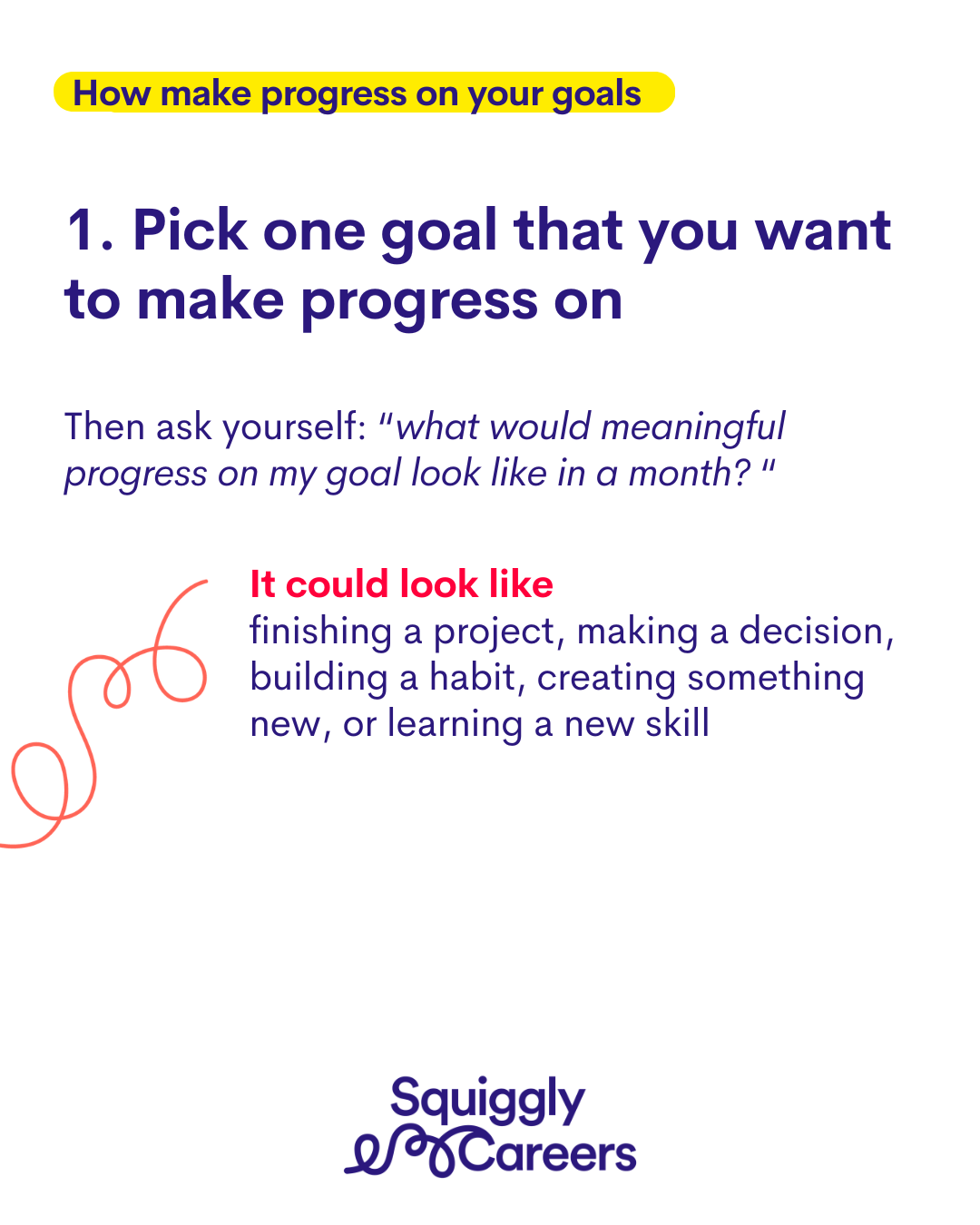
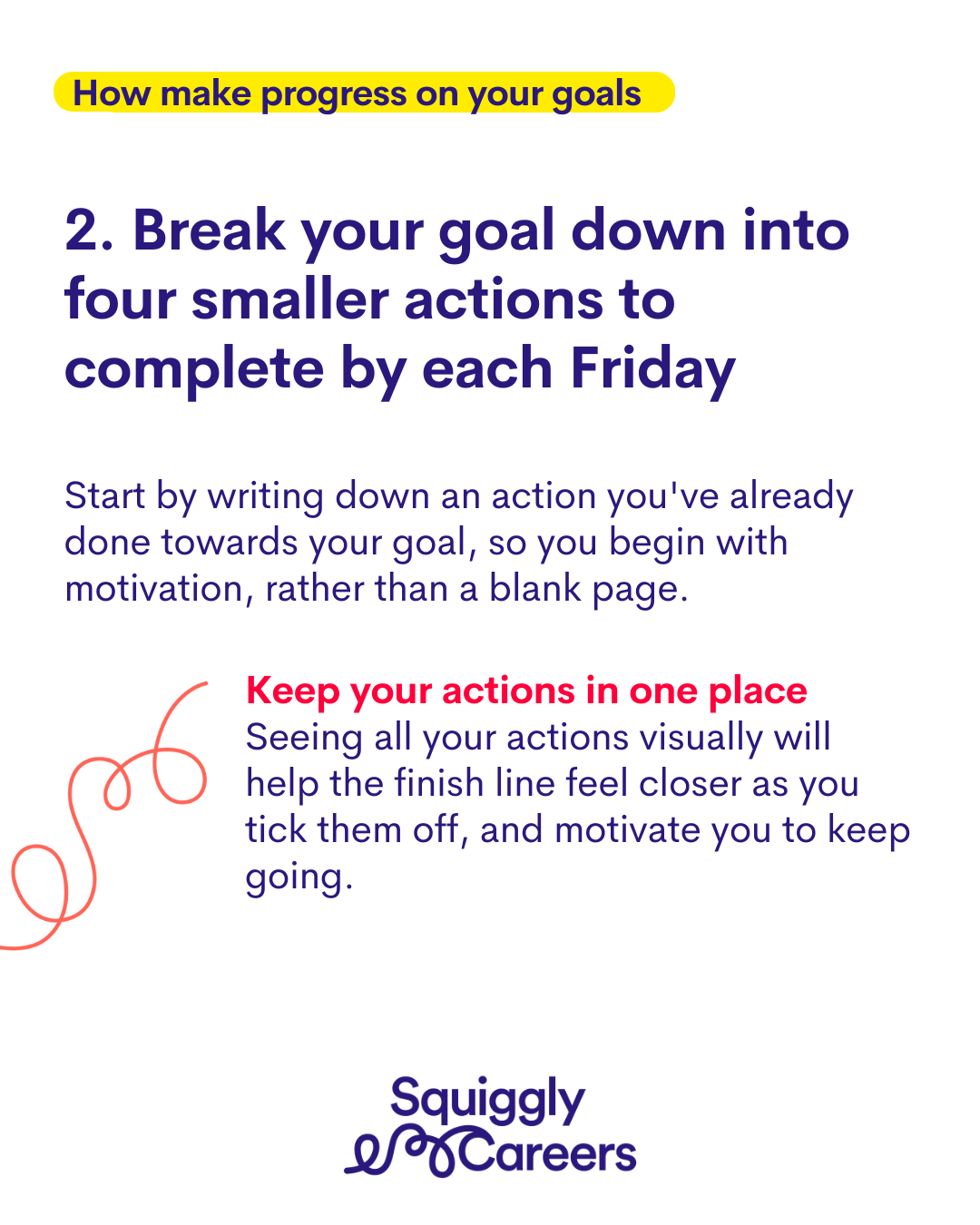
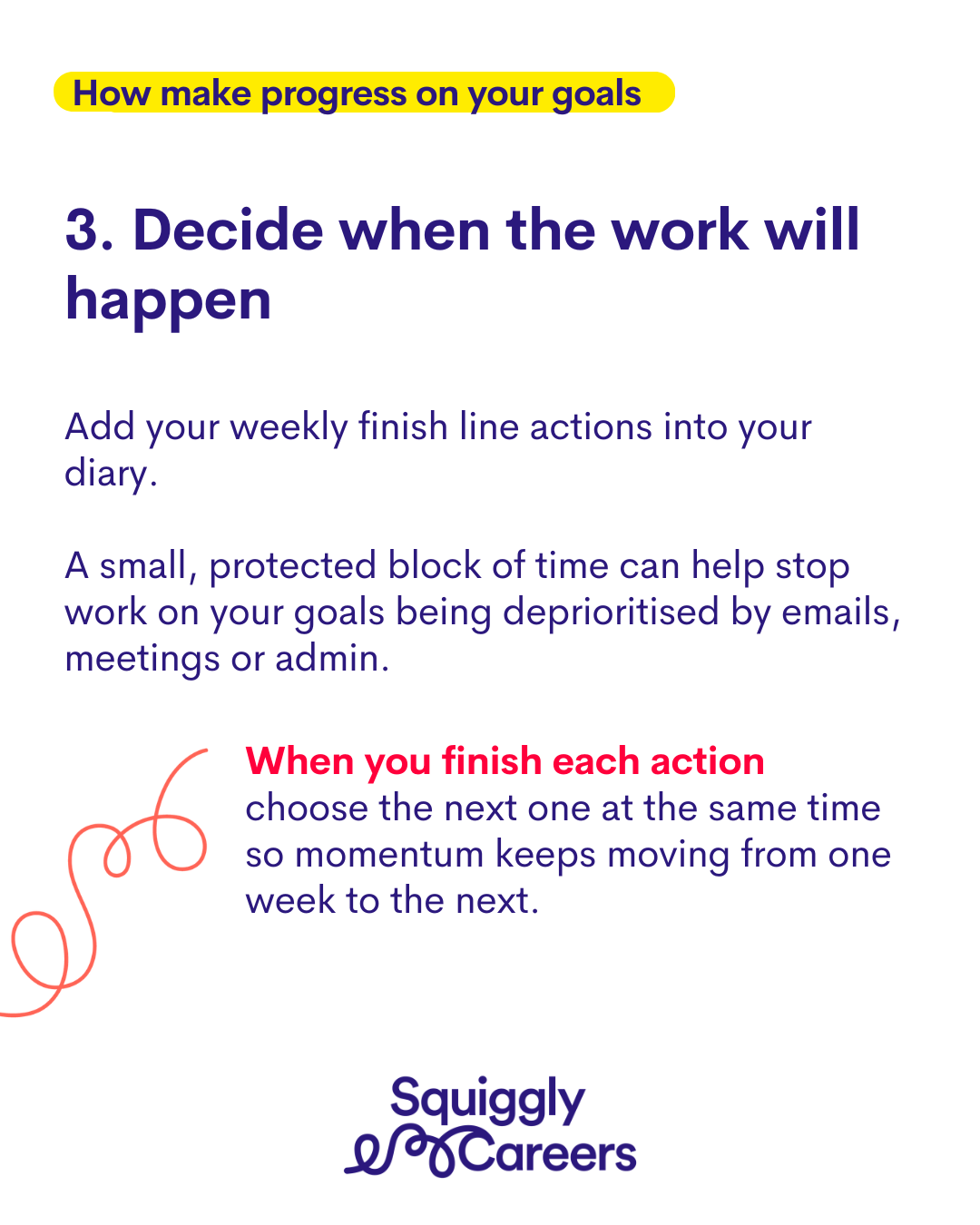
Sarah Ellis: Because I was like thinking, yes, you have a bit like, with fresh start effect, sometimes they're created for you, but you can also create them for yourself. And yes, there's a bit of a nice alliteration, but equally, it is the end of a week. It's a natural finish line. And it might be finish line Thursdays, if you work to a Thursday. And I think you could go through this process and just help yourself to sort of almost experiment with. Does this help you with your motivation? Do you move forward faster by doing what I'm going to describe. So I'm going to give an example just to show how it would work and then Helen's going to actually talk through a real example for herself. So, firstly, obviously, you've got to pick a goal that you want to make progress on, because interestingly, when I did this, I hadn't got a goal. I think my goal was. My goal actually probably was go on holiday and don't work. Okay, which is a goal, right? That's a goal. So it was. So for me, my. Without intentionally picking it, but that was probably what was going through my head, is like, I like going on holiday and having a break. So that was my goal. But you could pick, like, make LinkedIn a useful place for curiosity and connection. Like, that's my goal. Then each week, choose an action that you want to finish by the Friday. But for week one important point, choose an action you've already done. Okay, so back to the coffee card stamp, because you want to give yourself a stamp. And we'll talk in a second about, like, you can obviously create a scorecard using AI, but you want like a tick or something crossed off. So I might be like, you know, I could pick something really easy, like create a LinkedIn profile, like, done it brilliant or smug, feeling good about myself. And then what's interesting is part of the reason this works is when you get to the finish line, it's really important you then know what comes next. So what you could be tempted to do is get to the Friday being, like, done, and then I'll pick my new, like, action for the week as part of the kind of big goal on Monday. But you are way better to pick it on the Friday at the same moment that you're ticking off what you've done that way is that.
Helen Tupper: Do you know what's there? Is there some kind of psychology that you're like, more. You're more in like a goal zone or something?
Sarah Ellis: It says because yes, you have the kind of the end is in sight, like the Friday, but then your next beginning is already visible before, almost like. Like as the end arrives. So it's sort of knowing what comes Next.
Helen Tupper: Yeah.
Sarah Ellis: And I was thinking about this because I've read quite a few times how people who write books will leave writing day to day, mid sentence. And that's because they. They kind of then know what they're coming back to. That's so unsatisfied. Right. They.
Helen Tupper: Mid sentence.
Sarah Ellis: Yeah, yeah, yeah. Especially when people are. Because some people write in a very disciplined way. Yeah. And so they're like, well, I write until 3pm and an alarm goes off, or I have to. Or I go for a walk, or I go and pick the kids up from school or whatever I do. And, like, they just go wherever I get to. I literally shut the laptop, I walk away, or I get to the end of a paragraph.
Helen Tupper: Can you imagine if meetings work like that? You know, like, you're like. They're like, literally like the end of the meetings and then whatever you were. You just stopped. No one didn't finish the conversation.
Sarah Ellis: Just ended, just walked away. I did see something this week at an event I was at where they did quite. They were trying to do a different sort of panel because they were like, well, panels can be quite boring. Yeah. And they did some quick fire questions where you had 30 seconds to answer, and literally a tracker came on the screen, on a massive screen behind them, and they were like, we have to stop talking when it goes off.
Helen Tupper: Wow.
Sarah Ellis: And, yeah, it was an interesting one.
Helen Tupper: Were you on that panel? No. Would you have liked that?
Sarah Ellis: No. But what was. I get the point. Because you're trying to make people concise, Right. And you're like, sorry, stick. Like, stick to the point. But people were there mid sentence and then they didn't get the chance to sometimes finish that sentence. And I was like, oh, I did want to know what they were going to say. So it is an interesting one. But I guess sometimes, I suppose, because writing is hard, actually having something to pick up, you know, like a thread to pick up again, could. Could be quite useful. I get it.
Helen Tupper: Like, what do I. It's a bit like, you know, when you do that, Storey, I don't know if you ever do this with Max. It's Sarah's little boy. But do you ever do that game where you pass on a sentence? Like, once upon a time, there was a frog who. And then you kind of. It's sort of like there's something in that continuation.
Sarah Ellis: So that's kind of how you would. That's how you would do it. And I was like, oh, I think if I was gonna do this, I might do it over a month. Right. You pick a goal that you know is gonna take. Cause the goal has gotta be bigger than a week. So a goal that's gonna take a month, or if you've got a really big goal, you could be like, right, I've got a goal for this year that I really want, but it's feeling big and unwieldy and maybe I'm not doing anything and it's getting a bit frustrating. Then I'm like, oh, maybe by doing your Finish line Fridays, does that just sort of give you some momentum? I can't back to why I don't want to do activity trackers. I can't imagine doing it every week, but I can imagine doing it for, like, specific goals.
Helen Tupper: Okay.
Sarah Ellis: So we thought we'd try it out with Helen and see if it works.
Helen Tupper: Okay.
Sarah Ellis: So pick a goal that you want to make progress on. What goal are you going to go for?
Helen Tupper: Well, I mentioned that we were going to go back to university.
Sarah Ellis: Yeah. We have. Very exciting.
Helen Tupper: And that is because Sarah and I are both doing PhDs, which is exciting. And I. If I think about a goal that I would like for a month's time, which at the moment feels quite unrealistic, but I'll go with it. And I'll use finish line focus to help me. Yeah, I would really like within a month to have, like. So when we do our PhD, we have to read a lot. We have to do a literature review. And I would almost like to have a mind map of territories for the literature review. So we have our topic for the PhD in the middle. And I'd like to have like, like a mind map of, like. Well, here are, like, 10 areas that are relevant to this topic. And here are, you know, theorists and academics who've done work on them. I would really like to have that mind map because it'd be like a. Like a skeleton for the work. So I'd love to do that within a month's time. So that means I need four finish line Fridays. Right. To get me to that. And the first one needs to already be done.
Sarah Ellis: Yes. Okay, so the first. It's Friday tomorrow, so. So let's imagine that this was like the first week of you doing it.
Helen Tupper: Yeah.
Sarah Ellis: So pick something you've already done.
Helen Tupper: I have submitted the PhD proposal and I've had, like, the email back.
Sarah Ellis: You know, the email back.
Helen Tupper: That was quite a nice email. I nearly screenshotted it, so.
Sarah Ellis: Oh, you should have done.
Helen Tupper: Yeah, I mean, it's in my inbox.
Sarah Ellis: Oh, okay. You've got it. You've still Got it.
Helen Tupper: It's somewhere.
Sarah Ellis: It wasn't something that popped up and then disappeared. I didn't delete it. Good luck. Bye. See you. Four years.
Helen Tupper: Yeah, it's somewhere in my inbox.
Sarah Ellis: So.
Helen Tupper: Okay, well, I give myself a little.
Sarah Ellis: What do I do?
Helen Tupper: Do I get tick?
Sarah Ellis: So you get a tick. Yeah. And then at the same time. So let's imagine. Well, you are getting the tick because you have done it. Yeah. But then you need to decide one thing for next week now.
Helen Tupper: Okay. So I think I would like to. Oh, one thing for next week, maybe, like. Like, literally have a piece of paper. This is going to be paper. This is. I will do this on paper, which is probably very retro, but I'll do it on paper. So have the paper and maybe have. I'd like to have like, two of the bubble, like, two of the territories.
Sarah Ellis: Okay.
Helen Tupper: So I'm going to have to, like, do some reading around. I want to feel confident in, like, two of the territories.
Sarah Ellis: And so let's take this even further into, like, your practical week. So now you're like, okay, I know what I want it to be by next Friday. There's always a big difference between knowing and doing.
Helen Tupper: Right?
Sarah Ellis: So I know that you want to do that. What's most likely to get in your way next week?
Helen Tupper: Well, probably the fact that I don't even know what I'm doing next week at the moment. Like, I need to look in my diary and I need to find. That is a. That is a good three to four hours of researching, thinking, like, reading, in order for me to feel confident that there are two territories. So I need to find a chunk of time in my diary next week. And without looking at my diary, that's not going to get done. So that would be the action for that.
Sarah Ellis: Okay. And so just listening to you, how likely do you think it is that you'll be able to find three to four hours next week when we're on Thursday,
Helen Tupper: potentially? Because, I mean, I'm quite up for doing this in the evening or on a Saturday. My daughter goes to, like, her class on Saturday morning and I could literally drop her and I could sit in a coffee shop and do it. But I need to.
Sarah Ellis: That.
Helen Tupper: That needs to be very intentionally blocked out in my diary or just gets eaten up by work or life or email or whatever else I'm doing.
Sarah Ellis: So one of the things that we will often talk about is, you know, like, if it doesn't go in your diary, it doesn't get done. Because I think when I was going through This I was like, the when. You know, you talk a lot about, like, the why, the what and the how, but I increasingly spend a lot of time talking about the when. Like, when will that work get done? So I think if you were using finish line Fridays, I'm not sure it's enough to just be like, well, this is the, you know, this is the action for my PhD, or I don't think it's enough for me to go, oh, well, I don't want to work when I go on holiday, so I'll just work really hard this week. I think you then need to almost be specific about, well, when is that work happening? So that then when you get to your Friday, you kind of have got to the finish line. I was also wondering. This is all me just, like, making all this up now based on zero science.
Helen Tupper: You're like, I'm not doing gamification. I'm making some stuff up.
Sarah Ellis: But I was thinking about the rats and the runners getting faster at the end.
Helen Tupper: Yes.
Sarah Ellis: So I was like, do you then factor that in? Right. So potentially, you would be at your slowest or you'd have less momentum, let's say on a Monday versus a Thursday. Because on the Thursday, like, you know, like, the end is in sight, you're nearly at the finish line Friday of what? Creating your mind map with your kind of two territories. So you could also factor in increasing your time each day. So I was like, oh, is day one. If you've got a task, day one could be 10 minutes.
Helen Tupper: Yeah.
Sarah Ellis: Like, day two could be 20. Day three could be 30. Day four could be 40. And I was like, oh, does that. If you did it that way round versus the opposite way around, do you get more done? That would have to be the thing. You'd have to try. You'd have to try. Right.
Helen Tupper: I'd have to do a week where I just blocked a chunk versus a week where I had this sort of, like, incremental time. Yeah.
Sarah Ellis: I really don't know because it's quite. I always think it's quite. I couldn't think of many examples of where I'd done that before, you know, almost where, like, I'd built and built and built in a very conscious way, almost being like, oh, well, I know that actually being able to see the finish line will help me.
Helen Tupper: Just talking that example through with you. I definitely think what helps me is to kind of go, where do I want to be in a month? So you kind of go, you've got
Sarah Ellis: to zoom out first.
Helen Tupper: And then. And mine Is a particular visual because I can literally, in my head, I can see that mind map. And then seeing it then helps me to go, okay, so I want it to look like that at week three, that a week two. And, you know, your thing might not be quite as visual as mine. It could be something you want to do or relationships you want to build. But I think if you can imagine in some way what it want, what you want to look like in a month, if that feels like the right time frame, I think it. Then it's much easier to create your finish line Fridays. Whereas I think if you just try and do finish line Friday and then what would the next one be or the next one without that? I don't know if it would. Yeah. Get you where you really want to get to with the goal.
Sarah Ellis: So you want to break it down first before you then.
Helen Tupper: Yeah, I want to zoom out when I go. That's. That's where I want to be. That's what the goal looks like for me in a month. And then I want to go, what are the four finish line Fridays that are going to get me to that goal?
Sarah Ellis: And what's interesting, which you don't really read about, if you read any of the articles that will put in kind of the pod sheet and everything, is what happens when it doesn't work, you know, because you don't. It doesn't always work. Right. So you might feel more motivated, but stuff gets in the way.
Helen Tupper: Is this like someone who's got the end in sight of the marathon or the rat can see the cheese and then goes, yeah, not today.
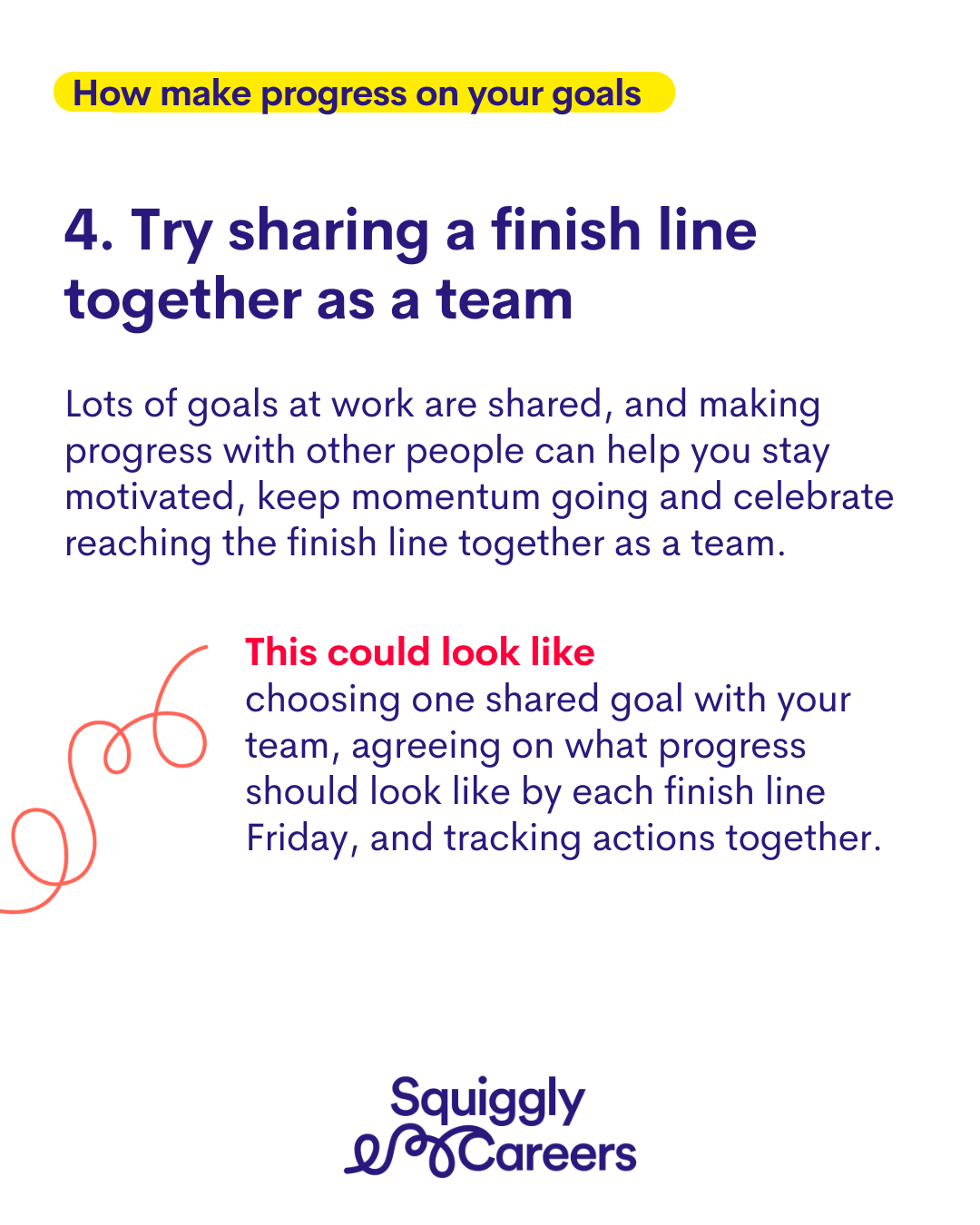
Sarah Ellis: Well, I was thinking person who couldn't get to the marathon, you're like, well, didn't happen for them. Right. Obviously it was a tough time and they were struggling. So I was thinking a bit about support and like the people around you. So we're working on something this week which is involving lots of our team. It's something for a learning partner that we work with. And we're responding to like a big brief that they've kind of sent our way and we actually have a finish line Friday because that is. That is the deadline. And I was thinking if that had been. And it's not just been this week. Right. So that is a good example of something where you could be like, we could have. We didn't, but we could have broken down responding to that in a finish line Friday way. Right. And being like, week one, week two, week three. But what has really helped us this week, almost like, because we have had a Finish line Friday has been like, okay, almost working in pairs to the finish line. So you're not. It's not always an individual pursuit. You know, so many things and so much research is done from such an individual perspective, like, does the rat run faster? Does the human run faster when they kind of see the finish line? But then I was also thinking, yeah, but most time we're in teams. Most of the time, the goals that you're working on, like the one you just described, you can make some Progress on your PhD without me, but only to a point, like we're saying.
Helen Tupper: But it's also. It's the quality of the progress where I can make progress, but whether it's actually good is another thing.
Sarah Ellis: So I was like, oh, what would it mean to share? To, like, share a finish line? To be like, okay, well, we've got a shared goal in every team. You have shared goals. And then we do exactly what you said. We kind of. We zoom out a bit, and then we have almost like a shared finish line Friday. My hypothesis is that it will also feel more satisfying. You know, it's always better to win together as a team than it is to sort of win by yourself. Like, I might feel good that I get to go on holiday and not work. You're like, fine, but I think I will feel. Let's imagine we do an amazing job with this thing that we're working on at the moment. And I'm gonna imagine that's true. Helen's crossing her fingers a lot of that you and I have done. The bits that we have done, you and I have done together. So it feels very shared. Like, the pursuit and the progress of that has felt very shared, and I think I will feel prouder of it and more motivated by it because of that. So I was like, oh, that's my. That's my other build on something that isn't. That's not a scientific build. That's my.
Helen Tupper: How many of your finish lines are solo versus shared?
Sarah Ellis: Yeah.
Helen Tupper: Like, it's an interesting thing.
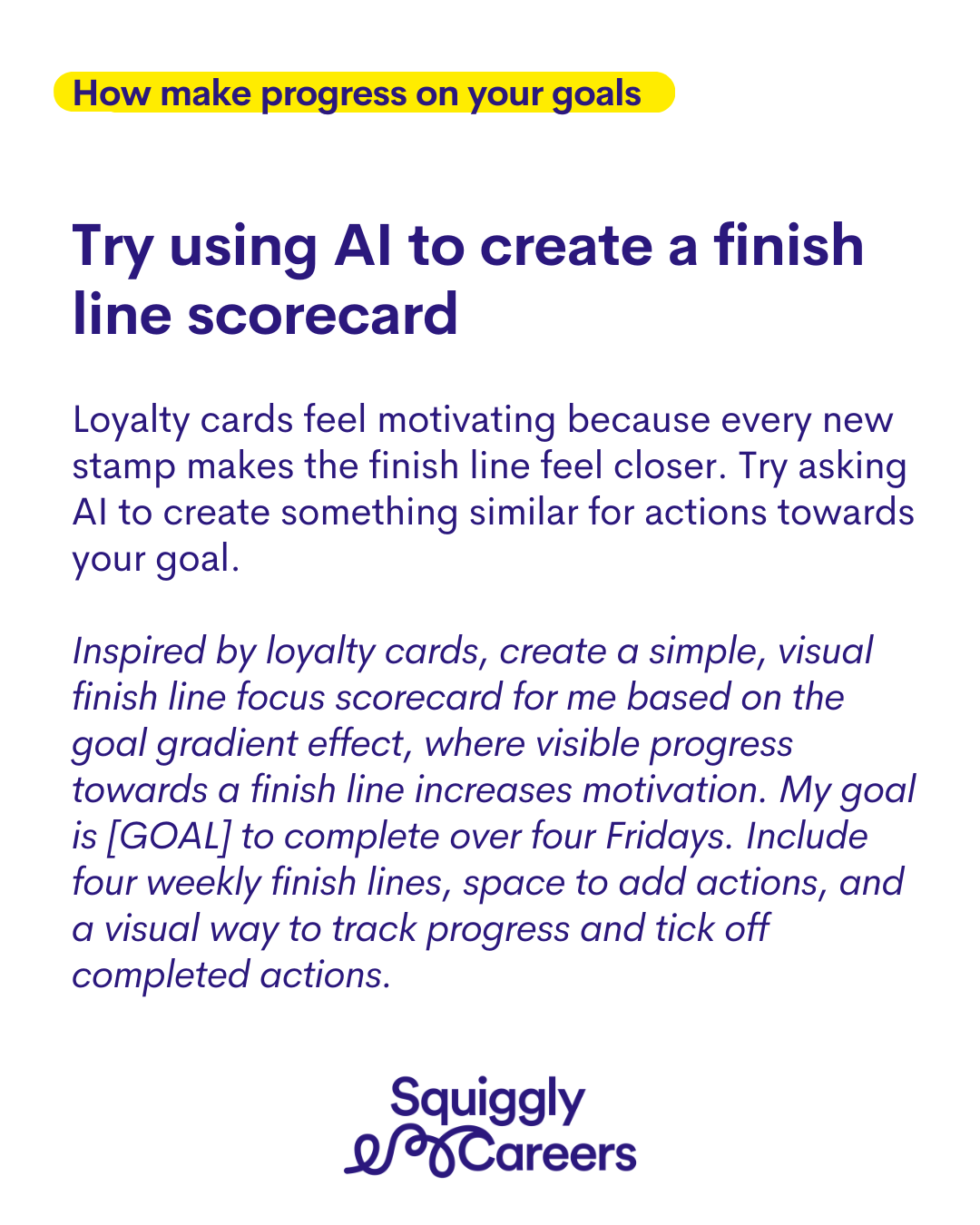
Sarah Ellis: So if you do want to have a go at it, last thing from me is I did go into Claude and just got it to create me a scorecard. It's quite funny, actually. When I go into Claude now, I give it a lot of feedback on branding. I was like, oh, it's like someone. It's like someone in our team. Claude's starting to really hate me. I'm, like, not happy with that. Pantone. I literally said that to it this week, and I got it to do a Squiggle. And you know, oh, the squiggle said it starts with Helen. I was like, oh, dear, crikey.
Helen Tupper: How optimum is the squiggle now?
Sarah Ellis: Well, now it's better. It's a wave rather than a squiggle, I think it's fair to say, but crikey, it's better than where we started. Okay.
Helen Tupper: Okay.
Sarah Ellis: So we've improved.
Helen Tupper: Well done, Claude.
Sarah Ellis: I hope Claude is learning about the squiggle. Did you know you can put pantones into Claude?
Helen Tupper: I would. Well, I do now.
Sarah Ellis: So, as in, we could put our pantones for our brand into Claude and say, well, yes, but create the scorecard in our pantones. If you're wondering if that made me happy.
Helen Tupper: Yeah, I could make me really happy
Sarah Ellis: to see that that's joy, which no one else will care about. But when you create your scorecard, you can put your overall goal at the top, which I did. And then I wrote down all of the actions. So I did the same thing as you. I was like, I worked out what all of the finish line Fridays would be. But you could also, as you learn, as you go, you could change the order. Right. You could be like, oh, actually, I've created my LinkedIn profile. I'm now going to follow five people I find interesting on LinkedIn. I'm going to update my summary, write a recommendation for one person, connect with three new people, join one LinkedIn Live. And I put brackets with squiggly careers.
Helen Tupper: We have got some.
Sarah Ellis: We have got some. And so I wrote those. And then I was like, oh, actually, I did find it useful to have something, you know, something visual that I could either print out or I could put in my notebook or I could add it into my. I was like, oh, actually, I'd probably add this into my diary. So you could take that PDF.
Helen Tupper: Yeah.
Sarah Ellis: Put it into the time when you were going to do some of the actions. You know, it's like a visual reminder and then kind of keep crossing it off. And then the thing that I couldn't work out because I'm just not good at it, I'm not good enough at it yet, was I wanted it to be live, you know, as in like something that then I could keep crossing off and it would, like, dynamically do it and that I could move them around. Basically, I think I wanted to create like a little GPT or an app, but I didn't. I didn't get as good as well. Well, I got a scorecard.
Helen Tupper: Maybe that can be on your finish
Sarah Ellis: Friday, you know, as in Like, I'd have to, I'd literally have to physically cross it off at the moment. So I didn't get as good as that.
Helen Tupper: Okay, okay, well, there's time, there's time for you to work on this. I, like, I definitely, I mean it. Even just talking about it has made me think about the thing I want to do with PhD. So that has definitely given me a bit of clarity. Still think I'm quite a fresh starter, but I would like to, I would like to bring in a bit more of the finish line focus, I think. Otherwise you just start loads of stuff you never finish. Right.
Sarah Ellis: So.
Helen Tupper: So I would like to sort of up my ability there. So I'm willing to experiment with it
Sarah Ellis: if that's been useful. Remember, you can find everything on the pod sheet in terms of a summary, some ideas. I'm just trying to work out whether I want to put the scorecard on there or not. Still not quite in our branding, everyone. So maybe, maybe, or maybe I'll put it on and write in brackets. Not in our branding. So whether you are a fresh start effect or a finish line focus person, we hope you found the episode useful. Quick reminder, our pod sheets, our other podcast episodes, and lots of free tools like the 10 minute tools on squiggly careers are all on amazingif.com so head there if you just want some extra inspiration and hopefully some useful summaries.
Helen Tupper: And we have something different happening on the podcast next week. I've replaced Sarah.
Sarah Ellis: Yeah, sorry, I was like. When you said something different, I was like, what are you doing? What's happening?
Helen Tupper: Oh, well, basically I'm taking the podcast over for a week, but it's.
Sarah Ellis: You say for a week. We'll see.
Helen Tupper: We'll see how long she's allowed.
Sarah Ellis: This could be my last ever episode.
Helen Tupper: No, it's not your last ever episode. It's just for a week. But it's for a really exciting reason. So we are working with LinkedIn to bring you their brand new book, which is called Open to Work. It's been written by the CEO of LinkedIn, Ryan Roslansky, and, and also Aneesh Raman, who is their Chief Economic Opportunity Officer. Very cool job title. Also used to be Obama’s speechwriter. It's very exciting.
Sarah Ellis: Oh, yeah, I know.
Helen Tupper: He's a brilliant communicator. And what we're gonna do is we're gonna take that book Open to Work and we're gonna do an episode a day over the week. Short episodes, like 10 minutes long. And we're gonna bring the book to live to talk about. They have these things called the five Cs, which are gonna be really useful for careers, like, now and in the future. So if that sounds interesting, make sure you are subscribed to squiggly careers wherever you listen or wherever you watch, so that you make sure you get the
Sarah Ellis: maybe I'll listen in case you replace me. And then I increase the opportunities for my career from listening. And then be like, oh, and then I went off and followed Helen's advice before she ousted me.
Helen Tupper: I think you should just come back the following week. That would be my preference. But thank you so much for listening today, everybody.
Sarah Ellis: Thank you so much. We're back again for you soon.
Sign up to the Squiggly Careers Newsletter and get our latest ideas, tools and inspiration every week - all in one place, straight to your inbox