

Are you a fix-it-fast problem solver?
In this Squiggly Shortcut, Helen makes the case for slowing down before you jump to solutions.
🎯 What You’ll Learn
– Why surface-level fixes create ping pong problems that just keep coming back
– How to use two simple questions “why is this a problem?” and “why is this an issue?” to get to the cause
– How to turn your answers into better, more targeted solutions rather than sticking plasters
– Why solving problems as a team (rather than solo) means people are more bought into what comes next
📚 Resources Mentioned
Squiggly Careers Skills Sprint Increasing Your Impact.
For questions about Squiggly Careers or to share feedback, please email: helenandsarah@squigglycareers.com
Need some more squiggly career support?
1. Download our free careers tools
2. Sign up for our Squiggly Careers Skills Sprint
3. Sign up for the Squiggly Careers Newsletter, a weekly summary of the latest squiggly career tools
4. Order our new book, Learn Like a Lobster.







Hi, I'm Helen, and you're listening to one of our squiggly career shortcuts. These episodes are designed to be deliberately short, so they're easy for you to fit into your week. And we focus them on something that we know lots of people might need help with.
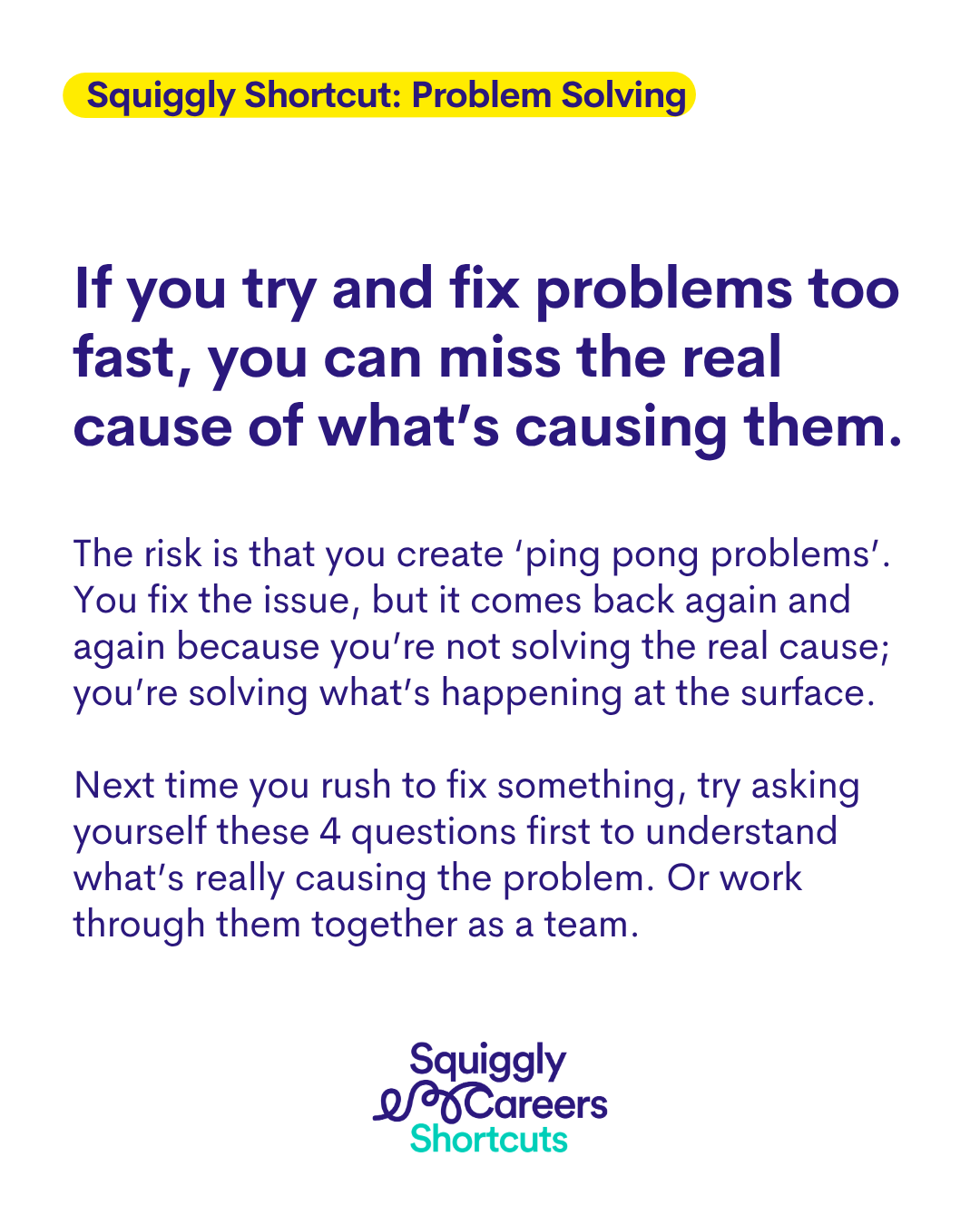
So today I want to talk to you a bit about how to solve the real problem at work. And I think this is a really relevant listen. If you are like, if you are a natural problem solver. I'm a natural problem solver. Like, I see a problem, I want to fix it fast because then I feel like, I feel like things are better. And the risk is, if you are a bit of a fix it fast problem solver, you can create what I think of as ping pong problems. So, like, you fix it, but then the problem just comes back again and you fix it again and it comes back again. And the reason that might happen is that you're not really solving the real problem. You're almost like solving the problem at the surface. But actually there's something else going on and it might, might be that the problem that is bein
g presented to you isn't the real problem. And there's loads of problems at work, right? There's problems on projects, there's problems with workload, there's problems with budgets. There's a lot of problems. But if we fix them too fast or we kind of take maybe what's first stated as the problem and try to solve that, we might not be really exploring the roots of it, the things that have caused the problem. And therefore you're just going to be in this ping pong trap. And it's not great for you, and it's not great for other people too.
So we need to start thinking about how we can solve the real problem. So this is my recommendation for you. Next time you are tempted to pick up a problem before you rush to solve it, I want you to ask a couple of questions and I'm going to say how to do this? And then I'm going to talk you through a real scenario that may or may not be relevant for our team right now. Amazing If.
So the first thing to do is to ask, “why is this a problem?” So let me give you, let me give you a scenario here. This is a, this is actually a real one for our team. One of the problems in my company is that we communicate on loads of different platforms. We communicate on Microsoft Teams, we communicate on WhatsApp, we communicate in meetings, and sometimes lots of actions get lost because they're in lots of different places. That is a problem. Now I could just fix that, right, and say, oh, that's a problem. I'm just going to put a rule in place that all communications need to happen on teams. But I probably haven't solved the real problem. I've done a bit of a sticking plaster solution.
So, first of all, you pick up the problem, communications are in lots of different places and actions are getting lost. You pick up the problem and you ask, “why is this happening?” It's happening because people have a preference for WhatsApp. It's happening because people have a perception that people respond more quickly on different platforms. It's happening because people are friends in our company and they're talking to each other on certain platforms and then work comes into the conversation and it stays in that domain. And you also want to ask “why is this an issue?” I think it is worth just thinking, why is this an issue? “What would be better if we fix this?”
Like just getting a few data points around the problem so you're not just rushing into solving it. Then take each of your answers and ask yourself, well, “how might we fix that?” So it might be. One of the problems that I mentioned there, when I was exploring was that there is a perception that people respond quicker on certain platforms than another. And so, well, how might we fix that? Maybe we have a red flag in front of messages that need a fast response. So we use Microsoft Teams, but we have this like red flag response. We give it a name so that people know that that particular message is one that needs a fast response rather than having to rely on a different platform to do it. So if you take this approach, it means that you're not fixing a surface level problem, you're spending time exploring, well, why is this happening and what would be better and why is what we did before not working now?
So it is worth spending time exploring around the problem and then using that. Well, how might we helps you to see are we solving the right problem and what are the other potential solutions? Now if you do this, and I think actually it works quite well if you do it as a team rather than having a solo endeavour to fix everything, it works really well as you have a team, because then people are more bought into the solution, which is sort of an extra benefit. But if you do this, you'll end up with lots of detail around the problem and you'll probably end up with quite a lot of ideas. And so as a team, it is then for you to decide, well, what is the biggest problem? Maybe it's that the speed of response thing for my example. So what is the biggest problem and what is the most impactful idea? So you've got a little bit of thought filtering to do, but I think that is a much better way of solving the real problem than you rushing in to fixing it fast. So because we know that problem solving is a bit of a super skill in a Squiggly Career, we actually included an episode in one of our previous sprints about increasing your impact. So if you want to go more into this world of how to be a better problem solver, go to www.squigglysprint.com and look out for that episode.
Sign up to the Squiggly Careers Newsletter and get our latest ideas, tools and inspiration every week - all in one place, straight to your inbox


