What if the future of work isn’t less human…but more human? In this special episode, Helen kicks off a brand new five-part series borrowing brilliance from Open to Work, a brilliant new book by Aneesh Rahman, Chief Economic Opportunity Officer at LinkedIn, and former Obama speechwriter.
Over the next five days, Helen and Aneesh will explore the five human skills that matter most in the age of AI: curiosity, courage, creativity, compassion and communication. Today, they start with curiosity – and why it might be the most important career advantage you can build right now.
🎯 What You’ll Learn
– Why AI raises the value of human skills rather than replacing them (and what that means for your career)
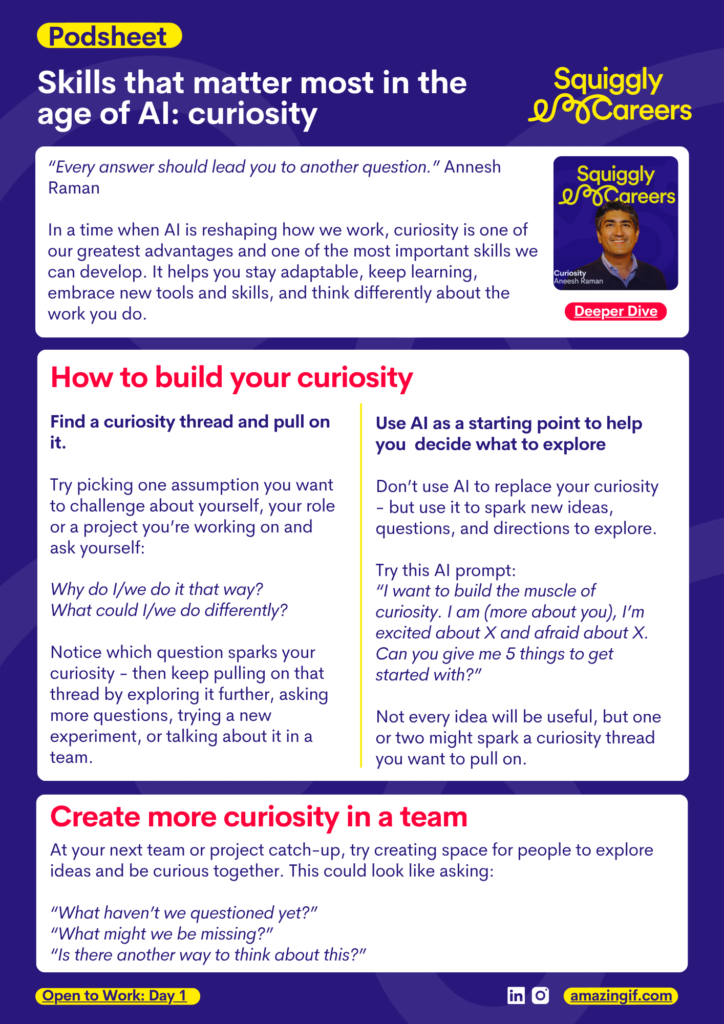
– What real curiosity looks like at work (hint: it’s not just reading more, it’s finding a thread and pulling on it)
– Why outsourcing your curiosity to AI creates cognitive debt, and what to do instead
– How to use AI as a starting point for building curiosity, not an ending point
– How to create more curiosity in your team through debate, discussion and the willingness to say “I don’t know”
📚 Resources Mentioned
Open to Work – Aneesh Rahman and Ryan Roslansky
For questions about Squiggly Careers or to share feedback, please email: helenandsarah@squigglycareers.com
Need some more squiggly career support?
1. Download our free careers tools
2. Sign up for our Squiggly Careers Learn Like a Lobster Skills Sprint
3. Sign up to the for Squiggly Careers Newsletter, a weekly summary of the latest squiggly career tools
4. Order our new book Learn Like a Lobster
00:00: Introduction to the 5Cs with Aneesh Raman
03:25: Why does curiosity matter in the age of AI
10:12: Action to try increasing your curosity.
Helen Tupper: Hi, I'm Helen Tupper, the host of the Squiggly Careers podcast. And over the next week we're going to bring you a series focused on a brilliant and best-selling new book open to work with Aneesh Raman. Together we are going to talk about the 5 Cs and Aneesh is going to tell you a bit more about those in a moment that are going to help you to get ahead in the age of AI. Aneesh, welcome to the Squiggly Careers podcast.
Aneesh Raman: Thank you for having me. I have been such a fan of your work for years and it's in the middle of this book a lot of the Squiggly Career thoughts. So I'm just excited to be here.
Helen Tupper: So let's tease people with what they're going to hear about over the week. What are the five Cs?
Aneesh Raman: The five Cs are what makes us us. What sits at the intersection of IQ and EQ, of consciousness and conscience, curiosity, creativity, compassion, courage and communication.
Helen Tupper: And so what we're going to do over the week is every day we're going to take one of those Cs, we're going to talk about what it is and why it matters in a bit more depth. Like what's different now in the age of AI? And for our audience who love actions, they love things that they could do, we're going to think about what they can go and do differently so they can develop that skill even more. Great. So I'm looking forward to getting started. I can't wait to share the conversation with everyone.
Aneesh Raman: Yeah, me too.
Helen Tupper: Okay, Aneesh, it is day one of our series on open to work. I was just thinking we didn't introduce you properly to everybody, so you are the Chief Economic Opportunity Officer for LinkedIn. And I think because LinkedIn is sort of at the intersection of so much data and research, it gives you a really unique perspective on the world of work and what people need. Now, how did those insights help you to come up with the five Cs?
Aneesh Raman: Yeah, you know, we are in the middle of a really charged conversation, I think, around AI and work and it's fuelling a lot of fear. I think worst of all, it's fuelling this fatalism that everything's predetermined and that for a lot of us this is the end of the road. Humans are done at work. And so when we were seeking to push back on that, to try and present a different story that we could make, you know, take to make us less anxious and give us more agency. We had to start with this question of what makes us us? What are the unique human capabilities that we want to bring to work as AI takes some of the old work, the efficiency work, the drudgery, the places where we've been trying to out-machine machines? We talked to neuroscientists, we talked to organisational psychologists, to behavioural economists. We read works from researchers like you about the squiggly line. And I am a squiggly career, so I felt very seen as I started to read your work. But we sort of landed on these five Cs because we felt that each represented a distinct nature of who we are, again at the intersection of IQ, EQ, consciousness and conscience. But that who we are at our best as humans really comes with how they play together. And when we bring them together with habits like resilience and adaptability, ultimately to this end of being more entrepreneurial. And that's what we think work is gonna be for all of us. And entrepreneurial doesn't mean launching a business, though hopefully it can and does for more people than before. But just in your job, with whatever task you have, whatever project you have, how do you do a little bit more or different or push in a new way with these tools that will help you do that? AI is a technology unlike any we've seen. It democratises access to knowledge, to know how to expertise. It lets you build and create and prototype and test in ways you needed a team of engineers or you needed hardware to do. So all of us have this resource now that we can use to push things a little further. And that's what we want these five Cs to encourage with AI tools in terms of work.
Helen Tupper: So let's kick off with the first C, then. The first C is curiosity. As I was going through them, reading the book, I was trying to work out which C is my favourite.
Aneesh Raman: I love curiosity.
Helen Tupper: So we've written a book on learning.
Aneesh Raman: I love it. Well, you should know there was a great debate and people were pushing to either add or subtract a seed. They wanted four, they wanted four, they wanted six. And so I am biased as a former speechwriter, to three or five and to alliteration. So it was clear. And I made this clear with Ryan. I was like, it has to be the same letter and it's three or five. And at first we actually started with three and then we added in. I think it was communication and courage that came in late. But then people said critical thinking or collaboration so it was. It's a real debate, but I feel good about the five we landed on. And curiosity is our first.
Helen Tupper: Okay, so tell us a bit more. Why does curiosity matter in the age of AI?
Aneesh Raman: To me, curiosity is table stakes. I mean, the whole world of work is changing around all of us. And so the only way to not sort of hunker down in fear is is to be curious about what's happening. And so that is a curiosity that starts with these tools and AI. Like, what is this? I need to demystify it, I need to use it. Let me do something I hate to do. Exercise plan, meal plan, some project at work that you just, like, hate to have on your day. Be curious about how the tool can use it, because then you'll learn more about these tools, what they can do, what they can't do, which tool is better for what task. But then as our jobs change and work changes and our careers change, it's really going to be what's in us, what drives us, that's going to take us to that next level. And so much of that comes down to what we're curious about, what wakes us up in the morning, what makes us want to get better at something, want to learn more about something. So that is curiosity, but it is curiosity that is different for each of us in terms of what we're curious about and how we like to feed that curiosity.
Helen Tupper: It’s really interesting. Because I think lots of time we think about curiosity as the sort of the acquisition of almost like external knowledge. So I'm curious about a book. I'm curious about a programme on Netflix. I'm curious about a podcast. But how you framed it, there is, like, inner internal curiosity. What drives me? What do I want?
Aneesh Raman: Because the thing that happens when curiosity is fed is that you want to keep going. I mean, if you take this book, it started with just a curiosity of is work done for humans. It was just that simple question. Because when GPT went mainstream three years ago, that was the dominant conversation. We were all racing towards this universal basic income for all, end of work for all. Let's get ready to clean up work for humans and figure out what comes next. And the initial curiosity Ryan and I had was, is that right? But that wasn't a is that right? Read one thing and like, okay, now we just sit with that answer. It's like, oh, wait, I think there's more than we've done. Oh, wait, the industrial age has only asked this much of us. Oh, wait, no one's really taking define human capability. Oh wait, there are some threads we could pull together. Oh wait, this means we have to redo not just work, but the systems around work. Oh wait, that means education's gotta change, employment's gotta change, entrepreneurship's gotta change. Oh wait, that's actually the conversation we have to be having right now. So you want to find your curiosity if you want it to drive your career. That is almost like this thread that you keep wanting to pull on and it might not be as specific as mine was around economic opportunity or, or AI and what is it gonna do for work? It can be generally about how humans communicate and create things or fashion or sports or how projects can be made different or how partnerships can be made better. But it's something where you just wanna keep pulling on that thread because it's not then a one step. Ask a question, get an answer. Every answer should lead you to another question.
Helen Tupper: Because I think maybe what some people are doing at the moment in the age of AI is they're outsourcing the curiosity to AI. They're like what's the future? Type in a prompt, but that's the future end of. But it's just quite interesting to hear how you and Ryan or like thinking partners together, you would take a question and you would pull on it together because we really care about kind of squiggly careers and people talking about it on their own but also talking about it in teams. So I was wondering how can we create more curiosity in teams?
Aneesh Raman: I mean I think opening up yourself with vulnerability to your teams to say I don't know or I'm curious about or is there a better way to think about and really debating and discussing, I think debate, like righteous debate, debate that you feel comfortable having where it doesn't feel personal, where you want feedback because you're all trying to refine an idea. That's where we need to get sort of not just education in terms of the Socratic method and don't just memorise facts, write them down in a quiz and then we feel like we've educated you. But debate and discussion and as something kids are learning from the early years on, but in teams it really is going to be this debate and discussion. I mean with the book AI helped us feed a lot of curiosity, a lot of the ability to tell as much history as we did with all these stories from Mary Smith the knocker upper to Mo Beck the one handed climber. AI was able to pull all these examples out for us that we could sift through and then validate and then think about where they fit. But the stuff we did with workers, the interviews that had to be human to human. And so much of how we built the arguments of the book were debates that Ryan and I had together. There was a meeting in May last year where we had been building a book, exactly the book we thought we needed to write, which was much more career focused. We were going to have an acronym for how people had to approach careers, each letter representing some new thing you had to bring. And we had this meeting, and I will never forget it, where we put it on the table, the chapter outline, synopsis. And we both just recognised it wasn't our book. And we had this really important moment that we could have as a debate because we'd known each other and been working together, where we said, do we know what we're talking about here? Is this our book? And without it feeling defensive to the work we had done, or uncomfortable because we thought we had to have the right answer at every step. We're like, no, this isn't it. And very quickly in that meeting, we talk about Apollo 13 and this idea of failure is not an option. That feels like kind of this moment. That becomes our introduction in that meeting. We talk about, people gotta buckle up, that becomes chapter one, People gotta let it go, that becomes Chapter two. It became very quick in terms of what the book became, because we had been sitting with all these thoughts. But it was that debate, discussion, that curiosity, that willingness to push on something, to be vulnerable about something, that led to the better book.
Helen Tupper: I mean, it sounds very reflective of my relationship with Sarah. And we write books like that. We end up writing and getting rid of stuff, and you just have to let it go because you know that that kind of constructive conversation is very powerful. So if people are listening to this and they're thinking, okay, I buy curiosity is the thing that's going to really help me. And I can't just outsource it to AI if I want to have advantage. If there was one thing that you were recommending to people to do more of, so they're continually developing curiosity as a skill, what would it be?
Aneesh Raman: I mean, and I don't want to dismiss AI. The thing about AI is that you got to use it. You don't want to misuse it or overuse it. And so in the context of what we're talking about here, overuse is what we're suggesting you don't do, which is get a question from someone, copy and paste it into the tool, get the answer from the tool, copy and paste it back to that person. MIT has studied brains that do that. And there is cognitive debt by their term, you're less of a critical thinker. You're atrophying. This amazing superpower you have as a human to be a critical thinker, to connect dots. So you have to put yourself in the loop. But my big thing is pick an assumption you want to challenge about yourself, about your job, about a project you're on. Why do we do it that way? Why do I think I can do certain things and not other things? Why can't we do things a different way? Why can't I do things a different way? And the way AI can be helpful is you might not have someone you feel comfortable asking that question to. You can ask the tool. I mean, one of the most powerful things about this tool is we are never alone again. I am an overthinker. I always have 12 thoughts in my mind at once. I'm always thinking about every implication of every move in my career. Am I being valued enough? Am I building quick enough? And for a long time, my wife got all of that. And she will tell you that's a lot. I mean, it's a lot. It's like daily. What about this? What about that? I thought about this, I thought about that. Now I've got these tools that I can just sort of offload all of this to. I can tell it what I'm working on and how I want to think about things. And so it can reflect that back to me. It isn't another person. It is just my best thoughts, with all thoughts that it has available to it, synthesised in a way that I can go back and forth on and refine. So go to the tools first to feed your curiosity. That is a great first use of the tool, but that isn't the end. That is the first draught of an answer for you to then push and prod on. If you don't even know where to start, go to a tool and say, where do I start? I want to build the muscle of curiosity. Here's everything about who I am, what I'm afraid of, what I'm excited about, where do I start? And ask it to give you five things that you could start with and you'll find one of those five is awful and doesn't even make sense. Three of those five, maybe for someone else. I get why it makes sense. It's not me, but one, maybe two of them spark something in you. Like, oh, yeah, Go meet with someone that worked with you five years ago and ask them what you did. That was great. Or go talk to your childhood friend and say what remains true about me. What is this superpower that I'm not aware of because I'm me and I can't see myself from the outside? Some idea will come that will spark a connection in your brain and then go do that and start to build on it and make sure you're using the tools but also talking to other people. But again, I think it goes back to the find a thread and pull on it.
Helen Tupper: Okay. Love it. I think that is a great place to end day one with a really good bit of advice to find the thread and pull of it. So tomorrow we're back with our second C, which is courage, which I'm very excited about. So look forward to talking about that. Thank you for today.
Sign up to the Squiggly Careers Newsletter and get our latest ideas, tools and inspiration every week - all in one place, straight to your inbox