What if the key to navigating uncertainty wasn’t a better plan – but a better experiment?
In this episode, Sarah borrows brilliance from Anne-Laure Le Cunff, author of Tiny Experiments. Together they explore what it means to have an experimental mindset, how to design a tiny experiment using the PACT framework, and why the only experiments that fail are the ones you don’t learn from. If you’ve ever felt stuck waiting for the perfect plan, this episode will give you possibilities you’ll be energised by.
🎯 What You’ll Learn
– Why a linear mindset is like climbing a ladder, and why an experimental mindset is a loop that keeps moving you forward
– What makes a tiny experiment “tiny”, and why keeping the duration short is the whole point
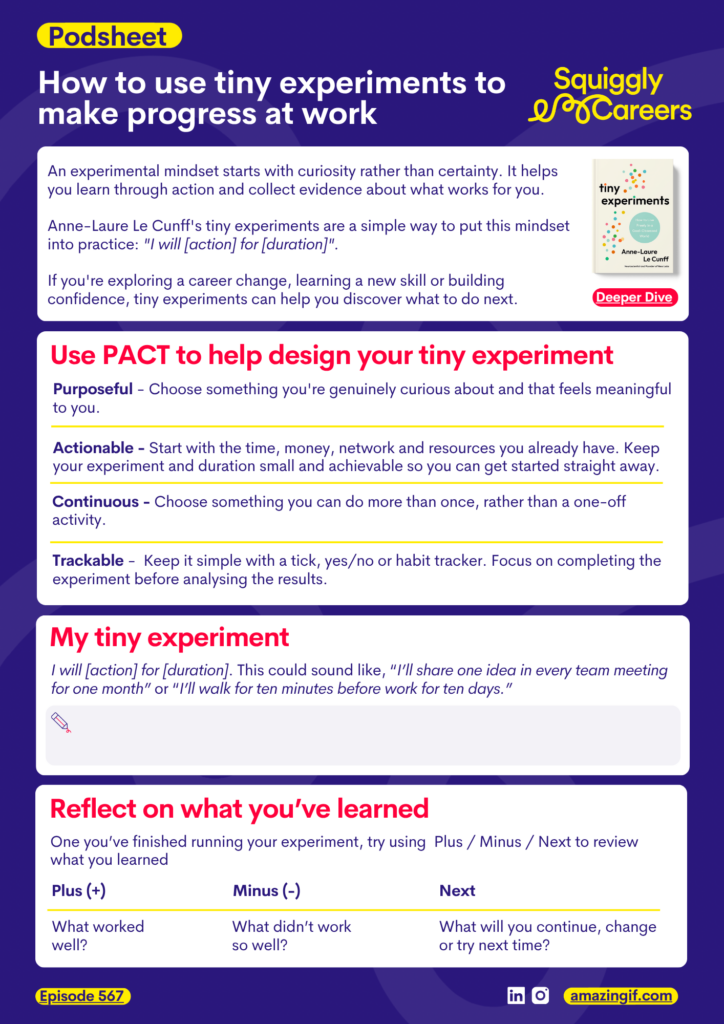
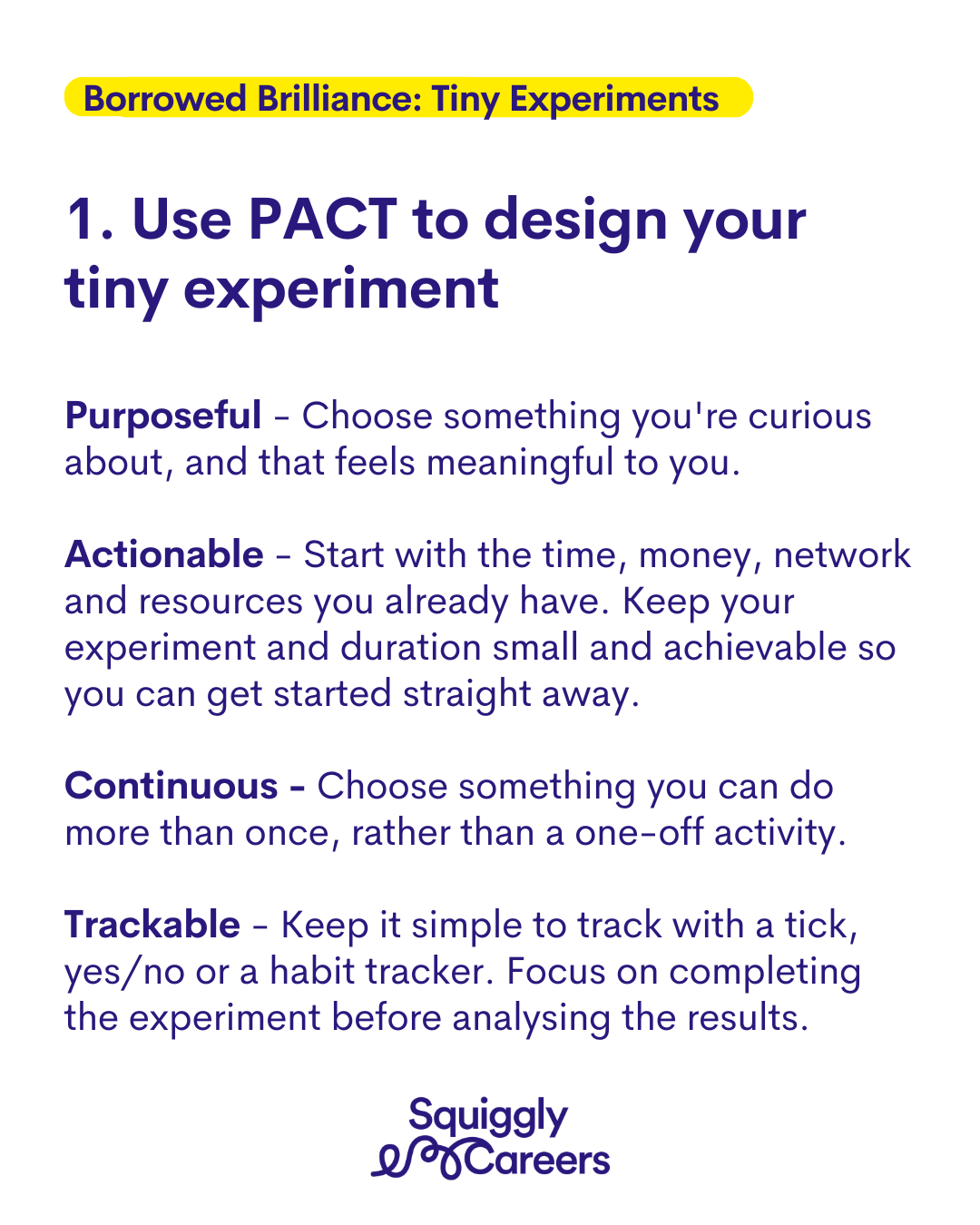
– How to use the PACT framework (Purposeful, Actionable, Continuous, Trackable) to design experiments that actually teach you something
– Why you should only track outputs while running an experiment — and save the outcome reflection for the Plus Minus Next tool afterwards
– How to apply tiny experiments to career change, team culture, and the moments when you feel most stuck
📚 Resources Mentioned
Tiny Experiments — Anne-Laure Le Cunff
For questions about Squiggly Careers or to share feedback, please email: helenandsarah@squigglycareers.com
Need some more squiggly career support?
1. Download our free careers tools
2. Sign up for our Squiggly Careers Learn Like a Lobster Skills Sprint
3. Sign up to the for Squiggly Careers Newsletter, a weekly summary of the latest squiggly career tools
4. Order our new book Learn Like a Lobster
00:00: Introduction to Tiny Experiments
02:28: Experimental mindset versus a linear mindset
10:48: How to design a tiny experiment using PACT
19:25: Tiny experiments that Sarah and Anne-Laure have learned from
36:30: Closing remarks
Sarah Ellis: Hi, I'm Sarah, and this is the Squiggly Careers podcast, where every week we borrow some brilliance from a person, a place, sometimes even an object, and turn that curiosity into useful action for you and your career. And this week, I have the Borrowed Brilliance with me in the room. And if you're not watching, don't worry, you'll be able to hear her along the way. And this is a very special guest. So we've got Anne-Laure with us, who I think lots of you will already follow on LinkedIn. And if you're not, you should be, who wrote an amazing book called Tiny Experiments. And do you want to know the worst thing about writing a book that I think is that we wrote Learn Like a Lobster, which has a whole chapter on experiments, and Anne-Laure's book hadn't come out. And so the thing that makes me most sad about our book is that you are not in it. And so I need to do a second edition because we have all of our expert insights in Learn Like a Lobster and we talk about experiments and we finished writing and then your book came out and I was like, no, because it is fantastic. So it's okay, though, because that's what podcasts are for, right? So welcome to the podcast. And Law, I'm so excited about our conversation today.
Anne-Laure Le Cunff: Thanks so much for having me. And I feel like what you just described first has happened to me as well, where I then talk to authors or discover books, and I feel like, oh, why didn't I know about it before writing my book? But also very aligned with what you write about and what I write about in my book. This happens because we keep on learning. So it's not a static thing. Right? So it's bound to happen.
Sarah Ellis: It is it just this one in particular, I was like, oh, it's so connected. But you're right. I mean, the whole point of Learning Like a Lobster is that we never stop learning and growing. So you're telling me something I already know. So we are going to start with one of my favourite quotes in the book that I'm going to read out because I think it helps to frame the conversation. And so you say, and you write so brilliantly. It's such an amazing mix of. It's my favourite mix of research evidence. It's super credible, really thoughtful, but I also understand it all, you know, like, I get it, and you say:“linear goals promise certainty. If we just stick to the plan and climb, we will arrive safely at the expected destination. But life rarely follows such rigid and predictable patterns. Experiments are built for the in betweens. They propel you forward even without a fixed destination, in constant conversation with your inner self and the outer world.” It got a double underline. And so I wanted to start before we talk about designing a tiny experiment and what that might mean in your working week. What does it mean to have an experimental mindset?
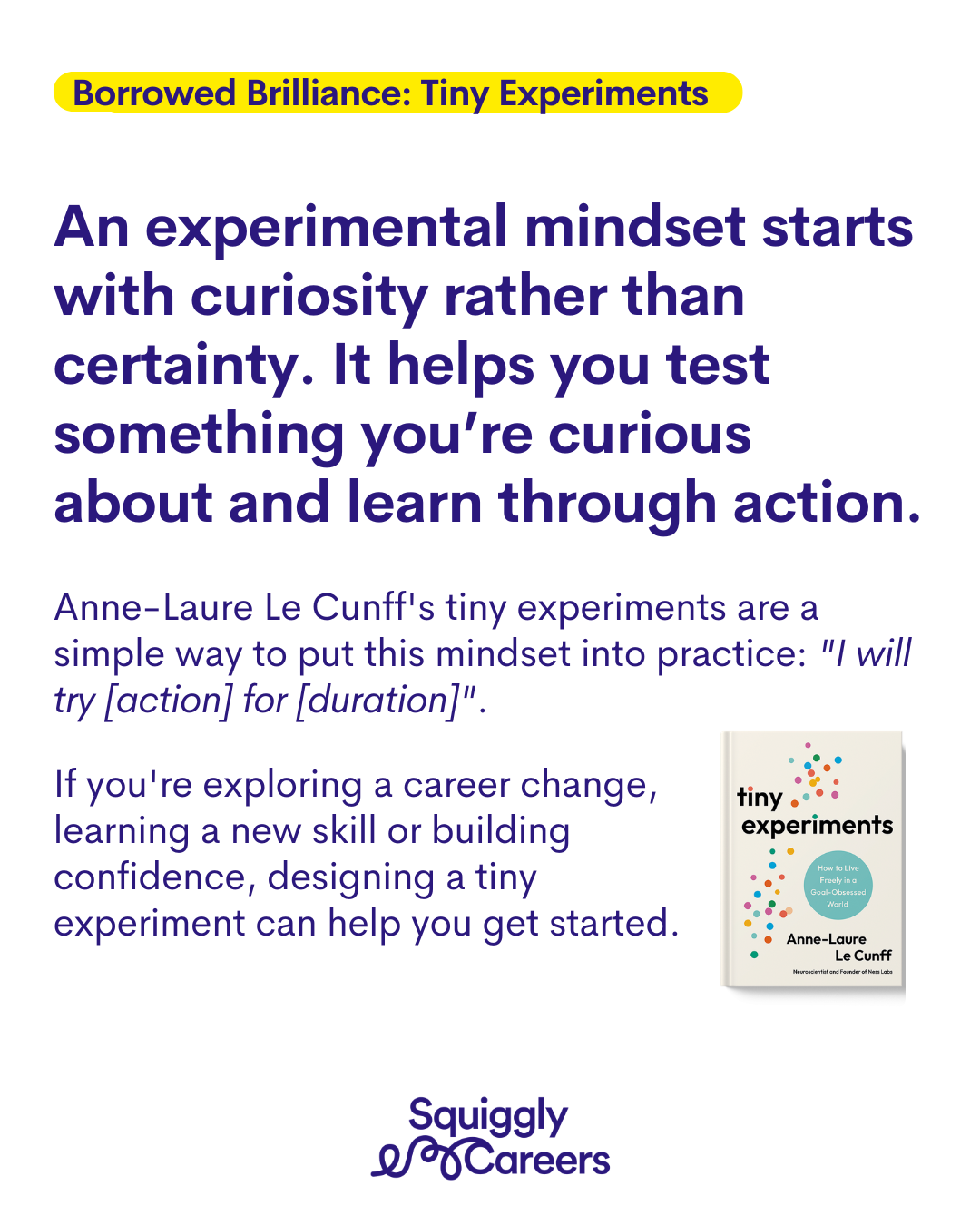
Anne-Laure Le Cunff: I really think about an experimental mindset in contrast with a linear mindset. And I think it can be helpful to use a mental model to think about them. So the mental model of a linear mindset is the one of a ladder. So you have a clear plan with clear steps, and you tell yourself, if I climb this ladder in the right order, if I go through these steps in the right order, then I'll get to this place of success. And as I say in the book and in this quote, unfortunately, life doesn't quite work like that. So, in contrast, the mental model of an experimental mindset is the one of a loop. So it's the idea that you don't really know where you're going. Instead of starting from a place of certainty, you try to start from a place of curiosity. You start from a hypothesis or a research question and you say, let me give this a try. Let me go through one cycle of experimentation, Let me collect my own data, and whatever the outcome, even if that outcome is not what I expected, I trust myself to learn from that result and then use that data to design a new experiment to go through another cycle of experimentation.
Sarah Ellis: And you do such a brilliant job in the book. You have a really lovely table which shows linear mindset versus experimental mindset. And you describe that mental model. You also talk about response to uncertainty, and I think I'm seeing that word a lot at the moment. Like people feeling particularly uncertain. The world feels very uncertain. And you were saying in a linear mindset, we kind of have that automatic response, right? The kind of fight, flight, or freeze, which typically is never that useful. It's very natural, but probably, like, not that helpful. And then you talk here about being kind of autonomous. So what does that mean? I was just thinking, so many people will be feeling uncertain in their career. I've spoken to a lot of people this week who are going through redundancies or restructures. How can perhaps when some things feel like they're happening to us, what would it mean to be autonomous, do you think?
Anne-Laure Le Cunff: So being autonomous is really about reconnecting with your sense of agency. When we're faced with uncertainty, there is a temptation to try and cling to any kind of blueprint that someone might give us.
Sarah Ellis: Yeah.
Anne-Laure Le Cunff: And this is why. Exactly. Give me a plan, give me a recipe, just tell me what to do. Right. And this is also why we see on social media, right here are the three steps to be successful. And the problem with that is that very often we try to copy paste those blueprints, not taking into account that our circumstances are probably very different from the ones of the person who shared that blueprint. And when it doesn't work, we don't question the blueprint.
Sarah Ellis: Oh, we question ourselves.
Anne-Laure Le Cunff: Exactly. We blame ourselves. Being autonomous is saying, okay, I'm sure this worked for you, but I have my own circumstances and I'm going to experiment with different ways to see what works and what doesn't for me. And I don't really know where I'm going, I'm not really sure what kind of results I'm going to get, but I'm not going to make decisions in an automatic way and I'm not going to try and copy paste an algorithm for success from other people.
Sarah Ellis: Yeah. I think it's a really dangerous starting point, isn't it, to think, oh, well, it worked that way for them, so it's going to be exactly the same for me. It could end up feeling very demotivating. And what I like about this idea of being autonomous that you talk about is you're making a choice about something you can control, which would be, okay, I'm going to do some tiny experiments. I can do that. Doesn't matter whether I've got a really tricky manager. I'm in a very hard team at the moment. I'm maybe going through restructure or I'm loving life, I'm, like, really enjoying work. We can all make that choice to create, design some tiny experiments for ourselves.
Anne-Laure Le Cunff: Yeah. And you're making, I think, a really good point about how it's all about our response to uncertainty. So you can't really get rid of it.
Sarah Ellis: No.
Anne-Laure Le Cunff: Right. There's always going to be uncertainty, but what you can change is how you respond to it. And you can either respond to it by trying to be in control, clinging to those plans, or you can respond a little bit more like a scientist getting curious and saying, okay, I'm not quite sure what's going to happen here. There is a lot of uncertainty. Fine. But I'm going to use this space to experiment. I'm going to use this space to learn to learn about myself, about my work and about the world around me.
Sarah Ellis: And so what is a tiny experiment and how do we design one. You have a sort of way of designing a tiny experiment and kind of walking through it after each one. I'd love to hear an example either that you've heard from your community. You have loads of people trying out tiny experiments, because I sometimes read about them, you know, in your newsletter, or someone will just share it on LinkedIn. And probably because we're in the same world, I'll be like, oh, they're trying out a part of the tiny experiments, or even your own. Your own experiences of each part. And particularly when we get to certain parts, there are some bits that have actually really challenged my thinking and perhaps some of the ways that I've approached things so far. So I was like, I really want to pause on those to see, you know, maybe how it might help me to reframe my own experiments. So, yeah, what is a tiny experiment and how should I get started?
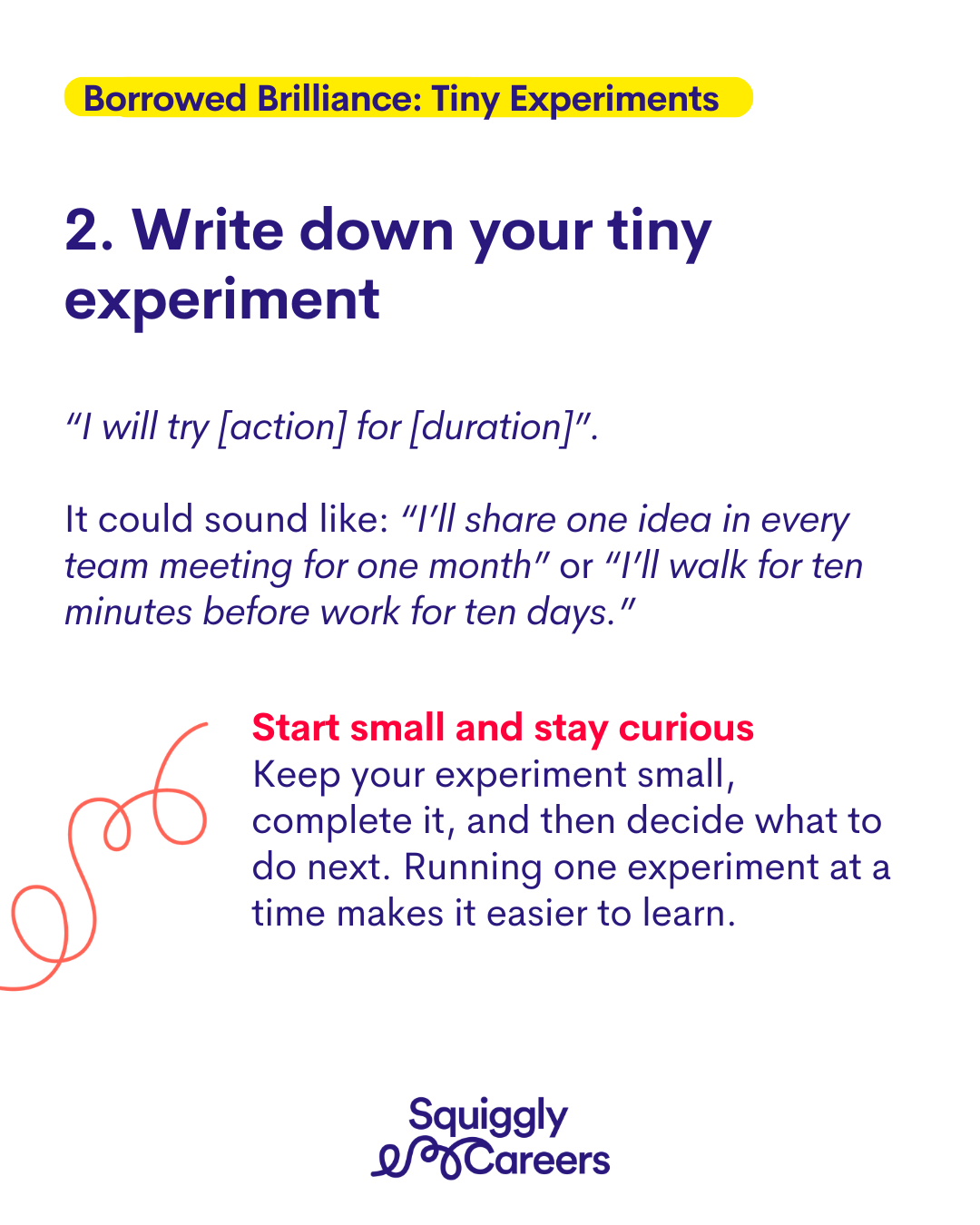
Anne-Laure Le Cunff: Yes. So a tiny experiment first is an experiment. So what is an experiment? What I did is that I basically tried to strip down everything that is not essential to run an experiment. So if you're a scientist working in a lab in a university like I am, we have to apply for money, funding, There's a lot of admin work. You need a lab, you need all of these things, Right? But if you remove all of that. What is an experiment? An experiment is deciding on something you want to test and a trial period. That's it. That's what an experiment is. So you're going to test something you're curious about and you're going to do it for a trial period. This is why when you read research papers, you see scientists say, we tested this intervention for six months or with 200 people, et cetera. So a tiny experiment is saying, I will try this action for this duration. You need an action and a duration. Yeah, and a tiny experiment is tiny. And this is where I really encourage people to keep that duration quite small at first. When people discover this concept of having an experimental mindset and designing experiments, they get a little bit excited and they're like, let me run five different experiments for 12 months. And they then don't complete the experiments because it becomes quite overwhelming. So the idea here is that if you want to collect your own data, if you want to see if it works or not for you, just start small. Start with maybe one week or a couple of weeks, try the thing, see what happens. If you love it, then you can do it for another bigger cycle. That's completely fine. And it works for really anything in your life and work. I've seen people experiment with I will meditate for 10 minutes every morning for 10 days. Action duration. I will post on LinkedIn every day for two weeks. That's a tiny experiment. I will reach out to an industry expert every Monday for six weeks. I will action for duration. So you can experiment with mindfulness, with the way you communicate, with the way you run your meetings, with the way you don't have meetings. Maybe you could say I will not have a weekly team meeting for three weeks and let's see what happens. Right. So, so always I will action for duration and start with a short duration.
Sarah Ellis: And so talk to me about PACT because this is where I've got some detailed questions. This is where I've got circles, I've got multicoloured Post-its at this point. So let's go through each at 10 and I might ask you a few extra questions if that's okay.
Anne-Laure Le Cunff: Absolutely. So something that kept coming up when I started creating this method is people were asking me but what makes a good tiny experiment? And so the acronym pact, P A C T. I created it for two reasons. The first one is because really when you design an experiment, you're making a pact with yourself. You're committing to curiosity, you're committing to collecting your own data and withholding judgement until you're done with the experiment. So that's why it's called a pact. And then PACT stands for P: purposeful, A: actionable, C: continuous and T: trackable. So P purposeful. It's very important that you choose an experiment that you are actually curious about that is meaningful to you.
Sarah Ellis: So again, okay, you're not doing it for the sake of it.
Anne-Laure Le Cunff: Exactly.
Sarah Ellis: Or because you think you should.
Anne-Laure Le Cunff: Exactly. And going back to what we were talking about earlier, not because you're seeing other people around you doing it right. It's not copy-pasting. Right. So that's purposeful. And what's great is that when each tiny experiment is purposeful, you don't need to find a grand purpose in your work and life because you just figure it out as you go then actionable. Something I hear people say quite often is I wish I could do this. I wish I could try this experiment, but I don't have enough time, enough money, I don't have the right professional network. I tell them start with something you can do right now that you can actually experiment with with your current resources. And this is what actionable is about, something you can do right now where you have no excuse to get started.
Sarah Ellis: Okay, that's good.
Anne-Laure Le Cunff: Then continuous. So when you have more of a linear goal, there's this target. Right. You do it and either you fail or you succeed. With an experiment, you want to do it several times, you want several trials, you want to see if there's a pattern. You want to learn from repetition. And this is why it needs to be continuous. So this is why you say, I will do this for five days, two weeks, a month, three months.
Sarah Ellis: So it's not a one off activity. Exactly. I don't experiment by trying it today and then deciding.
Anne-Laure Le Cunff: Yes, exactly. So you really need to have that repetition. And that's what becomes interesting with the data. Right. Because at the end of the experiment you can say, oh, I said I was going to do that every day for two weeks. I only did it maybe half of the time. Was it because it was a particularly busy time? Was it because I didn't have the right resources? Was it because the task was maybe a bit too ambitious and you can start understanding what worked and what didn't so you can keep on iterating. And the last one t trackable, not measurable, like in smart goals, trackable. So it's not about having big dashboards and complicated metrics. The only thing you want to track is whether you did it or not, yes or no. That's it. So if you say, I will do this thing for every day, for five days, every day. You can even use a habit tracker that you repurpose for this and just go, yes or no. And that's it.
Sarah Ellis: So this is where I get a bit stuck because so I do, I'm a big fan of outcomes. And you say focus on outputs, you know, like, did you do the thing that's, that's being trackable? Right. Rather than outcomes? And then I was, I was getting a bit stuck on, oh, but I want the outcomes. There's usually a more zoomed out outcome I've got in mind. And I think if we get too output focused, people get very focused on the task, but maybe forget why they're doing the task.
Anne-Laure Le Cunff: Yes.
Sarah Ellis: So what would you say about outputs versus outcomes to help me that. Because that's a bit of a block or a barrier for me when I think about this, especially because I think I advocate outcomes over outputs quite a lot in the work that I'm doing with companies. And so it may, you know when it makes you pause and you think, do I need to rethink or have I not understood properly?
Anne-Laure Le Cunff: This is such a good question. So when I talk about outputs here and focusing on the outputs, it's while running the experiment, while completing your pact. So the idea here is that when a scientist runs an experiment, they don't start poking at the data while they're still running the experiment. And so what you want to do is really complete your pact, complete this action for the duration you commit it to, and only when you're done, you can analyse the data. And so that's why while you run your pact, you only track whether you did it or not. And that's it, that's all you should be doing at the very end. I have other tools later in the book and actually, structurally, maybe it would have been more helpful to have them closer in the book. So it was clearer. But I have tools that are all about reflecting on the results, but that happens afterwards.
Sarah Ellis: Let's see if I've connected the right dots and you can totally tell me I'm wrong. So plus minus next.
Anne-Laure Le Cunff: Yes.
Sarah Ellis: Is that okay? Talk to me. So I was going to ask you about that in a bit, but I think let's do it now because that's kind of where we are in the conversation. It also got a post it note which is, that's me kind of picking out, going, ah, so is this, is this how I reflect on the experiment as a whole? Does that. Have I connected the right dots there?
Anne-Laure Le Cunff: Absolutely. And it's so interesting, especially talking about this with a fellow author, because we actually went back and forth with my editor so many times as to where
Sarah Ellis: to place the book. Right.
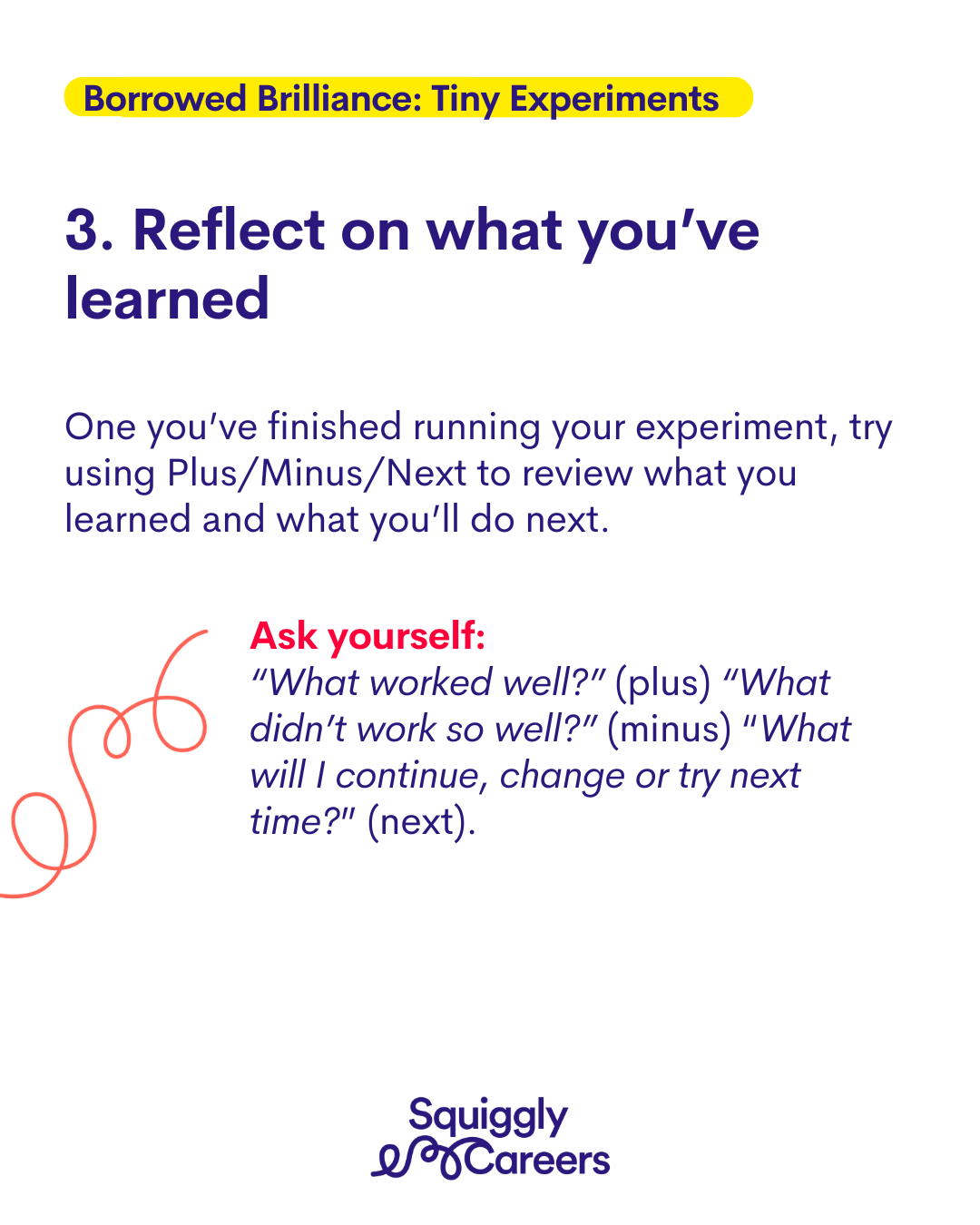
Anne-Laure Le Cunff: And so I'm not surprised that this happened with you reading it, where they're a little bit further apart and so maybe harder to connect. But yes, that's what comes after the data collection. So a pact is a commitment to collecting your data and withholding judgement until you're done. You're just curious at this stage. Just let's do it and let's see what happens. And only when we're done doing the thing, then, just like a scientist, it's time to analyse the data. And this is what plus minus next is all about. It's a reflection tool that's very, very simple. It has three columns. In the first column plus, you write everything that went well with the experiment. In the second column, minus everything that didn't go so well. And in the last column, and this is the most important column, it's not just a static snapshot of what worked and what didn't. This is how you create a loop by saying okay, based on what worked and on what didn't work, what am I going to tweak in my next iteration to have more of the plus, less of the minus, more of what worked, less of what didn't work?
Sarah Ellis: Yeah, it's a really good build on one of our favourite feedback tools and one of the ones that stuck the most with lots of the organisations we work with is what worked well, even better. If so, we will often use that. So that's basically your plus and the minus. Right? Similar thing. But I was thinking, oh, actually probably what would help that tool to be even better for behaviour change or for action would be what worked well, even better if what next? Because you've done the fast reflection. That can be. We're like, we're doing that not just on experiments, on lots of things, but that really helps to commit people to action. Because I think that's the learning loop that you talked about. And I think maybe one of the things that's useful to remember, I think maybe sometimes I forgot when I was like connecting dots, was it's a tiny experiment because I think when I'm thinking about outcomes, I'm not thinking about tiny experiments. You know, I'm thinking about big goals that I've got or things that I want to achieve. But actually in the context of a tiny experiment, it's like, keep it really simple, track it, almost be curious, but don't do. What I think I'm sometimes guilty of doing is I think I judge too fast because I'm naturally questioning. I start questioning before I've even got to the. To the end, you know, like, you've got to give it. It's not even that long, right? It's only like a week. But it's just the way that my brain works. I sometimes quite fast start to go, oh, well, maybe I've not designed it in quite the right way or maybe I've not quite done the right thing. So you've just got to, you know, like, hold it. Just hold on for long enough to let the experiment finish.
Anne-Laure Le Cunff: I think it's actually a very common thing that happens with people I work with, because the kind of people who are drawn to having this experimental approach are usually both very curious and very ambitious. And that combination means that this is why I had to say very explicitly, please wait until you're done collecting your data before you start making changes. Because I know how strong the temptation can be to optimise on the go, while you're on the fly, while you're still running the experiment.
Sarah Ellis: What's a tiny experiment that you have tried out that you feel like you've learned a lot from? So I'm sort of hesitating to say, oh, this worked really well. Because I feel like that misses the point of why we experiment. It's sort of. I think it matters less whether it worked really well. It's more. But did we learn loads from it? And maybe you've kept iterating on it or it's just had a positive impact or you've made a change as a result because you must have tried out loads of tiny experiments as part of this process.
Anne-Laure Le Cunff: Yeah, I think I want to go with an experiment where some people might say it was a failure. And I don't think it was a failure, I think it was very successful. So that was my YouTube experiment. Anyone who has been posting on social media, doing thought leadership or anything like that at some point has probably heard people say, you need a YouTube channel.
Sarah Ellis: Yeah, right.
Anne-Laure Le Cunff: That happened to what you.
Sarah Ellis: Some people will be watching on the Squiggly Careers YouTube channel right now.
Anne-Laure Le Cunff: And that happened to me too. I have a newsletter and a lot of friends started saying, you need a YouTube channel. So that got me curious enough that I said, okay, let me run a tiny experiment. So I. It was towards the end of the year and it felt like a natural stop. And I said, let me run a tiny experiment until the end of the year. I will publish one video every week until the end of the year and let's see what happens. I did that. And what was really interesting, and I also talk about that in the book, is that I looked at both the internal and external signals of success. External signals, subscribers, likes, comments, et cetera, looking pretty good, pretty encouraging. Internal signals. Every time I had to sit down in front of the camera and record myself, I hated it. I absolutely hated it. And because I was dreading this moment, I also was procrastinating on everything else during the days where I was supposed to record. So at the end of the experiment, after I was done collecting my data, I looked back, I did my plus minus next, and I realised that actually there were too many minuses in the sense that it was really affecting the rest of my work and that I really liked writing better as a medium to share my work. So I stopped posting on YouTube. And so the reason why, I say some people might say she failed at YouTube, she failed at this project. Right. For me, it was a huge success. Because now whenever someone says, " Hey, why don't you start a YouTube channel?” I can say, “Oh, I can tell you why. I can tell you why. I actually gave it a try and this is not for me”. And so I don't have that cognitive load anymore. This thing in the back of my head saying, oh, maybe. Maybe you should be doing this. I tried it, I experimented with it, and now I know that I want to focus my time and my energy on other things.
Sarah Ellis: Is a really good example. We've had a similar experience on things like TikTok. People are like, why are you not on TikTok? Because people, especially, you know, people in their early careers are using TikTok a lot for career advice. And we did a similar thing. I think. Actually, you know what? I think our team, because our team have all read your book. Our team had read the book and they. They were trying to persuade me basically to have a go. And I was relatively resistant. And I was like, okay, well, if we're gonna run it as a tiny experiment, I'm way more up for it. And that's one of the things I like about tiny experiments and experiments generally. It takes away the pressure to be perfect and puts all the emphasis on progress, you know, on doing something. And I think the genius of the tiny word makes it even easier. And I think you should never apologise for make things easy. I think it's good because it's easy to get started. There's not many barriers. It's actions you can take. And so we were like, right, okay, we'll just start reposting small things that we've done, like on a TikTok in TikTok, in the right format. Partly because I was like, I'm not creating new content for it. I don't want. I don't want to be that. And I also. I know I won't enjoy it. And then it's really. It's been really useful because also then it's allowed me to give our team, like, space to just experiment without me getting in the way and asking too many questions. Because we've said, oh, no, we're going to experiment for six weeks almost. So I just leave it alone. Because I'm like, well, we're experimenting for six weeks. That's what we've said. And I think I feel reassured because I know that after six weeks, we'll look at the data, we'll look at what we learned. Like, did we put something out every week? What's the data telling us? And then I feel like you make better decisions. I think part of experiments, the bit that I find really appealing Is then, because you're experimenting and you've got all these learning loops, your decision making and your choices improve because it's based, you know, like, you could keep going with that YouTube channel, but that would actually be a really bad choice for you. But now you've got sort of like, the data to, like, help you feel confident in that decision.
Anne-Laure Le Cunff: Yes. And it's your own data that's the most important thing, I think.
Sarah Ellis: So I feel like part of experimenting is that you will. They will fail. And you talk in a book about this idea of good mistakes. And we do quite a lot of work on mistakes and this idea of mistake moments. Because I think people have a really tough relationship with making mistakes sometimes. I'll ask people. I did it this week, actually. A big conference. It's like, shout out some words to me. How do you feel when you make a mistake? And some of these words are visceral. You get. I always get shame, usually the second or third word. And you're like, not often you say shame and work, you know, like in a work setting. So you get shame, disappointment, angry, frustrating. People feel awful about making mistakes. So I think just exploring this idea of good mistakes might be a helpful kind of reframe. What. What do you mean by a good mistake?
Anne-Laure Le Cunff: Well, it. I don't phrase it like that in my book, but since the book came out, I heard you say something where. I think you said something along the lines, correct me, but of the only failure is the failure to learn.
Sarah Ellis: Yeah. Yeah. We have a quote. The only experiments that fail are when you fail to learn.
Anne-Laure Le Cunff: So that was my moment of, oh, that was so good. I wish I had heard it before I finished writing the book because I think this is such a good definition of what I mean by a good mistake. Any mistake you learn from is a good mistake.
Sarah Ellis: Nice. Yeah. And I always think if you say to people, look for the learning. So I think when you make a mistake, you can get so distracted by those emotions that you forget to look for the learning. And I was reading some really interesting research that shows, you know, like, we like to think we learn from our mistakes, but because we like patterns and we do things that we've done before. Actually, if you don't look for the learning, the most likely outcome is that you'll repeat the mistake. That's quite disheartening. So I was like, oh, actually, if we could encourage everybody, you know, to go into that learning loop to look for the learning when you make a mistake, then actually you will start. You. I think you'll feel more comfortable experimenting. Because I think it's almost inevitable that the more we all start experimenting, you know, you'll make some mistakes with those experiments. Maybe it'll feel safer for people, though, you know, in the framing of the word experiment, I wonder if it will help people to feel more comfortable making mistakes.
Anne-Laure Le Cunff: It is. It is actually about creating space for making those good mistakes.
Sarah Ellis: Yeah.
Anne-Laure Le Cunff: And I think if you announce a project as an experiment, you're already giving yourself and others permission to make those mistakes. And so basically what you're saying is, and you mentioned earlier, having big goals. Right. And so companies still have goals, but that means that this is something they're very clear about what they're trying to achieve. They have a clear plan and it's about execution. Right. And that's fine. Right. But there are lots of areas in life that don't work like that, again, and where it's better to experiment. And so you can tell your team and tell yourself, this is an experiment. We are going to make mistakes. This is going to happen. This is expected. Let's make sure to learn. So the. I would say the minimum is just at an individual level, learning from your mistakes. Even better is if you share what you learned with others.
Sarah Ellis: Yeah, that's what we do. When we talk to companies, we. We have this idea of mistake moments and we do this in our company. So we use Microsoft Teams and we have a team's channel called mistake moments. And when we make a mistake in our team, you share it on the same day, also to stop the mistake magnifying and so that you can look for the learning really fast. That definitely works. I don't know if you see. I really thought of you. I was watching the Gordon Ramsay documentary on Netflix. Have you seen it?
Anne-Laure Le Cunff: No, I haven't.
Sarah Ellis: Because I was like, I'm going to send you the episode. So there is one episode where he says he's basically creating in London, I think it's Bishopsgate, one of the really high school skyscrapers, like five restaurants in there, massive, great big project. And they're doing like a practise night for one of the restaurants for Lucky Cat, one of these restaurants. And he says out loud, this is the night for everyone to make mistakes. I want people to make mistakes. And I was like, oh, that's. That's. He's essentially given everyone permission to be like, this is the moment. Like, I expect you, basically, I expect you to make mistakes. Cause, you know, they were sort of doing a dry run of the restaurant. Now, the second Part is less good because how you then responded when things went wrong, I was like, oh, not 100% sure how I feel about that bit of it, but the first bit I was like, oh, that's brilliant because he's being so explicit. People then did make mistakes and then I was like, oh crikey, it's quite shouty in those moments. But your observation is exactly what we see with companies. So when people use the word experiment, a whole different starting point, you know, in terms of how people feel. I also think you give people more permission just to try stuff out, like ideas they've got that maybe they, they don't say because they're like, oh, I'm not sure if it's going to work or maybe it feels a bit more risky. And so then saying tiny experiments I think just makes it even safer. You know, when you think about the amount of safety, I think a tiny experiment creates so much safety for people to just have a go and to test and learn.
Anne-Laure Le Cunff: And also your point about language and the example that you just gave, I think it's really, really important that it's not just language. So you start from the language and then as if you're in a position of leadership in your team, I think it's really important that yes, you start from the language but then when the mistakes actually happen, you've got to back it up. Exactly, yeah.
Sarah Ellis: And I think we had somebody new join our team quite recently and I think sharing your first mistake moment is scary. You know, if you've been in our team for a while, everyone gets really used to it. But when you've just joined, you don't know people that well. And also she said in her sharing her first mistake moment she's like self confessed perfectionist, so that's probably even harder. But then you look at how everyone responded and everyone was like congratulating her, oh, it's a milestone, it's your first mistake. And she just finished with this phrase. I never knew making a mistake could feel so good. And I was like, oh, well that has now hopefully set her up for being like, okay, this is just something that we do. One thing that I'm interested in because you will have had lots of conversations about tiny experiments. It's been out for a while now and you've also been all around the world talking about it. What's one thing that people don't really ask you about that's in the book that you wish people knew?
Anne-Laure Le Cunff: I feel like in general a lot of people ask about the applications in Work, which is interesting because that is not really where I started from when I started writing this book. And yeah, I wish more people also used the tool or ask me about ways to apply this in their personal lives. I think you can experiment with your conversations, with the people you love, relationships in general. You can experiment with the way you dress, you can experiment with, you could even experiment with where you live, like, you know, going and doing day trips and visiting different cities. And there are so many areas of our lives we can experiment with. Something I hear a lot of people say is, oh, surely I can't experiment with anything. Maybe not anything, but really you can experiment with most areas of your life. And so this is really my hope as more people read the book that people keep on surprising me with experimenting with different parts of their lives. That might not seem obvious at first.
Sarah Ellis: Yeah, that's a really nice one. I think it's, I don't think it's that hard to apply to lots of different things. I think when I read it I was like, oh, I can see this in day to day work in teams. I think Team Tiny Experiments is really interesting.
Anne-Laure Le Cunff: Yes.
Sarah Ellis: So we talk about in our team we have an experiments channel as well. And our team, when I say experiments channel, to be honest, most of the time when our team talk about it, they would always say I'm doing a tiny experiment that like has really stuck with them because they've heard you speak before and like I said, they've all read the book and, and so I think Team Tiny Experiments is like a diff that's very different to like an individual one. I also think Tiny experiments work really well in the context of a squiggly career. So when people are thinking, you know, we always say to people we want you to get really curious about where your career can take you. And you're like, well if you're going to get really curious about where your career can take you, one of the ways to do that is lots of tiny experiments. So if you think more specifically about, let's say career change, there are moments in people's squiggly career where they want to do something different. And if you look at the work of someone like Herminia Ibarra at London Business School, she will tell you no one career changes dramatically. No one goes from like over here to over there, like overnight. What you do is it's all about like small incremental changes. Actually what it's about is lots of small tiny experiments.
Anne-Laure Le Cunff: Yes.
Sarah Ellis: Will I enjoy this new area that I'm thinking about working in? Do I go and decide what an experiment might be over the next month? I'm going to try and have one curious career conversation every week with someone who's in that place that I might want to go to in the future. And so I think you could apply it for, you know, almost like when people are trying to make career choices or decisions or if you're feeling a bit stuck.
Anne-Laure Le Cunff: Absolutely. And when you do that, I think it's really important again to pay attention to both the external signals of success and the internal signals of success. Especially when it comes to career changes. There might be a temptation to go for the most prestigious option or the option everybody's talking about at the moment. It's AI right now. Right. So it's like, oh, do I need to pivot and work in AI? So when you have those conversations as part of an experiment or when you try, I don't know, doing research or maybe doing some side projects or whatever experiments you want to run, really having this honest conversation with yourself, those little check-ins and asking yourself, okay, maybe it's doing well from an external standpoint, I'm doing pretty well. How does it feel? Do I wake up in the morning excited to learn about this new area? Do I see myself growing in this industry? Do I like the conversations that I have with people? This is incredibly important if you're considering a career change.
Sarah Ellis: Well, what's so interesting is one of my friends is a scientist and she worked in sort of science and so pharmaceuticals and she's like a doctor and worked in a lab like yourself. And she did a career change to run her own shop, like an eco shop up in Yorkshire in the uk. And I was like, she didn't have to act like a scientist because she is a scientist. And I remember her telling me, and she's been doing it for a little while now, the way that she viewed that kind of career change and it was like a pretty big, you know, pivot from where she was. And yeah, she'd also been a consultant and all sorts of things, like super smart and she kept a spreadsheet. And part of that spreadsheet was one word to describe, I think it was how she felt at the end of every week. Amazing, because she was like, well, obviously I need it to make enough money and it needs to, it needs to work financially. But a big part of it was also for her was like, do I enjoy running a shop? Do I enjoy sourcing the products? Do I enjoy all of the, like, you know, all of the admin that I'm imagining goings with running a shop, do I enjoy serving customers? Like, what? How does it, like, feel for me? And I remember her saying, like, she gave that equal weighting, you know, that was just as important as, like, can I pay my rent this month? And so I was like, oh, that's so interesting that she naturally did that because she's sort of scientific in her view. And then I'm like, we can all sort of borrow a bit of brilliance from that kind of world of science, right?
Anne-Laure Le Cunff: Yeah, it's a little bit like scientists looking at both the quantitative and qualitative data. And. And yeah, we do need to do that. Really. What's the point? If you have a lot of money on your bank account, but you wake up every morning dreading your workday, that is. That's not success. Right.
Sarah Ellis: And just before we finish, finish, what's the biggest watch out? So when people start to design their tiny experiments, and whether you're doing that for your career or in your team or because you want to start running for the first time, whatever it might be, what do you see people maybe miss or maybe just not quite help them set themselves up for success. Because I'm guessing there must be some things that you've started to see where you're like, oh, okay, that's. It's a really consistent. Watch out. When I talk to people about my work.
Anne-Laure Le Cunff: Yes. I see a lot of people forgetting about the tiny part in the experiment.
Sarah Ellis: Everyone goes too big.
Anne-Laure Le Cunff: Yes.
Sarah Ellis: A lot of people get excited, I guess.
Anne-Laure Le Cunff: Yeah. They go too big with the experiment or they run five different experiments at the same time. And again, just think about experiments as a way to play with different variables in your work and in your life. If you're changing every single thing at the same time, how do you know? How do you know what works? So that's why I always tell people, try at first to only run one experiment at a time. Or the only exception is if they are in completely different areas of your life. So let's say you experiment with the way you run meetings at work and you experiment with meal prep on Sundays at home. No overlap, you're fine. Right. But outside of that, one experiment at a time, keep them tiny, finish your experiment, and then you can design the next one.
Sarah Ellis: Okay, that's good. And if people want to learn more about tiny experiments, so obviously they can read your book, which I would really recommend, I think a lot of people who will be listening or watching would have read Squiggly Career or Learn Like a Lobster. So I think if you have enjoyed our work, I think there are some similarities, probably in practicality and the approach that we both take. So I know people will enjoy it, but where else can they read, watch, listen, and learn from you?
Anne-Laure Le Cunff: Yeah. So I try and post regularly. We experiment a lot in public on LinkedIn and Instagram. And I also have a newsletter called Nesslabs, which you can find at nesslabs.com and I send it every Thursday. I write about a lot of the topics that we talked about today.
Sarah Ellis: I saw it today in my inbox because I saw. I was like. Because originally I was like, oh, is she emailing me about the podcast? I was like, oh, no. That's because I subscribed to a newsletter. And what I love about that newsletter is it's so thoughtful. I feel like you. And it also feels very you. It feels very personal. And so I feel like I'm getting a real insight into what's on your mind, your reflections and what you're working on, which I always just find fascinating. So I always feel like, oh, I'm gonna learn something about probably something I'm not doing, and I'll be that little bit smarter or a bit more curious because I've spent time with it. That would be my reflection on reading it.
Anne-Laure Le Cunff: Thank you. I am probably going to grab this from the transcript of this conversation and put it on my landing page.
Sarah Ellis: Oh, well, you're very welcome to. But Anna-Laure, thank you so much for taking the time to share your ideas and your reflections with the Squiggly career community. I suspect it will be very popular and that makes me really happy.
Anne-Laure Le Cunff: Thank you so much.
Sarah Ellis: Thank you.
Sign up to the Squiggly Careers Newsletter and get our latest ideas, tools and inspiration every week - all in one place, straight to your inbox