Do you often feel like you are just waiting for your turn to speak, rather than truly listening and learning? In this episode, we explore the power of oracy and how it can change the way you think and work.
Drawing on the work of Voice 21, Barbara Oakley, and research from More in Common, they explore what it means to develop this skill, and what your default response to it reveals about you.
🎯 What You’ll Learn
– Define oracy as the essential skill of speaking and listening well to build better conclusions.
– Discover why talking out loud helps you spot gaps in your reasoning and critical thinking.
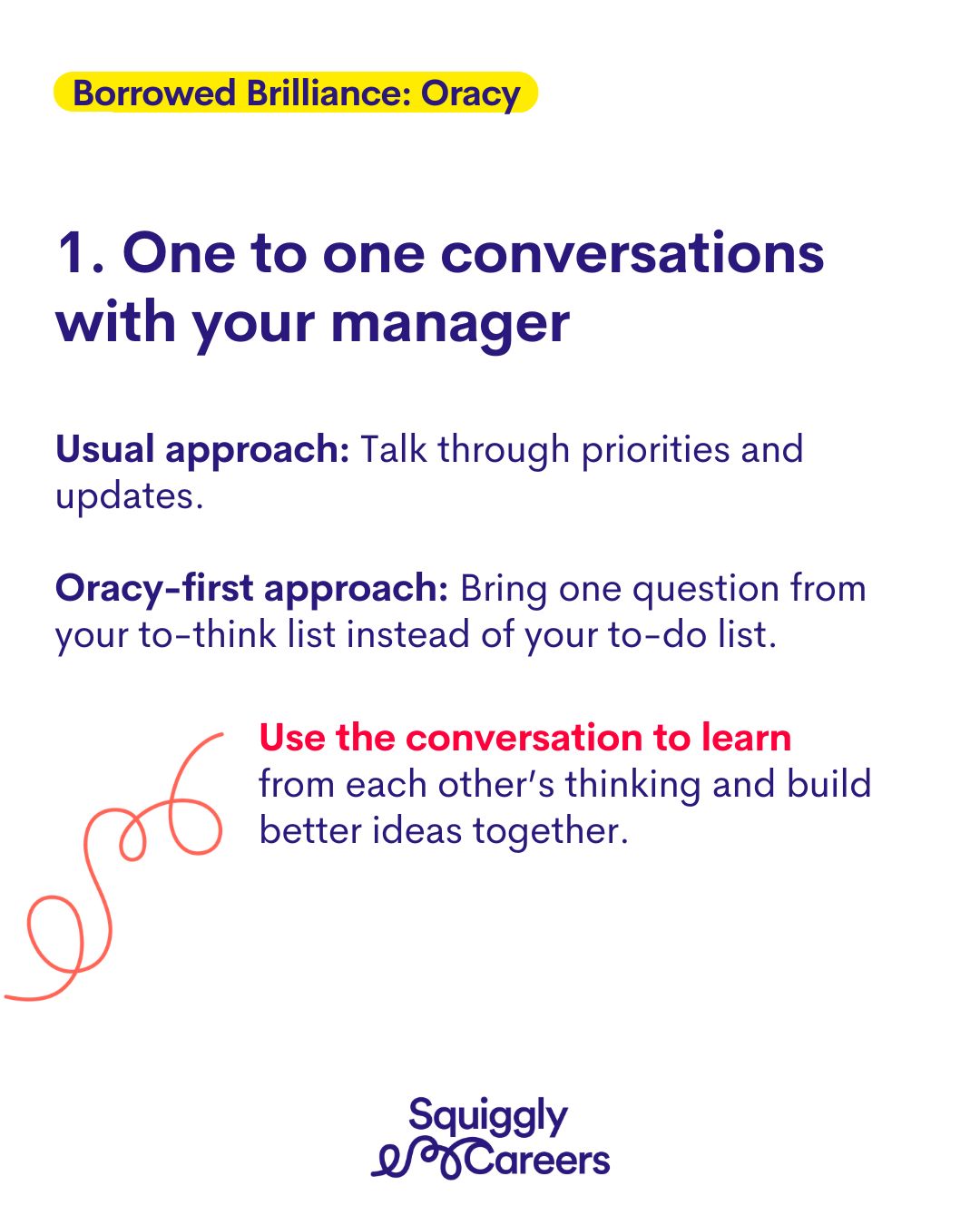
– Identify the difference between a standard 121 and an oracy-first approach to problem-solving.
– Learn how to facilitate meetings that ensure equal contribution and stop interruptions.
– Practice using oracy in team settings to move away from directive leadership.
– Apply oracy techniques to your squiggly career story to articulate your value more effectively.
For questions about Squiggly Careers or to share feedback, please email: helenandsarah@squigglycareers.com
Need some more squiggly career support?
1. Download our free careers tools
2. Sign up for our Squiggly Careers Skills Sprint
3. Sign up for the Squiggly Careers Newsletter, a weekly summary of the latest squiggly career tools
4. Order our new book, Learn Like a Lobster.
00:00: Introduction
00:35: Today we're borrowing brilliance from Oracy
05:45: 87% of Britons believe strong oracy skills are important for career progression
09:02: There's a lot of evidence around social mobility and this approach to learning
11:45: How to use Oracy in a 1:1
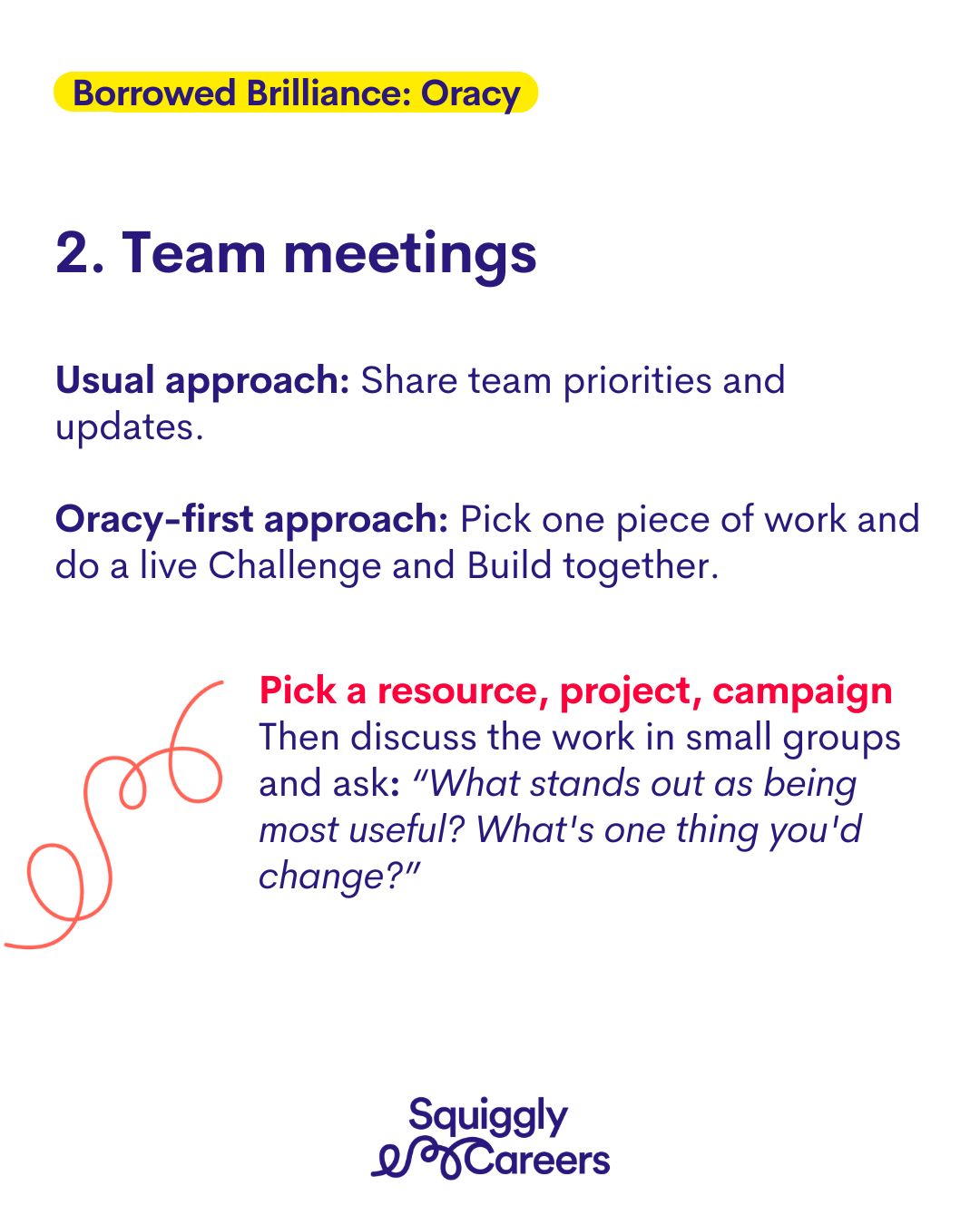
16:41: How to use Oracy in a team meeting
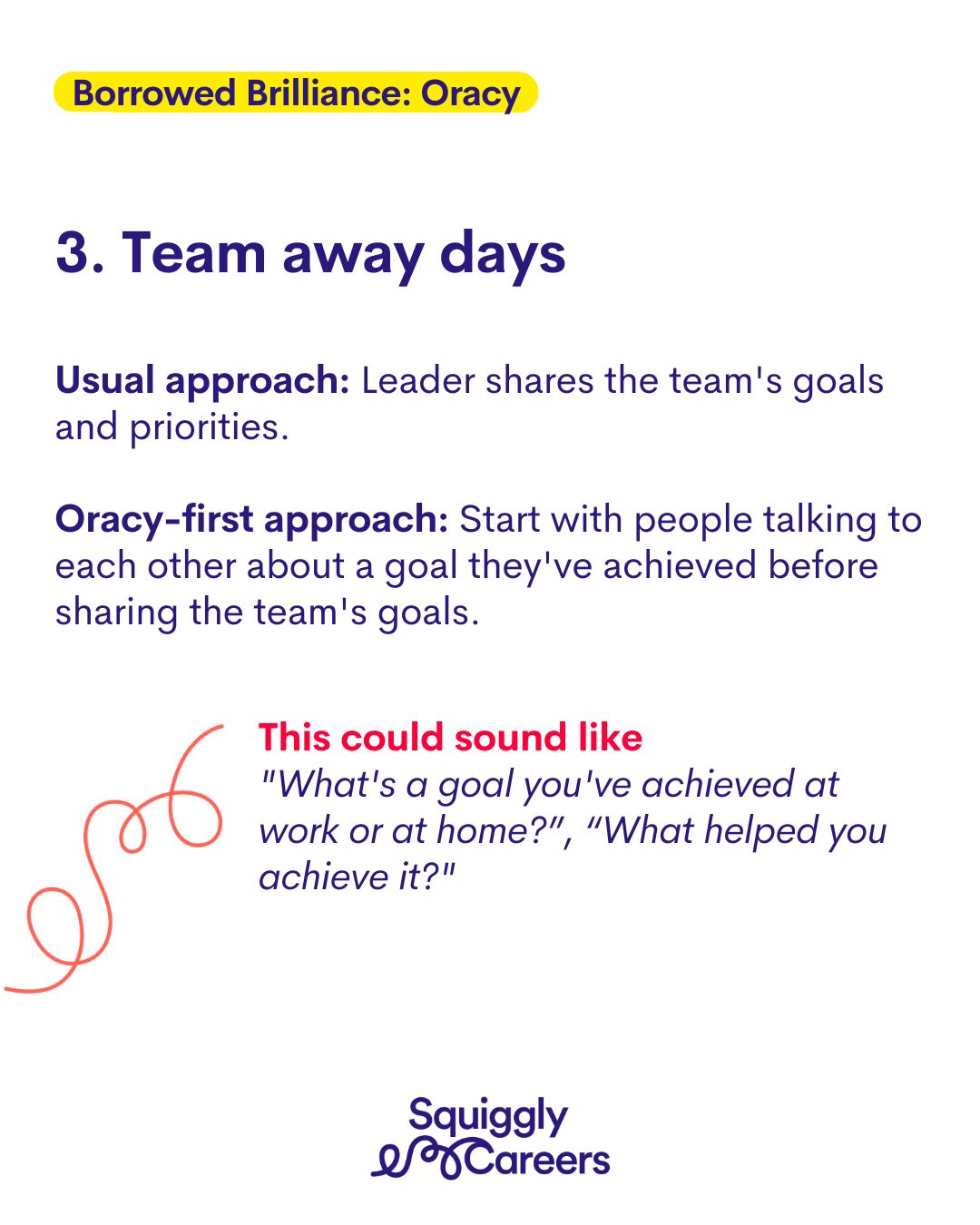
22:58: How to use Oracy at a team away day
32:51: Closing remarks
Helen Tupper: Hi, I'm Helen.
Sarah Ellis: And I'm Sarah.
Helen Tupper: And this is the Squiggly Careers Podcast, a weekly podcast where we borrow some brilliance from something we've been reading, watching, listening to, events we've been at, people we've been talking to, just wherever we take a bit of inspiration from. But the important thing is that we connect that to your career so that you've got some new ideas and actions so you can try out.
Sarah Ellis: And so regular listeners might guess quite quickly that I have chosen today's topic.
Helen Tupper: Next week's is the one that I've chosen.
Sarah Ellis: It'll be good. Well, it'll be a very niche guessing game. Who do you think chose the topic? So today we're borrowing brilliance from a word.
Helen Tupper: Lovely. Can't wait. No, I do. I do like it. I really struggle to say this word. I keep feeling like I get it wrong.
Sarah Ellis: So the word is oracy.
Helen Tupper: Yep.
Sarah Ellis: And if we are pronouncing it wrong, we would like to apologise for that up front.
Helen Tupper: Well, it was either auracy or.
Sarah Ellis: Or.
Helen Tupper: Oracy.
Sarah Ellis: Oracy.
Helen Tupper: Oracy.
Sarah Ellis: I thought. I thought it might be oracy because it felt more like oracy. But we're going to say oracy because it is about oral communication. To be fair, I listened to a podcast with two people who were experts, and they did both pronounce it slightly differently. So I feel okay about going with oracy.
Helen Tupper: Okay.
Sarah Ellis: And then we hope for the best. Okay. So that's. That's basically a boring brilliance for a word we can't say. So it is a concept that I came across through a lovely podcast called Word of Mouth, which is on Radio 4 with Michael Rosen. And unbelievably for someone who has never listened to our podcast, my partner recommended it. So I was like, oh, great.
Helen Tupper: So he obviously cares that he was like, you might like this. Did he recommend it in the context of the podcast or just as a ‘you might be interested in this, Sarah’.
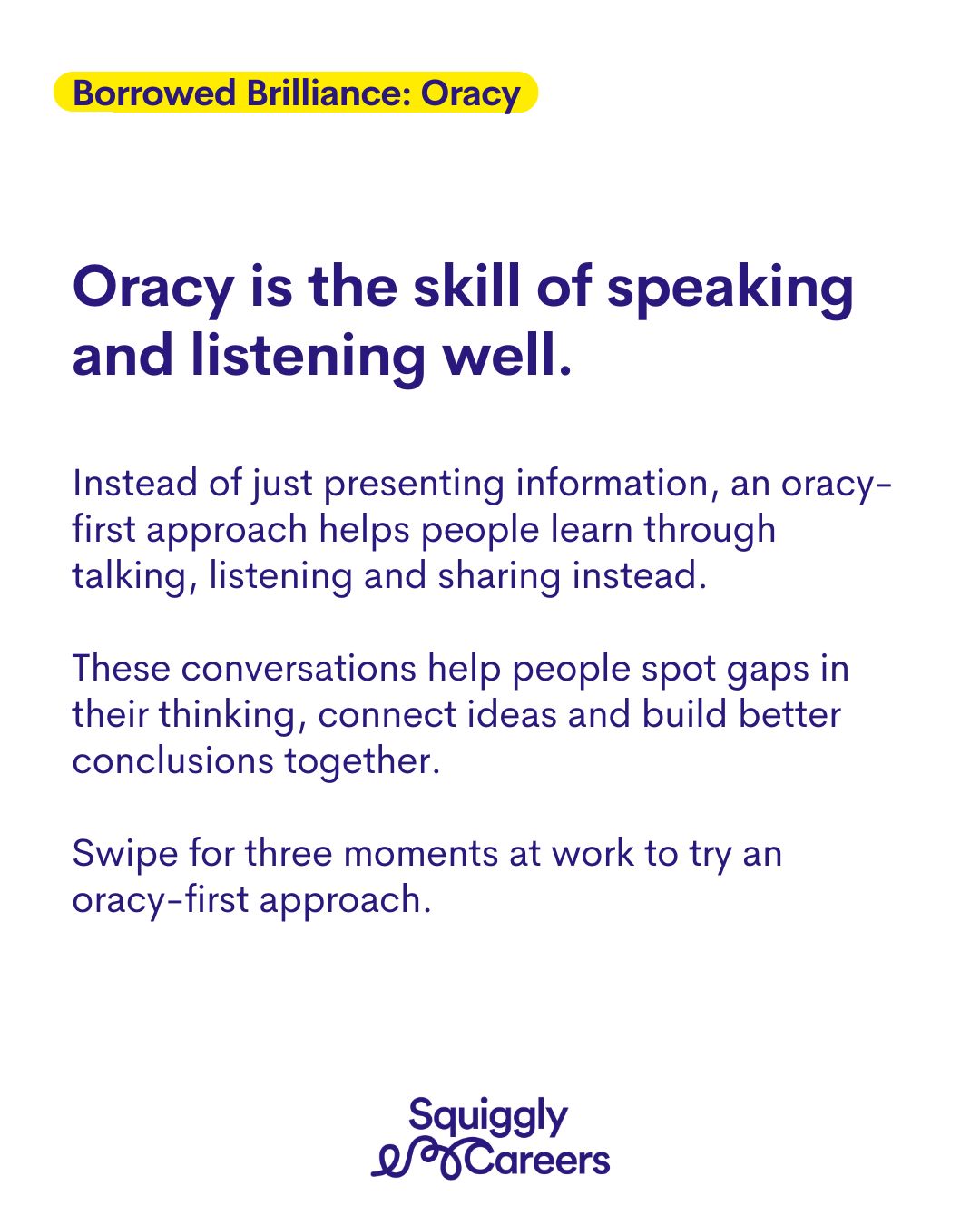
Sarah Ellis: You might be interested in this because he doesn't even know the format for our podcast.. But what it is is the skin skill of speaking and listening. Well, that is my short, very simple version. And so it's sort of learning through talking, listening and sharing. And the more sort of official definition, which comes from voice 21, who are a charity, because a lot of this work, pretty much all of this work actually is in education, is in schools. So they do. They actually have a school, but they also work with schools. They say oracy is articulating ideas, developing understanding and engaging with others through speaking, listening and communication. And as I said, it's mainly used in education. And it's not a skill that you learn separately. It's more about, from my understanding, like, how you teach. So initially I was like, oh, is it like, you know, you have English and maths. Yeah. Were my obvious. I was like, oh, is this like another subject? But it's not really a subject, it's more of a skill. And the example that really stuck with me, that really helped me to understand this was the lady from the charity was talking about assemblies. And I don't know about our listeners, but she said most assemblies, let's say at like, primary school, you all sit in rows, you know, like facing the front, and then you listen to the teacher. Is that what your assemblies were like at school?
Helen Tupper: Yeah, in the village hall. Not the village hall, the school hall.
Sarah Ellis: The school hall. You sit on the floor. We sat on the floor. Not even. Not even on a chair.
Helen Tupper: Yeah. I think. I think by secondary school we'd got to chairs, but you're like primary school.
Sarah Ellis: You were just on the floor.
Helen Tupper: Just sat on the floor. Guys, I think age order.
Sarah Ellis: Yeah, yeah, yeah. The little ones at the front all the way through to the oldest kids.
Helen Tupper: I think if you're in like year, Year six or whatever you could buy,
Sarah Ellis: you got to sit in the back. Yeah, I think in year six we got to sit on wooden benches, like long wooden privilege, which was exciting times.
Helen Tupper: And.
Sarah Ellis: And so her point was that's how assemblies happen. But if you were taking an oracy approach to an assembly, and this is what they do with some kids, rather than the kids sitting in rows, they sit in circles and they have conversations together about a topic or maybe they respond to a picture. They show a picture on the screen. And teachers jobs, really here is to, like, question and to facilitate. And so the kids talk to each other and then they actually share with other groups, like, what they've been thinking about. And it reminded me a bit of something we have in Learn Like a Lobster, where we talk about, think, pair and share as a way of learning, which is, again, you'd set a question, what do we want to be known for as a team? You think about it first by yourself, then you pair up and talk about, well, what did you come up with? And then you share it with a wider group, which is not only Barbara Oakley's work, but that was sort of where certainly I came across it for the first time. So it's almost taking learning that would already happen in a school and then I'm obviously starting to think about learning that would already happen at work or in a team and just sort of going, if you took an oracy approach, what might you do differently?
Helen Tupper: So as I'm processing and I've got questions in my mind. So my simplest sort of mirror to the assembly example in a work context is that this is, you know, presentation versus conversation.
Sarah Ellis: Yes.
Helen Tupper: So if I'm trying to communicate an important message to a team, I could do the presentation assembly straight at people in an audience tell you this is it.
Sarah Ellis: Clicking this is what you need to know.
Helen Tupper: Slide 2 is 3, 4. Or I could have a conversation which is there are three things we need to talk about in relation to this change. Going to give you some questions for you to discuss as a group and then we'll bring that back together. And so presentation for conversation. I was trying to think the work parallel and then the other thing in my mind is it's a bit like the so what? So okay, so I could do that, I could do a presentation. Why would I is the outcome. People learn more when you do it that way. What's the evidence of oracy?
Sarah Ellis: So the things that stuck out for me in terms of the skills were creative thinking and critical thinking. And there are a lot more. You can dive into this in much more detail on the Voices 21 website I actually thought was really interesting. It's very education focused. But I found that, you know, that's where most of the work has been done. But then actually in things like I was reading an article in HR magazine they were talking about. 87% of Britons believe strong oracy skills are important for career progression and leadership. But most people sort of don't know what it is. Like you. And I didn't know loads about it before and it's not something that kind of makes it makes its way into work. Also it's not a very common word
Helen Tupper: because I think the word is getting in the way of it getting into work.
Sarah Ellis: So what would be our word rather than oracy? Yeah, I think maybe conversations I like. I liked your conversation rather than presentation. You might need to add something to conversation because otherwise people are like, well,
Helen Tupper: I already have conversation in conversation or something.
Sarah Ellis: I mean some of the things, some of the kind of builds in case it gets us to any of the thoughts were the things that you would learn to be better at whether you're a kid or an adult would be just the process of talking out Loud helps you to spot gaps in your reasoning. We know that from things like self explaining, you connect ideas together and collaborative talk builds better conclusions. So that's one of the reasons I want kids to do it is, you know, I have my idea, you have your idea, but then actually if we both talk about it, you know, sort of the, your overall, then thinking progresses further. I spot my gaps, I see a perspective that I hadn't seen because you, you saw something different in the picture that I saw. So you're kind of better than when you would be by yourself. And the point when you get to kind of work, if you think about it, is I feel like human skills are becoming more important than ever before. Every AI conversation I'm in at the moment, everyone gets to what are the human skills?
Helen Tupper: We need to sat in a presentation about that today.
Sarah Ellis: Yeah, I mean that's sort of what everybody's focusing on. And I was like, well actually some of the outcomes of this approach I felt like were really relevant to work right now. I wouldn't use the word oracy because I think, you know, we love everyday words that people find easy to relate to. So I wouldn't. Like you said, whether it's like collaborative conversation or whether it's learning or even critical. Critical conversations.
Helen Tupper: There's something I feel like I'm just thinking for people listening. I don't want the word oracy to be a distraction for the ideas that we're gonna share, which is about how can you take everyday work situations and increase the amount of oracy that's going to. Into them. But I think if oracy, because I spend loads, I almost find it hard and I love words getting past the word. So I think maybe if you just kind of take that word and around it in your head as you're kind of listening or watching to this, you kind of think, oh, it's. They mean critical conversations or they mean connecting conversations. They mean these, these kind of the ability to add a discussion into a situation that creates a better outcome. It's that sort of a thing.
Sarah Ellis: And the one thing we're not going to talk about today, but I will just give it a quick shout out. In terms of. You asked the question, why should we care? One of the things that you do see in the research is there's a lot of evidence around social mobility and this approach to learning. And actually that also relates to work. So in terms of inclusion and everybody getting to learn and there's arguments for and against and they were kind of very, they're very Balanced on the podcast about saying, does it definitely do this? What. What kind of. What does it do? Because initially I think when you first hear it, you think, oh, does this only work for the confident kids? And I was thinking that would work as well. Does this only work for the confident
Helen Tupper: people that want to have the conversation?
Sarah Ellis: Because you're asking people to speak, to listen really well, those things don't always go hand in hand, but, you know, those are the two things and it is all about, you know, like, talking, listening and sharing. I was like, oh, that's interesting. If you're not feeling very confident or you don't feel like you belong, are those three quite hard skills to do really well at work? And I was like, oh, they would be. Their argument would be, actually, this approach helps everybody to kind of get better at those things. It's sort of, you know, all of the boats. Right sort of thing. So I was like, oh, it's just. It's definitely not our area of expertise. But if you're interested in that, there's quite a lot of connections to be made there too.
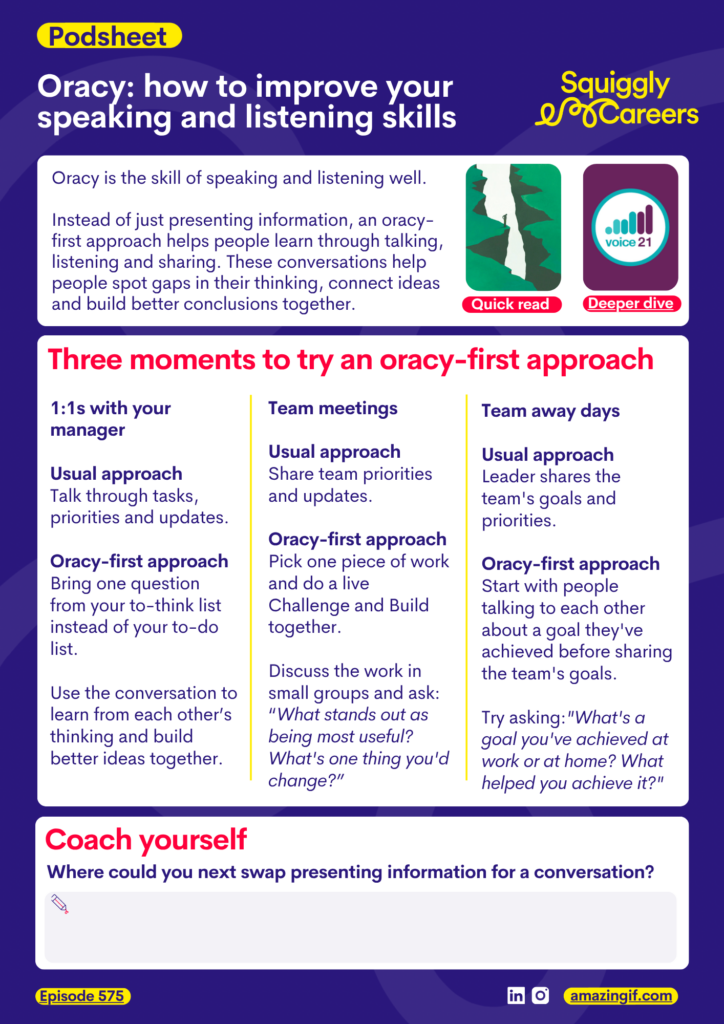
Helen Tupper: We'll put all the links to this. We have a podsheet. So if you are a new listener to the podcast, all of our episodes come with a pod sheet, which is a one page summary. And we'll put the links to the research, the websites that you've mentioned in there to make it easy for people.
Sarah Ellis: So we're now, this is where I got creative. So I was like, this is fascinating. And it did start. It really got me challenging myself on the way that I work, the way that we help people to learn, you know, like, what would you do differently? So to try and make this then very practical, to sort of move from something that might feel in some way sort of philosophical into, okay, what does this mean for me? Tomorrow at work? We've picked some examples of meetings and moments that we hope everybody will be able to relate to and will feel relevant for everyone. Helen is going to talk about, what do we all typically do, including us, like, what does it look like today? And then I've had a go at going, and if you were taking an Oracy first approach, what would you do differently? And some of it then actually is quite, you know, you have to take a deep breath. Oh, that feels quite challenging. And if anyone listening to this actually knows their stuff, you know, in terms of works in Oracy, because I have seen people with job titles who are teachers who are like, yeah, Head of Oracy, I'd love your challenge and builds on this. So please email us HelenandSarah@squigglycareers.com. Tell us what we have got right, Tell us what we have got wrong. And yeah, I think it's something I'm sure we all keep coming back to because we're genuinely interested to learn more.
Helen Tupper: So the first situation, like an everyday work situation is the one to one.
Sarah Ellis: Okay.
Helen Tupper: We've actually got rid of these in our companies because we found them like not that helpful. But most companies still have them. So normal approach of a one to one, I don't know what, half an hour, 45 minutes. And we are just talking through a list of sort of what I need to work on at the moment. So it's your task, here's some tasks, I might ask you some questions, but I'm probably leading it if it's my one to one. And I'm probably doing probably quite a bit of updating because I'm thinking this is the time for me to tell you, say you're my manager, what I'm working on.
Sarah Ellis: Yeah. So here, this is, this is my new idea. If you were taking an oracy first approach, I think you could use something like a To Think list. So let's imagine you're my manager for a moment. I've got my To Think list and I come to the one to one and what I want to do is talk about something on my To Think list. So we're not going through tasks or updates, we're taking a question and then we're sort of having a conversation where we're both sharing even more radically is. And again, I was trying to take inspiration from sort of the assembly idea is does it have to be one to one or could it be. Well, I've got this question on my To Think list. I actually feel like there are a couple of people in the team who could contribute to this. So I bring them with me to the one to many as it is now, rather than one to one. And actually we discuss it together and we include the leader as part of that conversation and maybe my job, because it's my, you know, it's my priority. It's the thing that I need to make progress on is I've got the questions prepared beforehand, maybe I even share them beforehand. So people have got a bit of time to think and to bring that thinking to that conversation.
Helen Tupper: Because that feels like two different things. I'm thinking, would I actually do this is what's going on in my head, like, because it feels like two different things there because you've Got to think list, which is a new concept. And then you've got one to many rather than one to one. So could you. To make that easier, it's a normal. So you know, normally in a one to one you're just going through a list of stuff. Could you kind of do that but in a one to many format? So I've got my list of stuff, but like everybody in this one to many meetings is gonna take one thing off their task list. Talk about it like in a bit. Talk about it in the one to many meeting, but it becomes more of a conversation. So I might say one of the things on my to do list this week is that I need to submit a proposal for an article to a magazine that we are published in. And in my one to many conversation, I want to have a discussion with this group about what you think about that and what you think could be differently and what you like and what you don't like. So it's still something that was already on a list that I had, you know, so it's not. It's like one thing's the same and then one thing's new.
Sarah Ellis: Yeah.
Helen Tupper: Or do you think that wouldn't be oracy?
Sarah Ellis: Well, I think if you go back to like the. Well, what is it? It is about talking, listening and sharing. You've included more people in that conversation. Your people are sharing their kind of thoughts with you. I think what you'd probably want to do. The thing that really struck me when I was learning about it is I think this is probably a real skill that teachers have in terms of, you know, facilitating oracy, like the questions that they ask. And so that's the thing that you need to think about beforehand is like, well, what are the questions that I'm going to ask the group so that they can contribute meaningfully. Because what you don't want to do is like, you're not doing what you think you're not.
Helen Tupper: Yeah, yeah.
Sarah Ellis: You're not doing it for the sake of.
Helen Tupper: Yes.
Sarah Ellis: Sake of it. It might be. Well, I've. I've submitted a proposal for a few. Like we've had this.
Helen Tupper: Right.
Sarah Ellis: You submit proposals for articles and we've had a few rejections. That would be true for us. We've had a few rejections and everybody might talk about a time when they've been rejected and what helped them to move forward. Because you're asking people to relate to the rejection, not necessarily the specific. Help me with my, my specific thing. I think, okay, so that might be more. And then that might be more useful, right? Because then I hear like, oh, well, every. We can all relate to being rejected. And what helps is perspective. Laughing about it. I don't know, doing something different, like just even a distraction. And so what I might then get in return is coping strategies for rejection, rather than necessarily a practical. Take this action now so that you don't get rejected next time.
Helen Tupper: Okay, I'll hold it. I'll hold it in my mind. Let's do another situation. I think I definitely feel like I'm learning as I go in this conversation with you about oracy.
Sarah Ellis: Both are, yeah. I'm just thinking, could I be a teacher?
Helen Tupper: I'm holding you up as, like, my oracy expert. I'm like, but what about this, Sarah? It's very helpful. I do feel like I'm learning more from doing it. Let's take a team meeting then. So typical team meeting probably happens on a Monday. Normally at the start of a week, we are going, like, round the room. We're all sharing our priorities for the week, and then probably kicks off with maybe the manager, Maybe manager starts it, then everyone goes round, and then that's the end of the meeting. See you next Monday. If other meetings run differently to that, I would love to hear about it. But most team meetings, particularly, like the update ones, kind of feel like they go like that. So what's our oracy first meeting gonna look like?
Sarah Ellis: So I've tried to make this really specific. We now create a monthly squiggly summary. So I'm not making this up. We actually do.
Helen Tupper: We do.
Sarah Ellis: You're, like, nodding. I'm like, hang on. We actually do. We actually do have this.
Helen Tupper: I shared it on LinkedIn.
Sarah Ellis: I know.
Helen Tupper: I thought you were, like, setting your scene, imagining.
Sarah Ellis: I'm like, you don't need to imagine. We actually do see my face.
Helen Tupper: It's just like, no, no. This is a real.
Sarah Ellis: I'm like, no, no. That thing that you shared. So we actually do do this. So, like, at the end of every month, like, we create a summary because we know that sometimes people find it hard to, like, navigate and find things. So we already. We have this, right, as a team. So an oracy first approach to a team meeting would be we put that up on the screen. Some people will have spent time creating that or working on that. Some people have been more involved or kind of less involved. And then you would do. And so everybody's seeing kind of the same thing. And then you would do, like, a live challenge and build together as a team. So you're ditching updates, you're ditching a manager go first. It's a sort of very. Everybody's opinion is valued and equal. What you might do is, let's say you've got quite a big team. Well, I don't know. Even if you've got like 10 people, that's quite a lot of people. You might initially go, right, we're going to split into groups. We want you to sort of share one word to describe that monthly squiggly summary. What stands out to you as being most useful. And if you were going to change one thing, what's one change you would make? And so I split off with somebody else in our team. We then go and have that kind of conversation together and we listen to each other, we then come back, everyone comes back, and then we all kind of share where we got. Where we got to a very, very different team meeting. Everybody gets the chance to contribute, we're all listening, we're all kind of sharing on something that feels kind of useful for all of us. That still probably is quite, quite a practical one. But I was trying to make it very relevant to you. Pick a piece of work. If you wanted to be more zoomed out or potentially even abstract, what you might do is pick something that wasn't yours. Yes, we do that summary. But you might pick a summary that another company does or a newsletter that somebody else does, and then you use that rather than kind of necessarily using your one, because you're trying to get people to zoom out. But I think you can do different things. But I was like, oh, I could really imagine us doing that in a team meeting. And I felt like that would. I would look forward to that team meeting. I decided, I actually quite like to
Helen Tupper: like, you know, just in that very specific example there about say, like a newsletter or something like that, like to do both. So you kind of do the discussion on yours and then you do the discussion on someone else's and then you're like. And then you could have an how. What could be. What's the kind of shared insight across them? Because you've got two data points. I was just thinking, I keep going back to. At the start we had like presentation versus conversation.
Sarah Ellis: So.
Helen Tupper: And it made me think, just as you were framing that we've talked before about challenge and builds. Yeah, and actually that. So the challenge and build is someone put some work up in the team and openly is asking for people to challenge it and then. And build on it. And the other little insight that is sticking with me from what you said Is that to go prepared with questions? So I could just say, what do you think? Challenge and build this, everybody? Yeah, but that's not what you're saying. I think what I'm hearing is for Oracy to be effective. Whatever you put in front of people, you then need to provide some questions that create the conversation.
Sarah Ellis: Yeah.
Helen Tupper: And that's part of your responsibility.
Sarah Ellis: The kids are not just being. It's not like a facet. Can you imagine when I was listening? I mean, both Michael and the lady from the charity were both very. They do teach in. He teaches. Michael Rosen is a poet, and he goes into schools and talks to kids about poems in this way. And so the thing he describes is what I don't get the kids to necessarily do is be like, right, I'm gonna tell you what this poem means, or I'm gonna necessarily ask you, you know, like, I'm gonna take line three. What do we think line three means? What he almost gets them to do is to go, right, well, in this poem, this person's talking about, you know, finding life hard. Like, when have you all found life hard?
Helen Tupper: Yeah.
Sarah Ellis: And they sort of talk about that first. And they sort of get into the poem in, like, a completely different way. And I was thinking, that's genius.
Helen Tupper: Right.
Sarah Ellis: Because you've kind of related it to yourself. And those things sometimes can be quite hard to connect to. And back to your presentation versus conversation. I was. I think another question you could just ask yourself is for things that you are doing, like, how conversational are they? So I thought about our team meeting, and if I was saying the hard thing about our team meeting, it's very presentational. We go around and everybody goes, here's my. What one thing for this week. Here's my high energy moment. Have I got anything on my worry list? And there's not really any conversation around any of that. Yeah, occasionally, like, you and I might make comment, but there's no conversation. So why couldn't that all just be done in a team's message? And I'm like, well, if something could be done in a team's message, you're sort of wasting a chance to come together and have a conversation. So this was the. You know, like, sometimes even just going through these things, like, what do you notice? It made me think, oh, I'm always, like, upbeat about our team meeting structure. I'm like, oh, that feels really good. We create clarity. We talk about energy, and that's one of our values. But the way that we run that meeting is not designed for conversation. It's designed for presentation.
Helen Tupper: This is true. I was trying to think about what's a meeting where there's no oracy And I was like, is it noracy?
Sarah Ellis: Noracy. Another word that we can't say.
Helen Tupper: Probably not for today. All right, let's take another context. Team away day. So typically we're going somewhere, I don't know, random hotel that's got a conference room and everyone's there. Maybe there's been an agenda that's gone out beforehand. Um, There is. Probably the leader's gonna kick things off.
Sarah Ellis: Yeah.
Helen Tupper: Maybe a bit of a business update. Our team away. This is what's happening at the moment.
Sarah Ellis: Yeah. Always a business update.
Helen Tupper: Maybe there's a bit of a cheesy activity of some sort.
Sarah Ellis: Icebreaker.
Helen Tupper: Icebreaker. A bit of an icebreaker. And then we're just gonna work through some things on the agenda. And then maybe we're gonna go for drinks at the end of the day.
Sarah Ellis: And probably not always. Cause we go to some of these days, right. And we do work. Or some of these days, usually quite a lot of listening. It did strike me recently this wasn't a team away day. This was a event. Just how much listening people were being expected to do and just how little conversation was part of that day. I have to say, the session we did on learnt like a lobster. There was lots of conversation. But it was noticeable that I was the only person that day that got people talking to each other. And I was like, oh, that's. I don't know. It's just interesting, isn't it? Like, that's sort of the opposite, basically, of what we're talking about today. So I was thinking here, typically when you're getting a team together, you want to talk about goals of some description, like, what are our team goals, what are our company goals, what are our business goals? So you could start the day in quite a different way. You could be like, well, we. It's not that you ignore the thing that you want to talk about. I think that's, like, important to say. You can still. You can still talk about your business goals or your team goals, but maybe you would start with getting everybody to talk together on, like, table. So the first thing you are doing.
Helen Tupper: Oh, before the leader goes.
Sarah Ellis: Before the leader goes. The first thing that happens is people are talking to each other. Controversial. About a goal that they have set in the past and achieved at work or at home, and what helped them achieve that goal. So if you were gonna answer that, for example, tell me about a goal that you've set and achieved. What would you be saying to the group?
Helen Tupper: A work one or an out of work one?
Sarah Ellis: You can choose.
Helen Tupper: Ooh, a goal that I've set and achieved. A. Probably like a house based one. Like a goal. Like I've got a big goal to renovate my house and then I've broken that down every year into like a particular thing. So like last year it was the garden, this year it's the bathrooms. Next year it's the bar. Like there's. I've got some specific goals and so far I've achieved each one, which takes quite a lot to make to achieve those things. But yeah, that would be my goals I've achieved.
Sarah Ellis: And so I've already heard you say one thing that helped you to achieve the goals so far. You were like. You talked about breaking them down.
Helen Tupper: Yeah.
Sarah Ellis: One of the things that's helped you
Helen Tupper: to achieve those goals, I mean, prioritising saving money for them. To be honest, like, that's had to be my husband's. That's so good. I mean, probably my husband's helpless because we were sat there last night and a bill came in and I was like, well, can't that just come from the savings? And he was like, no, because that's what the sa. The savings are for, the gold that you've got. So, no, that needs to come from your salary. And I was like, oh, damn it. So probably the fact that there is a distinction between like stuff that comes out of my salary and stuff that goes in saving and my husband helps protect that.
Sarah Ellis: Yes, it's. That's interesting. There's a bit about prioritising, protecting, like breaking things down. And so already you imagine those conversations in team. Everyone has a goal, right? Yeah. And I bet you a lot of people would talk about ones maybe outside of work. Not. Not universally, but I can imagine, you know, almost like that's often things that people.
Helen Tupper: No, but you're right though, because that get excited about. Like, if we were gonna talk about our company goals now, I would probably take some of those concepts and I'd think, okay, so how can we protect it? How can we prioritise it? How do I break it down? Yeah, and I wouldn't. If you'd said, how can we achieve the goal this year without that thinking, I wouldn't have to.
Sarah Ellis: This was one of my better ideas, I think. Cause I was going through.
Helen Tupper: They're all good ideas, but I think you have to kind of just.
Sarah Ellis: But what it. I think back to your point, the thing My own note to myself was, you have to really think about the questions, you know, as in like I, I had to think quite hard. I was like, right, okay, of course you're going to want to talk about team or business goals. But like where would you start? That still feels connected but is more, is very conversational, will get people listening and sharing. You can imagine that having quite a lot of energy in the room and then actually it doesn't feel like a massive leap then to then go, okay, so we know as a team these are our three goals based on what we've just talked about, like what do we need to do? And it feels so much more shared than a leader just going, well, here are some goals. Let's all talk about how we're going to get there.
Helen Tupper: Question and reflection for you. Yeah, my question is because I think that skill is hard. Like knowing what question to ask is hard. I just wondered whether you thought, do you think I could help you if you were like, I've got this team meeting, these are things I want to talk about but I want to take a more oratic.
Sarah Ellis: That can't be right.
Helen Tupper: An Oracy first approach to this meeting. How could I talk about goals differently? What are some questions? Do you think AI could help you?
Sarah Ellis: Because it is a skill.
Helen Tupper: The leap you've made with the question.
Sarah Ellis: Yeah, so I didn't do that. What I did with AI is I put so voice 21, who are the charity, have an Oracy framework, very educational Auric framework. So I did upload so you can download that and I uploaded that into Claude and then why was I doing that? Oh yeah, I just tried. I was actually just. I was just trying something out. I was seeing whether it could convert that framework into something that was more like work based rather than education based and it turns out not, not that useful. So that's why I didn't put it in the. But I didn't think to because what you could do, I was like, you'd sort of need to train. I think you'd need to train your agent. What you probably could do is build an Oracy AI agent which you trained on these. These are the principles. These, this is the approach. Here's the framework. There's quite a lot like freely available and then you could sort of use it as a thought partner for like I personally quite like to the intellectual challenge of. Yeah, yes, I agree.
Helen Tupper: But you are, but you are good at it and you're good at making those questions. My reflection is. Yeah, I was just thinking about this Podcast. And like, do you think this is, like, in this situation, is this oracy on oracy? Like this.
Sarah Ellis: Is it better?
Helen Tupper: Is it. Do you think? Because are we not doing. You could have presented to me about oracy. Right. And you could. You could just said this is all right. But then we're having this conversation about it. If I kind of go back to that present conversation, not presentation, and that we are. It's interpretation. That's another word that I've heard you talk about. Like the Michael Rosenberg poetry example. And then it's also kind of connecting and critical. They're all words that came up when we were kind of teasing around what it means.
Sarah Ellis: We're probably getting some of the way there. I think. I think you'd have to go even. I'd want to go even further.
Helen Tupper: You don't want to ask an even different question?
Sarah Ellis: Yeah, I think you would. I think you'd ask because I was thinking we're definitely not in presentation mode with our podcast. Probably listeners are thinking. I wish they would, to be honest.
Helen Tupper: Just give me a slide with the answer. It's on the pod sheet, everyone.
Sarah Ellis: Probably just like I could have done with, like, this being half the length. They could have a lot of less conversation and much more presentation. Tell me what I need to know. So it's definitely conversational, but I think you might ask each other some different questions kind of along the way.
Helen Tupper: Okay. So I feel like that we have enjoyed it.
Sarah Ellis: Have you enjoyed learning about it?
Helen Tupper: I feel like we've pulled it, you know, like little strings and threads. Yeah, I feel like we pulled it around a bit. And I've quite enjoyed that because I definitely came into it thinking it's an interesting word, but, like, what does it mean for me, like in work? And I definitely feel that and I
Sarah Ellis: would recommend that podcast. So if you are interested, that word of mouth podcast episode, that was my sort of introduction to. I felt like the examples they gave, I felt like I got upskilled quite quickly, you know, to have something to like, have a play with or have an experiment with, you know, feeling massively far from being an expert. Definitely in the kind of beginner mode, but it's a really good listen.
Helen Tupper: What's your one thing you're taking away then having pulled the strings?
Sarah Ellis: Mine is to both in our company, but also with the learning we do with other companies, continually ask that question around. What would an oracy first approach look like? I don't think it's a word that I will start necessarily using, but I do find the Question and the framing, a really helpful one, because I think I do believe in the usefulness, and I think the quality of the conversation, the listening and the sharing will be better because of it. And I feel like this is so important for learning, for teams, for kind of where we are. And so I really like that kind of challenge to myself to be like, am I presenting or is this actually a really good, quality conversation? And I think I'm in quite a lot of situations, we both are, where we could facilitate this, and we. We have the ability to bring some of this into the work that we do. And I think I'm very. Feel very motivated to do that.
Helen Tupper: Yeah. Yeah. It's got a little Sarah Sparkle. When you talk about oracy, I think mine, I've obviously got two. Even though I'm supposed to have one. I've got an easy one, a hard one. My easy one is just to kind of go, how do you make it more conversational? Like, you know, in situations? How do you make it more conversational? Because I feel like that's like oracy with a small O. But I think the oracy with a capital O is like, how can I start? What's a question that could help me start this differently? You know? Cause I think your questions, I feel like, are really interesting. And the Michael Rosen things, I'm like, oh, if I was leading a meeting or doing the presentation, and I'd think, what's a question? That I could start this off, which would, like, just start it differently than if I didn't do this, like, make people think differently. I'm gonna. But that's hard. So I might just pick, like, one a week, you know, rather than trying to do it in every meeting, just like in that. That's gonna be the meeting where I'm gonna ask a question just to take people's brains to a different place before we talk about the thing that I think is important for us to talk on. Thank you.
Sarah Ellis: So that is everything for this week. We hope you're finding these Borrowed Brilliance episodes useful. You can always email us at helenandsarah@squigglycareers.com if you've got any questions, insights, ideas for things that we could get curious about. But that's everything for this week. Thank you so much for listening, and back with you again soon. Bye for now.
Helen Tupper: Bye, everyone.
Sign up to the Squiggly Careers Newsletter and get our latest ideas, tools and inspiration every week - all in one place, straight to your inbox