How do you make your LinkedIn feed work harder for your career instead of just scrolling past the same ideas on repeat? In this episode, Helen and Sarah are Borrowing Brilliance from LinkedIn’s Top Voices list. They share three people worth following right now and why. This episode is all about curating smarter inputs, breaking out of echo chambers, and learning faster from the right voices.
🎯 What You’ll Learn
– How to escape the LinkedIn echo chamber
– Three experts to follow for smarter career insights
– Small ways to influence your algorithm and improve what you see
📚 Resources Mentioned
For questions about Squiggly Careers or to share feedback, please email: helenandsarah@squigglycareers.com
Need some more squiggly career support?
1. Download our free careers tools
2. Sign up for our Squiggly Careers Learn Like a Lobster Skills Sprint
3. Sign up for Squiggly Careers in Action, a weekly summary of the latest squiggly career tools
4. Pre-order our new book Learn Like a Lobster
00:00 Why your feed shapes how you think
00:53 Borrowed brilliance from LinkedIn’s Top Voices
05:17 Dr Shani Dhanda
10:45 Zoe Kleinman
16:35 Cassian Horowitz
Sarah Ellis: Hi, I'm Sarah.
Helen Tupper: And I'm Helen.
Sarah Ellis: And this is the Squiggly Careers podcast. Every week we borrow some brilliance from a people, a place, an article or a book, really anything that's piqued our curiosity. And we try to turn that curiosity into something useful for you and your career.
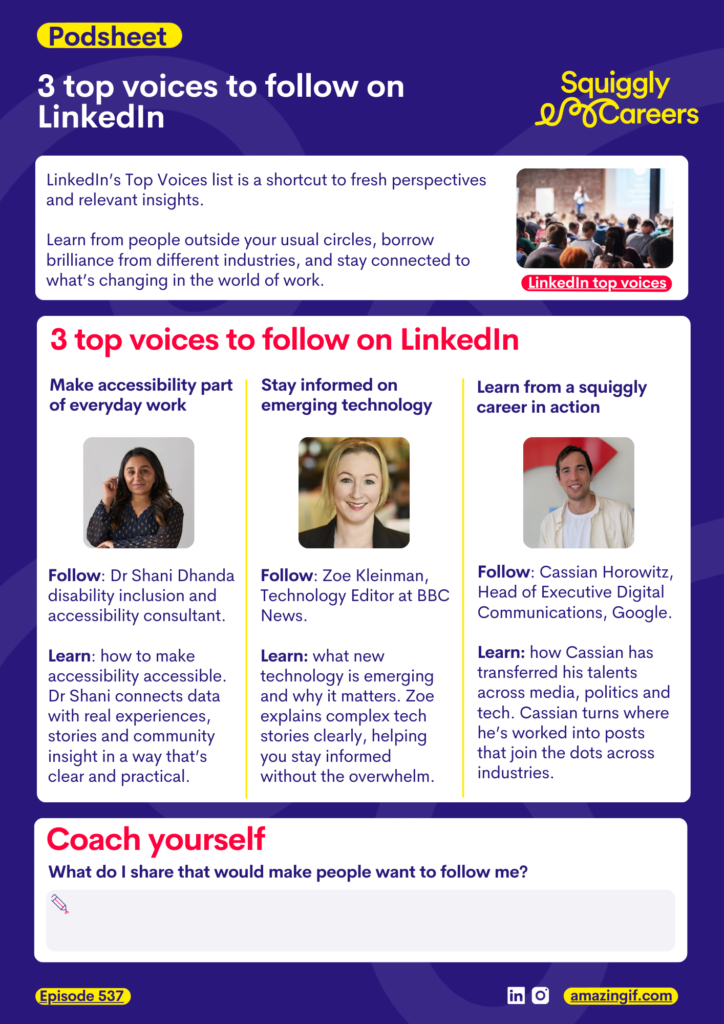
Helen Tupper: And so this week, Sarah sent me a WhatsApp over the weekend, actually, and said, have you seen that LinkedIn's latest top voices is out? Could it be a good one for us to borrow brilliance on? And I thought, oh, that could be useful. So if you're not familiar with what Top Voices are, it is a quarterly list that LinkedIn shares and they do it for loads of different markets, actually. But I looked at the UK Top Voices and it is people who are sharing things that feel, I guess, very relevant right now. It's like their. Their posts are interesting, insightful, connected to what's going on in the world. And as a list of people, it's a really good way to stay informed and I think connect with people beyond the people that you already know, because I think there's a bit of a risk of an echo chamber in just connecting with people that you already know. And I think looking at this list helps you to get beyond that and sort of learn outside of perhaps worlds that you might be working in at the moment.
Sarah Ellis: I was also reflecting on. Everybody talks about, like, the algorithm, you know, for like, whatever social platform you're on. And, you know, the algorithm means you don't always see what you want to see and it's hard to crack the algorithm. And I'm not sure I want to spend time trying to crack the algorithm, but I do wonder whether this is a way to at least influence the algorithm. So by following some of these people, you know, if you. You only have to, like, just to engage, engage with some of their content, I am sure. Or if I say I'm sure, I'm obviously not sure. I assume you might at least stand a better chance of, like, seeing more of their content and kind of maybe less of the content that you're not as interested in. And obviously LinkedIn is not the only way that you could, like, follow. Follow the work these people do. So actually, there's something we're going to talk about later today. I then actually independently then went and read a really long article about something on the Guardian because it had been mentioned by this person. So I don't think we're saying, you know, you must spend, like, more time on social platforms or this is just about LinkedIn. I think the bigger point here is we don't want to get stuck in a silo or be too kind of head down and keep hearing the same voices to Helen's echo chamber point. And I always think like new people bring like fresh perspectives, things you've not thought of before and they just open up your eyes. Right. It's just a really good way of borrowing brilliance. And this feels like quite an easy way to get started.
Helen Tupper: It also made me think, how am I showing up? So we've picked three people. I've picked three people.
Sarah Ellis: How am I showing up? Non existent.
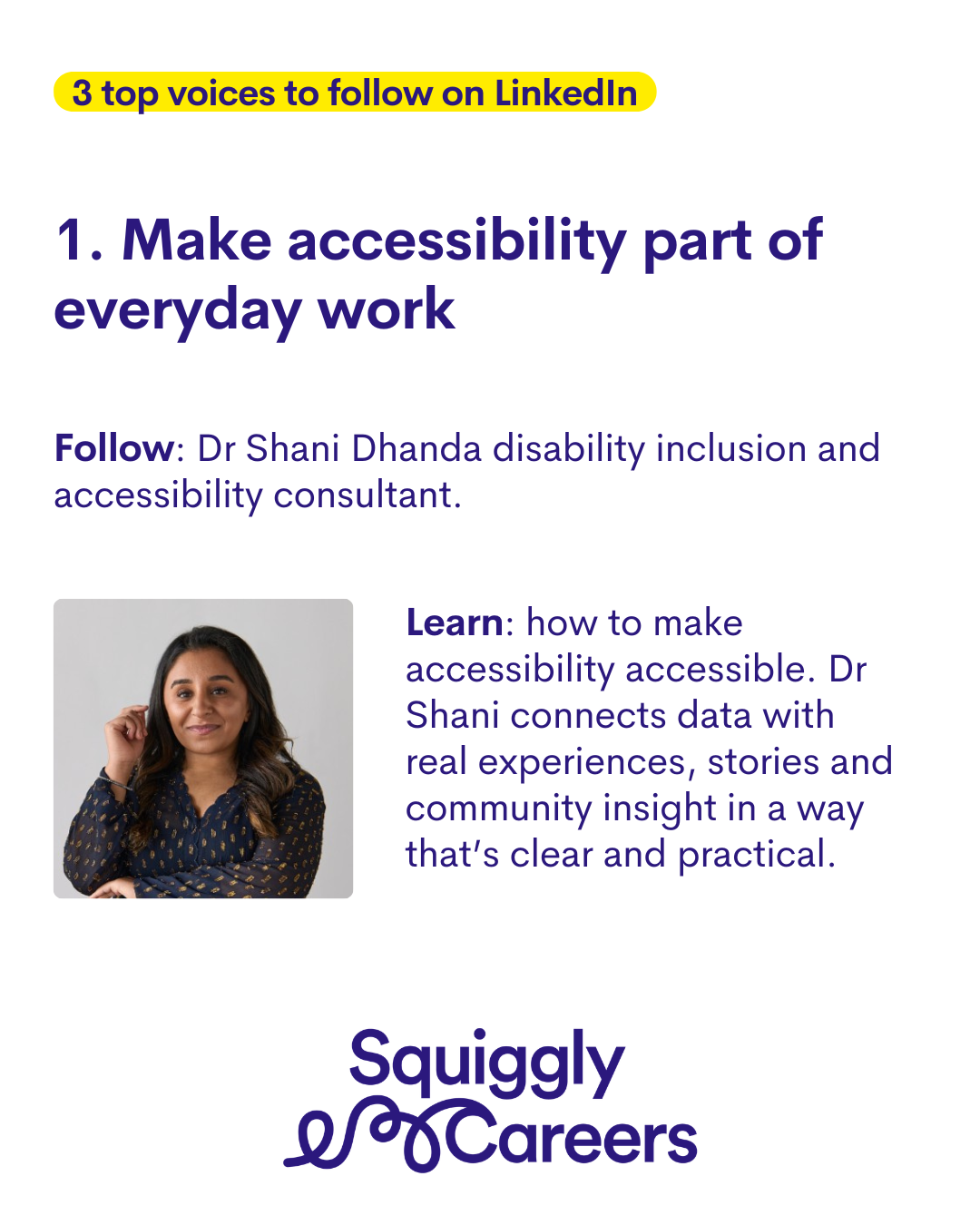
Helen Tupper: How am I showing up? So I went through the list and I thought, who are three people from this list that I think are really useful to follow in the context of your squiggly career? That I think that everybody who listens to this podcast would learn something useful from these people. And in diving into their profiles and looking at their posts, it, it really made me reflect on two, actually two specific things. One, it made me reflect on my like LinkedIn bio because there's someone I'll talk about in a minute who had a very good bio and I was like, oh, I should, I should make mine better. That's a really good example. And the other one was when I was looking at their posts, I really clicked on the posts that were useful and insightful. You know, people that were sharing insight and data and provocative questions. And it made me think, oh, if I was, you know, if I was looking at my LinkedIn profile for the first time, would, would that be what you would see in my post? Would you see an insight, a provocative question, something that you thought was worth spending time with me if you didn't know me? So I think yes, it's great to learn, but it's quite good to reflect. So we've got three people. I've gone through them and I've kind of picked out who the person is. And again, we'll put the longer list of all the people in the show notes if you want to kind of dive into the longer list. But these are three that I thought were useful for everybody who follows squiggly careers. So we've kind of got the person and what they do and then we've got kind of why follow them? What are you going to learn by following this person? So my first one is Dr. Shani Dhanda, who in her LinkedIn profile just describes herself as a multi award winning disability, inclusion and accessibility consultant. She got quite a lot of slashes. So she's also a broadcaster and an author and she was also voted the most influential disabled person in the UK in 2023. So did you. Was this one of people that you already followed?
Sarah Ellis: It was one of the people, yeah. Out of the three that you chose? This was. Yeah, two of the three I followed, but one. One was new to me because I
Helen Tupper: didn't follow any of these people until this list. So actually they're all sort of brand new to me. So how did you know about Dr. Shani's work?
Sarah Ellis: You remember, I think it was through our work with BBC and I think Shani does work. I think sometimes it's on the BBC or has worked kind of with the BBC because she does, like, broadcasts and interviews and those kind of things. And I think she came up with one of the BBC careers week that we've done in the past, where people recommended, like, her work to each other. And then obviously I just like, steal everybody's ideas,
Helen Tupper: borrow brilliance in all ways. And so why follow Shani? I think she makes accessibility accessible. So the way that she. What she shares and the way that she shares her thoughts, I think it makes it honestly, like, really easy to learn because I think sometimes you might
Sarah Ellis: fear, oh, I might get this wrong,
Helen Tupper: or I might not have the wrong facts, or I might know how to approach. How, how to approach this conversation at work. But I just feel like the way, the way that she writes, she kind of writes about, like policy updates, for example, or kind of insights from the community. In fact, she's created her own community. It's growing really fast on LinkedIn. It's called the Access to Work Collective. She created it last year and it's already got 6, 000 members. So I feel like she is, she's creating, she's having a conversation. That's what it feels like. She's having a conversation about accessibility that you can get involved in in lots, lots of different ways. One, I was going through a post and there was a stat in there that I thought, oh, gosh, that's something that I want to learn more about, was about the disability employment gap, which is now at nearly 30 percentage points. And it's the difference between how many disabled and non disabled people are in work, basically. And it's growing, it's not closing, so it's a, it's a worsening problem. But I just feel that the way she shares and what she's. You learn and you get insights about what you could do differently, but in a way that if there's. This is an area that you're starting, you know, quite from scratch. You just want to learn, you want to get involved. She just makes it very easy to do.
Sarah Ellis: Yeah, I had a read through some of her articles and, you know, she's. She's very good at using stats to tell stories and, you know, that's a skill I think lots of us, like, recognise is really useful. But I also like, because you know how much I enjoy copywriting and words generally. She. She's very concise and clear. So she has a sentence, actually, just after that stat that you. That you just shared, where she just finishes it by. By saying progress has stalled, full stop. And, you know, you just like it, but it leaves you in no doubt what that data is telling you. And, you know, sometimes you might get a bit confused or like, you say, you're newer to a subject and I just feel like she's very good at connecting the dots between the data that you need to know, using data to tell stories, but also just leaving you in no doubt. And I really like the clarity of her writing. So actually, just if you wanted to, as well as kind of learning about the topic, if you want to get better at writing, as Helen will tell you in a minute, her bio is also very, very good. She's clearly a very good writer.
Helen Tupper: Yeah, that was my. Yeah. When I was talking about kind of learning about people's profiles and how to write them better. Her profile is so good. Brilliant. It's so good. Please go and have a look at it, because I looked at this. She explains herself, then she talks about the results are clear. So she kind of has, here's what I do. This is what my expertise is in. The results of my work are clear. And then she has. She puts a quote from somebody else who's recommended in there and at the end she has some highlights. I was just. I looked at this and I was like, wow, you sound like you're doing really good work and you come across as really positive and you are the sort of person I want to influence my algorithm. Please, back to your point at the start.
Sarah Ellis: And it still felt like her. So I think that's always a tricky balance to get right. You know, you're trying to show up in a credible way. You know, the work that she does is serious. She's making a difference on an important topic. But equally, she manages to retain, like, warmth and personality. And I feel like she, you know, sometimes you feel like, did I write this now? When you read people's bios on LinkedIn, or sometimes people write them in third person, which I'm never 100% sure about, like writing about yourself in third person. But with hers, she sort of. There's an informality to it that makes it actually feel very believable whilst at the same time being incredibly impressive. And again, I think that's. I think that's hard to achieve. Yeah, I mean, I read it and then I was like, crikey, that. I feel like if hers is a nine out of ten, I was like, I feel like mine is a three, actually.
Helen Tupper: Yeah, I remember.
Sarah Ellis: I can't remember last time I did mine. I can't remember the last time I rewrote mine.
Helen Tupper: But, you know, you need some good examples. Don't you like people. I think she is a great example of someone who's got that. That profile. Right, so, yes, go and go and have a look and I'm going to update mine. Don't look at mine just yet, everybody, because I need to make it more like. More like Shani's. Okay, so our second person. I think this is another person that you followed.
Sarah Ellis: I did.
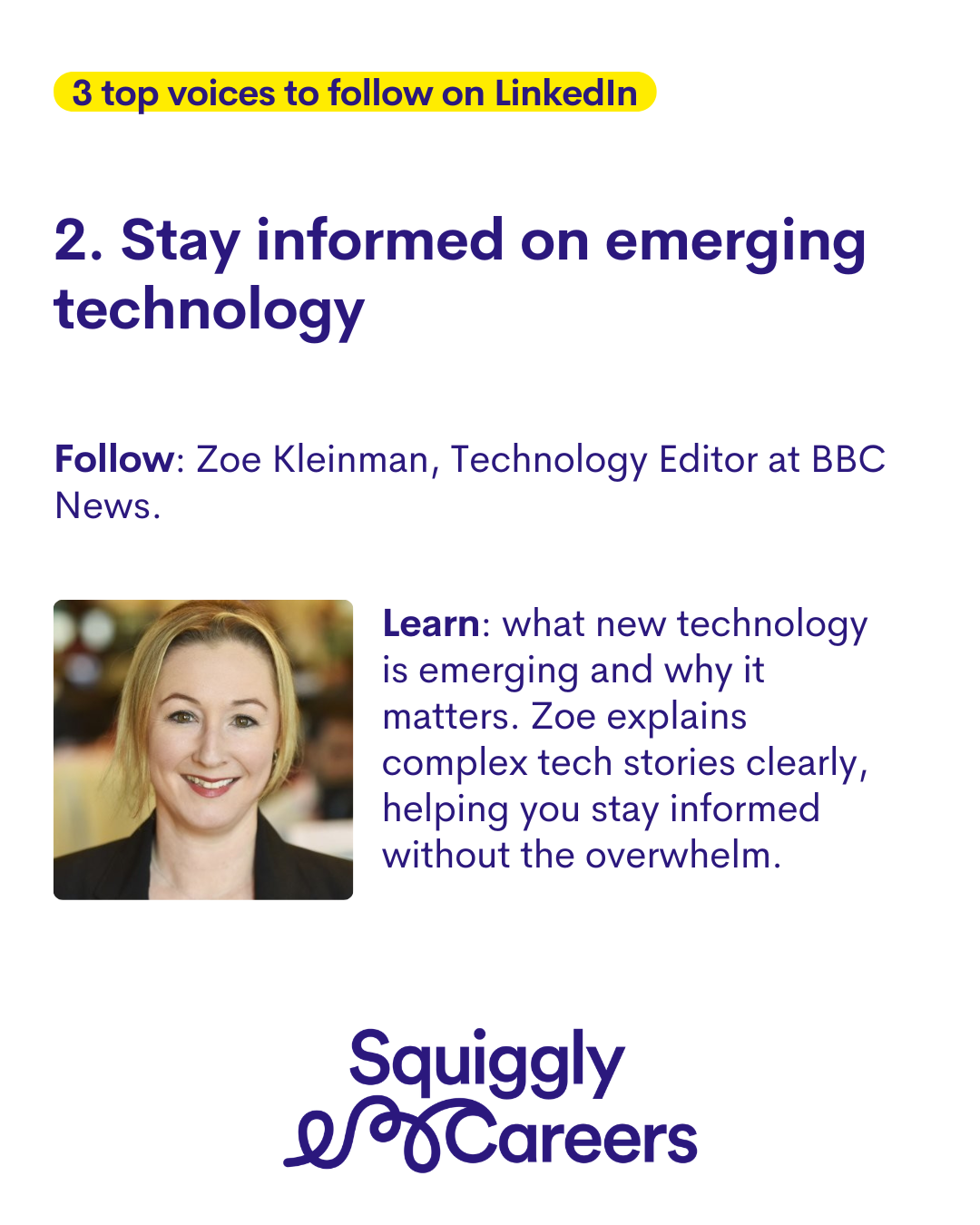
Helen Tupper: Because I saw you when I. When I screenshotted it, I was like, Sarah's there already. So this is Zoe Kleinman who works at BBC. It's interesting two people kind of with the sort of journalist background that I've picked out. But she is the technology editor on BBC News. And the reason I've picked her as somebody that I think is a really like, useful person to follow is she takes like complex text stories and she communicates them in a really useful way. And particularly she shares emerging tech that, you know, if you want to be. I think if you want to kind of just know what's going on, like what's all the hoo ha with grok and images or what's the latest tech that I can talk about in my team meeting. Like, if you quite like being on the pulse of that stuff and you're finding it hard to stay on top of it, I think Zoe has done the hard work for you. And by following her you will find out new, interesting tech. Straight away, I was learning about a new. A new social network for AI agents which I did not know about, called Malt Book. And then I also learned about, which I. I'd read about, but I think I'd lost it in my brain about that. Google's new, like, try it on tool, where it's AI and it can. You can like take an image of yourself and try on clothing and it'll put the Clothing on you, so you can see the clothing on you. But she shares all that stuff as well as insights about, you know, stats and data and research. So there's kind of. There's more serious implications of the tech as well. But she is really good for like, tech trends and new tech.
Sarah Ellis: Yeah, I think technology can feel for lots of people quite overwhelming or people just opt out. You know, they sort of go, oh, you know, like, you do hear the phrase, like, I'm not techie, I'm just not good with technology. And I think you hear it actually from people of all ages, from all backgrounds. Like, there's sort of this sense of like, oh, that's just like kind of not me or not for me. But I do think if you sort of start from that approach, it's. Then you are. Obviously you're going to limit your learning. But I understand why people kind of get a bit like, I don't really know where to start. And I think just following Zoe, you'd be so much better because of it. And this is actually the example where I saw actually someone else I know and Zoe had written about Malt book. And then I did go and read a Guardian article about it, which if I wasn't scared before, I was. I was more scared afterwards. But, you know, like, I, I want. I'd rather know, you know, like, ignorance is not always bliss, you know, when it comes to these things, I'm like, I. I'd rather be in the know. I want to see how people are using technology. It's very interesting to see how different people are framing kind of Malt book, which is essentially AI agents talking to each other. And as a human, you are only allowed to observe it. And I read the Guardian article, got so nervous about, like, what it can potentially do that I. I have built an AI agent, like a really, really basic one. But I don't dare put it in because. Because I'd read the article and then I was like, oh, no. But I would quite like to see what's happening. But I couldn't work out how to see the conversation without actually putting in my own AI agent, which I don't want to do. Have you tried it yet?
Helen Tupper: No, I haven't tried it. Well, I only read about it, like, literally, I only found out about it from following her preparing for this podcast. And then I went on and, yeah, no, I haven't spent time with it yet, but I, I think she's just a good, trusted voice in a world of tech. Like you say that can feel quite Overwhelming. I think she's just done a lot of the filtering. And by the way, in case people don't know when you. Whether it's the people that we've identified or just generally people who's in, like, posts you want to see more of or whose insights that you trust, there's like a little bell on people's profile. And if you. It's normally like if you go to that. So if you went to Sarah's page, for example, if you were like, I want to see everything that Sarah occasionally posts about squiggly careers, I mean, you're
Sarah Ellis: not going to be inundated. So it would be a real treat. Every so often.
Helen Tupper: There is a very occasional LinkedIn poster, but it. When she does it, I'm so proud
Sarah Ellis: of myself every time I do it.
Helen Tupper: But anyway, Sarah or someone else, you go to their profile and there's a little bell on the right side of their profile. And if you press that, it means that it will go to the top of your feed so that you won't. It's got a. It's like a double influence the algorithm. So you follow the person, you click the bell and then it. It kind of.
Sarah Ellis: Yeah, I didn't know that influences your feed.
Helen Tupper: There you go.
Sarah Ellis: Does everybody have a bow?
Helen Tupper: Yes, everyone has a bell. I think. Actually, I think I say that I hesitated.
Sarah Ellis: I'm gonna see if you've got a bell.
Helen Tupper: Oh, don't. Because my friend Anna messaged me.
Sarah Ellis: I can't find your bell. I'm going to do it now. Imagine if you don't have one. Will you be really upset?
Helen Tupper: I had to raise a request with LinkedIn about where's my bell?
Sarah Ellis: Did you come to my friend and
Helen Tupper: I was like, I can't find your bell.
Sarah Ellis: I mean, can you?
Helen Tupper: Oh, no.
Sarah Ellis: Have I got a bell?
Helen Tupper: Have I got a bell?
Sarah Ellis: Yes, you have. Next to the bell.
Helen Tupper: And there we go.
Sarah Ellis: Right.
Helen Tupper: Let me click it. I mean, you don't need to click the bell. You get enough of me. You don't need to click the bell.
Sarah Ellis: Oh, okay, let's have a look.
Helen Tupper: Sarah is live testing.
Sarah Ellis: I've saved it. And now you've got a double bell.
Helen Tupper: Yeah, there you go.
Sarah Ellis: Because I'm now. Because I'm now doing that.
Helen Tupper: Now you get me on LinkedIn as well as WhatsApp and Teams.
Sarah Ellis: I probably paused for a second because I was like, don't start. You know, you know how I feel about notifications. Because initially it was like there was a sense that I might get some notifications. I was like, I don't want to get notifications about LinkedIn posts me.
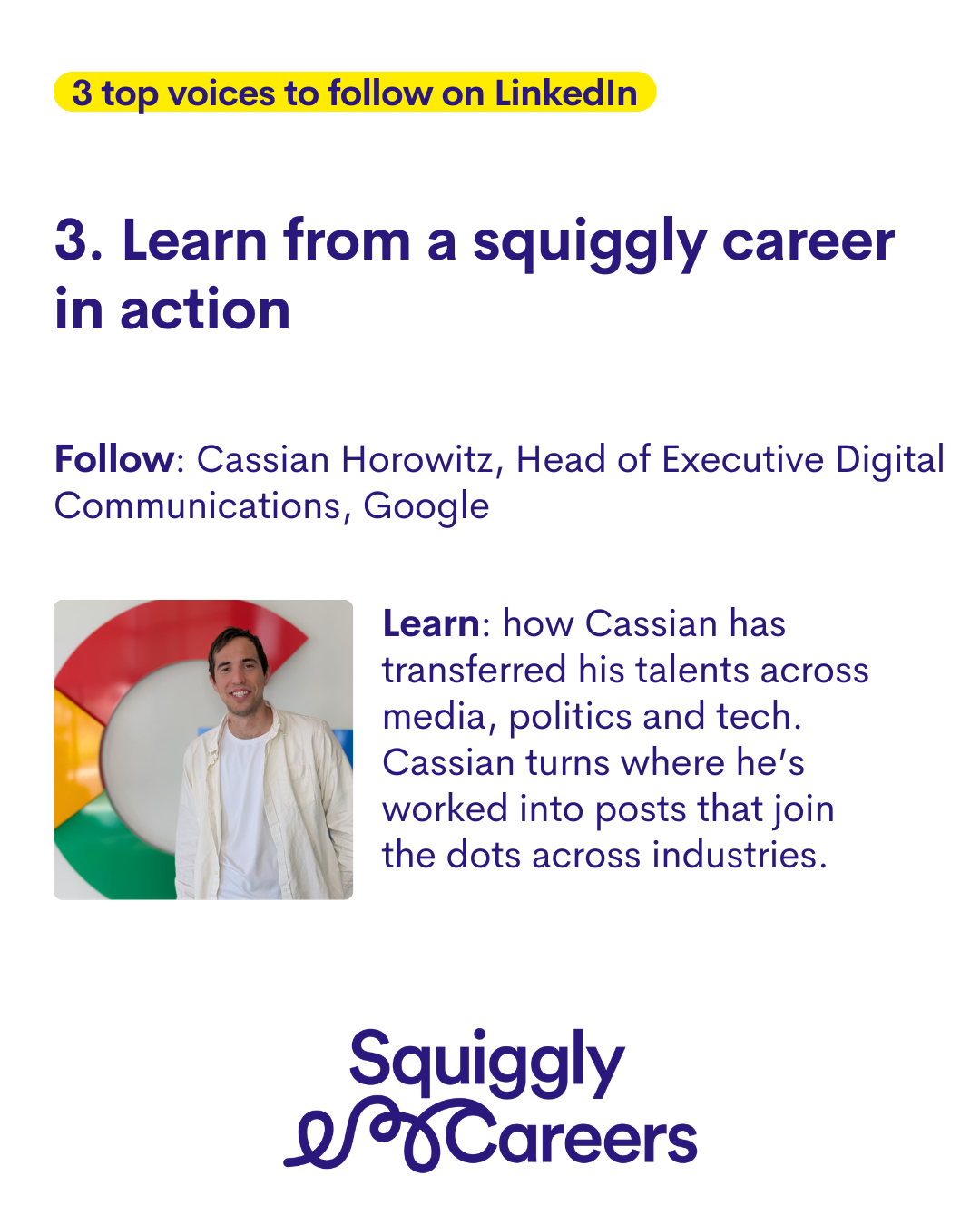
Helen Tupper: So anyway, everyone there, you can see how easy it was. And so not only can you influence your algorithm by who you follow, you can doubly do it by clicking. Clicking the bell. Clicking the bell. So yeah, that was Zoe. And then the, the last person I think was new to you and yeah, all new to me. So the third person that I wanted to kind of recommend was Cassian Horowitz, who is now the head of Executive Digital Communications at Google. But that's probably not why I would say follow him, though he does, he does share some interesting insights about like Google search trends. But the reason I would say follow Cassian is because of his squiggly career, which I think he presents very well in what he shares. So I will. This is from his LinkedIn bio. I'll just read it because it's interesting. My journey hasn't been a straight line. I started in the newsrooms, BBC and itv. Then I co founded a creative agency. Then I joined Rishi Sunak as a special advisor and then I became head of strategic communications at Digital and Digital and number 10. Now I'm based in California and I leave executive digital communications at Google. So he's just done so many different things in like the, in politics and the private sector things. Really interesting. And it's. He's. I think he's a really good example of somebody who is transferring their talents in their squiggly career rather than just moving from a more senior to a more senior title.
Sarah Ellis: I also love his not so humble brag on LinkedIn. He's got, you know, the photo that sits behind your circle photo.
Helen Tupper: Yeah.
Sarah Ellis: And he's like meeting Barack Obama and I'm just like, well, you know, if you were left in any doubt that he, I don't know, has friends in high places. Also, this is like true, true story. The second time in like two work days, a Friday and a Monday where someone I've talked to or we've been talking about knows Barack Obama. So I was interviewing the CEO of TED for the podcast. And I was like, how has this come up twice in like two days? Yeah, because the CEO of TED used to work for Barack Obama, like his foundation. So like worked for him for like 18 months.
Helen Tupper: Borrowed brilliance from Barack.
Sarah Ellis: Just. Can you. Oh my God, that sounds great.
Helen Tupper: Oh my gosh. Could someone. Can someone make the introduction?
Sarah Ellis: Maybe Cassian can, Maybe Cassian can.
Helen Tupper: Who knows? Cassian can. That could be his new thing.
Sarah Ellis: I mean, he should definitely be using that.
Helen Tupper: If he's not, Cassian can. If anyone can, Cassian can.
Sarah Ellis: I feel like also that's really not his vibe. Having read some of those, I don't think so.
Helen Tupper: No. What is his vibe is what he says you should follow him for a look at how tech, media and politics are converging to change our world. So this is why I think he's a really interesting follow because what he's done is he's taken all those different places that he's worked and then he sort of turns that into what he posts about. So of the three people, I think what he shares is the most thought provoking. I was. It's not provocative as in, I don't think he shares like really like challenging things that's going to encourage people to disagree with him. He's not kind of that kind of a poster, but it's thought provoking and it made like little things that he, he shared were about, for example, the BBC going YouTube first they're creating bespoke content for the platform. So just how traditional media is now changing onto new platforms I thought was quite interesting. And then he talked about prime ministers launching podcasts because politicians are using social media. I mean, Trump will be examples of this, right? Like, but to get to a lot closer, directly close to their audience and what, what are the implications of them being so unfiltered? Again, it just makes you. He sort of shares things based on fact that then make you think probably more than the other people with, with Shani and Zoe, I want to steal their stuff and I want to share it quite quickly. I want to steal Shani's stats so that we can drive change and I want to steal Zoe's tech so it makes me look smart. But Cassian, I'm like, you make me think about the impact of some of the changes that are happening and politics and in media and what that might mean.
Sarah Ellis: Well, he's also, he's probably making more suggestions or sort of sharing ideas. Like you say it's not like super provocative, but he is sort of going, oh, what would happen if a Prime Minister started a podcast? And actually then he sort of points to a few different places where it definitely made me think that's probably going to happen because you can see how that would be really useful. And actually some of his competitors are already doing those kind of things. And there's a challenge, isn't there, with like, how do you make politicians, like, warmer and more connected to people? And that's, you can have a Very different kind of conversation. So it doesn't feel a million miles off from something that could happen. And like you said, you were telling me beforehand when we were preparing, because he does work at Google, he has some interesting insights into what people are searching for, which is obviously always fascinating. Yeah, I know.
Helen Tupper: Isn't that weird how we always.
Sarah Ellis: It's like you get a little bit nosy, isn't it?
Helen Tupper: Yeah. He said that. Yeah, because he posted some data about Google search in 2025, which again, you can look at, there's like a Google report so you can find it. But the bits that I wrote and the insight was that people are using Google's AI search more like they would talk to a friend. So the con, the questions they're asking are just quite a changing over time. So for example, tell me about. So searches that start with tell me about were up 70%. He said there's also what's the deal with. As a start for a search prompt has hit an all time high and how do I, how do I. 25% increase? So rather than more tactically, people would search for, I don't know, the name of a product or something in the old form, just using AI. Much more, much more. As you would speak to a friend as a learning source, I suppose.
Sarah Ellis: And even that final stat, he said that 15% of Google searches every day are completely new. And I'm like, how is that possible? You know, I don't know that that was higher than I thought it would be because I was like, surely I don't know. In careers it's how do I ask for a pay rise? How do I do a brilliant job of this interview? You know, like I imagine I thought it would be a lot of sameness and quite a low percentage of when like completely new. I was like, oh, that's, that's fascinating.
Helen Tupper: Yeah.
Sarah Ellis: I also wondered whether some. That point about people treating search more conversationally, is that because of GPTs, you know, because the way that people are having conversations now with GPT, you then go, well, if I'm going into Google, I'm just getting used to asking in a different way and like writing in a more conversational way. And you know, like with GPTs, they definitely like pretend to be your friend. Yeah. So I think it encourages you to be more informal.
Helen Tupper: Well, it helps me honestly, like reading his stuff. I end up connecting the dots, which is what curiosity is about because I was at a presentation a week and a bit ago and it was talking about advertising and obviously traditional Google search. Like there's ads all over and you get your sponsored links, don't you, that go towards the top. But now what they're doing is they're obviously looking to get advertising within more of like the AI based search. Because at the moment, if you think about how you interact with it, you don't really get that sense of advertising as much. And so there's lots of lost ad revenue. So we're going to see that more in. But that was my point, I guess in engaging with his content. It's fired lots of light bulbs and things in my brain, which I think is, which is a useful thing. That's, that's what you want to do, right. When you're getting new insight from people.
Sarah Ellis: I didn't believe the two of the fastest growing jobs in the uk, you know, he said that they are strategic advisor and founder. I was like, I've got a lot more questions about that.
Helen Tupper: I just, I just can't believe it's LinkedIn data. I think it might be LinkedIn data. I'll show you that, I'll find the link for you. But they, because they, they do that, I think every year. I think they do their report on the fastest growing jobs in the UK,
Sarah Ellis: like the top 10, I suppose, you know, like it's the way you cut data. Maybe it's just, it's still not, it's not the job, it's not about the number of jobs, is it? It's just that it's had a big increase.
Helen Tupper: Yes.
Sarah Ellis: So I guess exactly that maybe, I mean, you could argue, I guess with things like founder maybe because the job market is more turbulent and there's more change and uncertainty, more people are doing their own thing because like maybe circumstances
Helen Tupper: or no, like younger generations as well, there is a greater desire to be founder, I think, because I did scan through, I did scan through the data.
Sarah Ellis: But financially it's really interesting. Right, because you're like, well, how do you afford to do that? You know, when you're. I actually did, I talked to someone actually last week who is doing something in careers and he's. Yeah. Come out of university, studied music at university and then basically thought he wanted to do one thing, didn't enjoy it and is actually now creating an AI to help you with your career. And I was like. So I suppose he would describe himself as like a founder. I also met someone over the weekend who talk. So maybe this is true because I can literally give two examples. Someone over the weekend who, during COVID they couldn't find anyone to look after their dog, like, they were looking for a dog sitter for, like the day and obviously I was going to see them for our puppy and then they decided, him and his partner decided to do that full time and, like, set up their own company and. And you, like, they. They're like professional dog sitters. So, like, you go around to the house and it's all like, super organised for dogs. It's incredible. But it's really embarrassing because my dog then literally took a running leap at. They've got like a child gate to stop dogs getting into where the food is. Not my dog, because my dog just hurdled it. And I was like, oh, my God, they're never going to look after him. But they were, they were, like, doing jobs before.
Helen Tupper: Don't scare me with your dog stories.
Sarah Ellis: because I know, I know. There's a dog coming.
Helen Tupper: There's a dog coming. Not just yet. So we hope that's been useful for you. Obviously, it's kind of a bit of a different way of borrowing brilliance, but I do think this, this format kind of gives us licence to learn from lots of different people, lots of different places to help you learn too. So we will put the links to Shani and Zoe and Cassian, we'll put their links in the show notes and also the link to the full list of people, because there are lots of people on there that might be useful for your learning. We just chose the three that we thought would have the broadest appeal to everyone who listens to our podcast.
Sarah Ellis: If you have any ideas or you spot something you think would be really interesting for us to borrow brilliance from, you can always email us. We're Helenandsarah@squigglycareers.com but that's everything for this week. Thank you so much for listening. I'm back with you again soon. Bye for now. Thanks, everyone.
Helen Tupper: Bye.
Sign up to the Squiggly Careers Newsletter and get our latest ideas, tools and inspiration every week - all in one place, straight to your inbox