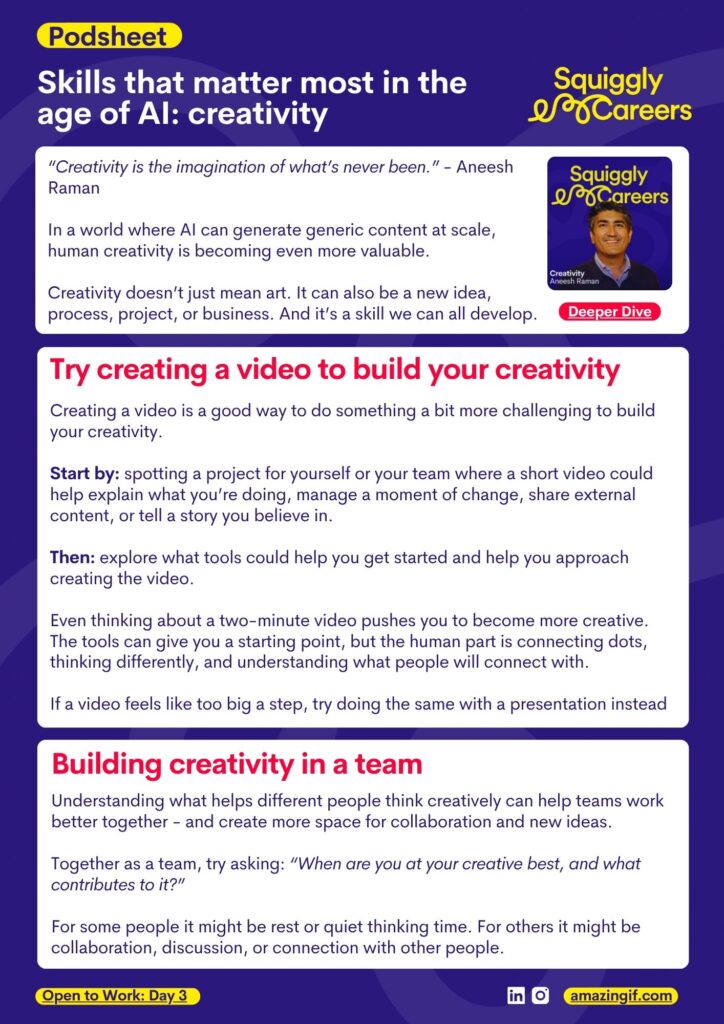
Creativity isn’t a talent some people have and others don’t, it’s a skill. In day three of this special five-part series, Helen and Aneesh Rahman explore the third C, creativity, and why it’s becoming one of the highest-value human skills in an age when AI can generate generic content at scale.
From Pixar’s science of storytelling to the neuroscience of flow, this is a conversation that will change how you think about your own creativity, and how to bring more of it to your team.
🎯 What You’ll Learn
– Why AI making generic creative content widely available actually raises the premium on human creativity
– What the neuroscience of flow tells us about when we’re at our creative best (and what gets in the way)
– Why creativity is a team sport, and what that means for how you design your working week
– A simple question to ask in your team: when are you at your creative best and what contributes to it?
– One practical thing anyone can do right now to build their creative muscle, even if they don’t feel creative at all
📚 Resources Mentioned
Open to Work – Aneesh Rahman and Ryan Roslansky
For questions about Squiggly Careers or to share feedback, please email: helenandsarah@squigglycareers.com
Need some more squiggly career support?
1. Download our free careers tools
2. Sign up for our Squiggly Careers Learn Like a Lobster Skills Sprint
3. Sign up to the for Squiggly Careers Newsletter, a weekly summary of the latest squiggly career tools
4. Order our new book Learn Like a Lobster
Helen Tupper: Aneesh. Welcome to the Squiggly Careers Podcast. We're on day three of our series on Open to Work. So so far, let's do a recap. We've covered curiosity, we've covered courage, and today we are going to focus on the skill of creativity. And I feel like people are already bought into this. People love creativity, so why does this make the five capabilities that are going to help people stay ahead in the age of AI. Tell us a bit more about creativity.
Aneesh Raman: Yeah, there are a few reasons. I love creativity, I love all the five Cs, but this one in for a few reasons. First, creativity is, to me, the imagination of what's never been. As we think about AI and a lot of the fear of AI and its ability to do things like write really quickly or create videos really quickly, to do a lot of the technical, analytic tasks, creativity has been under duress. You look to the creative professionals who are justifiably, really afraid of how this tool is going to replace them. But AI is going to just make generically creative content widely, universally available, and the human bit of creativity then becomes an even higher premium. But at the end of the day, innovation and entrepreneurialism, which is our best articulation of what work becomes for us all, is a creative endeavour. I mean, it is the ability to imagine something that's never been at a small level, a process that company hasn't had before, a job that's never existed before, a career that's never existed before, but also a business that's never existed before, an industry that's never existed before, a societally organising entity like the nation state or the monetary order that's never existed before. That's all creative art. And so I love creativity in part because it really bucks a lot of assumptions about what AI can do and reminds us about how core creativity has been to what we can do. The other reason I love creativity is while it's more in the mainstream, it's still largely seen as a talent. People think some people are creative and some people aren't. And if I'm not creative, that's just not who I am. Creativity is a skill. I mean, just all of these five Cs are skills that you can get better at, no matter who you are, through deliberate daily practise. But creativity is the one I like to demystify the most because it is, for so many of us, the most representative of a talent that some people have and that others don't. And if you do the work every day with these tools that help you be more creative, you get more creative. And so that's another reason I really love creativity.
Helen Tupper: So I have a bit of a personal reflection on this with creativity, because I do definitely think that everyone can be creative and it's not just confined to a role, but I feel like I have ebbs and flows of creativity. I'd love my creativity to be more consistent, but sometimes I'm just a bit tired and then when I'm tired, I default to doing the same things and I spend time in my inbox and all that kind of stuff. And I wondered if I could go from tired to inspired more often. I think I would be more consistently creative.
Aneesh Raman: I mean, one of the big things that was revealed to Ryan and I as we thought about this book is the differential between how much funding and focus is on artificial intelligence and how much funding and focus is on human intelligence. Hundreds of billions of dollars are going into the better understanding of and the building of artificial intelligence. Hundreds of millions are going across states, like across the sectors in the US alone. Let's say for neuroscience now, where there is happening, creativity is actually at the centre of it. We're in a hockey stick moment right now for neuroscience research on creativity. One of the books we talk about in our book is Peak by Anders Ericsson. Flow is another book that talks about the neuroscience of creativity. What we know about the brain is that at our best, when we are most creative, we are in a state of flow where we are almost removed from the process. Our brain is just connecting dots and finding things in the universe and coming up with new ideas and people in sports that are coming up with new moves. It's a state of flow where you're not tired or energised or exhausted or enthralled. You're just there as part of it. To get to that state of flow, you need to be well rested, you need to have time and space to think creatively by going on hikes, by doing nothing as a productive endeavour. And so I think this is going to be a real key question, not just for individuals, but organisations, because I think curiosity is the C that matters most for us as individuals. Creativity is the C that matters most for organisations, because creativity is what's going to get to innovation. And the only people that have really thought about it at the company level, I think, or that I've seen is Pixar. So Pixar movie studio, they brought a science to storytelling. How do you create these movies like Toy Story? That's on number five now. I mean, Just all of these juggernauts of storytelling. They had to build their company around creativity. And so there's a book, Creativity Inc, by their founders. And how do you build a headquarters that inspires creativity? Oh, you want to put the bathrooms in these areas where people have to walk by each other and have serendipitous, like interactions. You want to celebrate failure, you have to be willing to start over. But in a safe environment, you've got to give people space to re energise and to get into that state of flow. So I think as work index is more on the mind, not the machine. Oh, my gosh. There's going to be so much that we've got to rebuild around the mind to make the mind do what it does best, including be creative.
Helen Tupper: I love that. I love that also, just the more broader. So it's not like I can just read a book and use a tool. I have to think about my brain and how it works. I was also, when you were talking, I was thinking, what questions could people ask in teams? You know, if you're having a team conversation about creativity and maybe a question could be, when are you at your creative best and what contributes to it? Because if we knew a bit more about. So first of all, you recognise that it's individual. Your creative best might be different to my creative best. And maybe for me it's rest helps and maybe for you it's connection with other people. But knowing that in a team might help us to have a more creative culture, like collectively, so it's not just an individual thing.
Aneesh Raman: So first of all, you can't have a calendar for everyone. That is creativity all day, every day. The brain just can't do that. So there's a balance between what is a creative moment where we're going to brainstorm, or a creative project or task that you're going to do. This book, crazy creative. I can't do another crazy creative task right now. I've got to actually sit and process and reset a bit. So where you have a team, how are you distributing the creative work in ways that give people time to recover after a creative sprint or to get energised about what they're going to bring to the next creative sprint? That starts with the individual and how you manage the tasks across the team. But as we talk about in the book, creativity is a team sport. I mean, we talk about Da Vinci and Einstein as these two individuals who are completely creative in what they did and how, first of all, they had patrons, they had the time and space to fumble through unanswerable questions for a bit or to try and fail at something that they were gonna create, whether it was a painting or a new theory in the scientific community, but they did it with others all the time. It is really hard, if not impossible to do anything big alone. And that's part of what we're pushing up against. This idea that AI agents are going to do so much that you could just have individuals with agents doing big things, fine. But I'd put up that individual against a team of humans with AI agents and they'll do bigger things. Because where we're creative, together we're better.
Helen Tupper: Yeah, okay. So I love that because I really like teams to take this back. I think it's how we change culture when that happens, rather than just expecting individuals to do it. But there are individuals listening to this and they might not be in a team. So for them, if they're thinking, I do want to be more creative, maybe I just don't feel very creative at the moment, what would your advice be for them? What's an action you think they could take?
Aneesh Raman: You know, the most interesting arena of like anyone can do it and anyone can be creative. I think right now is creating a video. There's so many tools now. Cause it sounds so intimidating, this creative art of like creating a video. And it also sounds so urgent and necessary because you gotta do it for TikTok or LinkedIn or for any platform. I, I was actually, God, I'm travelling so much. I think I was in San Francisco, but I was somewhere where there was billboards from an AI video company that was like all the fear about I gotta be able to do a video, I gotta be able to do a video. And they're like, yeah, it's actually pretty easy. Like our tool will help you. There's so many tools out there. There's so many places you can use a video that you create to build your brand or to come in and present something at a team. So I think video is like this interesting place. So if you start with what's a project I'm doing for myself or for my team, where video would help either as part of how we're going to explain what we're going to do as content that we're going to push out. Okay, now what are the tools that I can use? And you just got to use the tools to tell you or look around and then how do I go shoot this video? And the minute you start thinking about even a two-minute video, you just necessarily get kind of creative and the tools can help you. Like, how would I start it? How would I not? I don't like that. I like that because, again, it'll make universal generic, so it gives you the starter kit, but then you'll find yourself connecting dots and thinking about things in different ways. And then ultimately, what's amazing about creativity is that to be creative in a way that works, it has to land with other humans. Like, AI is not human. We write about communication as one of the five C's, and I will get to it. But part of what we say there is like, to write the book we wrote, you had to know humans. You have to be human because it's about managing this moment of change. Telling a story that you'll believe in creativity is similar. You're seeing this conversation around taste emerge. Taste is this real differentiator that even people in creative jobs are saying will hold them firm in their jobs. Because taste is something indescribable, it's something unmeasurable. It's just like, am I doing something that I think the people watching this are going to like? You'll know that as a human doing this video, in terms of who you're trying to show this to. So you'll also realise not just, oh, I can be creative, here's a specific thing, but in the way that I'm being creative, that's a uniquely human thing, because I've got to think about whether this is going to land. So I think video is just like this interesting arena. Writing is another one. I think that storytelling is becoming this IT skill. You've got to creative about how you're going to present in meetings, how you're going to talk about yourself, talk about the work. So even if you don't want to do the clunkiness that comes with videos, just try and write a post, a blog entry, a presentation that you want to give, a speech you want to give, and use the tools to do that too, and be creative.
Helen Tupper: I remember I was just thinking about one of my favourite presentations that someone on my team did, a lady called Danielle, she works in finance. Those presentations are not always the most creative presentations, a lot of numbers. But Danielle did the most creative finance presentation I've ever seen and still remember it. I remember it. It was the best presentation.
Aneesh Raman: I mean, so think of that. So anyone, like, pick a presentation you've got in the next week, be creative and you can become a presentation that
Helen Tupper: people are thinking about years later and people remember the numbers, which, to your point, that was the thing we cared about. Okay, brilliant. Thank you so much for that. I really like just thinking about. I love the team context. I love the individual thing. I think it's a really practical, like write something, get video. Just do always get a bit hands on with creativity in whatever context you're working in. Brilliant. Thank you. So we're coming back for day four where we're going to talk about compassion conversation. I'm very much looking forward to it.
Sign up to the Squiggly Careers Newsletter and get our latest ideas, tools and inspiration every week - all in one place, straight to your inbox