Ever wondered what sets high-performing ‘super teams’ apart from those that are stalling? It’s not just about talent, but a shared belief in your collective ability to learn, adapt, and succeed together.
In this episode, Helen and Sarah borrow brilliance from a feeling and dive deep into one of the most relevant topics in work and careers right now.
Drawing on the latest research into high-performing team dynamics and Helen and Sarah’s own team-building frameworks, they explore how every team member can influence performance, and what your default response to collaboration reveals about you.
🎯 What You’ll Learn
– Understand the critical difference between a super team and a stalling team
– Learn why collective belief is one of the strongest predictors of real-world performance
– Design simple, low-risk experiments to build on what your team already does well
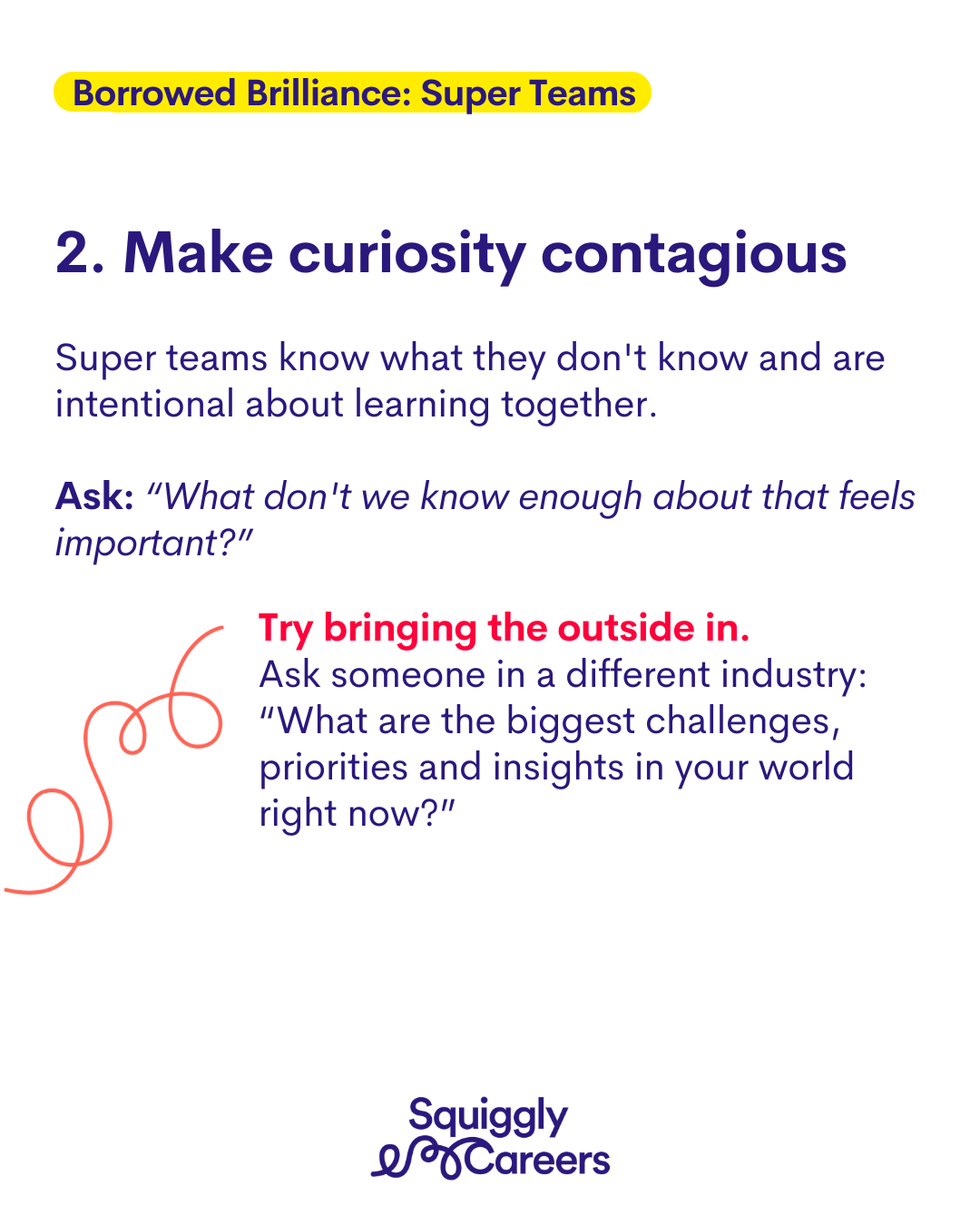
– Make curiosity contagious by identifying and filling your collective knowledge gaps
– Bring the outside in to swap ideas and accelerate your team’s adaptation in an AI-driven world
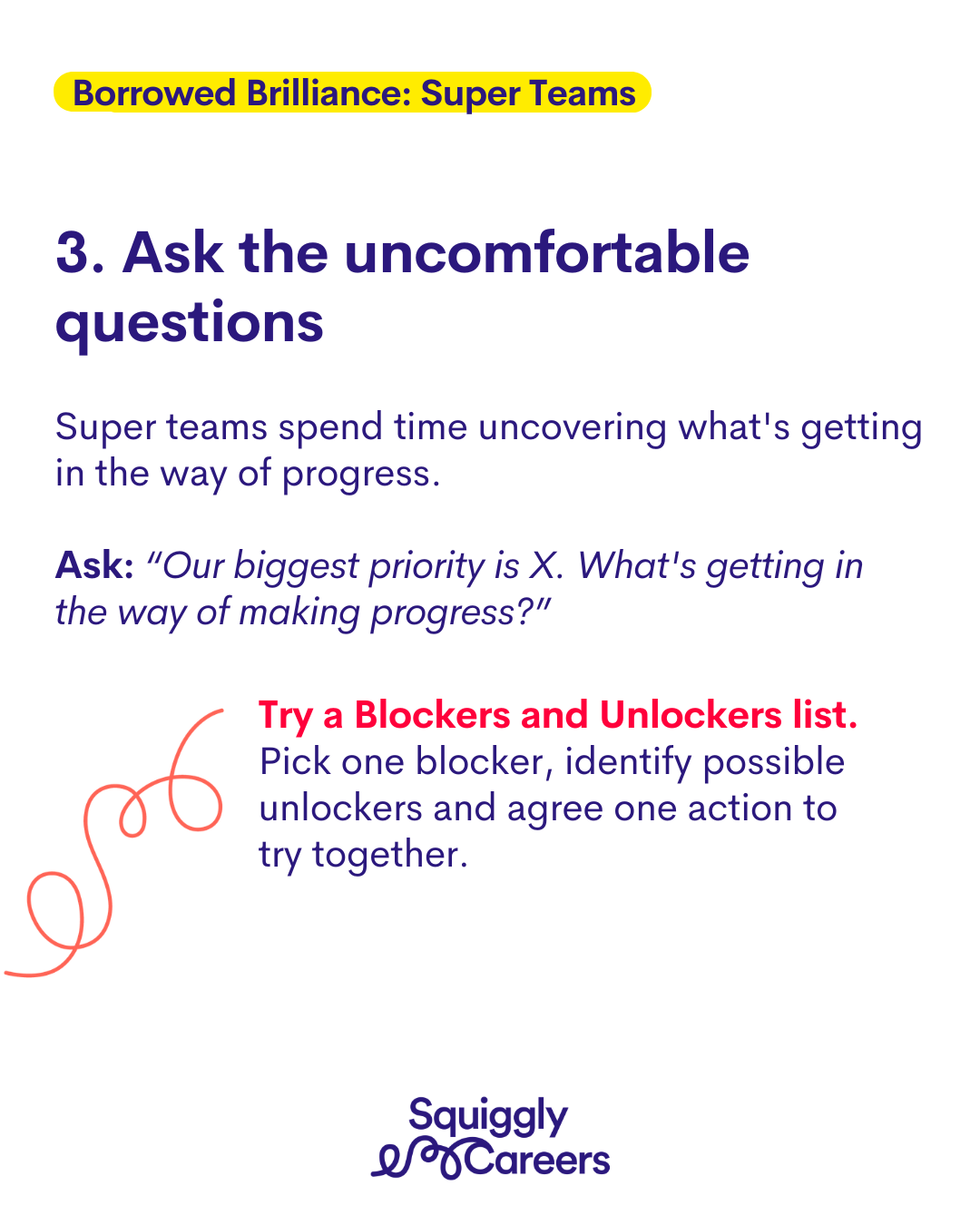
– Ask uncomfortable questions to uncover and remove the barriers getting in the way of progress
📚 Resources Mentioned
How to Build a Superteam That Keeps Getting Better. Seven research-backed practices. by Ron Friedman
For questions about Squiggly Careers or to share feedback, please email: helenandsarah@squigglycareers.com
Need some more squiggly career support?
1. Download our free careers tools
2. Sign up for our Squiggly Careers Skills Sprint
3. Sign up for the Squiggly Careers Newsletter, a weekly summary of the latest squiggly career tools
4. Order our new book, Learn Like a Lobster.
00:00: Borrowing Brilliance from Ron Friedman
07:55: Building super teams feels more important than ever because super teams can respond to change
10:19: What's one thing you're good at as a team?
14:36: Making curiosity contagious in super teams
21:19: Asking the uncomfortable questions
31:11: What are two strengths that you see being useful across your team?
34:18: Make feedback feel like support.
38:16: Super teams support side projects strength, stretching and development
43:17: What metrics getting in the way or distracting your team from making progress?
47:11: Closing remarks
Helen Tupper: Hi, I'm Helen.
Sarah Ellis: And I'm Sarah.
Helen Tupper: And this is the Squiggly Careers Podcast, a weekly podcast where we borrow some brilliance from things we've been reading, watching, listening to, just discovering in the world. And we try and connect that to your work so that we have some new insights and ideas to help us improve in our careers. And today's episode is another one that we are proud to be doing in partnership with Post-it Notes. So we have taken Post-it Notes and incorporated them into what we're going to be talking about today to make it super, super practical and easy for you to apply.
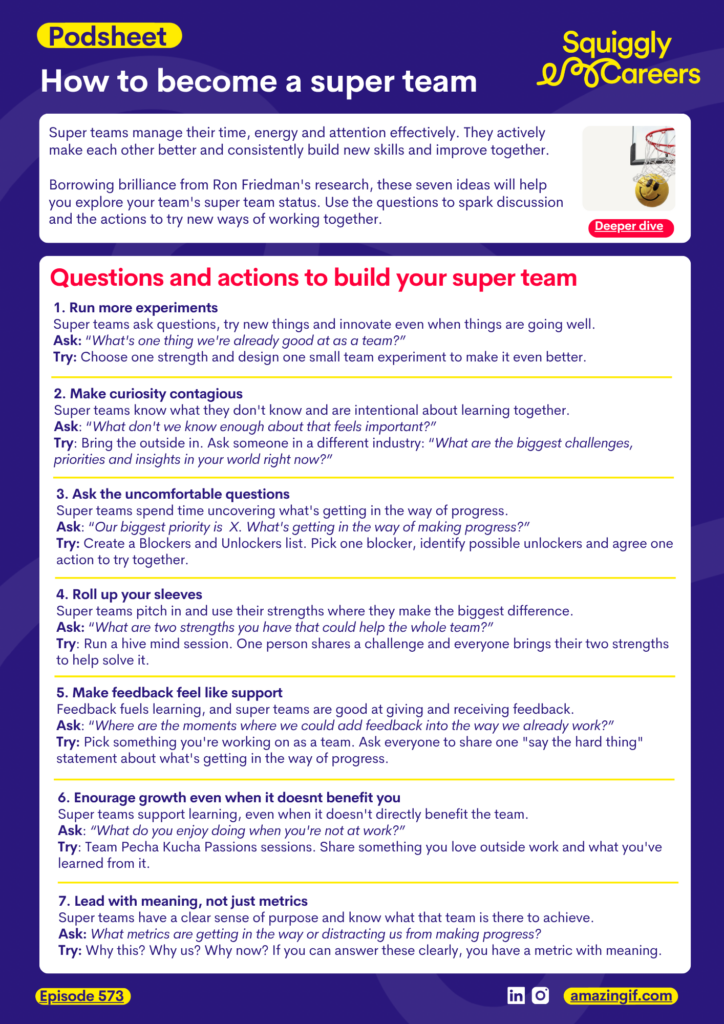
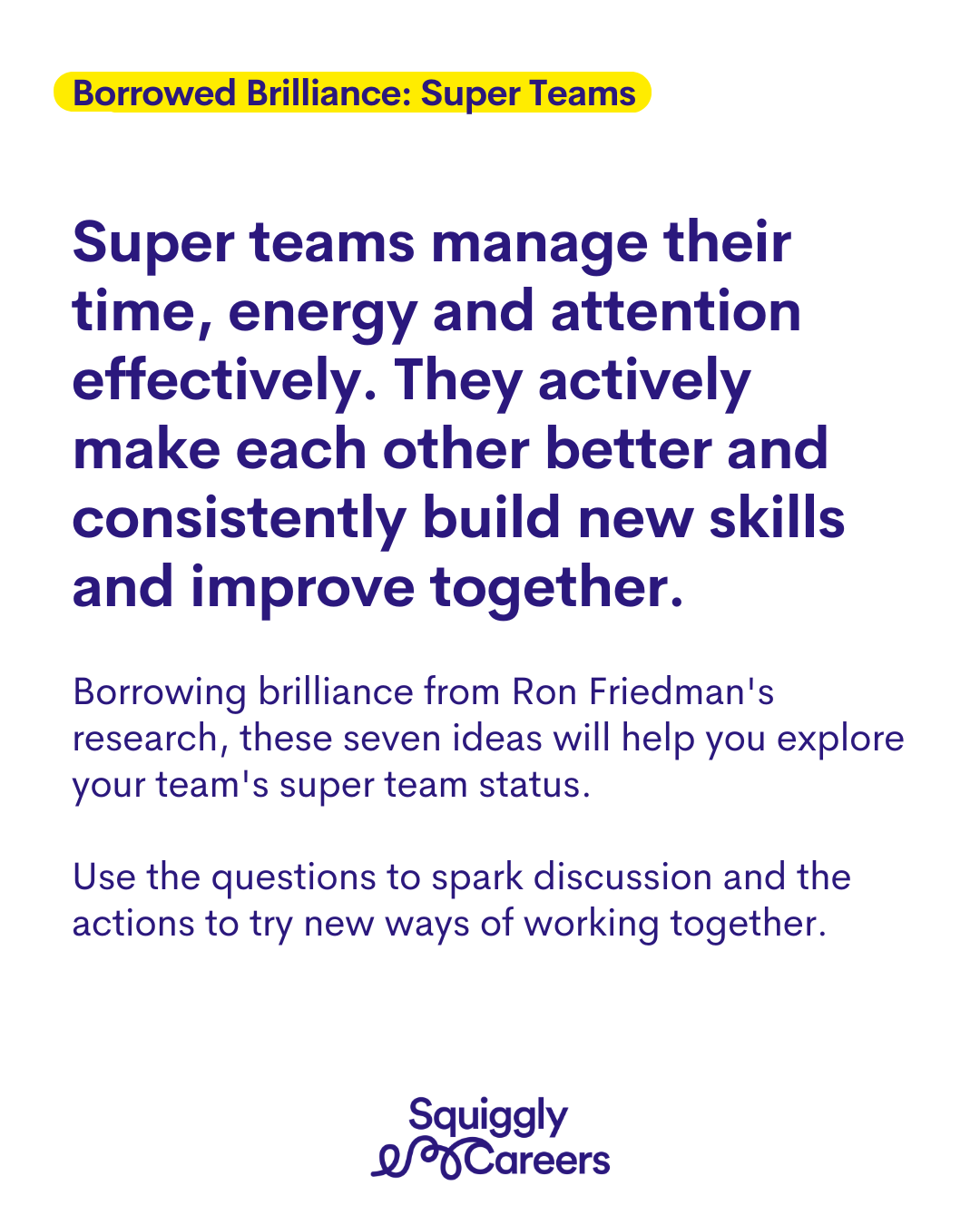
Sarah Ellis: And I think this one, given the topic, is one to do together as a team. Because we are borrowing brilliance from an article by Ron Friedman, which is called how to Build a Super Team that Keeps Getting Better, which is featured in Harvard Business Review. If you go on HBR website, you can usually get, I think it's three articles for free, so hopefully you'll have the chance to read it. But even if you don't, we're going to summarise it. Today we're gonna talk a bit about what a super team is and why we want to be in one. What's the. What's better because you're in a super team. And then there are these seven features that Ron Friedman found in his research. And so for each feature, we're going to describe a question that you could ask each other and then an action that you could take together to again try and make this very practical.
Helen Tupper: Remember Sarah got really excited cause you read this first.
Sarah Ellis: I did, yeah.
Helen Tupper: And then I think on WhatsApp you were like this article. I think you screenshotted the pages. Are we allowed to do that?
Sarah Ellis: I don't know. Sure.
Helen Tupper: Maybe we did do that, maybe we didn't. Perhaps I got some ideas. I don't know what copyright is anyway, we didn't share it beyond that. But I remember reading it and I was trying to zoom in because I hadn't got my copy of the magazine yet. And then I just read it online. So it's the easiest way for me to do it.
Sarah Ellis: So I think the three better becausees in terms of why, why you want to be a super team. And it not just being a sort of shiny title that draws people in, which it is a good title, is that these teams get more done because they manage their time, energy and attention effectively. I also particularly like the word attention there. You know, we talk about time and energy like we talk about energy a lot. But I like this idea of, like, attention, you know, what are you paying attention to? So that was the first point. The second one is that you actively make each other better, which I really liked. You know, the whole is bigger than the sum of the parts rather than just a collection of individual superstars. And then the final one, which is very learn like a lobster. And I think this is actually why I got excited and sent you the screenshots maybe is they consistently and constantly build new skills and improve. So they sort of have this sense of always learning and feedback and continual improvement. And that's always in the pursuit of sort of growing and developing. So there's lots in here about learning.
Helen Tupper: And so other than your current team, what, what is the superest super team you think you've been in to date?
Sarah Ellis: I was in one team at Sainsburys as part of a kind of a leadership team that I think does stand out for me in my career as a bit of a super team.
Helen Tupper: Can you see those factors in there?
Sarah Ellis: Yeah, I think. Well, whether I made other people better, I think is quite hard for me to judge.
Helen Tupper: This is your team that you were leading?
Sarah Ellis: Well, no, a leadership team that I was part of. But, you know, like, I feel like I can't say, oh, yeah, those people
Helen Tupper: because of me, because of me.
Sarah Ellis: Because to be fair, they're all in very impressive and high impact roles probably because of me. Right.
Helen Tupper: They could be listening and be like, Sarah's taking way too much credit.
Sarah Ellis: Well, some of them actually do listen because they are my friends. So they definitely made me better. Whether I made them better, who knows? But, you know, like working alongside them, I definitely learned new skills, saw different ways of doing things and also they were also really impressive. So, you know, like, they raise the bar and then I think that makes you want to be better, definitely to building new skills and improving. And I also think that's naturally in my DNA, so I do that in whatever team I'm in. But I think you do it probably more in your job, like more learning as you go when you're in these kind of teams, versus sometimes if you're in a lower performing team, perhaps you just have to lead your own learning and it perhaps feels a bit more separate. And then I think we did get more done. I think it was always really clear what we were doing and why we're doing it, which makes a big difference. And we, we knew what mattered, what mattered most. Like some of the work I am most proud of other than what we do. Was definitely sort of made or produced or happened like during that time. Yeah. How about you?
Helen Tupper: Mine would have been when I was at Aeon and it just feels so tangible. Like I was working for Phil Gilbert. We were in the Ignite team and. And we were in innovation and so time and energy. I don't know about attention, that's an interesting one. But time and energy because there was a real pace to that team because we had to get things out. So I really remember that we definitely made one another better. It was a really good leadership team. And because of Phil, Phil really invested in learning and spotted like I remember we were like, I remember. Cause we had to hire really quickly because it was a team that was starting from scratch and we had like a big. A big agenda to go after. And I remember he had. I mean it was slightly wasted on me. But this kind of football pitch analogy when we were recruiting about like the different players and the different talents and needing different. I mean, obviously I get lost in that.
Sarah Ellis: I'm like, what position do I play?
Helen Tupper: I cheer everyone on. Feels like rolling his eyes.
Sarah Ellis: It's interesting though you say that because actually as I was describing that team, I was thinking a lot about my leader at that time and just the difference that they made that she. That she made. I was working for actually a lady called Sarah there. And I think just so much of her behaviours like set. Set the. Set the tone and set the bar and then. And then almost like we could be like this as a leadership team. And actually when you read this research, there's not a lot of emphasis necessarily on like just. Just leadership. This is more about like what it's like to be in that team. But it's interesting, isn't it? It's like being a super team. Does it rely on. Have you sort of got to have a super leader to be a super team?
Helen Tupper: Yes. Maybe we'll have many super leaders in the team so we're not reliant on them. Maybe we get to that. It also I had two reflections. One was I don't think I've been in that many super teams. I've been in some good teams, but I don't think I'm in that many. When I looked at that criteria, like they felt nice to be in, but that criteria, constantly building skills, actively making one another better, getting more done because they manage their time, energy and attention. I was like, I don't think I've been in many that ticked all of those boxes.
Sarah Ellis: I think I've been in Lots of. Actually quite a few. Very good, but maybe not quite. Not quite great.
Helen Tupper: The super teams.
Sarah Ellis: Yeah. Not quite the super team, perhaps, where two of the three would have been true, but not all three.
Helen Tupper: Yeah. So that was my. Kind of. My reflection. It wasn't that I didn't enjoy being in them, but if that's the bar.
Sarah Ellis: Yeah.
Helen Tupper: I can see quite a few teams that didn't quite reach the bar. And then my other reflection was like, oh, what if that's a super team? Like, what's the opposite of what's the opposite of what? I was like, what does it feel when you're not in one of those? Because if the opposite of this would be. Your team isn't getting things done because people are rubbish at managing their time. They. You make each other worse. So maybe there's like, I have seen that toxicity. Yeah, maybe. And fear and blame and all that kind of stuff. And the skills are stagnating because nobody, you know, I don't know, no one gives it to the feedback. Yeah. So I was trying to work. I was like, what do we call that team? Stagnating, Stalling, Horrid. The opposite of a super team is a horrid team.
Sarah Ellis: Also quite stuck.
Helen Tupper: Stuck. Okay.
Sarah Ellis: I almost feel like you'd be stuck, right. Because you're like, you're not making progress. Like, individually, you're not making progress. Sad.
Helen Tupper: Somebody's a sad team to be in. Well, moving away from sad teams and back towards super teams, I think Sarah and I saw a lot of the work that we do in this, a lot of the work that we do with companies, a lot of the learning that we do, which was, I think, quite validating for what we do. And we also recognise that I think building a super team feels more important than ever because super teams can respond to the change and challenge that lots of us are experiencing. So I feel like if you've got super team strength, then you're just better equipped to navigate stuff. So what we have done, as Sarah said, we've got seven different factors that come from the research and from the article that you can read. For each one, we're just going to summarise what it is. What do super teams do? And we're going to give you a question that you can ask yourselves as a team so you can maybe evaluate how this works at the moment and then an action for you to try out. Ready to go?
Sarah Ellis: We are.
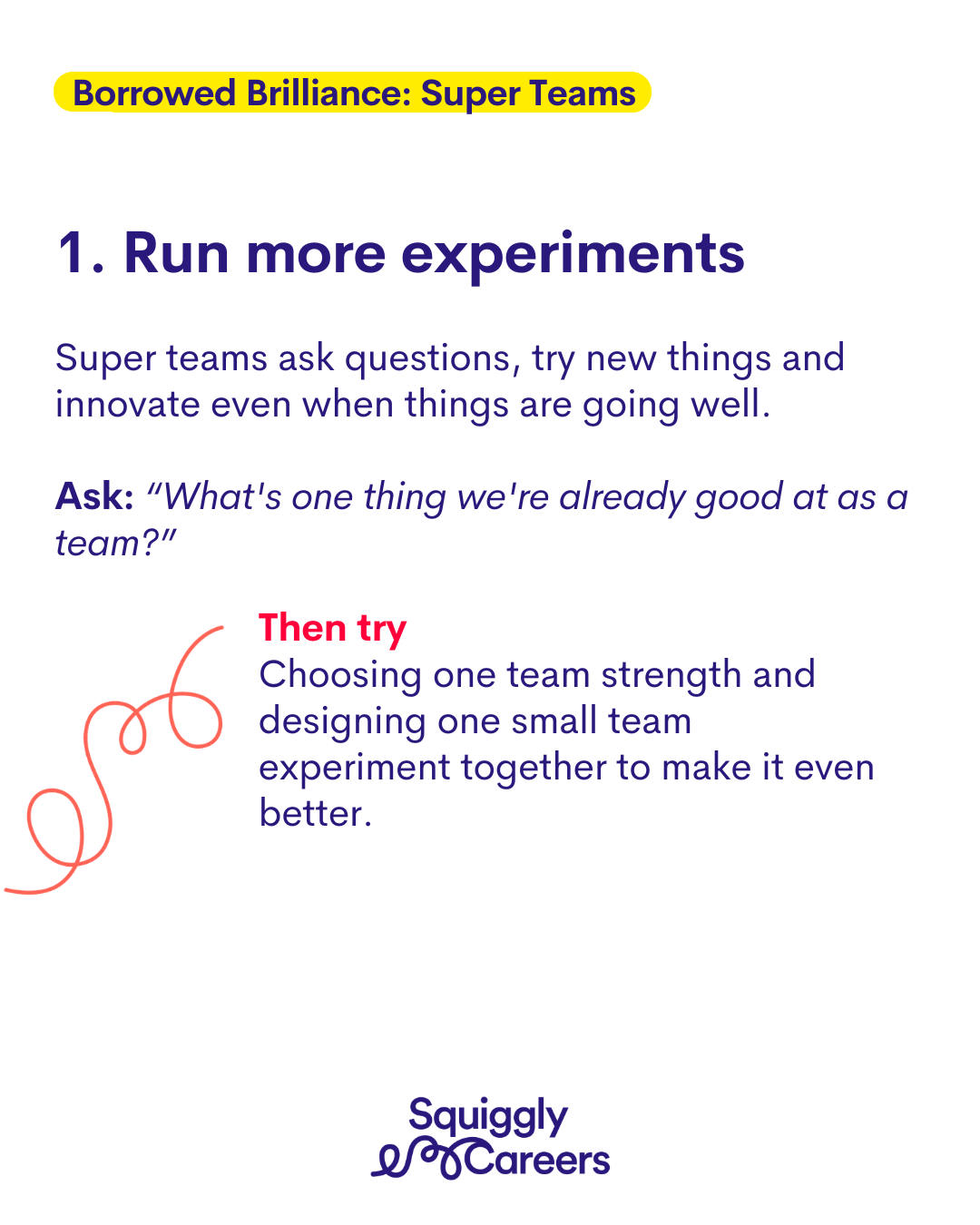
Helen Tupper: Okay, so super team feature number one is super teams run more experiments. So this means they are asking questions, they're not just accepting the status quo, they're trying new things out and they innovate. And I really like this point. They innovate even when things are going well. Because I think sometimes people wait for things to fail before they think, oh, we should probably do this differently because it's not working. And the bit that I took away from it was that it can be going brilliantly, but you can still look for ways you could do it differently and better.
Sarah Ellis: Yeah, I said the same to you. I think even in Learn Like a Lobster, where we've got a whole chapter on experimenting, we will often say to people, oh, you know, what are you finding frustrating? Use those frustrations as energy for experimenting, which is a good place to start. But I think looking at this in a different way of going, what is going really well or what are we really good at? And then be like, oh, okay, but don't, you know, it's almost like, don't get complacent. What's an extra experiment? Because what if that extra experiment makes you even better? So I think it's. And what we know with experiments is they're designed for learning. You learn fast, you learn by doing. Whenever I use that word in a workshop with people and say, you know, what do you think of when you think of experimenting? They're always really energetic words. Everyone's like, just try stuff out. Give yourself permission to fail. It's all about progress over perfection. And people are always really enthusiastic about experimenting. I think we naturally all enjoy experimenting. They sort of feel low pressure.
Helen Tupper: We just sometimes maybe need a bit of permission to do it back to kind of the environment. So let's make it easy then. So we thought about a question that you could ask as a team. And actually this is one that we have prepared on our post it notes. And we haven't told each other what our answers are going to be. So we will reveal them live and see how similar or different they are. And so the question to ask yourselves as a team is what's one thing we're good at as a team?
Sarah Ellis: Do you want me to go first?
Helen Tupper: Yes.
Sarah Ellis: So we've already written them down just so that if you're listening rather than watching, you don't have to listen to us write things down.
Helen Tupper: I also wrote three.
Sarah Ellis: Of course you did.
Helen Tupper: I'm really sorry. I know the question is, this is
Sarah Ellis: why we can never be a super team because you can't ever follow a brief.
Helen Tupper: So I do this every week in our meetings. Every week, every week in our meetings on a Monday morning we have like, what's your one thing this week? And I'm like, wow.
Sarah Ellis: And I'm like, oh, not again. Also, you know the research around, like clarity and prioritising.
Helen Tupper: Yeah, you just, you do.
Sarah Ellis: I think you just find it really hard because you get excited. I take it as you get enthusiastic about multiple things.
Helen Tupper: That's true.
Sarah Ellis: Okay, go on. So you haven't. Right. So I wrote down helping each other.
Helen Tupper: Okay, well, that was one of mine.
Sarah Ellis: Oh, there we go. We're in the same team.
Helen Tupper: I got very practical. So events. I think our team are very, very good at events. We, we put on some brilliant events.
Sarah Ellis: Yeah.
Helen Tupper: We have live podcast the event we did at BAFTA for the companies that we work with. Like launch of Learn Like a lobster. We are very good at that.
Sarah Ellis: Like a lobster was.
Helen Tupper: That was the dream. We hired the aquarium. It was brilliant. Support. I think the team are very, very good at supporting each other. There's this very nice sense of that in the team. And also experiments. I think we're getting better at experiments. I think people. We do talk about experiments.
Sarah Ellis: Yeah, no, we do.
Helen Tupper: I agree. So you would do that as a team and then I think, yeah, you could all do it on a post it note and put them up on a wall and then you could compare and you could do it.
Sarah Ellis: And actually there's a lot to be learned by. How much similarity, how much difference?
Helen Tupper: Yeah.
Sarah Ellis: Are there things that you are good at that maybe you're taking for granted? Did different people see different things? It's interesting that we got one that was the same. So you're like, oh, that's probably a bit of a standout strength.
Helen Tupper: Yeah, well, that's a nice way of terming a standout strength. So the action here is you take, you take the thing. So like, let's take support, for example. And you're going to design one easy experiment to try something new. So let's say, I guess if support was one of ours, an experiment could be. I don't know, each of you could. Every week one person puts forward a problem and then there's like the kind of team try to support and solve it together, like by the end of the week. So within a week, like team support for a week. And we just experiment with that over like a month. So we have four people's problems, one a week, and then we have this kind of team support. So the support is a little bit more focused to your point. Like we know it's a strength. We might take it for granted. So if we kind of focus that strength. We focus that support around a specific problem. Maybe it has more impact.
Sarah Ellis: I was thinking differently. I was thinking, I feel people are very good at supporting people in our team, but do we ever get support from things like AI? So I think our team's default would always be to support through each other through a conversation. I was like, what if when you were looking for support in a week, you sort of swapped out a real person with like a squiggly AI support instead? Like, what would, you know? Like, what would that look like? A different kind of support. The thing I also really like about what you described is I think we are very good at reactive, responsive support. You know, if something's gone wrong or we need to fix something fast or something's a priority, everybody would always rally around. Like, I've always had no doubt about that with our team. But what you described is actually more proactive support. Like, this is a bigger thing I'm thinking about. How could we support that person to think about that or to think that thing through or to come up with new ideas? So it's nice, isn't it, because you come up with experiments which are almost new strands around something that you're like, we're already proud of this thing. This is something we're really good at. And I can really imagine using Post-it notes for this, because you'd sort of use Post-it notes for the one thing we're good at, or three in your case. And then I can imagine using Post-it notes to connect experiment ideas with. Oh, okay. Well, if these are our consistent strengths, like, what are we going to do?
Helen Tupper: Yeah, you could just give people, like, five minutes to be like, okay, so what experiments have we got? And then just to give people, like, time to think.
Sarah Ellis: Yes.
Helen Tupper: I think that's one of the benefits of it because you write it down and then you can move it around. I love it. I love it. Okay, ready for our second feature of a super team?
Sarah Ellis: I like this one. I do too.
Helen Tupper: We like all. I think we like all of them.
Sarah Ellis: We're just like, yes. I don't know. There are certain ones where I was like, I really like this one.
Helen Tupper: Oh, I thought you were gonna say, there's certain ones I didn't like.
Sarah Ellis: And I said, oh, no, no, no. I think I did like all of them.
Helen Tupper: So the second feature is making curiosity contagious. I was like that contagious word. I'm always a little bit like, interesting choice. But I get the point here is that I guess almost like, curiosity is Impossible to miss in these super teams. Like, it is constant. They are. They know what they don't know. That was a point, actually, when I was reading it. That stuck out for me. So it's not just about they're constantly learning and they're learning from other people in other places, which I think sometimes is the default for when we think about what curiosity looks like. I really liked in the article that they said they know what they don't know.
Sarah Ellis: Yeah. I felt like, I think, is it called purposeful curiosity? I think I've got that book. But that was the word that sprung to mind. I was like, it was purposeful, intentional curiosity. And I do think that is different to just sort of, you know, being open and curious. Like, we would both say we're naturally curious. But I think what this is describing here is a much more. It's also a togetherness about your curiosity, because curious can feel quite an individual thing. You know, what am I curious about? I'm going off to learn about these different things. Whereas this was like collective curiosity. I was like, oh, how often do we think about curiosity? Like, together, what are we all curious about? What do we all want to learn about versus people just going off and doing it individually.
Helen Tupper: Well, it reminded me about, like in Lobster as well, about the. We have the point about Richard Feynman's don't know notebook. Yeah. And that idea of, like, as a team, taking time to think, well, what don't we know about this project rather than just kind of rushing, rushing on. And so that actually is our suggested question that we think would be useful for your team to ask together. What don't we know enough about that feels important for what we do?
Sarah Ellis: So I had a go answering, oh, did you?
Helen Tupper: Yes. Okay. Okay. I was going through the other night.
Sarah Ellis: I tried to answer all of them.
Helen Tupper: You have made me think on the spot now. Okay, what was your answer?
Sarah Ellis: Yes. Then to be fair, I've obviously not doing this on the spot. So I'd already thought the usefulness of AI coaches within companies, because I'm seeing more and more companies and tech providers who are clearly creating these AI coaches saying, oh, no, we've added that in now to how this company works. So they've got essentially a career coach by their side sort of day in, day out. And I was thinking, oh, I would be really interested to see how does that work versus, you know, just using Claude? Because I'm like, well, I would like, why could I not just use Claude to do that? There must be something that's Better because you've kind of got this AI coach. Is it because it's trained on a company's processes and policies or tone? And I've never seen one in action because I guess we don't have one in our company, but I am sure some of the companies that we work with must have a version. So I was like, that would be. I was like, I don't know. It feels very relevant to what we do at amazing if and with squiggly careers. And that felt like something that I was like, oh, we could have collective curiosity, right, about how these AI coaches are helping and also what are the kind of challenges with them? Because like most tech, it won't be perfect because I think loads and loads of the companies we work with will start to try them out.
Helen Tupper: We haven't asked our team these questions yet. I think we will do. I'm really interested to hear what they say. My head went to. So the question, what don't we know enough about? That feels important for what we do. We really want squiggly careers to go into companies because we think that when teams are talking about it together, that's when we can make a really big difference to development. And I don't think I know enough about how companies are using our resources. People tell me all the time, yeah, same, oh, I recommended this or I gave this person in my team, I
Sarah Ellis: used your company toolkit and I'm like, oh, yeah, when did you use that? When did you use it?
Helen Tupper: Which one? Yeah, which one have you never used? I feel like I really. I should ask a few more questions to have a bit more understanding there. I love that one. And so the action that we have got here to make curiosity contagious for your team is to bring the outside in. So I think quite. I mean, I say this because I've seen it a lot in companies that I've been where you just get a bit internal with.
Sarah Ellis: Yeah, of course.
Helen Tupper: You get team talk and company talk and it's like, yeah, industry even. And it's like a bubble which can get a bit bigger, but then it doesn't go beyond that. And so bringing the outside in is maybe you've got a friend that works in a completely different industry and you could say, you know, can you tell us, doesn't even have to be directly related to job that you do. Can you just tell us what are some of the priorities and problems and insights and issues in your industry right now? And I think the thing that makes it with curiosity is you don't want to constrain it too much. As soon as you go, well, we need to make this directly relevant to next week's team meeting. You suddenly put a boundary around it.
Sarah Ellis: I suppose that's the sort of balance, you know? Cause that's almost the opposite.
Helen Tupper: Right.
Sarah Ellis: To what I was saying. I was like, oh, we need to be purposeful and intentional. But actually what you're challenging with there is going. Yeah. But if you get too narrow, you kind of might miss out on boring brilliance and getting inspiration from elsewhere. So maybe what you have to try and do is sort of connect some dots around going, well, how do you solve problems as somebody working in the fashion industry? You know, I don't know. I don't know how those. Yeah. In fashion, how do people solve problems? So maybe you need to give that curiosity enough of a frame to be useful for a team to make it that kind of intentionality. But then go, but it doesn't really matter where people work or what kind of job that they do. Someone in our client actually was telling me this morning who I saw she works in HR and people. And there's a guy who I think, like, designs. He's like, really into gaming and designs games in the same company. But she got him to come and talk to the people, function about, like, games and like, dare I say it, gamification. For those of you who've listened to the gamification episode. And she was saying, like, how much they learn and how much energy it brought. And I was like, oh, that's a really good example of probably that team going, there's probably something in gamification that might be relevant for learning, but we don't know loads about it.
Helen Tupper: And what if everyone in the super team. I bet everyone in the team knows someone who does something interesting.
Sarah Ellis: Yeah.
Helen Tupper: And you can give it a frame.
Sarah Ellis: Like, who's got the most interesting job out of anyone? You know?
Helen Tupper: Yeah. And that kind of. And if. Because then it doesn't have to cost money. It's just like, bring them in. Like, what's an average day in your life look like? What the skills you use at work this week. Those sorts of questions could be really. See, we get so excited about this. Yeah, yeah, yeah. Okay.
Sarah Ellis: We should move on.
Helen Tupper: Okay. The third one. Well, this is probably. It's less. I don't want to say it's less exciting, but it's less. Harder. Yeah, it's harder. So the third feature of a super team is that they ask the uncomfortable question. So they're not just updating each Other. So think about, I guess, you know, we're talking about those sad teams or the stalling teams or the stuck teams.
Sarah Ellis: Well, that's when you just like default
Helen Tupper: to what I have. Yeah. It's like, do I need to be in this meeting to hear this?
Sarah Ellis: Yeah.
Helen Tupper: But super teams aren't doing that. What they are doing is uncovering what's getting in the way of progress. Their time spent together is not taken up by an update. Their time spent together is taken up by, how could we do this better? What's not working? What would be a different way? Like those kind of uncomfortable questions, which I think you are very good at an uncomfortable question. I think you bring this feature into the team, I think. So the question, if you want to kind of explore this together as a team, the question that we thought was useful here to kind of bring in a bit of that discomfort is first of all, state your most important priority. So our most important priority is as a team. And then the question is, what's getting in the way of us making progress? And again, I think this goes back to. To something we have said a few times about. I think a team has to feel safe to be able to say this, like, what's getting in the way? Because maybe it's you. Maybe if you're.
Sarah Ellis: Maybe.
Helen Tupper: Well, actually, Sarah, is the fact that
Sarah Ellis: whatever that might be true some of the time, to be fair, when I slow things down.
Helen Tupper: Your safe zone. Yeah. Yeah.
Sarah Ellis: I was just thinking about something I've worked on with the team this week where I kept asking questions. You know, you're just like, I think they thought they were done. And I was like, just one more question or like, I'd find another thing or something that didn't quite work.
Helen Tupper: And I.
Sarah Ellis: And you could just see them being like, well, are we done? Are we done? No, no one said that, obviously, but I was like, they must have been thinking anymore.
Helen Tupper: No more.
Sarah Ellis: So, yeah, I think I do ask. I think I do ask the uncomfortable questions. And I guess if you ask them together as a group and if everybody is sharing it, I think that makes it easier. Yes. You could ask these in one to one. But I think back to this. Being in a team, you're almost particularly if the person leading that team is listening. If you can create the safety where it's like, I genuinely. I really want to know this. It reminds me of Amy Edmondson's original work in, like, Fearless Organisations, when she did work in hospitals and the hospitals that were really good at kind of figuring out what didn't Work. And it took the leader quite a few goes to find the right question, you know, to get people to share what wasn't working. Because the same person would ask the question in one way, and people were like, I am not up for. I'm not up for sharing what's not working because I'm fearful of the consequences or I'm going to be blamed. I'm also in an environment where it has quite serious consequences if things go wrong. Where it was almost like when they then framed the question in a way that felt very supportive and was more like, well, what's one change that you would make that would make things safer or make these processes work better? So I also think here you might have to play around with asking different questions and see which are the ones that get you the most insight, see which is the ones that people. It's almost like you need people to be comfortable answering the uncomfortable question, otherwise you won't get the insights.
Helen Tupper: It's more. It's sort of asking the same question differently.
Sarah Ellis: I think that's exactly what it is. And I think some. I find this even, like, sometimes you'd have to. You just have to keep trying. And then you're like, oh, that's the one that's stuck. Or that's the one that people have obviously felt okay enough to answer.
Helen Tupper: Yeah.
Sarah Ellis: So what's the action here? Because when you came up with this action, and I was like, this is the most. Helen action of all time. So what do you want people to do?
Helen Tupper: What makes it. Helen, do you think the rhyming?
Sarah Ellis: No, I was like, I can just see the table.
Helen Tupper: And I could just.
Sarah Ellis: It was a table because I've got
Helen Tupper: a table in my head.
Sarah Ellis: I knew there'd be a table in your head. And I was like, I could just imagine you doing it. And I was like. When I read it, I was like, like, okay, yeah, we'll. We'll do this. Go and tell everyone.
Helen Tupper: What we're now going to do is a blockers and unlockers list, obviously. So you take the blocker. So the thing that's getting in the way of the important project that you want to make progress on. So you kind of got to name it, I think, to be able to kind of respond to it.
Sarah Ellis: Sarah is getting in the way of this project.
Helen Tupper: Sarah's inability to stop asking questions.
Sarah Ellis: Asking questions or improving stuff.
Helen Tupper: Well, actually, let's just take that as an example.
Sarah Ellis: Let's do it. Let's work it through.
Helen Tupper: And then. Okay, then you think, well, what would unlock it?
Sarah Ellis: So you know, maybe fire me.
Helen Tupper: No, I could add that to the list. That wasn't an option, but if it is an option, I might add it in. So unlocking it could be how actually framing a session. I always think framing a session's a useful way of this. So like having a challenge and build session. So it's, it's. Everyone goes into that session knowing that Sarah's going to ask questions and that other people can ask questions. So I'm not feeling like I was going to present something to you and your questions are coming at me in a way that I hadn't expected them. So that could be something. An unlocker could be sending you a draught and you kind of going through it on your own and sending your questions in a slightly different way.
Sarah Ellis: I think an unlocker could be more whens, you know, when do you need to get work done by. And, you know, sometimes them framing, you know, almost like, well, we want to get this out today, so it doesn't mean you don't have an opportunity to ask more questions and we can't still improve it. But, you know, sort of being able to signal to someone, like people being able to say, signal to me to say, well, we are going to share this now. Like, we were working on the thing we were working on earlier this week, to be very specific, because actually it will come out to lots of people listening, is we were doing how to use five Skills for a Squiggly Career for a team with some AI prompts. And we're using it for our companies, but we're also going to make it available to everybody who subscribes to the newsletter. So we're working on that as a team and I was asking question, question, question, and what someone in our team, because we not really got any dates or deadlines, I just kept going, yeah, Whereas actually if someone in our team had said, okay, wherever we get to by the end of today, that's the version we're going to use for this client because they need it now. And like almost kind of go, are you happy that it's good enough? Because it doesn't mean that we can't improve it after today. And actually, funnily, if it was me that ended up making, I ended up making the call for the team, like,
Helen Tupper: even I think I'm asking too many questions.
Sarah Ellis: Yeah, you know, and I sort of went, well, let's use what we've got, let's improve the rest of these things afterwards, ready for the next thing. But I think that's where we Struggled a little bit. Like, what was stopping us making progress was almost like we hadn't upfront got that clear sense of what do we need to do by when we knew what we needed to do and then we just kept on doing and doing, you know, like doing and doing, doing. So I think whens are helpful.
Helen Tupper: I'd probably also put a bit of a limiter on you. I'd say, like, what are your three biggest questions?
Sarah Ellis: Yeah.
Helen Tupper: And I'd be like, we, we can
Sarah Ellis: solve details solved today. Yes. Or what can we solve of. You can have as many questions as you want.
Helen Tupper: Yeah.
Sarah Ellis: But these are the ones that we can solve now. And the now versus not for now. That would have actually been really helpful because some of the things.
Helen Tupper: What are your not for now questions, Sarah?
Sarah Ellis: Well, some of the things that I think all my questions were fine, but some of the answers to the questions were now, some of them were not for now. And actually what our team tried to do was answer all of the questions now. And so if they'd have had that confidence to be like, oh, well, actually some of these things are like tech fixes or whatever, so they're not for now. And then you don't stall progress in the same way.
Helen Tupper: So to take it away from just. I know we've gone.
Sarah Ellis: We've got the rabbit hole of Sarah's
Helen Tupper: working style that the point is, you know, the blocker, because you got it from the question, but the unlockers, I think it's a really n nice team activity because there might not be one right answer, but it's the fact that you're all generating, well, what could we do to unlock this problem? And you end up with quite a few. And then I think there's then a lot of commitment because as a team, you then decide, well, this is the one, this is the one that we're going to do.
Sarah Ellis: Shall I do the next one?
Helen Tupper: Do it. Yeah.
Sarah Ellis: Rolling up your sleeves.
Helen Tupper: Yes.
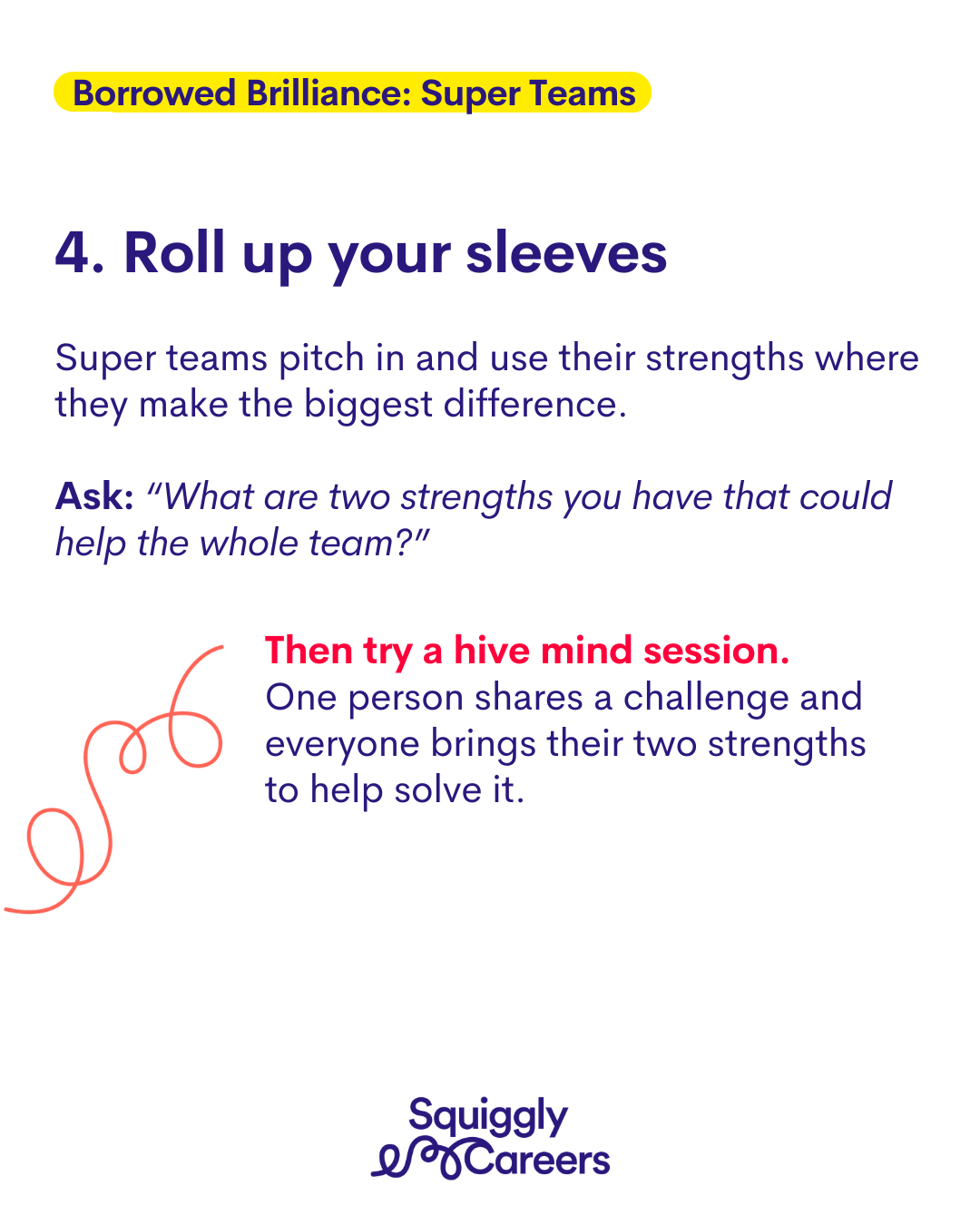
Sarah Ellis: And here what he talks about is that super teams support each other to deliver regardless of role or hierarchy. So those super teams might have structure. They just feel quite flat in terms of the ways of working. So there's not people being like, you know, that's not my job, or almost like, oh, I'm too senior for that. It's sort of when something matters, everybody sort of dives in and plays their part. Definitely don't want to micromanage. It's not about that, but it is about this kind of sense of, you know, like you're working together on something that matters. And no one is more important than anyone else. Everybody's contribution is really, really valuable. And I think, you know, there is always a temptation as a leader, you know, you can sometimes feel a bit separate. That can just feel like that's sometimes the nature people will say, you know, leadership is lonely. Yeah. And this is sort of the opposite of that. It's like, okay, but you can still get involved. You can still kind of get work done. And they talk in the article about not becoming disconnected from the work, you know, almost. I was trying to ask myself this question, actually. I was thinking, you know, like, could I. If I was thinking about our team, do I know all the tasks, could I have a go at all of those tasks? Or are there somewhere I'd be like, I actually don't know how that happens, and it would be a mix me, I wouldn't have to do them all.
Helen Tupper: So do you think then that you. In a super team, everyone needs to be able to do each other's job? Cause that seems quite a. Yeah, I
Sarah Ellis: think that's sort of not what they were describing. I think they were describing more. You know, when you're working on a big project together, like you were saying, and you've got real energy, is like, everyone's just sort of in it together and everyone's supporting each other, I don't think you have to be able to do each other's job. But I think there is often some value in, like, understanding the jobs that people do without necessarily having to do them all yourself. Like, there'd be things that would happen in our team where I think, oh, if I was a bit close to it, bit. Like when we talked about zero distance on the previous podcast, it probably helped me to roll up my sleeves a little bit more, maybe.
Helen Tupper: Yeah.
Sarah Ellis: So the question here is, what are two strengths that you have that you can see being useful across the team? And the idea of this question is so that you can see how your strengths can support opportunities and maybe solving problems in more than just your job. You know, like, trying to think more across the team rather than just kind of in your role. So my team that I thought of, because I was like, like I say, I answered all the questions, were creating new ideas.
Helen Tupper: Yep.
Sarah Ellis: So I was like, oh, if anyone needed to create new ideas, I like creating new ideas. And critical thinking.
Helen Tupper: Yes. These are two things that you are very good at that we need in our team.
Sarah Ellis: What would you have?
Helen Tupper: I think I would have relationship building so I can kind of go out and I have no fears about that. So. And that can help people that are like, oh, we could do with learning a bit more about this. And I think I also have we talked about before, but clarity creating. So I see sometimes when people in the team are maybe getting themselves in a bit of a muddle, you know?
Sarah Ellis: Yeah.
Helen Tupper: Like, seems. I'm like, oh, it seems we're making that, like, way harder than it needs to be. And I feel like I can kind of get in and simplify and cut some things away so that people can make progress. Whenever it's, like, messy, I'm like, oh, okay, let's. It doesn't need to be messy. Like, we can. We can get through that.
Sarah Ellis: And so an action that you might take here is run what we would call, like, a hive mind session, which is where somebody shares something that's maybe an objective or an outcome in their job, and then together the team almost bring their strengths to that. So I was thinking we might ask ourselves the question, how do we double the number of subscribers to the Squiggly Careers newsletter? And that does sit within a person's job, but it also matters to all of us. And I would bring ideas and critical thinking. You might bring, like, relationships, but almost, I suppose you're explicitly saying to people, we want you to bring those strengths, rather than it just being like an idea generation session. Because that could just be like a. What ideas have we all got?
Helen Tupper: Yeah, like Helen, what relationships? How could relationships help us solve this problem?
Sarah Ellis: And I almost wanted it to be a sort of more pointed session, a more specific session, where, let's say, almost frustratingly, there's so many Sarahs in our team. It's actually Sarah. I work for Sarahs. I've got Sarahs. It's Sarah in our team who looks after the newsletter. So Sarah might be facilitating this hive mind session, but she would say, well, Sarah, I want you to come to the session with three new ideas that we've not tried out yet that we could experiment with. Helen, I want you to then convert those ideas that Sarah's got into, like, Clarity. Cause I'll probably go all over the place. You might convert them into, like, some prototypes. Sarah might ask you a question about, well, who should we build relationships with who also have really good newsletters? So almost like you've beforehand, you've kind of done a bit of strengths mapping, and then you've given that person almost permission to, like, draw on all of those strengths, and you could do it one to one. But I think in a group, it would feel really nice.
Helen Tupper: By the way, if anyone does want to subscribe to Squiggly Careers newsletter, the link is in the show notes.
Sarah Ellis: That's how to double it. If everyone just subscribed, that would be really helpful for us. Should we talk about the next one? Let's do it. Which I also think is a hard one. I think this one might be the hardest actually out of all of them.
Helen Tupper: More than the uncomfortable questions.
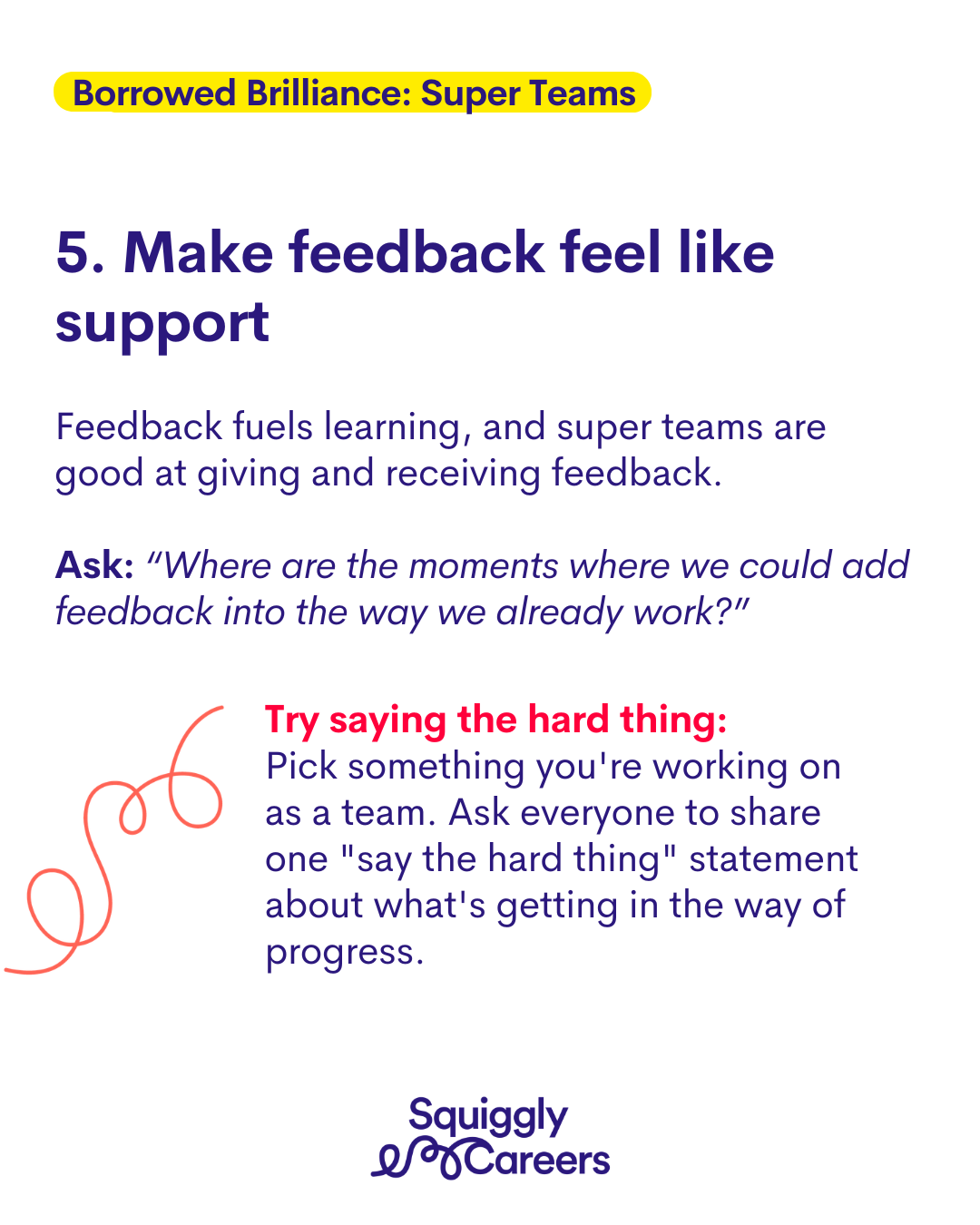
Sarah Ellis: I think so. Okay, so this is make feedback feel like support. So super teams learn quickly and feedback fuels learning. So they are very good at feedback, asking, giving, receiving feedback, which we've talked about before on the podcast. But there is a specific point in the article where they say, and this bit is actually focused on leaders, but this will be for everybody. When leaders say deliver harder to hear feedback, it feels like it's there to help everyone improve and to grow. And it's sort of well, well received. So even though it might be hard to hear, it's actually, you know, it's acted upon. It's. It's in the context, I guess of having a high trust team. So they do particularly point out that say the hard thing feedback works really well in a super team and this is why it's hard to be a super team.
Helen Tupper: Well, it's a skill to say it, isn't it? It's a skill to receive it and then it requires safety all around it. So it is.
Sarah Ellis: I felt like it was the tough one, so I thought an easy ask because I was like, you probably don't want to, you do want to think all feedback first before you then get into an action. Like maybe you say the hard thing action was what are the meetings and moments when we could add feedback into how we already work. So I often think the reason feedback doesn't happen is it's just you've got low frequency. So what does feedback look like in our one to ones? What does it look in a team meeting? What does it look like whether we're using teams or slack or whatever we're doing? So kind of making feedback a habit, making it unmissable and then the action here I think it is good to consider what saying the hard thing would mean for your team. And I liked the idea of like starting by saying the hard thing, which might be counterintuitive, but I wonder if you wait to say the hard thing till the end of a meeting or end of a project, it either gets rushed or it doesn't get done or you avoid it because maybe it doesn't
Helen Tupper: change anything because it's right at the end.
Sarah Ellis: So let's imagine we were starting something new or let's imagine our team meeting on a Monday. So this would be very different to what we do now. We always meet on a Monday. We could start our team meeting on a Monday by picking something we're all working on and go, right, we're all going to start by saying the hard thing about this, which is a really interesting one, because you'd be like, well, that feels quite neg. It feels like potentially quite a negative way to start the week. But the point of a super team is that wouldn't feel negative. It would feel like this is a shared project or priority. And so we're going to start with that and we're all just going to do one say the hard thing statement of, like, what might be getting in the way of that? Because we've agreed it really matters and you're just creating a bit of space for that before you move on to whatever else you might do. Now, it doesn't have to be in a team meeting, it might be about a project, it could be something you're working on. But I think the space and the practise of saying the hardest thing really matters. I think the sooner you start practising it, the sooner you start getting better. Given we've done a lot of work on it in the last nine months, it's just starting to be part of our language, the words that we use in our team. And I'm starting to think about more and more moments for it. But I think you've just. I would almost go. Just start anywhere, Start somewhere that feels easy to have a go at.
Helen Tupper: I think there's a lot to learn when you start doing it. You can see people who find it relatively easy, like, oh, you give me space, permission, here you go. And it's quite clear. And then you can see the people, they might giggle or they might. Yeah, they might sort of start and then say, but it doesn't matter, but it's okay, you know, like, you can. And actually it's like. And you kind of want, I think, to get everyone almost to a level of neutrality with it, which is we can say the hard thing without that being a bad thing to say. Yeah, it's okay to say it, but I do think that takes time and you'll be able to see way beware who might need some more support with it.
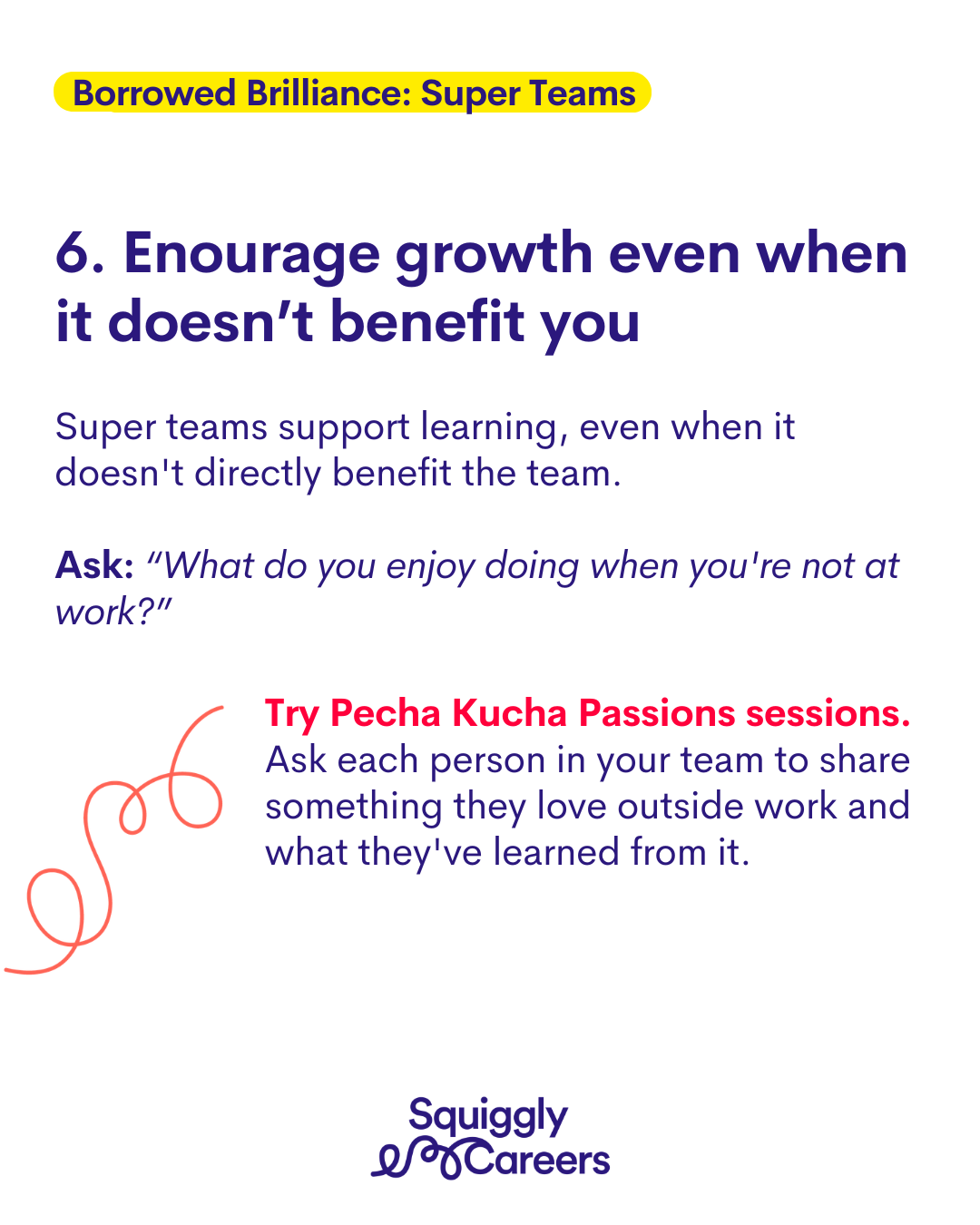
Sarah Ellis: Yeah, number six, which back to a lovely one. Encourage growth even when it doesn't benefit you. So this is really interesting. In super teams, they support side Projects strength, stretching and development beyond today's role. And so they talk about people's hobbies being celebrated, people who do different or interesting things that are not to do with the day job. Like that being sort of proactively encouraged and people being like intrigued by that. And I was thinking, well, that was very much us, right? That was, that was me at Sainsbury's and going off one day a week to do early, early days of squiggly careers and almost people not feeling like they have to hide it and like kind of talk about it. And so a really easy ask here is, what do you enjoy doing when you're not at work? We did our little post its for this, didn't we? And I was thinking, let me guess
Helen Tupper: what, let me guess what's on yours.
Sarah Ellis: Cause I think this is not gonna be that interesting for us. Surely we know she'd tell you.
Helen Tupper: What does Sarah enjoy doing when she's not at work?
Sarah Ellis: I don't think you will guess what I've written down.
Helen Tupper: I would say like reading or walking.
Sarah Ellis: Okay, that's not what I've written down.
Helen Tupper: Okay. What would you think I've written down?
Sarah Ellis: I think you said cooking.
Helen Tupper: Oh, no.
Sarah Ellis: Gardening.
Helen Tupper: More specific.
Sarah Ellis: Growing new seeds.
Helen Tupper: Growing vegetables.
Sarah Ellis: Growing vegetables.
Helen Tupper: You would be so impressed with my vegetables.
Sarah Ellis: I've seen them on Instagram.
Helen Tupper: I know my vegetables on Instagram. My child is like. I mean, he's the best child ever in the whole world.
Sarah Ellis: Well done.
Helen Tupper: What is on yours?
Sarah Ellis: Oh, I wrote building habitats and crabbing.
Helen Tupper: But is, do you enjoy doing that or do you enjoy spending time with Max?
Sarah Ellis: Oh, no, I enjoy the actual thing.
Helen Tupper: No, no, Max is Sarah's little boy for context.
Sarah Ellis: Yeah, No, I enjoy the actual.
Helen Tupper: So if Max wasn't there, you would still build habitats and go crabbing?
Sarah Ellis: Crabbing, definitely. I would. I actually don't know what I'm gonna do when he doesn't want to do that anymore. I mean, the other week there was this guy, right, who turned up on the beach. It's a slight segue, but honestly, it was amazing to watch. This guy turned up on the beach from Wales and we were down in Dorset and we were catching crabs, you know, with like the nets and bait and stuff. He just got in the sea and caught spider crabs with his hands. So he was just like putting his hands round the edges of rocks basically.
Helen Tupper: You crazy people, like, and coming back
Sarah Ellis: with these massive spider crabs. And honestly, I've never been so impressed. And my son was like, oh, mum, is he a professional? Like as in like A professional crab cat. Spider crab cat. I was just like, no, he's just incredibly at one with nature. I'm there with like my bacon trying to catch these crabs. But I do like. I like love. Yeah, I love it. I love catching crabs and fish and
Helen Tupper: creating the out of work life is about chard and crabs.
Sarah Ellis: I mean, I would say I actually thought our team do this better probably than us because the side projects across our team are fascinating. We've got people into sewing, like making amazing stuff, French ceramics, jewellery making. And people will often talk about those in like their wins of the week or they'll share how they're getting on and I feel like we all end up getting quite. I get quite invested in some of what they're doing.
Helen Tupper: Yeah.
Sarah Ellis: And that's really lovely. It's so nice. So my idea here for an action was Pecha Kutcha. Am I saying that right? Yeah, yeah. I'm calling it Pecha Kutcha Passions because there's alliteration and that made me happy. And so if you've not done this before, it's where you sort of do a presentation where you don't have to do it in this way but often you set a time limit and have a number of slides. But the point is you're kind of constrained. I did a version of this actually of Sainsbury's, the team I led at Sainsbury's and actually it was a really nice way to get to know everyone.
Helen Tupper: Images only as well.
Sarah Ellis: You just sort of show like big images quite a lot. I think it was like 20 maximum 20 slides but I almost feel like that's too many because that's from quite a long time ago, before the days of TikTok and people want things really short. So I think you could do your own like constraint maybe it's five minutes, five slides for example. And I think any team time together you've got or an away day, you could just get people to share a passion.
Helen Tupper: I'm afraid to see your Petra Kutcha passion on camping.
Sarah Ellis: I can show you a video right now, like no time.
Helen Tupper: It's fine.
Sarah Ellis: I've got videos of that. I've got the video, the spider crabs. I didn't have a picture of the guy but I really wish I had done. We all came back. My partner hadn't come but my sort of brother in law had and we're so enthusiastic.
Helen Tupper: He's like famous. That's not normal to be able to catch a spider crab in your hands.
Sarah Ellis: He had very like surfer Wildlife vibes and like. Yeah, yeah. We were all quite in awe of him. It was really funny. And you could. I was like, you could either do it all at once. So when I did it at Sainsbury's, everybody did it and we'd got the time to do that.
Helen Tupper: It's like five minutes each.
Sarah Ellis: Five minutes each and everyone's done it. If you were going to do it in your team meeting, which might be more realistic if people were like, I want to get started on it straight away, rather than wait for a team off site or whatever, I was like, you could do one a week.
Helen Tupper: Yeah.
Sarah Ellis: And I'm like, that's a nice thing
Helen Tupper: to look forward to.
Sarah Ellis: I would love. Yeah, I would love to maybe do say the hard thing first. And then you're like, right now with your passions. Be quite the contrast, wouldn't it?
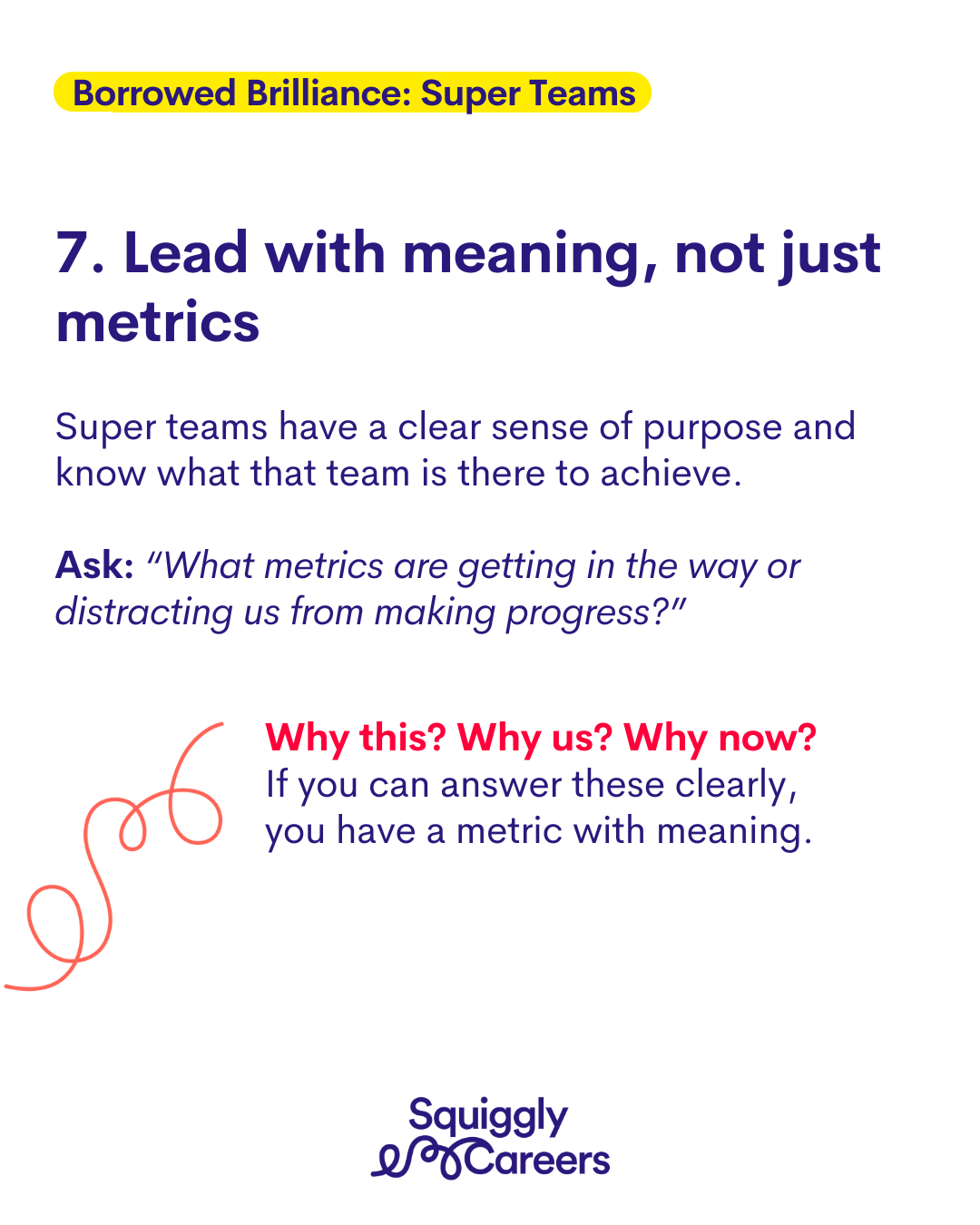
Helen Tupper: So the seventh and final one. Yeah. Is the lead with meaning and not just metrics. So super teams have got a sense of purpose, so a real focus on what that team is there to achieve and they are continually driving improvement. And a question that can help you explore your super team status on this one is, is what are metrics getting in the way or distracting us from making progress? And the reason we've asked this question is sometimes metrics can limit the work that we do because we all become so fixated on hitting a target that it doesn't always give people the freedom or the space to think, well, what would we do differently? If we're not defined by hitting that number every week, then maybe I'd have the space to do something different that could have even more impact. And so I think it's quite useful to question some of the metrics. So we. We have, for example, a metrics meeting every month and we've had the same metrics now for a while, but I think asking the team, like, you know, do those metrics still feel purposeful?
Sarah Ellis: Yeah.
Helen Tupper: How much time does it create for you to, like, to get to the metric? And is the time it takes to get to the metrics taking you away from doing the work that we'd want you to do? I think there are just questioning the metrics and working out whether they've really got meaning or it's just a metric that people are just filling in week after week, month after month?
Sarah Ellis: Yeah, it's so interesting, isn't it? Because there's that sort of old phrase, which I do, I still think is true, which is what gets measured, gets done. So it's almost like that's the watch out with a metric is like, well, if those are the metrics, that's where everybody puts their time, energy and attention. And you just, I think it's just a watch out to kind of go, but have you got the meaning with the metric? I actually don't think what they're trying to say is don't have the metric. I think it's connecting the metrics and the meaning and that's why the action here. This is something I learned at a recent board meeting where one of my fellow non execs said that she'd use this. And I was like, yeah, that's, that's helpful for all of the kind of big pieces of work that they did. And this was at a very big bank. The questions they always asked were, why this? Why us, why now? And so, you know, for anything you've got metrics on, you'd always want people to be clear on like, well, why are we doing this and why are we doing it? Like, why us versus our competitors or anyone else? And like, why now? Because that's the sort of priority point. And I think if you had the clarity on those three why questions, it'd be really useful.
Helen Tupper: I was just thinking about the earlier chat we had about the newsletter. And so why us is the Squiggly Careers newsletter. It's a way that we get all of the assets that we create out to our audience. No one else has got those assets. And the kind of the why this is obviously because it helps people succeed in Squiggly Careers. And why now? We could say this is more important than ever because, like, social platforms keep changing their algorithm and so we're not in control of what people see. But if people are subscribed to our newsletter, then the people that care about Squiggly careers are always guaranteed to get
Sarah Ellis: our tools and resources, which probably. I think if you can answer the questions as easily as you just did, then you probably go, yeah, that's why we have a metric. That is a metric.
Helen Tupper: Yeah, that is a metric that matters and one that has meaning.
Sarah Ellis: Whereas if you couldn't, you might. And there would be some, I think, that we have, where you couldn't articulate it as quickly. You're probably thinking, well then are we measuring the wrong metric? Is there a more useful metric? So I think we'll probably do this right, all of these things.
Helen Tupper: Yeah. So basically the shortcut for us is that we think that this is really useful research. I think we believe that those seven factors that have come up in that research are really important for teams, and we are recommending that asking the questions and doing the actions don't have to do it all in one go. You could do, you know, one a month as a team or something. But it does does feel really important. There's probably a way you could use AI as well to help you kind of assess some of these areas to get a bit of a super team scale or a super team starting point that you help you find a bit of focus.
Sarah Ellis: So we hope that's felt useful, whether you're a small super team or a massive one, or you want to be. But that's everything for this week. Thank you so much for listening. I'm back with you again soon. Bye for now.
Helen Tupper: Bye, everyone.
Sign up to the Squiggly Careers Newsletter and get our latest ideas, tools and inspiration every week - all in one place, straight to your inbox