
This is the fifth and final episode of the Squiggly Careers x AI skills sprint series.
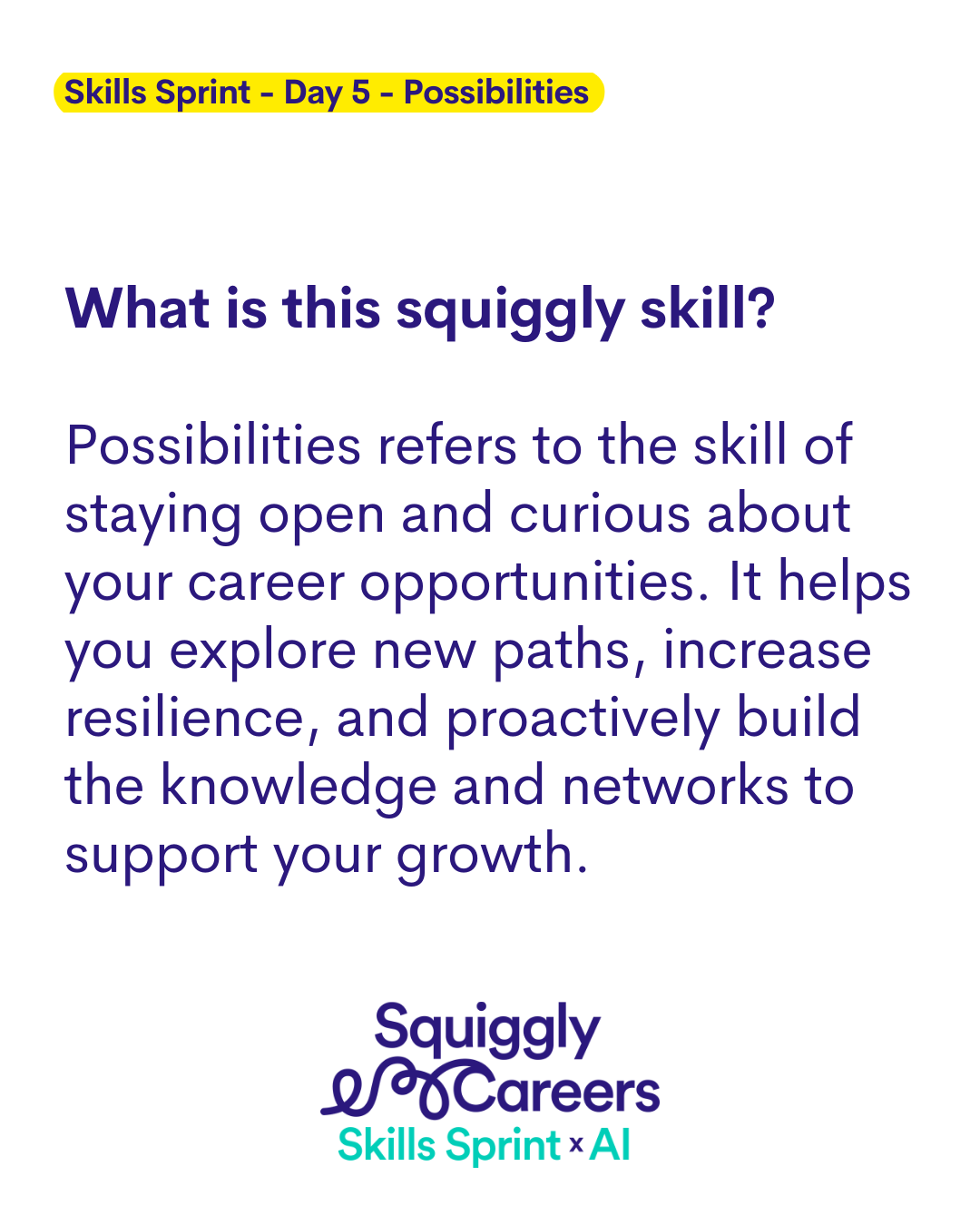
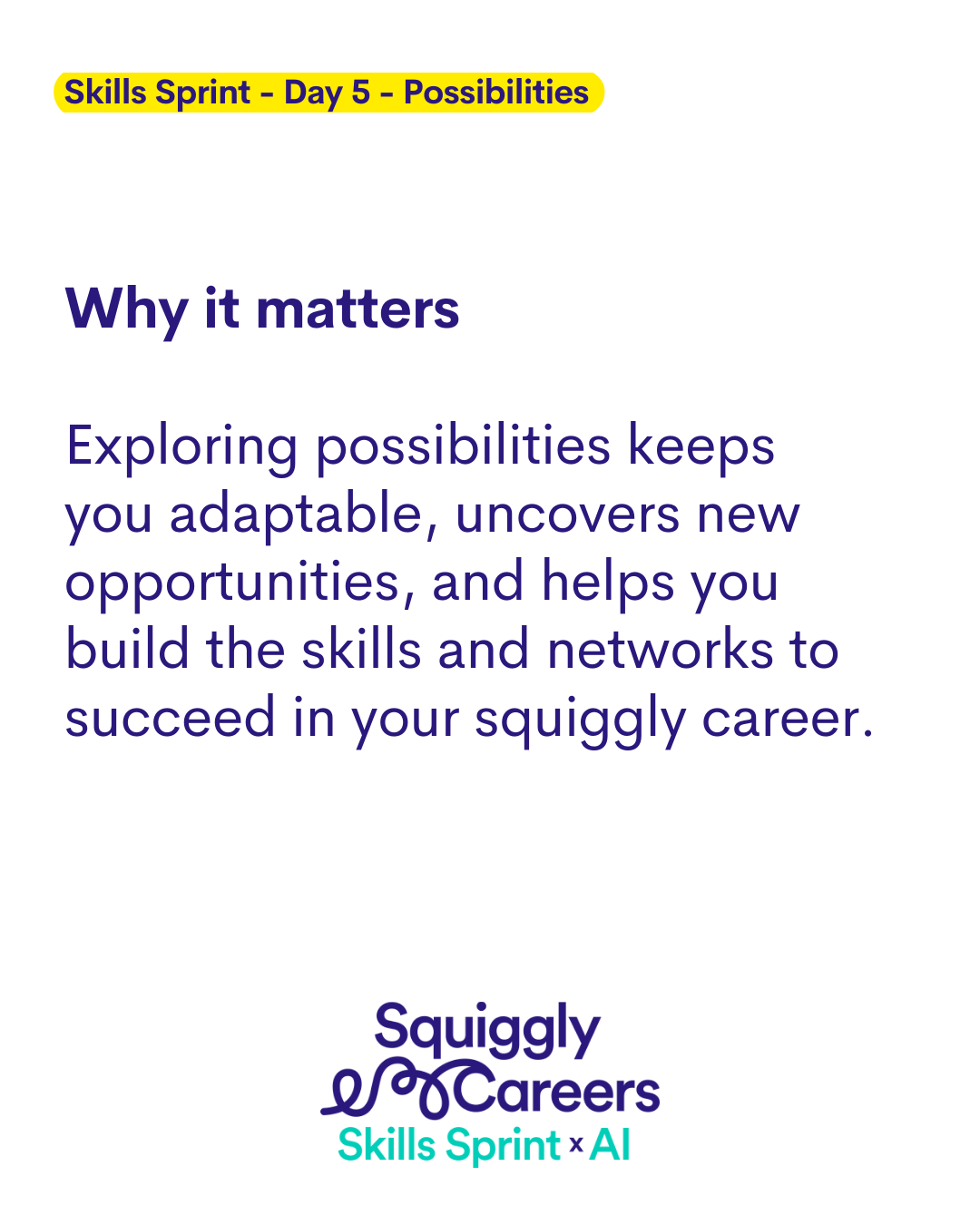
Today, Helen and Sarah talk about exploring Future Possibilities in your career. As careers become less linear and more unpredictable, having multiple options and directions is essential for resilience and control.
In this episode, they show how to use AI prompts to generate a mind map of career possibilities, from obvious to ambitious, pivot, and dream options. They also introduce an AI tool for practicing curious career conversations through role play, helping you build confidence and get feedback first.
With people having 10-15 different jobs on average throughout their working life, embracing a variety of possibilities actually reduces career risk and builds long-term resilience.
🥇 Sign up for the sprint here: https://bit.ly/41jasYO
🎯 What You’ll Learn
* The importance of having multiple career options
* How to use AI to generate a mind map of career possibilities
* Why creating rather than waiting for opportunities matters in modern careers
* How to practice curious career conversations
📚 Resources Mentioned
Future Possibilities Daily Summary – https://bit.ly/scss-ai-day5-summary
Yoodli – https://yoodli.ai/
For questions about Squiggly Careers or to share feedback, please email helenandsarah@squigglycareers.com
Need some more squiggly career support?
1. Download our free careers tools
2. Sign up for our Squiggly Careers Skills Sprint X AI.
3. Sign up for Squiggly Careers in Action, a weekly summary of the latest squiggly career tools
4. Read our books ‘The Squiggly Career’ and ‘You Coach You’
00:00:00: Introduction
00:00:43: All about future possibilities
00:02:49: An AI prompt
00:05:39: A curious career conversation tool
00:08:04: A team exercise
00:10:16: Final thoughts
Sarah Ellis: Hi, I'm Sarah.
Helen Tupper: And I'm Helen.
Sarah Ellis: And this is the Squiggly Careers podcast, and we are on day five, final day of our Squiggly Careers Skills Sprint. If you are starting here, it's also fine. But for lots of people, we know that you will have been working your way through the sprint. And so, firstly, well done for spending some time on your development every day. We know it's not easy. We know there are loads of demands on your day. And just as you were about to get started, someone will have asked you an annoying question. But the fact that you have stuck with it, you should feel really good about.
Helen Tupper: And we will send those people, everyone, today you will also get your --
Sarah Ellis: You get a badge.
Helen Tupper: You get a badge, "I've completed the Squiggly Skills Sprint", badge. So, if you put that on LinkedIn and tag us, we can celebrate your sprint success.
Sarah Ellis: And remember those daily summaries, I'm sure you're really used to them by now. In today's summary, for example, you'll get an example of a mind map, our first mind map, I think, of the week; you'll get a link for a tool that Helen's going to talk about; and loads of prompts, which again, cut and paste the prompts, use our prompt as a starting point. And by now, maybe you can just use our prompt and then make it even better for yourself.
Helen Tupper: So, we're talking about future possibilities, so let's just talk about why this matters in a Squiggly Career. When we looked at careers like ladders, you basically just had a plan, you were looking at the next step, you weren't really looking much beyond that and you definitely weren't looking in different directions. In the world that we are working in today, where there's lots of change, lots of uncertainty, that approach is risky, and it doesn't help you with your career resilience. We don't want either of those things for you. We want you to have lots of opportunity, lots of options, so you have more control in your career, and that is why future possibilities matter. It means that you'll be able to explore different directions that you can develop in, it means that you can get more curious and open about your opportunities and that just gives you more choice.
There's also a useful Squiggly stat here to support this point, which is that people now have 10 to 15 jobs on average in their working life, so lots of different jobs in potentially lots of different companies, and our average career is around 40 years. So, we're working for a longer time, we are having more roles, and we want you to have more resilience. That's what this skill is all about.
Sarah Ellis: And you want to create, not wait, when it comes to your future possibilities. You know, I think we are all guilty at some point in our Squiggly Careers of suddenly realising, "I want to do something different now". And then, we've not really been proactive or very intentional about it. And then, you default to, or just start applying for jobs. And sometimes, you can be lucky and you apply for the right one and it all kind of works out. But certainly, in my own career, when I think about all of the different squiggles and the moves that I've made, all of the best ones have been quite a while in the making. I've had curious career conversations, I've explored different ideas, I've almost been thinking about it and acting on it for a while.
Helen Tupper: Even this job, this was a while in the making for us.
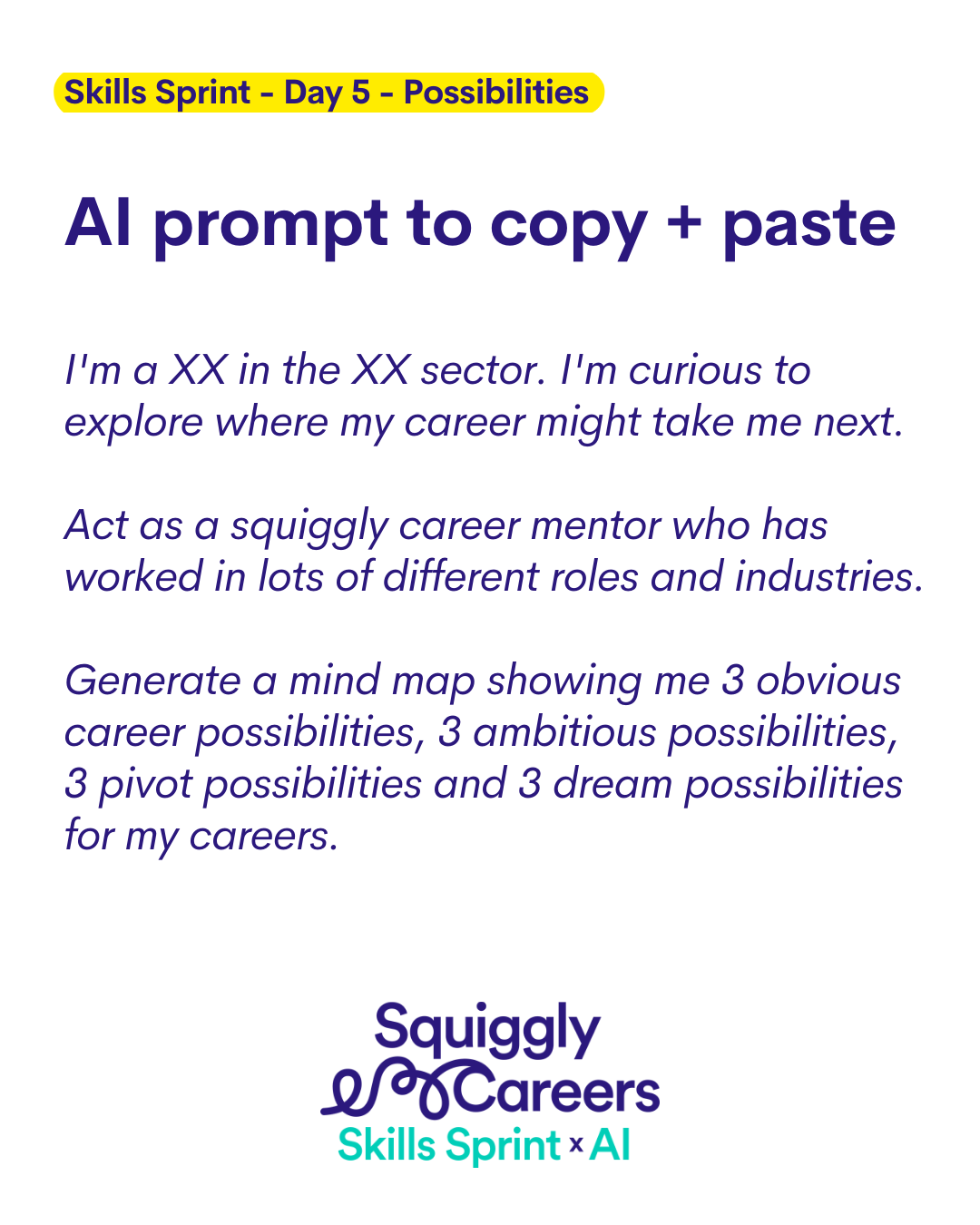
Sarah Ellis: Yeah. So, an AI prompt to get you to zoom out. I think we want to start here by not limiting ourselves, almost ignoring constraints and thinking about the art of the possible. That's why I enjoy this section and I like mind maps. I'm like, "Oh, what could be; what might happen?" And so, your prompt here is, give the AI a bit of context about you, but remember, don't share anything really personal or individual. So, don't say, "My name is Sarah and this is my job at this company", more like, "I'm a finance manager in a large organisation in the retail sector". So, specific enough, but without being too personal to you, "I'm curious about where my career might take me next. Act as a Squiggly Career mentor". I went for mentor today, slightly different to coach, hopefully for a good reason, "Act as a Squiggly Career mentor who's worked in lots of different roles and industries. Generate a mind map showing me three obvious possibilities, three ambitious possibilities, three pivot possibilities, and three dream possibilities for my career". So, quite a lot, quite a long prompt. And then it just does it.
Helen Tupper: I mean, if you were doing that yourself, that would take you a good, I mean, a good ten minutes, and it just did it quite quickly for you.
Sarah Ellis: And what I liked about this was, I mean, you could use this to build. So, what you could have done was put in the ideas you'd already got and then said, "Give me some new ideas", so ones you'd not already thought of. Or you could use it as a starting point, like a springboard. So, I think you can use it in either way. I like the fact it gave me mini definitions, which again, I'd not given it that, but it gave it back to me. So, it said, "For ambitious possibilities, for example, bigger leaps but they're still rooted in your strengths". So, I was like, "Oh, I like that", I like that little reminder that this is still about you and your strengths. It does give you a visual, you can download it as a PDF, you can print it out. And it was specific about roles. An ambitious one, for example, could be to move into strategy. I was like, "Oh, yeah". I mean, I'm not in finance for a start, but I wouldn't mind going to work in strategy. It talked about dream possibilities. I thought, "Oh, this is interesting. How has it decided what my dreams are?"
Helen Tupper: Whose dream is this? What dream did it give you?
Sarah Ellis: Well, I mean, so one of them was founder, co-founder. I was like, "Oh, that's so smart", which I was like, "Oh, that's interesting", right, because these things do learn, which, you know, scary/smart. Creative finance educator or coach. So, I was like, "Oh, it has learned about me, even though I'm not in finance". And then, the other one was Head of Impact, social enterprise leader.
Helen Tupper: I think you probably also would quite like that.
Sarah Ellis: Yeah, I mean I can't do the finance bit that I said in the actual prompt, but I would quite like some of those things. So, I just think this is a great way to get you started. And you know, sometimes the thing that we see is that the obvious possibilities are not always the most motivating ones. So, this gets you beyond the obvious, it just gets you into generating ideas, and then I think you move into like, "Right, okay, so what now?"
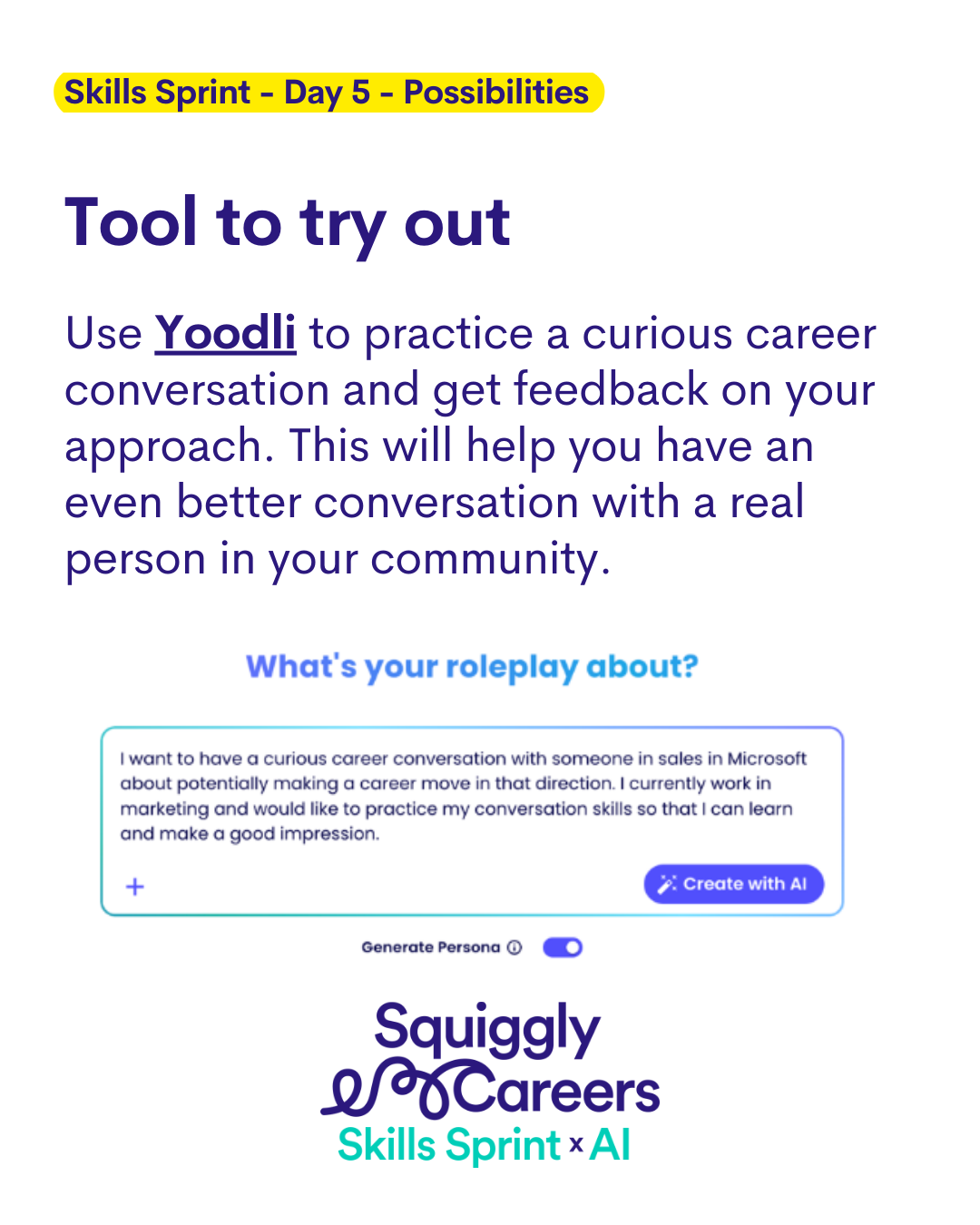
Helen Tupper: And so, on the 'so what now', all these ideas about your possibilities, you really want to put them into action in some way. And we always talk about the value of curious career conversations. So, the action isn't, "I'll apply for a job". The action is, "I'll go and learn more". Always let the learning lead you. And so, we often say, go and have curious career conversations. Now the good thing about AI is you can have a curious career conversation with AI about one of your possibilities. So, the tool that we played with here is Yoodli, and we'll put the link to that in the Squiggly Career summary, so you can just click through and give it a go. There is a page in there where you can design your own role play. Please do not cringe at the word role play. No one has to see this, this is just you. But you put the profile in.
So, I actually did, the profile that I used here was I said, "I want to have a curious career conversation with someone in sales in Microsoft, about potentially making a move in that direction. I currently work in marketing and would like to practise my conversation skills so I can learn and make a good impression". So, you're going to have to just put in there, you know, maybe use Sarah's prompt first, pick one of those possibilities that you're interested in, create a profile of a person you want to talk to, and what it will do is it will generate you a role play. So, you will literally have an avatar. I had someone called Rebecca who works in sales.
Sarah Ellis: How was Rebecca?
Helen Tupper: She was great.
Sarah Ellis: Yeah, you said this, you sounded like you'd made friends with Rebecca.
Helen Tupper: It was so good. So, I was chatting to Rebecca and she was saying, "Oh, what is it that interests you about sales? What skills do you think you could bring? What do you want to learn? What other questions have you got?" It was really, really useful. Now, I don't think that replaces meeting the real Rebecca, because the real Rebecca, if there is a real Rebecca in sales at Microsoft, but the reason being, we talked yesterday in the Skills Sprint about the role of networking and how that leads to often new opportunities. So, fake Rebecca is not getting me a job in the sales team. Real Rebecca might, but this could give me the confidence to have an even better conversation with the person who is actually in sales. Really give this a go. Also, it gives you feedback. That's the brilliant thing about this. And it gives you quite clear feedback. Like I got, "Strength, Helen. You showed up with enthusiasm for exploring opportunities and engaged with the professional and had relevant insights into their field. Nice job. Growth areas: slow down, sharpen points. Some answers felt a bit rushed or slightly disjointed. Balance elaboration with a brevity. Focus on delivering concise, yes, impactful answers".
So, I think it gives you feedback so that when you have the real conversation, you can show up even more effectively in it. And it's just safe. It's a nice, safe place to practise what could feel a bit like a scary conversation.
Sarah Ellis: So, I think it can either increase your confidence or it could just be an 'and'. I'm going to have some curious career conversations that are pretend or practice ones, 'and' I'm going to go and do the real ones as well. I had a play with it, because you were very enthusiastic about the fake Rebecca, and I was like, I think I'd ask better questions in my real career conversation because of the practice. So, I'm already confident enough to have them, but it made me more thoughtful.
Helen Tupper: Yeah, agreed.
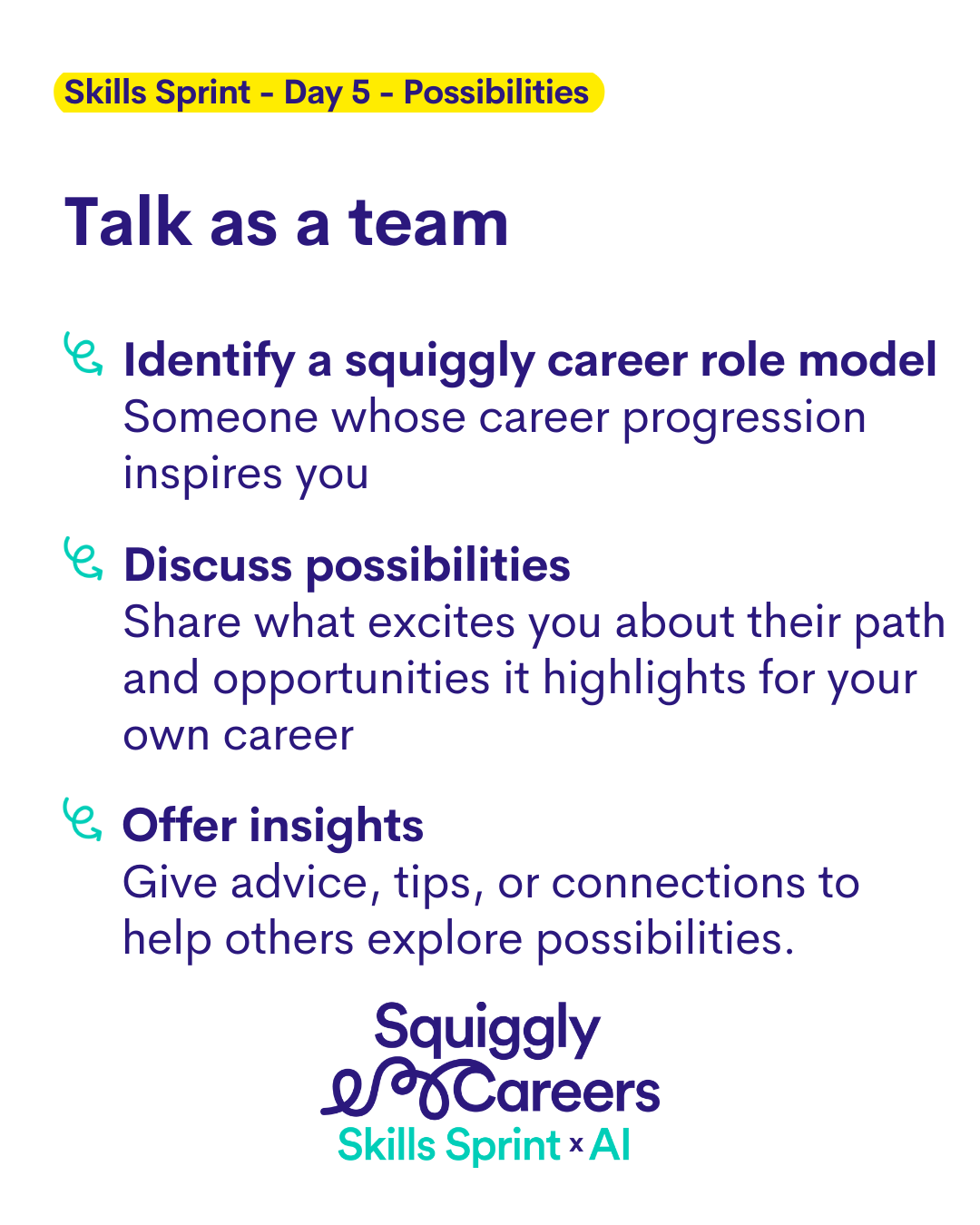
Sarah Ellis: So, how could you talk about this together as a team? I think we've got quite a nice exercise here, well we enjoyed doing it basically. So, we were thinking actually, when you're thinking about possibilities, it's nice to think about who are your Squiggly Career role models, so someone who is progressing in a way that feels inspiring for you. And actually, talking about that as a team I think is really nice. It's really nice to hear people's examples of who they find interesting and inspiring and what is it about what they do. Who would you pick?
Helen Tupper: The first person that came into my mind was Aviva Wittenberg-Cox.
Sarah Ellis: The brilliant Aviva.
Helen Tupper: She's brilliant. And then you just go into a 'why', "Why is it?" and I admire the changes that she's making in both generational and gender diversity at work. She's very generous, so she uses her space, I think, to support other people. And I love that she wins, but she helps other people win with their work too, I love that. What about you?
Sarah Ellis: Margaret Heffernan, long-time fan. And she's been on the podcast as well, basically, because I fangirled her until she came on the podcast. And I think the reason I find her an inspiring role model is her credibility, her expertise, she's not afraid to share her points of view. And again, probably similar to Aviva, I feel like she just wants the world of work to be better. And so, she'll call out things that are making it worse, but she's also really curious. She's been working for a really long time, and she's just stayed curious and relevant and resilient. And everything she writes, I read, and I think, "Oh, I'm a bit smarter because I've spent time with her" and I think that's an amazing thing to inspire.
Helen Tupper: It's a nice chat to have together as a team. So, that is the end. Yay! Well done for sprinting! Well done. It isn't easy to commit to your development and if you've got this far on the sprint, that is a commitment to yourself and your learning and we really hope that it's been useful. Energy and useful are two of our values so let us know if it's done that for you. Please share your badge, you should celebrate this with pride, make sure that you stay connected for Amazing If, because we will be doing another sprint, and just a big thank you from us for being part of the community and all of your support and love of Squiggly Careers as well.
Sarah Ellis: Of course, please share the sprint with other people. If you fancy giving us a rating or a review, those things really help us. So, if you've got time for a five-minute favour today, that's one way you can say thank you to us.
Helen Tupper: Thanks so much, everybody.
Sarah Ellis: Bye.
Sign up to the Squiggly Careers Newsletter and get our latest ideas, tools and inspiration every week - all in one place, straight to your inbox


