
This is the first episode of the Squiggly Careers x AI skills sprint series and today Helen and Sarah are kicking things off with Day 1: Strengths.
Our strengths are what we’re known for – they shape how we show up and help us make more impact at work. And because strengths develop throughout your career, it’s important to keep reflecting on them.
In this episode, Helen and Sarah share how to give AI the right prompts to help you spot your strengths in action, stretch your strengths in your team and build a clearer and more confident LinkedIn profile.
AI doesn’t know you better than you know yourself, but it can act as a sparring partner – giving you new ways of looking at your experiences and surfacing patterns you might miss. By combining reflection with the power of AI, you’ll walk away with practical ways to build on your strengths and accelerate your squiggly career.
🎯 What You’ll Learn
* Why strengths evolve throughout your career
* How to use AI prompts to uncover and reflect on your strengths
* How to optimise your LinkedIn profile to reflect your value
* Ways to stretch your strengths in a team setting for more impact
📚 Resources Mentioned
Amy Edmondson – https://amycedmondson.com/
Claude – https://claude.ai/
Canva’s AI Tool – https://www.canva.com/magic-design/
Strengths Toolkit – https://www.amazingif.com/toolkit/
For questions about Squiggly Careers or to share feedback, please email helenandsarah@squigglycareers.com
Need some more squiggly career support?
1. Download our free careers tools
2. Sign up for our Squiggly Careers Skills Sprint X AI.
3. Sign up for Squiggly Careers in Action, a weekly summary of the latest squiggly career tools
4. Read our books ‘The Squiggly Career’ and ‘You Coach You’
00:00:00: Introduction
00:00:50: All about strengths
00:02:13: Forming an AI prompt
00:04:34: An AI example
00:08:21: Expanding the insights
00:09:21: A team discussion
00:09:57: Final thoughts
Sarah Ellis: Hi, I'm Sarah.
Helen Tupper: And I'm Helen.
dSarah Ellis: And this is the Squiggly Careers podcast. This is the first episode of our Squiggly Career Skills Sprint.
Helen Tupper: You were trying really hard to say that, congratulations!
Sarah Ellis: It's like, "Please don't get that wrong!" And today, we're going to be talking about strengths. Now, if you haven't signed up for the daily sprint summary, this might be the moment to get that sorted; link in the show notes or just email us, helenandsarah@squigglycareers.com. And the reason that really matters is the prompts, the tools, the examples we're going to talk about today, all of that's going to be linked in there for you, just to make your life easier. You're going to be able to cut and paste those prompts, you're going to see examples of what some of these strengths profiles we're going to talk about actually look like. We're going to do our best to bring them to life, if you are listening in an audio way, but I do think some of these things are really nice to see at the same time as to hear us talk about.
Helen Tupper: So, let's start with this skill of strengths, what it is and why it matters. So, strengths are the things that give us energy at work, it's what we want to be known for. When your strengths stand out, it's actually a way that you can pull possibilities towards you. So, you decide what it is you want to be known for, and then because those are standing out, they're doing a bit of the talking for you, and you get to do more of the work that you enjoy. It is also proven to be a way that you are more impactful. And we did a bit of research on some Squiggly stats. There's an interesting relationship between strengths and stress, which is that people who use their strengths at work are 36% less stressed at work, which was a kind of surprising insight, I thought.
Sarah Ellis: It's always good for you and it's good for your team's strengths, isn't it? Because we know, from people like Amy Edmondson's work, in those high performing teams, people's strengths are useful and utilised. Everybody recognises everybody else's strengths and we're all using them. So, I always just feel like it's one of those areas where if you can get it right, it's just good for everyone.
Helen Tupper: I also think, because we talk about strengths quite a lot in our workshops, this is one of the areas that people think they have done.
Sarah Ellis: Yeah, definitely.
Helen Tupper: Like, "Oh, I've done strengths", and I'm like, "No, we need to keep doing strengths", because Squiggly Careers, our roles keep changing. We might decide we want to be known for different things. We need to keep stretching those strengths so that they stay relevant to our role. So, I don't think we are ever done with strengths, which I think means today's episode is particularly useful.
Sarah Ellis: And so, we're going to start today with an AI prompt about strengths, so what you will actually ask your AI tool to do for you. I would suggest perhaps as today is day one, you could actually do this simultaneously in two or three different AI tools. And just to start, experiment with which tool do you like, which one works for you. But today, I used Claude and I used the free version, so I just used the personal free version. Sometimes, there are ones where you pay a bit every month, but I didn't use that for this. I do like Claude, I did find myself probably keep coming back to Claude.
Helen Tupper: I feel like you've connected with Claude.
Sarah Ellis: I feel like I have actually connected with Claude.
Helen Tupper: Feels like a person to you.
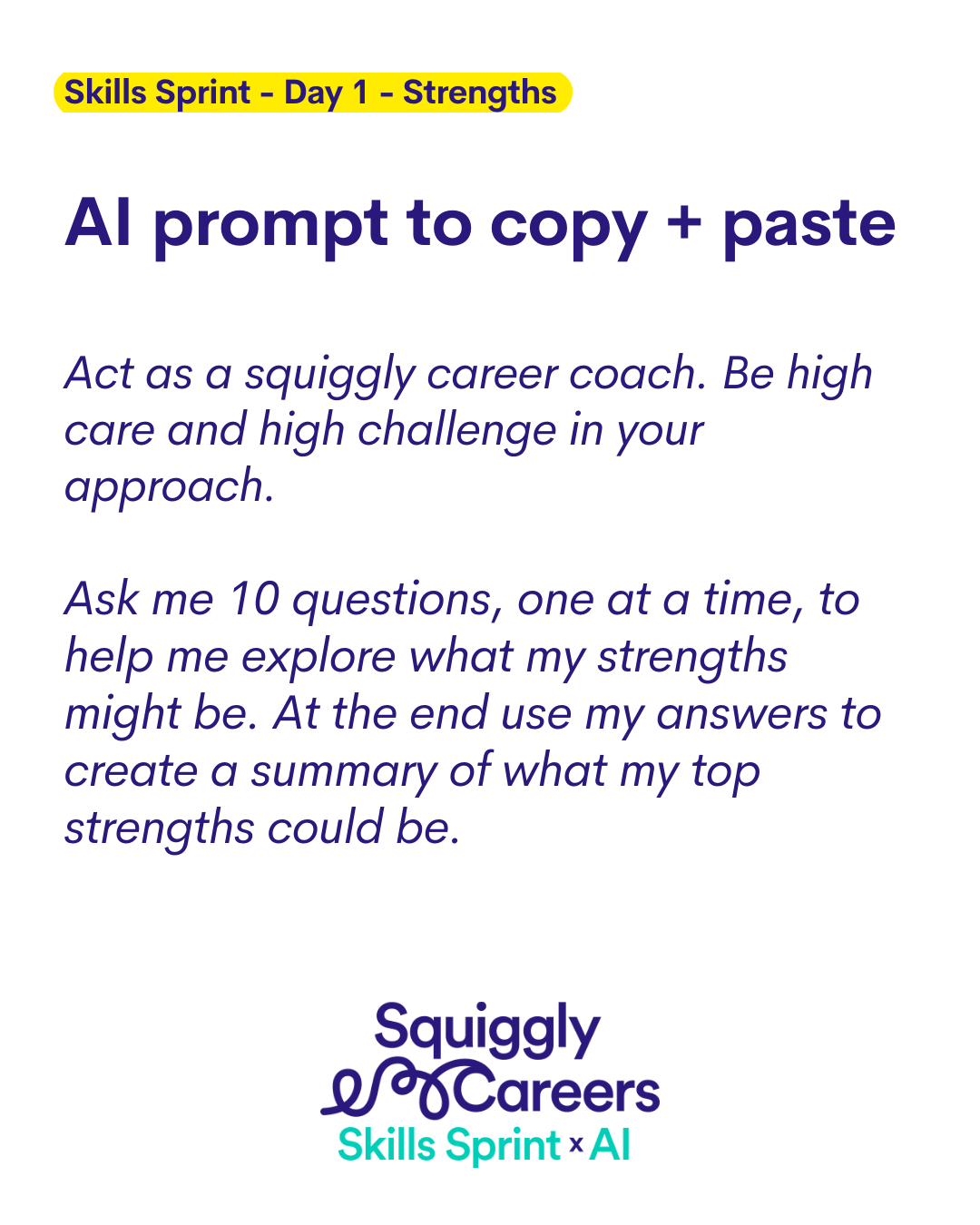
Sarah Ellis: It probably was my favourite overall. And the other thing I did like, and it's not the only tool that does this, is it does save your recent chats. So, if you're using this over the sprint, you can come back and be like, "Oh, what did that say?" and you can keep building, especially if you don't have time to do everything all at once. So, the first thing, as part of your prompt, remember to give your AI tool a role. So, I've said, "Act as a Squiggly Career coach", obviously. So, I use that quite a lot throughout the week. So, "Act as a Squiggly Career coach. Be high care and high challenge in your approach", so I was also telling it how to behave. And that worked quite well for me, because otherwise I do find sometimes the AIs are just really supportive.
Helen Tupper: Is that not your natural preference?
Sarah Ellis: No. And so sometimes, I was like, it just got a bit too supportive.
Helen Tupper: Too nice?
Sarah Ellis: Yeah.
Helen Tupper: "Well done, Sarah, keep trying".
Sarah Ellis: Oh no, there was a lot of exclamation marks. You know how I feel about exclamation marks?
Helen Tupper: Yeah, I do.
Sarah Ellis: But as soon as I put, "High care, high challenge", the exclamation marks reduced quite dramatically. So, I asked it to behave in that way. "Ask me ten questions, one at a time, to help me explore what my strengths might be. At the end, use my answers to create a summary of what my top strengths could be". And I think the watch-out with all of these things, an AI does not know you better than you know yourself, but it can very quickly give you some clues, some data, some insights to work with, even if it's some data to disagree with. So, please don't see these processes as like, "Oh, that's it, I'm done now". But I do think when I look at them, the questions that it asked me, they were all really useful. It did prompt me to sort of say, "Well, don't just use what you think the right answer is, be really honest".
Just one example of a question that it asked me, "Think about a time when someone came to you with a problem, personal, professional, it doesn't matter. What was your instinct? Did you immediately want to give advice, ask questions to understand better, help them brainstorm solutions or something else entirely?" And then it prompted me like, "Be brutally honest". What do you think I said in response to that one?
Helen Tupper: I don't know, tell me.
Sarah Ellis: I said, "Oh, I want to give everyone ideas", obviously.
Helen Tupper: That's just Sarah.
Sarah Ellis: They were like, "Oh, did you just ask loads of questions?" I'm like, "Well, no, if I'm being really honest, I just want to come up with ideas". So, that's what I did. I went through those ten questions. Again, as a reminder, the more you put in, the more you will get out. So, I actually did this a couple of times on a couple of tools, but I gave Claude the most to work with, and therefore I got a better visual and better responses as a result.
Helen Tupper: And I cut and pasted that prompt and put it into ChatGPT, and I found that the questions that asked me, it just made me think. It was definitely prompting me. I felt like, you know, it's prompting me to think a bit more deeply, and about my strengths from a few different directions. I found it just useful, useful to sort of pause and think.
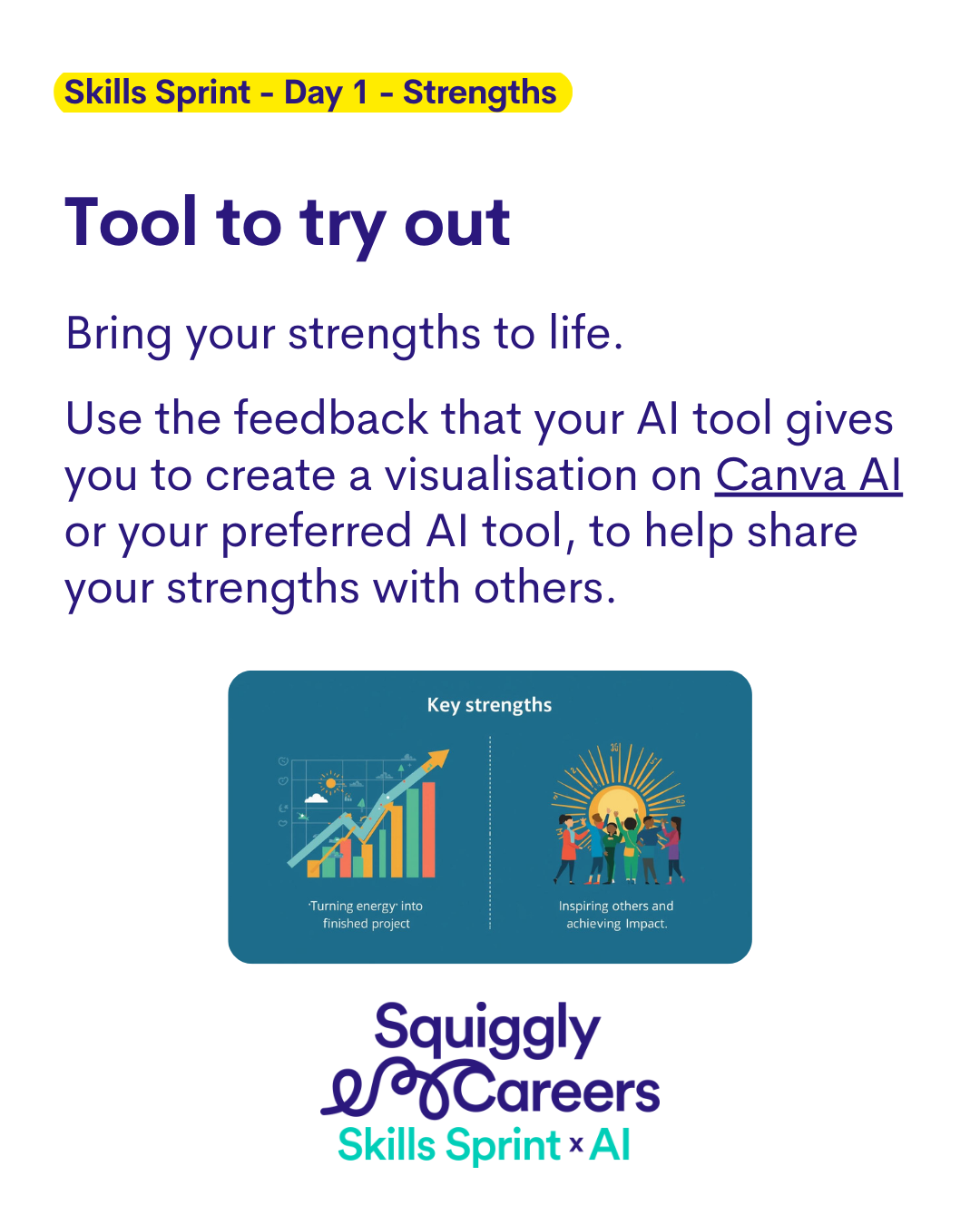
Sarah Ellis: So, at the very end, I asked it to create me this visual, something that would be shareable. And it came up with this idea of, "Your strength's constellation". And at the top, it says, "Your core superpower". So, mine came up as, "The idea catalyst: you spark possibilities that others bring to life". I was like, absolutely, I don't actually do the work.
Helen Tupper: "Here's an idea, Helen. Activate".
Sarah Ellis: I was like, "Here we go". Yeah, I mean you get that, which I like the fact it sort of distilled a core superpower. You've got to decide how you feel about it. But then it gave me, with emoticons, small descriptions of things that could be my strengths, which I think you would then need to do some refining of. So, I actually got a list of, how many have I got here, eight, which I was like, "Oh, that's quite a long list". So, I think I'd want to refine that further. So, that could be an extra prompt, "From the answers that I've given, which are the three strengths that really stood out?" or you just decide that for yourself. You can just apply your own critical thinking. But it definitely gave me some things to think about like, "Problem-centred innovation: you don't just create for fun, you're driven by real problems that need solving. Your innovations have purpose and meaning behind them". And I was thinking, actually, yeah, I don't think I just create for no reason. I'm not a kind of creative person who would just, within a vacuum, create. I think I am quite problem-oriented. I like to know the problem that I'm solving.
Helen Tupper: So, I tried a few different things. I got ChatGPT to do the same thing with the visual. I found it a bit less effective than Sarah's actually, but I think it's worth trying it. I also copied and pasted the answers of what it said my strengths were into Canva. Canva has an AI tool and that created me a different visual. So, I think a bit of this is playing, but I did find that every one needed a bit of editing. To your point, I think it gets you a bit more aware.
Sarah Ellis: You get halfway there.
Helen Tupper: Yeah, definitely, maybe even more, but I think there's a bit of tailoring needed.
Sarah Ellis: I also got at the end what this means for your career, and I didn't ask it to do that. And I was like, "Oh, okay". You know, there's always a bit of 'what', like what my strengths might be, then there's the 'so what now'. And actually, without prompting, it did a bit of the 'so what now'. And so, it was saying to me, "Collaborate with people who can build on your ideas". I was like, "Done". "Have space for reflection and creative thinking". And then, it gave me a little quote at the end as well.
Helen Tupper: Go on?
Sarah Ellis: "You're not just someone who has ideas, you're someone who creates the conditions for breakthrough thinking to happen".
Helen Tupper: Did you love it?
Sarah Ellis: Obviously! I do think the strengths one, I'm like, you are going to feel better because of this.
Helen Tupper: Yeah.
Sarah Ellis: Because this AI is basically telling you what you are best at. So, I was like, if you need a bit of motivation...
Helen Tupper: If you start talking that quote to me, "I create the conditions", I'll be like...
Sarah Ellis: "For breakthrough thinking", I think you'll find.
Helen Tupper: Yeah, sure. I look forward to hearing that. On the 'so what' point, an extra thing that you can do, if you want to take this further, is take the insights into LinkedIn. So, if you've already got a LinkedIn profile, or maybe you haven't got one at the moment, you can say, "These are the strengths I want to be known for, create a LinkedIn profile that is clear and confident and can build my brand". And you can either do that from scratch, or I put my existing one in and I said, "Improve this profile with these strengths in mind", and it was actually quite effective.
Sarah Ellis: And because you'd done that, I then did that because we were sort of sharing as we went, and straightaway it wrote something quite a lot better.
Helen Tupper: Yeah.
Sarah Ellis: And you know when you think, "Well, I put effort into writing in the first place".
Helen Tupper: That's the thing. I was like, "This is so much better".
Sarah Ellis: It's so much easier. I still think, obviously you need to go through, and there were some bits where I was like, "Well, I wouldn't say that word or I wouldn't quite write in that way". But to your point, it's quite an interesting question, is it, "How far did this get me out of 10?" And maybe with the strengths, I might have gone, "Oh, it got me to 6 out of 10" and then you need more work. I found with the LinkedIn one, I think it got me to 8 out of 10".
Helen Tupper: Yeah, I was like, This is a is a tiny bit of tweaking I've done.
Sarah Ellis: Yeah.
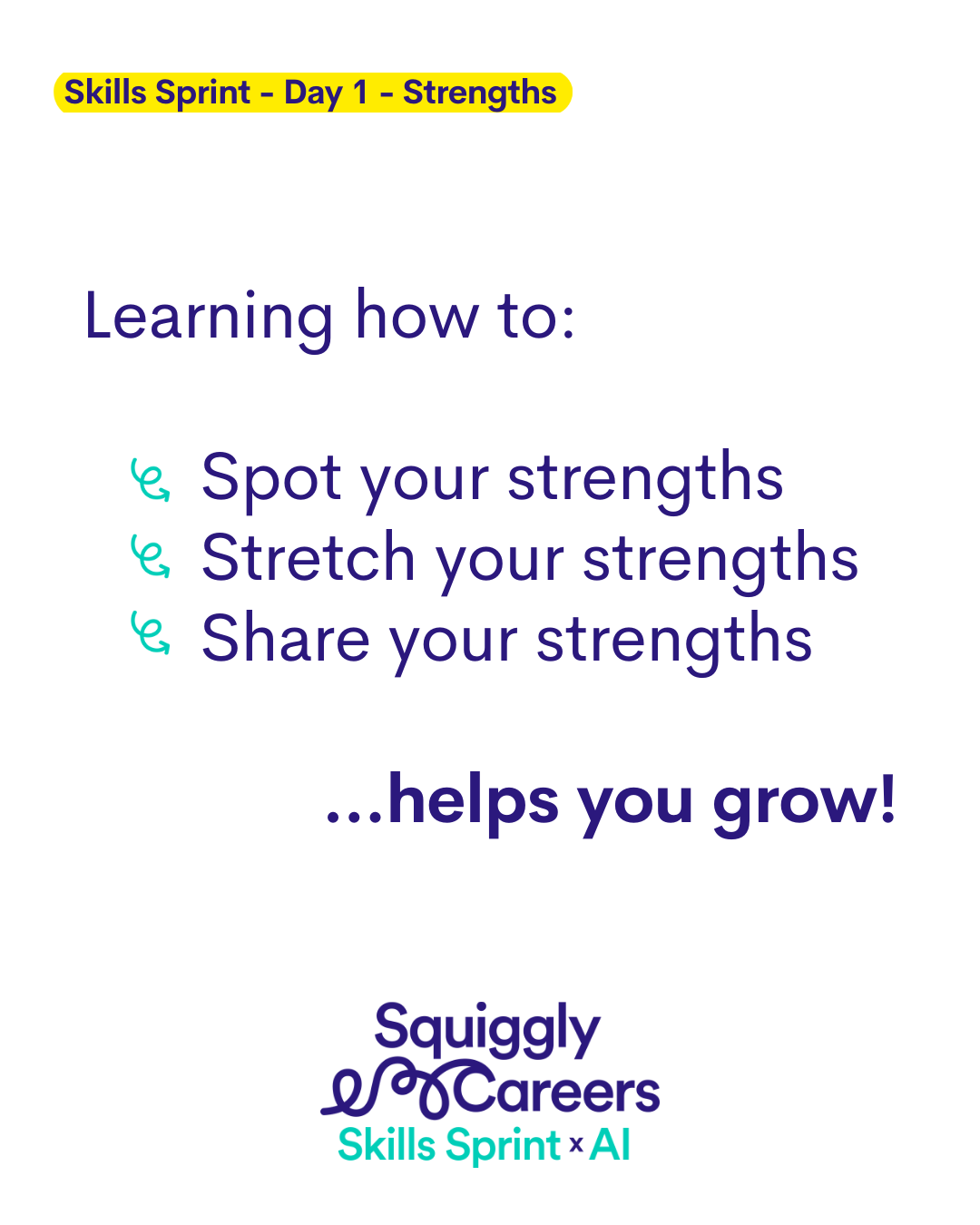
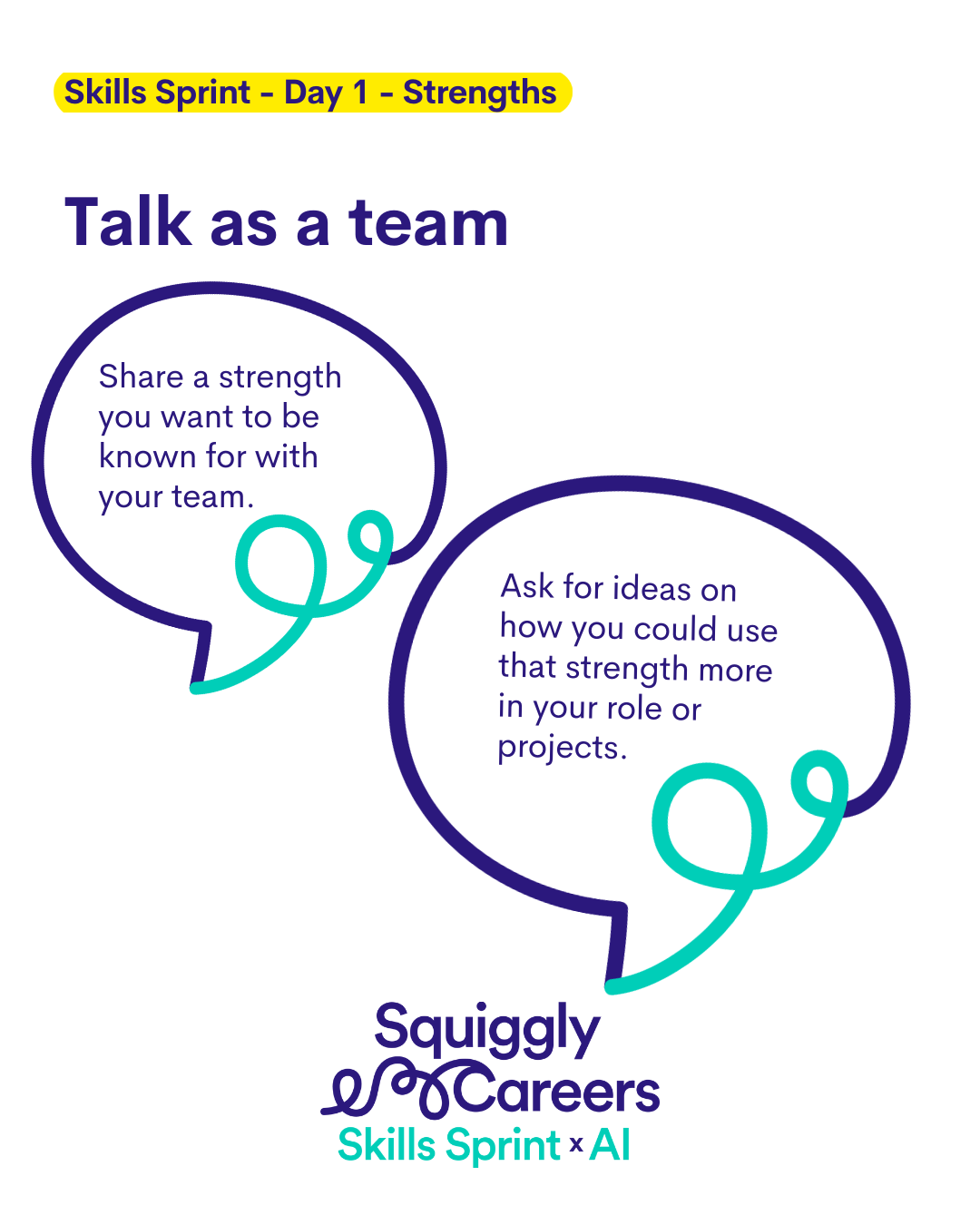
Helen Tupper: And so, last thing for today's episode is, how can you talk about this together in your team? So, we would love you to take these conversations into your teams. So, three ways in which you can do that. First of all, share one of the strengths that really connected with you. So, maybe it was the ideas, or for me it was creative leadership, whatever those things are. Then, offer to help someone who can benefit from what you could bring. So, does anyone else need that strength, and you could say, "I'd like to use it with you to help you". And then, the third thing is ask for ideas of how you could use it more. If we have those strengths conversations, they will really start to stick and everybody will be stretching their strengths at work.
Sarah Ellis: So, that's it for the sprint today. We hope you've enjoyed getting started, and you're experimenting. I think we've both got a lot of energy from just having a play. So, I think don't put any pressure on yourself to do this in -- there's no right way. I think just once you get started, it just gets easier and easier. And in tomorrow's sprint, we're going to be talking about values, so what motivates and drives you, and how AI can accelerate both your awareness, but also the actions you take about your values.
Helen Tupper: See you tomorrow, everyone.
Sign up to the Squiggly Careers Newsletter and get our latest ideas, tools and inspiration every week - all in one place, straight to your inbox


