
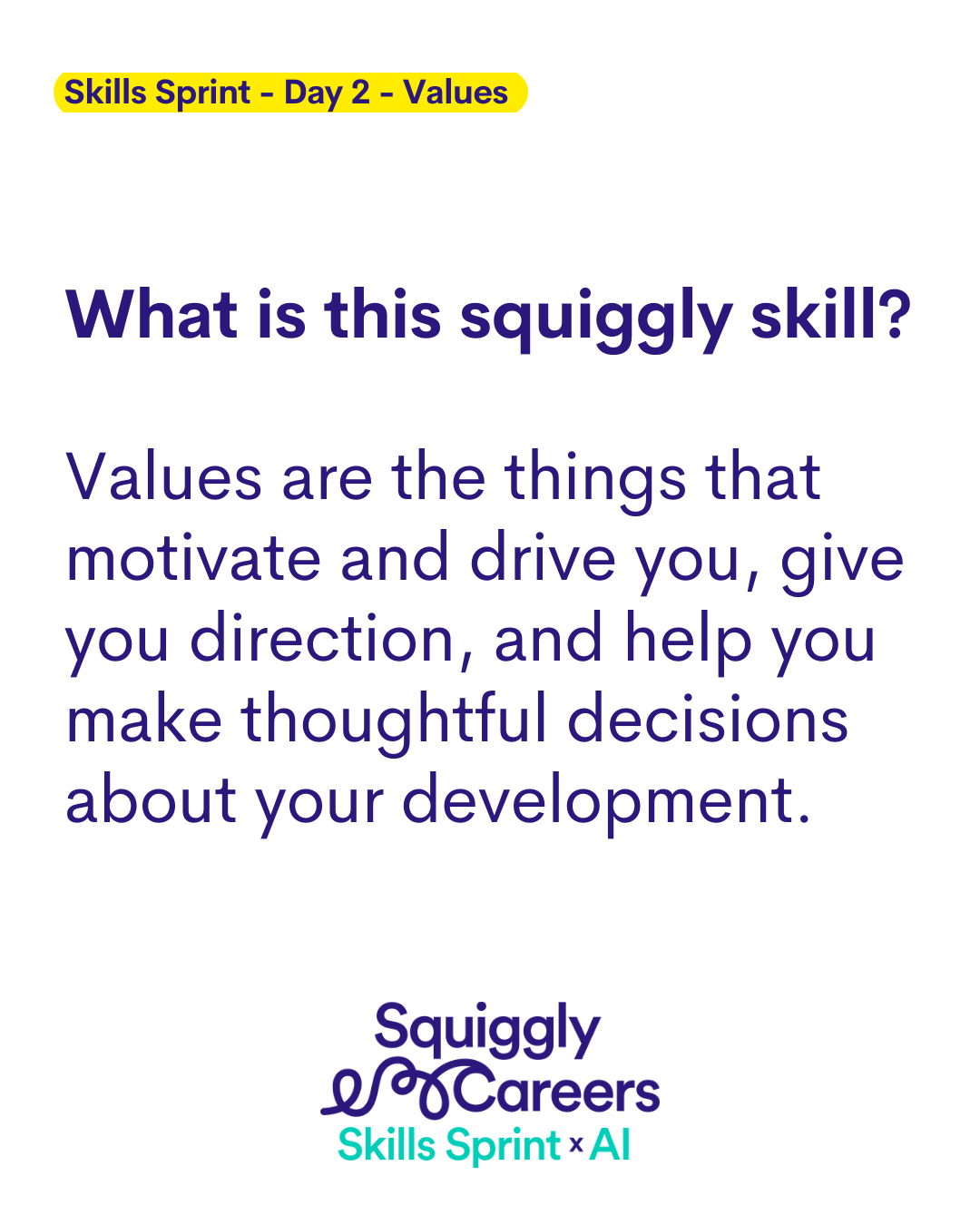
This is the second episode of the Squiggly Careers x AI skills sprint series and today Helen and Sarah are diving into Values. Your values are what motivate and drive you – they’re your internal compass that guides decision-making and career choices.
In this episode, Helen and Sarah share the best tool for identifying your values and how AI can accelerate the actions you take about your values, turning them into a brilliant filter for your future. They’ll show you practical ways to use your values to respond to challenges at work, and share some playful approaches you can also use with your team.
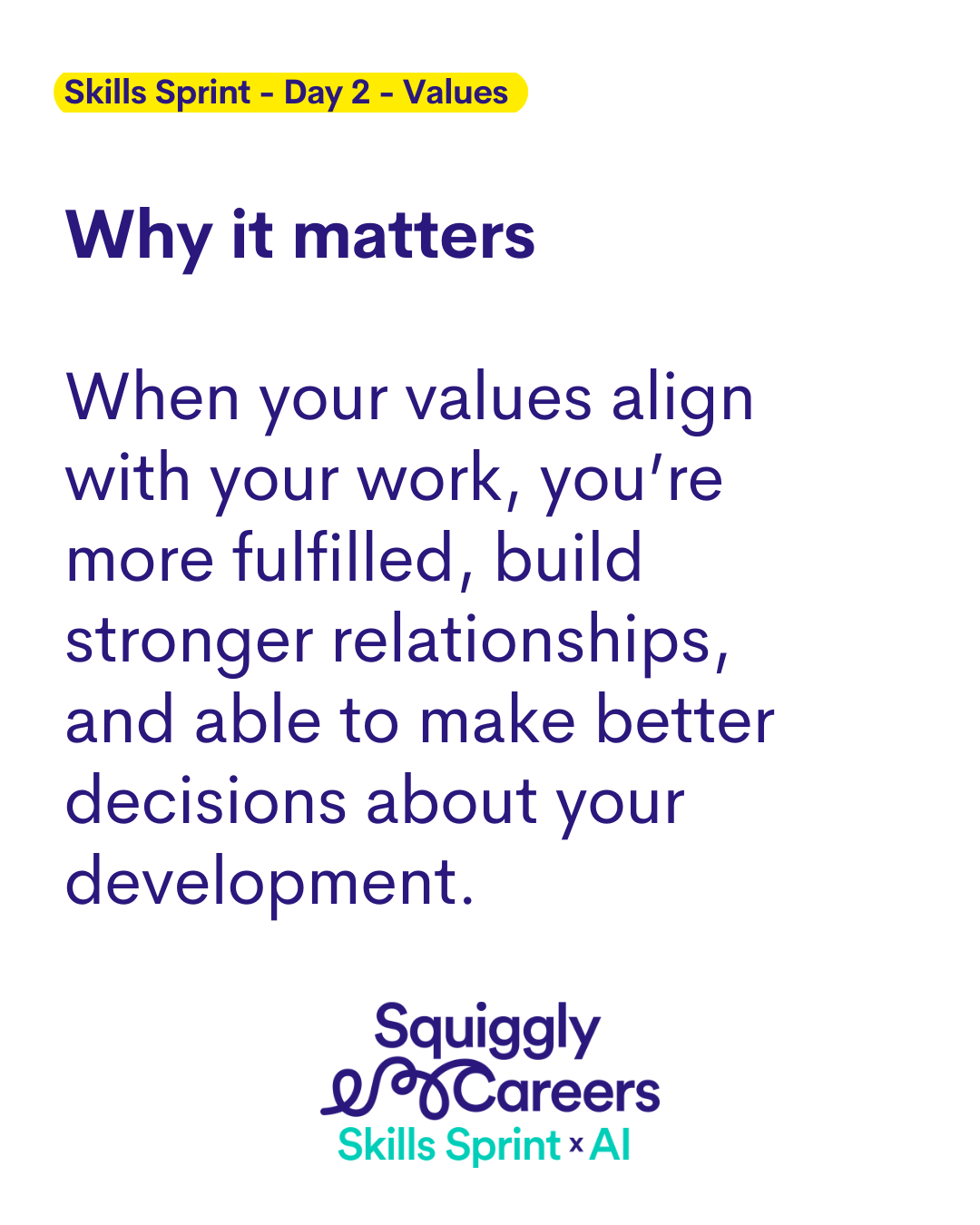
When you understand what really drives you, you make better decisions for your career and become more confident as a result of having clarity about what matters most to you.
🎯 What You’ll Learn
* How to identify and clarify your core values (and why it’s important)
* Why values are a powerful career decision-making filter
* How to use AI prompts to turn values into actionable insights
* Fun and engaging methods to share values with your team
📚 Resources Mentioned
Run Your Own Race Episode: https://youtu.be/cUdwIvnDpNQ
Ask the Expert: Purpose with Simon Sinek, author and speaker: https://youtu.be/DATg__SZcwE
Values Tool: https://values.institute/
Gemini: https://gemini.google.com
For questions about Squiggly Careers or to share feedback, please email helenandsarah@squigglycareers.com
Need some more squiggly career support?
1. Download our free careers tools
2. Sign up for our Squiggly Careers Skills Sprint X AI.
3. Sign up for Squiggly Careers in Action, a weekly summary of the latest squiggly career tools
4. Read our books ‘The Squiggly Career’ and ‘You Coach You’
00:00:00: Introduction
00:00:38: All about values
00:03:15: A great values tool
00:05:53: Forming an AI prompt
00:08:38: A tool for teams
00:09:57: Final thoughts
Helen Tupper: Hi, I'm Helen.
Sarah Ellis: And I'm Sarah.
Helen Tupper: And this is the Squiggly Careers podcast. And you are listening to day two of our Squiggly Careers Skill Sprint, where today we are going to be talking about values. More on that in a moment, but maybe you've started at day two of our sprint and you're thinking, what is this? So, this is a five-day learning experience to support you and your development. And probably the most important thing is that you are signed up for sprinting so that you get the daily summaries, which will have all of the links to tools we talk about today, prompts that you can cut and paste to make this easier for you, and we've got screenshots so you can see how to get started with some of the things that we're going to be talking about.
Sarah Ellis: So, what are values and why do they matter in the context of your Squiggly Career? So, values are what motivate and drive you, they're what makes you, you. You don't have work values and home values, you just have what's most important to you. And I think with values, they can feel a bit abstract or sometimes a bit fluffy like, "What are these 'value' things?" But the reason that it matters to spend some time thinking about your values, certainly from my own experience, is when you understand your real drivers, I think you just make loads better decisions. And in a Squiggly Career we have more choices, more decisions about where we might go, what we want to do, and there's more change and uncertainty. So, when you understand your values, I think they are a brilliant filter for your future, "Should I stay in this company? Should I do something different? What jobs do I want to do? Who do I want to work with? Who do I want to work for?"
If I think about my best Squiggly Career choices, when I've used my values, I've made what might look like brave decisions to other people, but have actually been brilliant decisions for me. And when I have ignored maybe my values and got distracted by the shiny objects, it has never worked out.
Helen Tupper: I think that I agree with you entirely about knowing values. And I think that it's probably one of the five skills that we're going to talk about in the sprint that I'm most personally passionate about, because of the difference it's made to my development. And I think it connects really well with the topic we'll talk about tomorrow on the sprint, which is confidence. I think I am more confident as a result of the clarity I have in my values, because we talk about the quotes, we did it actually in a series over the summer, that one of my quotes is, "Running your own race", and that really motivates me. And I can do that because I've got such clarity on my values, like what makes me, me, what motivates and drives me. So, I think there's a really nice link with the skill we'll talk about tomorrow.
Sarah Ellis: And one of the things that we know as a team is that when you understand each other's values, you collaborate better, you're more empathetic as a team. And often, we'll talk about in a team or in an organisation, we should start with the why, you know, Simon Sinek would tell us to start with the why. And in lots of ways, he's right, and you should listen to him talking to Helen on the podcast if you've not before. But I often think in a team environment, it's really useful to start with the who, who we all are, what motivates us, what's important to us, because then we just work better together. And you spend so much time working in a team, understanding each other I think is easy to miss, but when you make time for it, it does make a difference.
Helen Tupper: And we've got a very fun team exercise right at the end of the podcast today. We've got a really fun way that you can talk about values in teams. But we also have some good tools.
Sarah Ellis: You're so excited about this tool.
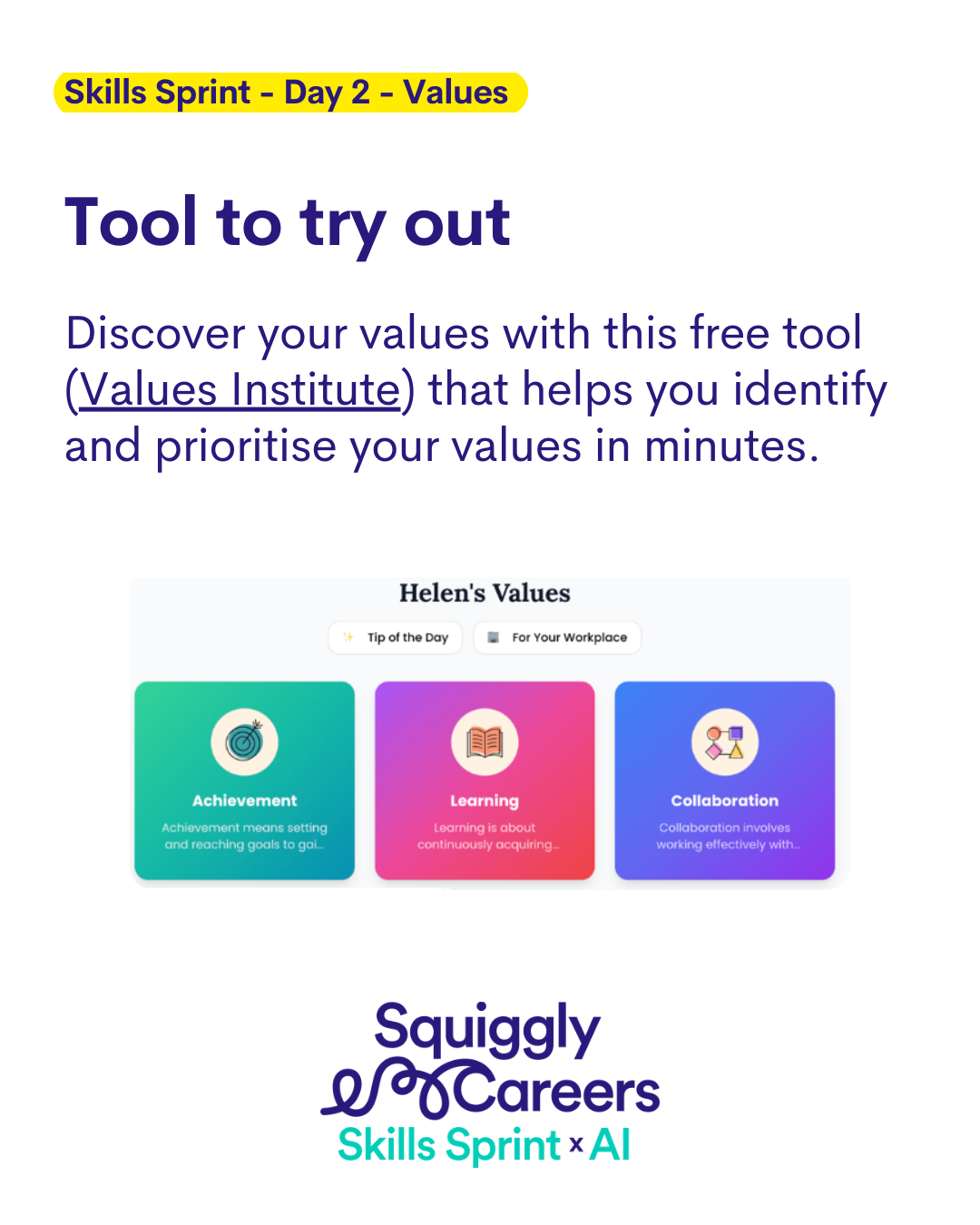
Helen Tupper: I feel like this is the best tool, I think, we've found on the sprint, and we've found some good ones. But I absolutely love the tool that we are going to recommend everybody tries out, it's the values.institute, and it is a tool which will help you to identify what your values are. I already had a lot of confidence in what my values are, so I was really intrigued as, from a blank piece of paper, how close did it get.
Sarah Ellis: Yeah.
Helen Tupper: So, it will ask you a series of questions, and then what you get is some really, really rich learning resources out of it. So, it will not only tell you what your values are according to the things that you've answered, so for example, mine came out as, "Achievement, learning and collaboration". It's pretty close to what I would hold as my values. It's not perfect, but I think it's definitely closer than a lot of other things that I would see. So, it will help you with that. But I think the really useful thing in this tool is, it then has three different ways in which you can put that insight into action.
So, the first is it gives you a bit of a profile. So, for each of the values, it talks about it in a bit more detail so that you can get more clarity. I think that's really useful when you are discussing your values, because I rarely go up to somebody and say, "Hi, my name is Helen and I've got a value of achievement". What I will often do is use the descriptions to discuss it, it just feels a bit more natural, so it gives you some of those words. Then, there's a bit on practice, and you can pick one of the values, and you can pick whether you want to do something in a day, something in a week or you want a mindset shift, and it will generate you an action. I'm like, "This is great". So, you get really specific actions. And then, there's a bit on challenge. So, you type out a challenge. So, for example, I said, "I really don't like my business partner. I'm really struggling to work with her. She's really difficult". I didn't do that one! But you put in whatever challenge you want, and then it uses your values to then recommend you a way to respond to that challenge.
I just find it very insightful, really practical. It's free, and it's just the best thing I've seen to support values. I'm a big advocate of this tool.
Sarah Ellis: And one of the things I actually really liked about it was it also felt quite playful. So, it gave me a long list of things that could be my values, asked me to do the prioritising, which we always encourage people to do. But again, it's very quick to do because you can kind of move around the words on the screen. And to your point, I like the fact that it went beyond just generating words. There's quite a few different tools that do that. But to me, quite a lot of the value in this felt like, well, this is maybe what I would go and do now, this is the action I would go and take. And that's the inspiration for the prompt that then we used. So, I actually used Gemini for this one, I was like, I've not used that one yet, so why not.
Helen Tupper: Give it a go.
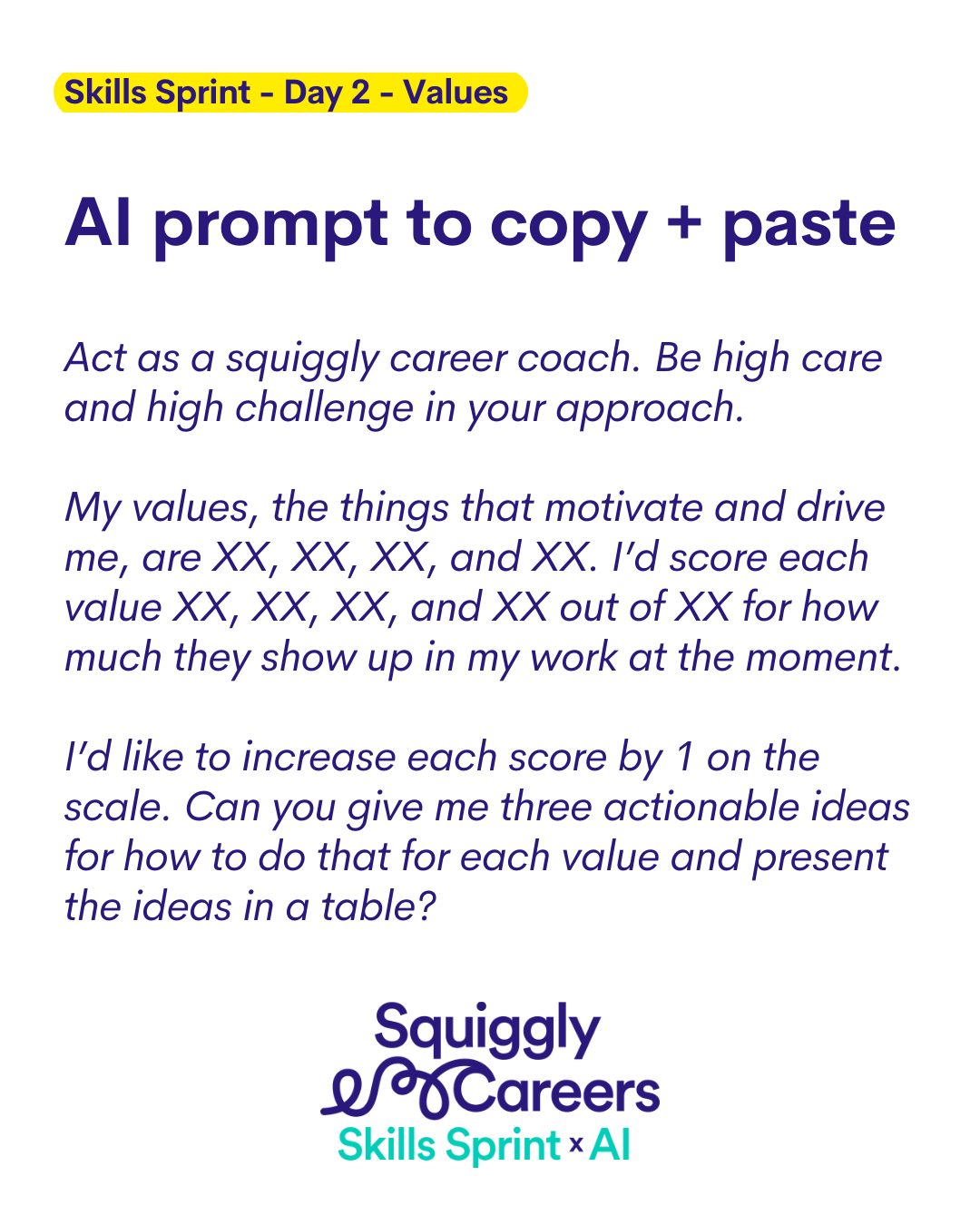
Sarah Ellis: Give it a go. And again, I asked it to act as a Squiggly Career coach, be high care, high challenge. I told it what my values are. So I said, "My values, which are what motivate and drive me, are achievement ideas, learning, and variety. I'd score each value 7, 6, 5 and 7 out of 10 for how much they show up in my work at the moment, and I'd like to increase each score by one on that scale. Can you give me three ideas for how to do that for each value and present the ideas in a table?"
Helen Tupper: And you pushed it.
Sarah Ellis: Yeah, also I've done a course on prompting, obviously. So, I've got quite a lot better at prompting. Thank you, David Hieatt at DO Lectures, very accessible prompting course. I think it's about £26 and I was like, "That was £26 very well spent". And that's why my prompts are as good as they are. And also, if you don't write a good prompt, ask the tool to write you a better prompt. Top tip. What I did find with Gemini, to be honest, that it struggles a little bit more with presenting information in such a clear way. Some of the other tools are much better at putting it into tables, converting it into PDFs. At the time of recording, Gemini didn't want to make me a PDF. It said, "I'm a text or a copy-based tool". And I was like, "Oh, okay". I thought I could just ask an AI to do me anything and it should do my bidding. But apparently that's --
Helen Tupper: Push back.
Sarah Ellis: Yeah, it did push back. But actually, once I then asked it to present the information in a different way, so I thought rather than just give up, obviously it didn't want to do that for my first version, I said, "Okay, can I have it in bullet points instead?" And then it did work. And I liked the idea. It said, "Ideas, current score 6, target 7". So, it had understood me. And then it gave me three bullet points, say, for ideas. So, one of them was about scheduling thinking time, like, "Add thinking time into your week". One of them was about preparing one new idea or thought-provoking question to share in a team meeting. So, at least it was a specific context. And then, it also gave me suggestions about, what about a small pilot project or experiment with testing a new process or tool that I've been thinking about.
So, I felt like it was helpful prompts because I think for values, one of the things that can feel hard is the 'so what now'. So, scales are helpful because they give us a starting point, so like where are you out of 10 with those values? Even if you're not 100% sure they're your values, you can still give them a score out of 10. And then just nudging up on that scale, you'll have your own ideas, but actually AI could either build on the ideas that you've got, or it could give you some ideas to get you started.
Helen Tupper: I think it's just, you've got nothing to lose by trying these out. I think you'll just become a bit more self-aware, you'll identify some actions. That's really what the sprint's all about.
Sarah Ellis: Do you want to do the team?
Helen Tupper: You might also want to have some fun.
Sarah Ellis: You're so excited about this.
Helen Tupper: So, we were chatting, we were like, "How can we get people…" and we have, to be fair, we have done a whole podcast on talking about values in teams. So, we were like, a small, quick thing that people could do. So, this is our recommendation.
Sarah Ellis: We approached this quite differently, I think it's fair to say, isn't it?
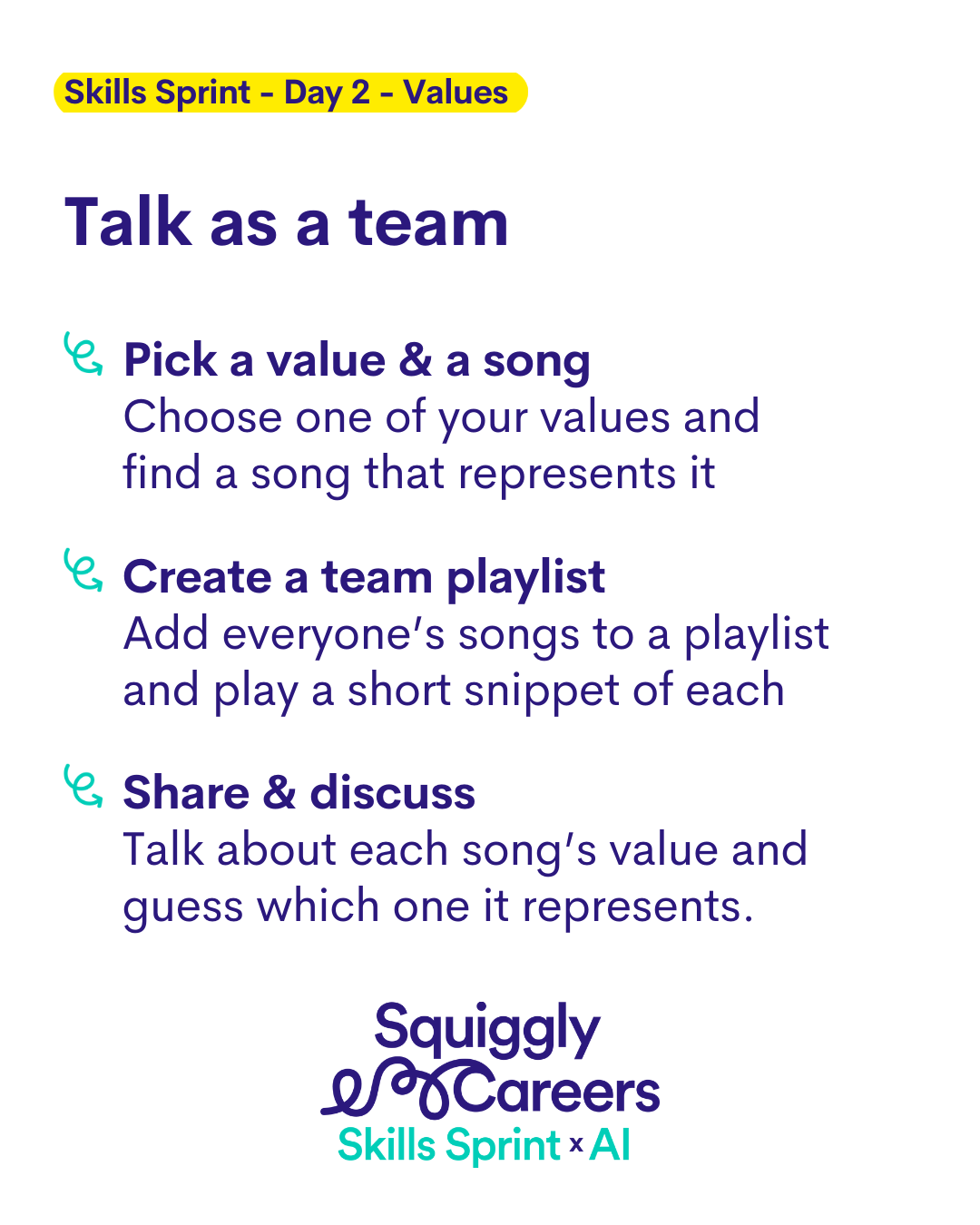
Helen Tupper: Yeah. So, you take one of your values, one that you really recognise, and think about a song that represents that value. You can create your own Spotify playlist as a team and you can play, like, ten seconds of the song, and then you can discuss what your value was, maybe even get people to guess, "This is my song, what do you think my value is?" You can have a lot of fun with it.
Sarah Ellis: That would work better with how you approach this than how I approach this. So, do you want to give the example?
Helen Tupper: We were having practising, we were chatting last night, we were practising.
Sarah Ellis: So, you went first, and what did you come up with?
Helen Tupper: Oh, I can't remember now, but I think one of mine's energy and I'd be like --
Sarah Ellis: No, you had, "Freedom". You started singing George Michael to me at like 10:30 at night, and I was like, "Oh, this is the point where I go, 'Bye'". You went quite literal.
Helen Tupper: Yeah, like a values song.
Sarah Ellis: Because you had, like, goal.
Helen Tupper: Yeah, well that was what I said for you.
Sarah Ellis: You said achievement.
Helen Tupper: "Always believe in yourself".
Sarah Ellis: I still can't believe you're singing on the podcast. But one of my values is ideas. And I felt like Kate Bush was a real pioneer of ideas and being creative.
Helen Tupper: I mean, go as deep as Sarah or go as shallow as me, but you'll have a lot of fun in the process.
Sarah Ellis: So, yeah, I didn't, I didn't go literal, I went quite conceptual, which I think is quite appropriate.
Helen Tupper: I think it's standard.
Sarah Ellis: Yeah, but I think music creates connection, it is a lot of fun. We have actually tested versions of this with groups before, and I think it just gets everyone talking about themselves in a way that is low-key, playful, and where sometimes I think values can feel quite serious, and also a bit off-putting for some people, but I think everybody could pick a song that tells you something about what's important to them. And that worked for us. You can either start singing, like Helen, or you can just get Spotify to do the work for you.
Helen Tupper: Feel free to give us some 'what worked well, even better if' feedback on my singing. No, don't!
Sarah Ellis: So, that's the end of today's Skills Sprint on values. Tomorrow, we will be back talking about confidence and those gremlins, beliefs that hold you back and how you can cage them.
Helen Tupper: Happy sprinting, everyone!
Sign up to the Squiggly Careers Newsletter and get our latest ideas, tools and inspiration every week - all in one place, straight to your inbox


