
Do you find yourself constantly checking your phone or email instead of focusing on your most important work? In this squiggly shortcut, Helen shares practical ways to beat distraction and reclaim your attention.
Drawing on Nir Eyal’s research on becoming indistractable, she explores what it really means to develop this skill.
🎯 What You’ll Learn
– Identify your personal distraction downfall
– Understand why you are attracted to distractions
– Learn why avoidance triggers procrastination
– Audit your environment for high-attention work
– Master the “not yet” rule to build focus
– Find the best timing for your deep work
For questions about Squiggly Careers or to share feedback, please email: helenandsarah@squigglycareers.com
Need some more squiggly career support?
1. Download our free careers tools
2. Sign up for our Squiggly Careers Skills Sprint
3. Sign up for the Squiggly Careers Newsletter, a weekly summary of the latest squiggly career tools
4. Order our new book, Learn Like a Lobster.
Helen Tupper: Hi, I'm Helen from the Squiggly Careers podcast, and you are listening to another one of our Squiggly Shortcuts. These are weekly episodes which we make deliberately short so that you can fit them into your week.
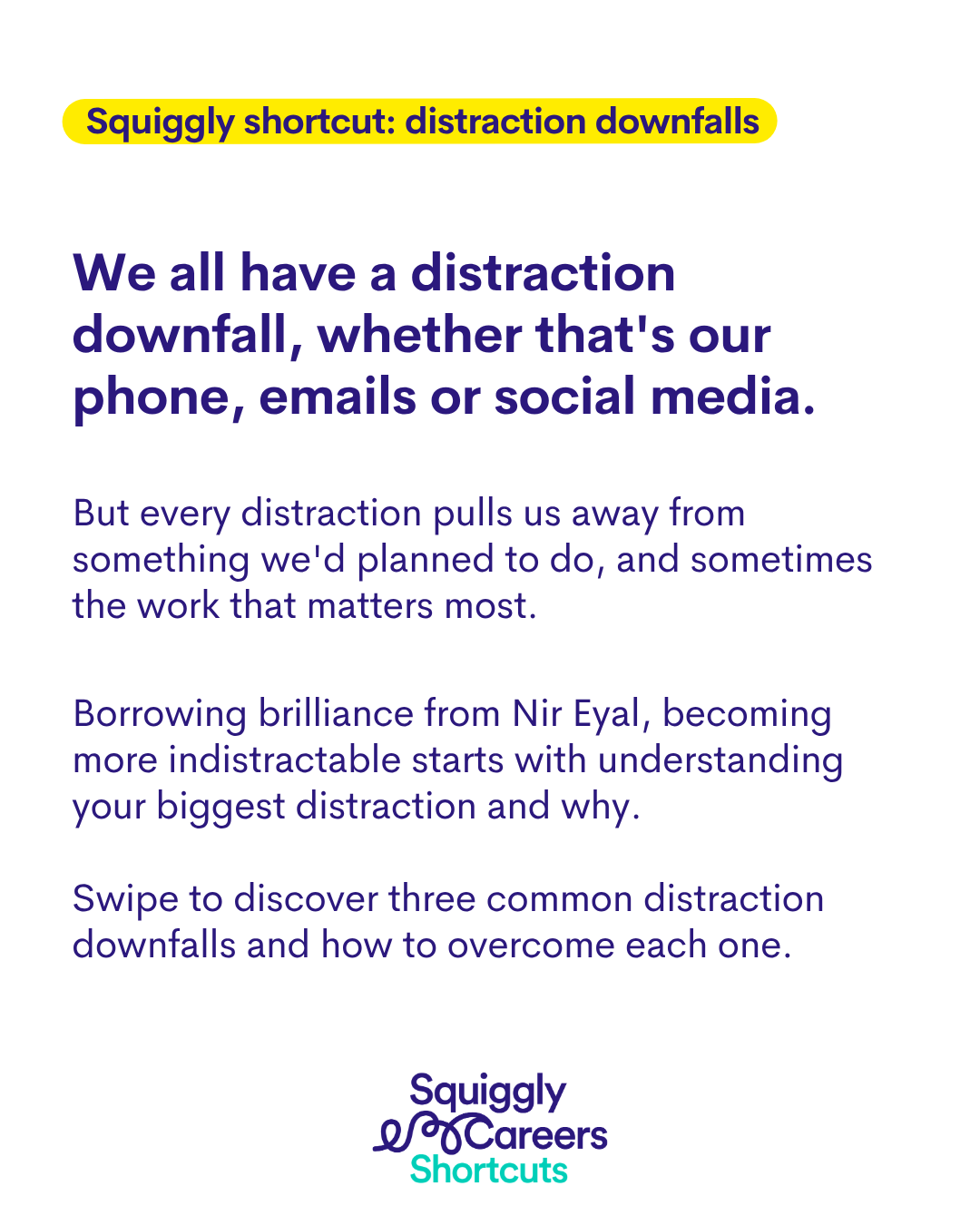
And today I'm going to talk about the topic of distractions. I'm actually going to talk about an idea that was in an earlier episode, like hundreds of episodes ago, episode 253. We're over 500 episodes now, so you might have missed it. But it was one of our Ask the Expert episodes that we did with Nir Eyal, who wrote the book Indistractable. And there was a little bit of that conversation that has stuck with me like years on from the conversation because I think it is really useful if you find yourself struggling with distractions.
So that's what I'm going to focus on in this shortcut today. So I'm going to imagine, if you are still listening, that you are somebody who perhaps struggles with distractions, because most of us do. And, and what Nir's advice was, if you are somebody who wants to become more indistractable, first of all, you have to identify your distraction downfall.
Now, I've asked loads of people about what their distraction downfalls are, and you get some really, I guess, obvious answers. So people will tell me email is a distraction downfall for them. You know, they're trying to do something. They're. I don't know, they're trying to do some of the exercises that we give them on the Squiggly Careers podcast. And as soon as they sit down, they get some emails and that distracts them. So people have said that to me. They said just their phone, like the notifications on your phone. People have said social media to me. I've had some random ones as well.
Somebody once said cheese, like, just cheese. Like, as soon as I try and concentrate on something, I just think I really want to eat some cheese. So there are lots of different distraction downfalls. But if you want to become indistractable, you have to start this process by understanding what you your distraction downfall is. Then you need to think about why. Why am I attracted to this distraction? And what Nir said was, there are three reasons why you are attracted to distraction. And you have to kind of work out what your why is. Because once you know what your downfall is and you know why you are attracted to that distraction, that's when you can do something different. That's when you become indistractable.
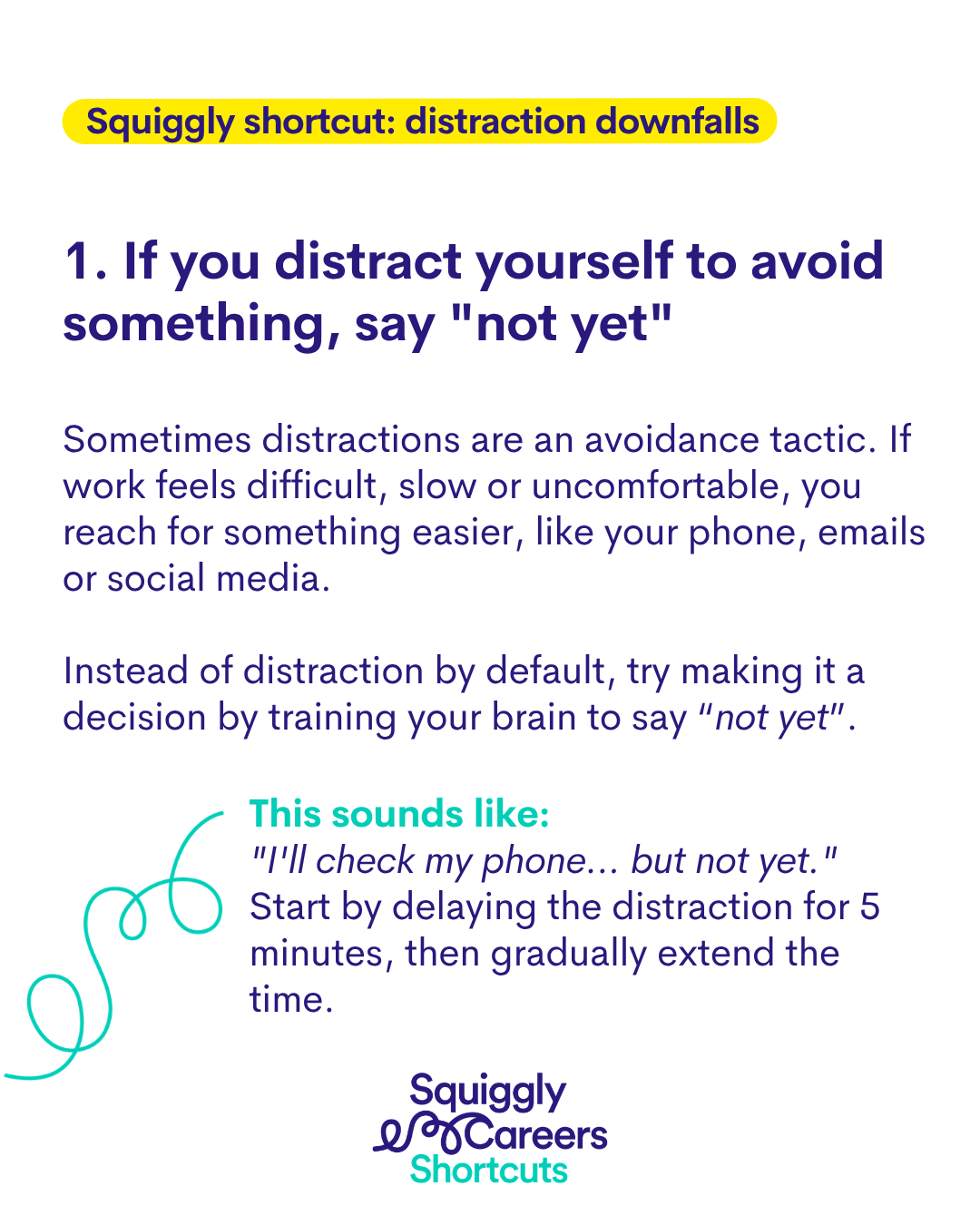
So, here are the three reasons why that he shared with me. The first was avoidance. So the reason why you are attracted to distraction is because you are using it as an avoidance tactic. The thing you are doing feels hard or slow or not particularly rewarding or difficult, whatever it is. But you are using your particular distraction downfall as an avoidance tactic because it's easier to send an email, it's easier to scroll through Instagram or whatever app you're using. It's easier to go and eat some cheese if that's what your downfall is. But the reason you're doing that is because you are avoiding the thing that feels hard or difficult or slow to do. So maybe that's your reason why you're attracted to distraction. Most of the time that's mine.
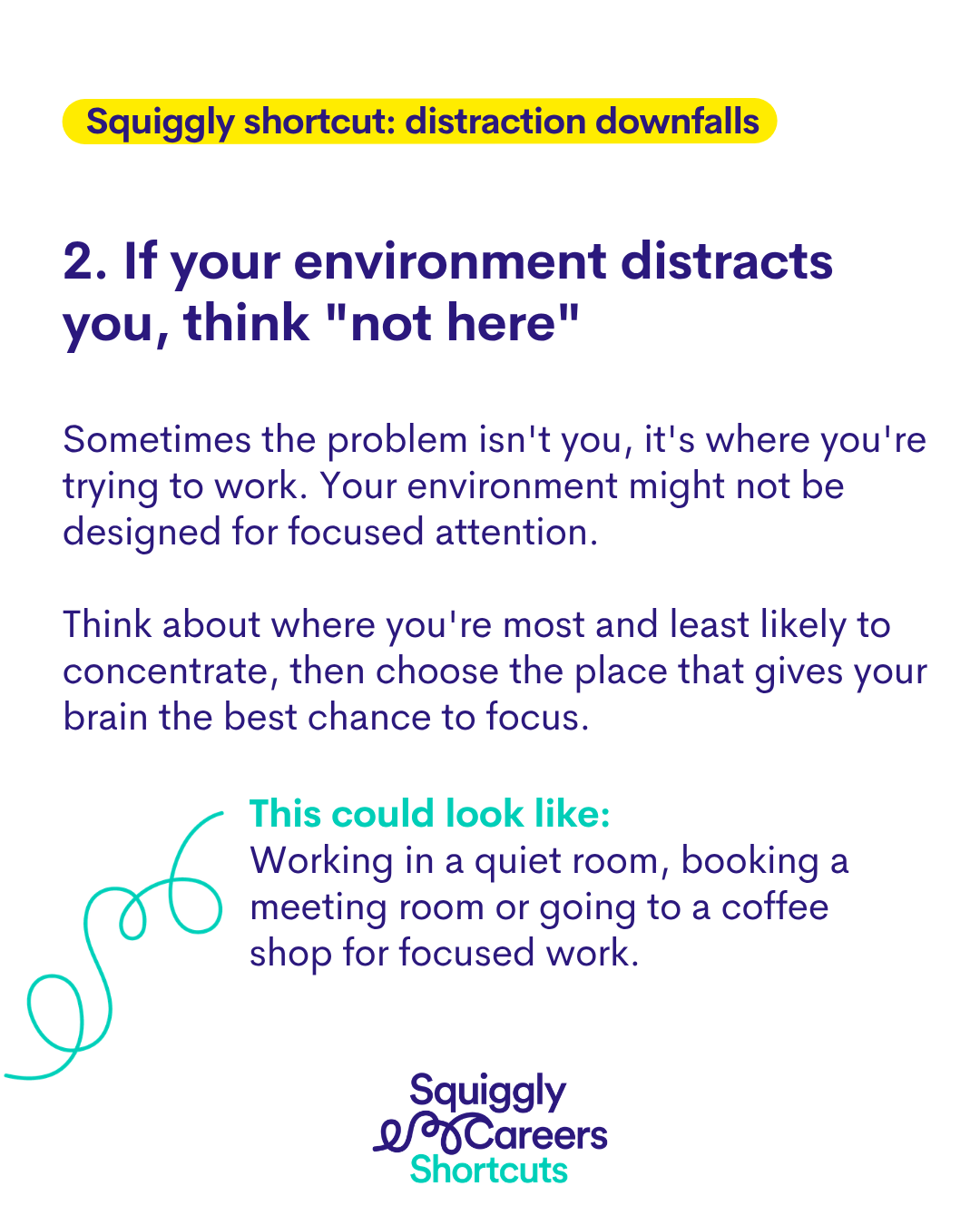
The second reason is your environment, like the place you are trying to do the this work in. Whether it's something on a project or something you need to read or whatever it is, but the place you are trying to be indestructible in is not designed for that. There are, you know, your phone is on your desk or you're doing it in the office when everybody comes to your desk, or you're doing it at home where people come and talk to you all the time. Your environment is not conducive to your attention. So maybe, maybe that's you, your issue. And the third one was about poor planning.
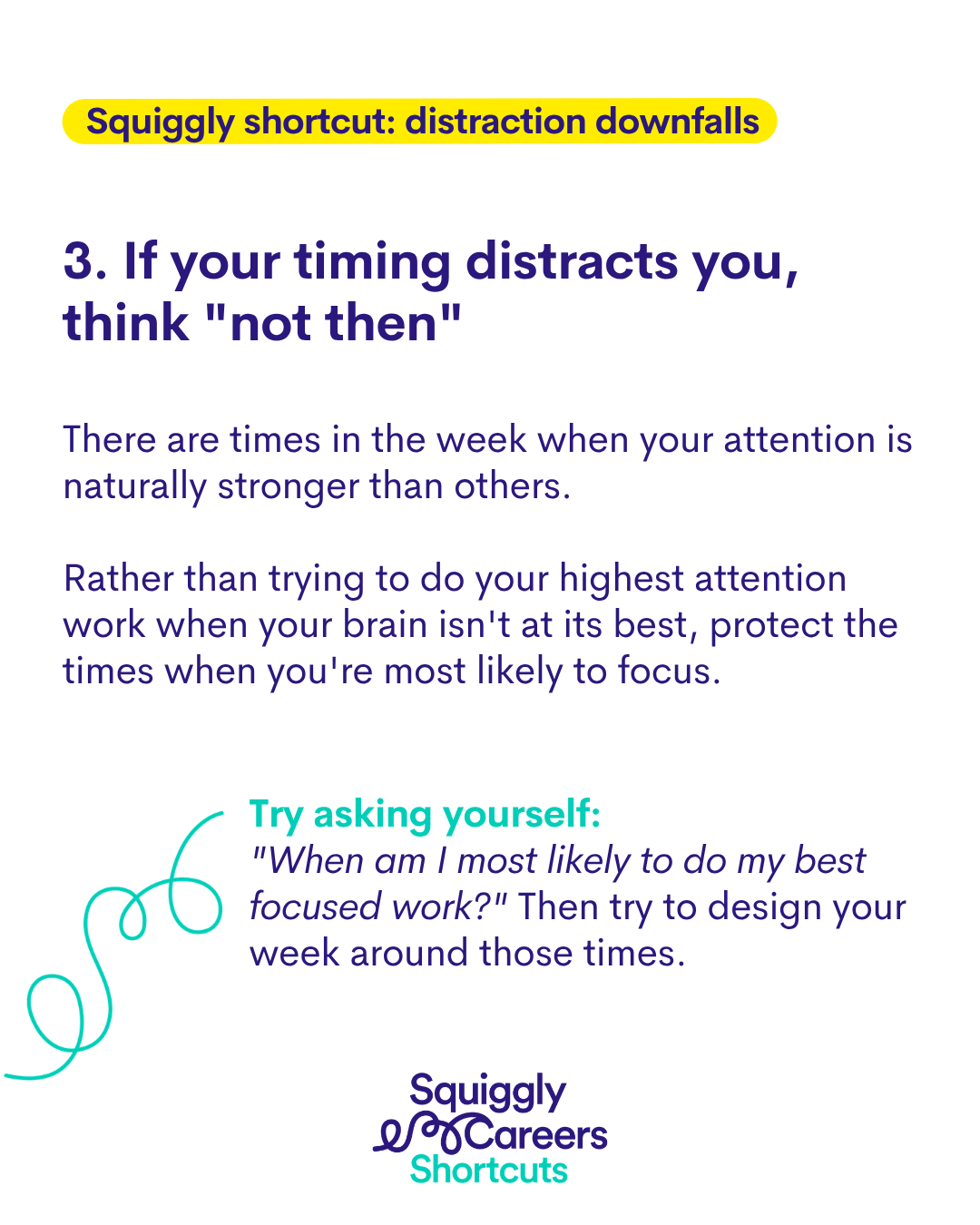
So what Nir said is there are times in our week where we are all better able to manage our attention. We are just more likely to be indistractable. So for example, for me, early in the morning and definitely earlier in the week. So like a Monday or Tuesday morning, I have a much higher level of, I guess work willpower and attention like that. That is the time in my week for me to do some really high quality work. Whereas 4:00 clock on a Friday, I am very distractible. You could send me a message and I'll go down a rabbit hole and do something entirely different to the thing that I'm trying to do. Because my, my brain is not great for being indistractable at that time. And what Nir says is often we're trying to do high quality work or high attention work at the wrong time of the day for our brain. And that, that is different for everybody.
So you've got to know what your downfall is. And then you've got to know why am I attracted to this distraction or avoidance environment or just poor planning? Once you've worked that out, then you can do something different. So here are the what to do differently.
So if like me, you think I am totally using my distraction downfall as an avoidance technique or an avoidance strategy or an avoidance issue. Whatever it is, you need to train your brain to say not yet. So let's say your downfall is your phone and, and you're sitting down to do some work and you feel the pull, you feel the pull to pick up your phone. You need to recognise that that is happening and respond by saying, well, I will pick up my phone, but just not yet. And it doesn't matter if not yet is in two minutes. It doesn't have to be a particularly long period of time, but what it is is a decision to be distracted by your phone rather than a default. And, and if you can start making it a decision, well, I'll pick it up, but in two minutes time, then you can start extending that time so it becomes 5 minutes and 10 minutes and then 30 minutes and that you have a longer period of time when you are indestructible. So if avoidance is your issue, then not yet is your response.
If your environment is your issue, then not here is your response. You need to work out where are the worst places for you to do the kind of work that requires you to be indestructible and you need to think, well then where, where is a better place? Maybe it's a different room in your house or for me, often it's going for a walk. I find that I can sit with my thoughts for a lot longer if I'm doing that, and perhaps it's in a coffee shop, but you need to think about your environments, where are the worst places and where are the best places and make sure you're doing this high attention work in the best places for your brain.
And last but not least, if planning is your issue, if you recognise that your attention is quite variable in a working week, you need to know when are your not then moments, when are the moments where you, you just don't have a high level of attention, you have very little willpower for your work. Like you know, my four o' clock on a Friday, what's the equivalent for you? And then you need to think about, well, when are the best times for my brain, when am I much more likely to be indestructible? Maybe you're a night owl or maybe like me, you're an early morning person. But, but you want to protect those times in your week and design this kind of indestructible work into those times.
So I hope that has been a useful recap of just one of the bits of that conversation that has really stuck with me over time. If you do want to listen to all of it, it's episode 253 of the Squiggly Careers Podcast. You can search for it on our website. Just go to amazingif.com and search for Nir Eyal. But we'll also put the link to that episode in the show notes for you. Thank you so much for listening and we're back with you again very soon.
Sign up to the Squiggly Careers Newsletter and get our latest ideas, tools and inspiration every week - all in one place, straight to your inbox


