Not all problems are created equal, and trying to solve them all the same way is likely to result in frustration.
In this episode, Helen and Sarah explore how to identify whether you are facing a tame, critical, or wicked problem and the specific approach needed to make progress on each.
Drawing on the work of Keith Grint, they explore what it means to develop this skill.
🎯 What You’ll Learn
– Identify the three distinct types of problems you encounter at work
– Apply the right process to clear up recurring tame problems
– Manage high-stakes critical problems without losing control
– Reframe wicked problems to move from stuck to progress
– Use ‘What if’ and ‘What would’ questions to unlock new perspectives
– Prioritize actions to stop overthinking complex challenges
For questions about Squiggly Careers or to share feedback, please email: helenandsarah@squigglycareers.com
Need some more squiggly career support?
1. Download our free careers tools
2. Sign up for our Squiggly Careers Skills Sprint
3. Sign up for the Squiggly Careers Newsletter, a weekly summary of the latest squiggly career tools
4. Order our new book, Learn Like a Lobster.
00:00: Introduction
01:34: Problem-solving is a really important skill that should be invested in
02:58: Not all problems are the same and so the way you solve them will be different
04:45: Problem one… Tame problems - easy to spot and relatively easy to solve
06:50: Problem two… Critical problems - need solving urgently
10:18: Problem three… Wicked problems - complex, ambiguous and interconnected.
10:45: How to solve each type of problem
22:59: Keith Grint's take on how to better solve problems and closing remarks
Sarah Ellis: Hi, I'm Sarah.
Helen Tupper: And I'm Helen.
Sarah Ellis: And this is the Squiggly Careers podcast, where every week we borrow some brilliance from a person, a place, an object, even a word when I get my way. And we turn that curiosity into useful action for you and your Squiggly career. And this is one of our episodes in partnership with Post-it Notes, which we always find exciting. But I think we used them loads before and now we just use them even more.
Helen Tupper: I feel like it's just given us an excuse. And also, I mean, I've got to bite you. I was in the car with Gareth, my husband, the other day. He was like, do you remember when you just like going. Going into stationery shops all the time. Staples. I'll be particular. And I just used to buy loads of Post-it notes. But I feel like maybe I paused and I just. I started to use the same Post-it notes. But now this has given me a
Sarah Ellis: new lease of life.
Helen Tupper: Oh, my gosh, A new lease of life. I mean, my favourite, like genuinely my new favourite Post it notes.
Sarah Ellis: The transparent ones. No. Oh, I love those.
Helen Tupper: I do too, but which I didn't have before this partnership. The dispenser.
Sarah Ellis: Oh, the little dispenser.
Helen Tupper: Absolutely love the dispenser.
Sarah Ellis: It's got little tabs, like with the little tabs. And you, well, you just pull out
Helen Tupper: the Post-it notes from it.
Sarah Ellis: Oh, you're talking. So I was talking about. You're probably meant to do this more professionally than this. Right, than we're doing it is very generous. I was talking about the small dispenser where it dispenses like the books tabs that you would put in books to be like, oh, I need to go back to that page. You're talking about the big dispenser. If you've not got one, I've probably got yours.
Helen Tupper: That's probably why I'm gonna get one now. No, no, like, so normal Post-it notes and they're like Z Post-it notes. So you pull one out and then your next one's there. So you can just like, oh, honestly, I sit there. They bring me a lot of joy. Anyway, more practically, we are going to talk about how Post-it Notes can be useful for the topic we're talking about today. So Sarah mentioned that sometimes she gets her way to talk about words like oracy, which was last week's podcast, which was. I really enjoyed talking about it.
Sarah Ellis: I'm glad.
Helen Tupper: And sometimes I get my way where we get to talk about problem solving
Sarah Ellis: and it's so made for Post-it notes as well.
Helen Tupper: It's so made for Post-it notes. But also I do love anything that has that. I don't know. Problem solving is just so practical, but it isn't just a selfish thing. I do think this is a really important skill because when you, when you look at a lot of the work that's coming out about AI and what skills we need to invest in, problem solving comes up a lot. I was actually at a presentation earlier today where someone from Skills England was saying, he gets asked all the time, like, what are the skills that I need to invest in? And he says, like, I'm not, I've not got a crystal ball, I've got some data. He was, he works in economics, like I've got some data. But I, I, he talks about them as no regrets skills.
Sarah Ellis: And he was like, that's nice framing.
Helen Tupper: I really like.
Sarah Ellis: I mean that's a podcast itself.
Helen Tupper: No regret skills.
Sarah Ellis: Yeah.
Helen Tupper: And he said like, like problem solving, for example, is a no regret skill. You, it doesn't really matter what is going to happen in the world.
Sarah Ellis: Problem solving, that will always be useful, always.
Helen Tupper: So invest in that skill, you're going to have no regrets. So we did cover this, we cover problem solving more broadly in our Sprint. So I will link to that episode because it's a really, it's a really short one that's a bit more broad on problem solving. But, but we are going to borrow brilliance today from somebody called Keith Grint who has got a particular perspective on problem solving.
Sarah Ellis: It's a lot of alliteration, one sentence
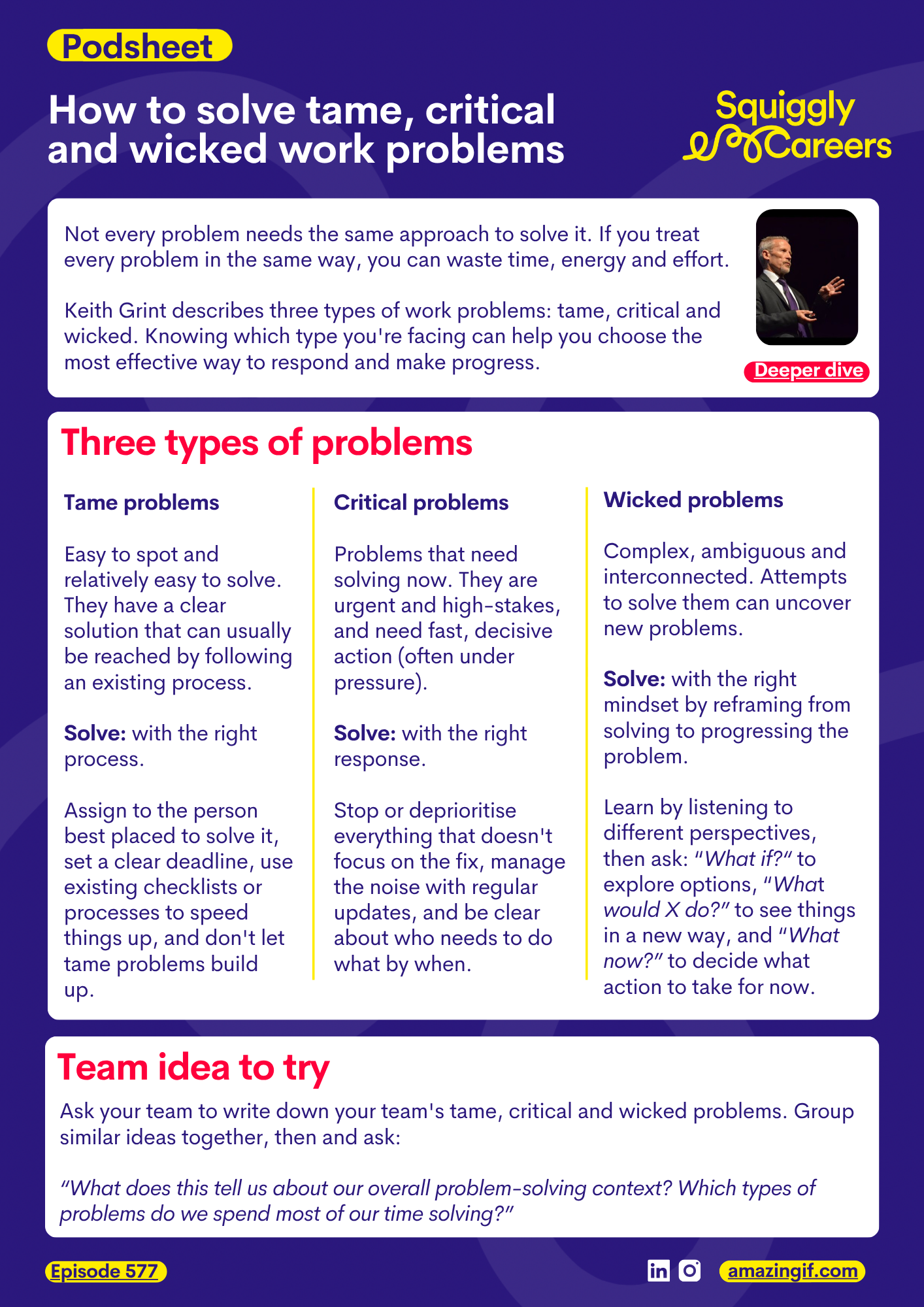
Helen Tupper: and it wasn't even planned. I almost wanna say it again, but I'd screw it up anyway. Keith Grint, he talks about something called Wicked Problems and a couple of other types of problems. And so what we're gonna do is talk about the three types of problems from Keith Grint's work. When I talk about what they are, how you can spot them, like what they might sound like if you've got one of these problems and probably most importantly, what you do to solve them.
Sarah Ellis: And just to zoom out momentarily, only for like one, for one minute. I did when I was researching this because Helen recommended a video from Keith which I watched and found very useful. There was also another link I'll put in there to, you know, one of those sort of scribed. Yeah, like the drawing description videos which I found really helpful, I was, you know, getting up to speed and then I found a lovely quote which is “a problem well stated is a problem half solved”. So you know when you're trying to think, like, well, why? Why would I spend time, like, figuring out what type of problem this is? It's like, well, almost. If you haven't figured out the type of problem, you might try and solve it in the wrong way and you sort of waste time and energy. And that comes from Charles Franklin Kettering, also associated with quite a few other people. So that was one of the people that the quote got attributed to. But I was like, let's not get quite.
Helen Tupper: It's a really important insight. I think it's a really good starting point for what we're going to talk about, which is the fact that not all problems are the same and therefore the way that you solve them will be different. But if you don't have a. If you don't have like a criteria, if you don't have a way of diagnosing what problem it is, then it's harder from the outset. So let's do the what type of problem it is.
Sarah Ellis: Okay, so problem number one, tame problems.
Helen Tupper: Right.
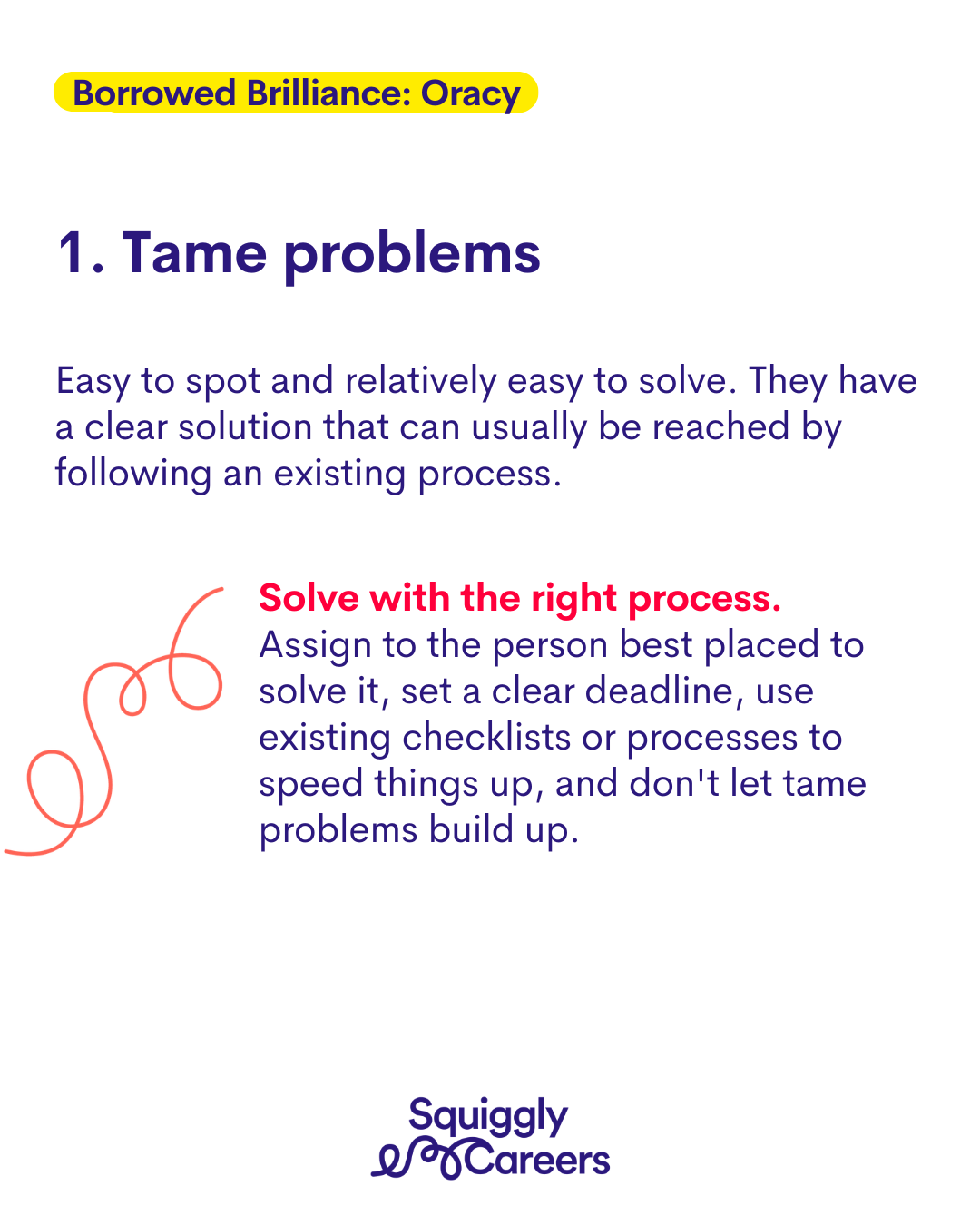
Sarah Ellis: I like the idea of this. Sounds easy, certainly easier. And actually the definition is here. A tame problem is easy to spot and relatively easy to solve. The problems are pretty well defined. There's a clear solution, and you can probably get to the solution by following a known process or a version of a process that already exists. So an example would be a broken link on our website. And I was like, that's a real example for you there. And it probably sounds like, oh, we understand the problem, we just need to decide on the best solution or the best way to fix it fast. You know, that's what I can imagine. You know, I can imagine saying that someone on our team, I've spotted this link's broken, you know, like, figure out the best way to fix it. Like, let's just, let's just get it sorted. It's just a fact. A fast fix. You don't need to chat about it load. You probably just, you know, you just need to figure out how to solve it.
Helen Tupper: I was just thinking then, like, because you might be like, what's the point? If it's a tame problem, why waste any time? Why waste any time solving it? But I think that if you don't solve tame problems, then they can become bigger ones over time. Because if you've got absolutely loads, you've got loads. You've got 20 broken links on your website and no one's coming to your website, yeah, it's gonna get really, really annoying. And also I Think that it becomes frustrating for people when the problem keeps coming up.
Sarah Ellis: It's like the recurring red flag thing that we sometimes talk about. Cause I think there are tame problems, like fixing a broken link on a website where if it's one off, it doesn't get that frustrating. And it's not a recurring red flag. And you're like, fine, but you and I would definitely have things that we could name in our company where we're like, yeah, that's still a problem. Still a problem. And it's only a tame problem. But nobody sorted it. We've not sorted it. No one else has sorted it. And they're really annoying.
Helen Tupper: They are really annoying.
Sarah Ellis: I don't like a tame problem.
Helen Tupper: I think they're like gnats, you know, like a nat. Like a little gnat.
Sarah Ellis: Like you're thinking it's not irritating. Really irritating.
Helen Tupper: Irritating. It's not going to like ruin your day. But it's just. And there's loads of them. Loads of.
Sarah Ellis: Yeah, I don't like the old 10 problems. Let's move on from those.
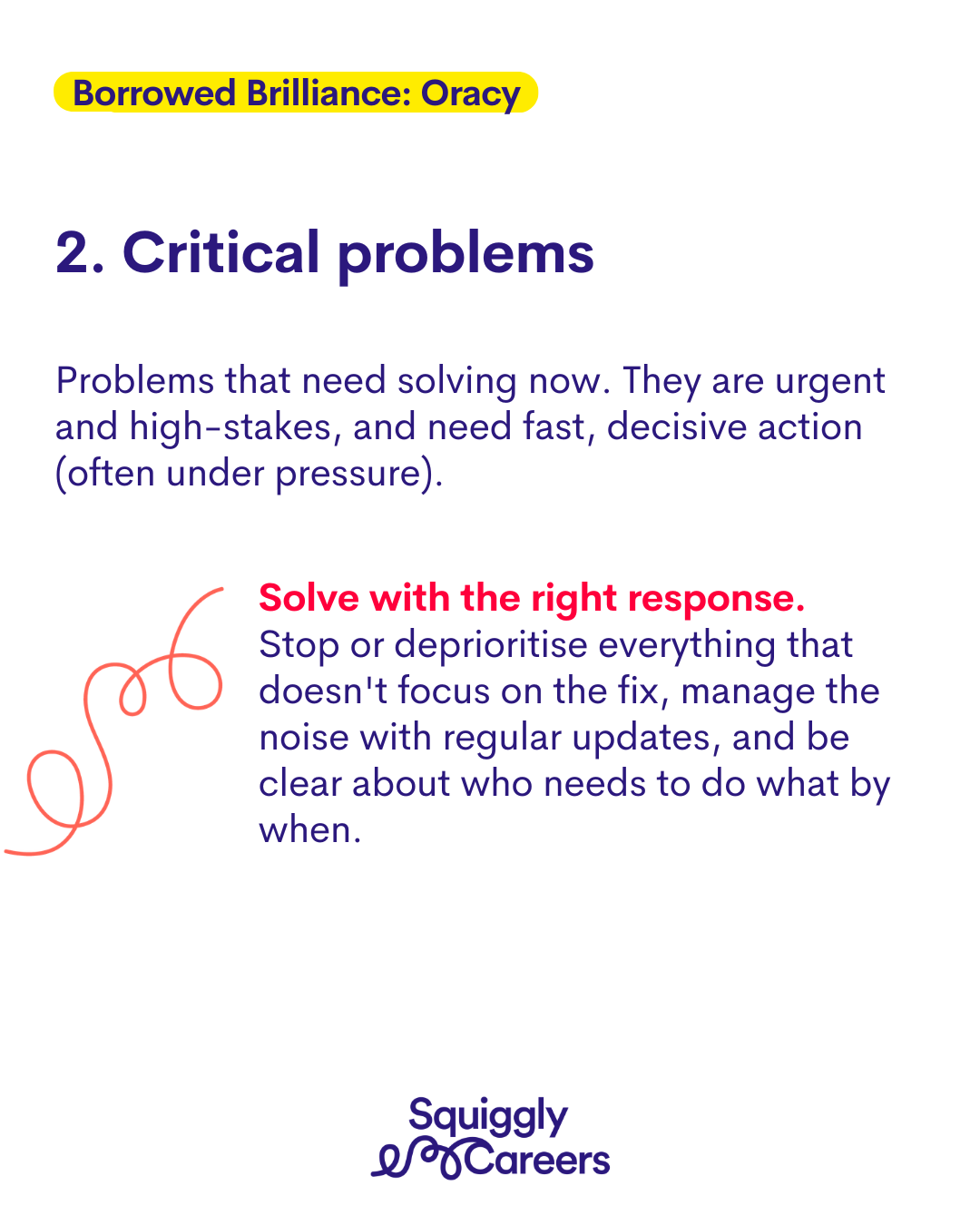
Helen Tupper: Let's move on. So we're going to critical problems. I mean, I'm not really sure I like these ones either. But the critical problems, these are problems that need solving. Now this is a problem that you might not have predicted or pre-empted, but when they happen, they are urgent.
Sarah Ellis: Yeah.
Helen Tupper: And they are high stakes. And you need to get the right people around this thing really fast.
Sarah Ellis: Troubleshooting vibes.
Helen Tupper: Yeah. I think you'll know it because people go, we need to sort this right now.
Sarah Ellis: Okay.
Helen Tupper: Yeah. Has that been sorted yet? Where are we with that problem? Like versions. Versions of that, I thought actually, just sounds like me.
Sarah Ellis: It does sound exactly like you. We'll come on to our own preferences for these problems in a moment.
Helen Tupper: But an example of this. I think I had one today. I had one today.
Sarah Ellis: Oh, you did, didn't you? Are you gonna share this one? Go on.
Helen Tupper: Oh, gosh. Okay. My critical problem today. Oh, this is really embarrassing. Okay. So I was doing a presentation today. It was an important presentation Sarah and I present on our iPads because we live draw everything. So we have this thing where we say we don't use slides because we don't use slides. We've run this business since 2013 and we've never used slides until. Until I was on the way to the event where I was presenting today and looked in my handbag so I could just prep and make sure I'd prepped last night.
Sarah Ellis: I know. I feel gutted for you for that.
Helen Tupper: I prepped quite late. I prepped. So it was in my head and I was excited about it. I thought, I'll get my iPad out and I'll just kind of have a little look. So I'm ready. I was like, oh, oh, oh.
Sarah Ellis: I mean, I could show people the WhatsApp messages.
Helen Tupper: This mad panic. And it was really. It was really interesting because my. So basically I had to create a presentation and had to get over the
Sarah Ellis: fact is that the first time we've. I don't think I've. I've never used a slide. Your first time? Yeah.
Helen Tupper: I mean, it was high stakes. It was urgent. I was literally 10 minutes away from the location.
Sarah Ellis: It was high stakes. I was thinking, what have we got? That she could just put us.
Helen Tupper: Yeah. And you know, decisive action under pressure. Because you were messaging me and you were like, how can people help? And I basically just thought, I'm muting you because I was just, I need to fix this fast and there is a limited amount of time and this needs to get done. It's that. Is that, you know, you can feel them and you can hear it. I think when there's a critical problem. Okay. Third.
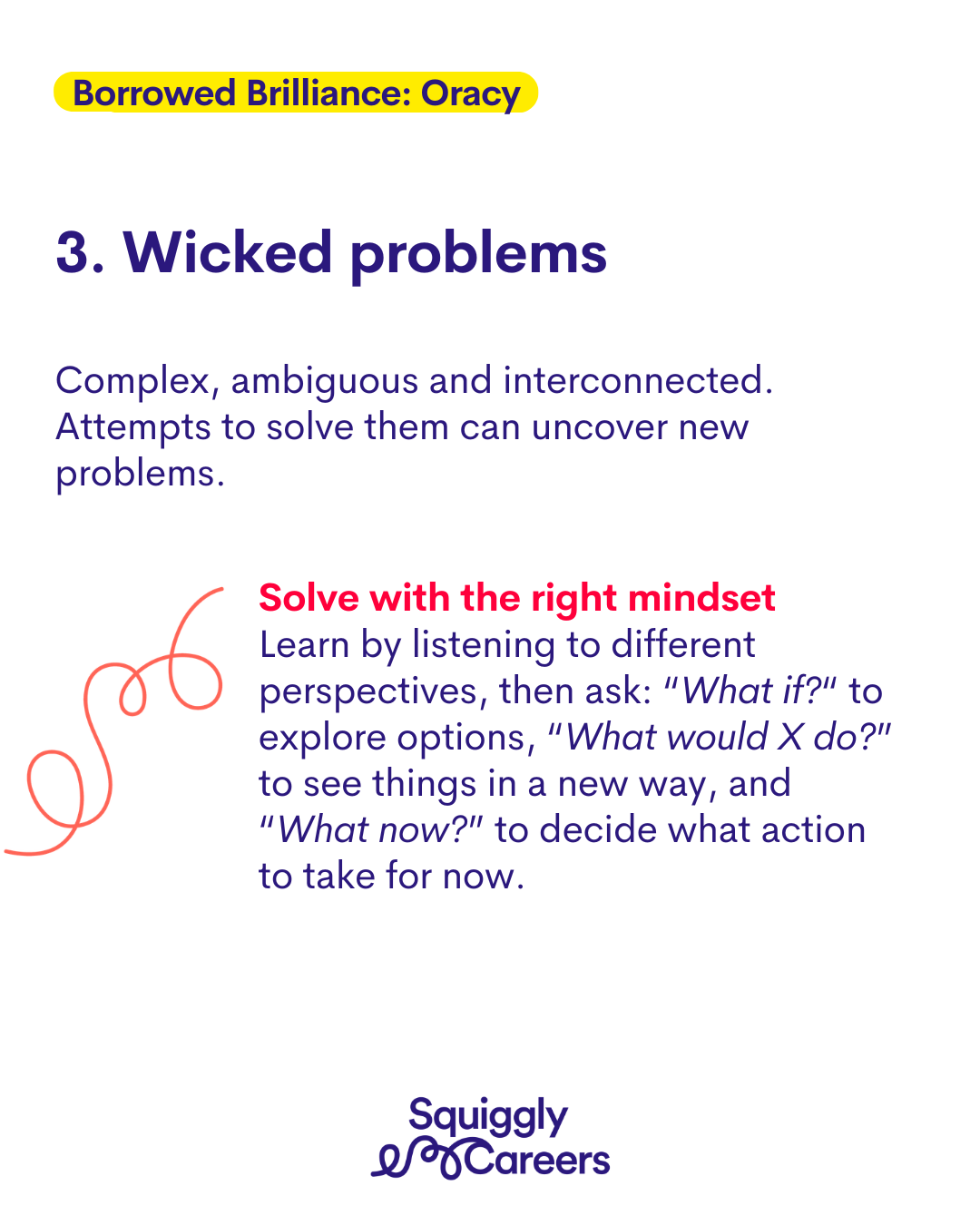
Sarah Ellis: The third is these wicked problems, which does still make me think of the musical. I always do get slightly distracted by the musical, but still. So these are problems that are complex, ambiguous, interconnected. There's no single right answer and almost there probably isn't an answer. And so even when you're trying to make progress on that problem, you might discover new problems or there might be new questions. So these are sort of really dynamic, ever changing problems that will feel hard.
Helen Tupper: Right.
Sarah Ellis: I think, like, these are hard problems, maybe hard and important. And so this might sound like, well, there's no easy answers to this problem, which I like. I've heard people say there's not an easy answer to this. So these are going to be quite big things that are likely to involve more than one team. So this might be like an organisation saying, how do we create psychological safety in our company?
Helen Tupper: Or even like now, how are we going to respond to AI?
Sarah Ellis: AI would be the wicked problem that everybody's talking about in the board. Right.
Helen Tupper: Of the world.
Sarah Ellis: Yeah. And actually some of the examples in the drawing video that I watched, they were talking about like climate change.
Helen Tupper: Yeah.
Sarah Ellis: Is like a wicked problem. Or poverty. So if you like really zooming out.
Helen Tupper: But I do think you've got. I do think you can zoom in to a wicked problem in a team.
Sarah Ellis: Yeah.
Helen Tupper: We've got wicked squiggly problems.
Sarah Ellis: Right.
Helen Tupper: It's not. It doesn't have to be so big, but it's that idea that they are messy, unsolvable. Also, I think some people enjoy them and some. But the majority of people don't because of the ambiguity and these are hard to solve, like.
Sarah Ellis: Yeah, you know, it's called. You know, we talked about uncertainty recently. I was like, oh, you have to have quite a high tolerance for uncertainty to spend time with wicked problems. I think. So, reflecting on our squiggly world, which sort of problems do you think we experience the most? Which ones do you think you're best at?
Helen Tupper: I think we have one or two wicked problems.
Sarah Ellis: Yeah.
Helen Tupper: That have been around for a while. Yeah. To be honest.
Sarah Ellis: Well, the point is that's. That's because they're wicked. Right. That's like. That's like.
Helen Tupper: I do wonder whether we could manage that.
Sarah Ellis: We could. Maybe some of what we're going to talk about you might make more progress on.
Helen Tupper: I think we probably go. We sort of almost accept it's a
Sarah Ellis: wicked problem and we probably don't maybe know but aren't.
Helen Tupper: Yeah, we don't. I don't think we're managing the wicked problem. I think, you know, occasionally we do have the critical ones, but I don't think we are defined as a company who has loads of critical problems.
Sarah Ellis: We're not that kind of industry in terms of our. What we. The service that we do and then we've got quite a lot of time.
Helen Tupper: I think we do probably because we've not got loads of operators like, you know, I don't know, I feel like we've just got loads of little gnats. I don't think we. If we had like a tame problem inventory or something like that, or we like tried to solve like 10 tame problems a month or something.
Sarah Ellis: But we want an interesting insight on this.
Helen Tupper: Yes.
Sarah Ellis: So we record our mistake moments as a team and we record them all in the same place. And I was doing something different the other day, so I used AI to analyse all of our mistake moments and basically what you noticed, what are the trends and themes? And a lot of it is about tame problems because what it said when the AI is quite confronting it was like the answers to most of your mistake moments always seem to be a checklist.
Helen Tupper: Oh.
Sarah Ellis: So the word checklist comes up like loads. And that's because the sort of, you know, because if you're solving a tame problem, tame problems, about things like processes and I was like, oh, that's really interesting. Like almost our mistake moments reveal we have these tame problems which we're probably maybe not getting as better at solving. We're not as good at solving as we could be, given we've have quite a lot of them. Whereas I've been in teams before that have loads of critical problems and so it's very different. Different vibe.
Helen Tupper: Yeah, very different vibe. And just to kind of pull in the Post-it notes. I think this is a really, like. With a team, I think this could be a really good activity where, like, you kind of.
Sarah Ellis: I would.
Helen Tupper: I mean, I would because I like different colours, but what I would do
Sarah Ellis: is you're picking up different colours as we speak. What are you going for? Green, pink and yellow. Yeah.
Helen Tupper: Doesn't really matter what colour they are, but I do think different colours help. So you basically get everybody to begin with writing down, like, what's a tame problem? Like. So I might be like, oh, broken links or. Yeah, the newsletters got, I don't know, the wrong URL on it or something, or whatever and everyone does it and then you just kind of stick them all up on the wall and then different colour. So let's say everyone's got pink, then they're writing, okay, what are some of the critical problems? And you might. I think for that one, you might wanna do, what's the critical problems that we've had over the last six months? Or something, just so people kind of get a sense of, is there a theme of these critical problems? And then you do the wicked problems. And then I think if you stick them all up, then you could. Where people have done some of the same ones, I'd put them like on top of each other. But I think you can then step back and be like, what does this look like for us? What does this mean for us?
Sarah Ellis: Our overall problem-solving context?
Helen Tupper: Yeah, what do we make of. I think you can get some insights that I don't think you could do unless you kind of pulled. You kind of pulled it well.
Sarah Ellis: Even like our conversation just then, I was like, I've probably not really reflected on having quite a lot of tame problems before today, but actually, as soon as you talk about it, you go,
Helen Tupper: the same wicked problems. And we've had them for a long time. You're like, well, why is that? Why do we want to see these? Yeah.
Sarah Ellis: Should we try and solve. Well, we're not going to solve our actual problems. What we are going to talk about is the fact that you solve problems, different types of problems in different ways and that if you sort of solve the problem in the wrong way, then you probably don't make the progress. So tame problems, this is the one we should probably just listen to. Need the right process. So this is all about processes. So there are three things here. One, don't overcomplicate tame problems. I think I do this. I don't think I'm very good at tame problems generally. That's probably. Well, it's probably one of the reasons we've got cause, well, I would ask too many questions and I would try and understand and blah, blah, blah. So it's like you shouldn't let me, I think anywhere near retain problem was the conclusion. Conclusion I've come up with having spent some time. So one, don't overcomplicate. Assign it to one person who is best placed to solve that problem and set a clear deadline to solve by. Okay, so that's like what I'm like, okay, then use anything that is existing to solve faster. So as in, if you've already got processes, you know, like, don't, you know, like don't reinvent a process. Yeah, don't start from scratch when you don't need to. Which we definitely do some of the time. And then the third one is don't let tame problems linger because that's when they grow. And you made this point already into the bigger problems.
Helen Tupper: So that becomes a hornet and that hurts. Yeah.
Sarah Ellis: So you almost need to name them if they're recurring. And we do sometimes say they're recurring red flags, like. But again, I think our challenge is we will say this is a recurring red flag. And then we don't do anything
Sarah Ellis: we're like, yeah, and you sort of need. I think some people are very good at tame problem solving because they're like, they're efficient, they're about the right process. They kind of just get stuff done. And so I think sometimes as well, identifying like who in your team is really good at this, who's good at sort of pro. It's process and pace because you don't want to over complicate this and then almost get those people to be like, can you look at that and sort it? And that person basically isn't me, but
Helen Tupper: they are hugely valuable.
Sarah Ellis: Oh yeah. All of the things that like you and I get frustrated about. I think you actually are quite good at this when you need to do it, but you don't want to do it. It doesn't give you any energy. But I think there are other people who actually enjoy this and that's a really good Thing.
Helen Tupper: It's a good thing.
Sarah Ellis: Critical.
Helen Tupper: Critical. Okay. So this is the one that I, I think I am good at partly. I think I stay very calm.
Sarah Ellis: Yeah, good.
Helen Tupper: In a critical situation, I almost feel like robotically calm, which is not one of the bits of advice that we've got. But there are some, some things that are useful here. So first of all, immediately stop. Deprioritize everything that doesn't focus on fixing this fast. I think you might want to signal that to people so that people don't think what's going on with my work. I think you have to say this has happened. I am working on this. I'll come back to that thing as
Sarah Ellis: soon as this is fixed.
Helen Tupper: So signal it, but stop. The other thing that I think is very important is that you manage the noise at the same time as the problem. So critical problems are noisy because you've got the. Is it fixed yet? Well, what does that mean? What's happening? Can you give me an update?
Sarah Ellis: Yeah.
Helen Tupper: And if you don't find a way to manage the noise, it gets in the way of you solving the critical problem. So that could be. You could say I'm going to send an email at the end of every day to let you know what's happened with the, with the problem, where we're at with it, what we're working on tomorrow. I've actually been in teams talking about you and me working environments where there are way more of these problems, where that updates come out every hour.
Sarah Ellis: Yeah.
Helen Tupper: When there's been things going wrong. And it's just, I think if you, if you know it is a critical problem, don't underestimate the importance of communication because one communication from you to lots of stakeholders is a lot easier than lots of stakeholders coming to you with
Sarah Ellis: questions and it being scattergun.
Helen Tupper: Yeah. No nightmare. And then be really, really clear on who needs to do what by when. I think clarity in communication with. When you've got a critical problem is really important. So just have the names like these are the five people that are working on solving this. This is what they're doing, this is what their role. Make sure everybody really knows what's going on there.
Sarah Ellis: And I think what is good about all of these different types of problems is I know that this is a really learnable skill because I learned the critical problem-solving skill. This is not me naturally. I don't like being responsive. I like being strategic and proactive. But I worked in a team that was all about critical response, though my job wasn't. But, but the overall team context was. And so initially when it was like drop everything, I was like, well, no, because, you know, in my head I got other things and these other things were happening. This is what my day looked like. And I am a natural planner. And so you have to be much more agile, you have to be adaptable. And initially I think it feels uncomfortable and it's just a new way of working. I think some people are. This is in their DNA, just like it can be in your DNA to be really good at processes. But I think with all of them, like having experienced it, I am so much better now at solving critical problems. Just because I learned to get better at it. Do I think I'm an absolute natural? Like, no, but almost from following these three. These three, I would know to do these three things and I could do it and I wouldn't enjoy it that much, but it's the right thing.
Helen Tupper: This is definitely the one tame I'm rubbish at, but I can see how I can easily do that better with bit support. Critical. I feel okay. I think almost like a diagnose. If you're listening, like, think, where do I need to work? Wicked, the one we're going on to next. This is the one where I'd like us to talk about this and share these ideas and apply them a bit more.
Sarah Ellis: So tame needs the right process, Critical needs the right response. Wicked needs the right mindset.
Helen Tupper: Okay.
Sarah Ellis: And so first thing, you've got to let go of solving wicked problems, which is the bit I think you find hard. I don't mind a wicked problem. I quite enjoy them because I think you will get new problems. I think you've got to reframe the job to be done or what success looks like. It's about exploring and progressing the problem, not solving the problem. I think if you start with solving, don't know, you could get quite demotivated or overwhelmed, I think. So that's that. That's the mindset point. There's a. There's a lot here around listening, which I really liked, which is when you've got a wicked problem, there's loads of dynamics and different people involved or, I don't know, different processes involved. Listening helps you to learn about the problem from different people and perspectives. So almost being more intentional and conscious about. Right. Part of solving this problem is listening. Like, who do I need to listen to? Who have I not listened to yet? Who could I listen to who might tell me something that I don't already know? You know that lovely quote, like, you learn by Listening, you know, we all learn by listening. You don't learn by saying what you already know. And so there's a big emphasis on like, to progress through a wicked problem. Like, how are you listening? So that's a really, I think, a really good question to ask yourself. And then third, when you then want to sort of start to move into action, because otherwise by this point you'll be very frustrated, I think, of what if. What would what now? So what if we only focused on one part of the problem? What if we only had half the amount of budget? So you're asking these kind of what if questions to start to generate options, scenarios provoking the problem. Yeah, they're like provocations. What would get you to look at the problem in a new way? What would Taylor Swift do? So I think, actually you and I have talked about this week. You said someone gave you that example. What would Ikea do? A brand that you know, that you just think are really interesting. So that just. You've asked yourself your own provocations. You've also thought differently by looking outside it in. And then you get to the what now? So now, what are the actions we're going to take? For now.
Helen Tupper: Yeah, now. For now.
Sarah Ellis: Now for now. And I think that just then means with wicked problems, the danger obviously is you could go around in circles. You know, like, you hear that, I hear that from some companies. They're like, we have the same conversations. You and I have it. I think with some of our wicked problems, we perhaps have the same conversations. I think we both quite enjoy exploring. But then maybe sometimes we get a bit. I think the what if. What would what now for now might help us a bit.
Helen Tupper: Circling, circling endlessly does not appeal. But learning from listening. So if we were like, well, we've still got the same wicked problem. The wicked problem has not gone away.
Sarah Ellis: Yeah.
Helen Tupper: However, this is what we've learned from listening and we've gone through the what if.
Sarah Ellis: What would ? What now? For now?
Helen Tupper: What now? For now, I would feel that I was making progress in the problem. Had I solved it. No. But had I made more progress than I would have by mind not doing those things. Yeah. So that. And that would mean, I think, progress on a problem. I would be comfortable circling around a wicked problem. I just feel like, what a waste. What a waste.
Sarah Ellis: What a waste.
Helen Tupper: What a waste. That is exactly like, how are you feeling, do you think? Because obviously we're borrowing brilliance. Right. So do you. This is Keith Grint's take on how to better solve problems. What is your take on this, do you think it's. Do you think it's better? Would you be better solving problems because of this?
Sarah Ellis: Yes, because I think it prompts you to be situational in your approach. So I think everybody is good at solving some sort of problem and you might be like, oh, that person's a really good problem solver. And I think you could say that about me and you could say that about you and mean really different things. And so I think this helps you a bit more with like, well, what type. I like the. I actually like the categorisation of like, well, what type of problem is this? Then? Also sometimes, you know, the right people to solve that problem. Like, are you and I the best people to solve some of the same problems? No. Doesn't mean that. It's not an excuse, though. You can't say, well, I'm never going to solve those same problems. But equally there are probably other people who'd be more energised and like, better at it.
Helen Tupper: Yeah.
Sarah Ellis: And also the. I think probably because I've seen the critical problems, like, learning that skill has been really helpful for me in my squiggly career and so I'm really glad that I learned that skill. And same with tame. Like, I. I still think that's a useful thing for me to learn. So I think I really liked where we started when you said about the no regret skills. That's really stuck with me and I feel like it's a no regret skill to actually get good enough at solving all the different types of problems. I'm like, actually, I want to get good enough at tame and critical. I think I am good enough at critical. I think I might need to work a bit on the old tame. And actually I think I'm already pretty good at the wicked one. But you could probably get even better and I enjoy those more. So it's helped me to be both more specific and also then think about, like, well, what will I now do differently? Because it's sort of specific and situational. So I, I initially. Do you know what? It did take me a little while. I had to watch the video twice. I didn't get there straight away, you know, with like, the difference between the two coming up with the examples. So if you're like me and you have to watch the video twice, like, don't worry because initially you think, oh, this would be really easy. But it just took me a moment to just work out the categorisations to come up with the examples. But having spent a bit of time. The more time I spent with it, the more useful I found it. Yeah.
Helen Tupper: And I just to build on that, I think I got there much more quickly, but just because I really like stuff like this. But one of the things that I do like is I think giving it a name helps people to talk about things. You know, to your point about, oh, we're good at problem solving in different ways and until you had this categorization, you wouldn't be able to draw that out. I think in a team being able to say that's one of those tame problems and people kind of having a shortcut going, oh, that's how we solve those ones.
Sarah Ellis: Yeah.
Helen Tupper: And then this is a wicked one. Okay, so we're not going to solve this, but who could we listen from? I think there's, like, shortcuts when you give it a name. I feel like names create frames for how people solve them. And if it's all just a problem, we don't kind of do that. So I do think it makes it easy for teams to talk about together.
Sarah Ellis: So we hope that's helped you, whatever type of problem you're trying to solve. That's everything for this week. We'll be back with you again soon. And bye for now.
Helen Tupper: Bye, everybody.
Sign up to the Squiggly Careers Newsletter and get our latest ideas, tools and inspiration every week - all in one place, straight to your inbox