In this episode of the Squiggly Careers Skills Sprint series Helen and Sarah talk about assertiveness and share ideas for how to respond in challenging situations.
There are 20 episodes in the Skills Sprint and each is designed to help you create a regular learning habit to support your squiggly career development. Each episode in the series is less than 7 minutes long and has ideas for action and go-to-gurus on a specific topic.
Sign-up for the sprint and receive our Ready, Steady, Sprint guide here.
If you have any questions or feedback (which we love!) you can email us at helenandsarah@squigglycareers.com
Download the episode summary below
00:00:00: Introduction
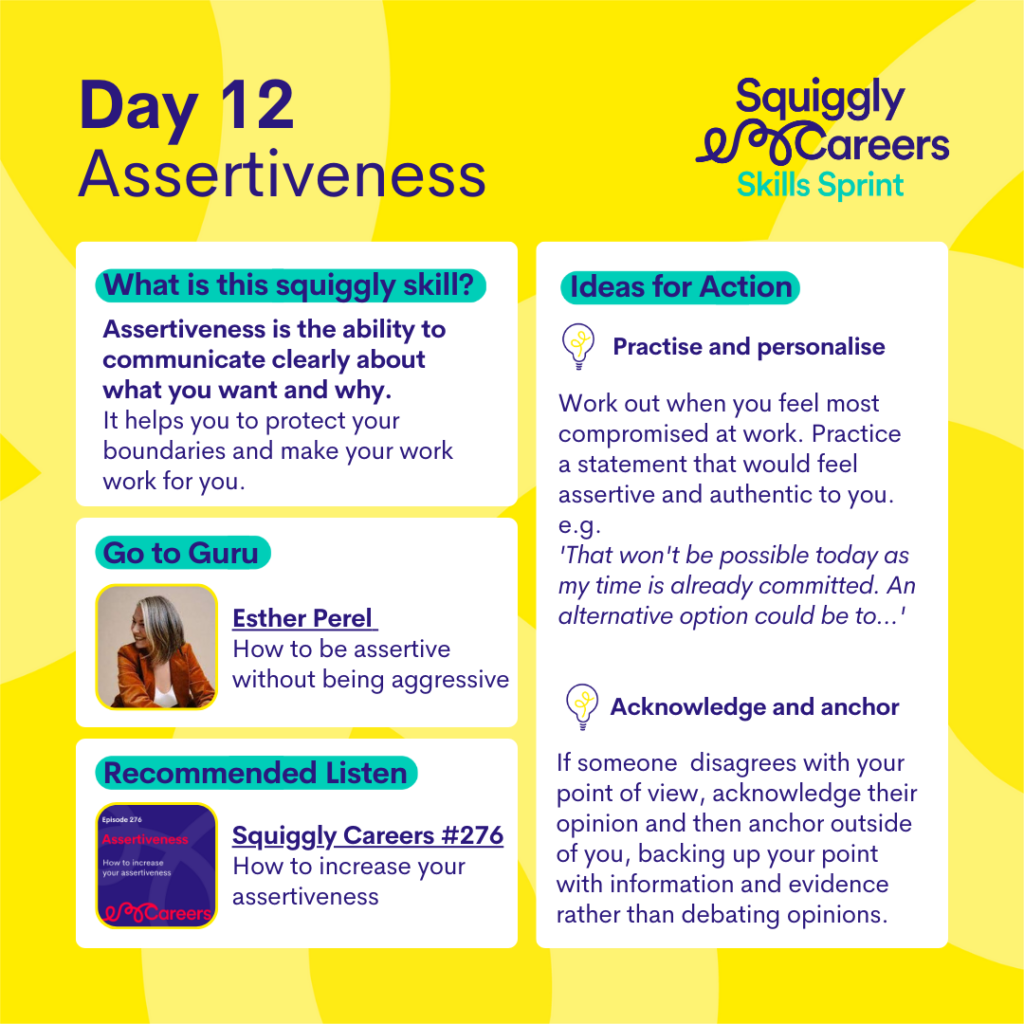
00:01:42: Idea for action 1: reject by providing alternatives
00:04:10: Idea for action 2: acknowledge and anchor
00:06:22: Go-to guru
00:06:32: Relevant podcast episode
00:06:40: Final thoughts
Sarah Ellis: Hi, I'm Sarah.
Helen Tupper: And I'm Helen.
Sarah Ellis: And you're listening to the Squiggly Careers podcast. This episode is part of our Skills Sprint series. We've recorded 20 episodes, each less than seven minutes long, that we hope are going to help you to build some career development momentum. In every episode, we talk about a Squiggly Skill, what it is and why it matters, share an idea for action each, and give you a go-to guru and a podcast episode so you can learn more. And we want you to turn your skills sprint into a learning streak. And so for everyone who completes a 20-day learning streak, we'll be offering you a free Five Skills to Succeed in a Squiggly Career virtual workshop in September. If you post about your progress on social and tag us @amazingif, and we'll be in touch to tell you more.
Helen Tupper: This Squiggly Skills Sprint is all about assertiveness. So, assertiveness helps you to communicate clearly about how you want to grow in your career and why, so it's a really important skill when we're trying to personalise our progression in Squiggly Careers. It also means that we're better able to protect our boundaries. So, there's going to be loads of things that are going on in your life and at work that will sometimes feel like it might be compromising you and your career, but when you have a strong assertiveness skill, you're able to push back on people and those situations that might be compromising you and those boundaries. And it also means that you're better able to make your work work for you. So, if I have a skill of assertiveness, it means that I can be open and honest when I'm talking to Sarah about where I want to take my career and what I want to work on and how I want to work, which means that all those hours I'm putting into my work not only work for the business, they also work for me too.
Sarah Ellis: So we thought we'd start the ideas for action with two, I suspect, quite common scenarios where we're probably not as assertive as we would like to be. So, the first one is when you are asked to do some work under very kind of tight deadlines; and then the second scenario we're going to talk about is when somebody, usually more senior than you, disagrees with you. So, we thought we'd take each of those scenarios and just talk about what would we do and what might help you. So, Helen, do you want to start with that first one? So, let's imagine now I'm your manager.
Helen Tupper: Great!
Sarah Ellis: Yeah, just what you've always wanted! And let's imagine we're based both in the UK and the US and I say to you, "Somebody in the US has said actually they need this by tomorrow morning, so can you get this done tonight, please? I know it's a bit last minute, but it's really important".
Helen Tupper: So, I think I would start, if it wasn't possible, like I've got some commitments, I think I'd call that out very quickly. So, I wouldn't beat around the bush, I'd say, "Actually, it isn't possible for me to do that tonight". But I would then follow that up with some questions about the deliverable. So I might say, "I'm sorry, it isn't possible for me to do that tonight because I have got some [probably] family commitments", would be the thing, "but let me try and understand a bit more about it". And then I would go into some open questions like, "Okay, who is it for; what is it for; what needs to be done?" Because I think if I had just a little bit more detail about that deliverable, what I might do is spot that I know the person that it's going to, and I might be able to extend that kind of deadline because they might be like an internal friend. Or I might be able to offer up an alternative, "Okay, so if you want that presentation for that person for tomorrow, what about if you send them this project update that I did last week?" So if I had that detail, I might be able to do that. Or I might be able to identify an alternative person, "Okay, if that's who it is and what it needs to be, then the other person that could help tonight is..." I don't think I would feel really comfortable just being a blocker and saying, "Sorry, I'm not going to do that". That isn't very me, to your point about authenticity. But I would have to ask a few probing questions to get a little bit more detail on the deliverable and then I would feel like I could be sort of assertively helpful about how that thing could be done, maybe in a slightly different way or by a different person.
Sarah Ellis: Yeah, I think what's really nice about that is for most of us, we don't just want to say no. And also, that doesn't feel constructively useful as a response. So, I think instead of just going, "Well, no, I can't make that work", and then you might actually come across as aggressive rather than assertive, sometimes unintentionally, what you're doing is trying to figure out creatively, "How can I still be helpful?" So, let's move on to the second example. So, someone senior disagrees with you and maybe we're put on the spot, just to make it even worse. The thing that I think is really helpful here, two things that I always have in mind, which is acknowledge and anchor. So, let's imagine now I've just presented a brilliant idea to Helen and Helen says to me…
Helen Tupper: "I've seen that before, competitors have done that, I don't think we should do it".
Sarah Ellis: Yeah, I mean that came out surprisingly quickly! So, I think actually the worst thing that you can do, and I think I have done this before in the past, is either skim past it or just completely change your point of view because someone more senior has said, "Oh, yeah, our competitors…" And I can imagine backing down very quickly and just going, "Oh, okay then, I'm obviously wrong". And I think that's what happens, we sort of lose confidence in ourselves. So, I think acknowledging often buys a bit of time, so saying, "Okay, that's interesting, I hadn't considered that". I might ask a curious question, "Oh, what competitor have you seen do this in a way that's interesting?" So, you are acknowledging that you have listened, then I think you can reinforce your perspective. The reason we say anchoring, I think it's often really helpful to anchor outside of you, because otherwise you get into a bit of almost like tennis around, "Well, this is what I think". And you're like, "This is what I think". I'm like, "Well, I think something different". Whereas, one of the things I've often found really helpful is saying, "Well, my perspective based on listening to our customers [or] spending time with our suppliers [or] looking at this data is..." so I'm anchoring outside of just, "This is what I think", or, "This is what I believe". Now, you might also believe that that is the right thing to do, but I think by anchoring outside of yourself what you're recommending or what you're suggesting, it brings a level of clarity to how you got to where you got to, but also it really encourages you to have an adult-to-adult conversation and breaks down some of the barriers that I think hierarchy can bring. So, I think if you're going into those meetings where you think there might be disagreement, or you just want to give yourself some helpful backup in case it does come your way, I think that acknowledge and anchor is quite a good shortcut to have in your brain ready to go.
Helen Tupper: So, if you want some expert advice to learn more about this topic, we recommend Esther Perel. We'll link to a really good video, we'll put it in the show notes, How to be Assertive Without Being Aggressive, it's a good watch from hers. And if you want a podcast that dives a bit deeper, then episode 276 of the Squiggly Careers podcast is on How to Increase Your Assertiveness.
Sarah Ellis: Thank you for listening to this Skills Sprint, we hope you found it useful. We'd love you to share and subscribe so you don't miss a sprint. And that's everything for this episode, so bye for now.
Helen Tupper: Bye everyone.
Sign up to the Squiggly Careers Newsletter and get our latest ideas, tools and inspiration every week - all in one place, straight to your inbox