In this episode of the Squiggly Careers Skills Sprint series, Helen and Sarah talk about creativity and share how to use AI to accelerate creativity and a technique to use in teams to generate new ideas.
There are 20 episodes in the Skills Sprint and each is designed to help you create a regular learning habit to support your squiggly career development. Each episode in the series is less than 7 minutes long and has ideas for action and go-to-gurus on a specific topic.
Sign-up for the sprint and receive our Ready, Steady, Sprint guide here.
If you have any questions or feedback (which we love!) you can email us at helenandsarah@squigglycareers.com
Download the episode summary below
00:00:00: Introduction
00:01:36: The importance of creativity
00:03:32: Idea for action 1: use AI to accelerate your creativity
00:04:28: Idea for action 2: eight in eight
00:05:50: Go-to guru
00:06:15: Relevant podcast episode
00:06:21: Final thoughts
Helen Tupper: Hi, I'm Helen.
Sarah Ellis: And I'm Sarah.
Helen Tupper: And you're listening to the Squiggly Careers podcast. And this episode is part of our Squiggly Skills Sprint series, where we've recorded 20 episodes, each of them are less than seven minutes long, to help you build some career development momentum. In each episode, Sarah and I are going to talk about a Squiggly Skill, what it is and why it matters, we're going to share an idea for action from each of us, give you a go-to guru and a podcast episode so that you can listen and learn a bit more. And we really, really want you to turn this Squiggly Skills Sprint into your own learning streak.
And for anyone who lets us know how they're getting on and who completes the 20-day streak, we can't prove that, so we trust you, but if you tag us that you've done the sprint, you've completed the streak, then what we will do is we'll get in touch with you and we will invite you to a free Five Skills to Succeed virtual workshop that Sarah and I are going to be running in September, so we can help you dive even deeper into the world of Squiggly Careers. All you've got to do is tag @amazingif in any of your social posts, and then we'll be in touch.
Sarah Ellis: In this skills sprint, we're talking about creativity, and everyone's creative but sometimes it shows up in different ways. And I think we often give ourselves a really hard time about whether we are creative or not, because we point to things that feel very creative, like somebody who can draw, or someone who's an incredible writer.
We're like, "Well, they're really creative". And then almost by default, I think, then I'm not. And it's one of those where I think we fall into that comparison trap of looking at the people around us, or maybe we just limit ourselves, I think too soon and too quickly. But being creative is so important. It's one of the skills that is the least likely to be replaced by AI.
It's number two in the top ten skills needed in 2023, according to the World Economic Forum, and the one that is classified as being most on the rise in terms of what organisations are looking for. And I think when organisations say they want people to be creative, what they're talking about is, "We want people to think creatively about problem solving, about spotting opportunities, about doing things differently, about how we navigate change". And I think one of the challenges with creativity is it feels too big, so then we don't get specific about, "What does this mean for me and my Squiggly Career; what does being creative look like; and what are the tools and techniques that are going to help me to be even better and more creative in my job today, but also to be creative in the future with maybe how I think about my career?"
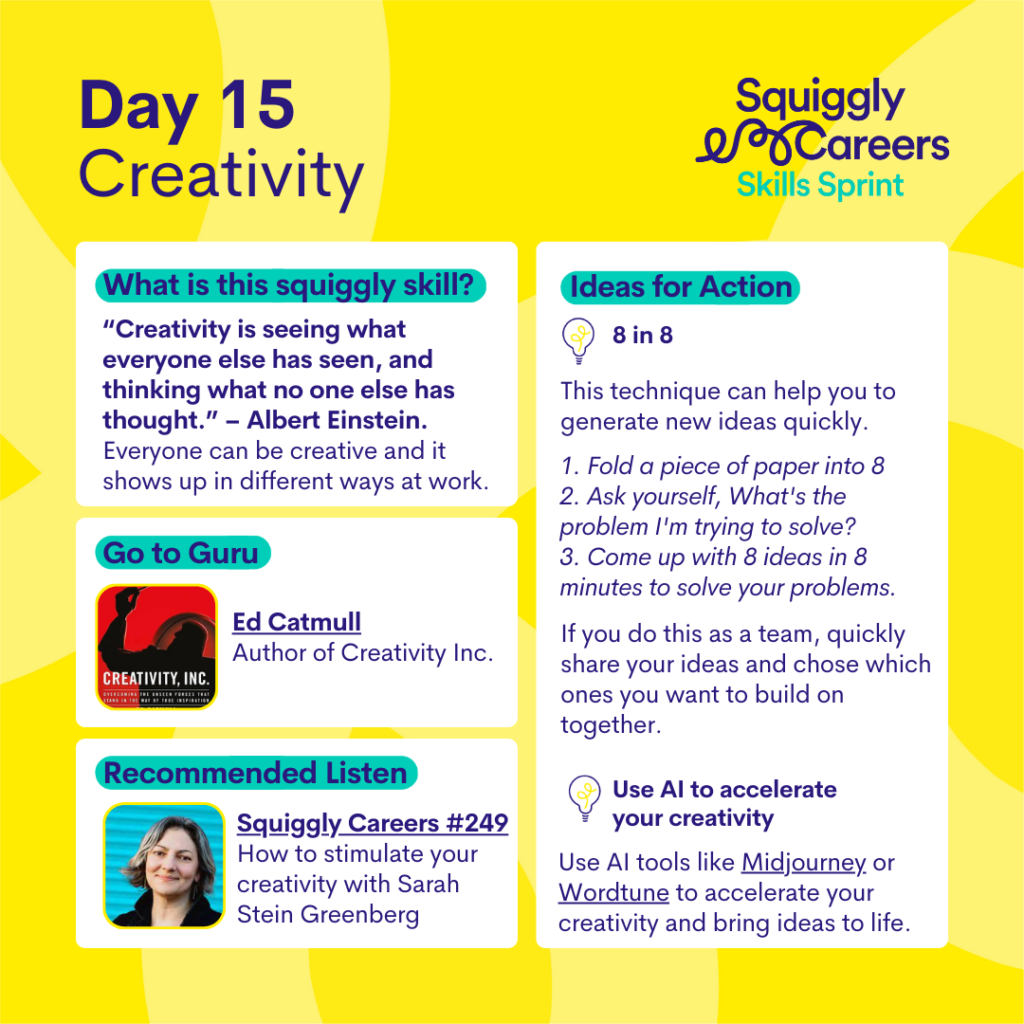
Helen Tupper: I always find it easier to think about what am I creating rather than how creative am I being, and it's obviously just words play really, but as long as you can connect with creativity in your own way, I think that's the most important outcome. So, words help me. One of the other things that helps me, and this is my idea for action, and I feel like this is me like competing with AI, so rather than being scared of how AI is going to take my job away in the future, I think it's really interesting to use AI to accelerate your creativity. So, I'm really enjoying at the moment playing around with different AI tools to help me to be more creative.
So for example, there's a tool called Midjourney and it really helps you to visualise your ideas. And so I'm sort of playing with that to help create different imagery around what Squiggly Careers could look like, and it's quite fun, and it's much quicker than I could draw it and it's probably much quicker than I can communicate it. So, that's helping me creatively bring my ideas to life. Equally, you can use tools like ChatGPT or WordTune and I might say like, "Well, I've got this idea about an article that helps people to be more practically creative at work. What are ten ideas for what that could look like?" I might look at those ideas and think, "Actually, that's an idea that I want to get more creative with. I want to put more of my brain on that idea". And so I think rather than looking at, "AI's going to take our jobs, therefore I need to be more creative", "How can AI accelerate my creativity?" is definitely something that I'm playing with at the moment.
Sarah Ellis: And my idea for action here is called eight in eight. And this is something that Helen and I had the opportunity to try out and practice really recently, and it worked in terms of helping us to create new ideas quickly. So, the idea here is that you have eight minutes and you basically fold a bit of paper into eight, and in eight minutes you come up with eight ideas, not just random ideas, there's a topic or a theme or a problem you're trying to solve.
And I would say having seen this in action, having somebody facilitate this is really important, because you do need some rules, essentially, you need some parameters. So, the eight and eight is a bit of a forcing function to sort of say, everyone's quiet, there's no talking, but you're very clear on what you're trying to do in that eight minutes. After the eight minutes, then there are a couple of ways I think you can take these forward. Firstly, everybody explains their ideas but in an incredibly tight way.
So it's not, you spend the next hour, everybody going through their eight ideas, and so I think seeing someone demonstrate this is really helpful. And we saw someone do this in a really brilliant way. He was like, "First idea is... Second idea is... My third idea", so you're taking like 10, 20 seconds on each of them, no one critiques them, you just listen. And you start to spot themes as you hear everybody talk them through. And then you go into smaller groups and you build on one or two of those ideas that you've heard. They might be from another group, so you might be swapping ideas, or you might just be taking one of the eight in eight that you created. So it's really simple, it's a straightforward tool. I think a few people said to me Google have used it.
I spoke to my sister, and she was like, "Oh, yeah, I've used that before", in some creative roles that she's done. And she said it always gets you to some really good outcomes. So, have a go with it. Like I say, it's really simple, and you do get to ideas I don't think you would create if someone just said to you, "Come up with eight ideas". And our go-to guru here is Ed Catmull. He wrote a book called Creativity Inc.
Most famous, I think, for his time at Pixar. Some of you might have heard us talk before about this idea of brain trust; how do you get people together to create one of the most creative things I guess that you can come up with, which is, you know, you're creating Disney films and Toy Story and those kind of things. And there are also TED Talks around that same topic that you can look into if you prefer that to what is actually quite a chunky book.
Helen Tupper: And episode 249 of the Squiggly Careers podcast is on how to stimulate your creativity.
Sarah Ellis: Thank you for listening to this Skills Sprint, we hope you found it useful. We'd love you to share and subscribe so you don't miss a sprint and that's everything for this episode so bye for now.
Helen Tupper: Bye everyone
Sign up to the Squiggly Careers Newsletter and get our latest ideas, tools and inspiration every week - all in one place, straight to your inbox