
Are you a conversational narcissist? In this Squiggly Shortcut, Sarah introduces a deceptively simple idea from Celeste Headlee that will change how you listen, and make you notice everyone else’s conversations differently too.
🎯 What You’ll Learn
– What a shift response is, why we all do it, and why it matters more than you might think
– What a support response sounds like in practice, and how it changes the dynamic of a conversation
– Why assuming your experience is the same as someone else’s can get in the way of really listening
– How to notice your own patterns over the next week, and what to do with that awareness
📚 Resources Mentioned
Episode 207: Celeste Headlee on the Squiggly Careers podcast.
For questions about Squiggly Careers or to share feedback, please email: helenandsarah@squigglycareers.com
Need some more squiggly career support?
1. Download our free careers tools
2. Sign up for our Squiggly Careers Skills Sprint
3. Sign up for the Squiggly Careers Newsletter, a weekly summary of the latest squiggly career tools
4. Order our new book, Learn Like a Lobster.
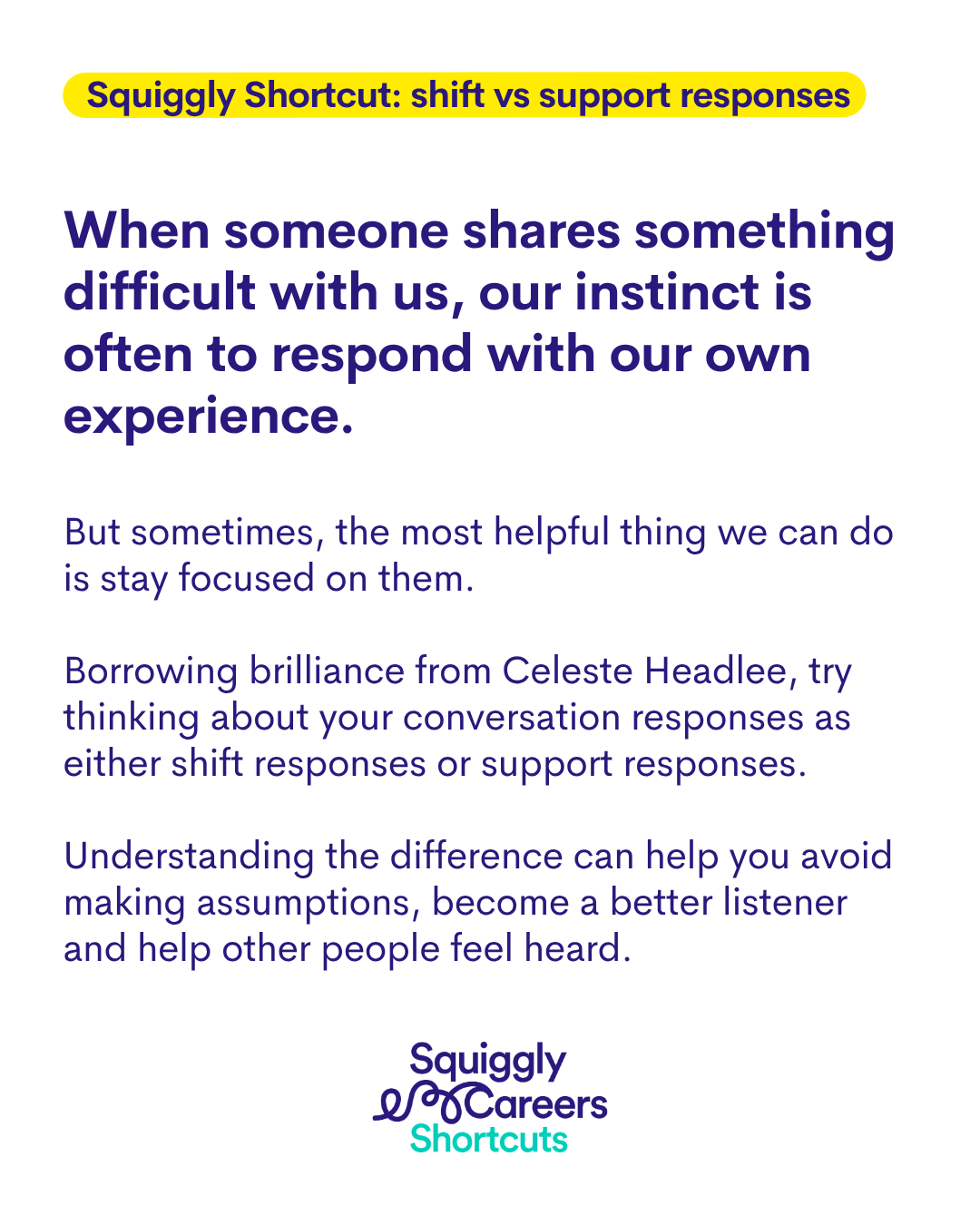
Sarah Ellis: Hi, I'm Sarah and in this squiggly shortcut I'm going to be talking about the difference between a shift and a support response in a conversation. Now this is inspired by Celeste Headlee, one of my favourite podcast conversations and her TED talk is absolutely brilliant. Short, specific and funny. Everything that you want from a TED Talk, I think it's called How to Have Better Conversations. Definitely something along those lines. And she talks about making sure that you are not a conversational narcissist. Which sounds really harsh, but I think when you get into this you realise we all do this some of the time.
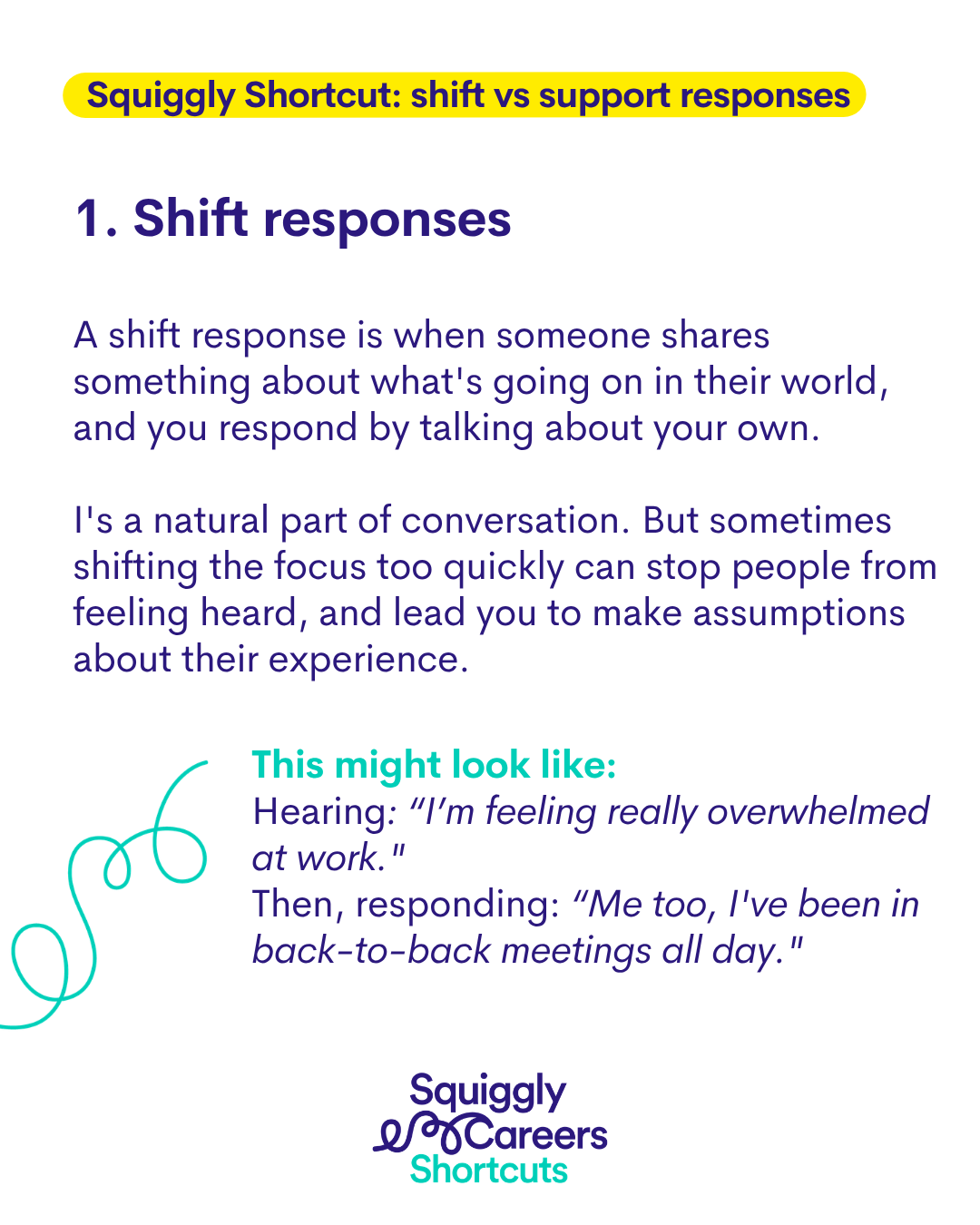
So what does a shift versus support response mean in a conversation? So let's talk about a shift response first. A shift response is where someone tells you something about what's going on in their world. So let's imagine you're a manager and someone you're having a one to one with someone in your team and they say to you, I'm just feeling really overwhelmed at the moment, struggling to prioritise, feels like there's a lot going on, maybe feeling like super stressed. And a shift response would be the manager coming back to that person and saying, do you know what? Me too, been in back to back meetings all day, just not even had a kind of moment to breathe. Now we all do this in conversations. It's part of kind of conversation tennis, isn't it, where someone tells you one thing and kind of you respond with your experience. So it's not wrong and it's not bad. But I think sometimes when people are telling you about what's going on in their world, if you then switch the focus to what's going on in your world, it maybe doesn't feel as empathetic as it could and perhaps it doesn't feel like you're listening as well as you might or that you're interested in actually learning more about that person's experience.
There's also sometimes a suggestion that you're making an assumption that your experience is exactly the same as the person talking to you. They've said they're really stressed and you're like, I know exactly what you mean, I'm really stressed too. And it's like, well there's an assumption there that kind of what we're experiencing is the same. But maybe that person talking to you is actually starting to feel really burnt out. Maybe you've had a stressful day, they're quite different situations so start to notice how often do you do a shift response in conversations?
Honestly, when Celeste first taught me this, I was like, oh, no. Because I think we all do this so often. You'll also, I promise you start to really notice it in other people, too. And we shouldn't judge because, like I said, it's fine.
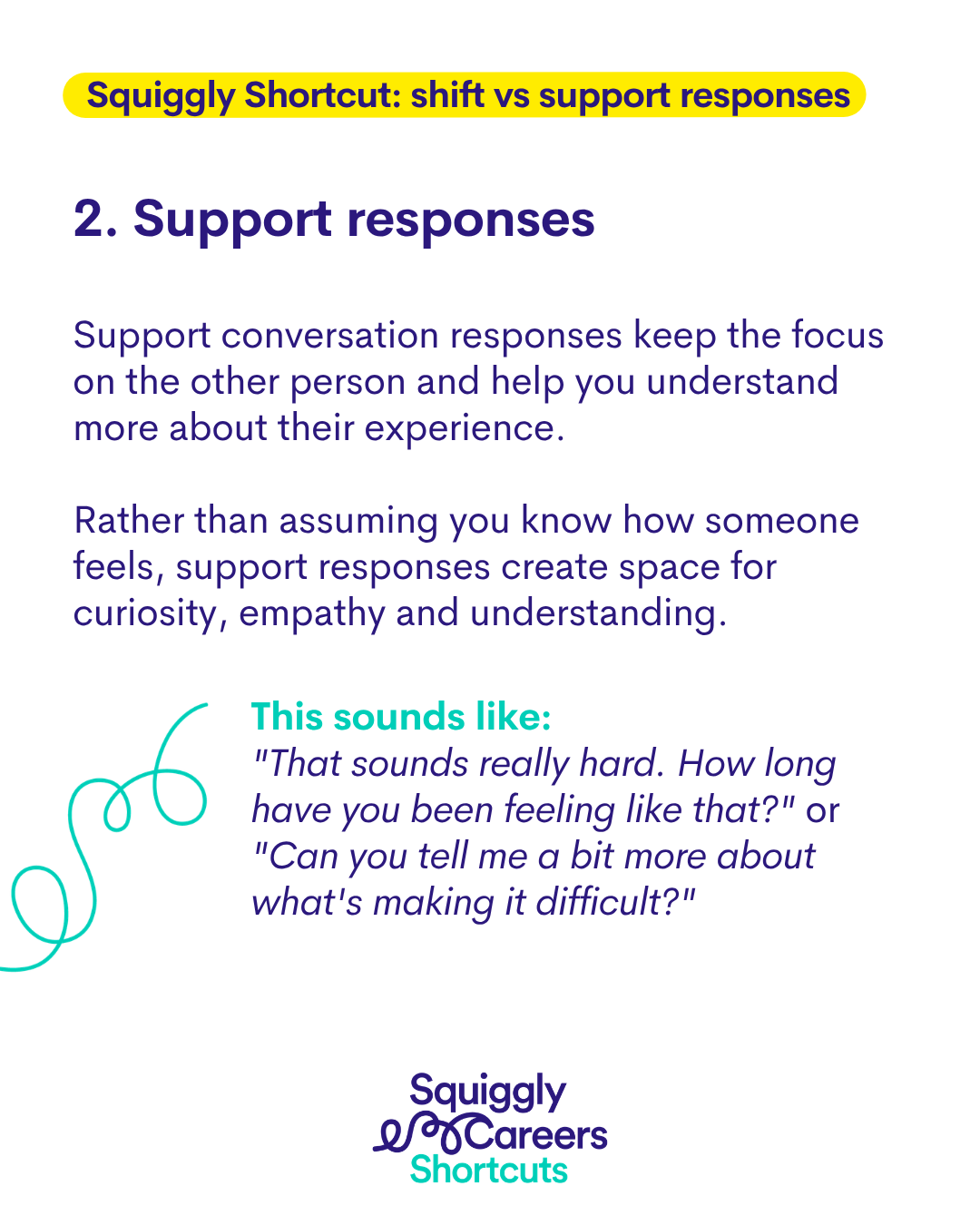
But there are moments, perhaps when someone is telling us something hard or something feels difficult, or you just really want to be supportive, where a support response serves you and the other person much better. So in that exact same example that I just shared, a manager might instead say to the person who's feeling really stressed, oh, that sounds really hard. How long have you been feeling like that? Or that sounds really hard. Talk to me a bit more about, like, what does that look like? Or give me some examples of, like, when. When it's feeling particularly hard at work at the moment. Or just, like, tell me a bit more about that is kind of the classic coaching question that sometimes people use. But I always think you want to show you've been listening and your job to do when you're trying to be really supportive and responding with supportive questions is you're trying to expand your understanding of their world.
You're trying to make sure that you aren't making assumptions, and you're just really trying to listen actively and question in a way that just feels like that person is the kind of most important thing. It's almost that reminder that I remember when I was first learning coaching. People say to you, it's not about you. And there are certain moments at work when we're leading teams or just with our colleagues where it's okay to not put yourself as part of that conversation. And people will really feel that. They'll really appreciate that and they'll feel really heard. So I think it's something that we can all do for each other probably a bit more from time to time. So have a go, maybe over the next week. Notice your shift responses, notice your support responses, and perhaps you could even try it out together as a team. If you'd like to listen to Celeste on the Squiggly Careers podcast, which I would recommend. She's a brilliant communicator. It's episode 207 of the podcast, if you want to go and find that. Otherwise, that's everything for this shortcut. And we're back with you again soon.
Sign up to the Squiggly Careers Newsletter and get our latest ideas, tools and inspiration every week - all in one place, straight to your inbox


