
This week on the Squiggly Careers podcast, Helen and Sarah borrow brilliance from a sweet source — the marshmallow experiment — to explore how the science of delayed gratification applies to our work and career choices.
Inspired by the famous psychology study, they unpack what it means to make one marshmallow versus two marshmallow decisions — the everyday trade-offs between instant satisfaction and long-term success. From replying to emails and saying yes to everything, to applying for jobs and building relationships, Helen and Sarah share real-life examples of how to recognise and reframe your choices for greater impact.
You’ll learn how to spot your own marshmallow moments, connect them to what motivates you most, and choose progress over quick wins (at least some of the time!).
🎯 What You’ll Learn
📚 Resources Mentioned
For questions about Squiggly Careers or to share feedback, please email: helenandsarah@squigglycareers.com
Need some more squiggly career support?
1. Download our free careers tools
2. Sign up for our Squiggly Careers Skills Sprint X AI.
3. Sign up for Squiggly Careers in Action, a weekly summary of the latest squiggly career tools
4. Pre-order our new book Learn Like a Lobster

00:00:00: Introduction
00:01:20: The Marshmallow Experiment
00:07:23: Common marshmallow decisions...
00:09:14: ... 1: emails
00:15:10: ... 2: what you say yes to
00:22:21: ... 3: applying for jobs
00:28:15: Final thoughts
Helen Tupper: They ran an experiment with kids where they could either eat one marshmallow now, or they could wait 15 minutes and then they could get two. And what they proved is that the kids that could delay gratification went on to do better in life. They could hold out for the better outcome. And then actually, when you do then start to put this into an everyday life context, you do realise it stacks up in lots of different ways. You probably do your best work when delayed gratification is part of the process. I think ladder-like careers sometimes have a bit more instant gratification things in there. You know, like, get promoted, get happy. This idea that if I do that, then this is the outcome. I think our days and weeks are full of one-marshmallow decisions that we often do without thinking, because of habits that we've got into. If you can start just thinking, "But what would the two-marshmallow payoff be here? With that in mind, what choice do I want to make?"
Sarah Ellis: Hi, I'm Sarah.
Helen Tupper: And I'm Helen.
Sarah Ellis: And this is the Squiggly Careers podcast. Every week, we borrow some brilliance from a people, place, object, book. We go all over the place. But we try to turn that curiosity into some useful action for you and your Squiggly Career. So, Helen, what are we borrowing from this week?
Helen Tupper: Well, it's kind of a combination of a something, a physical thing, and I suppose it's two somethings: the concept of delayed gratification and also the marshmallow.
Sarah Ellis: Let's talk marshmallows.
Helen Tupper: I think we're putting those two things together because there is quite a lot of research that has been done. It's called The Marshmallow Experiment, and this was slightly sparked by a couple of things. I was doing a long train journey to Padstow to meet Sarah to go and meet some lobsters a week or so ago.
Sarah Ellis: As you do.
Helen Tupper: As you do. Standard week in the life of Amazing If. And I was in the train station and I thought, "Do you know what, I'm just going to pick up a random book so I can read it on the train". And I picked up The Marshmallow Experiment, because when we were writing Learn Like a Lobster, at one point there was a chapter on marshmallows.
Sarah Ellis: Which doesn't sound likely, but it's 100% true.
Helen Tupper: I know. But it's because marshmallows have been used in lots of different experiments. So, there's quite a lot to learn from marshmallows. But specifically, we wanted to focus on one particular experiment that was done with marshmallows, which is around the concept of delayed gratification, which is the topic for today. Sarah, would you like to distil in a minute what that research was for people.
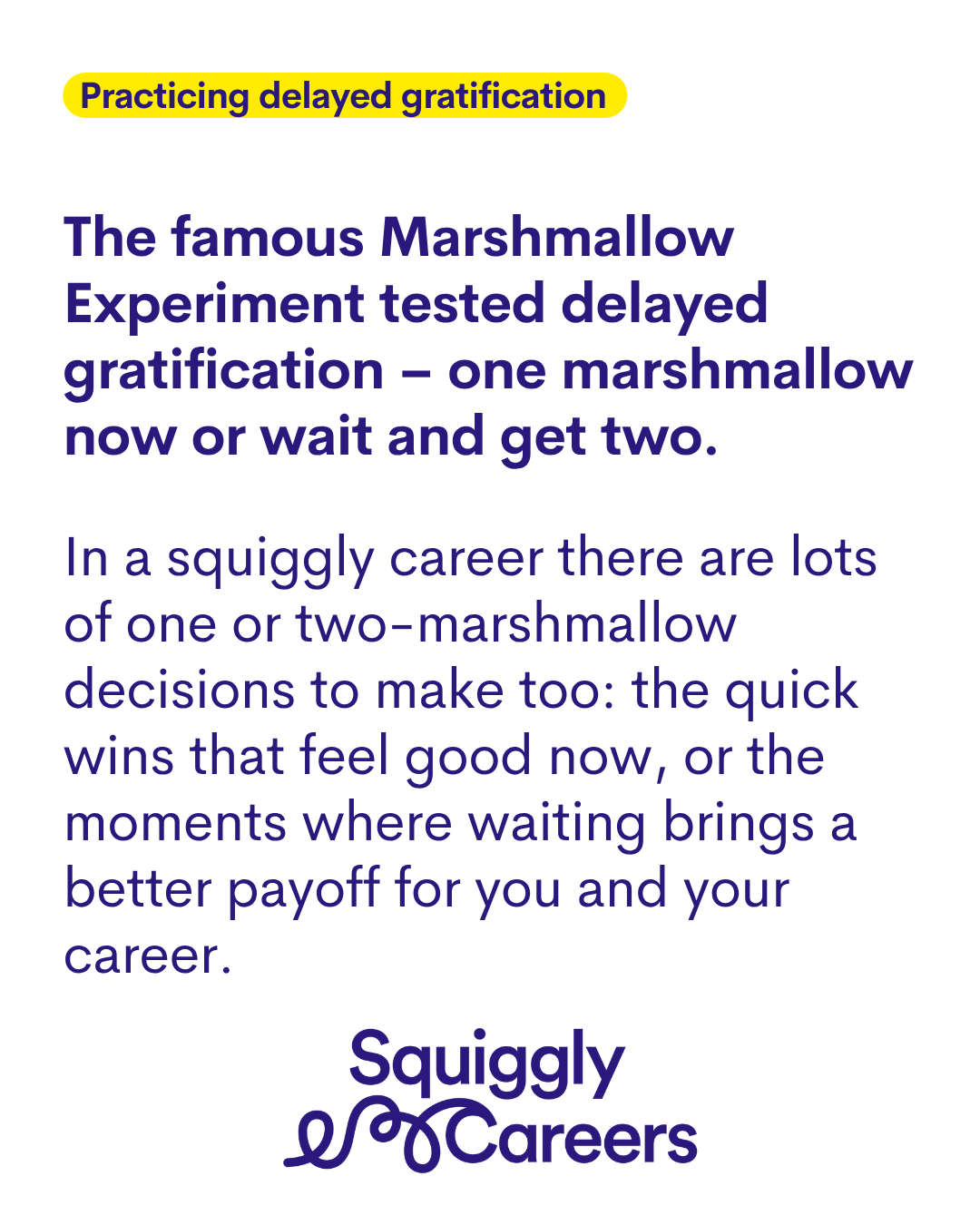
Sarah Ellis: Yeah and I think this is one study, and the more you delve into this, people always have the caveats of like, "It's only one study". But if you have got kids, it is quite a fun game to play. And basically, they ran an experiment with kids where they could either eat one marshmallow now, or they could wait 15 minutes and then they could get two. And I was thinking, "My 8-year-old would 100% just be like, 'Fine, I'll just have the one now'". That's definitely him. And what they proved, in what is a kind of quite a small sample though, worth having that in mind, is that the kids that could delay gratification went on to do better in life. They could hold out for the better outcome, because obviously two marshmallows is better than one; 15 minutes is not that long; great. You just sort of need, I suppose, the short-term sacrifice for the long-term gains. And then actually, when you do then start to put this into an everyday life context, you do realise it stacks up in lots of different ways, whether you think about exercise or health, any big work things that you're really proud of, typically there tends to be quite a lot of delayed gratification along the way.
So, I do think it is a useful skill to learn, particularly when almost at the same time, there's a bit of a tension. You probably do your best work when delayed gratification is part of the process. At the same time, there are probably more things trying to distract you from that than ever before; more immediate gratification available, I guess.
Helen Tupper: And I think, just in the context of career development, I think ladder-like careers sometimes have a bit more instant gratification things.
Sarah Ellis: Yeah, definitely.
Helen Tupper: Like, "Get promoted, get happy", this idea that if I do that, then this is the outcome. Whereas I think sometimes, Squiggly Careers are a bit more about the delayed gratification, which is like we talk about, develop the skills of values, knowing what motivates and drives you, and use those as a filter for your future. That means that you might not take a role. Sometimes, we talk about like shiny objects. You might not take a job that looks really shiny, because it's got a really good job title or it's working for a really good brand, you might not take that now because you know that actually it's not going to give you what you really need over the long term, which is your values. So, you might delay the gratification of moving into a new role, because you know that a role that is likely to be better for you in the long term is coming. And I think that Squiggly Careers, a lot of it is about developing the self-awareness to make better decisions about your development. But that probably means you're going to have to use the appeal of some shiny objects that might be presented to you that are quite ladder-like in their appeal, for the longer term delayed gratification of something that's probably going to be a better fit for you.
Sarah Ellis: And that really reminds me of, I remember working with somebody and being so impressed by it, where she decided to do a squiggle-and-stay sideways move into working in digital, when digital was kind of not where it is today. So, this probably, what, 10, 11 years ago. But at the same time, she could have taken a more senior role; more senior role, more pay, more status, much more ladder-like. And she delayed that gratification because I think she could see her at the outcome that she was like, "Yeah, but this is a skill that's going to be really important to me. I'm going to be much more employable in my Squiggly Career if I get these skills. And this is one job in the scheme of lots and lots of jobs. I'm going to be working for a long time". And I just remember thinking, that takes a lot of confidence to delay that gratification. But also then, obviously, I've seen how she's kind of squiggled after that, and that it's totally paid off. But like you say, probably in that moment, she took the two-marshmallow decision, right?
Helen Tupper: Yes. Yeah, this is what we're going to talk about, everyone. So, we thought that in work, there are lots of one-marshmallow and two-marshmallow choices to be made.
Sarah Ellis: Yeah, we've decided.
Helen Tupper: So, whether it's about, I don't know, how you build relationships or how you show up in project meetings, all these different things or the activities in our day-to-day life, there are one-marshmallow decisions, which are, "This is going to feel great right now", and then there are two-marshmallow decisions, which is, "But if I wait, the payoff is going to be better". And it is a choice as to what you do, and we're not going to say, "Always choose two". It's a personal choice. Do you want the one marshmallow? It's like, Sarah's little boy, Max, is not bad because he chose the one marshmallow. It's just, he potentially could have had two if he'd waited. And what we want to present to you is some, what we think are common one-marshmallow and two-marshmallow decisions that you might have, and help you to possibly be a bit more informed about the choice you're making, rather than just defaulting to probably the one-marshmallow decision. We just want to present the choice to you.
Sarah Ellis: I also think it's really helpful, the more Helen and I dived into this, you can then start to apply this in a really personal way. And almost, I think you could go through a week and be like, "Right, today, how many one-marshmallow decisions did I make, and how many two-marshmallow decisions did I make?" And the more we started talking about this, the more I think you start to spot them. And, no one's perfect, I sometimes think we need the one marshmallow. I actually do think sometimes --
Helen Tupper: "I want a quick win. Just give me the quick win".
Sarah Ellis: I think sometimes it is okay to be like -- you know, no one's perfect. I feel like if you're always doing two-marshmallowing, you're too perfect. That's nobody. But I do think there are probably some things where you might be like, "Do you know what? I could take myself away from the one marshmallow here, because actually I want --" the whole point here is you're not just doing the two-marshmallow decision just for the sake of it. There should be a really motivating outcome that you want. Now, for the kids, it's they just want the two marshmallows. But for us at work, if you can connect the two marshmallows with something that matters to you and that you find motivating, then I think you stand more of a chance of being able to be like, "Well, I'm not going to do that thing right now".
Helen Tupper: So, shall we talk about the common situations that we think everyone can relate to? Because I think once you've got your head around those, you can start to then think about, "Well, what other one-marshmallow, two-marshmallow decisions am I making in my day at work?" And I think you can personalise this a little bit more. Where should we start?
Sarah Ellis: Let's start with email. I think that's the most obvious one- versus two-marshmallow opportunity, probably for everybody.
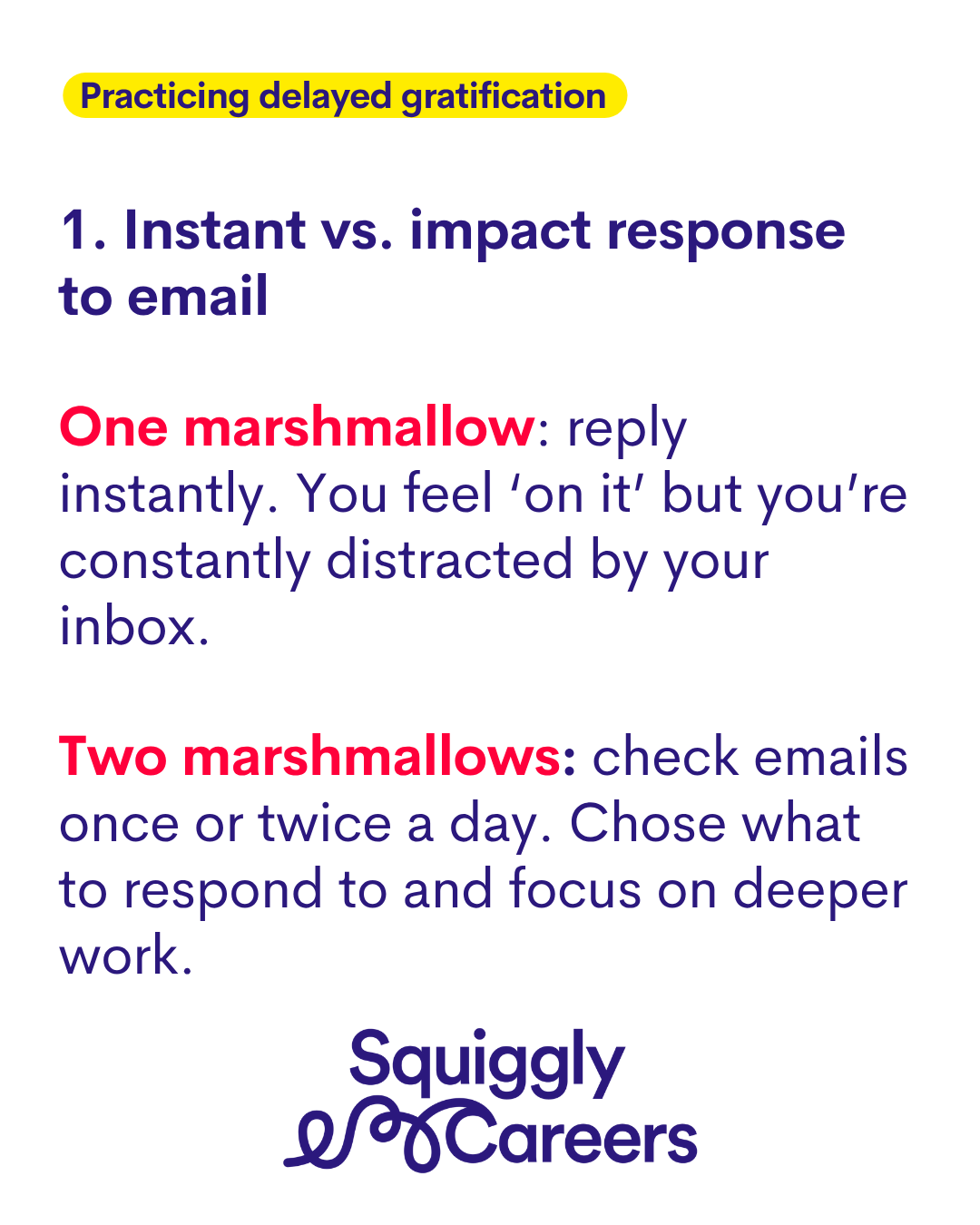
Helen Tupper: Okay, so on email, we think the one-marshmallow decision leads to people instantly replying. So, because the benefit that often you're getting when you get an email and then you instantly reply to it and you're in your inbox all day, is I think it feels good for lots of people to be responsive. You know, "I'm the sort of person who does it and gets it done. And therefore, I answer my emails as soon as they come in and I'm responsive". And that's quite a one-marshmallow decision, because you're being very reactive and it feels really, really good in the moment. And I am probably the sort of person who does that quite a lot. I think I'm quite one-marshmallow about my email.
But the two-marshmallow decision is, what if you only checked your email twice a day, okay, so you just do it twice a day. So, you're not doing the replying to everything, getting the instant buzz when you press send. You just check your emails twice a day, so that's the delayed gratification. But the payoff, the two marshmallows that you get is you're likely to be more efficient and effective with the rest of the work that you do that day, because you're not task-switching, you're not distracted, you're not wasting your time constantly checking your emails, and you're not even prioritising what you're applying to in that situation. So, we think with email, you have a one-marshmallow, respond straight away, or a two-marshmallow, delay that gratification and the payoff is efficiency and effectiveness of your work?
Sarah Ellis: I think, and you're going to not like this, I think I'm like a one-and-a-half-marshmallow with email.
Helen Tupper: Oh, of course!
Sarah Ellis: See, I knew she's not going to be up for this.
Helen Tupper: Of course she is. I'm like, it's really important that we create clarity for people on the podcast so that they make sense of it. And Sarah's like, "Yes, but also could we just..."
Sarah Ellis: Well, the reason I say that is, so I don't do what you do. Also, I'm not naturally as responsive as you are. So, I don't feel like I have to read and respond straight away. So, I think I can delay that gratification. But I think, so I have a flagging system. So, I do read them a lot though. So, actually the idea of doing it twice daily, that actually does feel quite hard for me. So, I'm like, "Oh, that's not what I do". I'm pretty on top of what's coming in when I'm not doing other things, but I never respond straightaway. It's quite rare actually for me to respond in that moment.
Helen Tupper: But you read straightaway? Do you read straightaway?
Sarah Ellis: I read straightaway, but I don't respond straightaway.
Helen Tupper: So, what's your payoff? So, if you're like one-marshmallow and you're reading when they come in, what's your payoff for that?
Sarah Ellis: What, in the reading in the moment?
Helen Tupper: Yeah.
Sarah Ellis: Just probably that I feel like I still feel on top of things. But for me that's enough. I don't actually feel like I need to respond. And I suppose if it was super-urgent, at least I've seen it.
Helen Tupper: So, you feel more in control. Your one-marshmallow is control.
Sarah Ellis: Yeah, control.
Helen Tupper: I mean, not that I was trying to get you to say that, but I thought that might be it.
Sarah Ellis: So, I think I feel in control. The one-marshmallow helps me to feel in control. With two, I'm like, "Oh, I feel out of control".
Helen Tupper: Well, so wait, because then you're never going to take the two marshmallows. So, I'm trying to work out. So, if your one-marshmallow is, "I read it as soon as it comes in, because the payoff for me is I feel in control".
Sarah Ellis: Yes.
Helen Tupper: So, what if I said to you, "But Sarah, only check it twice, only read twice a day. Don't waste your time reading those things. Stay focused on whatever else you're doing. Only read twice a day", what could your two-marshmallow payoff be? What's a bigger and better benefit for you of reading twice a day?
Sarah Ellis: It wouldn't be efficiency. Don't think I care enough about that. It would need to be something to do with the quality of the work. So, if I felt that actually, even the quality of my email responses, because I actually would care about those. So, the quality of responding to emails that are in a way that is clear and straightforward and makes sense, because I think that matters to people and it matters to me. And if it meant that the quality of the work that I did the rest of the time was also higher, then that would always motivate me. So, mine would be quality.
Helen Tupper: So, your one-marshmallow is control in a kind of omnipresent control.
Sarah Ellis: Always in control.
Helen Tupper: Yeah, always in control, omnipresent control, "I see it and I know it and I'm in control of it".
Sarah Ellis: That's very appealing. That's why I have the marshmallow. I'll take that marshmallow every time.
Helen Tupper: Whereas your two marshmallows is potentially increasing the quality of your work and your communications. And it's quite appealing.
Sarah Ellis: It is. I still think it's hard. It's why all the kids take the one marshmallow. It's why I'm like, "Argh", because the one marshmallow, I think you have to remind yourself, is still attractive and tastes good and is appealing. So, it is appealing to be in control. And also, probably we're all more used to the one marshmallow. And so, I think when we've talked before about experimenting or trying stuff out, rather than probably doing this in a dramatic way, if I was going to do this, and maybe I won't try next week because I'm on holiday, so that's basically cheating, I could be like, "I'll do it next week".
Helen Tupper: "I got 20 marshmallows!"
Sarah Ellis: I think I could try this. I think I would pick a day that I felt most confident about picking, so probably a Friday. So, I think I get the least amount of emails on a Friday. And I think I would try it on a Friday. And I'd be like, "Can I hold out for the two marshmallows on a Friday?" Okay, I'll have a go. I promise I will have a go. I feel like I'm at a kid's show now, "I promise".
Helen Tupper: "I promise, Helen, I'll try".
Sarah Ellis: I promise I will have a go and report back.
Helen Tupper: Okay.
Sarah Ellis: Are you going to have a go?
Helen Tupper: Yeah! I mean, I might have the one marshmallow on this.
Sarah Ellis: That was the least convincing. Okay, maybe do another one, because I feel like maybe that's not your one.
Helen Tupper: Well, we did say it's a choice, right? So, all we're trying to do is present people with the benefits.
Sarah Ellis: You're like, "No"!
Helen Tupper: This might not be my one.
Sarah Ellis: Okay, let's do another one.
Helen Tupper: Okay, I think this next one, this is more appealing. The two marshmallows might be more appealing to me here.
Sarah Ellis: Okay.
Helen Tupper: So, I'll get Sarah to explain it. But at a high level, this is about managing what you say yes to. So, we think that particularly if you're a bit of a people pleaser, there are lots of situations at work where you might find yourself saying yes. So, Sarah's going to talk through the one-marshmallow benefit of why we do that, and a potential two-marshmallow payoff of doing something different.
Sarah Ellis: And here, I think I'm already a two-marshmallow-er, so I think I'm okay here. So, it's also good, right? It's good to know where you're already good at this. So, the one marshmallow would be you say yes to everything and to everyone, perhaps if you particularly feel good at people-pleasing, and those people are always usually really nice people in my experience. And you do that because you're helpful, and also it feels good. I ask someone in our team, "Can you help me with this?" They say yes and they just do it. But I've obviously derailed or distracted whatever they were doing. I actually thought about this one. I was like, "Oh, I actually did that yesterday". I asked the team for some help with something, and do you know what was interesting? There were two people that offered to help. And do you know who was one of them? You.
Helen Tupper: Me. Oh, yeah. Of course it was!
Sarah Ellis: Two people offered to help and one of them was Helen, who probably is the busiest person in our team. But because you're really helpful and because you're really nice and because you're a yes --
Helen Tupper: I like you, I hate you feeling stuck. I'm like, "I can help you".
Sarah Ellis: To be fair though, I came with everything by myself in the end and I was like, "Perfect". So, the one-marshmallow payoff is, "I feel really helpful and I feel good and I feel useful". So, they're all really good feelings, that's why we all want the one marshmallow. The delay, the two-marshmallow option, is to say no. And I don't think what we're saying here is like, say no all the time. It's saying no, and the outcome of the two marshmallows is so you can have more impact. I think probably very practically, you're saying no so you can make more progress on your priorities. So, often, if I say to people in workshops, "Oh, do you feel like your priorities kind of get overtaken by other people's priorities?" or you end up doing other work that you've not anticipated, that's often a problem for people. Lots of people recognise that. So, I think, yeah, the payoff here is that you will make more progress on things that really matter to you in your job versus I don't think the two marshmallows suddenly makes you an unhelpful person, I think it just makes you a more impactful person.
Helen Tupper: Yes, I agree, and that is really appealing to me. And I've reflected on this a little bit. I think I can do the two-marshmallow one. In this situation, if you say yes a lot, which I do, because I love to help and I love to say yes, and I hate to say no, but I think I have got better at the saying no because I know that my payoff will be better with people outside of Amazing If, which has been hard for me. So, lots of people have said, "Can you get involved in this thing? Or can you help us with this? Or can we do this?" And I've had to say no, because for Sarah and I at the moment, we're running our business and launching a new book, and that's two really big things. And so, I've had to say to some people, "I'm really sorry, I can't get involved in that because I'm trying to make this the best book yet, the best book launch yet". And that's my two marshmallows and I'm very attached to that. But I really struggle inside our business.
So, when anyone in Amazing If wants help, I will often say, "Yes, of course", and I will drop the two-marshmallow payoff, like the get the project being even better or the quality of the thing that I'm working on, the impact of my work. I will just drop that instantly and just take the helpful feeling and take that. And I think I could get a bit better at the two-marshmallow choice in the company, with the people who work in the business. My reflection.
Sarah Ellis: That's useful, because I think what you've then done is also thought about situations. So, you've identified specific situations where the two marshmallow versus the one marshmallow, what's more likely where? So, you're like, "Actually, do you know what, I'm all right at it now", and you know what that feels like, because you've had the two marshmallows. You're like, "Okay, I know that that feels like I have more impact".
Helen Tupper: I feel better, actually, I feel good. The two marshmallows, it's not just about my impact, it's about when I say no, because self-respect is a very big thing to say, but I feel a bit proud of myself. I'm like, "Oh, I felt I was really clear about why I can't get involved and I was still nice. And I maybe helped them in some other way, I maybe gave them some other bit of information". I kind of feel a bit proud of myself. I think that's also like a little mini marshmallow that I get when I do that.
Sarah Ellis: Now we're getting into like those little, tiny ones.
Helen Tupper: The ones that you get hot chocolate!
Sarah Ellis: Yeah. We've got there. We've come up with every version of them. When do we get to those giant ones?
Helen Tupper: The giant ones. Oh my gosh.
Sarah Ellis: The giant ones, like what's the big, giant-marshmallow payoff?
Helen Tupper: I don't know.
Sarah Ellis: The other thing I was thinking there was, you could still be helpful, but without it being you. So, that's what you described a little bit there. So, one of the things that you might want to do if you're thinking about the internal thing is, part of your assumption is that help has to be you. And so, one of the things that you could do to someone in our team, because I think you'd find a very straight 'no' hard, because you are so naturally helpful, you might be like, "So, I can't help you today on it", because whatever you're doing, "because I've got five workshops", or whatever you've got on that day, "But do you know what? I actually think Sarah will be able to help you on that, or I think Lucy might be able to help you". So, someone else in our team who you know has got those skills, or at least could offer a bit of support, because I reckon there's always someone somewhere who could help. So, I think it's probably also a bit letting go of like, "This has to be me".
Helen Tupper: I feel like I need on my desk like a drawing of two marshmallows with the project I'm working on, to keep it in mind.
Sarah Ellis: Yeah.
Helen Tupper: It would be like, "Okay, my two-marshmallow thing this week is making this project brilliant". And then almost having it like a little Post-it Note. I could feel like I could draw it and stick it on my laptop. And every time I go to type, "Yeah, sure", I'm just going to look at that Post-it Note with the two marshmallows against the project and be like, "No, that's the payoff. That's the thing that you really, really want", to keep it in my mind.
Sarah Ellis: I guess, even if you did it 50% of the time. If you're saying yes to everyone in the team 100% of the time, which I bet you're not far off, as in percentage of times that you actually -- I can't actually imagine you even doing it.
Helen Tupper: You wait until you hear my noes next week when you're on holiday, and you won't actually know if I did it or not.
Sarah Ellis: Yeah, when I'm on holiday and can't actually do it. But even to me, and I'm the person that you should be able to say no to. You just know me really well. We have a different relationship, right, our relationship's all over the place. But I should be someone that you can be like, "Do you know what? There's something more important than helping Sarah with this question she's got", and you still say yes to me. So, maybe it's about starting saying no to the people that feel easiest to say no to. So, I reckon I am easier for you to say no to than anyone else in the team, or I should be. And then you maybe go from there.
Helen Tupper: Maybe, maybe. I am quite motivated by that one. I'm much more motivated by that than checking my emails twice a day for that payoff.
Sarah Ellis: I'm not, because you're solving my problems, but it's all right. I want you to have the two marshmallows. Shall we talk about jobs and applying for jobs?
Helen Tupper: Yes.
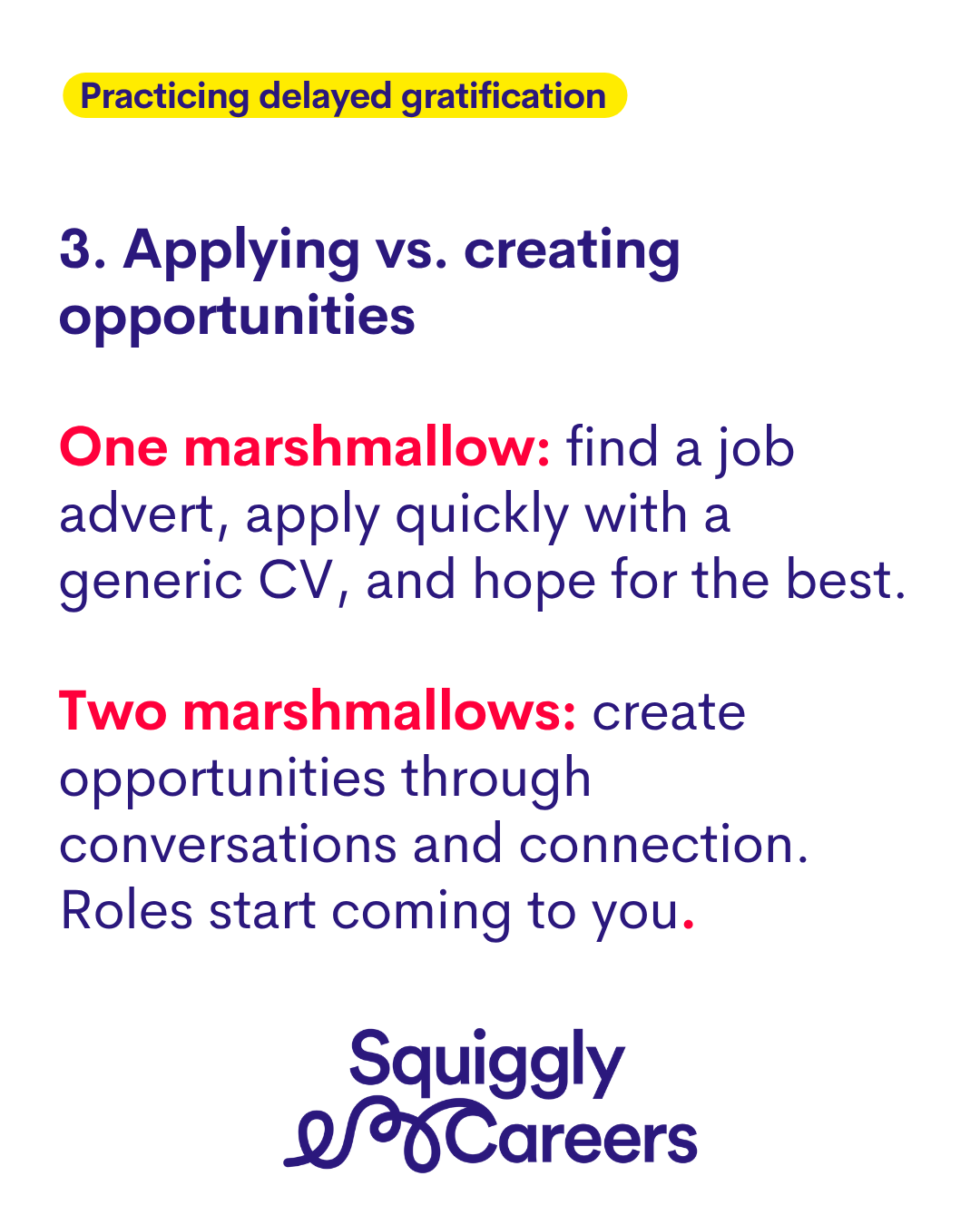
Sarah Ellis: I think this is a good one with the one versus two marshmallows. Maybe if I do the one marshmallow, and then you do what the two looks like. So, the one-marshmallow version of applying for a job is, wait to see a job advertised, apply for the job, and you either get it or you don't. It's very wait rather than create, It's very reactive. Also, you feel good maybe about applying for a job. You're like, "I'll just put my CV in, send my covering letter", because I do think actually doing those things can be quite stressful.
Helen Tupper: It's very instant.
Sarah Ellis: But you're sort of responding to something and maybe you get an interview, maybe you don't, but you're like, "I've just done it in that instant moment. I've seen a job I want and I've applied for the job".
Helen Tupper: I was pausing a little bit because I'm wondering whether I should tell you this story, because you might panic. But I saw one today. I mean, I didn't think about applying for it. No, I did think. I kind of did think about applying for it.
Sarah Ellis: Right.
Helen Tupper: Because, it was a bit like, "Wow, that's so cool". So, the job was an entrepreneur in residence.
Sarah Ellis: I've seen jobs like this.
Helen Tupper: Yes, it's really cool, and it wasn't even full time. You could just do a couple of hours a month, and your job was to inspire the people in the company.
Sarah Ellis: Pressure!
Helen Tupper: I was like, I know, yeah, that's so true. I didn't think that, I was just like, "Yes, let me go do this". I was like, maybe I could have a little side project.
Sarah Ellis: Are they paying someone for that?
Helen Tupper: Yes! And I thought, "This is really cool. An entrepreneur in residence for a couple of hours a month".
Sarah Ellis: Maybe you should apply for that and just put the money into our company.
Helen Tupper: Yeah, but then I looked at it. I thought, "Sarah will kill me". And then I looked at it, and you needed to know some very specific technical things. I was like, "I haven't got that". But it did sound quite cool.
Sarah Ellis: You can't just bring your energy. I think you were imagining you could just walk around, "I'm so energetic".
Helen Tupper: "Hi, everyone, would you like just some ideas about careers?" And they're like, "No, because we need some molecular knowledge that you don't have".
Sarah Ellis: Shame.
Helen Tupper: But anyway, that's kind of the one-marshmallow thing is you see something, like Sarah said, you're waiting, you see it and you just apply straightaway without really thinking about it, because that's what feels good. The two-marshmallow approach to applying for a job, so this is where you're delaying the gratification, you're not getting the instant, "I've applied, I'm in the mix", is to build relationships around the roles that you are interested in. And so, there could be more than one role. So, I might be like, "Oh, who's been an entrepreneur in residence? I might go talk to some people around those particular roles", or maybe there's a function you want to move into, or whatever it is. But you pick two or three people who are connected in some way to those opportunities, and you are going to build relationships with them, understand what they do, understand how they got there, understand what knowledge that they developed to be able to do those things. And the reason that you want to do this is because it is often conversations and connections that create career opportunities. And if you can build relationships around the roles that you're interested in, it is much more likely that the opportunities will come to you.
So, the delayed gratification thing here is, that's going to take longer. Building relationships around the roles that you are interested in is going to take a lot longer than just applying for a job that you're seeing on LinkedIn today. But the payoff of doing this is that jobs come to you. And I've definitely seen this, because I had this feedback from somebody in my career, when I'd applied for a job and I didn't get it and I was really demotivated by it. And they said, "Helen, you want to put yourself in a position where the jobs come to you", and relationships are a massive way. Building your brand and building relationships are basically how that happens, and both of them take a bit of time. But if you can do it, I think that's the big marshmallow. You know we were like, "What's the big chunky one?"
Sarah Ellis: Oh, "What's the giant?" let's call it the giant marshmallow.
Helen Tupper: The giant marshmallow, the one that you put on the bonfire, the really big ones.
Sarah Ellis: Yeah.
Helen Tupper: I think having jobs come to you is a giant marshmallow in your Squiggly Career.
Sarah Ellis: Yeah. And yeah, you're right, because I think also, some of those curious career conversations won't go anywhere. But I go, but the worst-case scenario is you've built a new relationship or a new connection. Or sometimes, you just never know when things are going to come back or pay off. There are some people who've got in touch with me, who maybe I've not seen for ten years. I actually had this yesterday. Someone emailed us to say how much they love the Squiggly Careers in Action newsletter, someone I used to work with when I was at Barclays. This is a really long time ago, like 15 years ago. He was like, "Every time I read it, I just think I'm so proud almost of the business that you and Helen are building". And he's like, "I just wanted to say that, because I think it every week, but I wanted to tell you".
Helen Tupper: What a nice thing to say.
Sarah Ellis: "Also, do you fancy having a coffee?" and I was like, "Yeah, of course I do". I always loved spending time with this guy. He was like a smart, sparky, strategic person I've always learned a lot from. And I was like, "Yeah, great". And who knows where that will go or that will lead. If you're going to leave me to be an entrepreneur in residence, maybe I'll go and work for him.
Helen Tupper: I'm not, but I just thought it was cool!
Sarah Ellis: I'm like, "Maybe I need to start having these chats quick"! But you know when you're like, well, that would be so easy to not do. There'd be no Amazing If reason, that's not on any to-do list anywhere, that's not on any career list even anywhere, but those kind of people know people I don't know, see things I can't see. And I always want to pull interesting opportunities and possibilities for us for career stuff, to work with different people and for things that we could try out for the first time. And it's other people who make those happen. And that's why I will say yes to that, because I mean, I will enjoy it, so it's not that much of a hardship. But also, the one-marshmallow thing would be no, because I'm going to tick one more thing off my to-do list. The two-marshmallow thing is you're going to just go and have a conversation with someone and be really curious.
Helen Tupper: And I guess that the conclusion of the conversation about marshmallows is that I think our days and weeks are full of one-marshmallow decisions that we often do without thinking, because of habits that we've got into and how it makes us feel in the moment. And if you can start just thinking, "But what would the two-marshmallow payoff be here? And with that in mind, what choice do I want to make?" And you still might choose one marshmallow, but at least you've done it with awareness and intention, and you know what you're trading off. I think maybe if we can add a bit more of that into our days and weeks, then I think ultimately you're going to just make more choices about how you want to show up and what you want to do and not just operate on autopilot, which is a bit of the one-marshmallow trap sometimes.
Sarah Ellis: A really good article to read on this. If you've read this and you're like, "Oh, I'm actually interested to learn a bit more", James Clear has got a really good article on delayed gratification, and he's also got some really good top tips in there. He links through to some really interesting strategies. So, we've not talked about all of those today, but I read it and I was like, "Oh, this is all really helpful". Quite a good guide for if you're setting up your own one- versus two-marshmallow decision-making for your working week. So, I'd recommend having a quick look at that. Obviously we'll put it in the show notes.
Helen Tupper: And do you know where else we'll put it, Sarah? In the Squiggly Careers in Action newsletter, which has been recommended by one of Sarah's friends.
Sarah Ellis: It comes highly recommended.
Helen Tupper: It come highly recommended. Just on the Squiggly Careers in Action newsletter, I am really proud of that because we didn't used to have a newsletter. We used to have this email we sent out to our brilliant populous community. And we just decided, "You know what, we're creating so much stuff, we want to put it together in a way that's useful". So, if you do not subscribe to the Squiggly Careers in Action newsletter, it is something that we work really hard on each week to pull together the podcast and the Squiggly Shortcuts and the behind-the-scenes stuff, and stories about what Sarah and I are doing, and research and reports we've found. So, if you are interested in the work that we are doing and you want to learn more, I would recommend signing up for it. Head to either the show notes or our website, amazingif.com. Or if you still can't find the link to sign up, just email us, helenandsarah@squigglycareers.com, and we will send it your way.
Sarah Ellis: But that's everything for this week. Thank you so much for listening. I don't know about you, but I'm considering having a marshmallow. The advantages of having an 8-year-old. We'll be back with you again soon. Bye for now.
Helen Tupper: Bye everybody.
Sign up to the Squiggly Careers Newsletter and get our latest ideas, tools and inspiration every week - all in one place, straight to your inbox


