What does it mean to live (and work) with moral ambition? In this episode of the Squiggly Careers podcast, Sarah introduces ideas from Rutger Bregman’s book Moral Ambition and Helen helps turn them into practical actions you can apply in your own career.
You’ll hear why moral ambition is about using your 80,000 working hours wisely, how to close the belief–behaviour gap, and what small steps you can take to make a bigger difference. Together, Helen and Sarah explore how to connect Bregman’s big ideas to the everyday reality of squiggly careers.
🎯 What You’ll Learn
-What moral ambition is and why it matters
– How to spot your own belief–behaviour gaps
– Practical ways to volunteer and use your strengths for impact
– How to extend your positive influence beyond your current circle
– Why finding morally ambitious role models helps you take action
For questions about Squiggly Careers or to share feedback, please email: helenandsarah@squigglycareers.com
Need some more squiggly career support?
1. Download our free careers tools
2. Sign up for our Squiggly Careers Skills Sprint X AI.
3. Sign up for Squiggly Careers in Action, a weekly summary of the latest squiggly career tools
4. Pre-order our new book Learn Like a Lobster
00:00:00: Introduction
00:00:32: About moral ambition
00:03:47: The belief-behaviour gap
00:09:38: Ideas for action ...
00:10:10: ... 1: volunteer
00:17:01: ... 2: expand your moral circle
00:21:32: ... 3: be a zero
00:27:16: Final thoughts
Helen Tupper: Hi, I'm Helen.
Sarah Ellis: And I'm Sarah.
Helen Tupper: And this is the Squiggly Careers podcast, where every week we get curious and use our conversation to turn that curiosity into action to support you in your Squiggly Career. And we're borrowing brilliance from lots of different things. It could be people, so we've done one with Richard Feynman, a physicist; it could be books; it could be objects. And we're taking it in turns to lead the conversation. So, Sarah is leading us through her curiosity today. What are we going to be talking about, Sarah?
Sarah Ellis: So, today we are talking about Moral Ambition. Deep, deep breath everybody, I would say.
Helen Tupper: Is it hard hitting?
Sarah Ellis: Yes, yes it is, by Rutger Bregman. And so, yes, it is. My starting point for this is, it is quite confronting. I do think, as you go through this, for most people it is quite confronting. Maybe some people though will just feel really smug. So, if you are doing something incredible and saving the world in every which way, you'll feel really good about yourself. For the rest of us, I think it will encourage you to ask some provoking questions. And what I have tried to do today is take the concept and go, "Right, what could everybody do?" And do you know what, it is a really good read. Actually, it's a really inspiring read. But at the same time, I don't know, sometimes those people who have changed the world can make you also feel like, "Oh, I'm so far away from that". But reading the book is very time well spent. It is a really good book.
Helen Tupper: What made you buy it, pick it up?
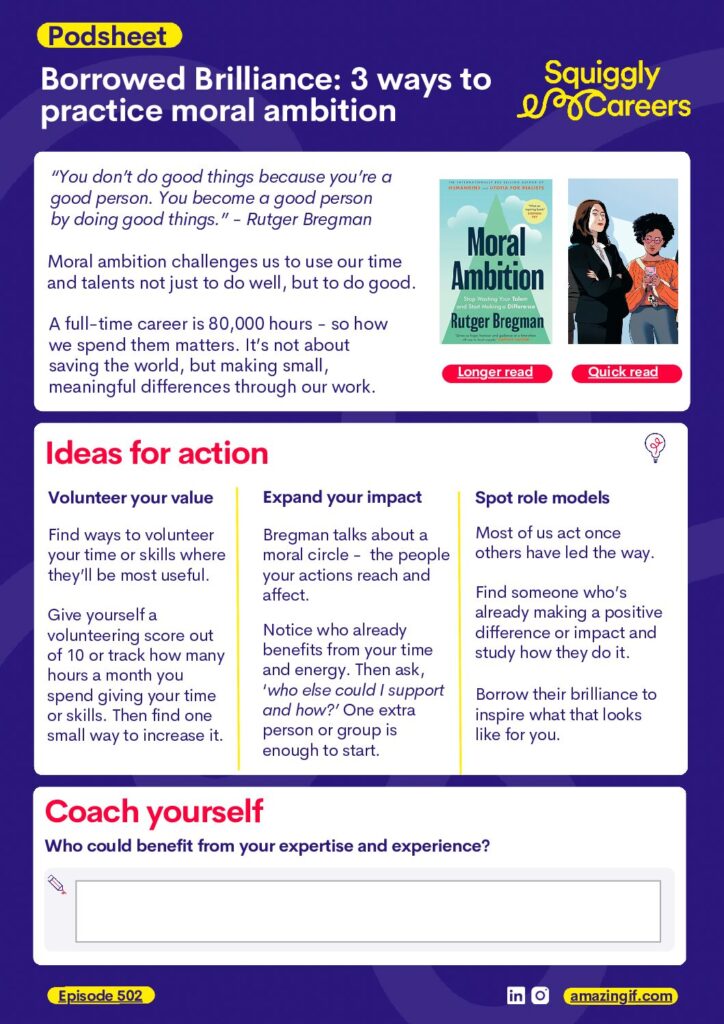
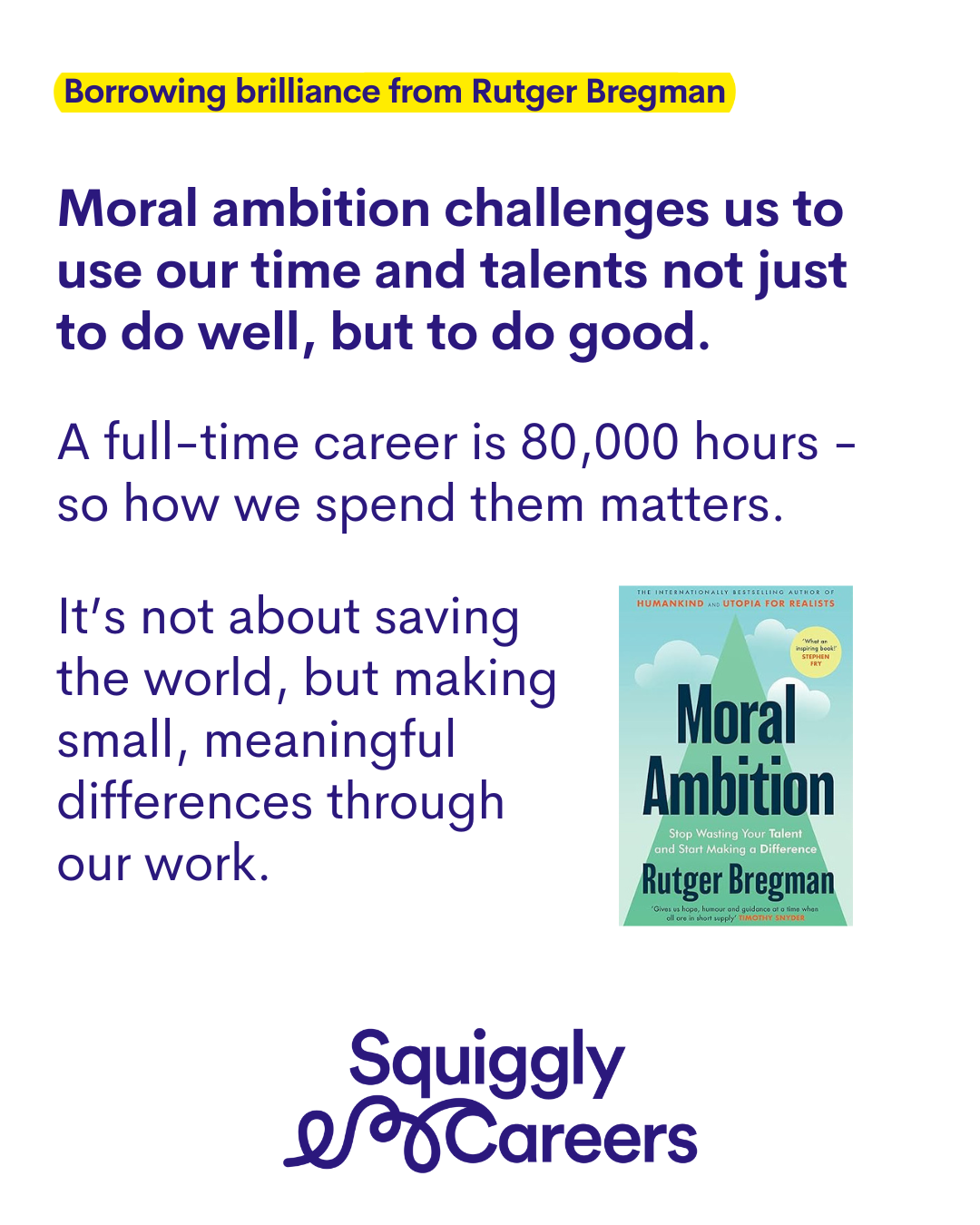
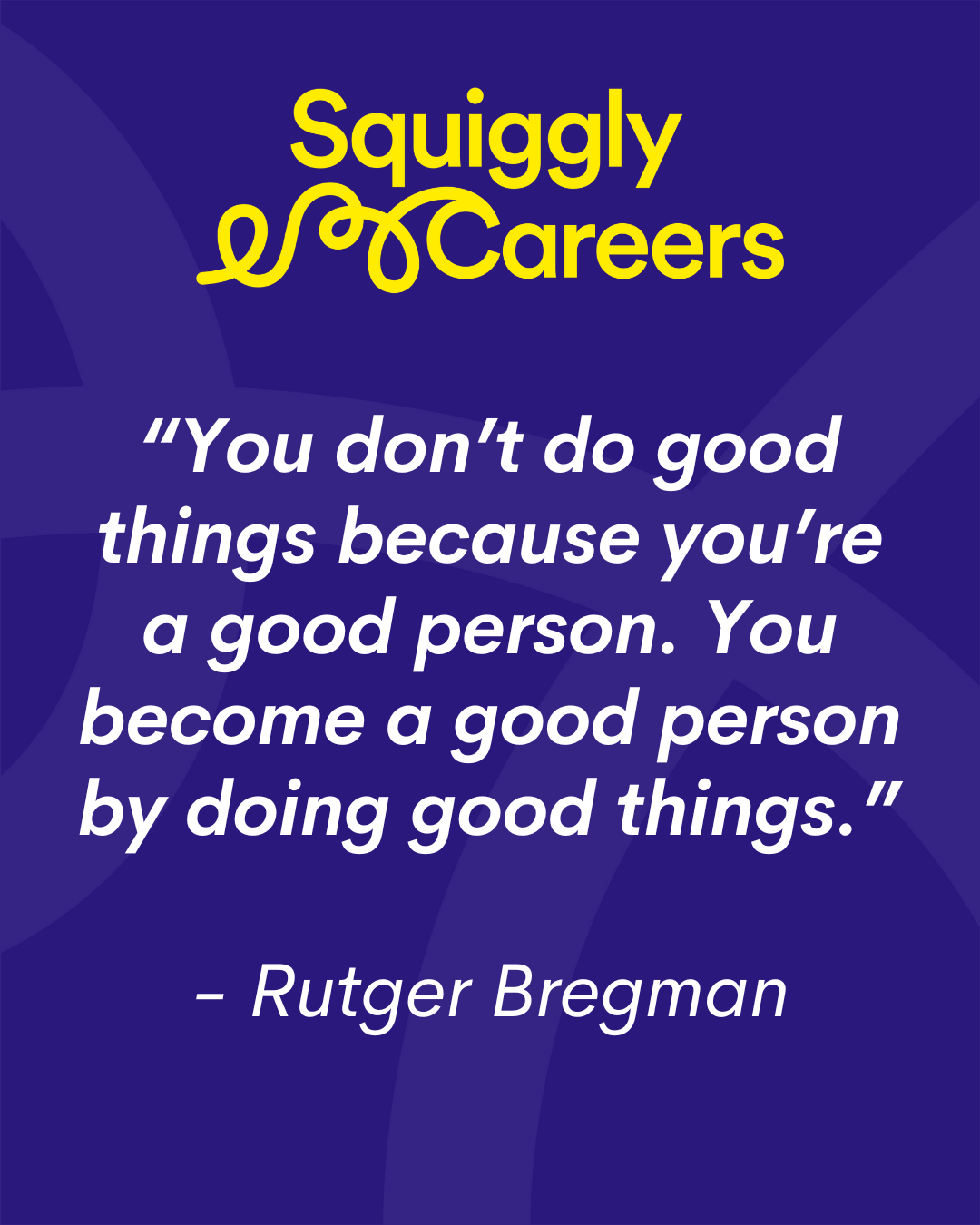
Sarah Ellis: I was like, "Oh, I wonder what Moral Ambition is". I recognised Rutger Bregman's name from Humankind, which I think I did read some of, but I didn't ever connect with it. I've not really read it, like I couldn't tell you all the key themes. And so, I was like, "Oh, I'm interested. I'm interested in what that is". And if you're wondering, "What is it?" So, his definition of moral ambition, so this is where I'm like, "Prepare yourself", "The will to make the world a wildly better place. It's the longing to make a difference and to leave a legacy". And so, it is really ambitious in terms of what you're asking of yourself, definitely. And he does have this really good quote, which I think this is maybe reassuring, "You don't do good things because you're a good person, you become a good person by doing good things". So, we can all do that, right? It's not like some of us are listening to this now and go, "Oh, I'm a bad person". It is very much about your action.
The book does start with this statement where he says, "A full-time career consists of 80,000 hours, 10,000 workdays or 2,000 work weeks. How you spend that time is one of the most important moral decisions of your life!
Helen Tupper: Okay, we've got heavy.
Sarah Ellis: Yeah, I mean, it's not going to get loads lighter. It might do as I try to come up with some actions for us all. What is interesting is the real emphasis on doing. So, you could read books like this and be like, "Oh, it's very think-y and reflective", and you need to think really deeply. All of those things would be true. But he does put a real emphasis on the people who are very good at being morally ambitious, they do take action. It's like, what counts is are you prepared to do something? And he talks about this belief-behaviour gap. So, you know you believe something is the right thing to do, but do you behave in a way that reflects that? And he said loads of us have lots of belief-behaviour gaps, of course you do. Like, you could say -- so, you are going to have to say some things here about yourself where you're like, "Oh, okay" -- so, for example, I still eat meat. And that's a good example of the belief-behaviour gap of going, well actually, if you wanted to do more that was good for the world, you would stop eating meat. So, you can feel smug about that, you don't eat meat, so there you go.
Helen Tupper: Can I just ask, when we're talking about moral ambition, because I think it will frame how I think about what you're going to share, are we talking about, like, making the world a better place because we're not eating meat or we're aware of our, I don't know, carbon footprint or the resources we're consuming, are we talking about that; or if that doesn't connect with people, does it also relate to like an average day at work and how you build relationships?
Sarah Ellis: So, I think he does direct people to working on the world's biggest problems. So, there is definitely that zoomed-out point of view. And he has got a website called moralambition.org, where he actually describes some of those collective challenges, sometimes by a set of countries, sometimes they're like a world problem, to give some examples of things that we could all work on. So, things like tax, making sure tax is fair. So, those are big problems, kind of global problems. He does, as you get into it, at least hint to what individuals can do, and that it does matter for everyone within your own context.
He has this matrix of not so idealistic, idealistic, not so ambitious, ambitious. And he basically says people are in four categories. And so, if you're not so idealistic and you're not so ambitious, I mean, he describes this as you're doing a bullshit job basically. Then you get into idealistic and not so ambitious, you're like a passionate part-timer or maybe you're like an online activist. If you're ambitious but not idealistic, you're a corporate lawyer, you're a consultant, you're in finance or tech. Both of us have worked in both of those industries. This is what I mean, you're like, "Okay". And then, he said if you're idealistic and ambitious, you should have moral ambition. And there is a good link to the key concepts in the book, a good Guardian article. So, if you're like, "I don't know if I want to read the book yet or I just want to get started", I would really encourage you to read the Guardian article which is free and there's no paywalls, and you do get a real feel for a bit of a starting point.
Helen Tupper: Yeah, my initial thoughts are, I'm very open and I'm very intrigued and I'm looking forward to learning, but I would say that the majority of people are kind of in probably what he is phrasing as a sort of bullshit job thing. Like, they're probably not necessarily consciously thinking about some of these world's biggest problems every day, and probably not going to work every day going, "I'm so ambitious!" They're sort of, you know, they're going to work. So, I feel a little bit like, "Oh, I don't know". The bullshit job thing, I feel I have a little bit of friction with that term. But I think I understand what he's trying to do, which is saying, "The world is spending a lot of time at work and if we put that to work on something bigger, it would be better". So, I'm going to hold that in my mind.
Sarah Ellis: His big argument would be, there is loads of talent being wasted rather than well spent. You know, like, are you doing work that matters, that makes a difference, that feels meaningful? I think your observation is a really good one, like the majority. Where within that matrix is the majority of people, who are probably a bit idealistic and a bit ambitious, because I think that's where most people would be? But maybe not you and I. I think, in some ways, by his categorisation, you and I would have both at times gone in the ambitious, not idealistic one. I worked for a big bank, you worked for a big global tech company, which is why, as you are reading, it does make you think, "Crikey!" But he isn't trying to beat you up. I would actually say, though some of the things that I have picked out are deliberately provocative because I'm like, it's interesting, right, it is an optimistic read and he is encouraging, and he does give you loads of good examples of people who have made a difference.
So, I think you can get to this point and be like, "Well, that sounds really daunting. That's not doable". But in the book, he does say, "The majority of people who end up making actually a really significant difference start really small, they rarely start from scratch, and usually you're learning from other people". So, it's not like you have to create a massive movement or save the world by yourself or completely re-engineer everything. It's often just like one small action kind of leads to another. I think the thing that he would always want people to be doing is just doing something, like not being passive, being active rather than passive.
Helen Tupper: Okay, so talk to us about what we can do, some guidance. I'm ready.
Sarah Ellis: You're ready. Hopefully, if nothing else, I think it's something to be curious about, like you said, feel really intrigued by. So, what could you, and I wrote in capitals, 'DO'? I was like, "Right, crikey, what am I going to do?" One of the phrases he does use, which may or may not reassure people is like, "You've got to demand more of yourself". And I was like, "Okay". I actually do think though, since reading the book, I have demanded more of myself. So, I mean it sort of worked. So, I'm going to give some examples.
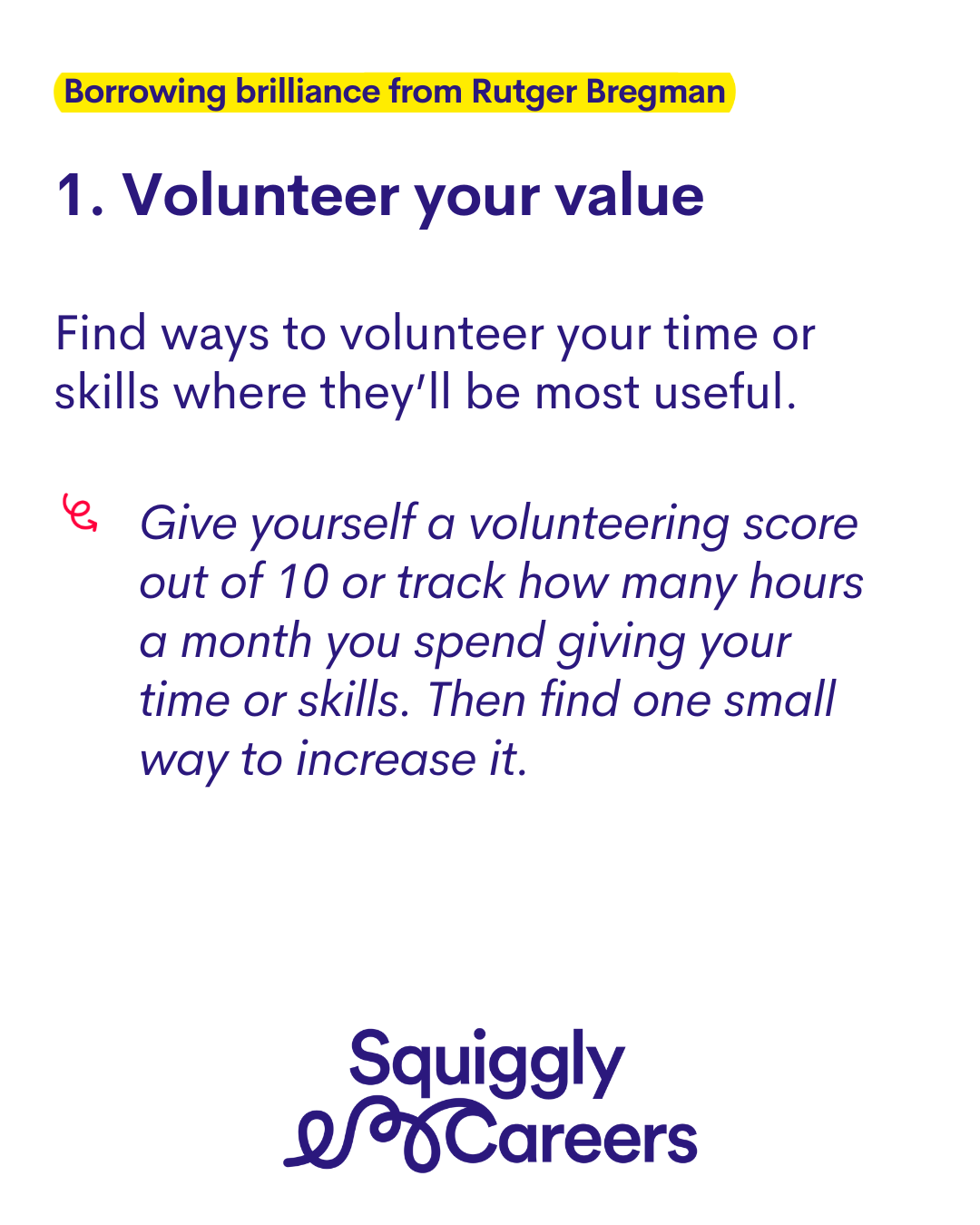
So, number one, you can volunteer. We can all volunteer more or start volunteering in some way. And actually, what's good about volunteering is it's good for you. We know there's loads of research that we've talked about before around your own happiness, how healthy you are, it's really good for your mental health, and obviously really good for other people too. It's kind of that point, like, givers gain more. You do come back to that actually, this idea of having a giving mindset. And that volunteering can be anything, and I think it can also serve quite a few different purposes. It could be a way of you exploring something that if you do want to do something different, volunteering is a great way to start understanding that world.
So, I do think some people might read this book and go, "Right, I want to do something dramatically different". If that's you, I think volunteering helps you to get there. Some people, like me, will read it and think, "Okay, I don't want to do something dramatically different, but I do take the point that I could probably demand more of myself. So, what might that look like?" And it means you get to spend time with different people. And a practical way of making progress on the question is, I think, "How can I contribute the most? Where can I volunteer my time, my skills in a way that's going to be really useful?" Because I think this is all about being useful, rather than necessarily just following your passions. He's quite anti the 'following your passions' statement.
Helen Tupper: So, I guess just thinking about that in terms of volunteering times in ways that we could be useful, things like speakers for schools to inspire young people to think differently about how they enter the workforce, or helping other businesses in our ecosystem, as in other businesses that want to make careers better for everybody, just giving them some of their time to help them start and scale their ideas and thinking. Or you and I both work in trustee roles, so giving our time to other organisations that are working on something that we're passionate about and can contribute to, but it's of no commercial benefit to us. We're trading time to help them do what they're trying to do. That sort of thing?
Sarah Ellis: Yeah, totally. And I was like, "Right, okay, how would I make this really concrete?" Because I was like, right, we're going for really quite a big, zoomed-out idea here to something quite zoomed-in. So, I gave myself a score. I was like, "Right, if action one is to volunteer, start, build, expand your volunteering, what would I give myself out of 10 at the moment in terms of my volunteering; about how much of a meaningful contribution do I make through my volunteering?" So, I gave myself a 5 out of 10. So, I'm not starting from zero, which I think as you go through this, it's quite good to recognise what you already do, before you beat yourself up too much. And to your point, I was like, "Well, I do volunteer my time for some mentoring every year through a programme; I do volunteer my time for three organisations who I believe are making careers and work better for everyone". Some of those are completely voluntary organisations as well. So, I feel like you've kind of doubled your impact perhaps that way, for some of them are commercial, which I don't think feels quite the same.
But then you can start to challenge yourself to go, "Right, if I'm demanding more of myself, what else could you and I do, what else could Amazing If do, given our mission and our ambition is to make careers better for everyone?" So, I don't think it's a surprise. So, I read this book for the first time in the summer. And we are now actively exploring quite a few partnerships, where we could support people with their careers that we don't support today. And I don't know if I would have had those conversations or been as proactive if I hadn't read the book. And I think that's sort of the point. So, that's not dramatically different to what you and I do today, but I think it's pushed me and nudged me to go further.
Helen Tupper: Heightened it. I think, just given where you started from about the 80,000 hours and those metrics, I think I would, rather than maybe a score, I do like your score, but I think I might even go one bit further with that and almost do the percentage of my time. I think I would go to hours, hours a month or hours a year and think, "Well, how do I redesign my week?" Or if I was in a corporate, could I speak to my manager? Because lots of companies that I've worked in have had policies where they can support volunteering hours, and I'd maybe try and lock that in and formalise it so it's becoming part of my work.
Sarah Ellis: Yeah, and it's sort of like the thing, you know some companies do, "We're always going to give 10% of our profits away". You could be like, well, I'm always going to give -- because the thing that's not talked about loads in the book is like, it's also money. He does talk about privilege, as in if you're privileged, it's often easier to make some of these choices. Certainly, historically, he gives some examples of people who've, not everyone, but some people who've done some amazing things, like hundreds and hundreds of years ago, they were quite privileged. So, they sort of could, you know, they had the means to make those arguments. But what there's not a lot of discussion of is like, okay, but most people can't give up loads of time or money to do lots of volunteering because everybody still has mortgages to pay and rent to pay, and things. So, I think your point is a really good, practical one, because you could say, "Well, if I don't do any of this at the moment, what would one hour a week look like?"
Helen Tupper: Yeah.
Sarah Ellis: And I think connecting that with something that you care about. I think this could be to do with work, but I don't think it has to be.
Helen Tupper: You could do something with kids, right?
Sarah Ellis: Yeah, I was thinking schools, kids, volunteering for reading time. I was reading in my local magazine that the local food bank near where I live have more requests for food than ever before, but are 25% down year-on-year on donations. Even though they get loads, they're still not getting enough to meet the demand. And so, that connected to me. I've worked on food waste before when I worked in a supermarket, and I was like, "Oh, okay, I am quite new to this area". I was like, "Oh, I didn't realise that was there". I was like, "I wonder if there's something I could do there", and that's completely separate to work.
Helen Tupper: My mum recently dressed up as a daffodil in order to collect money for charity in the supermarket. And I think she was there, I think you're not allowed to shake, but I think she was very happy.
Sarah Ellis: You're not allowed to shake!
Helen Tupper: You're not allowed to shake, are you? So, I think she just smiled, dressed up as a daffodil, with a little note.
Sarah Ellis: "Please", yeah.
Helen Tupper: Yeah, "Please put it in the bucket".
Sarah Ellis: So, that's doing action one. Do we feel a bit more concrete, a bit more doable than we did ten minutes ago?
Helen Tupper: Yes, I think volunteering is a way that you can do good and making that concrete by either giving yourself a score or setting some hours aside, I feel absolutely fine with that, I feel good about that.
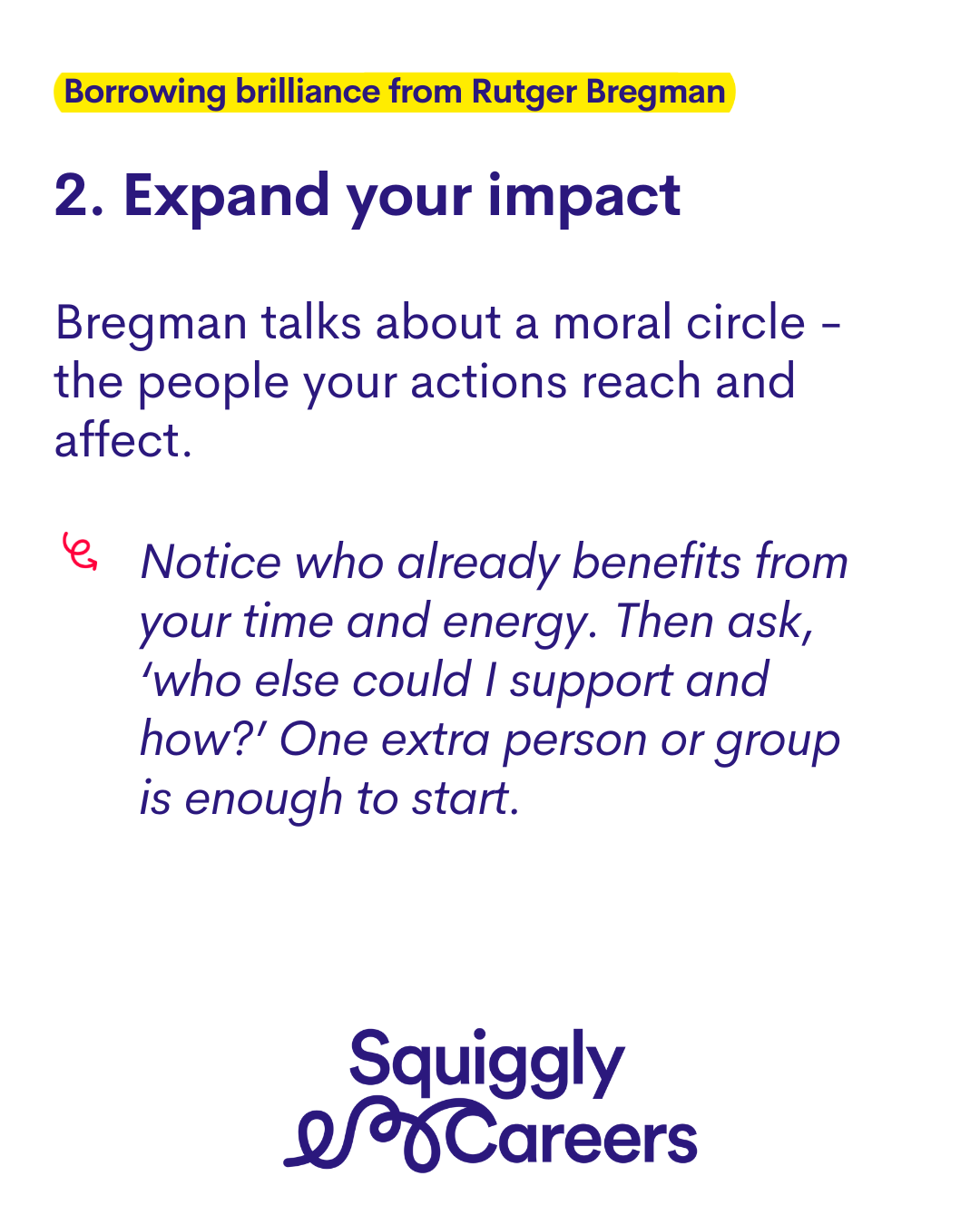
Sarah Ellis: So, action number two is expanding your impact by one person or group. So, I like this one because I feel like we can all do this. Now, he describes this as your moral circle. And there's sort of a diagram.
Helen Tupper: When you frame it, I'm like, "That sounds great". And then the terms, I'm like, "Oh, that sounds heavy".
Sarah Ellis: So, your moral circle, imagine concentric circles, and it starts in the middle and it's you, and then it goes out to your loved ones, your friends, people you work with, neighbours, people in the community, the country, people, animals, you know, you can kind of keep going. And so, I was like, okay, this one I can get to quite quickly, because you could just literally think about your role today, who do you already have a positive impact on and how, like what does that look like? And if you were just going to extend that by one person or one group of people, where would you go first? Who else would benefit from what you've got to give? So, I could think of one for you straight away, because this happened last week. So, I was like, okay, so this was Helen doing this. So, you already do in Squiggly Careers in Action, in our weekly newsletter, you will sometimes do a Helen how-to for our community. And I'm like, great, people love those, and it helps them with how to do something. And then last week, you were talking to our team about a GPT, creating a GPT, and you offered to do a Helen's how-to for our team. So, actually you do something externally that actually you don't do for our team at the moment, and everyone's face just lit up. They were like, "Yes, please, please do me a Helen how-to. And so, that would be a really good example of you extending your impact by basically looking inwards rather than outwards, just with that example.
Helen Tupper: So, question on that point, because the way you described it, I sort of saw moral circles, like concentric circles. You have you, you have family, friends, kind of going out. Is the aim to have more people in an existing circle, so can I help more friends, can I help more family; or is the aim to go further out, so helping friends of friends, or outside of my company people?
Sarah Ellis: Yeah, it's a good question. I think what he's trying to get you to is a 'who else?' So, rather than help the people you currently help more deeply, which you could obviously also do, it's kind of who else are you not supporting that you could. And so, then you go out and you're kind of hitting more people in more places. So, it would be like us saying, "Whose career are we not making better, and how could we help those people, because they're not the people that we help today? And so, for example, I could also think of one quite quickly, which that's always quite good if you can think of one. I mentor people through a programme one-to-one. But then this week, I'm going to an event that I've been to before, and I'm actually hosting a table of ten people, so that I can help more people at once and also connect those people together. So, I've expanded my impact from one-to-one to one-to-ten. So, that's not dramatic, that's not unrealistic. And again, this is where you see these things get to you. That idea came after I read the book. I think because you then start to think, I was so, I mean, trying not to beat myself up too much, but I was trying to challenge myself to kind of go, "Well, what would that look like for me, expanding my moral circle?" also in a way that feels realistic, with my time and my effort and those kind of things.
But back to positive impact, this is not about just knowing more people. So, it's not like I'll just extend my number of connections. It's in a way where you are giving. It's back to that people helping people. So, we would always talk about that's a great way to build your network. And I do wonder, he would never say this, and I suspect this is like his worst-case scenario. But if you go through each of these, I do feel like I could make a pretty good business case for each of these being useful for your Squiggly Career, like volunteering, new people to borrow brilliance from, stretch your strengths in different situations. Extending your impact is a really good way to use your strengths in a new way to discover new people. It's very people helping people. That's really not the point.
Helen Tupper: That's not why he wrote the book.
Sarah Ellis: No, but I can get there.
Helen Tupper: We're not trying to save the world, we're trying to save careers. Yes, third action.
Sarah Ellis: So, third action, I actually didn't have a good answer to, but I liked the action. So, one of the points he makes is there are hardly any what he calls zeros, like people who completely start from scratch and think, "I'm going to create this thing". Like 99.9% of people are not that.
Helen Tupper: People are already doing something good, or no?
Sarah Ellis: Because it is very hard to be the first one. So, like the first person to speak out against slavery.
Helen Tupper: Okay, so a different thing, not because we're already doing something good, someone could have done the good thing we might try to do.
Sarah Ellis: Yeah, and because it's actually quite hard, because when he talks about being a zero, you are typically going against something that is very accepted, and everyone does, and this is just how we do things. It'd be like somebody going now, "Well, we're all just going to stop using cars, or we will stop flying". So, it takes a lot of bravery, a lot of courage, you've got to be incredibly visionary; and typically, put up with a lot of people disagreeing with you. But I mean, it's almost good news, because actually if you read some of those examples, and some of them are in the book, they are inspiring, but they're really far away, right, because you're like, "Well, that feels really tricky". So, most of us, we're not a zero, and we don't have to worry about it.
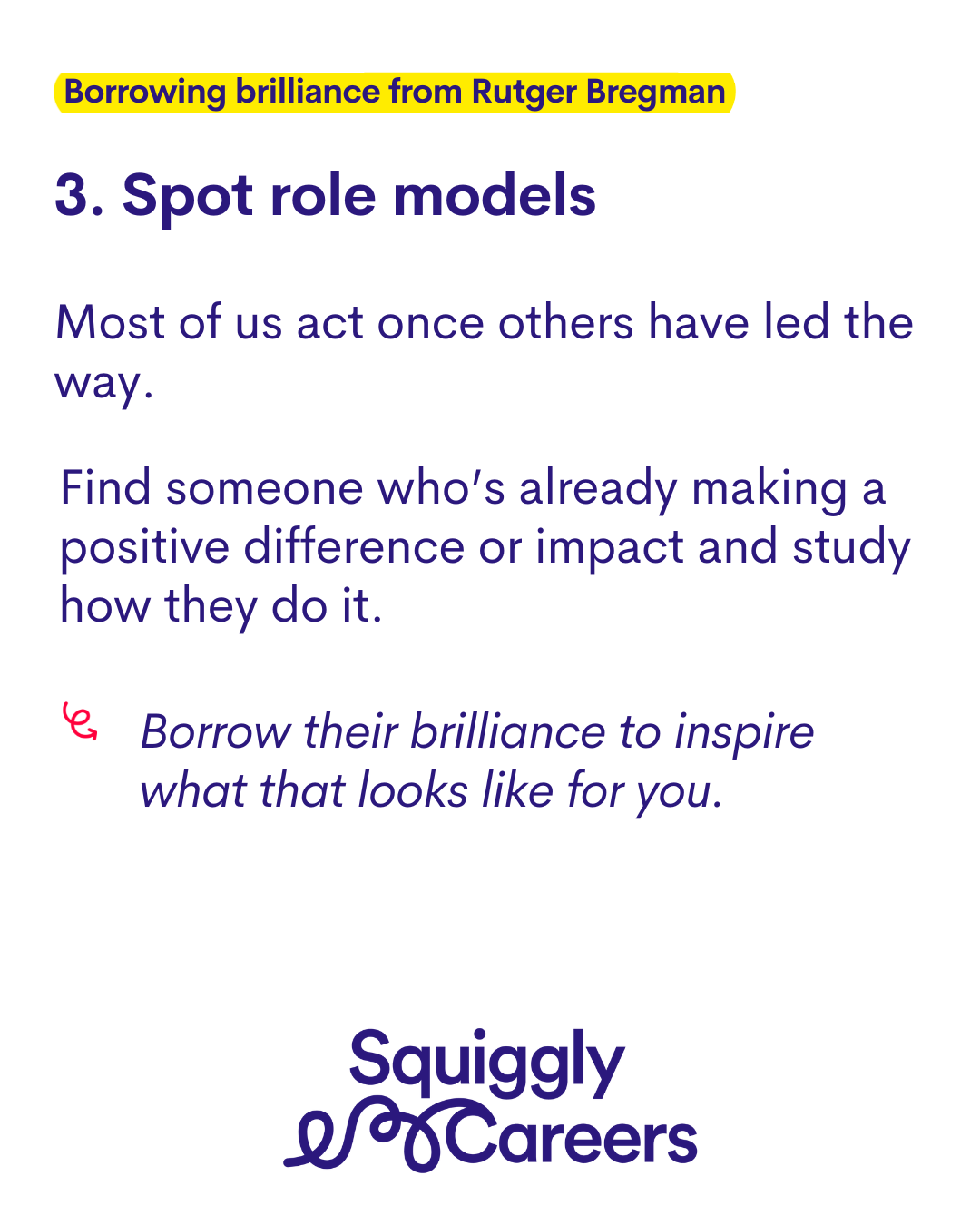
But what is helpful to have is spot a specific role model. So, we act once others have led the way. The majority of us are really good followers, but you have to have someone or something to follow. And then actually, people really innovate. People are often inspired by something or someone else and then they come up with like brilliant things. And so, I think one of the things to do is to start the search, if you don't already have one, for like what's the answer to that for you? Because actually, when I thought about it, I can think about role models in the work that we do, so I can name people whose work I admire or people where I'm like, I really like how they do what they do. But if I am connecting this back to being morally ambitious, how they have maybe approached building their business, they're kind of more connected to something more purposeful in that way. I was like, oh, that's a bit harder.
So, there's somebody I know, I was thinking I really like. So, my friend, Tom, runs a company called Nice and Serious. And what I love about Nice and Serious, they do morally ambitious work, actually. They're a good example. So, they're a creative agency who do morally ambitious work, and they have a filter for who they decide to work with; they have some brilliant policies; they've got a really good period policy that they talk about. He writes a really good newsletter called Agency in Progress. And every time I read that, I feel like they're always stretching and challenging themselves. They do good work for good brands or good businesses, often charities or social enterprises, those kind of things. And I was like, actually, that's a good example of the sort of business I want to build. So, I was starting to get there, but it took me a little while. And that's obviously a little bit of an individual, but a bit of a business too, because then what you can start to ask yourself is, "Okay, well how could I learn more from --" I see Tom every so often, but probably only every couple of years, and I follow Nice and Serious, but I could dive into their world a bit more, think about how they work. I could ask some more questions.
Helen Tupper: You could volunteer.
Sarah Ellis: I could.
Helen Tupper: Close the loop!
Sarah Ellis: I could go and do a Squiggly session for Nice and Serious, and in return, just ask them loads of questions to be like, "Okay, so how do you make some of these decisions?" What about you? It took me a bit of thinking.
Helen Tupper: Well, I was listening and thinking how you framed it, and I was thinking about Alex Hirst and Lizzie Penny, because of how they've involved Hoxby. So, I think now it's just Hoxby. When I first became aware of them, it was Hoxby Collective, and their initial, and I may not kind of have the words quite right, but my perception initially of their purpose was about creating a new way for people to work, so bringing people with lots of different skills together who wanted to work with lots of freedom in a sort of freelance way, bringing people together on projects. But actually, over time, they've really taken what they have learned from managing this global community of people that want to work differently, and then they wrote this book called Workstyle, and now they're sort of influencing policy to create better work for people. And I think that they are really good role models, because how they are evolving their business and how they are pivoting towards purpose, I find that quite inspiring, that the business you are today isn't the one you always need to be, and you can build on these principles over time to get closer to this purpose-based outcome that you want. That was who I thought of when you were talking.
Sarah Ellis: Yeah, but that took me a moment. So, again, you might have someone listening, you might be like, "Oh, I already know. I know the person, I know the company, I know the community".
Helen Tupper: I was thinking about Cook as well, who we've worked with for ages, that's another company.
Sarah Ellis: That's a good example. Just shows though, doesn't it, you have to start talking about it and thinking. Cook are a very good example. Again, I love how transparent they are, I love how morally ambitious they are with who they recruit. They recruit a lot of ex-offenders and they've really committed to that.
Helen Tupper: James Timpson? I mean, now you're going on, I could probably --
Sarah Ellis: I think because initially, when I think role model, that probably wasn't my filter. And so, actually, it's just taken me a little while. You're asking the question from a different angle, which I think is a good thing. So, I really hope everyone listening is okay and hasn't found it too overwhelming. It's funny, I recommended this book to Cath Bishop, who's been on the podcast before. Cath wrote a book called The Long Win, and she's brilliant. And she was like, "I've already bought it". I knew she was going to like it. And we both said afterwards, we were like, "It really does make you pause for thought". And I think every so often, you do need a book that challenges you, provokes you, prompts you to really ask yourself some difficult questions, and I don't think that's a bad thing. We don't want everything to be easy, right?
Helen Tupper: I mean, a single book transforming you is probably a bit of a stretch, but a book that makes you think differently and question yourself, I think that is a good outcome. I always say to myself, it's a good book if I've made notes in the margin, and I think if I had read it, I probably would have made a lot of notes in the margin.
Sarah Ellis: I did make -- I have got underlines, yeah.
Helen Tupper: Thank you so much for listening. If you've got any feedback on this new format for us, because it is slightly different, let us know. And don't forget that we also have got our new Thursday episodes, which are Squiggly Shortcuts. So, very specific, very action-oriented to help you in your Squiggly Career. Our email is helenandsarah@squigglycareers.com. Let us know your thoughts on this episode. Let us know your feedback on the format and any other ideas or topics that you'd love us to cover.
Sarah Ellis: Thank you so much for listening everyone, we'll be back with you again next week. Bye for now.
Helen Tupper: Bye everyone.
Sign up to the Squiggly Careers Newsletter and get our latest ideas, tools and inspiration every week - all in one place, straight to your inbox