In a world full of words, the people who communicate with clarity, humanity and story will stand out.
In the fifth and final episode of this special series, Helen and Aneesh Rahman close out Open to Work with the last of the five Cs, communication, and why it might be the skill that ties everything together.
From Martin Luther King to Pixar to the pressure of a TED Talk, this is a conversation about why great communication has never been more human, and what you can do to make yours more so.
🎯 What You’ll Learn
– Why AI making generic communication universally available raises (not lowers) the value of human storytelling
– Why the most important story you’ll ever tell is the story of yourself
– How clarity fits into communication, and why speaking simply doesn’t mean thinking simply
– Two practical things you can do right now to make your next presentation more human: add a story or make an analogy
– Why the future of communication comes down to four words: speak human, be human
📚 Resources Mentioned
Open to Work – Aneesh Rahman and Ryan Roslansky
For questions about Squiggly Careers or to share feedback, please email: helenandsarah@squigglycareers.com
Need some more squiggly career support?
1. Download our free careers tools
2. Sign up for our Squiggly Careers Learn Like a Lobster Skills Sprint
3. Sign up to the for Squiggly Careers Newsletter, a weekly summary of the latest squiggly career tools
4. Order our new book Learn Like a Lobster
Helen Tupper: Aneesh. We're on day five of our series of Open to Work, so I think I should recap what we've covered.
Aneesh Raman: Yes.
Helen Tupper: So we've done day one curiosity. Then we talked about courage. We've done creativity, we've done compassion. And our fifth and final skill that we're going to talk about today is communication. I wonder whether people who are listening or watching, they might think, oh, I know about communication. You know, I communicate every day. What, what do I need to do differently? Why is it more important now? Let's dive into this and give people meaningful, useful stuff that they can do, because this is all about the human skills that help us to stay relevant and succeed in the age of AI. So let's tackle communication. Why did it make the five? Why wasn't it just a foundation for everything?
Aneesh Raman: This one is the most personal for me of the fives, because my whole career at some level has been built around communication and I have honestly struggled with that term. There were periods of my career I ran away from anything that had communications in it because I wanted to be more than and I didn't want to be limited by in the job I'm in now. I remember my co author, Ryan early at LinkedIn said, You're a great storyteller. And I reacted negatively to that because I felt storytelling was around a campfire or with children's books. It didn't feel mature, business, relevant. And I have over the course of writing this book, but also just coming to terms with my strengths and really what makes me amazing. So embraced communication now as so core to who we are at our best as humans. And I think some of the idea of communication and why is it a 5C? It's already been out there. There's also this sense that AI can make communication possible for everyone. Why do I have to do anything if I can just ask it to write the thing I have to write or write the talking points I need to use. And so this is another one, like creativity, where AI will make the generic universally available. So that means all of us can be better communicators. Because communication and storytelling has often again been seen as a talent that some people have, some people don't. We all can now get better at it with this tool. But the moments of great communication as we talk about in the book, Martin Luther King saying I have a dream and that mobilising a movement, the Beatles saying all we need is love and that mobilising a culture, I mean, the power of words, so spoken well in moments that are waiting for those words to be articulated is sort of indescribable in terms of its impact on individuals, on cultures. And so part of the storey of self that I've been building around communication and storytelling made me a student of storytelling. And so I learned about Pixar, we talked about Pixar and the creativity episode. How did they bring a science to storytelling, but also just the importance of storytelling? So in Sapiens, which is another great book people should read, A Brief History of Humankind.
Helen Tupper: It's not brief.
Aneesh Raman: It's not brief. I know now, having written a book, I'm like, oh my gosh, he really went at it. But it is not brief. But he talks about storytelling as equivalent to tool building is what makes us the apex species. It's not that we go from fire to wheel to AI, it's that we tell stories that create inner subjectivity around this imagination and this made up thing that becomes real, like the nation state, like the monetary order without storytelling, like we don't get situated in the world. And then I think often about Joan Didion, the great American writer, and she has this line, we tell ourselves stories in order to live. And we just talked about it at the end of the compassion episode. But the story of self is the most important storey that any of us will ever tell. And most of us don't understand that that's a story. We think self is some locked identity based on the nature, nurture, intersection, often around 10 years old, that makes us us in an unchangeable way. We either are always restless or not, or we are creative or not, or we are someone that people get or we are someone that people don't. All of that is a story. We're all those things. We're both of those things. We're neither of those things. And so the work of storytelling and communication, again, like the end of compassion, really starts with self. And that's why I'm excited about this as a C, because I think it will change lives if people can grab hold of this skill.
Helen Tupper: I have thoughts. I have thoughts. Aneesh. One is you've reminded me of when Sarah and I did our TED talk. They said on the most successful TED talks, the ones that are most popular, you've got to tell good storeys. I was like, oh my gosh, the weight. The weight of having to tell a good story.
Aneesh Raman: Like Shakespeare.
Helen Tupper: Yeah, yeah. It's like, oh my gosh, what's a good story? And they were like, oh, no, it can just be like something that happened this morning. Like, it doesn't. They're like, it doesn't have to be this big thing. So I think sometimes, like with stories, it's just a simple thing that's personal to you that you communicate to others. Like, it doesn't have to be this.
Aneesh Raman: And by the way, everyone tells stories in their everyday life. To your spouse, to your kids, to your family, to your friends, when you call up and say, did you know what just happened? Or did you hear what just happened? Or can you imagine this just happened, all of that is storytelling.
Helen Tupper: Yeah, I feel like take the pressure off. It's just kind of something that's happened to you that you relate to someone else. And then the other thing I was thinking with communication is, so there's a lot of words in the world, right? Like, wherever you're, you might be listening to them or reading them or there's a lot of words in the world. And I think you and I might have a shared skill and it could have been a sixth, I don't know. But I think it fits in here with clarity, because I think in the context of a lot of words in the world, communicating with clarity is a really valuable thing that people can do. And you don't even have to be the person that's telling the story or doing the thing, because if you can summarise and you can create clarity for other people, that's a really valuable skill that I think sometimes gets missed when we talk about communication.
Aneesh Raman: And I think, again, if AI makes expertise, generic expertise, available to all, then in that world everyone can communicate anything, at whatever length about any subject.
Helen Tupper: Great.
Aneesh Raman: So then that becomes baseline in a world where we're already realising is filled with slop. So then what graduates, the things that break through is communication that breaks through. And I do think a lot of it is going to rely on these other Cs. The curiosity that leads you to clarity and to taking complex and making it simple. The compassion that tells a story that actually lands with the people that you're writing about or speaking to. The courage to tell a story before it's been told before, to be the first. A lot of it is the summary of the other Cs, too. And the book we talk about in Communication, we use the book as an example of this, as a skill. And we say how AI helped us, helped us research things that we've talked about. It helped us structure arguments and we could go back and forth with different versions of what we could do. But it was the human to human battling and debating that led to this. And the final words of the section on communication make this point that to tell this story, which was, take the complex, make it simple, and make it simple in a way that is empathetic with where people are at and can move them from anxiety to agency. That was the assignment that we signed up for. Well, to understand where people are at, to move individual readers from anxiety to agency. The final lines of communication say you need to know humans, you need to be human. And I think that's where communication is going to go. It's going to be communication in ways that are uniquely possible because we're human. Some of that is going to be the connection of dots and the complexity that's made simple. Some of that is going to be the way that we introduce these ideas to so we can meet people where they're at, so we can, with empathy, understand who people are, what they're caring most about, how we move them in new ways. So the art of communication is about to get easier because now we can all do it, which is great for everyone who thought it was a talent that they could never get, and harder for everyone who's done it before, because it's no longer possible to just do generic and feel okay about it. It's got to get more human.
Helen Tupper: And so let's end with an action for everybody. I'm going to share maybe one of my own, because I have had to learn this with communication. So my context is worked in Lots of big companies ended up talking corporate speak quite a lot, which is not
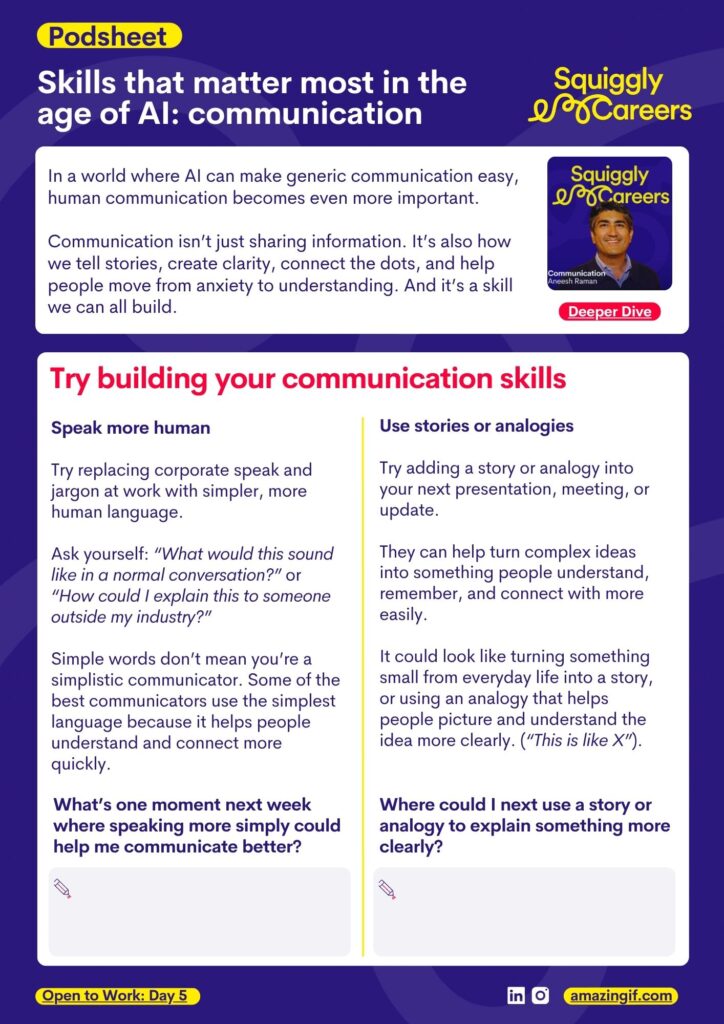
Aneesh Raman: always a lot of what we said in the book is we need to speak human.
Helen Tupper: So I think my business partner, Sarah, is a very speak human kind of person, and she has taught me through lots of feedback that every time I talked about strategic development of an ambiguous opportunity, just say, helen, like, do a new thing or something like that. So I think your speak human, use simple words, don't mean you're a simplistic communicator. In fact, I think some of the best communicators and the cleverest communicators use simple words. So be human, speak simply.
Aneesh Raman: Well, what's interesting about that is that in certain environments, corporate speak is shorthand for things where you want to use it because it speeds through some of the stuff that you've got to do. If you're going beyond those environments, it becomes distancing, limiting, clunky. So a lot of it is like knowing your environment, I think. But I'm a big believer we all have to speak human. Because a lot of old world is based upon jargon that is going to be hard to translate into new work. Like old math won't work for new equations. So the best thing we can all do right now is speak human, be human, be pro human. I think for people that are communicating in any way, any day, which you do at work, you've got to do a presentation, a team meeting, you're a team leader. You just got to present your work. There are two things I think you could do to push yourself. One is the TED Talk exercise, add a story. Literally, whatever you're presenting about, there's the possibility for you to add a story. Find a way where it connects to something in your everyday life or someone's everyday life. And start with that. And then if you can't find a story, you can do the other thing. Even though I think you can always find a story. Make an analogy. So this is like xyz and I think analogies are so powerful in helping humans process things. And you could do that through a story. That's personal experience or through a. This is just like a lot of what we did with managing is. It's like sports. And when you're on a team and you're like in a key game or in the playoffs, like, think of what that locker room's like, that environment's like, it's that Ubuntu “I am because we are”, that great African phrase. You want feedback from others because you want to get better and you want them to get better because the better they are, the better you are, the better we are. And so that helps people really get it. And what does a sports coach do? They don't tell you how to dribble the ball. They cheque your energy, ask you how you're doing, how you're feeling. They build camaraderie. So that's an analogy I've been using a lot as we've been telling this story. So I think pick one of those two things and hold yourself accountable to adding one of those two things to whatever is your next presentation.
Helen Tupper: I think that's a very good action for people listening today to take away. Aneesh, I just want to say thank you because this is the end of our five-day series on Open to Work. And I said it before, I think this book is a brilliant companion to what we talk about on squiggly careers, because I do think it really sets the scene for why people need to invest in those skills, because this is the world that we are now working in. So thank you for spending your time with us, thank you for sharing all of your ideas and congratulations on the book.
Aneesh Raman: Well, I have to say thank you back. And now you're making me remember that one of the exercises I had for compassion, and I ended up going with sort of like be pro you, was express gratitude to others. Because it's one of the easiest ways that you can build compassion is to make sure you let known to other people how you value them and why you value them. And so for you specifically, I have to express extreme gratitude because in even contriving this book, but even as an individual who had a squiggly line career and has spent most of my career feeling really limited by that, really insecure about it, the term squiggly line career, when it introduced itself into the world in front of me was this organising event in my brain. It was like, oh, my gosh, this makes sense. This is me. There's this thing that I am and there's this kind of cause for. For what I can be if I carry this forward. And so I just have to express extreme gratitude for what you've done for me. So many people out there who had these atypical careers but didn't know how to think about them. And then for everyone who is about to have an atypical career, which is literally every worker who now has the know how that they can build from.
Helen Tupper: Thank you, Anish, so much. I really appreciate it.
Aneesh Raman: Yeah, thank you.
Sign up to the Squiggly Careers Newsletter and get our latest ideas, tools and inspiration every week - all in one place, straight to your inbox