Even if you’re not changing jobs, your job is changing. In day two of this special five-part series, Helen and Aneesh Rahman explore the second C, courage, and why it’s becoming one of the most important skills you can bring to work right now.
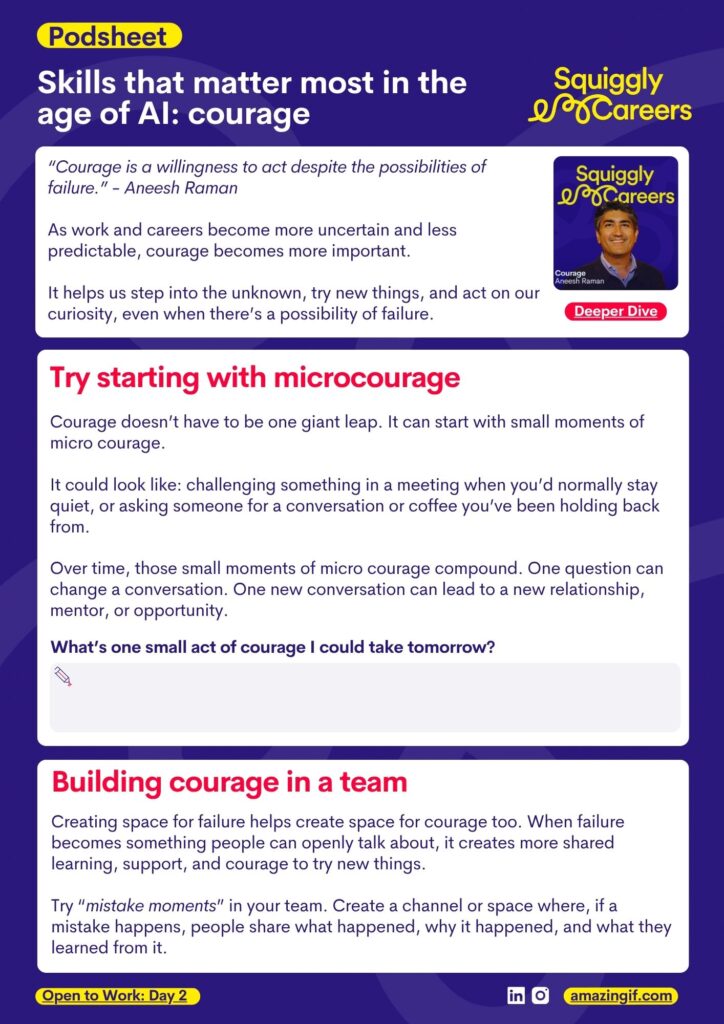
From Polynesian wayfarers to Apollo 13 to leaving a high-profile CNN career to become an unpaid intern on a presidential campaign, courage has always been at the heart of how humans do anything worth doing. The good news? You don’t have to start with a giant leap.
🎯 What You’ll Learn
– Why courage is necessary for curiosity (and why being told to be compliant at work has made courage harder than it should be)
– Why if you aren’t failing, you aren’t doing enough in this new world of work
– How micro courage compounds over time (and why small, uncomfortable actions build to bigger leaps)
– What companies and leaders need to do to create environments where courage is actually possible
– One thing you could do tomorrow that feels uncomfortable today
📚 Resources Mentioned
Open to Work – Aneesh Rahman and Ryan Roslansky
Email Helen and Sarah to share your moment of courage and get an accountability partner: helenandsarah@squigglycareers.com
For questions about Squiggly Careers or to share feedback, please email: helenandsarah@squigglycareers.com
Need some more squiggly career support?
1. Download our free careers tools
2. Sign up for our Squiggly Careers Learn Like a Lobster Skills Sprint
3. Sign up to the for Squiggly Careers Newsletter, a weekly summary of the latest squiggly career tools
4. Order our new book Learn Like a Lobster
Helen Tupper: Aneesh. Welcome back to day two of our series on Open to Work. Your New York Times bestselling book, how did you feel when it was on the bestseller list?
Aneesh Raman: I think because we weren't sure how it was gonna land and if anyone wanted to read it and if the message would resonate. So I think it was, oh, this was worth it. Is what it felt like.
Helen Tupper: Well, I think it's a brilliant book. I also think for all of the squiggly career listeners, it's a real companion to squiggly careers. Because I'm like, this is why you have to develop the skills. Cause this is what's happening at work every day.
Aneesh Raman: Well, this is partly why we wrote it and you're called out in this book. And so many sort of early thoughts about how we should change work and careers are in the book. We wanted to take all of that and all that you've been doing for years now and give it this bigger frame, this complete disruption to work. I think the greatest disruption to work in human history, backed by LinkedIn as a point of view that people will believe, feels credible because we've got more than a billion members, we're in 200 countries and territories, so we're so thankful and grateful for the work that so many of you have done to tee up how we should approach this. And felt like our role was to sum all that up into this big moment so that people could like pull from it.
Helen Tupper: Actually, it's a super quotable book. I was like highlighting and like, that's a great point. That's a great point. We've got so many points in it I really like. There's a quote in here that says, even if you're not changing jobs, your job is changing. And that's such an important point because I think some people might think, oh, well, I'm in my job, I'm happy this change is happening to you.
Aneesh Raman: I mean, what's interesting, I hadn't thought about it till now, is that you might be in a squiggly line career in ways you don't realise in the job that you're in without changing that job title. Take software engineers right now. Their job is fundamentally changing from largely coding to now things like talking to customers, thinking about ethical implications of what they build. That's like changing your job even if you're not changing jobs into a new job. So there's going to be squiggly line careers happening. Even for people who don't change jobs or job titles.
Helen Tupper: It's constant. So that links me to the skill that we're going to focus on today, which is all about courage, which I think of the five, I was like, oh, this is the hard one. And I was like, there's a whole context that sits around courage. So tell me why you felt that this was necessary to be one of the five capabilities that helps people get ahead in the age of AI Again,
Aneesh Raman: we were looking across human history at what has made us us and what has led to everything up to including AI but going back to nation states, to civilizations, to the monetary order, all the things humans have done before the industrial age. And courage is just so central to that. I mean, we talk about in the book exploration, which defined the human, you know, humanity for a period of time, just to explore the. Talk about the Polynesian wayfarers just going into the ocean, into the unknown, not knowing if they'd come back, what would be out there, and finding places where they seeded cultures that exist still. Today. We open with Apollo 13. Think about what astronauts do, the courage it takes to go out beyond our atmosphere for the sake of humanity and our understanding of the world. So actually, curiosity has fed courage because courage is necessary to feed curiosity, as we wanted to know more. But courage is so instrumental in how we've done anything as humans. And so we felt like that had to be a key part of it.
Helen Tupper: And I was thinking there about, like, careers which can often feel quite unknown. You know, you need the courage because people are feeling uncertain and there isn't this ladder, like, predictability anymore. And people don't know what's coming. What's coming next.
Aneesh Raman: I think part of what gave you cause to talk about squiggly line is for a long time at work, you were told not to be courageous, but to be compliant. And so it's gonna take courage to be courageous right now because it is so different than how the world of work has worked today.
Helen Tupper: Yeah. And then in the book, you talk about it, it sort of turns hesitation into action. And I was thinking it is both a human skill to develop, but it was also in the context of an environment that supports it. Like those two things have to go together, or you have these courageous individuals that get knocked back in companies.
Aneesh Raman: I mean, a lot of my career has been that, across the sectors I've been in. It has been me trying to push something new. Me trying to try something new in environments that have generally been about compliance. No, we're not looking for individuals to do something new. We're looking for you to fit a job description, to fit a job category, to fit a functional set of responsibilities. And so the environment has to be there. And the easiest way to understand it, I think, for companies is you have to give permission for failure, because courage is a willingness to act despite the possibilities of failure, whatever that gets defined as. And if you're in an environment that disallows failure, that is going to stifle innovation, it is going to stifle growth, it is going to stifle and suffocate your company over time. But building around an allowance of failure is a completely new way of work. And that's got to happen around individuals. One of the important things we did with the book, which was written for individual workers, is as we get through the chapters about how to think about your job, how to think about your career, the end of the career chapter says, and we have to acknowledge something important, there's only so much we can do individually. You can follow all our advice. Your advice. We can all do the right things individually, but if we aren't in companies that are adapting, if we aren't in economies that are adapting, there's only so much we can do individually. So this is a call to action, not just for individuals, but for companies and for policymakers as well.
Helen Tupper: So I'm going to come back to the individuals, but I just want to share because I totally support what you're doing. And we found it exactly the same with squiggly careers. It's not. It's not just about the individual developing the squiggly skills. You have to work somewhere that supports a squiggly structure so people can squiggle and stay. You've got to have both. So what we do, in case it's helpful to anybody listening for that kind of. How do you create an environment where failure is okay? We have mistake moments.
Aneesh Raman: Oh, that's great.
Helen Tupper: So we use Microsoft Teams, and we have a channel on teams. And when people make a mistake, the rule is within 24 hours, you have to share it. And people take a deep breath. And I had one. I saw one of my my team yesterday who did this. And I know it was a deep breath moment. And you share the mistake. You say what it was, why it happened, and what you've learned. And it kind of. It gets the weight of the mistake out. But what comes back is a whole lot of shared learning and a lot of support. And I think creating that environment where someone can be courageous to do something they've not done before. And if it doesn't work, you can share it. You don't have to be weighed down by a mistake and we move on and learn from it.
Aneesh Raman: Well, and if you're doing something courageous, failure is inevitable. I mean nothing great has happened without going through failure. And courage is necessary because you're going to go through failure. So if you aren't failing, you aren't doing in this new world of work. And to fail is to be courageous because we have asked everyone to not be allowant of failure. And I think that that is a great way to frame it. I mean there are different versions I've used. There was a period I went deep in philosophy as part of the research for the book and Marcus Aurelius has this great line of the obstacle is the way like you only going to learn through the failure, like how to handle hard. Well, all the sort of work that's out there on that. And then with my girls we have a 9 year old and 11 year old. I'm so thankful. Social emotional learning is now part of early childhood education, Emotional regulation, problem solving. We talk about great mistakes and how you can make a mistake, but it's great because you learn something or for next time there's a new way to go at it. But if you like lose your retainer twice, that went from great mistake of we learned that you got to do this to okay, we've made the mistake twice. Usually the second time isn't great is our reminder that he didn't do the thing you were going to change.
Helen Tupper: I also have a 9 and 11 year old, I might adopt that. But in a work sense I also really look to the work of Amy Edmondson who kind of differentiates different types like avoidable failures versus intelligent failures. And I think it's a really just an interesting topic for teams to talk about. So if someone individually is listening and they're thinking, okay, I would like to, I'd like to bring a bit more of courage to my career, to my work. What would your advice be?
Aneesh Raman: I think with something like courage, start small. I mean the great thing about the human brain, which is the most amazing object in the known universe, human intelligence, not artificial intelligence, is why everything, including artificial intelligence, exists around us and why I'm so excited about where work is going. Because the mind, not the machine, will be at the centre of work. We are able with neuroplasticity to literally rewire our brain around new habits, new beliefs, new storeys, including the Self. And the way we do that is through deliberate practise every day in small steps. I just finished a few books called Tiny Experiments and Little Bets. Tiny Experiments is about literally how to rewire your brain. The neuroscience of like habit changing. And then Little Bets is about how all innovation starts with little bets. So courage can sound really intimidating and I think if you overdo it and just go flame throwing into a meeting and say blow it all up, it could backfire. You don't want to do that, you don't need to do that. You'll get to the giant leap through the small steps. So it's micro courage you're going to build in these microwaves. You're going to push on something in a way you wouldn't have otherwise. Like challenging a conversation in a meeting where otherwise you might have felt uncomfortable. You're going to ask for a conversation or for a coffee with someone that you were sort of holding back with. You didn't think it was something that you could ask for. Just find these small ways in small ways to be more courageous. It's like micro resiliency that you're building and over time that compounds and you start to get a positive feedback loop over time because you start to realise, oh, because I asked that question, the conversation changed because I asked for that meeting, I now have a new peer or a new mentor. And so then that's going to encourage you to take more of those steps and to turn those steps into bigger leaps. I've done both. I mean, I've had moments of small courage, especially with parenting, where you don't want to overcorrect in any direction. So you're trying a different way as your kid gets older. I mean, each age is a totally different map that you're trying to understand. My wife and I were just talking yesterday about our 11 year old and middle school and what do we have to course correct, and how do we want to do it and how do you do it? In small ways to test. And then I've had moments of big leaps. I mean, when I left CNN, I was probably our most known international correspondent in the Middle East, and I left that entire career to be an unpaid intern on an Obama presidential campaign where he hadn't won the presidential nomination of the Democratic Party, let alone the presidency. So many reasons that could have gone wrong, so many reasons I shouldn't have done it for financial security reasons, career stability reasons. But I had built up enough belief that I had to go be part of that, that it was actually the easiest thing I'd ever done. So you'll build to big moments and you want to have some big moments of great courage, some big moments of big leaps. You want to just live life that at its fullest is just this. I'm going to try something completely new or I'm going to start over in some new way. I firmly believe that we get to reveal ourselves to ourselves most fully through those big challenges because that's when you realise what you've got in you and what you're capable of. That's beyond anything you could. That only happens through courage. It only happens in challenge. But you don't have to do that often. Writing a book was really courageous and really hard. I'm not doing another one anytime soon. I'm going back to the small steps.
Helen Tupper: So we'll end today with that advice to look for more moments of micro courage.
Aneesh Raman: Find something that you're gonna do tomorrow that feels uncomfortable for you to think about today, but feels doable to do tomorrow. Literally. I'm gonna ask one question in this meeting that I usually don't talk in or that I don't say the thing I believe or I'm gonna reach out to one person that I otherwise wouldn't feel comfortable doing. Should make you feel uncomfortable today as you think about it, but it should feel something like you can hold yourself accountable day after tomorrow, that you did it tomorrow.
Helen Tupper: Okay? And on the accountable, I'm going to put an offer out to our listeners that they can email. We'll be their accountability partners. They can email us helenandsarah@squigglycareers.com and if you need an accountability partner, you can share what that moment of courage is going to be.
Aneesh Raman: Which that itself might be the act of courage. Because if they email you, they know they're accountable for it. But I guess they can't be like, I'm going to email you that. I'm going to email you because then they're done.
Helen Tupper: It's a bit better. Thank you so much for day two. I can't wait for day three.
Sign up to the Squiggly Careers Newsletter and get our latest ideas, tools and inspiration every week - all in one place, straight to your inbox