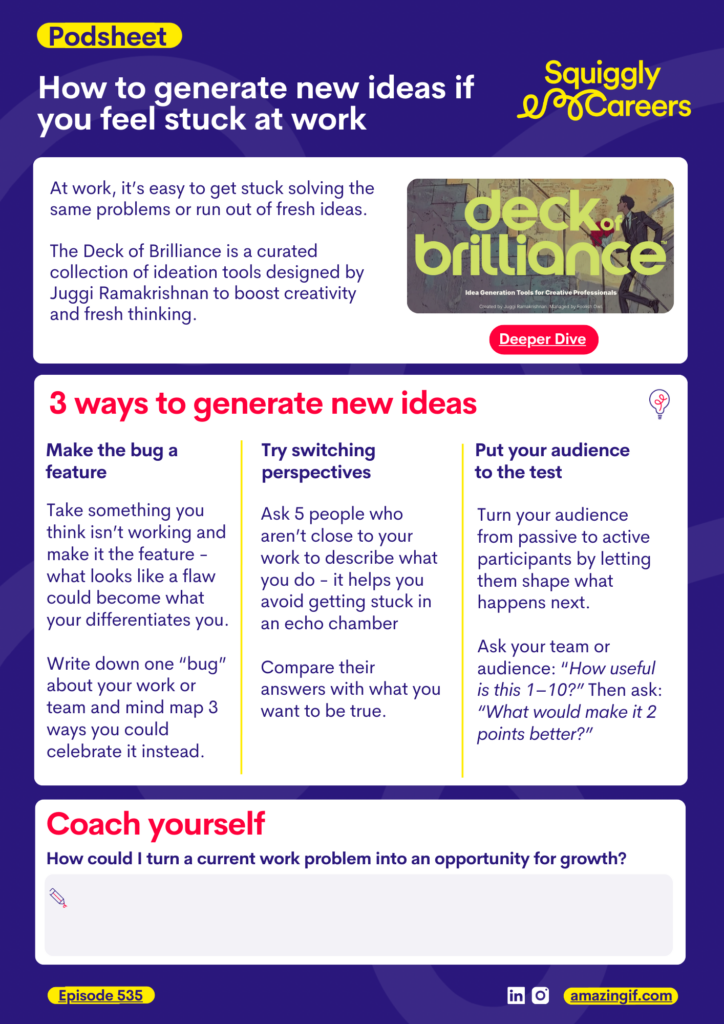
Do you ever find yourself going round in circles with the same problem or struggling to come up with fresh ideas at work? In this episode, Helen and Sarah are borrowing brilliance from the Deck of Brilliance – a creative thinking tool packed with prompts to help you break out of your default patterns and see things differently. Together, they explore three simple techniques that help you reset your thinking, unlock new ideas, and make better decisions when you feel stuck.
For questions about Squiggly Careers or to share feedback, please email: helenandsarah@squigglycareers.com
Need some more squiggly career support?
1. Download our free careers tools
2. Sign up for our Squiggly Careers Learn Like a Lobster Skills Sprint
3. Sign up for Squiggly Careers in Action, a weekly summary of the latest squiggly career tools
4. Pre-order our new book Learn Like a Lobster


00:00: Introduction
00:43: What is the Deck of Brilliance?
04:27: Idea 1 … Make a bug a feature
10:56: Idea 2 … Switch Perspectives
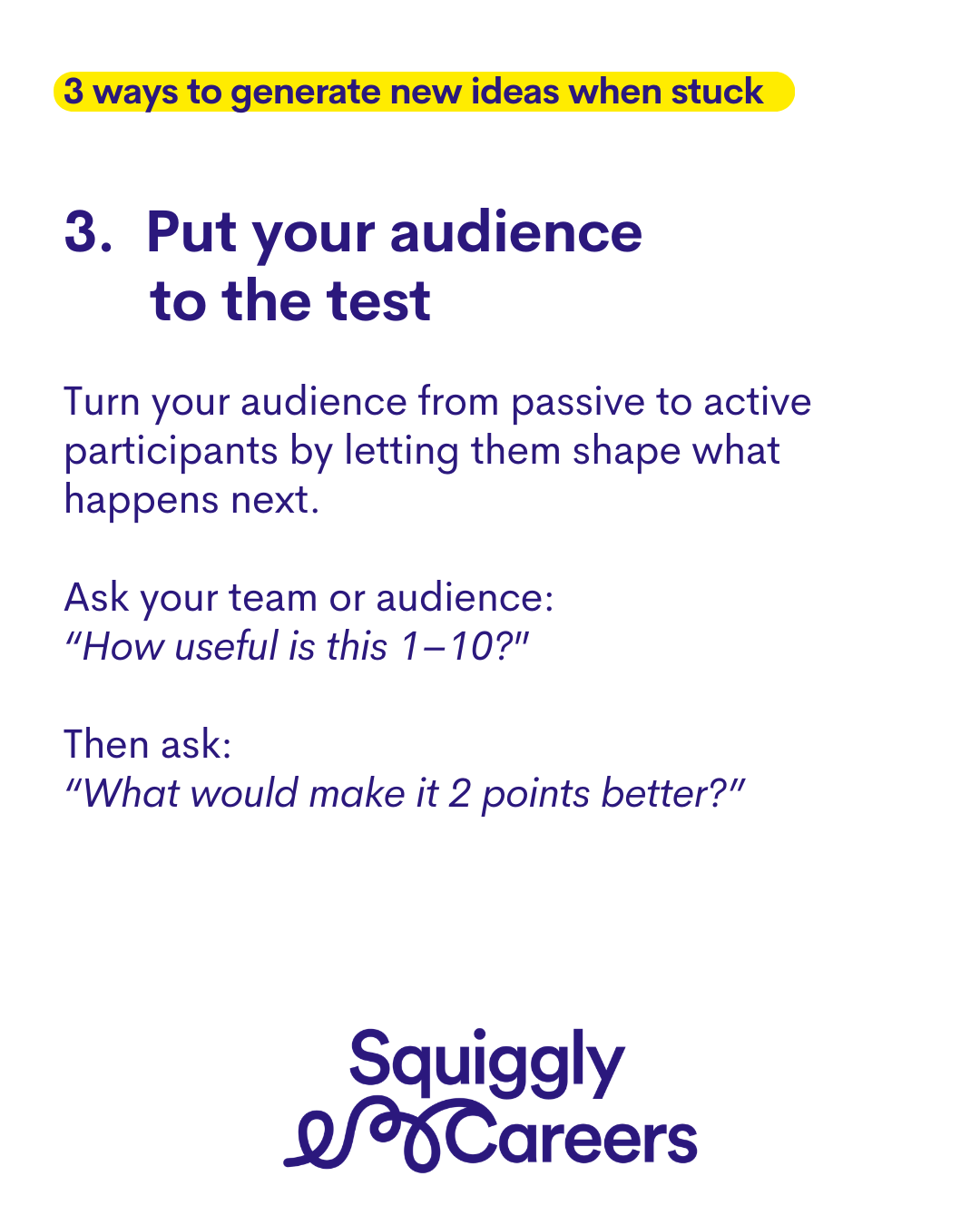
18:41: Idea 3 … Put your audience to the test
Helen Tupper: Hi, I'm Helen.
Sarah Ellis: And I'm Sarah.
Helen Tupper: And this is the Squiggly Careers Podcast, a weekly podcast where we talk about work and borrow some brilliance from things that we've been seeing, listening to, reading, and try to connect that to your careers in hopefully interesting and useful ways. And all of our episodes come with a one page summary which we call a PodSheet. It has all of the ideas that we talk about, it has some coaching questions, it has some layout links. If you want to learn a bit more, you can always find that on our website, which is amazingif.com so Sarah is leading the show today and she has borrowed some brilliance and she's going to tell us more about it and I'm going to learn as we go.
Sarah Ellis: Okay, so a bit of a different one today because we're always trying to try different things out and I couldn't resist, partly because this is actually called Deck of Brilliance. So I'm like, well, if you can't borrow brilliance from a deck of Brilliance, someone's going wrong. We're either going wrong or the deck has failed. But you'll be glad to know it's anything but a failure. And actually Helen asked me before this, she was like, how did you first hear about it? And I actually don't know, you know, like, I can't, I can't remember whether it was someone recommending it to me or whether it popped up on LinkedIn or something, but I just remember start, you know when you start to have a play with something and then you're like, wow, this is really good and really interesting and really useful.
Helen Tupper: What is it?
Sarah Ellis: So the Deck of Brilliance is. So it's a guy who's put this together. It's a website, but it's a very beautiful looking website and the guy's name is Juggi Ramakrishnan and apologies to him if I've not pronounced that right. And what he has done is he has put together a number of decks of brilliance based on a kind of overall theme. So one of them might be generating ideas. So like, if you need to generate ideas, here is a deck that shows you 15 different ways to generate ideas and then it will give you an example. So it might show you like an advert or a product that like brings that to life. So it could be idea generating, it could be storytelling, it could be working out a mission for your organisation. It's all creative, I would say, overall, if you want to get better at creative thinking, I feel like spending some time with a deck of brilliance would help you to do that. I don't think you need to be in a creative job to find it useful. But what is lovely is all of the different examples. So you kind of read about the different ideas. But then, like, I've ended up watching old Skoda adverts. I've learned about. It's very global, you know, I've learned about different products that just were completely new to me from all across the world. And it's very thoughtfully curated. So it's not just, you know, like, throw loads of stuff at the wall and see what sticks. For generating ideas you feel like he's really thought about. Okay, well, one way of generating ideas is Jeopardy. And then maybe he would show Jeopardy in a few different ways, like Jeopardy in a film or Jeopardy in an advert that you really remember. Um, and, you know, generally we talk about borrowed brilliance is about curiosity, looking out, not getting stuck in your silo. It just helps you to do all of those things. And it's free, so most of it is free, which is why we felt good about putting it on the podcast. And though I do subscribe, even the subscription is not very much, it's definitely something you could afford individually.
Helen Tupper: I looked at it. It's like $10 a month, isn't it? Or $100 for the year.
Sarah Ellis: So I did do that partly also to say thank you. You know, when you feel like someone's put together something really amazing, and it's clearly. I read a bit about him and it's clearly he has just done this. So use the free version. And if you're thinking, well, maybe as a team, we would use this all the time, you could always have it for like, three months and see what's useful. So I have picked three different ways of coming up with ideas, and I thought we would apply those to squiggly careers and to amazing if life. I did actually have to give Helen a bit of homework for this one today because we actually went away and did a bit of extra research. And so I just thought by bringing these to life, we could have a bit of fun with it and see how we get on. Are we ready?
Helen Tupper: I'm ready. I'm ready. I'm intrigued. I'm curious.
Sarah Ellis: Okay, so the first sort of idea, like, way of creating ideas is make a bug a feature. So the idea here is you take the thing that you're most self conscious about and you double down on it, flaws, the bits that don't work. And he, he says in his description, stop fixing it and start flaunting it. And I was like, well, I really like that. So some of the examples he gives is like, you know, maybe you've got a product, maybe your pack's really ugly or maybe your name's hard to pronounce. I've actually worked on a fashion brand before where that was true. Like the name was hard and people said it in lots of different ways. Maybe your product is like loads slower than everybody else's. Use that as your hook. So making the bug the feature is kind of the whole point. So I was like, oh, that's fascinating because I think both you and I wouldn't like this. I'm like, I don't want to talk about the bugs of Squiggly Careers and Amazing If.
Helen Tupper: So let's do it on a podcast episode where thousands of people can hear us doing it.
Sarah Ellis: Yeah, I sometimes forget about that bit, but I was like, but neither what you and I, I think have the opposite approach. I think we go right, how do we fix it? How do we make it better? We certainly wouldn't want to talk about flaunt our bugs. We wouldn't want to. And I think that it's quite anti both you and I, I think for different reasons. So maybe we should start with what we think our bugs are. I've had a few thoughts. What would you think are some of the bugs about Squiggly Careers and Amazing If?
Helen Tupper: Obviously I haven't thought about this advance. These are very, very much off the top of my head and bit sparked by some of the examples that you were giving. I was thinking, actually I think Squiggly Careers and Amazing If as two brand names that coexist is a bug because it confuses people. Okay, okay, so that's one place. What is another bug? Our size is sometimes a bug. So we want to make squiggly careers better for everybody. But we are sort of like a deliberately small team. So it's like, how do we have the impact that we want to have in the world when we also want to keep our team small? So that's almost like could that, could that be a bug our size?
Sarah Ellis: Do you know one I had which people have said to us before is a bug could be having too much. So people say, People say like you’ve got too much content, essentially. You've got too many podcasts. You create too much. And people are not saying that in a great way. Sometimes people are like, it's, like, overwhelming, or it's hard. We know that sometimes it's hard to find. So I was like, one of our bugs could be Squiggly Careers. Like, all the work that we do for Squiggly Careers can feel hard to find, or it could feel hard to navigate, or it could be overwhelming. That would be a bug. You could say, like, one of the bugs about. You could also go, what are the bugs about Squiggly Careers as a concept? I started to think about that as well. So I think sometimes what might bug people about Squiggly Careers would be money. So, oh, well, I'd really like to develop in different directions. But the bug there is. But I can't afford to earn less. So are we talking more if I get promoted? I can only get paid more if I get promoted. So you could look at it as, like, the bugs in our company, which are some things we just described, but you could also look at bugs in your concept, and then you could go, well, look, so how are we going to hero that we've had the feedback.
Helen Tupper: For example, like, Amazing If and Squiggly Careers. Sitting with both of them, and we've even kind of gone, oh, do we get rid of one or do we get rid of the other? And so what. How do you think that would. So if the bug is we have two different brand names that we invest in to showcase the work that we do to the world. And the bug is. That could be confusing.
Sarah Ellis: So what you could do is these things actually do really appeal to me. I'm like, oh, yeah, you could have a logo that goes, you know, our Squiggly Careers logo and our Amazing If logo has the same squiggle. So your Squiggly Careers logo could be dynamic. So it disappears and gets replaced by the Amazing If one. And then disappears and gets replaced by the Squiggly Careers. So you actually always put them together. Rather than going, oh, you do one or the other, or they're two separate things. You connect the two. Maybe you have Squiggly Careers. It finishes the squiggle, then goes into Amazing If, and you always put them together. But that would be making the bug a feature. You go, well, actually, it really works for us to have those two things and you and I can rationalise why we have both of those. I think what's really interesting about this, the reason I chose this one, is I think it's very against you and I's natural instincts and I think that's sometimes really good.
Helen Tupper: Yeah, yeah, yeah, yeah. It's definitely. It definitely feels uncomfortable for me because I think I go to. I go, okay, so we do that. So it stops being you. You kind of go, oh, the bug is that it's confusing. But what we could do is put them together so it's actually more curious. But then I go, oh, no, because am I supposed to keep that? It's confusing. Is that the point? Don't. Don't make it curious. Keep it confusing.
Sarah Ellis: Yeah, yeah, yeah. Or you, you could. I suppose the point is, as well you can be. And it's why looking at the deck is also really helpful. It does give you lots of different examples. So there is not only one way to make a bug a feature. And also the examples are all different things. So it's not always like, well, we might be talking about a website, or you might be talking about an advert, or you might be talking about a logo. You could be talking about a newsletter. But I think the point is, I think it gets you to different kinds of ideas and different kinds of conversations. And even if, like, talking these things through with you now, what you might realise is actually we don't want to keep that bug. Like, we don't want to make that bug a feature. And if you want, almost like, if you don't, well, then maybe you should be squashing the bug, but maybe you should be doing it, you know, maybe you should be doing it sooner. Maybe you should be prioritising it more. Who knows? Like, you have to decide right, what you're going do. But it does get you to some new ideas. I think it gets you thinking differently. So I found it interesting. Uncomfortable and interesting. Are you ready for the next one?
Helen Tupper: Yep.
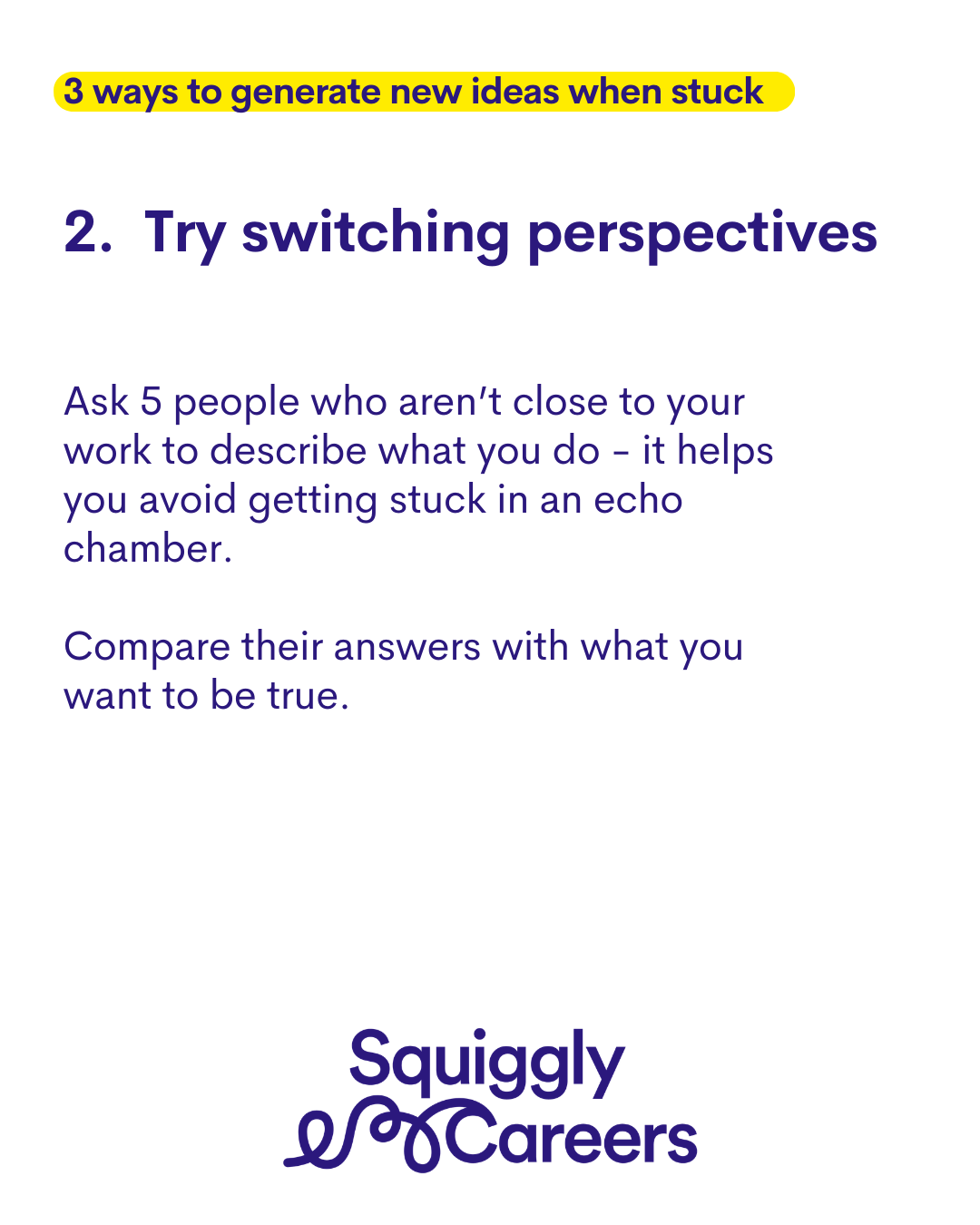
Sarah Ellis: Ready. This one you do know a little bit more about because I had to get you to do some homework. So next one is called Switch Perspectives. So the idea here is sort of putting like, what you do, your product, what your team does and give it to somebody else. Get someone else to describe what you do, who doesn't already know it, who isn't really close to it. So here they describe, like, a parent becomes the child, a human becomes the product.
Helen Tupper: I guess a manager could do your job. You could do the manager's job for a day.
Sarah Ellis: Yeah. And so the idea is that if you get this right, the kind of reversal they describe it as can be, like, funny, surreal, emotional, but it should be revealing. You should, like, learn something maybe you didn't know before. So for us to do this, we asked everybody in our team to ask somebody, friends or family, who didn't know squiggly careers well or at all, to say, what is a squiggly career? And we asked people to record them with voice notes. And we thought we would play some of those now so that you can. You can hear them. So we're going to start with someone in our team and their son sharing what he thinks a squiggly career is. Here we go.
Voice note: What do you think a squiggly career is? A career that changes or has the ability to change.
Sarah Ellis: So short and specific there from someone in our team. And then same person asked her husband, so what do you think a squiggly career is?
Voice note: A squiggly career, in my mind, is one that pivots and changes course throughout your career. I guess just using different transferable skills you've picked up and acquired over the years and applied just to different scenarios and different changing roles.
Sarah Ellis: We're going to have Helen's kids next. Okay, let's see what they've got to say. So this is Henry.
Helen Tupper: Henry Mummy works on squiggly careers. What do you think a squiggly career actually is?
Henry: We work together and join in, even if that means stepping out of our comfort zone.
Helen Tupper: Impressive.
Sarah Ellis: I know. What I really enjoyed at the end was where you said impressive and you just went, I know. Okay. And then here's Madeline.
Helen Tupper: Madeline, what do you think a squiggly queer is?
Madeline: Even if you have butterflies in your tummy? Just keep going. Motivational statements there for you all from Helen's kids. Motivational Madeline.
Helen Tupper: That's what I call her.
Sarah Ellis: Okay, and then now we're going to finish with Max, my little boy. Do you think a squiggly career is a good thing or a bad thing or an okay thing?
Max: Bad.
Sarah Ellis: You think it's a bad thing?
Max: Yeah.
Sarah Ellis: Why do you think it's a bad thing?
Max: Because squiggly is going all over the place. Maybe.
Sarah Ellis: Yeah. Interesting. So do you think you would want a Squiggly career or not?
Max: No.
Sarah Ellis: No. What kind of career? Do you know what the word career means?
Max: Yeah, kind of like what you do for your job.
Yeah. Okay, well done. So what kind of career would you want then if you don't want a squiggly one? A straight career.
Max: A straight career.
Sarah Ellis: So there you go. Obviously not indoctrinated the people around me enough. So he wants a straight, he wants a straight career. No, a squiggly career is not a bad thing.
Helen Tupper: How to have a straight line career.
Sarah Ellis: And we won't play all of the others, but we also got someone in our team to pass a phone around in a pub and say, like, what is a Squiggly Career? And what is so interesting is these are people who genuinely don't know us, don't know our work. And I heard from people a real 50/50 split as to whether a Squiggly career was a good thing or not a good thing. So still 50% of people saying, yeah, it's like messy. It's when you don't really know what you want to do. You know, basically a sort of. Even the adults, a kind of more sophisticated version of what you just heard from Max, like, oh, I don't, I don't want a Squiggly Career. That doesn't sound, that doesn't sound motivating or that doesn't sound like something you would want. I think one, one person was just like, yeah, when you're just like a bit all over the place. And your kids, as we said, did the, they just did really good motivational statements. They feel like they're just channelling it, ready to go. And so the point there is, I think by asking people outside of yourself, it stops you getting stuck in that echo chamber trap. And honestly, listening to them all this morning and I probably had about 15 to listen to, it really made me realise I was like, okay, so for a lot of people, like, they probably are still attached to the idea of like good looks like climbing a ladder. And if they haven't come across squiggly careers, their first thought, hearing the name is, is not what we would want. You know, we don't want people to think that it's naughty and messy and all over the place. I mean, my 8 year old doesn't want one now, you know, and he's quite, he's quite a long way from work. So it would make you challenge yourself on kind of going, okay, like what would we need to do? What would we need to change? How could we help people have a different view of squiggly career? Do you know if you're being really, if you're being very dramatic, you might be like, change the name. Is it the word? Does the word squiggly like get in the way for people? If you ask a different group of people, a non linear career, which we would never want to say, but would you get a different set of answers? Don't know. If you asked people to draw it, what would everybody draw? So the idea really here is just to, it's kind of that taking a moment to sort of step away from your day to day. And I suppose it like for me, I mean it definitely made me laugh, but it also sort of bursts the bubble, you know, the bubble of being like, oh well, everyone understands now that squiggly careers are just the reality. I will say for listeners that apparently my son had a little existential crisis in the car with my partner afterwards saying, did I get the answer wrong and should I have said it was a good thing?
Helen Tupper: I feel so much more. I was just thinking about situations to relate this to because obviously we kind of, we've got a concept. It's quite interesting to look at it that way. But I was thinking sometimes when you're in a company you're working on a project. If I think about, if I relate it to me, when I was at Virgin, we were launching Virgin Red and everyone in the bubble of launching that business was, you know, we were bought into it. Yeah, it was the biggest and most important thing in the whole working world. And it was, you know, you know, all the things that happen when you are working on a project in a bit of a bubble with people. And I think it could be quite interesting to ask those sorts of questions of people outside the bubble to get more perspective because I think you can, you know, you're on a high pressure project or a high profile project or a pacey project, those ones you can lose a bit of perspective and maybe asking people, you know, how would you describe what you think this project is designed to do or, or if you were to describe the impact of that project in three words, what three words would you use? And then just you could do it with a type form, couldn't you? Or you could just email me your three words or in one sentence, what would you say? You know, ways to frame it so that it's quick and easy for people to respond to. But comparing those outside responses to what you all think, believe or want to be true within the bubble that you are in would be quite a useful way of, I think, not making assumptions that everyone thinks the same as you or values it as much as you do.
Sarah Ellis: Well, I also thought you did this. And it's a smaller switch, but it's still a switch with the listener focus group that you did for the podcast. So you've got the people, us recording the podcast, then you've got people listening to the podcast. And we don't, we don't get that much time with people who listen to podcasts. You sometimes might meet someone who listens, but then they probably just go, oh, I listen to the podcast. And you think, you say, thanks, but you're not getting. I'm not getting a new perspective on the podcast in that moment. But actually by doing that focus group, you definitely heard things that we didn't.
Helen Tupper: Know my favourite thing about that. So we had maybe, I forget, maybe like 14 people in the room. And I split people into three groups based on their engagement with our work. And there was like, the people that always listen to the podcast, like, never miss an episode, probably listening to this. Hello to you. And then there were people that, on a sort of needs basis, listen. So, oh, I need to listen to an episode because I've got an interview, or, oh, I'm intrigued by the Deck of Brilliance. I might listen to that one. So kind of slightly more sporadic, occasional. And then there were people in the room that just didn't listen. They just didn't listen to the podcast. And you might think, well, why were they there as a focus? But it was so interesting because they, they said, oh, I listened previously, but I don't listen anymore because I have sort of slightly disengaged with that form of learning. But I still look at all your resources, so I follow you on LinkedIn. I use your pod notes, I use your pod sheets, and that's sort of enough for me. But it was just really interesting to say, well, I often think about listeners, whereas I think it made me think, oh, we should think about learners. Like, listening is not the only way people learn. And it made me think what we create is a system of learning around squiggly careers that people can choose how they want to engage. So it definitely made me think differently about it.
Sarah Ellis: And then this one, which I'm still figuring out, like, what this would look like for us. So I was like, oh, this one is an intriguing one. So this one is called Put the Audience to the Test. And the idea here is that you, whoever you kind of work with, whatever audience means to you, you turn them from being passive to active participants. So they almost have to make a choice or judge a situation, and then kind of what comes next is kind of down to them. So at a very basic level, it's a bit like the kids books, where.
Helen Tupper: That's where my head was going.
Sarah Ellis: Okay, yeah, you know, so the kids. You go, well, do you want the person to sleep in a haunted house or to go and live in the cottage in the woods or whatever?
Helen Tupper: You go through the door and meet the wizard. Turn to page 96.
Sarah Ellis: So it's kind of like that, or I suppose like Matrix Red Blue Pill. That was one of the examples actually in that deck. And funnily enough, I've watched that again recently. And then one that I've seen that I've perhaps talked about before on the podcast, but I've seen people bring, like, books to life using, like, a GPT, but where you, as the person using it, has to answer questions, and that will then take you in different directions, depending on, like, how you answered and kind of what you wanted to do next.
Helen Tupper: There's a workshop that Sarah and I run based on our book the Squiggly Career, which has five skills in it. And so if we are just running that session, normally we just do all five skills in the order that we have planned to do it. But sometimes we would say, here are the five skills. Which skill feels most important to you right now? I'm going to spend most of my time there. And then the second most popular one, I'll cover that one, too. So we let the audience design the workshop based on what's most important to them that day. Is that the kind of thing?
Sarah Ellis: Yes, though perhaps with some of the examples that I've seen even more involved than that. So that's probably like a good starting point. But I suppose it would be more about an audience choosing, let's say you gave prompts on a GPT and then they would choose a prompt. Let's say it was, say, the hard thing, the GPT we did recently. And then you'd be like, here, say the hard thing scenario 1, 2, 3, 4, which is how we did it, like micromanaged by your manager. You need to give hard feedback. And then as well as then them maybe learning how to say the hard thing, they would then maybe have some sort of test afterwards. Then rather than coaching you through it, perhaps at some point it would also switch to going, now I'm going to give you a situation, you tell me what you think you should do and like take you kind of down that route. So it's just, it's almost like things get revealed as you go and it's really trying to make the person very active. I mean, there is, it's, it's. I've not seen it. It's. In the US it was a computer game that was done called the Final Exam, and it was created actually by a parent of a kid who had been killed in a school shooting. And it is. I'd not seen it, but it is like watching it is really moving because the idea is that people don't understand the safety measures that schools need to put in place. And so they brought it to life in a computer game. Obviously, it's horrible to watch, but it was this guy going, well, it's the best way we can think of to bring this to life. This dad who really wanted to kind of advocate for these rights and for obviously tougher gun laws. Watching that one, you really see how you can get really creative with like decision making. So should you put a sign here or a sign here and then you see the consequences of the sign in part A versus part B. So there’s almost more of a right answer and a wrong answer. Oh, if you put it there, it's not going to work. But if you put it in this other place, actually that helps to know.
Helen Tupper: Because the struggling with thinking about it in a team like an, like average. I don't know. We're working on a project. We're trying to put a new process in whatever it is. How do you think it could work there?
Sarah Ellis: Well, one thing I was thinking about is scenario planning because I feel like scenario planning gets you to figure out different situations, like what might happen next. But that's obviously not putting the audience to the test. That's almost you putting yourself to the test, which is not quite the same, but that's okay, right? The whole point of these is just to, to have a play with them. So I saw it a little bit as scenario. So I think, I think that might work. If we made this decision, then follow it through, you know, like if we made this process twice as fast, this would happen, that would happen. You know, all of the kind of knock on impact and kind of consequences for your audience. I was thinking about, you know, most companies, your audience is often another team. You know, it's an internal, you know, like I'm in, I don't know, I'm in sales and it's marketing or in my marketing. And I'm trying to persuade finance to give me more money to spend on marketing. It's sort of like gamifying. So I was like, oh, is there a way, I mean, I'm not sure how, how ethical this is, but you know, of like gamifying choices and kind of going, well, we could do this or we could do that and if we do, let's, you know, it was like kind of like deal or no deal, like what's behind this box? And I've not quite, I've not quite worked it through. I think I find it intriguing. It is a bit of a harder one to make that jump to how would we do this? How would we involve our audience? I was wondering whether, you know, all of those cool direct to customer brands that have popped up over the past couple of years, I feel like they're very good at involving their audience about going, you know, what would you prefer? Like, like make a choice about this packaging or. And I feel like they're very sort of user led or very, very audience led. They're really good at like listening to their audience. They'd let their audience make choices or kind of make decisions or at least appear to. But yeah, it's worth, it's worth having a look at the idea.
Helen Tupper: I think what I'm struggling with is almost like the execution of it, but the idea to be audience led. So you kind of, you know, we could be Helen and Sarah led to squiggly careers, which is this is what we think we should put out in the world. Or we could be audience led and we could say the next six months of what we produce is up to you ultimately our businesses to support people with their squiggly careers. So what do you need most topics, tools like fill this in and the next six months of our work is going to be led by you and then sort of make that commitment that that's what we're going to do. So I almost find that framing when I, when I was thinking about, oh, GPTs and team meetings, all that kind of stuff, find that hard. But actually think if you were going to be entirely audience led for a week, a month, six months, whatever, how would you do it and what could that mean that you'd be doing, I think is an interesting, an interesting thing to play with, even if you don't actually do it. Even if you said, well, let's imagine we were going to be audience led, like where we're getting information from what they're likely to say. And even if you get some insights and say what? What would that mean we were doing. I don't think you necessarily have to change everything. But it's that mindset of being audience led.
Sarah Ellis: Some of the things that it talks about, which I was like, oh, this could be interesting with some training is you can use it to test assumptions. So, you know, like getting people to make choices and then it can be quite confronting. So it might come back and then say to you, okay, well, you know, for things like bias actually based on those answers, Sarah, what's most likely to get in the way of your learning? Recency bias. You know, almost like because of the choices that you've made or because of what you've just told us. Yeah, like, maybe it's recency bias. Maybe it is a bias to spending time with people a bit like you because. Yeah, yeah, that feels more comfortable. And so I think it's. You can almost either work with the audience, which is the way that you just described it. So you like being very like audience first you tell us our job is to give you what you want, or you can sort of almost test your audience and because then they're so involved. And I do, I do think the reason I was like interested in it, I was like, there is something in it, you know, like when we are involved in anything, you're so much more engaged. You're participating, you know, you're part of the process. You feel like you're shaping something rather than having something happening to you, you know, like learning and career development. You don't want to be told. No one wants us to be like, do all of these things in this way.
Helen Tupper: I always think with these things. I find it with my brain examples easier to understand these ideas. Otherwise I'm like, oh, I get it's a nice idea, but what can you do with it? And I was just thinking about, there's a programme that Sarah created with a company that we work with, where you started it with. This is what we think about. I think it was on feedback. This is what we think about feedback. And then you put it up to the group to say, why wouldn't this work and what needs to be better? And then you kept then the next time you took that version and then you evolved it again. And so what then after, I don't know, six or seven versions of that, you ended up with something different than you started with. And I guess that is an example of being audience led in that situation because you didn't know where you were going to end up, you just kept letting them iterate on the start that you provided them with.
Sarah Ellis: Yeah, that's a really good example. And with another programme actually we've done something where I will say, right, on a scale of 1 to 10, how useful is this idea? And let's say they say six and then the way you put the audience to the test is I then say to them, turn that six to an eight. So that would be doing that, that would be putting the audience to test. So again, rather than us going, here's the answer, you've gone, well, use your skill, use your knowledge to make this better. And then it also becomes, becomes yours. And actually when I was reading about it, it says this approach drives deep self reflection and conversation and people realise what they might have missed or how they responded. And so that's why I think it's quite interesting kind of for our work. It's like, how do you really involve people in it? Um, but generally, I mean I have just picked out three here and I could have picked out 25. There was, there were, I mean I think I got rid of three or four that I was like, well that's interesting, that's interesting. There was one about symbols, you know, also about as in like the squiggle itself, like a sim, how symbols are really interesting. There's ones about sounds, all sorts of different ones and I think you can pick the ones as well that you think feel like, oh, that might be interesting for like my team or for kind of wherever I work. And as I said, then you click in and then you just, you can like play and watch with all the examples. But you do get these nice descriptions which I have read out to you today, like some of them which just brings it, brings it to life.
Helen Tupper: We’ll include the link to the deck of brilliance in the pod sheet and we'll also put it in the show notes as well. So if you want to go and have a play, you can find it there.
Sarah Ellis: But I hope that brilliance has helped you to be more brilliant. If you ever have anything involving the audience that you would like us to borrow brilliance from, please just email us. We're helenand sarah@squigglycareers and we're always really interested to collect and connect more curiosity dots so we can help everyone to learn and grow in their squiggly careers. But that's everything for this week. Thank you so much for listening and we'll see you again soon. Bye for now. Bye, everyone.
Sign up to the Squiggly Careers Newsletter and get our latest ideas, tools and inspiration every week - all in one place, straight to your inbox